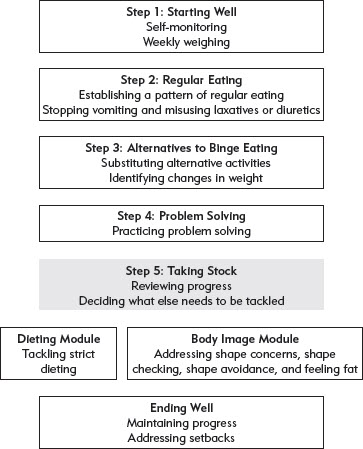
If you are binge eating intermittently, or you have been at Steps 2, 3, and 4 for 6 to 8 weeks, it is a good time to take stock. By “taking stock,” I mean reviewing in detail how you are getting on. To do this, you will need your summary sheet.
SHOULD I CONTINUE WITH THE PROGRAM?
By now, if the program is going to help you, you should be seeing definite signs that you are benefiting. Introducing a pattern of regular eating (Step 2) should have had the effect of displacing many of your binges, and engaging in alternative activities should have helped you resist urges to binge (Step 3). And problem solving (Step 4) should be helping you deal with the type of day-to-day difficulties that tend to trigger your binges. But things may not be improving or you may feel that the program is not for you. This is a good time to take stock. See which of the following “outcomes” applies to you.
1. Things are going well. If the frequency of your binges has clearly decreased (and, if applicable, so has your vomiting and/or use of laxatives or diuretics), you should continue with the program. These are very promising signs, and you are doing well.
2. There has been little change, but you have not been following the program as well as you could. If you are not benefiting in terms of your eating, but you know that you are not following the program as well as you could, you need to question your commitment to change. Reread the section “Why Change?” at the beginning of Part II to remind yourself why you embarked upon the program. If you conclude that you really do want to change, you should consider restarting, perhaps after a short break. On the other hand, if you are unsure whether you want to change—perhaps it all seems too much effort, or this is the wrong time—then it might be better to stop. You can always restart at some point in the future.
3. There has been little change despite your best efforts. If you are doing your best to change, a good measure of which is the number of “change days” you are having each week, yet the frequency of your binges has not altered significantly, the program is not working. There are various reasons why this might be the case. The eating problem may simply be too severe to tackle by yourself or the processes maintaining the eating problem (described in Chapter 4) may be so powerful that any inroads you do make simply do not last. If either appears to be the case, you should seriously consider getting outside help. Guidance for doing so is provided in Appendix I.
Another possibility is that one or more associated problems are getting in the way of you making progress. It is not uncommon for people with eating problems to have other difficulties. These vary, the most common being a clinical depression; difficulties with self-esteem and assertiveness; problems with perfectionism; and unsatisfactory relationships and life circumstances. If these accompanying difficulties are not severe, they do not necessarily obstruct progress. And, indeed, overcoming the binge eating problem can have a positive effect on them—for example, overcoming an eating problem often results in an improvement in mood, self-esteem, and relationships. However, if these accompanying problems are marked they can be a barrier to change. Here are two examples. The day-to-day stress that arises from relationship problems can trigger episodes of binge eating and unless the relationship problem improves the binge eating may prove impossible to overcome. Alternatively, you may be prone to perfectionism. If so, you will have high standards. This is fine, but if your standards are so high that nothing is really good enough, this will interfere with your progress through the program.
If you have accompanying difficulties of this type and they are obstructing your progress, then they need to be addressed. To do so you have two options; either tackle the difficulty yourself or get professional help. If you choose the former route, Appendix IV (Tackling “Other Problems”) provides guidance as to how to proceed. Whichever option you choose, you may need to suspend the program for the meantime and instead focus your efforts on overcoming the accompanying difficulty. The one exception can be relationship problems. Often they can be successfully addressed using the problem-solving approach that you learned in Step 4.
WHAT NEXT?
Assuming you are going to continue with the program, now is the time to plan its remaining steps. Exactly what they should be depends upon the nature of your binge eating problem and, more specifically, what are (or “were,” if you have stopped binge eating) the processes responsible for your binge eating. To work this out, you will need to reread Chapter 4. Having done so, ask yourself the following two questions:
1. Does dieting contribute to my tendency to binge eat? If this seems likely, your dieting will need to be addressed, as described in the forthcoming Dieting Module.
2. Do concerns about my shape or weight contribute to my binge eating problem? If so, these concerns will need to be addressed. How to do so is described in the Body Image Module.
The remainder of the program therefore depends upon your answers to these two questions because tackling a binge eating problem requires not only addressing the binge eating directly but also reversing the processes responsible for it. You may need to focus on your tendency to diet or your concerns about shape and weight, or you may need to tackle both. If both, then the next question is where to start. Here are two guidelines:
1. If there is just one process to address, say dieting, then go straight to the relevant module.
2. If both dieting and concerns about shape and weight are contributing to your eating problem, start by focusing on the process that seems most important. Then, after 3 or 4 weeks, begin to address the other one as well. In other words, do not embark upon both modules at once. This would be too much to take on.
Meanwhile you will need to continue to practice what you have learned in Steps 1 to 4.