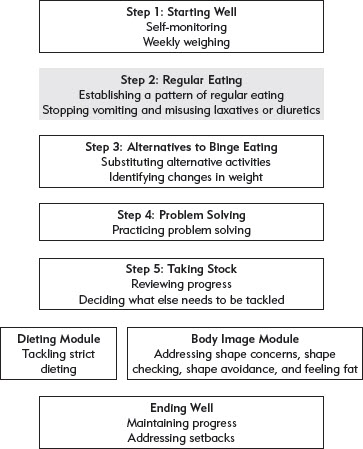
Establishing a pattern of regular eating is the single most significant change you can make when tackling a binge eating problem. One of the most consistent findings from over 30 years of research is that introducing a pattern of regular eating pushes aside most binges. Binge eating that was frequent becomes intermittent or stops altogether. To obtain this effect it is essential that you follow the guidelines below, so do read them carefully.
ESTABLISHING A PATTERN OF REGULAR EATING
You should aim to eat three planned meals each day, plus two or three planned snacks. Your eating pattern should therefore look something like this:
| 8:00 A.M.: | Breakfast |
| 10:30 A.M.: | Midmorning snack |
| 12:30 P.M.: | Lunch |
| 3:30 P.M.: | Midafternoon snack |
| 7:00 P.M.: | Evening meal |
| 9:00 P.M.: | Evening snack |
The exact times do not matter.
When introducing this eating pattern there are four main things to remember.
1. Plan ahead. At the beginning of each day (or the preceding evening), work out in advance when you are going to eat your meals and snacks, and write down the times at the top of the day’s monitoring record. At all points in the day you should know when you are next going to have a meal or snack. If the day is going to be unpredictable, plan ahead as far as you can. Then, once you know what is next going to be happening, plan the remainder of the day.
2. Make sure you eat each of your planned meals and snacks. Do your best not to skip any of them.
3. It does not matter (at this stage) what you eat in the meals and snacks so long as you do not vomit or take laxatives or diuretics afterwards. Eat foods that you are comfortable with and, I shall shortly discuss, make sure you eat enough.
4. Do your utmost not to eat in the gaps between the meals and snacks. In this way your day will be divided up by the meals and snacks. They will be like stepping-stones through the day. So, morning will be the time between breakfast and lunch; early afternoon will be the period between lunch and your midafternoon snack; late afternoon will be between your midafternoon snack and your evening meal; and the evening will be divided in two by your evening snack. Breaking long periods of time into more manageable chunks of no longer than 3 to 4 hours contributes to the reduction in the frequency of binge eating. This is because many people are prone to binge when faced with extended periods of empty time.
Further Guidelines for Introducing “Regular Eating”
Your plan should be flexible rather than rigid. It is important that you adjust the times of your meals and snacks to suit your commitments, but do try to establish as regular a pattern as possible. Obviously, the precise times will vary from day to day; for instance, work days are likely to differ from nonwork ones.
When you eat should be dictated by your plan for the day and not by sensations of hunger or urges to eat. Popular articles in the media often tell us to listen to our body’s signals and eat in response to them. This apparently wholesome advice ignores the fact that these signals are often disturbed in those who binge. Erratic eating, especially when it consists of alternating binge eating and dieting, disrupts the normal mechanisms that control hunger and fullness with the result that they are no longer a reliable guide as to when to eat. Later, once you have been eating regularly for some time, normal sensations of hunger and fullness will return—although this may take many months. Once this happens, you can use these sensations to guide your eating, although maintaining a pattern of regular eating should remain a priority.
Try not to leave more than 4 hours between the meals and snacks. Long gaps between episodes of eating create a mounting psychological and physiological pressure to eat that can eventually result in a binge. It is therefore wise to eat at regular intervals, with a 4-hour gap being the maximum. A possible exception to this “4-hour rule” is the morning because this is the time when most people are least likely to binge. If this applies to you, it would be reasonable to omit the midmorning snack as there are unlikely to be any negative effects.
Resist the temptation to compensate for the planned meals and snacks. There is no need to compensate for the planned meals and snacks, even if they are a new addition to your usual way of eating, as their introduction will reduce your frequency of binge eating, and therefore your calorie intake. Remember, this is true even if you vomit or take laxatives or diuretics immediately afterwards because none of these methods gets rid of anything like all the calories from the food that you have eaten. (If you have doubts about this statement, reread Chapters 4 and 5 to remind yourself about the ineffectiveness of these methods.)
Some people are tempted to eat very little in their meals or snacks for fear of gaining weight. This is not wise since it will increase the risk of binge eating by creating physiological and psychological pressures to eat (as we discussed in Chapter 4). Introducing a pattern of regular eating has little, if any, effect on body weight.
What to eat. As noted above, it does not matter exactly what you eat in your meals and snacks so long as you eat enough. If you would like guidance on what to eat, the best advice is to consume a broad range of foods and average-sized portions. The size of an average portion can be determined from the eating habits of friends and relatives, from recipes, and from the labels on packaged meals. If someone is helping you follow the program, you might want to ask his or her advice on what is a reasonable amount to eat. The critical point is that it does not matter what you eat so long as you do not vomit or take laxatives or diuretics afterwards to compensate and so long as you eat enough.
Initially, this pattern of eating may create feelings of fullness. This is particularly likely if you are not used to eating without vomiting or taking laxatives or diuretics. The feelings of fullness almost invariably subside within an hour or so, and moreover, within a few weeks you will be less prone to have them. They are best dealt with by avoiding wearing tight clothes at mealtimes and by engaging in distracting activities for an hour or two afterwards (along the lines outlined in Step 3).
Your planned pattern of eating should take priority over other activities. Do your best not to let other commitments take priority over your planned meals and snacks. At times, of course, your plan will need to be adjusted to accommodate important engagements. For example, if you know that your evening meal will have to be late, say at 10:00 P.M., then a sensible plan would be to move the evening snack earlier to midway between the midafternoon snack and the 10:00 P.M. evening meal.
If things go wrong, try to get back on track immediately. It is especially important to avoid writing off the remainder of a day because there was a problem earlier on. This “all-or-nothing” way of responding just makes matters worse. Always try to get back on track as soon as you can.
If your eating is very chaotic, you may not be able to introduce this eating pattern in one go. If this description applies to you, introduce the pattern in steps, starting with the part of the day that is least chaotic, which is usually the morning. So, begin by introducing breakfast and lunch (and possibly a midmorning snack) according to the guidelines above. Then, over the next few weeks, progressively introduce the other meals and snacks until the full pattern is in place.
Figure 21 shows a monitoring record completed by someone with bulimia nervosa who was at this stage in the program. You can see that at the top of the record she wrote when she planned to eat and that she did well at sticking to her plan.
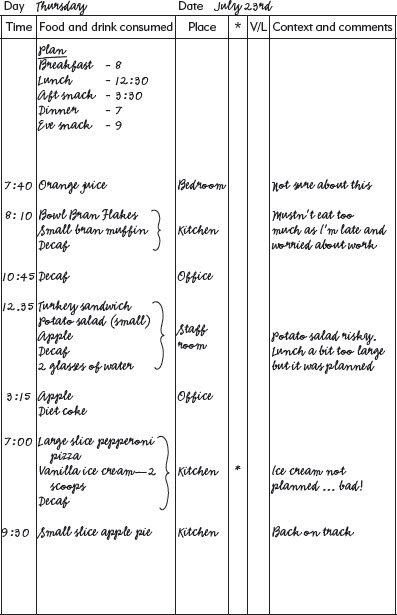
FIGURE 21. A monitoring record of someone 4 weeks into the program.
Introducing Regular Eating: What to Do
Introduce this pattern of eating while continuing to monitor. Do not expect this to be easy. You may well have problems. For example, you are likely to want to eat when you should not; conversely, you might not want to eat when you should, especially after you have binged. Do your very best, while at the same time noting down on your monitoring records any difficulties you are having. The suggestions made below regarding meals, shopping, and cooking may help you deal with some of these difficulties. Further suggestions are made in Steps 3 and 4.
So, start eating this way and assess your progress at the end of each day. Then make whatever adjustments seem appropriate. For example, you may discover that you are having your evening snack so late in the day that it is not breaking up the evening. In that case, try moving it to an earlier time.
Remember also to complete your summary sheet at the end of each week. A “change day” at this stage is one on which you monitored accurately, weighed weekly, and did your best to stick to your planned pattern of eating, irrespective of whether you binged.
WHAT TO DO ABOUT SELF-INDUCED VOMITING
If you make yourself vomit after binge eating, and only then, your vomiting will go away as you introduce the pattern of regular eating. This is because it is tied to your binge eating (see Figure 9)—it will resolve as your binge eating resolves.
For the first few weeks you may experience a strong urge to vomit after some of the planned meals or snacks. If this is the case, you should do your best to distract yourself until the urge has declined (usually within an hour or so). You might also want to make vomiting more difficult by staying in the company of others.
If you are someone who vomits at times other than after binge eating, and you are unable to break this habit, you should seek professional help. This way of eating can be difficult to overcome on your own.
WHAT TO DO ABOUT LAXATIVE AND DIURETIC MISUSE
As we discussed in Chapter 4, some people with binge eating problems misuse laxatives or diuretics. This misuse takes two forms. They may take them to compensate for specific episodes of overeating, in which case the behavior is very similar to self-induced vomiting. Alternatively, they may take them on a more routine basis, independent of particular episodes of overeating, in which case the behavior is more like dieting.
What has just been said about self-induced vomiting applies equally to the first type of laxative misuse. It will cease as binge eating ceases. However, if you have been taking laxatives or diuretics independently of binge eating, my advice is to make a firm decision to stop taking them from now on. Most people are capable of doing this, especially once they know how ineffective these drugs are at preventing calorie absorption (see Physical Effects of Laxative Misuse).
If you have been taking laxatives or diuretics on an occasional basis then you can stop taking them in one go. However, as you may recall from Chapter 5 (Physical Effects of Diuretic Misuse), if you have been taking them on most days, stopping suddenly can result in a period of fluid retention lasting a week or so, and obviously this will result in weight gain. It is therefore better to phase the drugs out, perhaps by halving your daily intake each week. In the unlikely event that you experience fluid retention (evidence of which is swelling of the hands and feet), it is important to keep in mind that the accompanying weight gain is accounted for by water, not fat, and that it is temporary. It will go away within a few weeks as the excess water is lost. Nevertheless, you should see your physician if you experience fluid retention as it is potentially serious and it can have other causes.
SOME ADVICE ON EATING IN AND EATING OUT
People with binge eating problems often find mealtimes difficult, especially when eating out. Below are some useful tips, although some of the suggestions may not be relevant to you. I suggest that you read through them and try those that apply. Keep in mind that you will not have to behave this way forever. These are interim measures designed to help you regain control over your eating. You will be able to drop them once they are no longer relevant.
Restrict your eating to certain places in your home. Part of regaining control over eating involves formalizing your eating habits. When you eat at home it is a good idea to have one or two set places where you eat. These should be at a table or its equivalent, and not within an arm’s reach of supplies of food. You should not eat in your bedroom or in the bathroom. If you have only one room, it is best to restrict your eating to one place in the room.
When eating, concentrate on what you are doing. While it may be tempting to distract yourself when eating, this is not a good idea. Instead, focus on what you are doing. Try to savor your food. You also need to ensure that you are not eating in an abnormal way. For example, check to see that you are not eating too fast. Being aware of what you are doing will also help to reduce the chance that your meals and snacks evolve into binges. For this reason try not to engage in other activities (such as watching television) when eating. Also, sit down, as eating on the move can result in inadvertent “grazing.”
When eating, restrict the availability of food. When eating a meal or snack, have only the preplanned amount of food at hand. Whenever practicable, keep packages and serving dishes off the table in case you are tempted to eat more than you had intended.
If need be, impose some controls over the way you are eating. If you tend to eat automatically or rapidly, practice putting down your utensils between mouthfuls and insert pauses into your meals. Also practice leaving food on the plate. This may seem wasteful, but anything that will minimize the likelihood of binge eating is not truly wasteful. And discard leftovers because at this stage in the program they may be too tempting to resist.
When eating with others, do not be persuaded to eat more than you had planned. It is not uncommon to be put under pressure to have second helpings or larger quantities than you want. You must resist this pressure. Practice polite but firm ways of declining—for example, “No, thank you. I really have had enough. It was delicious.’’ If someone still puts unwanted food on your plate, leave it untouched. Under such circumstances it is the other person who is being impolite, not you.
When eating a meal out, take stock between courses. It is easy for meals in restaurants or at other people’s homes to get out of hand. You may not know how many courses there will be or what they will contain. You therefore need to keep a careful eye on what is happening and take stock at intervals. Make some excuse—for example, that you have to make a quick phone call—so that you can leave the table and collect your thoughts. Ideally, get out your recording sheet and complete it while thinking over what to do next. In meals with a large number of courses, it is often easier to skip one or two courses altogether than to try to limit the amount you eat at each one.
Buffets are a particular challenge. The best approach is to take some time to look over what is being offered, and then step away to give yourself some moments to plan exactly what you are going to eat. Once you have finished eating, get rid of your plate and utensils and stay well away from the food.
Although you may not feel like doing this, it is a good idea not to drink too much alcohol when eating out as otherwise your judgment and willpower will be impaired.
SOME ADVICE ON SHOPPING AND COOKING
Many people with binge eating problems also have difficulties with shopping and cooking. Here are some tips for addressing these difficulties. Remember, as with the advice concerning mealtimes, not all the suggestions may be relevant to you.
Limit your stock of foods on which you are likely to binge. At this stage in the program it is best to restrict your access to foods that either trigger your binges or comprise them. It is unhelpful having them around. Therefore, when shopping, avoid buying these foods. If this is not practicable, limit the quantities that you purchase.
Ensure that you have adequate supplies of foods that are acceptable to you. It is important that you have a ready supply of food that you feel comfortable eating.
Plan your shopping. For the meantime do not shop for food on the spur of the moment. Instead, plan your shopping in advance and adhere to your shopping list. If possible, avoid shopping when hungry and on days when you feel at risk of binge eating. Shopping online can be helpful.
When cooking, avoid tasting the food. Picking at what you are cooking can trigger binges. Some people find it helpful to chew gum since this makes picking almost impossible.
Avoid unnecessary exposure to food. As we discussed in Chapter 4, many people with binge eating problems are preoccupied with thoughts about food and eating, and this can fuel an interest in food and cooking. Partly as a result, some spend a lot of time cooking for others. This should be resisted since, for obvious reasons, unnecessary exposure to food is risky. Some have a tendency to press food on others. This is not a good idea. Instead, treat others as you would want to be treated yourself. Offer food, but do not put people under pressure to eat more than they want. It is also not uncommon for people with binge eating problems to work directly or indirectly with food. If this applies to you and you can see that it is contributing to your eating problem, you should seriously consider changing your job.
STEP 2 REVIEW SESSIONS
It usually takes a few weeks to establish a pattern of regular eating. It may take longer. You should review your progress twice a week. On each occasion study your monitoring records, and once a week complete the summary sheet. A “change day” at this point is one on which you monitored accurately; you adhered to weekly weighing; and you did your best to stick to a planned pattern of regular eating, whether or not you binged.
Each Step 2 review session should have three parts to it. The first is rereading Step 2 to remind yourself what you have been trying to do. The second part is asking yourself the four questions from Step 1:
Have I been monitoring?
Can I improve my monitoring?
Are any patterns in my eating becoming evident?
Am I weighing myself once a week?
The third part is asking yourself the following eight questions regarding Step 2.
1. Each day, am I planning regular meals and snacks? Remember, to get control over your eating, you need to stay one step ahead of the problem, rather than be one step behind it. Each morning (or the previous evening if this suits you better) you should work out when you will be eating the next day’s meals and snacks, and you should do your best to stick to this plan. This way you will be more likely to foresee problems than come upon them unawares.
2. Am I trying to restrict my eating to the day’s meals and snacks? This is also central to the program.
3. Am I skipping any of the meals and snacks? It is important that you do not skip any meals or snacks as doing so will make you vulnerable to binge.
4. Are the gaps between my meals and snacks longer than 4 hours? For the same reason, the gaps between your meals and snacks should not be long, and never longer than 4 hours.
5. Am I eating between my meals and snacks? The goal is to restrict your eating to the planned meals and snacks. If you are succeeding in doing this, your monitoring records will have a clear pattern to them. Furthermore, this pattern should match the plan written at the top.
6. Am I getting back on track when things go wrong? It is important not to give up whenever something goes wrong. There is a tendency for people with binge eating problems to view days as a single unit with the result that when anything goes wrong they see the whole day as being ruined. This is not helpful and is an example of all-or-nothing thinking.
When you start to introduce a pattern of regular eating you will still be having binges. Do not feel despondent about this. The important thing is that after each binge you get back on track as soon as possible rather than delay until the next day. Try hard not to skip the next meal or snack because this will only make you vulnerable to binge again.
7. Am I adjusting the timing of my meals and snacks to accommodate events and circumstances? Your eating pattern must not be too rigid—otherwise you will run into difficulties when faced with special occasions. Examine your monitoring records to see whether there have been any such times and review how well you have dealt with them.
8. Am I following the advice regarding vomiting and the misuse of laxatives and diuretics? As we discussed in Chapter 4, all these behaviors encourage binge eating. It is therefore essential that you stop them by following the advice in this chapter.
Deciding When to Move on to Step 3
Most people need to spend quite a few weeks consolidating this way of eating. However, you do not need to wait until you have established a pattern of regular eating before moving on. This is because Step 3 will help you follow Step 2. What is essential is that you are having six or seven change days each week. If you are not, then you should reread Step 2 and stay at this stage for at least another week.
If you are ready to move on, continue with Steps 1 and 2 while starting to implement Step 3.