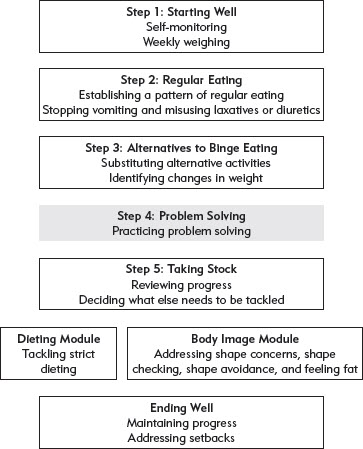
Most binges do not occur at random. As I described in Chapter 1, many are triggered by unpleasant events or circumstances including problems with relationships. It is therefore important to develop your skills for tackling problems of this type. This is the focus of Step 4. And even if your binges are not generally triggered by external forces, most people find that developing their problem-solving skills is of value to them.
DEVELOPING YOUR PROBLEM-SOLVING SKILLS
How people solve problems has been extensively studied, as has how to help people become better at it. What follows are guidelines for becoming a good problem solver.
How to Solve Problems
Efficient problem solving involves six steps. Good problem solvers go through these steps without being aware of it. You can become a good problem solver too by following the same process. In an informal way you have already been doing something like this when addressing your urges to binge in Step 3. Now it is time to formalize the process.
Effective problem solving involves the following six steps:
Step 1: Identifying the problem as early as possible.
Step 2: Specifying the problem accurately.
Step 3: Considering as many solutions as possible.
Step 4: Thinking through the implications of each solution.
Step 5: Choosing the best solution or combination of solutions.
Step 6: Acting on the solution.
If you are trying to enhance your problem solving, there is a seventh step. This involves looking back over how well you have “problem-solved.” We will now discuss each of these steps in some detail.
Step 1: Identifying the Problem as Early as Possible. Spotting problems early can prevent them from becoming overwhelming. In the example we considered in Step 3, you could have spotted the problem—having nothing planned for the evening—during the afternoon if you had been thinking ahead. Next best would have been spotting the problem as soon as it arose, say on finishing your evening meal.
There may be clues that a problem is developing. Maybe you are feeling fed up or beginning to have an urge to binge. Urges to binge are often a sure sign that there is a problem afoot, so whenever you have such an urge you should consider whether there is a problem lurking behind it.
Sometimes you will find that there is more than one problem. When this is the case, distinguish the two and problem-solve them separately because their solutions may differ.
Step 2: Specifying the Problem Accurately. Working out the true nature of the problem is essential if you are to find the right solution. If we return to the same example, you might have thought that the problem was the urge to binge. In fact the urge was your reaction to the true problem, which was that you had nothing to do all evening and you were tired. So, properly specified, the problem was “I have nothing to do this evening and I am tired.”
Step 3: Considering as Many Solutions as Possible. Do not censor yourself. Be creative. Try to think of all possible solutions. This way you are more likely to come up with a good one. Returning to our example, you might come up with these possible solutions:
Watch television.
Go to bed.
Go on Facebook.
Call some friends to see if they are free.
Clean the apartment.
Go for a jog.
Step 4: Thinking Through the Implications of Each Solution. Staying with our example, here are the likely ramifications of each of the above solutions:
Watch television. This is not a great idea since there is nothing worth watching and I will therefore get bored. This will make the risk of binge eating even greater.
Go to bed. This is also not a good idea. It is how I react when I am fed up, and it solves nothing. Indeed, it makes me feel worse. What tends to happen is that it makes me feel even sorrier for myself. It makes me feel like a failure, and eventually I get up and binge.
Go on Facebook. This is probably a bad idea right now. I am not feeling good about myself, and seeing what everyone else is doing might well make me feel worse.
Call some friends. This is not a bad idea. When I feel this way I usually hide away, but if someone calls it often cheers me up, especially if we can arrange to meet. Why should I wait for them to call me? I could just as well call them. If they are busy, they can always say so.
Clean the apartment. It’s clean enough already! I need to get a life! I don’t have to be productive all the time.
Go for a jog. This is not a bad idea in principle, but given my present weight I don’t enjoy jogging. Also, I have eaten too much, and it’s raining. I suppose I could go for a brisk walk. This would serve the same function since it would help me let off steam while I would also feel good about having exercised. And what’s so bad about getting wet!
Step 5: Choosing the Best Solution or Combination of Solutions. Choosing the best solution is often not difficult. If you have come up with a good number of potential solutions and carefully thought through their implications, the best solution or combination of solutions is usually fairly clear.
Returning to the example, you decide that calling some friends and exercising are the best options. Note that these are also the alternative activities that you chose to help cope with the urge to eat (in Step 3 of the program). When this happens, they are likely to be especially effective.
Step 6: Acting on the Solution. The final step is to put your solution(s) into practice. You do not have to stick rigidly to the chosen solution, if it turns out not to be a good idea, try one of the other solutions.
The Extra Step: Reviewing Your Problem Solving. To become an efficient problem solver, you need to take one crucial final step. This involves reviewing the entire problem-solving process, usually the next day, to see whether you could have done it any better. The matter at hand is not whether you solved the problem in question, although this is relevant, but rather it is how well you problem-solved. Maybe you overcame the problem but did not problem-solve very well (e.g., you thought of just one possible solution and simply got on with it). While this was a success in one sense, it wasn’t a success in terms of becoming a good problem solver. It is important to remember that the goal is that you become a good problem solver. You are trying to develop a skill.
Returning to our example, say you first called three friends. Two of them were in. Neither was free to meet there and then, but you caught up with each other’s news and made arrangements to meet in the next week or so. You then forced yourself to go out for a long fast walk. You were out for nearly 40 minutes. This made you feel tired (and you got soaked), but you felt healthier and happier when you got home, and the urge to binge had passed. By this time it was 9:15 P.M. and time for your planned evening snack.
The next day you reviewed your problem solving. You considered each step one by one. You thought that you could have done better at identifying the problem early. Looking back, you saw that it would have been perfectly possible to have spotted it in the afternoon, before you left work. On the other hand, you accomplished the other five steps pretty well. It certainly demonstrated that you could address such circumstances, whereas in the past you would have had a binge and felt even worse.
Developing Your Problem-Solving Skills
Practice problem solving as often as possible. You can practice it on more or less any type of problem. It can be used to address problems entirely separate from the eating problem, such as problems at work or in your relationships.
Do note that when problem solving, it is far better to write out each step than it is to problem-solve in your head. From now on, look out for problems, and each time you identify one, work through the six steps and then review the entire process the following day.
It is a good idea to use your monitoring records for this purpose. Write “Problem” in column 6 and then turn the sheet over and work through the six steps on the back. Also write down the findings of your review (the extra step). Figures 24 and 25 show monitoring records that illustrate the example that we have just discussed.
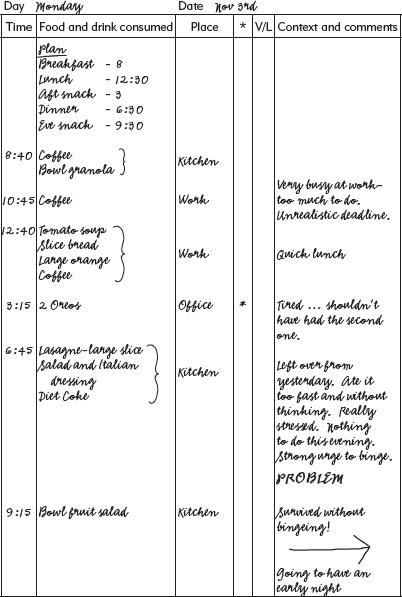
FIGURE 24. A monitoring record showing a “problem.”
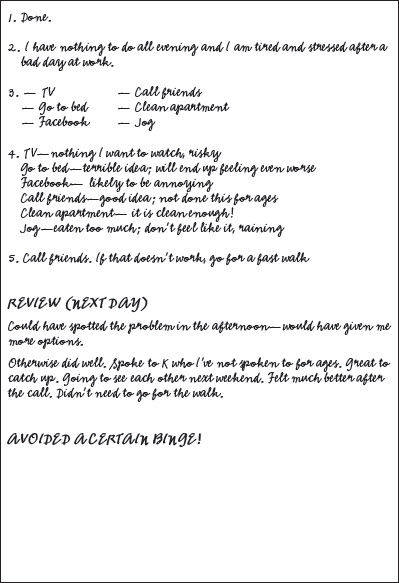
FIGURE 25. The back of the monitoring record shown in Figure 24 showing a successful attempt at problem solving.
Proactive Problem Solving
A recent refinement of this process is called “proactive problem solving.” It is designed for people who tend to be rather late in identifying problems. It is generally the case that problems spotted early are easier to address than those spotted later on. So, if this applies to you, become a proactive problem solver by repeatedly screening the rest of your day for possible problems. A simple way of doing this is to screen the remainder of the day every time you make an entry on your monitoring records. In this way you keep looking out for potential difficulties and problem-solve them then and there.
STEP 4 REVIEW SESSIONS
At each review session you should study your monitoring records and summary sheet and ask yourself the three questions below, in addition to those relating to Steps 1, 2, and 3.
1. Am I problem solving frequently enough? It is important to look out for opportunities to practice your problem-solving skills, whether or not the problem might lead to a binge. Any problem, however trivial, will provide you with a chance to develop your skills.
You might feel that problem solving is “obsessive” and not your style. Be that as it may, it is worth the effort and will not have to be continued forever. Many people are surprised at how useful they find the technique. Some continue with it long after their eating problem has gone. Others abandon it once it no longer seems relevant. For now, it is important to practice problem solving.
2. When I am problem solving, am I doing it properly? It is important that you follow the six steps and write them down at the time. This will help you think clearly and it will also assist the review process afterwards.
3. Am I reviewing my problem solving? Reviewing each attempt at problem solving is central to developing your problem-solving skills. Remember, the matter at hand is not whether the problem was solved (although hopefully it was) but rather whether you followed the six steps as well as you could. Could your problem solving have been any better?
Also, remember to complete your summary sheet each week. Classify as a “change day” any day on which you monitored accurately; you adhered to weekly weighing; you did your best to stick to your planned pattern of eating, as described in Step 2, whether or not you also binged; you used your list of alternative activities to deal with any urges to eat or vomit, as described in Step 3; and you practiced problem solving at every available opportunity, as described here.
Deciding When to Move On to Step 5
As before, it is not possible to provide specific guidelines for when to move on as you may or may not be having opportunities to problem-solve. This said, if your binge eating is becoming infrequent, or you have been at Steps 2, 3, and 4 for 6 to 8 weeks, now is a good time to move on to Step 5 and take stock.