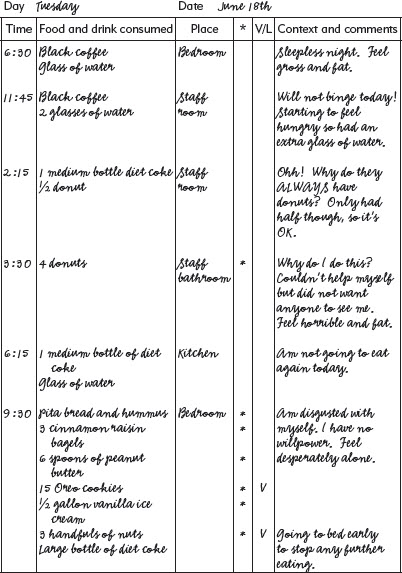
FIGURE 1. An eating record of someone with bulimia nervosa. Note the undereating in the first half of the day followed by binge eating later on. (Asterisks signify eating viewed by the person as excessive. V/L signifies vomiting or laxative use.)
It starts off with my thinking about the food that I deny myself when I am dieting. This soon changes into a strong desire to eat. First of all it is a relief and a comfort to eat, and I feel quite high. But then I can’t stop, and I binge. I eat and eat frantically until I am absolutely full. Afterwards I feel so guilty and angry with myself.
This book has been written for anyone who has a problem controlling their eating, whatever their age, whatever their gender, whatever their weight. It is about eating in an uncontrolled way. It is about binge eating.
The term binge used to mean one thing to most people: drinking to excess. Today the word more often means eating to excess. For many people a binge is something perfectly innocuous—a dietary slip or lapse, a simple overindulgence. For others, though, it signifies partial or complete loss of control over eating. This is a major problem for a large number of people, and not just those in the Western world.
Yet despite the fact that binge eating is undeniably widespread, most people know comparatively little about the problem. Are binges always large? Are they always followed by purging? Is binge eating a lifelong problem, or can it be overcome? Is binge eating a sign that something else is wrong? What sort of person is prone to binge and why? How do we distinguish—in ourselves or in those we care about—between a true binge and simple overeating? And, most important of all, how can people learn to overcome binge eating?
None of these questions can be answered without a full understanding of what a binge is, and that is the subject of this opening chapter.
WHAT DOES BINGE MEAN?
The meaning of the word binge has changed over the years. It has been in common use since the mid-nineteenth century when binge meant principally “a heavy drinking bout, hence a spree,” according to the Oxford English Dictionary. While that remains one of its meanings, nowadays dictionaries often define a binge in terms of overeating, and the term indulgence may be used. Merriam Webster’s Collegiate Dictionary, Eleventh Edition, for example, says that one meaning of the word binge is “an unrestrained and often excessive indulgence.”
This so-called “indulgence” is actually a common phenomenon reported by both men and women. For some it is an occasional indiscretion, as mentioned earlier; it has no effect on their lives. For others, though—such as the woman whose description opened this chapter—it is a genuine problem, something that has a profound impact on many aspects of their lives. Failure to understand this distinction—between indulgence and binge eating—lies at the heart of much of the confusion about the behavior.
Recognizing the need to clarify the meaning of the term binge eating, researchers have investigated the experiences of those who binge eat. While no two personal accounts are identical, it turns out that the episodes of eating that people view as binges have two core features in common: The amount eaten is viewed as excessive—although it might not seem so to the outsider—and, crucially, there is a sense of loss of control at the time. It is important to be aware that technical definitions of a binge generally specify an additional feature, namely, that the amount eaten was definitely larger than most people would eat under similar circumstances. This size requirement is somewhat contentious, as we will discuss later in this chapter, but it is widely employed.
THE CHARACTERISTICS OF A BINGE
I randomly grab whatever food I can and push it into my mouth, sometimes not even chewing it. But I then start feeling guilty and frightened as my stomach begins to ache and my temperature rises. It is only when I feel really ill that I stop eating.
Personal descriptions of binge eating can be tremendously revealing. What emerges is an account that you might recognize if you binge or someone you know binges.
Feelings. The first moments of a binge can be pleasurable. The taste and texture of the food may seem intensely enjoyable. Such feelings seldom last long, however. Soon they are replaced by feelings of disgust as the person consumes more and more food. Some people feel revulsion over what they are doing but nevertheless continue to eat.
Speed of Eating. Typically people eat rapidly during a binge. Many people stuff food into their mouth almost mechanically, barely chewing it. Some also drink copiously to help wash the food down, which contributes to their feeling full and bloated. Drinking a lot also helps people bring up the food later on.
Agitation. Some people pace up and down or wander around during their binges. They may exhibit an air of desperation. They feel the craving for food as a powerful force that drives them to eat. This is why the term “compulsive eating” is sometimes used. Obtaining food may take on extreme importance; people may take food belonging to others, shoplift from stores, or eat discarded food. Most view such behavior as shameful, disgusting, and degrading.
I begin by having a bowl of cereal. I eat it really quickly and then immediately have two or three more bowls. By then I know that my control is blown and that I am going to go all the way and binge. I still feel very tense, and I desperately search for food. These days this means running around college looking for food people have thrown out. I know that this is really disgusting. I stuff the food down quickly. Sometimes I go into town, stopping at stores along the way. I buy only a little from each store so as not to arouse suspicion. I stop when I have run out of money or, more usually, because I am so full that I physically cannot eat any more.
A Feeling of Altered Consciousness. People often describe feeling as if they are in a trance during a binge. If you have experienced this trance-like state, you know that your behavior seems almost automatic, as if it is not really you who is eating. But, like the person below, people also report that they watch television, listen to loud music, or engage in some other form of distraction to prevent them from having to think about what they are doing.
It all starts with the way I feel when I wake up. If I am unhappy or someone has said something to upset me, I feel a strong urge to eat. When this urge comes, I feel hot and clammy. My mind goes blank, and I automatically move toward food. I eat really quickly, as if I’m afraid that by eating slowly I will have too much time to think about what I am doing. I eat standing up or walking around. I often eat watching television or reading a magazine. This is all to prevent me from thinking, because thinking would mean facing up to what I am doing.
Secretiveness. A hallmark of the typical binge is that it occurs in secret. Some people are so ashamed of their binge eating that they go to great lengths to hide it—and may succeed for many years. One way they accomplish this is by eating in a relatively normal manner when they are with others. Another is by exercising considerable subterfuge. Perhaps you are familiar with some of the ways that people keep their behavior hidden: for example, after eating a normal meal, some people later return surreptitiously to eat all the leftovers. Others take food to their bedroom or bathroom to eat it without fear of detection.
I leave work and go shopping for food. I begin eating before I get home, but it is in secret with the food hidden in my pockets. Once I’m home, proper eating begins. I eat until my stomach hurts and I cannot eat any more. It is only at this point that I snap out of my trance and think about what I have done.
Loss of Control. As mentioned earlier, the experience of being out of control is one of the two core features of binge eating. It is what distinguishes binge eating from everyday overeating. The experience varies considerably between people. Some feel it long before they begin eating. For others it emerges gradually as they start to eat. Or it may come on suddenly as they realize that they have eaten too much.
Interestingly, some people who have been binge eating for many years report that their sense of being out of control has faded over time, perhaps because experience has taught them that their binges are inevitable, so they no longer try to resist them. Some even plan ahead for what they see as unavoidable binges, thus setting up a self-fulfilling prophecy. Planning ahead allows these people to exercise some degree of control over when and where their binges take place, thereby minimizing their impact. They therefore feel that they have not lost control. This is not really the case, however, since they are still unable to prevent the episodes from occurring. Furthermore, many of these people report being unable to stop eating once they have started. This seems to be the case even when a binge is interrupted—say, the telephone may ring or someone may come to the door—as when this happens, it is common for the binge to be suspended only to restart once the interruption ends.
HOW PEOPLE BINGE
People vary widely in how often they binge and what foods they eat. It is therefore difficult to define a typical binge in these terms.
Frequency and Duration
To be given a diagnosis of the eating disorder bulimia nervosa or binge eating disorder, two of the three main eating disorders recognized in adults (see Chapter 2), a person’s binges have to occur on average at least once a week. This threshold is arbitrary and has changed over the years. It has been criticized for implying that people who binge less frequently, or who do so intermittently, are less impaired, whereas this is often not the case. Consequently, clinicians often ignore thresholds of this type when making a diagnosis. What matters is whether the person has regular binges and whether their binges are interfering with their physical health or quality of life.
The significance of the frequency of binge eating is also confusing. If you binge “only once in a while,” does this mean there is no need for concern? At what frequency is binge eating a problem? Is it the numbers—how often you binge, for how long, over what time span—that determine how serious the problem is? Or should the guiding factor be how much binge eating affects your life? As noted above, in practice clinicians are concerned with impairment—the degree to which binge eating interferes with physical health or quality of life.
How long do binges last? This depends on a variety of factors, a particularly important one being whether the person intends to vomit afterwards. Data from our patients in Oxford indicate that, among those who do vomit, binges last on average about an hour, whereas among those who do not, they are almost twice as long. This is almost certainly because those who vomit feel under pressure to complete their binge as soon as possible so that they can bring up the food and thereby minimize the amount absorbed.
The Foods Eaten in a Binge
The food I eat usually consists of my “forbidden” foods: chocolate, cake, cookies, jam, condensed milk, cereal, and improvised sweet food like raw cake mixture. Food that is easy to eat. Food that doesn’t need any preparation. I never eat these kinds of food normally because they are so fattening. But when I binge I can’t get enough of them.
When people who binge are asked “What do you eat when you binge?” they typically give two types of reply. The first relates to the character of the food. So they may reply “sweet food” or “filling food.” The second reply relates to their attitude toward the food. So they may answer “forbidden food,” “dangerous food,” or “fattening food.” What is clear is that most binges are composed of foods that the person is trying to avoid. This is a crucial point that we will return to later. It is central to understanding the cause of many binges, and it is central to overcoming binge eating and remaining well.
You may have read that binges are characterized by their high carbohydrate content and are driven by “carbohydrate craving”—a widespread myth. In fact, the proportion of carbohydrates in binges is not particularly high, no higher than that in ordinary meals. What characterizes binges is not their composition in terms of carbohydrates, fats, and proteins, but rather the overall amount eaten. If you binge or know someone who does, you know that binges typically include cakes, cookies, chocolate, ice cream, and so on. But, as Timothy Walsh of Columbia University has pointed out, while it is commonly believed that these foods are high in carbohydrates, they are more accurately described as sweet foods with a high fat content.
Interestingly, though, the notion of carbohydrate craving may have had more relevance a decade or so ago. It is my impression that the composition of binges changes over time and that it is governed by what foods are currently avoided or viewed as “forbidden.” Carbohydrates used to be regarded as “bad” foods and therefore featured prominently in binges, whereas more recently fats have had the bad press. (Dietary fashions and fads are discussed in Chapter 5.)
Figure 1 shows the eating record of someone with bulimia nervosa. It illustrates the typical eating pattern comprising undereating punctuated by episodes of binge eating.
FIGURE 1. An eating record of someone with bulimia nervosa. Note the undereating in the first half of the day followed by binge eating later on. (Asterisks signify eating viewed by the person as excessive. V/L signifies vomiting or laxative use.)
The Size of Binges
The amount of food eaten during binges varies widely from person to person. Some people consume vast quantities of food; occasionally a person describes eating 15,000 to 20,000 calories at one time. However, this is not typical. When people are asked to describe exactly what they have eaten and then the number of calories is calculated, a typical binge contains between 1,000 and 2,000 calories. About a quarter of binges contain more than 2,000 calories which is close to the average daily calorie needs of many women (see Table 5).
Laboratory studies support these accounts as similar figures have been obtained when people have volunteered to binge and then the precise composition of their binges has been calculated. One study found that one in every five patients with bulimia nervosa had binges of more than 5,000 calories and one in ten had binges of more than 6,000 calories.
While many binges are large, it is equally clear that many otherwise typical binges are small in size in that only average or even small amounts of food are consumed. These binges do not meet the technical definition of a binge described earlier owing to their small size, yet the person views them as binges because the amount eaten is perceived as excessive and there is an accompanying sense of loss of control. The Eating Disorder Examination, an interview for assessing the features of eating disorders that I devised together with my colleague Zafra Cooper, describes such binges as subjective binges. In contrast, binges in which truly large amounts are eaten are referred to as objective binges.
Subjective binges are not uncommon and can be a cause of considerable distress. They are especially typical of people who are attempting to adhere to a strict diet, including those with the eating disorder anorexia nervosa. (In Chapter 2 I describe the various “eating disorders.”)
The Cost of Binges
Spending on food is my biggest single expense every month. Over the years it’s got me further and further into debt.
Binge eating can be expensive and can get people into financial difficulties. This explains in part why some people resort to stealing food. Figure 2 illustrates the cost of binge eating. Scott Crow and colleagues in Minneapolis recently studied the monetary cost of binge eating in a sample of people with bulimia nervosa. They found that about a third of people’s food bills were accounted for by the food that they consumed during their binges.
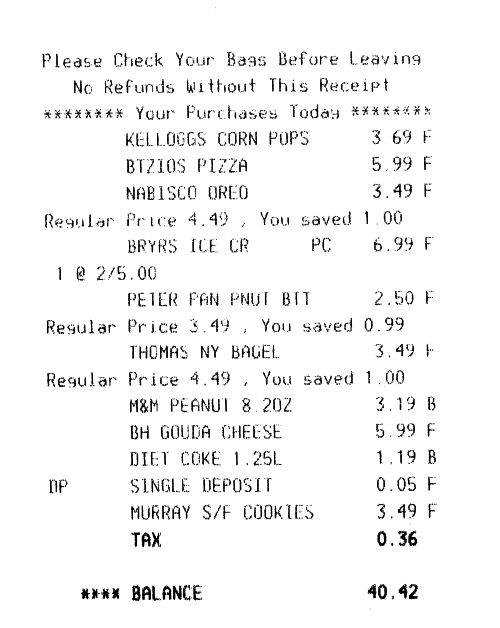
FIGURE 2. The cost of binge eating: a supermarket receipt showing the cost (in U.S. dollars) of the food bought for a single binge.
ARE ALL BINGES THE SAME?
Binges vary considerably, not only from person to person but also within a single individual. It is common for people to report that they have more than one type of binge, although some of these binges may not fit the technical definition (of an objective binge). One person described having three types of binge.
Full-Blown Binges
I eat and I eat, usually very fast, and without enjoyment, apart from initial taste pleasure which anyway is tempered with guilt. Usually furtively, and in one place: at home, the kitchen; at college, my room. I eat until I physically cannot eat any more. This is usually the type of binge where I take laxatives—during and after—which intensifies the feeling of panic and guilt. Immediately afterwards I am so physically bloated that emotions are dulled, but later I feel terrible.
Half-Binges
These usually take place late at night and are similar to full-blown binges except that I eat food hurriedly in one place, and without enjoyment, but also without a great deal of panic. It is almost an automatic reaction, often to some situation. I can stop these.
Slow-Motion Binges
Usually I have these at home, not college. I can see them coming in advance. I may fight them for a while, but eventually I give in and have an almost pleasurable feeling. There’s definitely a release of tension at the time because I don’t have to worry anymore. I actually enjoy these binges, at least to start with. I choose foods that I like and don’t usually allow myself or allow myself only in limited quantities. I may spend time preparing the food. At some stage it hits me what a fool I’m being and how much weight I will gain (not how greedy I am being), and then I become even more guilty, but I still feel a compulsion to carry on.
Certain groups of people have distinctive binges. For example, people with the eating disorder anorexia nervosa often have small, subjective binges, but these are accompanied by the same distress and sense of loss of control that is associated with objective binges. And the binges of people who are significantly overweight (many of whom have “binge eating disorder”; see Chapter 2) tend not to be distinct in the sense that their beginning and end can be difficult to identify. These binges generally last longer than those of people with bulimia nervosa; indeed, they can last almost all day.
HOW BINGES BEGIN
By now you may be baffled by the fact that binge eating occurs at all. Why would something that leaves people feeling disgusted and ashamed happen again and again? This raises two issues. What causes binge eating problems to begin in the first place, and what keeps them going? These matters are addressed in Chapter 6. Also important, however, are the more immediate triggers of individual binges. What circumstances tend to precipitate a binge?
Many things trigger binges. A classic early study identified the main triggers of binges and a more recent one obtained information on exactly where they take place (see Box 1). Some of the most common triggers are described in the following paragraphs.
BOX 1. The triggers of binges and where they take place.
A detailed description was obtained of the binges of 32 patients seen at an eating disorder clinic in Sydney, Australia.1 The majority met diagnostic criteria for bulimia nervosa (see Chapter 2). The main precipitants of their binges were reported to be as follows:
| 91% | Tension |
| 84% | Eating something (anything at all) |
| 78% | Being alone |
| 78% | Craving specific foods |
| 75% | Thinking of food |
| 72% | Going home (either after school or work) |
| 59% | Feeling bored and lonely |
Thirty-three women with binge eating disorder (see Chapter 2) were given handheld computers for a week.2 At regular intervals they were asked questions about their eating and mood. It emerged that their binges most commonly occurred when they were alone and in the following places:
| 31% | Kitchen |
| 31% | Living room |
| 10% | Car |
| 10% | At work |
1Source: Abraham, S. F., & Beumont, P. J. V. (1982). How patients describe bulimia or binge eating. Psychological Medicine, 12, 625–635.
2Source: Stein, R. I., Kenardy, J., Wiseman, C. V., Dounchis, J. Z., Arnow, B. A., & Wilfley, D. E. (2007). What is driving the binge in binge eating disorder? International Journal of Eating Disorders, 40, 195–203.
Undereating and the Associated Hunger. Some people who binge, especially those with bulimia nervosa or anorexia nervosa, eat little outside their binges. The resulting deprivation can have many undesirable effects, as it would for anyone who was essentially starving him- or herself. Imposing strict limits on eating and eating too little creates a mounting physiological and psychological pressure to eat, and once eating starts it can be difficult to stop. Many say that it is like a dam bursting.
The urge to binge usually begins around midday on a “normal” day—that is, a day on which I am trying not to eat. During the afternoon thoughts of food become more and more of a preoccupation; and eventually at around 4:00 P.M. my power of concentration will be sufficiently nonexistent for thoughts about food to be totally overwhelming. So I leave work and go to the store.
One thing that definitely sets me off is hunger. If I am hungry, instead of eating something to satisfy it, I eat anything I can lay my hands on. It’s almost as if I have to satisfy all tastes, even for things I don’t like.
Breaking a Dietary Rule. Many people who binge also diet, and their dieting tends to be highly characteristic in its form (as we will discuss in Chapter 4). They are usually trying to follow strict rules about what, when, and how much they should eat. Breaking such rules commonly triggers a binge.
Drinking Alcohol. Some people find that drinking alcohol makes them vulnerable to binge. There are a number of reasons for this link. Alcohol reduces the ability to resist immediate desires and so interferes with the ability to stick to dietary rules. For example, a plan to eat only a salad could, after a few drinks, be readily abandoned in favor of eating a full meal. Alcohol also impairs judgment and causes people to underestimate how bad they will feel if they break their rules. In addition, alcohol makes some people feel gloomy and depressed, thereby further increasing the risk of binge eating.
Unpleasant Emotions. Unpleasant feelings of all types can trigger binges. Feeling depressed is a particularly powerful stimulus.
Binges start when I’m tired or depressed or just upset. I become tense and panicky and feel very empty. I try to block out the urge to eat, but it just grows stronger and stronger. The only way to release these feelings is to binge. And binge eating does numb feelings. It blots out whatever it was that was upsetting me. The trouble is that it is replaced with feeling guilty, self-critical, and drained.
Other emotional triggers include stress, tension, hopelessness, loneliness, boredom, irritability, anger, and anxiety.
Unstructured Time. The absence of structure in the day makes some people prone to binge, whereas having a routine may be protective. Lack of structure may also be accompanied by feelings of boredom, one of the moods that tend to trigger binge eating.
Being Alone. As already mentioned, binges mostly occur in secret. Being alone therefore increases the risk as there are no social constraints against binge eating. If the person is lonely as well, the risk is even greater.
Feeling Fat. Feeling fat is an experience reported by many women—it is uncommon in men—but the intensity and frequency of the “feeling” appear to be greater among those who have an eating problem. (I discuss feeling fat in more detail in Chapter 4.) In these people feeling fat tends to be equated with being fat, whatever the person’s actual shape or weight. And feeling fat can trigger binge eating.
Gaining Weight. Most people who are concerned about their weight react badly to any increase. A weight gain as little as 1 pound (0.5 kilograms) may precipitate a negative reaction and, among those prone to binge, one response is to give up attempts to control eating with a binge being the result. This reaction is based upon a misunderstanding: body weight fluctuates within the day and from day to day, and short-term changes reflect changes in hydration not body fat. (In Chapter 5 I discuss body weight and weight fluctuations and I provide advice on how to interpret the number on the scale.)
Premenstrual Tension. Some women report that they find it particularly difficult to control their eating in the few days before a menstrual period. This may be their response to various factors including feeling bloated, premenstrual weight gain, or to an adverse mood such as depression or irritability.
HOW BINGES END
After a binge I feel frightened and angry. Fear is a large part of what I feel. I am terrified about the weight I will gain. I also feel anger toward myself for allowing it to happen yet again. Binge eating makes me hate myself.
The hardest thing after a binge is waiting for the effects to die down. I hate feeling so useless and unable to do anything. Sometimes I feel I could literally rip open my stomach and pull out the garbage inside, the disgust and revulsion are so great. Failing that, laxatives are the next best thing.
After everyday overeating, most people either accept the episode as an indulgence (“naughty but nice”) or have some feelings of guilt (more accurately they feel regret). They may decide to compensate by eating less and perhaps by exercising, but their self-recrimination and compensatory behavior are likely to end there.
The aftermath of binge eating is quite different. Those who binge often report that they experience some immediate, though temporary, positive feelings. For example, they may experience a sense of relief from the psychological and physiological deprivation that preceded it. Feelings of depression or anxiety that triggered the binge may also have dissipated. But these positive effects are soon replaced by feelings of shame, disgust, and guilt. Self-recrimination sets in, and people feel hopeless about ever being able to control their eating. Anxiety is also common as fears of weight gain mount. These negative feelings may be exacerbated by the physical effects of having binged, with sleepiness and abdominal distension being particularly common. The fear of weight gain may be so intense that it drives some people to take extreme compensatory measures which, ironically, may encourage yet further episodes of binge eating (as we will discuss in detail in Chapter 4).