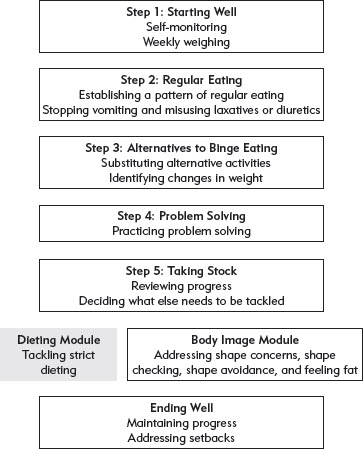
To build on your progress and maintain it, you now need to tackle the processes that make you vulnerable to binge. For example, if your binges are triggered primarily by stress, eating at regular intervals, using alternative activities to cope with urges to eat, and efficient problem solving will often be sufficient on their own. On the other hand, if dieting is contributing to your binge eating, then it also needs to be addressed.
In Chapter 4 you learned about three forms of dieting: delaying eating for long periods of time, restricting the overall amount of food eaten, and avoiding eating certain types of food. All three are common among those who binge, and all three tend to encourage binge eating. You may recall that this is particularly true if the dieting is strict, that is, governed by highly specific rules that tend to be applied in an all-or-nothing fashion. Strict dieters tend to impose on themselves a variety of demanding dietary rules, and they respond to any breaking of these rules by giving up and overeating. As a result they alternate between dieting and binge eating, with each encouraging the other.
To determine whether you are a strict dieter, review your monitoring records to get answers to these two groups of questions:
1. What do I eat between my binges?
Am I purposely restricting what I eat? If so, am I attempting to follow any particular dietary regimen (or goals)?
Am I trying not to eat for long periods of time?
Am I attempting to limit the overall amount I eat, perhaps by staying below a set calorie limit?
Am I avoiding particular types of food, ones that I view as fattening or liable to trigger a binge?
And, most important, am I dieting in an all-or-nothing way, such that if I break my diet I tend to give up and binge?
2. What are the triggers of my binges?
Are they triggered by breaking one of my dietary rules?
Do they occur if I eat more than I feel I ought to?
Are they triggered by eating a banned or forbidden food?
If you are dieting, and most especially if you are dieting in a strict way, and if this seems to be triggering your binges, then it is essential that you tackle your dieting. If you don’t, you will remain prone to binge. Below are guidelines for addressing strict dieting. While following these guidelines it is essential that you continue to practice what you learned in Steps 1 through 4.
ADDRESSING STRICT DIETING
The three types of dieting each require their own approach.
Delaying Eating for Long Periods of Time
This was tackled when you established a pattern of regular eating in Step 2. If in the past you were prone not to eat for long periods of time, it is essential that you place great importance on eating at regular intervals, now, and in the longer term. You might want to reread Step 2.
Restricting the Overall Amount You Eat
Imposing strict limits on how much you eat—for example, by setting a calorie limit—must be resisted for two reasons. First, if the limit is extreme, it will inevitably encourage binge eating because it will create a physiological pressure to eat. Certainly any diet that involves eating much less than 1,500 calories a day will have this effect. It will also create a psychological pressure to eat because it will result in preoccupation with food and eating. Second, strict dieters often set themselves very specific dietary goals, and they are prone to binge if they do not meet them. For example, eating anything over 1,500 calories will represent “failure” to someone who is trying to keep to a 1,500 calorie diet.
To tackle this form of dieting, you must first decide whether there is any good reason to restrict your calorie intake. There is no need for most people with binge eating problems to diet; indeed, it is unwise for them to do so since dieting makes them vulnerable to binge. Assuming that there is no good reason for you to diet, you should do your best to stop doing so. You should stop attempting to restrict the overall amount that you eat and, if applicable, stop counting calories. Paradoxically, this may well result in you eating less overall as you will be less prone to binge.
If you are afraid that you will overeat if you stop dieting, you may need guidelines as to what is a “normal” amount to eat. As suggested in Step 2, one option would be to identify people of about your age (and gender) and see what they eat. Alternatively, you could follow the advice on food packages and in recipes. A friend or relative who is helping you with the program could also advise you. Finally, remember that Table 5 specified the approximate calorie needs of adults with various lifestyles.
Trying to Avoid Certain Foods
It is particularly important to tackle this form of dieting (“food avoidance”) because it is especially likely to encourage binge eating (see “Avoiding Certain Types of Food”).
In principle, food avoidance is the easiest form of dieting to tackle since all you have to do is introduce the avoided foods into your diet. In practice, however, this is easier said than done. For example, you may have become so used to not eating these foods that you are no longer aware that you are avoiding them. The first step therefore is to identify what foods you are avoiding. The best way of doing this may seem odd, but it works. Go to a local supermarket that stocks most types and brands of food, and walk up and down the aisles, writing down in a notebook—other shoppers may think you are an employee!—all the foods that you would be reluctant to eat, either because of the effect they might have on your weight or shape, or because you think eating them might trigger a binge. A typical list is shown in Figure 26. Then, at home, organize this list (often it contains 40 or more items) into three or four groups according to the degree of difficulty that you would have starting to eat them.

FIGURE 26. A list of foods avoided by someone with bulimia nervosa.
The next step is to introduce these foods into your diet. Do so by including them in your planned meals and snacks, and do this only on days on which you feel in control over your eating because otherwise they might trigger a binge. Start by introducing foods from the easiest of your groups and focus on them for a couple of weeks. Then move on to the next group, and so on. Within 6 to 8 weeks you should have incorporated most, if not all, of the foods into your diet. (If your list is particularly long, this might seem unlikely. In practice, the introduction of a food often deals with other related foods so that they are addressed at the same time.) It does not matter how much of the food you eat—even a little will do. Generally it is the thought of having eaten the food that triggers a binge rather than concern about the amount eaten.
Some people find doing this easy, but others do not. Either way, it requires sustained practice. You should keep introducing these foods until you no longer find it difficult. The time to stop is when eating these foods no longer unsettles you. Remember, if you are not avoiding any foods, you are much less likely to binge. By introducing your avoided foods you are inoculating yourself against binge eating.
Following this advice may require you to eat foods that you regard as fattening or unhealthy. It is important to persist nonetheless. No foods are inherently fattening; it all depends on the amount of them that you eat. Introducing these foods will enhance your control over eating because you will be less prone to binge. As for their unhealthiness, it is preferable to eat these foods in moderation than to binge on them.
Another point worth stressing is that you will not need to eat these foods forever. Rather, as soon as doing so ceases to make you anxious it would be reasonable to cut back somewhat on those generally accepted to be unhealthy—those high in saturated or trans fats—although it would be best not to exclude them altogether. You should allow yourself to eat anything at times; nothing should be rigidly banned.
Finally, it is important to recall that some people justify dieting on the grounds that they are vegetarians or have a food allergy. Whatever the justification, any dietary restriction that is at least in part designed to reduce weight or change shape is a form of dieting that needs to be tackled if you are prone to binge.
Addressing Strict Dieting: What to Do
Follow the guidelines for dealing with the three forms of dieting, and assess your progress at each of your review sessions. Remember to consider each form of dieting.
DIETING MODULE REVIEW SESSIONS
At each weekly review session you should study your monitoring records and summary sheet, and ask yourself the two questions below, in addition to those relating to Steps 1 through 4 and, if applicable, the body image module.
1. Am I tackling the three forms of dieting?
Trying not to eat for long periods of time.
Trying to restrict the overall amount I eat.
Trying to avoid certain types of food.
2. Am I tackling eating in front of others? If not, should I be doing so?
If your answer is “No” to either of these questions, you should consider rereading this module. Also, remember to complete your summary sheet each week. Classify as a “change day” any day on which . . .
You monitored accurately.
You adhered to weekly weighing.
You did your best to stick to your planned pattern of eating (Step 2).
You used your list of alternative activities to deal with any urges to eat or vomit (Step 3).
You practiced problem solving at every available opportunity (Step 4).
You tackled strict dieting.
WHEN TO MOVE ON
It takes some time to break out of strict dieting, at least a month or two. It is most important to persevere as otherwise you will remain vulnerable to binge. In the meantime, you may also be addressing your body image, the other module at this stage in the program.
One final point. Do not forget to complete the final module, “Ending Well.” It will help to ensure that the changes you have made persist in the long term.