PREFACE
[Modern] organisational design . . . is about designing for collaborative technologies, for the voice of the customer.
—Naomi Stanford, Guide to Organization Design
Teams are always works in progress, but they are also your best shot at delivering value continuously and sustainably by aligning them with the business. Ideally, teams should be long lived and autonomous, with engaged team members. However, teams don’t live in isolation. They need to understand how and when to interact with each other. And these team interactions need to evolve over time to support the distinct phases of discovery and execution that products and technology go through during their lifetimes. In short, organizations not only need to strive for autonomous teams, they also need to continuously think about and evolve themselves in order to deliver value quickly to customers.
This book offers a practical, step-by-step, adaptive model for organizational design that we have used and seen work across businesses at varying levels of maturity: Team Topologies.
However, Team Topologies is not a universal formula for building and running software systems successfully. There are teams and organizations who succeed with organizational dynamics very different from those described and recommended here (particularly in organizations with excellent culture and best practices already in place).
Team Topologies is meant to provide clear patterns that are straightforward for many different teams and organizations to follow and interpret, not to dictate to outstanding players how to perform. We like to think of Team Topologies as a set of music parts for an orchestra or big band, not the melody for a top jazz trumpeter. Printed music for a large musical ensemble helps the group to succeed but does not dictate every aspect of performance; lots of detail is left for the ensemble to interpret to suit the occasion, venue, or mix of players. Likewise, there is huge value in agreeing to a coherent vocabulary and way of working together across teams to achieve good software delivery.
The Team Topologies approach helps organizations that are struggling to find a way to optimize their team structure, or for those that are not yet aware of the impact team design can have on good business outcomes and software systems in particular. Team Topologies helps organizations succeed more quickly and more continuously than before.
This book is for anyone who cares about the effectiveness of the delivery and operations of software systems: C-level leaders (including CTOs/CIOs, CEOs, CFOs, and so on) managers, heads of department, software architects and systems architects, and anyone else involved in building or running software systems who wants or needs to make the delivery and running of those systems more effective.
How We Came to Write This Book
In 2013, while introducing DevOps and Continuous Delivery at a company in the UK, Matthew devised the original DevOps Topologies patterns (and anti-patterns) in a blog post titled “What Team Structure Is Right for DevOps to Flourish?”1 At the time, the company he was consulting with was struggling to adopt modern approaches to software delivery, and the early topology patterns Matthew created provided the company a way to explore different options.
Manuel interviewed Matthew at the QCon London software development conference back in 2015, where Matthew was speaking on Conway’s law and the early DevOps Topology patterns. The resulting article, “How Different Team Topologies Influence DevOps Culture,” was published by InfoQ and translated into several languages.2 Later that year, Manuel helped to expand the DevOps Topology patterns and there were contributions from the community.
Since then, the use of DevOps Topology patterns has exploded. They have been referenced over and over again in talks, articles, and conversations. They have helped organizations of all sizes and from varying industries around the world to think about the relationships between teams and how their interactions influence both organizational culture and software architecture.
Over time, we realized that the original DevOps Topologies presented a static view of team interrelationships that, while useful for initial discussions, was quite limited in scope. Through our combined experience with training and consulting organizations from across the world, we discovered that some teams work better relatively isolated or autonomous, while other teams work better with strong collaboration. We asked ourselves why, and we kept evolving our ideas based on feedback from our clients.
Eventually, this led to the Team Topologies as you see them presented in this book: a dynamic and evolving approach to organizational design based on real scenarios from across different geographies and industries.
How to Use This Book
Team Topologies is meant to be a functional book. It is our intention to provide content that is interactive and delivers as much learning as we are able to fit within these pages. To help with that, we have made some design choices that will help you navigate this book.
First, the book is organized in three parts:
Part I of the book explores Conway’s law, the way organizational interrelationships constrain the design of systems we build, and how we can use this tendency to our advantage. We then define what we mean by teams and look at some practical constraints that affect effective teamwork.
In Part II, we investigate a set of static team patterns that have been proven in the industry and the implications of choosing one pattern over another with Conway’s law and organizational context in mind. This section should help you think about team topologies that are broadly suitable for your organizational context. This part also provides some guidance in deciding how to align teams to areas of the system, taking into account Conway’s law and fundamental team topologies.
Finally, in Part III, we deal with ways to evolve the organization design to provide powerful capabilities for innovation and rapid delivery in response to a quickly changing operating context. We explain how to use the Team Topologies approach to create a sensing organization that responds to the market and user demands, and accounts for the implications this has for hiring and skills.
Each part opens with a breakdown of key takeaways from each of the chapters. Throughout the chapters, we have included figures and callouts to highlight information we think is helpful to know and/or reference. We also provide easy-to-recognize scenarios, case studies, and explicit recommendations for different situations along the way.
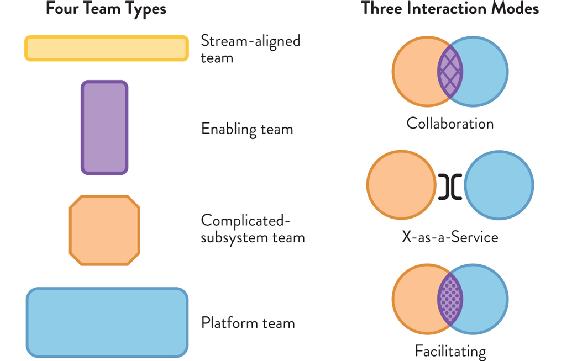
Finally, the shapes, colors, and patterns found within many of the figures also have consistent meaning throughout much of the book. Here is the key:
Figure 0.1: The Four Team Types and Three Interaction Modes
For the fullest understanding, you should read the book from cover to cover, as the subject matter builds up chapter by chapter. However, we have written the material so that each section is fairly independent.
In that spirit, here are some scenarios with corresponding ways to read the book that might match with your current situation:
Key Influences that Informed this Book
In addition to our own experience, this book is strongly influenced by several related approaches and sets of thinking. First, we assume that an organization is a sociotechnical system or ecosystem that is shaped by the interaction of individuals and the teams within it; in other words, that an organization is the interaction between people and technology. In this aspect, the book fits with ideas from the fields of: cybernetics (especially the use of the organization as a “sensing mechanism,” which goes back as far as 1948, when Norbert Wiener’s book Cybernetics: Or Control and Communication in the Animal and the Machine was first published), systems thinking (particularly the work of W. Edwards Deming), and approaches such as the Cynefin framework for assessing domain complexity (described by Dave Snowden and Mary Boone in their 2007 Harvard Business Review paper titled “A Leader’s Framework for Decision Making”), and adaptive structuration theory (a term coined by Gerardine DeSanctis and Marshall Scott Poole in their Organization Science article, “Capturing the Complexity in Advanced Technology Use: Adaptive Structuration Theory,” where they emphasized that the impact of technology is not a given, as it depends on how groups and organizations perceive it).
Second, we assume that “the team” is something that behaves differently from a mere collection of individuals, and that the team should be nurtured and supported in its evolution and operation. In this respect, we draw on ideas from Bruce Tuckman (who proposed the four-stages model—forming, storming, norming, performing—for team development in his 1965 paper “Developmental Sequence in Small Groups”), Russ Forrester and Allan Drexler (who explored team-based organization performance in their 1999 paper “A Model for Team-Based Organization Performance”), Pamela Knight (who found evidence that storming takes place throughout the entire lifetime of a team in her 2007 paper “Acquisition Community Team Dynamics: The Tuckman Model vs. the DAU Model”), Patrick Lencioni (who explores common interaction issues in his seminal book The Five Dysfunctions of a Team: A Leadership Fable), and similar team-focused theories and research.
Third, we assume that Conway’s law (or a variant of it) is a strong driver of software product shape and that organizations would benefit from explicitly addressing the implications of this law. In this regard, we draw on writing and ideas from Mel Conway; from software architecture consultant and team organization design award-winner Ruth Malan; from ThoughtWorks technical director and one of the “reverse Conway maneuver” proponents James Lewis; and from similar authors and practitioners.
Finally, we draw on numerous sources that describe practical successes developing and running software systems at scale, including organizations such as Adidas, Auto Trader, Ericsson, Netflix, Spotify, TransUnion, and others. The size and speed of these organizations has made it possible for them to see tangible gains from changes in organization structure and team interaction over the space of several months to a few years.
As you travel through this book, we hope you get inspired to challenge how you think about teams, their structures, and how they function.