3 | Team-First Thinking |
Disbanding high-performing teams is worse than vandalism: it is corporate psychopathy.
—Allan Kelly, Project Myopia
Experts in organizational behavior have known for decades that modern complex systems require effective team performance: in particular, Driskell and Salas found that teams working as a cohesive unit perform far better than collections of individuals for knowledge-rich, problem-solving tasks that require high amounts of information.1 Even previously hierarchical organizations such as the US Army have adopted the team as the fundamental unit of operation. In the bestselling book Team of Teams, retired US Army General Stanley McChrystal notes that the best-performing teams “accomplish remarkable feats not simply because of the individual qualifications of their members but because those members coalesce into a single organism.”2 (italics added)
In software development specifically, the speed, frequency, complexity, and diversity of changes needed for modern software-rich systems means that teams are essential. Relying on individuals to comprehend and effectively deal with the volume and nature of information required to build and evolve modern software is not sustainable. In fact, research by Google on their own teams found that who is on the team matters less than the team dynamics; and that when it comes to measuring performance, teams matter more than individuals.3 We must, therefore, start with the team for effective software delivery. There are multiple aspects to consider and nurture: team size, team lifespan, team relationships, and team cognition.
Use Small, Long-Lived Teams as the Standard
In this book, “team” has a very specific meaning. By team, we mean a stable grouping of five to nine people who work toward a shared goal as a unit. We consider the team to be the smallest entity of delivery within the organization. Therefore, an organization should never assign work to individuals; only to teams. In all aspects of software design, delivery, and operation, we start with the team.
In most organizations, an effective team has a maximum size of around seven to nine people. Amazon, for instance, is known for limiting the size of its software teams to those that can be fed by two pizzas.4 This limit, recommended by popular frameworks such as Scrum, derives from evolutionary limits on group recognition and trust known as Dunbar’s number (after anthropologist Robin Dunbar). Dunbar found fifteen to be the limit of the number of people one person can trust deeply.5 From those, only around five people can be known and trusted closely.6
Allowing teams to grow beyond the magic seven-to-nine size imperils the viability of the software being built by that team, because trust will begin to break down and unsuitable decisions might ensue. Organizations need to maximize trust between people on a team, and that means limiting the number of team members.
When delivering changes rapidly, it is important to ensure that high trust is explicitly valued and designed for. High trust is what enables a team to innovate and experiment. If trust is missing or reduced due to a larger group of people, speed and safety of delivery will suffer.
NOTE
High-trust organizations may sustain larger teams.
There are exceptions to the seven-to-nine rule, but these are rare. If an organization has engendered a very strong culture of trust, mutual respect, and acceptance of failure, teams might work at up to around fifteen people. However, in our experience, very few organizations fit this criteria.
Smaller Size Fosters Trust
The limit on team size and Dunbar’s number extends to groupings of teams, departments, streams of work, lines of business, and so on. In addition to Dunbar’s number, anthropological research shows that the type and depth of relationship we can have with people has clear limits:7
Some researchers have identified possible limits to effective social relationships at around 500 and 1,500 (there is roughly a three times multiplier at work here). The key point is that—whether we like it or not—there are natural restrictions on the size of effective groupings within any organization. As the size of a group increases, the dynamics and behaviors between group members will be subtly or radically different, and patterns and rules that worked at a smaller scale will probably fail to work at a larger scale.
Teams need trust to operate effectively, but if the size of a group grows too large for the necessary level of trust, that group can no longer be as effective as it was when it was a smaller unit. Within an organization building and running software systems, it is therefore important to consciously limit the size of team groupings to Dunbar’s number to help achieve predictable behavior and interactions from those teams:
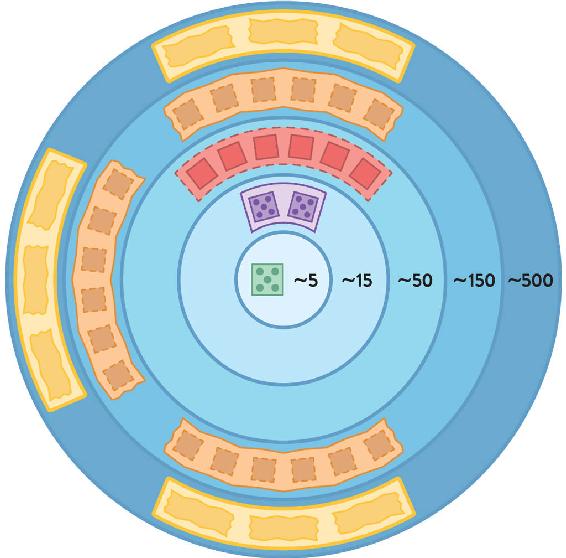
Organizations can be composed from Dunbar-compatible groupings of these sizes; when one of the limits is reached, the need to split off another unit as a semi-independent grouping arises. We can visualize this “scaling by Dunbar” as concentric circles of increasingly larger or smaller groups (see Figure 3.1, based on the “onion” concept from James Lewis8):
Figure 3.1: Scaling Teams Using Dunbar’s Number
Organizational groupings should follow Dunbar’s number, beginning with around five people (or eight for software teams), then increasing to around fifteen people, then fifty, then 150, then 500, and so on.
In the context of products and services enabled by software systems, the limits exposed by Dunbar’s number mean that the number of people in different business lines or streams of work should also explicitly be limited when the number of people in a department exceeds fifty (or 150, or 500), the internal and external dynamics with other groupings will change. This, in turn, means that the software architecture needs to be realigned with the new team groupings so that teams can continue to own the architecture effectively. This is an example of what we like to call “team-first architecture,” which requires a substantially new way of thinking for many organizations; but companies like Amazon (with its “two-pizza” rule) have proven it can be a highly successful and scalable approach.9
TIP
Team-first software architecture is driven by Dunbar’s number.
Expect to change the architecture of software systems to fit with the limits on human interactions set by Dunbar’s number. Approaches like microservices can help if applied with a team-first perspective.
Work Flows to Long-Lived Teams
Teams take time to form and be effective. Typically, a team can take from two weeks to three months or more to become a cohesive unit. When (or if) a team reaches that special state, it can be many times more effective than individuals alone. If it takes three months for a team to become highly effective, we need to provide stability around and within the team to allow them to reach that level.
There is little value in reassigning people to different teams after a six-month project where the team has just begun to perform well. As Fred Brooks points out in his classic book The Mythical Man-Month, adding new people to a team doesn’t immediately increase its capacity (this became known as Brooks’s law).10 In fact, it quite possibly reduces capacity during an initial stage. There’s a ramp-up period necessary to bring people up to speed, but the communication lines inside the team also increase significantly with every new member. Not only that, but there is an emotional adaptation required both from new and old team members in order to understand and accommodate each other’s points of view and work habits (the “storming” stage of Tuckman’s team-development model).11
The best approach to team lifespans is to keep the team stable and “flow the work to the team,” as Allan Kelly says in his 2018 book Project Myopia.12 Teams should be stable but not static, changing only occasionally and when necessary.
In high-trust organizations, people may change teams once a year without major detrimental effects on team performance. For example, at cloud software specialist Pivotal, “an engineer would switch teams about every 9 to 12 months.”13 In typical organizations with lower levels of trust, people should remain in the same team for longer (perhaps eighteen months or two years), and the team should be given coaching to improve and sustain team cohesion.
NOTE
Beyond the Tuckman Teal Performance Model
The Tuckman model describes how teams perform in four stages:
However, in recent years, research by people like Pamela Knight has found that this model is not quite accurate, and that storming actually takes places continually throughout the life of the team.14 Organizations should continually nurture team dynamics to maintain high performance.
The Team Owns the Software
With small, long-lived teams in place, we can begin to improve the ownership of software. Team ownership helps to provide the vital “continuity of care” that modern systems need in order to retain their operability and stay fit for purpose. Team ownership also enables a team to think in multiple “horizons”—from exploration stages to exploitation and execution—to better care for software and its viability. As Jez Humble, Joanne Molesky, and Barry O’Reilly put it in their book Lean Enterprise,15 Horizon 1 covers the immediate future with products and services that will deliver results the same year; Horizon 2 covers the next few periods, with an expanding reach of the products and services; and Horizon 3 covers many months ahead, where experimentation is needed to assess market fit and suitability of new services, products, and features.
The danger of allowing multiple teams to change the same system or subsystem is that no one owns either the changes made or the resulting mess. However, when a single team owns the system or subsystem, and the team has the autonomy to plan their own work, then that team can make sensible decisions about short-term fixes with the knowledge that they will be removing any dirty fixes in the next few weeks. Awareness of and ownership over these different time horizons helps a team care for the code more effectively.
Every part of the software system needs to be owned by exactly one team. This means there should be no shared ownership of components, libraries, or code. Teams may use shared services at runtime, but every running service, application, or subsystem is owned by only one team. Outside teams may submit pull requests or suggestions for change to the owning team, but they cannot make changes themselves. The owning team may even trust another team so much that they grant them access to the code for a period of time, but only the original team retains ownership.
Note that team ownership of code should not be a territorial thing. The team takes responsibility for the code and cares for it, but individual team members should not feel like the code is theirs to the exclusion of others. Instead, teams should view themselves as stewards or caretakers as opposed to private owners. Think of code as gardening, not policing.
Team Members Need a Team-First Mindset
The team should be the fundamental means of delivery rather than the individual. If we follow this team-first approach, we need to ensure that the people within our teams also have (or develop) a team-first mindset. This may be unfamiliar to some people, but with the right coaching and time to learn, many people adapt.
For teams to work, team members should put the needs of the team above their own. They should:
However, even with coaching, some people are unsuitable to work on teams or are unwilling to put team needs above their own. Such people can destroy teamwork and, in extreme cases, destroy teams. These people are “team toxic” and need to be removed before damage is done. There is a good amount of research in this area. For example, one study found that “collectively oriented team members were more likely to attend to the task inputs of other team members and to improve their performance during team interaction than egocentric team members.”16
Embrace Diversity in Teams
In the context of rapidly changing requirements and technologies, teams must continuously find novel and creative ways to address the challenges placed upon them and to communicate effectively with other teams. Recent research in both civilian and military contexts strongly suggests that teams with members of diverse backgrounds tend to produce more creative solutions more rapidly and tend to be better at empathizing with other teams’ needs.17
This diverse mix of people also appears to foster better results, as team members make fewer assumptions about the context and needs of their software users. Tom DeMarco and Timothy Lister, authors of the influential book Peopleware, observe that “a little bit of heterogeneity can be an enormous aid to create a jelled team.”18 In the context of discovering new possibilities, having a variety of viewpoints and experiences helps teams traverse the landscape of solutions much more rapidly. As Naomi Stanford, author of Guide to Organisation Design, puts it: “people and organizations benefit from a diverse workforce where differences spark positive energy.”19
Reward the Whole Team, Not Individuals
W. Edwards Deming, author of Out of the Crisis and a pivotal figure in the Lean manufacturing movement, identified one of his key fourteen points for management as “abolishment of the annual or merit rating and of management by objective.”20 Looking to reward individual performance in modern organizations tends to drive poor results and damages staff behavior. One particularly insidious usage of individual bonuses is when companies use it to leverage their end-of-year profitability. Outstanding individual efforts might receive limited or no bonuses because of a crisis year. This increases the misalignment between the individual’s merits and the bonus they actually receive, leading to frustration and demotivation.
With a team-first approach, the whole team is rewarded for their combined effort. One of the defining features of work at technology company Nokia during its hugely successful years in the 1990s and 2000s was: “Pay differences across the organization were muted. Bonuses were small and typically paid on a team basis and on overall company performance, not individually.”21
The same can be applied to training budgets. With a team-first approach, the whole team rather than each individual gets a single training budget. If the team wants to send the same person to six or seven conferences during the year because they are so good at reporting back to the team, that should be the team’s decision.
Good Boundaries Minimize Cognitive Load
Having established the team as the fundamental means of delivery, organizations also need to ensure that the cognitive load on a team is not too high. A team working with software systems that require too high of a cognitive load cannot effectively own or safely evolve the software. In this section, we will identify ways in which the cognitive load on teams can be detected and limited in order to safely promote fast flow of change.
Restrict Team Responsibilities to Match Team Cognitive Load
One of the least acknowledged factors that increases friction in modern software delivery is the ever-increasing size and complexity of codebases that teams have to work with. This creates an unbounded cognitive load on teams.
Cognitive load also applies to teams that do less coding and more execution of tasks, like a traditional operations or infrastructure team. They can also suffer from excessive cognitive load in terms of domains of responsibility, number of applications they need to operate, and tools they need to manage.
With a team-first approach, the team’s responsibilities are matched to the cognitive load that the team can handle. The positive ripple effect of this can change how teams are designed and how they interact with each other across an organization.
For software-delivery teams, a team-first approach to cognitive load means limiting the size of the software system that a team is expected to work with; that is, organizations should not allow a software subsystem to grow beyond the cognitive load of the team responsible for the software. This has strong and quite radical implications for the shape and architecture of software systems, as we shall see later in the book.
Cognitive load was characterized in 1988 by psychologist John Sweller as “the total amount of mental effort being used in the working memory.”22 Sweller defines three different kinds of cognitive load:
For example, the intrinsic cognitive load for a web application developer could be the knowledge of the computer language being used (on top of the fundamentals of programming), the extraneous cognitive load might be details of the commands needed to instantiate a dynamic testing environment (which needs multiple hard-to-remember console commands), and the germane cognitive load could be the specific aspects of the business domain that the application developer is programming (such as an invoicing system or a video-processing algorithm). Jo Pearce’s work on cognitive load in the context of software development provides numerous additional examples.23
Broadly speaking, for effective delivery and operations of modern software systems, organizations should attempt to minimize intrinsic cognitive load (through training, good choice of technologies, hiring, pair programming, etc.) and eliminate extraneous cognitive load altogether (boring or superfluous tasks or commands that add little value to retain in the working memory and can often be automated away), leaving more space for germane cognitive load (which is where the “value add” thinking lies).
As we have seen earlier in this chapter, there is an effective maximum size of seven to nine members for a team building and running software systems (see Figure 3.1 on page 34), so it follows that there is a maximum amount of cognitive load that a certain team can deal with. Many organizations do not consider the cognitive load on teams when assigning responsibility for parts of a software system, instead assuming that by adding more teams to the problem, the cognitive load will be shared across the teams. Instead, the teams will suffer from similar communication and interaction strains as mentioned in Brooks’s law.
If we stress the team by giving it responsibility for part of the system that is beyond its cognitive load capacity, it ceases to act like a high-performing unit and starts to behave like a loosely associated group of individuals, each trying to accomplish their individual tasks without the space to consider if those are in the team’s best interest.
Limiting the cognitive load for a team means limiting the size of the subsystem or area on which the team works, a tactic suggested by Driskell and colleagues in their research paper: “For those settings in which effective teamwork is critical, it may be necessary to structure the task to make it less demanding (i.e., by delegating subtasks), so that attention can be maintained on essential task and teamwork cues.24
At the same time, the team needs the space to continuously try to reduce the amount of intrinsic and extraneous load they currently have to deal with (via training, practice, automation, and any other useful techniques).
Measure the Cognitive Load Using Relative Domain Complexity
A simple and quick way to assess cognitive load is to ask the team, in a non-judgmental way: “Do you feel like you’re effective and able to respond in a timely fashion to the work you are asked to do?”
While not an accurate measure, the answer will help gauge whether teams are feeling overloaded. If the answer is clearly negative, organizations can apply some heuristics to understand if and why cognitive load is too high. If it is, the organization needs to take the necessary steps to reduce cognitive load, thus ensuring that the team is able to be effective and proactive again. Incidentally, this will increase motivational levels within the team as members see more value and purpose in their work.
Trying to determine the cognitive load of software using simple measures such as lines of code, number of modules, classes, or methods is misguided. Computer researcher Graylin Jay and colleagues found in 2009 that some programming languages are more verbose than others (and after the emergence of microservices, polyglot systems became increasingly more common), and teams using more abstractions and reusing code will have smaller but not necessarily simpler codebases.25
When measuring cognitive load, what we really care about is the domain complexity—how complex is the problem that we’re trying to solve with software? A domain is a more largely applicable concept than software size. For example, running and evolving a toolchain to support continuous delivery typically requires a fair amount of tool integration and testing. Some automation code will be needed, but orders of magnitude less than the code needed for building a customer-facing application. Domains help us think across the board and use common heuristics.
While there is no formula for cognitive load, we can assess the number and relative complexity (internal to the organization) of domains for which a given team is responsible. The Engineering Productivity team at OutSystems that we mentioned in Chapter 1 realized that the different domains they were responsible for (build and continuous integration, continuous delivery, test automation, and infrastructure automation) had caused them to become overloaded. The team was constantly faced with too much work and context switching prevailed, with tasks coming in from different product areas simultaneously. There was a general sense in the team that they lacked sufficient domain knowledge, but they had no time to invest in acquiring it. In fact, most of their cognitive load was extraneous, leaving very little capacity for value-add intrinsic or germane cognitive load.
The team made a bold decision to split into microteams, each responsible for a single domain/product area: IDE productivity, platform-server productivity, and infrastructure automation. The two productivity microteams were aligned (and colocated) with the respective product areas (IDE and platform server). Changes that overlapped domains were infrequent; therefore, the previous single-team model was optimizing for the exceptions rather than the rule. With the new structure, the teams collaborated closely (even creating temporary microteams when necessary) on cross-domain issues that required a period of solution discovery but not as a permanent structure.
After only a few months, the results were above their best expectations. Motivation went up as each microteam could now focus on mastering a single domain (plus they didn’t have a lead anymore, empowering team decisions). The mission for each team was clear, with less context switching and frequent intra-team communication (thanks to a single shared purpose rather than a collection of purposes). Overall, the flow and quality of the work (in terms of fitness of the solutions for product teams) increased significantly.
Limit the Number and Type of Domains per Team
To be clear, there is no final answer for “Is this the right number and type of domain for this team?” Domains are not static and neither is the team’s cognitive capacity. But the reasoning around relative domain complexity can help shape teams’ responsibilities and boundaries. When in doubt about the complexity of a domain, always prioritize how the responsible team feels about it. Downplaying the complexity (e.g., “There are plenty of tools for continuous delivery—it’s not difficult.”) in order to “fit in” more domains with a single team will only lead to failure.
To get started, identify distinct domains that each team has to deal with, and classify these domains into simple (most of the work has a clear path of action), complicated (changes need to be analyzed and might require a few iterations on the solution to get it right), or complex (solutions require a lot of experimentation and discovery). You should finetune the resulting classification by comparing pairs of domains across teams: How does domain A stack against domain B? Do they have similar complexity or is one clearly more complex than the other? Does the current domain classification reflect that?
The first heuristic is to assign each domain to a single team. If a domain is too large for a team, instead of splitting responsibilities of a single domain to multiple teams, first split the domain into subdomains and then assign each new subdomain to a single team. (See Chapter 6 for more help on how to break down large domains.)
The second heuristic is that a single team (considering the golden seven-to-nine team size) should be able to accommodate two to three “simple” domains. Because such domains are quite procedural, the cost of context switching between domains is more bearable, as responses are more mechanical. In this context, a simple domain for a team might be an older software system that has only minor, occasional, straightforward changes. However, there is a risk here of diminishing team members’ motivation due to the more routine nature of their work.
The third heuristic is that a team responsible for a complex domain should not have any more domains assigned to them—not even a simple one. This is due to the cost of disrupting the flow of work (solving complex problems takes time and focus) and prioritization (there will be a tendency to resolve the simple, predictable problems as soon as they come in, causing further delays in the resolution of complex problems, which are often the most important for the business).
The last heuristic is to avoid a single team responsible for two complicated domains. This might seem feasible with a larger team of eight or nine people, but in practice, the team will behave as two subteams (one for each domain), yet everyone will be expected to know about both domains, which increases cognitive load and cost of coordination. Instead, it’s best to split the team into two separate teams of five people (by recruiting one or two more team members), so they can each be more focused and autonomous. (See Figure 3.2 on page 44.)