1 | The Problem with Org Charts |
Organizations should be viewed as complex and adaptive organisms rather than mechanistic and linear systems.
—Naomi Stanford, Guide to Organisation Design
Technology workers are in a constant state of action: creating and updating systems at an unbelievable rate, and combining different types of technology to create a compelling user experience. Mobile applications; cloud-based services; web applications; and embedded, wearable, or industrial IoT devices all need to interoperate effectively to achieve the desired business outcomes.
Today, these systems affect nearly every aspect of people’s day-to-day lives in ways that are increasingly profound. If software is poorly designed—or more importantly, if there is a mismatch in the interaction of the software, the provider, and the customer—people will be adversely affected. They can be stranded long distances from home if a taxi-hailing application fails. They may be unable to pay rent if the software or processes for internet banking fail. They may even see their life in danger if a medical device fails. Never before has explicit sociotechnical design been so important.
Building and running these highly complex, interconnected software systems is a team activity, requiring the combined efforts of people with different skills across different platforms. In addition, modern IT organizations must deliver and operate software systems rapidly and safely, while simultaneously growing and adapting to changes and pressures in the business or regulatory environment. Businesses can no longer choose between optimizing for stability and optimizing for speed.
But despite these risks and demands, many organizations are still organizing their people and teams in ways that are counterproductive to modern software development and operations. Organizations that rely too heavily on org charts and matrixes to split and control work often fail to create the necessary conditions to embrace innovation while still delivering at a fast pace. In order to succeed at that, organizations need stable teams and effective team patterns and interactions. They need to invest in empowered, skilled teams as the foundation for agility and adaptability. To stay alive in ever more competitive markets, organizations need teams and people who are able to sense when context changes and evolve accordingly.
The good news is that it is possible to be fast and safe with the right mindset and with tools that emphasize adaptability as well as repeatability, while putting teams and people at the center. As Mark Schwartz and co-authors put it in their 2016 paper Thinking Environments, “the organizational structure must coordinate accountabilities to support the goals of delivering high-quality, impactful software.”1
As members of the technology teams managing these interfaces, we must shift our thinking from treating teams as collections of interchangeable individuals that will succeed as long as they follow the “right” process and use the “right” tools, to treating people and technology as a single human/computer carbon/silicon sociotechnical ecosystem. At the same time, we need to ensure that teams are intrinsically motivated and are given a real chance of doing their best work within such a system.
This chapter will introduce Team Topologies as an adaptive model for technology organization design allowing businesses to achieve speed and stability. But first, let’s look at how real communication structures in most organizations are often quite distinct from what the org chart tells us, and what the implications of that are.
Communication Structures of an Organization
Most organizations want or are required to have a single view of their teams and people called the “org chart.” This chart depicts the teams, departments, units, and other organizational entities, as well as how they relate to each other. It usually shows hierarchical lines of reporting, which imply lines of communication running “up and down” the organization.
The org chart does have its uses in the context of building software systems, specifically around regulatory and legal compliance. However, in a highly collaborative context filled with uncertainty over outcomes, relying on the org chart as a principal mechanism of splitting the work to be done leads to unrealistic expectations. We need to rely instead on decoupled, long-lived teams that can collaborate effectively to meet the challenge of balancing speed and safety.
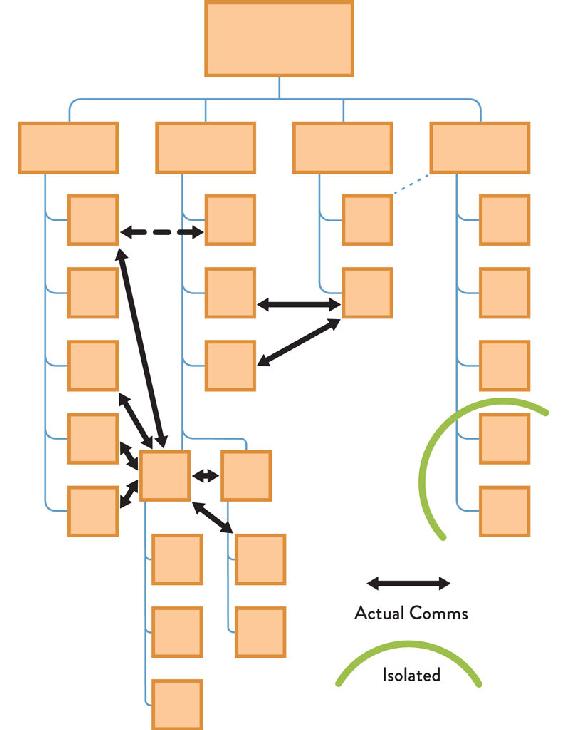
The problem with taking the org chart at face value is that we end up trying to architect people as if they were software, neatly keeping their communication within the accepted lines. But people don’t restrict their communications only to those connected lines on the chart. We reach out to whomever we depend on to get work done. We bend the rules when required to achieve our goals. That’s why actual communication lines look quite different from the org chart, as shown in Figure 1.1 (see page 6).
Figure 1.1: Org Chart with Actual Lines of Communication
In practice, people communicate laterally or “horizontally” with people from other reporting lines in order to get work done. This creativity and problem solving needs to be nurtured for the benefit of the organization, not restricted to optimize for top-down/bottom-up communication and reporting.
Org Chart Thinking Is the Problem
Traditional org charts don’t help us understand what the actual patterns of communication in our organization are, as illustrated in Figure 1.1. Instead, organizations need to develop more realistic pictures of the expected and actual communication happening between individuals and teams. The gaps will help inform what types of systems are a better fit for the organization.
Furthermore, decisions based on org-chart structure tend to optimize for only part of the organization, ignoring upstream and downstream effects. Local optimizations help the teams directly involved, but they don’t necessarily help improve the overall delivery of value to customers. Their impact might be negligent if there are larger bottlenecks in the stream of work. For example, having teams adopting cloud and infrastructure-as-code can reduce the time to provision new infrastructure from weeks or months to minutes or hours. But if every change requires deployment (to production) approval from a board that meets once a week, then delivery speed will remain weekly at best.
Systems thinking focuses on optimizing for the whole, looking at the overall flow of work, identifying what the largest bottleneck is today, and eliminating it. Then repeat. Team Topologies focuses on how to set up dynamic team structures and interaction modes that can help teams adapt quickly to new conditions, and achieve fast and safe software delivery. This might not be your largest bottleneck today, but eventually, you will face the issue of rigid team structures with poor communication and/or inadequate processes, slowing down delivery.
Thinking of the org chart as a faithful representation of how work gets done and how teams interact with each other leads to ineffective decisions around allocation of work and responsibilities. Much like a software architecture document gets outdated as soon as the actual software development starts, an org chart is always out of sync with reality.
Naturally, we are by no means the first to acknowledge the imbalance between formal organization structures and the way work actually gets done. Geary Rummler and Alan Brache’s book Improving Performance: How to Manage the White Space on the Organization Chart set the stage for continuous business process improvement and management. The recent focus (at least within IT) on product and team centricity, as illustrated by Mik Kersten’s book on moving from Project to Product, is another major milestone. We like to think that Team Topologies is another piece of this puzzle—in particular, having clear and fluid team structures, responsibilities, and interaction modes.
Beyond the Org Chart
So if org charts are not an accurate representation of organizational structures, what is? Niels Pflaeging, author of Organize for Complexity, identifies not one but three different organizational structures in every organization:2
Pflaeging suggests that the key to successful knowledge work organizations is in the interactions between the informal structure and the value creation structure (that is, the interactions between people and teams).3 Other authors have proposed similar characterizations, such as Frédéric Laloux in Reinventing Organizations or Brian Robertson’s Holacracy approach.4
The Team Topologies approach acknowledges the importance of informal and value creation structures as defined by Pflaeging. By empowering teams, and treating them as fundamental building blocks, individuals inside those teams move closer together to act as a team rather than just a group of people. On the other hand, by explicitly agreeing on interaction modes with other teams, expectations on behaviors become clearer and inter-team trust grows.
Over the last several decades, there have been many new approaches to organizing businesses, but usually the new design remains a static view of the organization that does not take into consideration the real behaviors and structures that emerge after reorganization. For instance, the “matrix management” approach that started in the 1990s—and became quite popular over the next couple of decades—tried to address the inherent complexity of highly uncertain, highly skilled work by having individuals report to both business and functional managers. Despite a clearer focus on business value compared to a purely functional organization of teams, this is still a static view of the world that becomes outdated as the business and technology domains quickly evolve.
For workers, re-orgs, like introducing matrix management, can bring a lot of fear and worry. Often, it’s seen as a time and effort drain that is more likely to set the business back rather than move it forward. And once the next technological or methodological revolution hits, the business undertakes yet another re-org, breaking down established forms of communication and splitting up teams that were just starting to get their mojo.
The Team Topologies approach adds the dynamic and sensing aspects required for technology organizations that are missing from traditional organization design.
It is increasingly clear that relying on a single, static organizational structure, like the org chart or matrix management, is untenable for effective outcomes with modern software systems. Instead of a single structure, what is needed is a model that is adaptable to the current situation—one that takes into consideration how teams grow and interact with each other. Team Topologies provides the (r)evolutionary approach required to keep teams, processes, and technology aligned for all kinds of organizations.
In her excellent 2015 book, Guide to Organisation Design: Creating High-Performing and Adaptable Enterprises, Naomi Stanford lists five rules of thumb for designing organizations:5
As we continue to move through this book, we will explore how to address these five heuristics for organization design.
Team Topologies: A New Way of Thinking about Teams
The Team Topologies approach brings new thinking around effective team structures for enterprise software delivery. It provides a consistent, actionable guide for evolving team design to continuously cope with technology, people, and business changes, covering size, shape, placement, responsibilities, boundaries, and interaction of teams building and running modern software systems.
Team Topologies provides four fundamental team types—stream-aligned, platform, enabling, and complicated-subsystem—and three core team interaction modes—collaboration, X-as-a-Service, and facilitating. Together with awareness of Conway’s law, team cognitive load, and how to become a sensing organization, Team Topologies results in an effective and humanistic approach to building and running software systems.
In particular, it looks at ways in which different team topologies can evolve with technological and organizational maturity. Periods of technical and product discovery typically require a highly collaborative environment (with overlapping team boundaries) to succeed. But keeping the same structures when discovery is over (established technologies and product) can lead to wasted effort and misunderstandings.
By emphasizing an adaptive model for organization design and actively prioritizing the interrelationship of teams, the Team Topologies approach provides a key technology-agnostic mechanism for modern software-intensive enterprises to sense when a change in strategy is required (either from a business or technology viewpoint). The end goal is to help teams produce software that aligns with customer needs and is easier to build, run, and own.
Team Topologies also emphasizes a humanistic approach to designing and building software systems. It sees the team as an indivisible element of software delivery and acknowledges that teams have a finite cognitive capacity that needs to be respected. Together with the dynamic team design solidly grounded on Conway’s law, Team Topologies becomes a strategic tool for solution discovery.
The Revival of Conway’s Law
We’ve mentioned the importance of Conway’s law as a driver for team design and evolution. But what is this law exactly?
In 1968, the computer systems researcher Mel Conway published a paper in Datamation called “How Do Committees Invent?” in which he explored the relationship between organizational structure and the resulting design of systems. The article is full of sparkling insights, some of which we cover later in this chapter, but this is the phrase that became known as Conway’s law: “Organizations which design systems . . . are constrained to produce designs which are copies of the communication structures of these organizations.”6
Conway based his observation on organizations building early electronic computer systems. In his words, this “law” indicates the strong correlation between an organization’s real communication paths (the value creation structures mentioned by Pflaeging) and the resulting software architecture,7 or what author Allan Kelly calls the “homomorphic force.”8 This homomorphic force tends to make things the same shape between the software architecture and team structures. In other words, building software requires an understanding of communication across teams in order to realistically consider what kind of software architectures are feasible. If the desired theoretical system architecture does not fit the organizational model, then one of the two will need to change.
Eric Raymond stated this in a humorous way in his book The New Hacker’s Dictionary: “If you have four groups working on a compiler, you’ll get a 4-pass compiler.”9
Since 1968, it has become increasingly clear that Conway’s law continues to apply to all software built. Those of us who have built software systems that had to comply with an “architecture blueprint” can surely remember having times when it felt like we were fighting against the architecture rather than it helping steer our work in the right direction. Well, that’s Conway’s law in action.
Team structures must match the required software architecture or risk producing unintended designs.
A sort of “revival” of Conway’s law took place around 2015, when microservices architectures were on the rise. In particular, James Lewis, Technical Director at Thoughtworks, and others came up with the idea of applying an “inverse Conway maneuver” (or reverse Conway maneuver), whereby an organization focuses on organizing team structures to match the architecture they want the system to exhibit rather than expecting teams to follow a mandated architecture design.10
The key takeaway here is that thinking of software architecture as a standalone concept that can be designed in isolation and then implemented by any group of teams is fundamentally wrong. This gap between architecture and team structures is visible across all types of architectures, from client-server to SOA and even microservices. Specifically, that is why monoliths need to be broken down (in particular, any indivisible software part that exceeds the cognitive capacity of any one team) while keeping a team focus, a topic we will discuss in depth in Chapter 6.
Cognitive Load and Bottlenecks
When we talk about cognitive load, it’s easy to understand that any one person has a limit on how much information they can hold in their brains at any given moment. The same happens for any one team by simply adding up all the team members’ cognitive capacities.
However, we hardly ever discuss cognitive load when assigning responsibilities or software parts to a given team. Perhaps because it’s hard to quantify both the available capacity and what the cognitive load will be. Or perhaps because the team is expected to adapt to what it’s being asked to do, no questions asked.
When cognitive load isn’t considered, teams are spread thin trying to cover an excessive amount of responsibilities and domains. Such a team lacks bandwidth to pursue mastery of their trade and struggles with the costs of switching contexts.
Miguel Antunes, R&D Principle Software Engineer at OutSystems, a low-code platform vendor, relayed an example of this very challenge. Their Engineering Productivity team at OutSystems was five years old. The team’s mission was to help product teams run their builds efficiently, maintain infrastructure, and improve test execution. The team kept growing and took on extra responsibilities around continuous integration (CI), continuous delivery (CD), and infrastructure automation.
Victims of their own success, sprint planning for the now eight-person-strong team was a mix and match of requests across their stack of responsibilities. Prioritization was hard, and the frequent context switching even throughout a single sprint led to a dip in people’s motivation. This is not surprising if we consider Dan Pink’s three elements of intrinsic motivation: autonomy (quashed by constant juggling of requests and priorities from multiple teams), mastery (“jack of all trades, master of none”), and purpose (too many domains of responsibility).11
While the team in this industry example was providing internal services to development teams, the effect is the same for teams working on software for external customers. The number of services and components for which a product team is responsible (in other words, the demand on the team) typically keeps growing over time. However, the development of new services is often planned as if the team had full-time availability and zero cognitive load to start with. This neglect is problematic because the team is still required to fix and enhance existing services. Ultimately, the team becomes a delivery bottleneck, as their cognitive capacity has been largely exceeded, leading to delays, quality issues, and often, a decrease in team members’ motivation.
We need to put the team first, advocating for restricting their cognitive loads. Explicitly thinking about cognitive load can be a powerful tool for deciding on team size, assigning responsibilities, and establishing boundaries with other teams. (We will cover this in detail in Chapter 3.)
Overall, the Team Topologies approach advocates for organization design that optimizes for flow of change and feedback from running systems. This requires restricting cognitive load on teams and explicitly designing the intercommunications between them to help produce the software-systems architecture that we need (based on Conway’s law).
Summary: Rethink Team Structures, Purpose, and Interactions
Developing and operating software effectively for modern, interconnected systems and services requires organizations to consider many different dimensions. Historically, most organizations have seen software development as a kind of manufacturing to be completed by separate individuals arranged into functional specialties, with large projects planned up front and with little consideration for sociotechnical dynamics. This led to the prevailing problems depicted in Figure 1.2 on page 12.
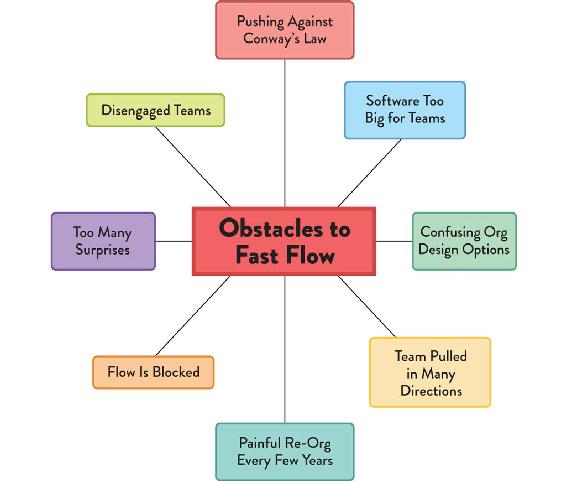
Figure 1.2: Obstacles to Fast Flow
The Agile, Lean IT, and DevOps movements helped demonstrate the enormous value of smaller, more autonomous teams that were aligned to the flow of business, developing and releasing in small, iterative cycles, and course correcting based on feedback from users. Lean IT and DevOps also encouraged big strides in telemetry and metrics tooling for both systems and teams, helping people building and running software to make proactive, early decisions based on past trends, rather than simply responding to incidents and problems as they arose.
However, traditional organizations have often been limited in their ability to fully reap the benefits of Agile, Lean IT, and DevOps due to their organizational models. It’s no surprise that there is a strong focus on the more immediate automation and tooling adoption, while cultural and organizational changes are haphazardly addressed. The latter changes are much harder to visualize, let alone to measure their effectiveness. Yet having the right team structure, approach, and interaction in place, and understanding their need to evolve over time is a key differentiator for success in the long run.
In particular, traditional org charts are out of sync with this new reality of frequent (re)shaping of teams for collaborative knowledge work in environments filled with uncertainty and novelty. Instead, we need to take advantage of Conway’s law (organizational design prevails over software architecture design), cognitive load restrictions, and a team-first approach in order to design teams with clear purposes and promote team interactions that prioritize flow of software delivery and strategic adaptability.
The goal of Team Topologies is to give you the approach and mental tools to enable your organization to adapt and dynamically find the places and timing when collaboration is needed, as well as when it is best to focus on execution and reduce communication overhead.
NOTE
We found a fascinating example of strategic and collaborative interaction in a totally different field when researching for this book. It turns out that grouper fish and moray eels, seemingly unrelated species (silos, anyone?), explicitly collaborate (via signals) to hunt down smaller fishes that hide in crevices. The eel sneaks into the crevices and scares off smaller fish, which are then forced to come out and become easy prey for the grouper. Read on to find out how to enable the groupers and eels in your organization to join forces for better flow and business outcomes!