7 | Team Interaction Modes |
Technologies and organizations should be redesigned to intermittently isolate people from each other’s work for best collective performance in solving complex problems.
—Ethan Bernstein, Jesse Shore, and David Lazer, “How Intermittent Breaks in Interaction Improve Collective Intelligence”
In Part II, we saw how combinations of the four fundamental team topologies—stream aligned, enabling, complicated subsystem, and platform—provide a clear pattern for software delivery with fast flow. However, simply arranging teams into patterns is not enough for high effectiveness; it is also necessary to identify how these teams interact and when to change the teams and their interactions.
Part III will look at how the evolution of team interactions can become a strategic advantage for organizations building software systems. Through a combination of well-defined team interaction patterns and clear heuristics for evolving team topologies, organizations can use team interactions as a sensing mechanism for innovation and self-steering toward better customer or user outcomes.
So far, we have seen several static (point-in-time) team topologies that work well for different scenarios, along with some guidelines for choosing sensible team boundaries. However, it is not sufficient to simply choose a team boundary a single time and expect no further changes; instead, organizations must anticipate the need for evolution of team patterns to meet business, organizational, market, technological, and personnel needs.
As teams gain more experience in one area, new technology becomes available, or the organization expands and contracts in size, the dynamics between teams and economics (particularly the economies of scale) change, and the choice of team topologies can help facilitate that change. In some cases, the same two teams might need to collaborate closely at some point in time but be independent six or nine months later in order to achieve the most effective software delivery outcomes. The team topologies used should adapt and evolve to meet emerging challenges, while still retaining the key team-focused and architectural considerations encountered in Part I.
In this chapter, we explore three core team interaction modes that simplify and clarify the essential interactions needed between teams building software systems: collaboration, X-as-a-Service, and facilitating. These team interaction modes define expectations and behavior patterns for all teams in the organization, simplifying team interactions and acting as a way to detect misaligned boundaries.
We will also explore some essential team interaction modes that should guide choice of evolution for team topologies. The dynamics behind team interaction modes act as the foundation for choosing team topologies effectively. Crucially, using a well-defined set of team interaction patterns avoids the ambiguity present in many team-software relationships, thereby producing more coherent subsystem boundaries and APIs.
Well-Defined Interactions Are Key to Effective Teams
In many organizations, poorly defined team interactions and responsibilities are a source of friction and ineffectiveness. A team may have been told it is autonomous and self-organizing, but team members find they have to interact with many other teams in order to complete their work; and this feels frustrating. Another team may have responsibility for providing an API or service, but they don’t really have the experience to do this effectively.
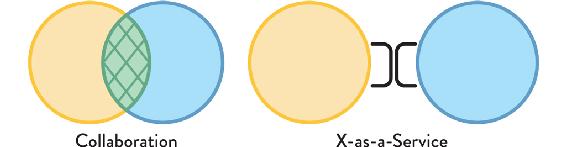
When considering the relationship between any teams, a key decision is whether to collaborate with another team to achieve an objective or to treat the other team as providing a service (see Figure 7.1 on page 133).This choice between collaboration or consuming a service can be made at many different levels within the organization: consuming infrastructure as a service (from AWS, Azure, or Google Cloud, for instance), collaborating on logging and metrics, relying on a complicated-subsystem team to build a complex audio-processing codec, or working together on application deployment. What must be avoided is the need for all teams to communicate with all other teams in order to achieve their ends; just as a jazz band coordinates the music it plays, we should expect to carefully curate the communication that takes place within an organization.
Figure 7.1: Collaboration vs. X-as-a-Service
Collaboration means explicitly working together on defined areas. X-as-a-Service means one team consumes something “as a service” from another team.
NOTE
Intermittent collaboration gives the best results.
Researchers recently devised an ingenious experiment to assess the effectiveness of team-based solutions to complex problems. Bernstein and colleagues found that “groups whose members interacted only intermittently . . . had an average quality of solution that was nearly identical to those groups that interacted constantly, yet they preserved enough variation to find some of the best solutions too.”1 Intermittent collaboration found better solutions than constant interaction.
The Three Essential Team Interaction Modes
To understand how and when to adapt the Team Topologies model for software systems, we need to define and understand three essential ways in which teams can and should interact, taking into account team-first dynamics and Conway’s law:
A combination of all three team interaction modes is likely needed for most medium-sized and large enterprises (and these modes are useful to introduce at smaller organizations sooner than many people expect). In addition, one team might use two different interaction modes for two different teams with which it works. We represent these different interaction modes graphically using the patterns in Figure 7.2:

Figure 7.2: The Three Team Interaction Modes
Collaboration mode is shown with diagonal cross-hatching, X-as-a-Service mode is shown with brackets, and facilitating is shown with dots.
For example, let’s say Team A is a stream-aligned team working on software for managing personal finances. They may use the collaboration mode to interact with Team B on new cloud-monitoring tooling, and use the X-as-a-Service mode to interact with Team C, which provides the platform on which the software runs (see Figure 7.3 on page 135).