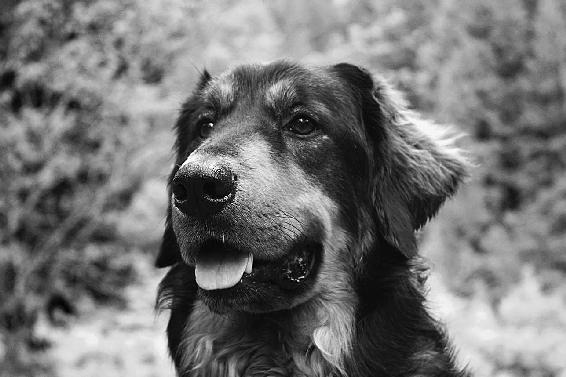
I don’t have a dog, but several friends’ dogs are part of my extended family. One of my favorites is Rowdy, part Golden Retriever and part Bernese Mountain Dog, who is an energetic, playful mutt, always ready for action. True to his name, Rowdy is a barker and a jumper, and he’s known to growl when other dogs or strangers come near. In other words, he’s a dog.
Sometimes Rowdy can barely contain himself, and once this nearly proved to be his undoing. Rowdy was out for a walk with his owner, my friend Angie, when a teenage boy approached to pet him. Rowdy did not know the boy and proceeded to bark and jump up on him. The boy was not visibly hurt, so it was a surprise when a few hours later, his mother (who had not been present) had Rowdy arrested and registered as a “potentially dangerous dog.” Poor Rowdy had to be muzzled on walks for several years afterward. And if Rowdy ever again jumps up on someone, he will be registered as vicious and maybe even put down.
The boy was afraid of Rowdy and perceived him as angry and dangerous. When you encounter a dog who barks and growls, does he actually feel anger? Or is this merely territorial behavior, or an overly boisterous attempt to be friendly? In short, can dogs experience emotion?
Common sense seems to say yes, of course, Rowdy feels emotion when he growls. Numerous popular books explore the issue, like The Emotional Lives of Animals by Marc Bekoff, Animal Wise by Virginia Morell, and How Dogs Love Us by Gregory Berns, to name just a few. Dozens of news stories inform us of scientific discoveries in animal emotion: dogs get jealous, rats experience regret, crayfish feel anxiety, and even flies fear the incoming fly swatter. And of course, if you live with pets, you’ve certainly seen them behave in ways that seem emotional: running around in fear, jumping up in joy, whining in sadness, purring with love. It seems so obvious that animals experience emotions just the way we do.* Carl Safina, author of Beyond Words: What Animals Think and Feel, puts it succinctly: “So, do other animals have human emotions? Yes, they do. Do humans have animal emotions? Yes, they’re largely the same.”1
Some scientists are not so sure. They suggest that emotions in animals are just illusions: that Rowdy has brain circuits that trigger behaviors for survival but not for emotion. From their perspective, Rowdy can approach or withdraw in dominance or submission, to defend his territory or to avoid a threat. In these instances, the argument goes, Rowdy might experience pleasure, pain, arousal, or other varieties of affect, but he does not have the mental machinery to experience more than that. This latter explanation is deeply unsatisfying because it denies our own experiences. Millions of pet owners would bet money that their dogs growl in anger, droop in sadness, and hide their heads in shame. It’s hard to conceive that these perceptions are illusions built around some general affective responses.2
I myself have succumbed to the allure of animal emotions. For years, my daughter has maintained a herd of guinea pigs in her bedroom. One day, we acquired a small baby, Cupcake. Every night for the first week, all by herself in a strange pen, Cupcake sounded like she was crying. I’d carry her around in my sweater pocket, all warm and cozy, which made her chirp with happiness. Whenever I approached the cage, the other pigs would squeal and run away, but little Cupcake would sit still as if waiting for me to pick her up, and then immediately crawl into the crook of my neck for a nuzzle. In those moments, it was very hard to resist the belief that she loved me. For many months, Cupcake was my late-night companion. She would nestle in my lap, purring, as I worked at my desk. Everyone in our house suspected that Cupcake was actually a puppy trapped in a guinea pig’s body. And yet, as a scientist, I knew that my perceptions did not necessarily reveal what little Cupcake was actually feeling.
In this chapter, we’ll systematically explore what animals are capable of feeling, based on their brain circuitry and on experimental research. We’ll have to set aside our fond feelings for our pets, as well as the essentialist theory of human nature, to look carefully at the evidence. Scientists pretty much agree that many of the earth’s animals, from insects to worms to humans, share the same basic nervous system plan. They even agree, more or less, that animal brains were built according to the same general blueprint. But as anyone who has renovated a house has learned, the devil is in the details when translating a blueprint into reality. When it comes to comparing brains of different species, even if they have the same networks of regions, microscopic differences in wiring are sometimes as important as these large-scale similarities.3
The theory of constructed emotion prompts us to ask whether animals have three necessary ingredients for making emotion. The first ingredient is interoception: do animals have the neural equipment to create interoceptive sensations and experience them as affect? The second is emotion concepts: can animals learn purely mental concepts like “Fear” and “Happiness,” and if so, can they predict with these concepts to categorize their sensations and make emotions like ours? Finally, there’s social reality: can animals share emotion concepts with each other so they are passed down to the next generation?
To see what animals are capable of feeling, we’ll focus primarily on monkeys and great apes because they’re our closest evolutionary cousins. In the process, we’ll discover whether animals share the kinds of emotions that we feel . . . and the answer has an unexpected twist.
All animals regulate their body budget to stay alive, so they all must have an interoceptive network of some sort. My lab, together with neuroscientists Wim Vanduffel and Dante Mantini, set out to verify this network in macaque monkeys and were successful. (Macaques and humans shared their last common ancestor about 25 million years ago.) The macaque interoceptive network has some of the same parts as the human interoceptive network we discovered, as well as some differences. The macaque network is structured to function by prediction in the same way that the human network does.4
Macaques also likely experience affect. They can’t tell us verbally how they feel, of course, but one of my former doctoral students, Eliza Bliss-Moreau, has evidence that they show the same bodily changes in the same situations that we humans do when we feel affect. Eliza studies macaques at the California National Primate Research Center at the University of California, Davis. Her monkeys watched three hundred videos of other monkeys playing, fighting, sleeping, and so on, while Eliza tracked their eye movements and cardiovascular responses. She found that the activity in the monkeys’ autonomic nervous system mirrored what a human’s would do when viewing these videos. In humans, this nervous system activity is related to the affect they feel, suggesting that macaques experience pleasant affect when watching positive behaviors like foraging and grooming, and unpleasant affect when watching negative behaviors like cowering.5
Based on these and other clues from biology, macaques pretty definitely process interoception and feel affect, and if that’s the case, then great apes such as chimpanzees, bonobos, gorillas, and orangutans surely feel affect as well. As for mammals in general, it’s harder to say for sure. They undoubtedly feel pleasure and pain, as well as alertness and fatigue. Many mammals have circuitry that looks similar to ours but has different functions, so we can’t answer the question just by examining the wiring. No one, to my knowledge, has specifically studied the interoceptive circuitry of dogs, but it seems pretty clear from their behavior that they have an affective life. And how about birds, fish, or reptiles? We don’t know for sure. I have to admit that these questions preoccupy me as a civilian (as my husband calls me in non-scientist moments). I can’t shop for meat or eggs in a supermarket or attempt to rid my kitchen of bloody irritating fruit flies without asking myself . . . what do these creatures feel?
I think it’s best to assume all animals can experience affect. I realize this discussion has the potential to transport us from the land of science to the land of ethics, coming perilously close to moral issues such as pain and suffering in laboratory animals, creatures who are factory-farmed for food, and whether fish feel pain when a hook enters their mouth. The natural chemicals that relieve suffering within our own nervous systems, opioids, are found in fish, nematodes, snails, shrimps, crabs, and some insects. Even tiny flies might feel pain; we know that they can learn to avoid odors that are paired with electric shock.6
The eighteenth-century philosopher Jeremy Bentham thought that an animal belongs in the human moral circle only if we can prove the animal can feel pleasure or pain. I disagree. An animal is worthy of inclusion in our moral circle if there is any possibility at all that it can feel pain. Does that keep me from killing a fly? No, but I’ll make it quick.7
Macaques do have an important difference from humans where affect is concerned. Many, many objects and events in your world, from the tiniest insect to the largest mountain, cause fluctuations in your body budget and change your affective feelings. That is, you have a large affective niche. Macaques, however, don’t care about as many things as you and I do. Their affective niche is much smaller than ours; the sight of a majestic mountain rising in the distance doesn’t impact their body budget in the least. Simply put, more things matter to us.8
An affective niche is one area of life where size truly matters. In the lab, if we present a human toddler with a collection of toys, they are usually within her affective niche. My daughter, Sophia, would sort her toys by shape, by color, by size, for the sheer fun of it, over and over, statistically honing the various concepts involved. Not so with macaques. The toys alone are uninteresting and don’t impact the macaque body budget or prompt the monkeys to form concepts. We must offer the macaque a reward of some kind, like a tasty drink or treat, to bring the toys into the macaque’s affective niche so statistical learning can proceed. (Eliza tells me that favorite monkey treats include white grape juice, dried fruit, Honey Nut Cheerios, grapes, cucumbers, clementines, and popcorn.) Repeat the reward enough times and the macaque will learn similarities among the toys.
A human infant also receives rewards from his human caregivers: not just tasty treats like breast milk or formula but also the day-to-day effects of tending to his body budget. His caregivers become part of his affective niche because they feed him, keep him warm, and so on. He is born with rudimentary concepts for his mother’s scent and voice, learned in utero. In the first few weeks of life, he learns to integrate his mother’s other perceptual regularities, such as the feel of her touch and eventually the sight of her face, because she is regulating his body budget. She and other caregivers also guide the infant’s attention to things of interest in the world. He follows their gaze to an object (say, a lamp), then they look at him, then at the lamp again, and talk about what he is looking at. They say the word “lamp” to him with intent, alerting and orienting him with a “baby talk” tone of voice.9
Other primates do not share attention like this, and so they cannot use it to regulate each other’s body budgets the way that humans do. A mother macaque may follow her infant’s gaze, but she will not look back and forth from the object to the infant’s face, as if inviting her baby to wonder what is in her mind. Baby primates do learn concepts without the explicit reward of their mother’s presence, but not with the range and diversity that baby humans do.10
Why do humans and macaques have such differently sized affective niches? For starters, a macaque’s interoceptive network is less developed than a human’s, particularly the circuitry that helps control prediction error. This means a macaque is not as nimble in directing attention to stuff in the world based on past experience. More importantly, a human brain is almost five times as large as a macaque brain. We have much greater connectivity in our control network and in parts of our interoceptive network. The human brain employs this heavy-duty machinery to compress and summarize prediction error in the way we discussed in chapter 6. This allows us to integrate and process more sensory information from more sources more efficiently than a macaque can, to learn purely mental concepts. That’s why you can have majestic mountains in your affective niche and a macaque cannot.11
An interoceptive network, along with the affective niche it helps create, is not sufficient for feeling and perceiving emotions. For that, a brain must also be equipped to build a conceptual system, to construct emotion concepts, and to make sensations meaningful as emotions in themselves and others. A hypothetical macaque with the capacity for emotions must be able to look at another macaque swinging in a tree and see not only the physical movement but an instance of “Joy.”
Animals can definitely learn concepts. Monkeys, sheep, goats, cows, raccoons, hamsters, pandas, harbor seals, bottlenose dolphins, and plenty of other animals learn concepts by smell. You might not think of smell as conceptual knowledge, but each time you smell the same aroma, such as popcorn in a movie theater, you’re categorizing. The mix of chemicals in the air differs each time, and yet you perceive buttered popcorn. Similarly, most mammals use olfactory concepts to recognize friends, foes, and offspring. Many other animals learn concepts by sight or sound as well. Sheep apparently recognize one another by face (!), and goats by vocal bleats.12
In the lab, animals can learn additional concepts if you reward them with food or drink, widening their affective niche. Baboons can learn to distinguish a “B” from a “3” regardless of font, and macaques can distinguish animal images from food images. Rhesus macaques can learn the concept “Rhesus macaque” as distinct from “Japanese macaque,” even though they are the same species and differ only by color. (Does this remind you of something that humans do?) Macaques can even learn concepts to distinguish painting styles by Claude Monet, Vincent van Gogh, and Salvador Dalí.13
The concepts that animals learn will not be the same as human concepts, however. Humans construct goal-based concepts, and a macaque brain simply lacks the necessary wiring to do so. It’s the same lack of wiring that accounts for their smaller affective niche.
What about apes—can they construct goal-based concepts? Chimpanzees, our genetically closest cousins, have larger brains than macaques do, with more of the wiring necessary for integrating sensory information. A human brain is still three times as large as a chimp brain, though, with more of this critical wiring. That doesn’t rule out goal-based concepts for chimps. It’s just likely that your brain is better equipped to create purely mental concepts, such as “Wealth,” whereas a chimpanzee brain is better equipped to create concepts for actions and concrete objects, like “Eating” and “Gathering” and “Banana.”14
Apes almost certainly have concepts for physical behaviors, such as swinging from branch to branch. The big question is, can one chimp watch another chimp swinging in a tree and perceive an instance of “Joy”? That would require the observing chimp to have a purely mental concept and infer the swinging chimp’s intention, making a mental inference. Most scientists assume that mental inference is a core ability of the human mind. So a lot is at stake if apes can do it. We know that monkeys cannot; they can understand what a human is doing but not what he is thinking, desiring, or feeling.15
Where apes are concerned, it’s conceivable they could make mental inferences and construct goal-based concepts, but the scientific jury is still out. Chimps might have the prerequisites because they can create some mental similarities amid perceptual differences. For instance, they know that leopards climb trees, snakes climb trees, and monkeys climb trees. It’s conceivable that chimps could extend this concept to a new animal who can perform a similar action, such as a housecat, and predict that the cat will climb a tree. But a human concept “To Climb” is more than just an action; it’s a goal. So the real test would be whether chimps would understand that a person running up a flight of stairs, ambling up a ladder, and crawling up a rock face all share the goal “To Climb.” That mental feat would show us that chimps really can go beyond physical similarities, grouping together instances of climbing that look very different but have a shared mental goal. And if chimps could comprehend that moving up a social hierarchy is also climbing, then their concepts would be identical to our own. Human infants can accomplish such feats, as we learned in chapter 5, if they have a word to represent the concept. The next question, then, is whether great apes have the capacity to learn words and use them for learning concepts in the way that human infants do.16
Scientists have been trying to teach language to apes since the 1960s, usually with a visual symbol system such as American Sign Language because their vocal machinery is not well-adapted for human speech. Apes can learn to use hundreds of words or other symbols to refer to particular features of the world if there is a reward along the way. They can even combine symbols to communicate complex requests for food, such as “cheese eat—wanting to” and “gum hurry—wanting to have some.” Scientists still debate whether these apes understand the meanings of the symbols or are just mimicking their trainers in order to request rewards. For our purposes, the most important questions are whether great apes can learn and use words or symbols under their own steam, without an explicit reward, and whether they can build purely mental concepts like “Wealth” or “Sadness.”17
So far, we have very little evidence that apes can learn and use symbols on their own. They appear to have only one such concept that they can map to a symbol without requiring an external reward: “Food.” But when apes do learn to use a word, do they take the next step? Do they use a word as an invitation to go beyond what they see, hear, touch, and taste to infer the mental? We don’t know yet. Words certainly don’t prompt apes to search the minds of other creatures for concepts the way a human infant does. But there are intriguing possibilities. For example, it appears that chimps can categorize dissimilar-looking objects according to their function—tools, containers, food—if you reward them, and if they already have firsthand experience with the function. Moreover, if you teach and reward them to associate a symbol with a category like “Tool,” they can match the symbol to unfamiliar tools.18
Do apes use words in this way only to request rewards? Skeptics point out that apes certainly don’t use symbols or words to talk about the weather or their children; they can refer to something other than a reward, but only if a reward is waiting at the other end. (It would be interesting to observe what would happen to symbol-trained apes if their trainers stopped rewarding them. Would they continue to use the symbols?) The important point, I think, is that words don’t seem to be intrinsically part of most apes’ affective niche, as they are for typical human babies. To apes, words alone are not worth learning.19
One important exception to this story might be bonobos. They are very social creatures, far more egalitarian and cooperative than common chimps. They also have a larger social network and play longer before assuming adult roles. And some bonobos appear able to complete tasks without external rewards, whereas chimps seem to require them. Take the story of Kanzi, an infant bonobo who watched his stepmother and other adult bonobos earn food rewards for learning language-like symbols. By six months old, Kanzi appeared to be learning the symbols too, on his own, by watching other bonobos earn rewards. At a certain point, the scientists realized with careful testing that Kanzi appeared to understand some spoken English. So it is possible that a bonobo brain, immersed in a language-rich environment, can learn the meaning of concrete words.20
Chimps, in contrast to bonobos, have been characterized as charming, clever creatures with a dark side. They hunt and kill each other opportunistically to take over territory or get food. They also attack strangers for no reason, maintain a rigid dominance hierarchy, and beat females into sexual submission. Bonobos would rather work out their conflicts by having sex. That’s a much better alternative than genocide.
Nevertheless, chimps may have been given a bad rap in the lab when it comes to concept learning. Chimps in language experiments were removed from their mothers in infancy and raised in a human-like environment vastly different from their natural habitat. These infants would normally live with their mother for up to ten years and nurse with them for five, so this premature separation could have changed the wiring of each chimp’s interoceptive network and strongly influenced the results of the experiments. (Imagine separating a human infant from his mother like this!)21
When tested under more natural circumstances, a chimp’s affective niche appears to be broader than many experiments suggest. For this insight, we have to thank the primatologist Tetsuro Matsuzawa at Kyoto University’s Primate Research Institute. Matsuzawa has accomplished a truly impressive task. He has three generations of chimps who live in an outdoor compound built to look like a forest. Each day, chimps come to the lab by choice to do experiments. Sometimes they are rewarded, of course, but to emphasize this is to miss the point. These animals have a long-term, trusting relationship with Matsuzawa and the other human experimenters at the institute. A mother chimp will hold her baby on her lap and allow a human to run an experiment with her infant. For example, one study tested human and chimp infants as they learned concepts for mammals, furniture, and vehicles (using lifelike miniatures). This learning proceeded with no rewards as each infant was tested while sitting on his or her mother’s lap. The infant’s proximity to the mother, in relation to the trusting bond with the human experimenter, may have been enough to bring this situation into the chimp infant’s affective niche. Incredibly, the chimp and human infants formed concepts equally well under these conditions. Still, the human infants spontaneously manipulated the objects, like moving toy trucks around, making concept formation more likely, whereas the chimps did not.22
Matsuzawa’s troupe would be ideal for learning the limits of a chimp’s conceptual abilities. We could test infant chimps, whose conceptual systems are still malleable, in a natural environment on their mothers’ laps, perhaps conducting concept-building experiments like those in chapter 5. Would chimp infants be able to use a nonsense word like “toma” to group together objects or images that share little perceptual similarity, as human infants can?
At present, however, we have no firm evidence that chimps can form goal-based concepts. They cannot imagine something completely novel, like a flying leopard, even though they and macaques have a network that’s analogous to the human default mode network (part of the interoceptive network). They cannot consider the same situation from different points of view. They can’t imagine a future that is different from the present. They also do not realize that goal-based information resides inside the heads of other creatures. That’s why chimps and other great apes most likely cannot create goal-based concepts. When rewarded, apes can learn a word, but they cannot spontaneously use the word to form a mental concept with a goal, like “Things That Taste Good with Termites.”23
Any concept can be goal-based—recall that “Fish” can be a pet or a dinner—but emotion concepts are only goal-based, so it seems very likely that chimps cannot learn emotion concepts like “Happiness” and “Anger.” Even if they can learn an emotion word like “angry,” it’s not clear that they can understand it or use it in a goal-based way, like categorizing another creature’s actions as anger.
Sometimes apes appear to understand a purely mental concept when they do not. In one experiment, chimps earned tokens for completing tasks and could exchange them for food. They spontaneously learned to save up their tokens to exchange them for a desired treat. When you watch chimps engage in this transaction, it is tempting to infer that chimps understand the concept “Money.” But here, the token was just a tool for obtaining food, rather than a form of currency that’s exchangeable for goods in general. The chimps did not understand, as many humans do, that money comes to have value for its own sake.24
If chimps cannot form goal-based concepts, then necessarily, chimps are not naturally equipped to teach concepts to one another; that is, they don’t have social reality. Even if they could learn a concept like “Anger” from a human trainer, one generation doesn’t create the context for the next generation to bootstrap concepts into their brains. Chimps and other primates do have shared practices, like cracking nuts with rocks, but chimp mothers don’t spontaneously instruct their infants on the finer culinary points; the children learn by observation. For example, in a troop of macaques in Japan, one member began washing her food before eating it, and within ten years, three-quarters of the adults in her troop had picked up the practice. This sort of collective intentionality is very limited compared to what we humans do with words and the mental concepts that we invent.25
The human capacity for social reality appears unique in the animal kingdom. Only we can create and share purely mental concepts using words. Only we can use these concepts to more effectively regulate our own body budgets and each other’s, while we cooperate and compete with one another. Only we have concepts for mental states, such as emotion concepts, for predicting and making sense of sensations. Social reality is a human superpower.26
Which brings us back to Matsuzawa and his chimps. It is remarkable how he nestled a chimp troupe, preserving its family relationships, into human culture in an intimate way. I wonder whether, over time, Matsuzawa’s very human cultural context will influence the brain development of the infant chimps, as they are raised by mothers who are acculturated by a group of trusting, loving humans.
One example that I find particularly striking, relayed by Virginia Morell in her book Animal Wise, describes two human experimenters who provide social support to a nursing mother chimp. The mother is reluctant to nurse her infant, but the experimenters gently encourage her to be brave. In Morell’s words, “A researcher gently picks up the baby and places it in the mother’s arms. The infant’s hands latch on to her fur. The mother then attempts to nurse but cries when the baby takes her nipple; she seems about to drop her infant to the floor. But then the soft voice of the scientist is heard again. Yes, yes, he says soothingly, it may hurt at first, but soon it will not. And slowly the mother settles down, cradling her baby against her breast and letting the infant nurse.” Thousands of human mothers each day experience nursing for the first time, and I can tell you from experience that it hurts like hell. But someone else (a nurse, an older female relative, or a friend) offers supportive encouragement and shows you what to do, and eventually all is well.27
To the mother chimp, these helpful humans are not merely her caretakers: they are affectively salient to her, regulating her body budget. She and her infant and their relationship are being bathed in human culture. Will this social contact make a difference to the language and conceptual abilities of these chimps long-term? If their offspring eventually become able to form goal-based concepts, it’s a whole new ballgame.
Okay, so chimps and other primates don’t appear to have emotion concepts or social reality. How about dogs like Rowdy? After all, we have bred dogs to be human companions, so they, like us, are truly social creatures. If any non-human animals were to be capable of emotion, dogs would seem to be prime candidates.
Just a couple of decades ago, it took the Russian scientist Dimitri Belyaev only about forty generations to transform wild foxes into something that approximated domesticated dogs. Each time female foxes gave birth, Belyaev chose the fox pups who were most interested in and least aggressive toward humans and selectively bred them. The experimentally bred beasts looked like dogs; their skulls were shorter and they had wider muzzles, curly tails, and floppy ears, even though Belyaev did not select for these features. Their chemical makeup was closer to dogs than foxes. And they had a strong motivation to interact with humans. Modern dogs also have long been bred for certain desirable characteristics, like attaching to a human caregiver, and other characteristics surely have come along for the ride, perhaps even something like human emotion concepts.28
One of those inadvertently bred characteristics, I speculate, is a certain kind of dog nervous system. We can regulate a dog’s body budget, and dogs can regulate ours in turn. (I wouldn’t be surprised if dogs and their human owners even synchronize their heart rates, the way close humans do for each other.) We also probably selected for dogs with eyes that we perceive as expressive and facial muscles that move easily to serve as a canvas upon which we can paint complex mental states. We love dogs so much that we bred them to love us back, or at least to see them as loving us. We treat them as little almost-humans with four legs and a fur coat. But do dogs experience or perceive human emotion?29
Dogs, like other mammals, feel affect. No big surprise here. One way they appear to express affect is by wagging their tails. They apparently make larger tail-wagging movements to the right during pleasant events, such as seeing their owner, and to the left for unpleasant events, such as seeing an unfamiliar dog. The choice of side has been associated with brain activity: wagging to the right is said to mean relatively greater activity on the left side of the brain, and vice versa.30
Dogs also appear to look at each other’s tails to perceive affect. They’re more relaxed when they view movies of right-wagging tails and more stressed for left-wagging tails, as measured by heart rate and other factors. Dogs also appear to perceive affect in the faces and voices of humans. I haven’t come across any relevant brain-imaging experiments on dogs, but if they have affect, it stands to reason that they have some sort of interoceptive network. Just how large their affective niche is no one knows, but given their social nature, I’ll bet it is yoked to their owners in some way.31
Dogs can learn concepts too. Again, not surprising. They can distinguish dogs from other animals in photographs, for example, if trained to do so. It takes them a thousand or more trials to get the knack of it, compared to human infants who need only a few dozen trials. But dogs can learn to be accurate over 80 percent of the time, even if the dog in the photo is completely new or embedded in a complex scene. Not bad for a dog brain.32
Dogs also form olfactory concepts. They can distinguish the smell of an individual human, grouping together different smells from different parts of the body to treat as equivalent, and yet distinct from the smells of other humans. And of course, we know that dogs can be trained to track categories of objects by smell. Anyone who’s been caught in an airport with food or drugs in their suitcase can tell you so.33
I will gingerly concede that dogs appear to infer intentions of some sort. Dogs are better than chimps at perceiving human gestures and following human gaze. When Sophia was younger and would play in the sand with her favorite beach dog, Harold, the two of them often looked to a human adult for permission to run farther away: Sophia to me and Harold to his owner. Dogs use our gaze to tell them what to attend to, and their skill is so great that they seem to read our mind in our eyes. Even more remarkably, dogs follow each other’s gaze to get information about the world. When Rowdy wants to know what’s going on, he spontaneously looks to his “sister,” Biscuit, a Golden Retriever, and follows her gaze. The two of them freeze as they reference each other, and then . . . they both suddenly leap into action. It’s like watching a silent movie.34
But being the skeptic that I am, I have my doubts that dogs are making goal-based mental inferences. They could be just really good at perceiving human actions, because, let’s be honest, we’ve bred them to be sensitive to our every whim.
Dogs do appear to understand that humans use symbols to communicate intent. For example, in one study, an experimenter put dog toys in different rooms and then used miniature replicas of the toys as symbols. Her test subjects (Border Collies) understood she was asking them, via the miniature, to retrieve the matching toy from the other room. This is rather more sophisticated than playing fetch. Studies also show that dogs use different growls and barks to communicate with each other, although they might just be communicating arousal (affect) in the acoustic signal. One study even shows that a dog named Sofia, like our chimp friends, could be trained to press symbols on a keyboard to communicate a few basic concepts: a walk, toy, water, play, food, and her crate.35
Clearly, dogs have something nontrivial going on upstairs, but even so, scientists have no indication yet that dogs have emotion concepts. In fact, there’s pretty good evidence that they don’t, though many dog behaviors look emotional. Dog owners, for example, infer guilt when they believe their dog is hiding something (for example, avoiding eye contact) or is being submissive (such as drooping the ears, lying down and showing the belly, or holding the tail low). But do dogs have a concept of guilt?
A clever study investigated this question. In each trial, a dog owner offered his or her dog a desirable biscuit, then explicitly instructed the dog not to eat it and promptly left the room. Unbeknownst to the owner, however, an experimenter then entered the room and influenced the dog’s behavior, either handing the treat to the dog (who ate it) or removing the treat from the room. Afterward, the experimenter either told the owner the truth or lied. Half the owners were told that their dog had obeyed and to greet their dog in a warm and friendly manner; the rest heard that the dog had eaten the biscuit and should be scolded. This created four different scenarios: obedient dog with a friendly owner, obedient dog being scolded, disobedient dog with a friendly owner, and disobedient dog being scolded. What happened? The scolded dogs performed more behaviors that people perceive as stereotypically guilty, regardless of whether or not the dogs had disobeyed. This is evidence that dogs were not experiencing guilt at performing a forbidden act; rather, their owners were perceiving guilt when they believed the dog had eaten the biscuit.36
Another study looked at jealousy in dogs, asking owners to interact with a toy dog while the real dog watched. The toy barked, whined, and wagged its tail. The study found that dogs in this situation would snap, whine, push at the owner and the toy, and insert themselves between the owner and the toy, more often than when the owner interacted with a different toy (a jack-o-lantern) or read a book. The authors interpreted these findings to mean that the dogs were jealous, particularly because many of the dogs tested sniffed the anus of the toy dog. Unfortunately, the experimenters did not test to see if the owners were behaving differently in the three conditions (toy dog, jack-o-lantern, and reading) in any way that could account for the dogs’ behavior. They assumed that the owner’s behavior was identical, and that the dog understood that jealously was called for in only one condition. So even though many pet owners are confident that their dogs experience jealousy, we have no scientific evidence to support this belief.37
Scientists are still exploring the limits of what dogs can do, emotionally speaking. Their affective niche is broader than ours in some respects, because their senses of smell and hearing are superior; but their affective niche is narrower in other respects, because they can’t travel into the future to imagine a world other than the present one. My view, from evaluating the evidence, is that dogs don’t have human emotion concepts like anger, guilt, and jealousy. It’s conceivable that one individual dog could develop some emotion-like concept of its own, different from any human emotion concept, in relation to its owner. Without language, however, the dog’s emotion concept would necessarily be narrower than a human’s, and it couldn’t teach the concept to other dogs. So the possibility of a common “Anger” (or similar concept) experienced by dogs is vanishingly remote.
Even if dogs don’t share human emotions, it’s remarkable just how much dogs and other animals can accomplish through affect alone. Many animals can experience unpleasant affect when another animal nearby is suffering. The first animal’s body budget is taxed by the second animal’s discomfort, so the first animal tries to fix the situation.* Even a rat will help another rat who is in distress, for example. Human infants can comfort another infant who is in distress. You don’t need emotion concepts for this ability, just a nervous system with interoception that produces affect.38
Amid the accumulating evidence that dogs have some truly remarkable skills, we still severely misunderstand dogs. We see them relative to ourselves, using the outmoded essentialist theory of human nature, instead of seeing them on their own terms. John Bradshaw, the author of Dog Sense, explains that we view dogs wrongly as having a dominance-seeking “inner wolf” that needs to be tamed by a civilizing force, their owners (an intriguing parallel to our own mythical inner beast that must be tamed by rationality). Dogs are extremely social creatures, continues Bradshaw, as are wolves in the wild when you don’t toss them into zoos with a bunch of strangers. Put a few dogs together in a park and in a few moments they’re playing together. What looks like dominance in dogs is what Bradshaw calls “anxiety,” and what we’d say is a body budget that’s out of balance. Think about it: we take an affiliative, affectionate creature whose body budget we regulate, and we abandon it for most of every day. (Can you imagine doing that to a human child?) Of course their body budget will get out of whack and they’ll feel high-arousal, unpleasant affect. We’ve bred them to be affectively dependent on us. So owners must take care with their dogs’ body budget. Dogs might not feel fear, anger, and other human emotions, but they do experience pleasure, distress, attachment, and other affective feelings. But for dogs to be successful as a species, living cooperatively with their human companions, affect may be enough.39
Let’s recap where we are. Do animals regulate their body budgets by interoception? I cannot speak for the entire animal kingdom here but for mammals—rats, monkeys, apes, dogs—I think we are on pretty safe ground answering yes. Do animals experience affect? Again, I think we can give a pretty confident yes, based on some biological and behavioral clues. Can animals learn concepts and can they categorize predictively with those concepts? Definitely. Can they learn action-based concepts? Unquestionably yes. Can they learn the meaning of words? Under some circumstances, some animals can learn words or other symbol systems, in the sense that the symbols become part of the statistical patterns that a brain can capture and store for later use.
But can animals use words to go beyond the statistical regularities in the world, to create goal-based similarities that unite actions or objects that look, sound, or feel different? Can they use words as invitations to form mental concepts? Do they realize that part of the information they need about the world resides in the minds of other creatures around them? Can they categorize actions and make them meaningful as mental events?
Probably not. At least not in the way that we humans do. Apes can construct categorizations that are more similar to our own than we might have imagined. But right now, there is no clear evidence that any non-human animals on the planet have the sorts of emotion concepts that humans do. We alone have all the ingredients necessary to create and transmit social reality, including emotion concepts. This holds true even for Man’s Best Friend.
So, let’s return to Rowdy: was he angry when he growled and jumped up on the boy? Based on our discussion so far, Rowdy lacks emotion concepts, so you might guess that my answer is no.
Well, not exactly. (Get ready for that twist I mentioned at the beginning of the chapter.)
From the perspective of the theory of constructed emotion, the question “Is a growling dog angry?” is the wrong question to ask in the first place, or at least incomplete. It assumes that a dog is measurably angry or not angry in some objective sense. But as you’ve learned, emotion categories have no consistent, biological fingerprints. Emotions are always constructed from some perceiver’s point of view. So the question “Was Rowdy angry?” is actually two separate scientific questions:
“Was Rowdy angry from the boy’s perspective?”
“Was Rowdy angry from his own perspective?”
These questions have substantially different answers.
The first question asks, “Could the boy construct a perception of anger from Rowdy’s actions?” Absolutely. When we observe a dog’s behavior, we use our own emotion concepts to make predictions and construct perceptions. Rowdy was angry, from a human perspective, if the boy constructed a perception of anger.
Was the boy correct in his assessment? Accuracy for categories of social reality, you may remember, is a matter of consensus. Let’s say that you and I are walking past Rowdy’s house and he growls loudly. You experience him as angry. I don’t. Accuracy could be: Do we agree? Do our experiences of Rowdy agree with his owner Angie’s experience, as she knows him best? Do our experiences of Rowdy match the social norms of the situation, because this is social reality after all? If we agree, then our constructions are in sync.
Now let’s consider the second question, regarding Rowdy’s experience. Did he feel anger when he growled? Was he able to construct an experience of anger from his sensory predictions? The answer is almost certainly no. Dogs do not have the human emotion concepts necessary to construct an instance of anger. Lacking a Western concept of “Anger,” dogs cannot categorize their interoceptive and other sensory information to create an instance of emotion. Nor can they perceive emotion in other dogs or in humans. Dogs do perceive distress and pleasure and a handful of other states, a feat that requires only affect.
Dogs may well have some emotion-like concepts. For example, a number of scientists now suspect that very social animals, such as dogs and elephants, have some concept of death and can experience some kind of grief. This grief need not have exactly the same features as human grief, but both could be rooted in something similar: the neurochemical basis of attachment, body budgeting, and affect. In humans, the loss of a parent, lover, or close friend can wreak havoc with your budget and cause much distress that operates similarly to drug withdrawal. When one creature loses another who helped to keep its body budget on track, the first creature will feel miserable from the budget imbalance. So Brian Ferry of the rock band Roxy Music was right—love is a drug.40
Rowdy’s misadventure has a backstory that may have affected his behavior on that fateful day. Earlier that week, before his arrest, Rowdy lost his “sister” Sadie, a Golden Retriever who died of old age. Their owner Angie believes this is why Rowdy jumped up on the boy that day. She said Rowdy was grieving, which in canine terms means he lost a creature who helped to regulate his body budget, and he temporarily forgot his training. Rowdy knows he is not supposed to jump, but maybe he just wasn’t himself that day—whatever self a dog can have.
There are anecdotal reports of dogs who stop eating or become apathetic after the death of another dog in the family. Some people see these cases as evidence of grief in dogs, but they also could be understood more simply as an effect of body-budget imbalance, accompanied by unpleasant affect. After all, Angie was probably grieving Sadie’s death, and Rowdy, being very sensitive to her behavior, could have detected some affective change in her, throwing off his own budget even more.
Dividing our growling dog question into two questions, reflecting human and canine perceptions separately, is not a parlor trick. I’ll admit, the distinctions I’m making here are subtle. Construction views of emotion are frequently misinterpreted as saying “dogs don’t have emotions” (and sometimes even “people don’t have emotions”). Such simplistic statements are meaningless because they assume emotions have essences so that they can exist, or not, independent of any perceiver. But emotions are perceptions, and every perception requires a perceiver. And therefore every question about an instance of emotion must be asked from a particular point of view.
If apes, dogs, and other animals don’t have the capacity to experience human emotions, why are there so many news stories about emotions being discovered in animals, even in insects? It all comes down to a subtle mistake that’s repeated over and over in science, and which is very difficult to detect and overcome.
Picture this: a rat is placed into a small box with an electrical grid on the floor. Scientists play a loud tone and then a moment later give the rat an electrical shock. The shock causes the rat to freeze and its heart rate and blood pressure to rise, as it stimulates a circuit that involves key neurons in the amygdala. The scientists repeat this process many times, pairing the tone and the shock, with the same results. Eventually, they play the tone without the shock, and the rat, having learned that the tone foreshadows the shock, again freezes and has increased heart rate and blood pressure. The rat’s brain and body respond as if expecting the shock.
Scientists who adhere to the classical view say that the rat has learned to be afraid of the tone, calling this phenomenon “fear learning.” (This is the same type of experiment performed on SM, the woman with no amygdala who allegedly couldn’t learn fear, as described in chapter 1.) All over the world, for decades, scientists have been shocking rats, flies, and other animals to map how neurons in the amygdala allow them to learn to freeze. Having identified this freezing circuit, scientists then infer that the amygdala contains a fear circuit—the essence of fear—and the increased heart rate, blood pressure, and freezing is said to represent a consistent, biological fingerprint for fear. (I’ve never been sure why they decided it’s fear. Couldn’t the rat be learning surprise, or vigilance, or maybe just pain? If I were the rat, I’d be pretty pissed off about the shocks, so why isn’t it “anger learning”?)41
Anyway, these scientists go on to say that their fear learning analysis extends from rats to humans, because the relevant fear circuitry in the amygdala has been passed to us through mammalian evolution à la the “triune brain.” These fear learning studies helped to establish the amygdala as the supposed brain location of fear.42
In psychology and neuroscience, so-called fear learning has become an industry. Scientists use it to explain anxiety disorders like post-traumatic stress disorder (PTSD). It’s employed to aid with drug discovery in the pharmaceutical industry and to understand sleep disturbance. With over 100,000 hits on Google, “fear learning” is one of the most commonly used phrases in psychology and neuroscience. And yet, under the hood, fear learning is just a fancy name for another well-known phenomenon: classical conditioning or Pavlovian conditioning, named after the physiologist Ivan Pavlov, who discovered it with his famous experiments on salivating dogs.* The classic fear learning experiment demonstrates that a benign stimulus, such as a tone, can acquire the ability to trigger certain amygdala circuitry in anticipation of uncertain danger. Scientists have spent years mapping this circuitry in elegant detail.43
Now comes the subtle mistake I alluded to. Freezing is a behavior, whereas fear is a much more complex mental state. The scientists who believe they study fear learning are categorizing a freezing behavior as “Fear” and the underlying circuit for freezing as a fear circuit. Just as I categorized Cupcake the guinea pig as happy, when she herself couldn’t construct an experience of happiness, these scientists unknowingly apply their own emotion concepts, construct perceptions of fear, and attribute fear to the freezing rat. I call this general scientific mistake the mental inference fallacy.
Mental inference is normal; we all do it every day, automatically and effortlessly. When you see a friend smile, you might instantly infer that she is happy. When you see a man drinking a glass of water, you might infer that he’s thirsty. Alternatively, you might infer that he’s feeling dry-mouthed anxiety or pausing dramatically before making a point. When you’re on a lunch date and you feel hot and flushed, you might infer that it’s caused by romantic feelings or by a case of the flu.44
Children of course perceive emotions in their toys and their security blankets and have fascinating two-way conversations with them, but adults are also experts in this regard. In a famous experiment from the 1940s, Fritz Heider and Mary-Ann Simmel created a simple animation of geometric shapes to see if viewers would infer mental states. The video features two triangles and a circle moving around a large rectangle. The video contains no sound and no explanation for the movements. Even so, viewers readily assigned emotions and other mental states to the shapes. The large triangle, some said, was bullying the small, innocent triangle until the brave circle came to the rescue.

Figure 12-2: Still image from a Heider-Simmel video available at heam.info/heider-simmel
Scientists, as members of the human species, make mental inferences when interpreting the findings of their own experiments. In fact, every time scientists record a physical measurement and assign it a mental cause, they commit the mental inference fallacy. “That change in heartbeat was caused by excitement.” “That scowl is expressing anger.” “That activity in the anterior insula was caused by disgust.” “That test subject pressed the computer key slightly faster because of anxiety.” Emotions do not cause these actions in any objective, perceiver-independent sense. These actions, on their own, are surely evidence that something psychological has occurred, but the scientists are guessing what it is. That is what scientists do: we measure stuff, and then we transform the pattern of numbers into something meaningful by making an inference. But when scientific explanation is your goal, some inferences are better than others.45
The fear learning phenomenon is the most dramatic example of the mental inference fallacy in the science of emotion.* Its practitioners blur the important distinction among movement, behavior, and experience. Contracting a muscle is a movement. Freezing is a behavior because it involves multiple, coordinated muscle movements. The feeling of fear is an experience that may or may not occur together with behaviors like freezing. Circuitry that controls freezing is not circuitry for fear. This egregious scientific misunderstanding, along with the phrase “fear learning,” has sown confusion for decades and turned what’s effectively an experiment on classical conditioning into an industry of fear.46
The whole notion of fear learning is fraught with other problems. Rats in threatening situations do not always freeze. When you put them into a small box with tones and shocks arriving together at unpredictable times, rats indeed freeze, but in a larger enclosure, rats run away, unless they’re cornered, in which case they attack. If you restrain the rat during the tone (which shouldn’t matter, because the rat is going to freeze anyway), its heart rate goes down instead of up. Additionally, not all of these varied behaviors require the amygdala. To date, scientists have identified at least three alleged fear pathways in the rat brain, each associated with a specific behavior, all of them products of the mental inference fallacy. Finally, a simple behavior like freezing is supported by multiple circuits within a distributed network that is not specific to freezing or fear.47
In a nutshell, you can’t study fear by shocking rats unless at the outset you have defined “fear” circularly as “the freezing response of a shocked rat.”
Humans, like rats, act in various ways when threatened. We might freeze, flee, or attack. We might also crack jokes, faint, or ignore what’s going on. Such behaviors might be evoked by distinct circuitry in the brain that is shared among mammals, but they are not inherently emotional, and they’re not evidence that emotions have biological essences.
Nevertheless, some scientists continue to write that they’ve isolated highly complex mental states in animals. Baby rats, for example, when separated from their mother after birth, make a high-pitched noise that sounds like crying. Some scientists inferred that the brain circuitry responsible for the crying must be the circuitry for distress. But these baby rats aren’t sad. They’re cold. The sound is just a byproduct as the baby rats try to regulate their body temperature—part of their body budget—a task normally done by their absent mothers. It has nothing to do with emotion. The mental inference fallacy strikes again.48
From now on, any time that you read an article about animal emotion, watch for this pattern. If a scientist labels a behavior like freezing using a mental state word like “fear,” you should think, “Aha, the mental inference fallacy!”
To be fair, it’s extremely hard for scientists to avoid the trap of mental inference. Grant agencies prefer to fund research that is directly relevant to humans. Scientists must also recognize that they are performing a mental inference in the first place, which is a nontrivial feat of introspection. And then they must be brave enough to face the criticism and scorn of their colleagues for swimming against the tide. But it can be done.
The neuroscientist Joseph E. LeDoux, who popularized the idea of fear learning in his acclaimed book The Emotional Brain, now argues against using the term “fear” altogether when referring to a rat. In taking this stand, he is a scientist of rare intellectual courage. He had published hundreds of papers on so-called fear learning, and a popular book on the brain basis of fear in the amygdala, yet he carefully considered the contrary evidence and revised his position. In his revised view, freezing helps keep an animal safe when facing threat; it is a survival behavior. His classic experiments reveal what he now calls a survival circuit that controls freezing behavior, not a mental state like fear. LeDoux’s theoretical shift is just another example of the new scientific revolution of the mind and brain, steering the field toward a more scientifically defensible theory of emotion.49
Although LeDoux and other like-minded scientists have made the shift, you can still easily find the mental inference fallacy in YouTube videos and TED talks by other researchers who study emotion in animals. The speaker shows you a compelling movie or a picture of an animal engaging in some behavior. See how the rat is happy when you tickle it; see how sad the dog is when he whimpers; see how afraid the rat is when she freezes. But remember, emotions are not observed, they are constructed. When you watch the video, you have no awareness that you’re using conceptual knowledge to make an inference, any more than you were aware of the processes that turned random blobs into a bee in chapter 2. So to you, it seems like the animal is emotional.
In chapter 4, I explained that every so-called emotionally reactive brain region is issuing predictions to regulate the body budget. Add the mental inference fallacy, mix well, and you have a recipe for a grand mythology of how emotions work in the brain. It’s one thing to observe that a rodent’s anterior cingulate cortex increases its activity when a neighbor is in pain. It’s quite another to say the rodent is feeling empathy. A simpler explanation is that the two animals are just influencing each other’s body budgets, as so many creatures do.50
You’re more likely to engage in mental inference when the animal in question is similar to yourself. It’s easier to perceive joy in a scampering dog than in a scampering cockroach. It’s easier to see love in a mother bunny sleeping with her young than in a mother caecilian, a worm-like amphibian, feeding her little babies on her own flesh. The Oscar-nominated science-fiction film District 9 provides a fantastic example of this phenomenon. Its alien creatures seem at first like disgusting, human-sized insects, but once we glimpse that they have families and loved ones, we feel empathy for them. Even Heider’s and Simmel’s shapes seem human-like, because their speed and trajectories are reminiscent of people chasing one another. We start to perceive their actions in terms of mental causes, and they enter our moral circle.51
Mental inference toward animals is not a bad thing in itself—it’s completely normal. Every day, I drive by a billboard featuring an adorable baby orangutan. I beam every time I approach it, no matter what else I am brooding about, even though I know the orangutan is not really smiling toward me and does not share a mind like my own. Frankly, if everyone engaged in the mental inference fallacy with animals, and in the process we admitted those animals into our moral circle, maybe we’d have fewer poachers who slaughter elephants and rhinos for their ivory or hunt gorillas and bonobos as food. If people engaged in more mental inference when observing their fellow humans, perhaps we’d have less cruelty and fewer wars. When we have our scientist hats on, however, we must resist the lure of mental inference.52
We are accustomed to thinking about animals in terms of ourselves: how similar they are to us, what they teach us about ourselves, how they might be useful to us, how we are superior to them. It’s okay for us to anthropomorphize animals if it’s going to protect them. But when we see animals through the lens of our own identity, we can harm them in ways that we often don’t think about. We treat anxiously attached dogs as “too dominant” and punish them when we should be offering them predictable care and affection. We rip baby chimps from their mothers when in the wild they would nurse until they are five years old, secure in the warmth and smell of their mother’s fur.
Our challenge is to understand animal minds for their own sake, not as inferior human minds. The latter idea comes from the classical view of human nature, which implies that chimps and other primates are less evolved, diminished versions of ourselves. They’re not. They’re adapted to the ecological niche that they live in. Chimps have to forage for food and modern humans largely do not, so a chimp brain is wired to identify and remember details, not to build mental similarities.53
In the end, if we learn about animals on their own terms, we will benefit because our relationship with them will be better. We humans will do less damage to them and to the world that we all inhabit.
Animals are emotional creatures, at least as far as human perceivers are concerned. This is part of the social reality that we create. We grant emotions to our cars, our houseplants, and even little circles and triangles in a movie. We also grant emotions to animals. However, this does not mean that animals experience emotion. Animals with a small affective niche cannot form emotion concepts. A lion cannot hate a zebra when she hunts and kills it as prey. That is why we don’t find the lion’s actions immoral. Anytime you read a book or news story about animals experiencing human emotions (“News Flash: Cats Feel Schadenfreude toward Mice”), keep this mindset and you’ll quickly see the mental inference fallacy materialize before your eyes.
Some scientists still presume that all vertebrates share preserved, core emotion circuits to justify the claim that animals feel as humans do. One prominent neuroscientist, Jaak Panksepp, routinely invites his audiences to see evidence of such circuits in his photos of growling dogs and hissing cats, and in videos of baby birds “crying for their mothers.” It is doubtful, however, that these proposed emotion circuits exist in any animal brain. You do have survival circuits for behaviors like the famous “four F’s” (fighting, fleeing, feeding, and mating); they’re controlled by body-budgeting regions in your interoceptive network, and they cause bodily changes that you experience as affect, but they are not dedicated to emotion. For emotion, you also need emotion concepts for categorization.54
The search for emotional capacities in animal minds is ongoing. Bonobos and perhaps chimpanzees, our close cousins, might have the hot-wiring in their brain circuitry to form their own sort of emotion concepts. Elephants are another intriguing possibility; they are long-lived, social animals who form strong bonds in close-knit herds. Ditto for dolphins. Even dogs like Rowdy are good candidates, having been bred alongside humans for thousands of years. Something more may be going on in these animals, even if it is not human emotion. As for laboratory rats, Cupcake the guinea pig, and most other animals that we experience as having emotion, they cannot construct emotion because they don’t have the necessary emotion concepts. Non-human animals feel affect, but the reality of their emotion is, for the moment, only within ourselves.