4
The Origin of Feeling
Think about the last time you were awash in pleasure. I don’t necessarily mean sexual pleasure but everyday delights: gazing at a vivid sunrise, sipping a cold glass of water when you are hot and sweaty, or enjoying a brief moment of peace at the end of a troubling day.
Now contrast this with feeling unpleasant, like the last time you were sick with a cold, or just after an argument with a close friend. Pleasure and displeasure feel qualitatively different. You and I might not agree that a specific object or event produces pleasure or displeasure—I find walnuts delicious whereas my husband calls them an offense against nature—but each of us can, in principle, distinguish one from the other. These feelings are universal, even as emotions like happiness and anger are not, and they flow like a current through every waking moment of your life.1
Simple pleasant and unpleasant feelings come from an ongoing process inside you called interoception. Interoception is your brain’s representation of all sensations from your internal organs and tissues, the hormones in your blood, and your immune system. Think about what’s happening within your body right this second. Your insides are in motion. Your heart sends blood rushing through your veins and arteries. Your lungs fill and empty. Your stomach digests food. This interoceptive activity produces the spectrum of basic feeling from pleasant to unpleasant, from calm to jittery, and even completely neutral.2
Interoception is in fact one of the core ingredients of emotion, just as flour and water are core ingredients of bread, but these feelings that come from interoception are much simpler than full-blown emotional experiences like joy and sadness. In this chapter, you’ll learn how interoception works, and how it contributes to emotional experiences and perceptions. We’ll need a little background first about the brain in general and how it budgets the energy in your body to keep you alive and well. That will prepare you to understand the gist of interoception, which is the origin of feeling. After that, we’ll discover the unexpected and frankly astonishing influence that interoception has over your thoughts, decisions, and actions every day.
Whether you’re a generally calm person, floating unperturbed in a stream of tranquility, unaffected by the vicissitudes of life; a more reactive person awash in a river of agony and ecstasy, easily moved by every little change in your surroundings; or somewhere in between, the science behind interoception, grounded in the wiring of your brain, will help you see yourself in a new light. It also demonstrates that you’re not at the mercy of emotions that arise unbidden to control your behavior. You are an architect of these experiences. Your river of feelings might feel like it’s flowing over you, but actually you’re the river’s source.
…
For the bulk of human history, the most learned members of our species have wildly underestimated the human brain’s capabilities. This is understandable, since your brain occupies only about 2 percent of your body mass, and it looks like a blob of gray gelatin. Ancient Egyptians deemed it a useless organ and tugged it out of dead pharaohs through the nose.
The brain eventually earned its due as the seat of the mind, but it still received insufficient credit for its remarkable abilities. Brain regions were thought to be primarily “reactive,” spending most of their time dormant and awakening to fire only when a stimulus arrives from the outside world. This stimulus-response view is simple and intuitive, and, in fact, neurons in your muscles work this way, lying still until stimulated, then firing to make a muscle cell respond. So scientists assumed that neurons in the brain operated similarly. When a gigantic snake slithers across your path, this stimulus was thought to launch a chain reaction in your brain. Neurons would fire in sensory regions, causing neurons in cognitive or emotional regions to fire, causing neurons in motor regions to fire, and then you’d react. The classical view typifies this mindset: when the snake appears, a “fear circuit” in your brain, which is usually in the “off” position, supposedly flips into the “on” position, causing preset changes in your face and body. Your eyes widen, you scream, and you run away.3
The stimulus-response view, while intuitive, is misguided. Your brain’s 86 billion neurons, which are connected into massive networks, never lie dormant awaiting a jump-start. Your neurons are always stimulating each other, sometimes millions at a time. Given enough oxygen and nutrients, these huge cascades of stimulation, known as intrinsic brain activity, continue from birth until death. This activity is nothing like a reaction triggered by the outside world. It’s more like breathing, a process that requires no external catalyst.4
The intrinsic activity in your brain is not random; it is structured by collections of neurons that consistently fire together, called intrinsic networks. These networks operate somewhat like sports teams. A team has a pool of players; at any given moment, some players are in the game and others sit on the bench, ready to jump in when needed. Likewise, an intrinsic network has a pool of available neurons. Each time the network does its job, different groupings of its neurons play (fire) in synchrony to fill all the necessary positions on the team. You might recognize this behavior as degeneracy, because different sets of neurons in the network are producing the same basic function. Intrinsic networks are considered one of neuroscience’s great discoveries of the past decade.5
You might wonder what this hotbed of continuous, intrinsic activity is accomplishing, besides keeping your heart beating, your lungs breathing, and your other internal functions working smoothly. In fact, intrinsic brain activity is the origin of dreams, daydreams, imagination, mind wandering, and reveries, which we collectively called simulation in chapter 2. It also ultimately produces every sensation you experience, including your interoceptive sensations, which are the origins of your most basic pleasant, unpleasant, calm, and jittery feelings.6
To understand why this is the case, let’s take your brain’s perspective for a moment. Like those ancient, mummified Egyptian pharaohs, the brain spends eternity entombed in a dark, silent box. It cannot get out and enjoy the world’s marvels directly; it learns what is going on in the world only indirectly via scraps of information from the light, vibrations, and chemicals that become sights, sounds, smells, and so on. Your brain must figure out the meaning of those flashes and vibrations, and its main clues are your past experiences, which it constructs as simulations within its vast network of neural connections. Your brain has learned that a single sensory cue, such as a loud bang, can have many different causes—a door being slammed, a bursting balloon, a hand clap, a gunshot. It distinguishes which of these different causes is most relevant only by their probability in different contexts. It asks, Which combination of my past experiences provides the closest match to this sound, given this particular situation with its accompanying sights, smells, and other sensations?7
And so, trapped within the skull, with only past experiences as a guide, your brain makes predictions. We usually think of predictions as statements about the future, like “It’s going to rain tomorrow” or “The Red Sox will win the World Series” or “You will meet a tall, dark stranger.” But here, I’m focusing on predictions at a microscopic scale as millions of neurons talk to one another. These neural conversations try to anticipate every fragment of sight, sound, smell, taste, and touch that you will experience, and every action that you will take. These predictions are your brain’s best guesses of what’s going on in the world around you, and how to deal with it to keep you alive and well.8
At the level of brain cells, prediction means that the neurons over here, in this part of your brain, tweak the neurons over there, in that part of your brain, without any need for a stimulus from the outside world. Intrinsic brain activity is millions and millions of nonstop predictions.
Through prediction, your brain constructs the world you experience. It combines bits and pieces of your past and estimates how likely each bit applies in your current situation. This happened when you simulated the bee in chapter 2; once you’d seen the full photograph, your brain had a new experience to draw on, so it could instantly construct a bee from the blobs. And right now, with each word that you read, your brain is predicting what the next word will be, based on probabilities from your lifetime of reading experience. In short, your experience right now was predicted by your brain a moment ago. Prediction is such a fundamental activity of the human brain that some scientists consider it the brain’s primary mode of operation.9
Predictions not only anticipate sensory input from outside the skull but explain it. Let’s do a quick thought experiment to see how this works. Keep your eyes open and imagine a red apple, just like you did in chapter 2. If you are like most people, you will have no problem conjuring some ghostly image of a round, red object in your mind’s eye. You see this image because neurons in your visual cortex have changed their firing patterns to simulate an apple. If you were in the fruit section of a supermarket right now, these same firing neurons would be a visual prediction. Your past experience in that context (a supermarket aisle) leads your brain to predict that you would see an apple rather than a red ball or the red nose of a clown. Once the prediction is confirmed by an actual apple, the prediction has, in effect, explained the visual sensations as being an apple.10
If your brain predicts perfectly—say, you predicted a McIntosh apple as you came upon a display of them—then the actual visual input of the apple, captured by your retina, carries no new information beyond the prediction. The visual input merely confirms the prediction is correct, so the input needn’t travel any further in the brain. The neurons in your visual cortex are already firing as they should be. This efficient, predictive process is your brain’s default way of navigating the world and making sense of it. It generates predictions to perceive and explain everything you see, hear, taste, smell, and touch.
Your brain also uses prediction to initiate your body’s movements, like reaching your arm out to pick up an apple or dashing away from a snake. These predictions occur before you have any conscious awareness or intent about moving your body. Neuroscientists and psychologists call this phenomenon “the illusion of free will.” The word “illusion” is a bit of a misnomer; your brain isn’t acting behind your back. You are your brain, and the whole cascade of events is caused by your brain’s predictive powers. It’s called an illusion because movement feels like a two-step process—decide, then move—when in fact your brain issues motor predictions to move your body well before you become aware of your intent to move. And even before you actually encounter the apple (or the snake)!11
If your brain were merely reactive, it would be too inefficient to keep you alive. You are always being bombarded by sensory input. One human retina transmits as much visual data as a fully loaded computer network connection in every waking moment; now multiply that by every sensory pathway you have. A reactive brain would bog down like your Internet connection does when too many of your neighbors are streaming movies from Netflix. A reactive brain would also be too expensive, metabolically speaking, because it would require more interconnections than it could maintain.12
Evolution literally wired your brain for efficient prediction. As an example of this wiring in your visual system, have a look at figure 4-1, which shows how your brain predicts far more visual input than it receives.
Consider what this means: events in the world, such as a snake slithering at your feet, merely tune your predictions, roughly the way that your breathing is tuned by exercise. Right now, as you read these words and understand what they mean, each word barely perturbs your massive intrinsic activity, like a small stone skipping on a rolling ocean wave. In brain-imaging experiments, when we show photographs to test subjects or ask them to perform tasks, only a small portion of the signal we measure is due to the photos and tasks; most of the signal represents intrinsic activity. You might think that your perceptions of the world are driven by events in the world, but really, they are anchored in your predictions, which are then tested against those little skipping stones of incoming sensory input.14
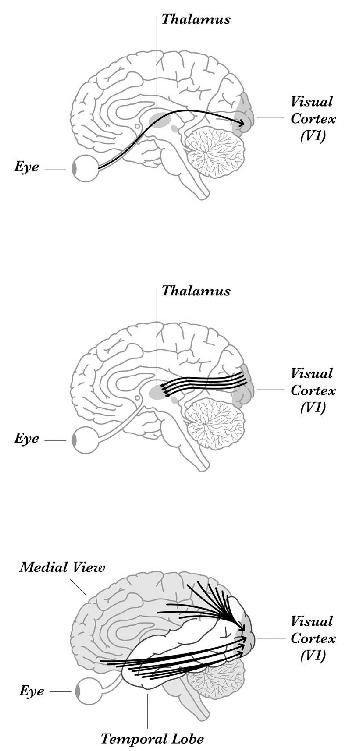
Figure 4-1: Your brain contains complete maps of your visual field. One map is located in your primary visual cortex, known as V1. If your brain merely reacted to the light waves that hit your retina and traveled to primary visual cortex (V1) via your thalamus, then it would have many neurons to carry that visual information to V1. But it has far fewer than one would expect (top image), and ten times as many projections going in the other direction, carrying visual predictions from V1 to the thalamus (center image). Likewise, 90 percent of all connections coming into V1 (lower image) carry predictions from neurons in other parts of cortex. Only a small fraction carries visual input from the world.13
Through prediction and correction, your brain continually creates and revises your mental model of the world. It’s a huge, ongoing simulation that constructs everything you perceive while determining how you act. But predictions aren’t always correct, when compared to actual sensory input, and the brain must make adjustments. Sometimes a skipping stone is large enough to make a splash. Consider this sentence:
Once upon a time, in a magical kingdom far beyond the most distant mountains, there lived a beautiful princess who bled to death.
Did you find the last three words unexpected? That’s because your brain predicted incorrectly based on its stored knowledge of fairy tales—it made a prediction error—and then adjusted its prediction in the blink of an eye based on the final words: a few skipping stones of visual information.
The same process happens when you mistake a stranger’s face for someone you know, or step off a moving walkway in an airport and feel surprised by the change in your pace. Your brain computes prediction errors speedily by comparing the prediction to actual sensory input, and then it reduces the prediction error quickly and efficiently. For example, your brain can change the prediction: the stranger looks different from your friend; the moving walkway came to its end.
Prediction errors aren’t problems. They’re a normal part of the operating instructions of your brain as it takes in sensory input. Without prediction error, life would be a yawning bore. Nothing would be surprising or novel, and therefore your brain would never learn anything new. Most of the time, at least when you are an adult, your predictions aren’t too far off-base. If they were, you would go through life feeling constantly startled, uncertain . . . or hallucinating.
Your brain’s colossal, ongoing storm of predictions and corrections can be thought of as billions of tiny droplets. Each little drop represents a certain wiring arrangement that I’ll call a prediction loop, shown in figure 4-2. This arrangement holds at many levels throughout your entire brain. Neurons participate in prediction loops with other neurons. Brain regions participate in prediction loops with other regions. Your multitudes of prediction loops run in a massive parallel process that continues nonstop for your whole life, creating the sights, sounds, smells, tastes, and touches that make up your experiences and dictate your actions.
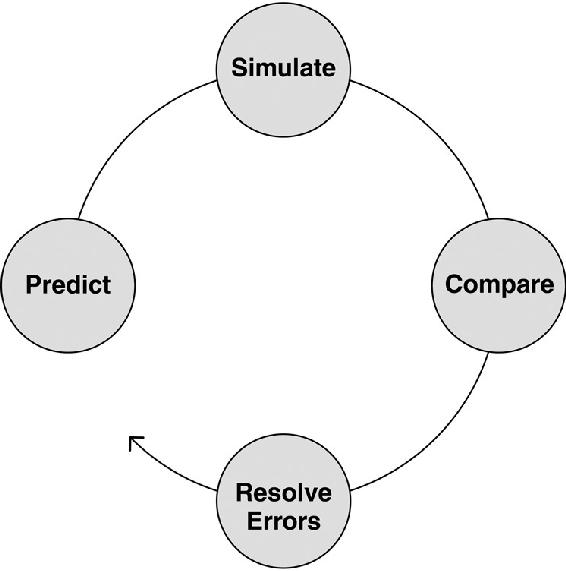
Figure 4-2: Structure of a prediction loop. Predictions become simulations of sensations and movement. These simulations are compared to actual sensory input from the world. If they match, the predictions are correct and the simulation becomes your experience. If they don’t match, your brain must resolve the errors.
Suppose you are playing baseball. Someone throws the ball in your direction, and you reach out and catch it. Most likely, you’d experience this as two events: seeing a ball and then catching it. If your brain actually reacted like this, however, baseball couldn’t exist as a sport. Your brain has about half a second to prepare to catch a baseball in a typical game. This isn’t enough time to process the visual input, calculate where the ball will land, make the decision to move, coordinate all the muscle movements, and send the motor commands to move you into position for the catch.15
Prediction makes the game possible. Your brain launches predictions well before you consciously see the ball, just like it predicts a red apple in the grocery store, using your past experience. As each prediction propagates through millions of prediction loops, your brain simulates the sights, sounds, and other sensations that the predictions represent, as well as the actions you will take to catch the ball. Your brain then compares the simulations to actual sensory input. If they match . . . success! The prediction is correct, and the sensory input proceeds no further into your brain. Your body is now prepared to catch the ball, and your movement is based on your prediction. Finally, you consciously see the ball, and you catch it.16
That’s what happens when the prediction is correct, like when I throw a baseball to my husband, who has some skill at the sport. On the other hand, when he tosses the ball back to me, my brain’s predictions aren’t particularly good, since I cannot play baseball to save my life. My predictions become simulations of the catch I hope to make, but when they get compared to the information I actually receive from the world, they do not match. This is a prediction error. My brain then adjusts its earlier predictions so that I can (in theory) catch the ball. The entire prediction loop process repeats, predicting and correcting many times as the ball hurtles toward me. All of this activity happens in milliseconds. In the end, most likely, I become aware of the ball sailing past my outstretched arm.
When prediction errors occur, the brain can resolve them in two general ways. The first, which we’ve just seen in my lame attempt to catch a baseball, is that the brain can be flexible and change the prediction. In this situation, my motor neurons would adjust my body movements, and my sensory neurons would simulate different sensations, leading to further predictions involving prediction loops. I could dive for the ball, for example, when it is in a different place than I expected it to be.
The brain’s second alternative is to be stubborn and stick with the original prediction. It filters the sensory input so it’s consistent with the prediction. In this situation, I could be standing in a baseball field but daydreaming (predicting and simulating) as the ball sails toward me. Even though the ball is fully within my visual field, I don’t notice it until it thumps at my feet. Another example would be the food-filled diapers at my daughter’s disgusting foods birthday party: our guests’ prediction of a baby poo aroma dominated their actual sensory input of mashed carrots.17
In short, the brain is not a simple machine reacting to stimuli in the outside world. It’s structured as billions of prediction loops creating intrinsic brain activity. Visual predictions, auditory predictions, gustatory (taste) predictions, somatosensory (touch) predictions, olfactory (smell) predictions, and motor predictions travel throughout the brain, influencing and constraining each other. These predictions are held in check by sensory inputs from the outside world, which your brain may prioritize or ignore.18
If this talk of prediction and correction seems unintuitive, think about it this way: your brain works like a scientist. It’s always making a slew of predictions, just as a scientist makes competing hypotheses. Like a scientist, your brain uses knowledge (past experience) to estimate how confident you can be that each prediction is true. Your brain then tests its predictions by comparing them to incoming sensory input from the world, much as a scientist compares hypotheses against data in an experiment. If your brain is predicting well, then input from the world confirms your predictions. Usually, however, there is some prediction error, and your brain, like a scientist, has some options. It can be a responsible scientist and change its predictions to respond to the data. Your brain can also be a biased scientist and selectively choose data that fits the hypotheses, ignoring everything else. Your brain can also be an unscrupulous scientist and ignore the data altogether, maintaining that its predictions are reality. Or, in moments of learning or discovery, your brain can be a curious scientist and focus on input. And like the quintessential scientist, your brain can run armchair experiments to imagine the world: pure simulation without sensory input or prediction error.
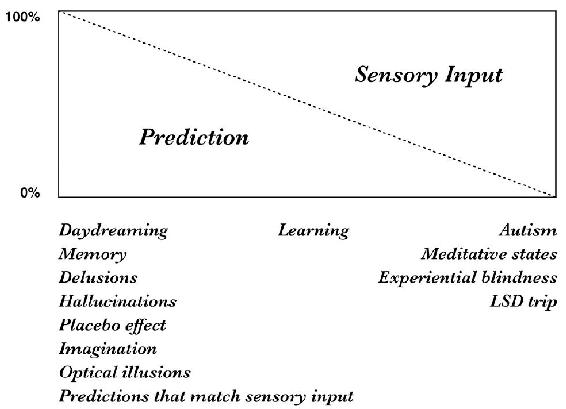
Figure 4-3: A variety of mental phenomena can be understood as a combination of prediction and sensory input.19
The balance between prediction and prediction error, shown in figure 4-3, determines how much of your experience is rooted in the outside world versus inside your head. As you can see, in many cases, the outside world is irrelevant to your experience. In a sense, your brain is wired for delusion: through continual prediction, you experience a world of your own creation that is held in check by the sensory world. Once your predictions are correct enough, they not only create your perception and action but also explain the meaning of your sensations. This is your brain’s default mode. And marvelously, your brain does not just predict the future: it can imagine the future at will. As far as we know, no other animal brain can do that.
…
Your brain is always predicting, and its most important mission is predicting your body’s energy needs, so you can stay alive and well. These crucial predictions, and their associated prediction error, turn out to be a key ingredient for making emotions. For hundreds of years, scholars believed that emotional “reactions” were caused by certain brain regions. As you’ll now discover, those brain regions do the opposite of what everyone expected, helping to make emotion in a way that overturns centuries of scientific belief. And once again, the story begins with movement—not the large-scale movements of a baseball game, but the inner motion of your body.
Any movement of your body is accompanied by movement in your body. When you shift position quickly to catch a baseball, you have to breathe more deeply. To escape from a poisonous snake, your heart pumps blood faster through dilated blood vessels to rush glucose to your muscles, which increases your heart rate and changes your blood pressure. Your brain represents the sensations that result from this inner motion; this representation, you may remember, is called interoception.20
Your inner-body movements, and their interoceptive consequences, occur every moment of your life. Your brain must keep your heart beating and your blood pumping and your lungs breathing and your glucose metabolizing even when you are not playing sports or fleeing from a snake, even when you are sleeping or resting. Interoception is therefore continuous, just as the mechanics of hearing and vision are always operating, even when you aren’t actively listening or looking at anything in particular.
From your brain’s point of view, locked inside the skull, your body is just another part of the world that it must explain. Your pumping heart, your expanding lungs, and your changing temperature and metabolism send sensory input to your brain that is noisy and ambiguous. A single interoceptive cue, such as a dull ache in your abdomen, could mean a stomachache, hunger, tension, an overly tight belt, or a hundred other causes. Your brain must explain bodily sensations to make them meaningful, and its major tool for doing so is prediction. So, your brain models the world from the perspective of someone with your body. Just as your brain predicts the sights, smells, sounds, touches, and tastes from the world in relation to the movements of your head and limbs, it also predicts the sensory consequences of movements inside your body.21
Most of the time, you’re unaware of the miniature maelstrom of movement inside you. (When’s the last time you thought, “Hmm, my liver seems to be producing a lot of bile today”?) Of course, there are times when you directly feel a headache, a full stomach, or your heart pounding in your chest. But your nervous system isn’t built for you to experience these sensations with precision, which is fortunate, because otherwise they’d overwhelm your attention.22
Usually, you experience interoception only in general terms: those simple feelings of pleasure, displeasure, arousal, or calmness that I mentioned earlier. Sometimes, however, you experience moments of intense interoceptive sensations as emotions. That is a key element of the theory of constructed emotion. In every waking moment, your brain gives your sensations meaning. Some of those sensations are interoceptive sensations, and the resulting meaning can be an instance of emotion.23
In order to understand how emotions are made, you’ll need to understand a bit about some key brain regions. Interoception is actually a whole-brain process, but several regions work together in a special way that is critical for interoception. My lab has discovered that these regions form an interoceptive network that is intrinsic in your brain, analogous to your networks for vision, hearing, and other senses. The interoceptive network issues predictions about your body, tests the resulting simulations against sensory input from your body, and updates your brain’s model of your body in the world.24
To simplify our discussion drastically, I’ll describe this network as having two general parts with distinct roles. One part is a set of brain regions that send predictions to the body to control its internal environment: speed up the heart, slow down breathing, release more cortisol, metabolize more glucose, and so on. We’ll call them your body-budgeting regions.* The second part is a region that represents sensations inside your body, called your primary interoceptive cortex.26
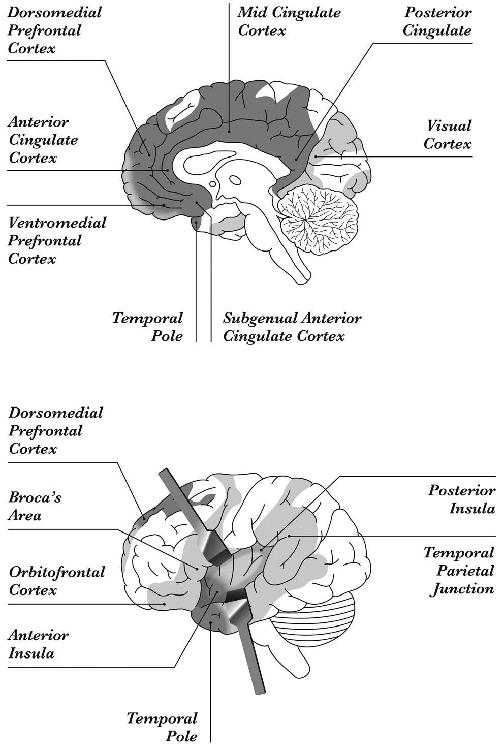
Figure 4-4: The cortical regions of the interoceptive network. Body-budgeting regions are dark gray, and primary interoceptive cortex is given its technical name, the posterior insula. Subcortical regions of this network are not shown. The interoceptive network encompasses two networks commonly known as the salience network and the default mode network. Visual cortex is shown for reference.25
The two parts of your interoceptive network participate in a prediction loop. Each time your body-budgeting regions predict a motor change, like speeding up the heart, they also predict the sensory consequences of that change, like a pounding feeling in your chest. These sensory predictions are called interoceptive predictions, and they flow to your primary interoceptive cortex, where they are simulated in the usual way. Primary interoceptive cortex also receives sensory inputs from the heart, lungs, kidneys, skin, muscles, blood vessels, and other organs and tissue as they perform their usual duties. The neurons in your primary interoceptive cortex compare the simulation to the incoming sensory input, computing any relevant prediction error, completing the loop, and ultimately creating interoceptive sensations.27
Your body-budgeting regions play a vital role in keeping you alive. Each time your brain moves any part of your body, inside or out, it spends some of its energy resources: the stuff it uses to run your organs, your metabolism, and your immune system. You replenish your body’s resources by eating, drinking, and sleeping, and you reduce your body’s spending by relaxing with loved ones, even having sex. To manage all of this spending and replenishing, your brain must constantly predict your body’s energy needs, like a budget for your body. Just as a company has a finance department that tracks deposits and withdrawals and moves money between accounts, so its overall budget stays in balance, your brain has circuitry that is largely responsible for your body budget. That circuitry is within your interoceptive network. Your body-budgeting regions make predictions to estimate the resources to keep you alive and flourishing, using past experience as a guide.28
Why is this relevant to emotion? Because every brain region that’s claimed to be a home of emotion in humans is a body-budgeting region within the interoceptive network. These regions, however, don’t react in emotion. They don’t react at all. They predict, intrinsically, to regulate your body budget. They issue predictions for sights, sounds, thoughts, memories, imagination, and, yes, emotions. The idea of an emotional brain region is an illusion caused by the outdated belief in a reactive brain. Neuroscientists understand this today, but the message hasn’t trickled down to many psychologists, psychiatrists, sociologists, economists, and others who study emotion.29
Whenever your brain predicts a movement, whether it’s getting out of bed in the morning or taking a sip of coffee, your body-budgeting regions adjust your budget. When your brain predicts that your body will need a quick burst of energy, these regions instruct the adrenal gland in your kidneys to release the hormone cortisol. People call cortisol a “stress hormone,” but this is a mistake. Cortisol is released whenever you need a surge of energy, which happens to include the times when you are stressed. Its main purpose is to flood the bloodstream with glucose to provide immediate energy to cells, allowing, for example, muscle cells to stretch and contract so you can run. Your body-budgeting regions also make you breathe more deeply to get more oxygen into your bloodstream and dilate your arteries to get that oxygen to your muscles more quickly so your body can move. All of this internal motion is accompanied by interoceptive sensations, though you are not wired to experience them precisely. So, your interoceptive network controls your body, budgets your energy resources, and represents your internal sensations, all at the same time.30
Withdrawals from your body’s budget don’t require actual physical movement. Suppose you see your boss, teacher, or baseball coach walking toward you. You believe that she judges everything you say and do. Even though no physical movement seems called for, your brain predicts that your body needs energy and makes a budget withdrawal, releasing cortisol and flooding glucose into your bloodstream. You also have a surge in interoceptive sensations. Stop and think about this for a minute. Someone merely walks toward you while you are standing still, and your brain predicts that you need fuel! In this manner, any event that significantly impacts your body budget becomes personally meaningful to you.
Not long ago, my lab was evaluating a portable device for monitoring the heart. Whenever the wearer’s heart rate sped up 15 percent above normal, the device would beep. One of my graduate students, Erika Siegel, was wearing the device as she worked quietly at her desk, and it remained silent for some time. At one point, I walked into the room. When Erika turned and saw me (her Ph.D. advisor), the device beeped loudly, to her embarrassed surprise and to the amusement of everyone else around us. Later in the day, I spent time wearing the device, and during a meeting with Erika, it beeped several times as I received emails from a granting agency. (So Erika had the last laugh that day.)31
My lab has experimentally demonstrated the brain’s budgeting efforts hundreds of times (as have other labs), observing as people’s body-budgeting circuitry shifts resources around, and sometimes as their body budgets fluctuate in and out of balance. We ask volunteers to sit completely motionless in front of a computer screen and view pictures of animals, flowers, babies, food, money, guns, surfers, skydivers, car crashes, and other objects and scenes. These pictures impact their body budget; heart rates go up, blood pressures change, blood vessels dilate. These budgetary changes, which prepare the body to fight or flee, occur even though the volunteers are not moving and have no conscious plan to move. When our volunteers view these pictures during an fMRI experiment, we observe their body-budgeting regions controlling these inner-body movements. And even though our subjects are lying down, completely motionless, they simulate motor movements like running and surfing, as well as the sensations from moving muscles, joints, and tendons. The pictures also change our volunteers’ feelings as interoceptive changes in their bodies are being simulated and corrected. Based on these and hundreds of other studies, we now have good evidence that your brain predicts your body’s responses by drawing on prior experiences with similar situations and objects, even when you’re not physically active. And the consequence is interoceptive sensation.32
To perturb your budget, you don’t even require another person or object to be present. You can just imagine your boss, teacher, coach, or anything else relevant to you. Every simulation, whether it becomes an emotion or not, impacts your body budget. As it turns out, people spend at least half their waking hours simulating rather than paying attention to the world around them, and this pure simulation strongly drives their feelings.33
When it comes to managing your body budget, your brain does not have to go it alone. Other people regulate your body budget too. When you interact with your friends, parents, children, lovers, teammates, therapist, or other close companions, you and they synchronize breathing, heart beats, and other physical signals, leading to tangible benefits. Holding hands with loved ones, or even keeping their photo on your desk at work, reduces activation in your body-budgeting regions and makes you less bothered by pain. If you’re standing at the bottom of a hill with friends, it will appear less steep and easier to climb than if you are alone. If you grow up in poverty, a situation that leads to chronic body-budget imbalance and an overactive immune system, these body-budgeting problems are reduced if you have a supportive person in your life. In contrast, when you lose a close, loving relationship and feel physically ill about it, part of the reason is that your loved one is no longer helping to regulate your budget. You feel like you’ve lost a part of yourself because, in a sense, you have.34
Every person you encounter, every prediction you make, every idea you imagine, and every sight, sound, taste, touch, and smell that you fail to anticipate all have budgetary consequences and corresponding interoceptive predictions. Your brain must contend with this continuous, ever-changing flow of interoceptive sensations from the predictions that keep you alive. Sometimes you’re aware of them, and other times you’re not, but they are always part of your brain’s model of the world. They are, as I’ve said, the scientific basis for simple feelings of pleasure, displeasure, arousal, and calmness that you experience every day. For some, the flow is like the trickle of a tranquil brook. For others, it’s like a raging river. Sometimes the sensations are transformed into emotions, but as you will now learn, even when they’re only in the background, they influence what you do, what you think, and what you perceive.35
…
When you wake up in the morning, do you feel refreshed or crabby? In the middle of the day, do you feel dragged out or full of energy? Consider how you feel right now. Calm? Interested? Energetic? Bored? Tired? Cranky? These are the simple feelings we discussed at the beginning of the chapter. Scientists call them affect.*
Affect is the general sense of feeling that you experience throughout each day. It is not emotion but a much simpler feeling with two features. The first is how pleasant or unpleasant you feel, which scientists call valence. The pleasantness of the sun on your skin, the deliciousness of your favorite food, and the discomfort of a stomachache or a pinch are all examples of affective valence. The second feature of affect is how calm or agitated you feel, which is called arousal. The energized feeling of anticipating good news, the jittery feeling after drinking too much coffee, the fatigue after a long run, and the weariness from lack of sleep are examples of high and low arousal. Anytime you have an intuition that an investment is risky or profitable, or a gut feeling that someone is trustworthy or an asshole, that’s also affect. Even a completely neutral feeling is affect.36
Philosophers from the West and the East describe valence and arousal as basic features of human experience. Scientists largely agree that affect is present from birth and that babies can feel and perceive pleasure and displeasure, even as they disagree whether newborns emerge into the world with fully formed emotions.37
Affect, you may recall, depends on interoception. That means affect is a constant current throughout your life, even when you are completely still or asleep. It does not turn on and off in response to events you experience as emotional. In this sense, affect is a fundamental aspect of consciousness, like brightness and loudness. When your brain represents wavelengths of light reflected from objects, you experience brightness and darkness. When your brain represents air pressure changes, you experience loudness and softness. And when your brain represents interoceptive changes, you experience pleasantness and unpleasantness, and agitation and calmness. Affect, brightness, and loudness all accompany you from birth until death.38
Let’s be clear on one thing: interoception is not a mechanism dedicated to manufacturing affect. Interoception is a fundamental feature of the human nervous system, and why you experience these sensations as affect is one of the great mysteries of science. Interoception did not evolve for you to have feelings but to regulate your body budget. It helps your brain track your temperature, how much glucose you are using, whether you have any tissue damage, whether your heart is pounding, whether your muscles are stretching, and other bodily conditions, all at the same time. Your affective feelings of pleasure and displeasure, and calmness and agitation, are simple summaries of your budgetary state. Are you flush? Are you overdrawn? Do you need a deposit, and if so, how desperately?39
When your budget is unbalanced, your affect doesn’t instruct you how to act in any specific way, but it prompts your brain to search for explanations. Your brain constantly uses past experience to predict which objects and events will impact your body budget, changing your affect. These objects and events are collectively your affective niche. Intuitively, your affective niche includes everything that has any relevance to your body budget in the present moment. Right now, this book is within your affective niche, as are the letters of the alphabet, the ideas you’re reading about, any memories that my words bring to mind, the air temperature around you, and any objects, people, and events from your past that impacted your body budget in a similar situation. Anything outside your affective niche is just noise: your brain issues no predictions about it, and you do not notice it. The feel of your clothing against your skin is usually not in your affective niche (though it is now, since I just mentioned it), unless it happens to be relevant, say, to your physical comfort.40
The psychologist James A. Russell developed a way of tracking affect, and it’s become popular among clinicians, teachers, and scientists. He showed that you can describe your affect in the moment as a single point on a two-dimensional space called a circumplex, a circular structure with two dimensions, as in figure 4-5. Russell’s two dimensions represent valence and arousal, with distance from the origin representing intensity.41
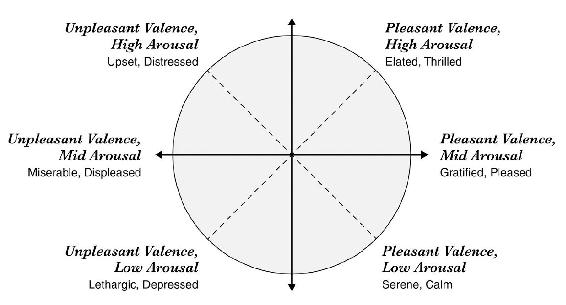
Figure 4-5: An affective circumplex
Your affect is always some combination of valence and arousal, represented by one point on the affective circumplex. When you sit quietly, your affect is at a central point of “neutral valence, neutral arousal” on the circumplex. If you’re having fun at a lively party, your affect might be in the “pleasant, high arousal” quadrant. If the party turns boring, your affect might be “unpleasant, low arousal.” Younger American adults tend to prefer the upper right quadrant: pleasant, high arousal. Middle-aged and older Americans tend to prefer the lower right quadrant (pleasant, low arousal), as do people from Eastern cultures like China and Japan. Hollywood is a $500 billion industry because people are willing to pay to see movies so that, for a few hours, they can travel within this affective map. You don’t even have to open your eyes to have an affective adventure. When you daydream and have a large change in interoception, your brain will swirl with affect.42
Affect has far-reaching consequences beyond simple feeling. Imagine you are a judge presiding over a prisoner’s parole case. You are listening to the inmate’s story, hearing about his behavior in prison, and you have a bad feeling. If you agree to parole, he could hurt someone else. Your hunch is that you should keep him locked up. So you deny parole. Your bad feeling, which is unpleasant affect, seems like evidence that your judgment was correct. But could your affect have misled you? This exact situation was the subject of a 2011 study of judges. Scientists in Israel found that judges were significantly more likely to deny parole to a prisoner if the hearing was just before lunchtime. The judges experienced their interoceptive sensations not as hunger but as evidence for their parole decision. Immediately after lunch, the judges began granting paroles with their customary frequency.43
When you experience affect without knowing the cause, you are more likely to treat affect as information about the world, rather than your experience of the world. The psychologist Gerald L. Clore has spent decades performing clever experiments to better understand how people make decisions every day based on gut feelings. This phenomenon is called affective realism, because we experience supposed facts about the world that are created in part by our feelings. For example, people report more happiness and life satisfaction on sunny days, but only when they are not explicitly asked about the weather. When you apply for a job or college or medical school, make sure you interview on a sunny day, because interviewers tend to rate applicants more negatively when it is rainy. And the next time a good friend snaps at you, remember affective realism. Maybe your friend is irritated with you, but perhaps she didn’t sleep well last night, or maybe it’s just lunchtime. The change in her body budget, which she’s experiencing as affect, might not have anything to do with you.44
Affect leads us to believe that objects and people in the world are inherently negative or positive.* Photographs of kittens are deemed pleasant. Photographs of rotting human corpses are deemed unpleasant. But these images do not have affective properties inside them. The phrase “an unpleasant image” is really shorthand for “an image that impacts my body budget, producing sensations that I experience as unpleasant.” In these moments of affective realism, we experience affect as a property of an object or event in the outside world, rather than as our own experience. “I feel bad, therefore you must have done something bad. You are a bad person.” In my lab, when we manipulate people’s affect without their knowing, it influences whether they experience a stranger as trustworthy, competent, attractive, or likable, and they even see the person’s face differently.45
People employ affect as information, creating affective realism, throughout daily life. Food is “delicious” or “bland.” Paintings are “beautiful” or “ugly.” People are “nice” or “mean.” Women in certain cultures must wear scarves and wigs so as not to “tempt men” by showing a bit of hair. Sometimes affective realism is helpful, but it also shapes some of humanity’s most troubling problems. Enemies are “evil.” Women who are raped are perceived as “asking for it.” Victims of domestic violence are said to “bring it on themselves.”46
The thing is, a bad feeling doesn’t always mean something is wrong. It just means you’re taxing your body budget. When people exercise to the point of labored breathing, for example, they feel tired and crappy well before they run out of energy. When people solve math problems and perform difficult feats of memory, they can feel hopeless and miserable, even when they are performing well. Any graduate student of mine who never feels distress is clearly doing something wrong.47
Affective realism can also lead to tragic consequences. In July 2007, an American gunner aboard an Apache helicopter in Iraq mistakenly killed a group of eleven unarmed people, including several Reuters photojournalists. The soldier had misjudged a journalist’s camera to be a gun. One explanation for this incident is that affective realism caused the soldier, in the heat of the moment, to imbue a neutral object (a camera) with unpleasant valence. Every day, soldiers must make quick decisions about other people, whether they are embedded in a unit during wartime, on a peacekeeping mission, negotiating in a cross-cultural setting, or collaborating with unit members on a stateside base. These quick judgments are extremely difficult to negotiate, especially in such high-stakes, high-arousal settings where errors are often made at the expense of someone’s life.48
A little closer to home, affective realism may also play a role in police shootings of unarmed civilians. The U.S. Department of Justice analyzed shootings by Philadelphia police officers between 2007 and 2013 and found that 15 percent of the victims were unarmed. In half of these cases, an officer reportedly misidentified “a nonthreatening object (e.g., a cell phone) or movement (e.g., tugging at the waistband)” as a weapon. Many factors may contribute to these tragedies, ranging from carelessness to racial bias, but it is also possible that some of the shooters actually perceive a weapon when none is present due to affective realism in a high-pressure and dangerous context.* The human brain is wired for this sort of delusion, in part because moment-to-moment interoception infuses us with affect, which we then use as evidence about the world.49
People like to say that seeing is believing, but affective realism demonstrates that believing is seeing. The world often takes a backseat to your predictions. (It’s still in the car, so to speak, but is mostly a passenger.) And as you’re about to learn right now, this arrangement is not limited to vision.
…
Suppose you’re walking alone in the forest, and you hear a rustle in the leaves and see a vague movement on the ground. As always, your body-budgeting regions initiate predictions—say, that there’s a snake nearby. These predictions prepare you to see and hear a snake. At the same time, these regions predict that your heart rate should increase and your blood vessels should dilate, for instance, in preparation to run. A pounding heart and surging blood would cause interoceptive sensations, so your brain must predict those sensations as well. As a result, your brain simulates the snake, the bodily changes, and the bodily sensations. These predictions translate into feeling; in this case, you’ll begin to feel agitated.50
What happens next? Maybe a snake slithers out from the brush. In this case, the sensory input matches your predictions and you run. Or perhaps no snake is present—the leaves were just rustled by the wind—but you see a snake anyway. That’s affective realism. Now consider the third possibility: there is no snake, and you don’t see a snake. In this case, your visual predictions of a snake are corrected quickly; however, your interoceptive predictions are not. Your body-budgeting regions keep predicting adjustments to your budget long after the predicted need is over. You therefore may take a long time to calm down, even if you know there is nothing wrong. Remember when I compared your brain to a scientist who makes and tests hypotheses? Your body-budgeting regions are like a mostly deaf scientist: they make predictions but have a hard time listening to the incoming evidence.51
Some of the time, your body-budgeting regions are sluggish to correct their predictions. Think about the last time you ate too much and felt bloated. You might be able to blame your body-budgeting regions. One of their jobs is to predict your level of circulating glucose, which determines how much food you need, but they don’t receive the message “I’m full” from your body in a timely manner, so you keep eating. If you’ve ever heard the advice, “Wait 20 minutes before you take a second helping, to see if you’re really still hungry,” now you know why it works. Whenever you make a big deposit or withdrawal from your body budget—eating, exercising, injuring yourself—you might have to wait for your brain to catch up. Marathon runners learn this; they feel fatigue early in the race when their body budget is still solvent, so they keep running until the unpleasant feeling goes away. They ignore the affective realism that insists they’re out of energy.52
Take a moment and consider what this means for your day-to-day life. You’ve just learned that the sensations you feel from your body don’t always reflect the actual state of your body. That’s because familiar sensations like your heart beating in your chest, your lungs filling with air, and, most of all, the general pleasant, unpleasant, aroused, and quiescent sensations of affect are not really coming from inside your body. They are driven by simulations in your interoceptive network.53
In short, you feel what your brain believes. Affect primarily comes from prediction.
You’ve already learned that you see what your brain believes—that’s affective realism. Now you know the same is true for most feelings you’ve experienced in your life. Even the feeling of the pulse in your wrist is a simulation, constructed in sensory regions of your brain and corrected by sensory input (your actual pulse). Everything you feel is based on prediction from your knowledge and past experience. You are truly an architect of your experience. Believing is feeling.
These ideas are not just speculation. Scientists with the right equipment can change people’s affect by directly manipulating body-budgeting regions that issue predictions. Helen S. Mayberg, a pioneering neurologist, has developed a deep brain stimulation therapy for people suffering from treatment-resistant depression. These people don’t just experience the anguish of a major depressive episode—they are in agony, trapped in a pit of self-loathing and unending torment. Some of them can barely move. During surgery, Mayberg works with a team of neurosurgeons who drill small holes in the skull and sink electrodes into a key predictive area in the patient’s interoceptive network. When the neurosurgeons turn on the electrodes, Mayberg’s patients report immediate relief from their agony. As the electrical current is turned off and on, the patients’ crippling wave of dread approaches and recedes in synchrony with the stimulation. Mayberg’s remarkable work might represent the first time in scientific history that direct stimulation of the human brain has consistently changed people’s affective feelings, potentially leading to new treatments for mental illness.54
While predictive brain circuitry is important for affect, it likely is not necessary. Consider the case of Roger, a fifty-six-year-old patient whose relevant circuitry was destroyed by a rare illness. He has an above-normal IQ and a college education but also plenty of mental difficulties, such as severe amnesia and difficulty with smell and taste. Nevertheless, Roger experiences affect. Most likely, his affect is driven by actual sensory inputs from his body; other brain regions could be supplying the predictions, an example of degeneracy (different sets of neurons producing the same outcome). The opposite situation can also occur. Patients with spinal cord damage or Pure Autonomic Failure, a degenerative disease of the autonomic nervous system, have interoceptive predictions but don’t receive sensory inputs from their organs and tissue. These patients likely experience affect based primarily on uncorrected predictions.55
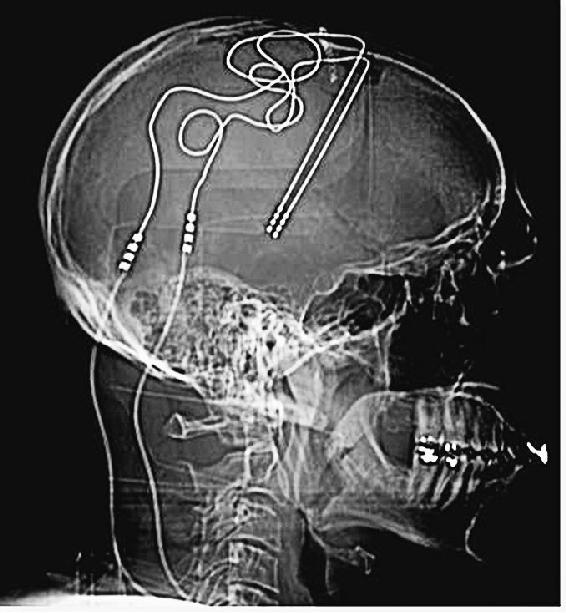
Figure 4-6: Deep brain stimulation
Your interoceptive network doesn’t just help determine how you feel. Its body-budgeting regions are some of the most powerful and well-connected predictors in your entire brain. These regions are loud and bossy, like a mostly deaf scientist with a big megaphone. They launch predictions for vision, hearing, and your other senses; your primary sensory regions, which don’t issue predictions of their own, are wired to listen.56
Let me show you what this means. You might think that in everyday life, the things you see and hear influence what you feel, but it’s mostly the other way around: that what you feel alters your sight and hearing. Interoception in the moment is more influential to perception, and how you act, than the outside world is.
You might believe that you are a rational creature, weighing the pros and cons before deciding how to act, but the structure of your cortex makes this an implausible fiction. Your brain is wired to listen to your body budget. Affect is in the driver’s seat and rationality is a passenger. It doesn’t matter whether you’re choosing between two snacks, two job offers, two investments, or two heart surgeons—your everyday decisions are driven by a loudmouthed, mostly deaf scientist who views the world through affect-colored glasses.57
Antonio Damasio, in his bestseller Descartes’ Error, observes that a mind requires passion (what we would call affect) for wisdom. He documents that people with damage to their interoceptive network, particularly in one key body-budgeting region, have impaired decision-making. Robbed of the capacity to generate interoceptive predictions, Damasio’s patients were rudderless. Our new knowledge of brain anatomy now compels us to go one step further. Affect is not just necessary for wisdom; it’s also irrevocably woven into the fabric of every decision.58
The shouting power of body-budgeting circuitry has serious implications for the financial world. It helped to precipitate the greatest economic disasters of our time, most recently the global financial meltdown of 2008 that cast countless families into economic ruin.
The science of economics used to employ a concept called the rational economic person (homo economicus), who controls his or her emotions to make reasoned economic judgments. This concept was a foundation of Western economic theory, and though it has fallen out of favor among academic economists, it has continued to guide economic practice. However, if body-budgeting regions drive predictions to every other brain network, then the model of the rational economic person is based on a biological fallacy. You cannot be a rational actor if your brain runs on interoceptively infused predictions. An economic model at the foundation of the U.S. economy—some might say the global economy—is rooted in a neural fairy tale.59
Every economic crisis in the last thirty years has been related, at least in some part, to the rational economic person model. According to journalist Jeff Madrick, author of Seven Bad Ideas: How Mainstream Economists Have Damaged America and the World, several of economists’ most fundamental ideas caused a series of financial crises leading up to the Great Recession. A common theme running through these ideas is that unregulated free-market economies work well. In these economies, decisions regarding investments, production, and distribution are based on supply and demand with no government regulation or oversight. Mathematical models indicate that under certain conditions, unregulated free-market economies do work well. But one of those “certain conditions” is that people are rational decision makers. I have lost count of the number of experiments published over the past fifty years showing that people are not rational actors. You cannot overcome emotion through rational thinking, because the state of your body budget is the basis for every thought and perception you have, so interoception and affect are built into every moment. Even when you experience yourself as rational, your body budget and its links to affect are there, lurking beneath the surface.60
If the idea of the rational human mind is so toxic to the economy, and it’s not backed up by neuroscience, why does it persist? Because we humans have long believed that rationality makes us special in the animal kingdom. This origin myth reflects one of the most cherished narratives in Western thought, that the human mind is a battlefield where cognition and emotion struggle for control of behavior. Even the adjective we use to describe ourselves as insensitive or stupid in the heat of the moment—“thoughtless”—connotes a lack of cognitive control, of failing to channel our inner Mr. Spock.
This origin myth is so strongly held that scientists even created a model of the brain based on it. The model begins with ancient subcortical circuits for basic survival, which we allegedly inherited from reptiles. Sitting atop those circuits is an alleged emotion system, known as the “limbic system,” that we supposedly inherited from early mammals. And wrapped around the so-called limbic system, like icing on an already-baked cake, is our allegedly rational and uniquely human cortex. This illusory arrangement of layers, which is sometimes called the “triune brain,” remains one of the most successful misconceptions in human biology. Carl Sagan popularized it in The Dragons of Eden, his bestselling (some would say largely fictional) account of how human intelligence evolved. Daniel Goleman employed it in his bestseller Emotional Intelligence. Nevertheless, humans don’t have an animal brain gift-wrapped in cognition, as any expert in brain evolution knows. “Mapping emotion onto just the middle part of the brain, and reason and logic onto the cortex, is just plain silly,” says neuroscientist Barbara L. Finlay, editor of the journal Behavior and Brain Sciences. “All brain divisions are present in all vertebrates.” So how do brains evolve? They reorganize as they expand, like companies do, to keep themselves efficient and nimble.61
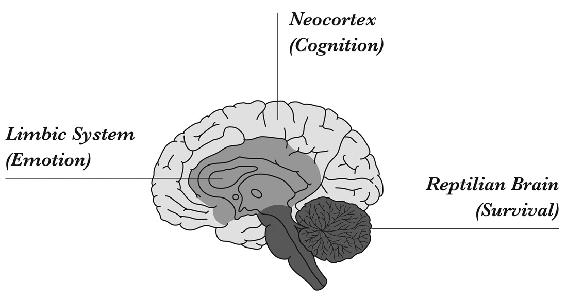
Figure 4-7: The “triune brain” idea, with so-called cognitive circuitry layered on top of so-called emotion circuitry. This illusory arrangement depicts how thinking supposedly regulates feeling.
The bottom line is this: the human brain is anatomically structured so that no decision or action can be free of interoception and affect, no matter what fiction people tell themselves about how rational they are. Your bodily feeling right now will project forward to influence what you will feel and do in the future. It is an elegantly orchestrated, self-fulfilling prophecy, embodied within the architecture of your brain.
…
Your brain, with its billions of neurons, has much more going on than I’ve sketched out in this chapter. Most neuroscientists agree that we are decades away from knowing the intricacies of how a brain works, let alone how it creates consciousness. Still, we can be fairly sure of some things.
Right now, as your brain makes meaning from these words, it is predicting changes in your body budget. Every thought, memory, perception, or emotion that you construct includes something about the state of your body: a little piece of interoception. A visual prediction, for example, doesn’t just answer the question, “What did I see last time I was in this situation?” It answers, “What did I see last time I was in this situation when my body was in this state?” Any change in affect you feel while reading these words—more or less pleasant, or more or less calm—is a result of those interoceptive predictions. Affect is your brain’s best guess about the state of your body budget.
Interoception is also one of the most important ingredients in what you experience as reality. If you didn’t have interoception, the physical world would be meaningless noise to you. Consider this: Your interceptive predictions, which produce your feelings of affect, determine what you care about in the moment—your affective niche. From the perspective of your brain, anything in your affective niche could potentially influence your body budget, and nothing else in the universe matters. That means, in effect, that you construct the environment in which you live. You might think about your environment as existing in the outside world, separate from yourself, but that’s a myth. You (and other creatures) do not simply find yourself in an environment and either adapt or die. You construct your environment—your reality—by virtue of what sensory input from the physical environment your brain selects; it admits some as information and ignores some as noise. And this selection is intimately linked to interoception. Your brain expands its predictive repertoire to include anything that might impact your body budget, in order to meet your body’s metabolic demands. This is why affect is a property of consciousness.
Interoception, as a fundamental part of the predictive process, is a key ingredient of emotion. However, interoception alone cannot explain emotion. An emotion category like anger or sadness is far more complex than a simple feeling of unpleasantness and arousal.
When Connecticut Governor Dannel Malloy’s voice wavered during his speech after the Sandy Hook Elementary School massacre, he didn’t cry, he didn’t pout, and at one point he actually smiled. And yet, somehow, viewers inferred that he was experiencing intense sadness. Sensation and simple feeling are not sufficient to explain how an audience of thousands perceived the depth of Malloy’s anguish.
Affect alone also doesn’t explain how we construct our own experiences of sadness, nor how one instance of sadness differs from another. Nor does affect tell you what sensations mean or what to do about them. That’s why people eat when they are tired or find a defendant guilty when they are hungry. You must make the affect meaningful so your brain can execute a more specific action. One way to make meaning is to construct an instance of emotion.
So, how do interoceptive sensations become emotions? And why do we experience these sensations (really predictions) in such diverse ways: as physical symptoms, as perceptions of the world, as simple affective feeling, and sometimes as emotion? That is the next mystery we’ll address.