2
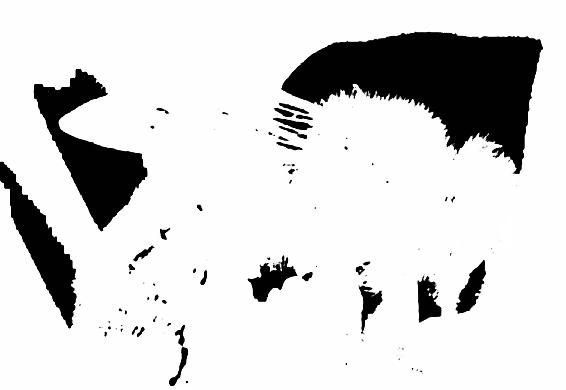
Please take a look at the black splotches in figure 2-1.
If this is your first time viewing these blobs, your brain is working hard to make sense of them. Neurons in your visual cortex are processing the lines and edges. Your amygdala is firing rapidly because the input is novel. Other brain regions are sifting through your past experiences to determine if you’ve encountered anything like this input before and are conversing with your body to prepare it for an as-yet-undetermined action. Most likely, you are in a state called experiential blindness, seeing only black blobs of unknown origin.
To cure your experiential blindness, look at the image on page 308 (appendix B). Then come back to this page. You should no longer see formless blobs but a familiar object.
What just happened in your brain to change your perception of these blobs? Your brain added stuff from the full photograph into its vast array of prior experiences and constructed the familiar object you now see in the blobs. Neurons in your visual cortex changed their firing to create lines that aren’t present, linking the blobs into a shape that isn’t physically there. You are, in a manner of speaking, hallucinating. Not the scary “I’d better get to the hospital” kind of hallucination, but the everyday “my brain is built to work like this” hallucination.
Your experience with figure 2-1 reveals a couple of insights. Your past experiences—from direct encounters, from photos, from movies and books—give meaning to your present sensations. Additionally, the entire process of construction is invisible to you. No matter how hard you try, you cannot observe yourself or experience yourself constructing the image. We needed a specially designed example to unmask the fact that construction is occurring. You consciously experienced the shift from unknown to known because you saw figure 2-1 both before and after you had the relevant knowledge to draw on. The process of construction is so habitual that you might never again see this figure as formless shapes, even if you try hard to un-see it and recapture experiential blindness.
This little magic trick of the brain is so common and normal that psychologists discovered it time and time again before they understood how it worked. We will call it simulation. It means that your brain changed the firing of its own sensory neurons in the absence of incoming sensory input. Simulation can be visual, as with our picture, or involve any of your other senses. Ever have a song playing in your head that you can’t get rid of ? That audio hallucination is also a simulation.1
Think of the last time someone handed you a red, juicy apple. You reached out for it, took a bite, and experienced the tart flavor. During those moments, neurons were firing in the sensory and motor regions of your brain. Motor neurons fired to produce your movements, and sensory neurons fired to process your sensations of the apple, like its red color with a blush of green; its smoothness against your hand; its crisp, floral scent; the audible crunch when you bit into it; and its tangy taste with a hint of sweetness. Other neurons made your mouth water to release enzymes and begin digestion, released cortisol to prepare your body to metabolize the sugars in the apple, and perhaps made your stomach churn a bit. But here’s the cool thing: just now, when you read the word “apple,” your brain responded to a certain extent as if an apple were actually present. Your brain combined bits and pieces of knowledge of previous apples you’ve seen and tasted, and changed the firing of neurons in your sensory and motor regions to construct a mental instance of the concept “Apple.” Your brain simulated a nonexistent apple using sensory and motor neurons. Simulation happens as quickly and automatically as a heartbeat.2
For my daughter’s twelfth birthday, we exploited the power of simulation (and had some fun) by throwing a “gross foods” party. When her guests arrived, we served them pizza doctored with green food coloring so the cheese looked like fuzzy mold, and peach gelatin laced with bits of vegetables to look like vomit. For drinks, we served white grape juice in medical urine sample cups. Everybody was exuberantly disgusted (it was perfect twelve-year-old humor), and several guests could not bring themselves to touch the food as they involuntarily simulated vile tastes and smells. The pièce de résistance, however, was the party game we played after lunch: a simple contest to identify foods by their smell. We used mashed baby food—peaches, spinach, beef, and so on—and artfully smeared it on diapers, so it looked exactly like baby poo. Even though the guests knew that the smears were food, several actually gagged from the simulated smell.3
Simulations are your brain’s guesses of what’s happening in the world. In every waking moment, you’re faced with ambiguous, noisy information from your eyes, ears, nose, and other sensory organs. Your brain uses your past experiences to construct a hypothesis—the simulation—and compares it to the cacophony arriving from your senses. In this manner, simulation lets your brain impose meaning on the noise, selecting what’s relevant and ignoring the rest.
The discovery of simulation in the late 1990s ushered in a new era in psychology and neuroscience. Scientific evidence shows that what we see, hear, touch, taste, and smell are largely simulations of the world, not reactions to it. Forward-looking thinkers speculate that simulation is a common mechanism not only for perception but also for understanding language, feeling empathy, remembering, imagining, dreaming, and many other psychological phenomena. Our common sense might declare that thinking, perceiving, and dreaming are different mental events (at least to those of us in Western cultures), yet one general process describes them all. Simulation is the default mode for all mental activity. It also holds a key to unlocking the mystery of how the brain creates emotions.4
Outside your brain, simulation can cause tangible changes in your body. Let’s try a little creative simulation with our bee. In your mind’s eye, see the bee bouncing lightly on the petal of a fragrant white flower, buzzing around as it searches for pollen. If you’re fond of bees, then the flutter of imaginary wings is right now causing other neurons to prepare your body to move in for a closer look—preparing your heart to beat faster, your sweat glands to fill, and your blood pressure to decrease. Or if you have been badly stung in the past, your brain may ready your body to run away or make a swatting motion, formulating some other pattern of physical changes. Each time your brain simulates sensory input, it prepares automatic changes in your body that have the potential to change your feeling.
Your bee-related simulations are rooted in your mental concept of what a “Bee” is. This concept not only includes information about the bee itself (what it looks and sounds like, how you act on it, what changes in your autonomic nervous system allow your action, etc.), but also information contained in other concepts related to bees (“Meadow,” “Flower,” “Honey,” “Sting,” “Pain,” etc.). All this information is integrated with your concept “Bee,” guiding how you simulate the bee in this particular context. So, a concept like “Bee” is actually a collection of neural patterns in your brain, representing your past experiences. Your brain combines these patterns in different ways to perceive and flexibly guide your action in new situations.5
Using your concepts, your brain groups some things together and separates others. You can look at three mounds of dirt and perceive two of them as “Hills” and one as a “Mountain,” based on your concepts. Construction treats the world like a sheet of pastry, and your concepts are cookie cutters that carve boundaries, not because the boundaries are natural, but because they’re useful or desirable. These boundaries have physical limitations of course; you’d never perceive a mountain as a lake. Not everything is relative.6
Your concepts are a primary tool for your brain to guess the meaning of incoming sensory inputs. For example, concepts give meaning to changes in sound pressure so you hear them as words or music instead of random noise. In Western culture, most music is based on an octave divided into twelve equally spaced pitches: the equal-tempered scale codified by Johann Sebastian Bach in the seventeenth century. All people of Western culture with normal hearing have a concept for this ubiquitous scale, even if they can’t explicitly describe it. Not all music uses this scale, however. When Westerners hear Indonesian gamelan music for the first time, which is based on seven pitches per octave with varied tunings, it’s more likely to sound like noise. A brain that’s been wired by listening to twelve-tone scales doesn’t have a concept for that music. Personally, I am experientially blind to dubstep, although my teenage daughter clearly has that concept.
Concepts also give meaning to the chemicals that create tastes and smells. If I served you pink ice cream, you might expect (simulate) the taste of strawberry, but if it tasted like fish, you would find it jarring, perhaps even disgusting. If I instead introduced it as “chilled salmon mousse” to give your brain fair warning, you might find the same taste delicious (assuming you enjoy salmon). You might think of food as existing in the physical world, but in fact the concept “Food” is heavily cultural. Obviously, there are some biological constraints; you can’t eat razor blades. But there are some perfectly edible substances that we don’t all perceive as food, such as hachinoko, a Japanese delicacy made of baby bees, which most Americans would vigorously avoid. This cultural difference is due to concepts.7
Every moment that you are alive, your brain uses concepts to simulate the outside world. Without concepts, you are experientially blind, as you were with the blobby bee. With concepts, your brain simulates so invisibly and automatically that vision, hearing, and your other senses seem like reflexes rather than constructions.
Now consider this: what if your brain uses this same process to make meaning of the sensations from inside your body—the commotion arising from your heartbeat, breathing, and other internal movements?
From your brain’s perspective, your body is just another source of sensory input. Sensations from your heart and lungs, your metabolism, your changing temperature, and so on, are like the ambiguous blobs of figure 2-1. These purely physical sensations inside your body have no objective psychological meaning. Once your concepts enter the picture, however, those sensations may take on additional meaning. If you feel an ache in your stomach while sitting at the dinner table, you might experience it as hunger. If flu season is just around the corner, you might experience that same ache as nausea. If you are a judge in a courtroom, you might experience the ache as a gut feeling that the defendant cannot be trusted. In a given moment, in a given context, your brain uses concepts to give meaning to internal sensations as well as to external sensations from the world, all simultaneously. From an aching stomach, your brain constructs an instance of hunger, nausea, or mistrust.8
Now consider that same stomachache if you’re sniffing a diaper heavy with pureed lamb, as my daughter’s friends did at her gross foods birthday party. You might experience the ache as disgust. Or if your lover has just walked into the room, you might experience the ache as a pang of longing. If you’re in a doctor’s office waiting for the results of a medical test, you might experience that same ache as an anxious feeling. In these cases of disgust, longing, and anxiety, the concept active in your brain is an emotion concept. As before, your brain makes meaning from your aching stomach, together with the sensations from the world around you, by constructing an instance of that concept.
An instance of emotion.
And that just might be how emotions are made.
Back when I was in graduate school, a guy in my psychology program asked me out on a date. I didn’t know him very well and was reluctant to go because, honestly, I wasn’t particularly attracted to him, but I had been cooped up too long in the lab that day, so I agreed. As we sat together in a coffee shop, to my surprise, I felt my face flush several times as we spoke. My stomach fluttered and I started having trouble concentrating. Okay, I realized, I was wrong. I am clearly attracted to him. We parted an hour later—after I agreed to go out with him again—and I headed home, intrigued. I walked into my apartment, dropped my keys on the floor, threw up, and spent the next seven days in bed with the flu.
The same neural process of construction that simulates a bee from blobs also constructs feelings of attraction from a fluttering stomach and a flushing face. An emotion is your brain’s creation of what your bodily sensations mean, in relation to what is going on around you in the world. Philosophers have long proposed that your mind makes sense of your body in the world, from René Descartes in the seventeenth century to William James (considered the father of American psychology) in the nineteenth; as you will learn, however, neuroscience now shows us how this process—and much more—occurs in the brain to make an emotion on the spot. I call this explanation the theory of constructed emotion:9
In every waking moment, your brain uses past experience, organized as concepts, to guide your actions and give your sensations meaning. When the concepts involved are emotion concepts, your brain constructs instances of emotion.
If a swarm of buzzing bees is squeezing underneath your front door while your heart is pounding in your chest, your brain’s prior knowledge of stinging insects gives meaning to the sensations from your body and to the sights, sounds, smells, and other sensations from the world, simulating the swarm, the door, and an instance of fear. The exact same bodily sensations in another context, like watching a fascinating film about the hidden lives of bees, might construct an instance of excitement. Or if you see a picture of a smiling cartoon bee in a children’s book, reminding you of a beloved niece whom you took to a Disney movie, you could mentally construct the bee, the niece, and an instance of pleasant nostalgia.
My experience in the coffee shop, where I felt attraction when I had the flu, would be called an error or misattribution in the classical view, but it’s no more a mistake than seeing a bee in a bunch of blobs. An influenza virus in my blood contributed to fever and flushing, and my brain made meaning from the sensations in the context of a lunch date, constructing a genuine feeling of attraction, in the normal way that the brain constructs any other mental state. If I’d had exactly the same bodily sensations while at home in bed with a thermometer, my brain might have constructed an instance of “Feeling Sick” using the same manufacturing process. (The classical view, in contrast, would require feelings of attraction and malaise to have different bodily fingerprints triggered by different brain circuitry.)10
Emotions are not reactions to the world. You are not a passive receiver of sensory input but an active constructor of your emotions. From sensory input and past experience, your brain constructs meaning and prescribes action. If you didn’t have concepts that represent your past experience, all your sensory inputs would just be noise. You wouldn’t know what the sensations are, what caused them, nor how to behave to deal with them. With concepts, your brain makes meaning of sensation, and sometimes that meaning is an emotion.
The theory of constructed emotion and the classical view of emotion tell vastly different stories of how we experience the world. The classical view is intuitive—events in the world trigger emotional reactions inside of us. Its story features familiar characters like thoughts and feelings that live in distinct brain areas. The theory of constructed emotion, in contrast, tells a story that doesn’t match your daily life—your brain invisibly constructs everything you experience, including emotions. Its story features unfamiliar characters like simulation and concepts and degeneracy, and it takes place throughout the whole brain at once.
This unfamiliar story creates a challenge because people expect stories with familiar structures. Every superhero story is assumed to have a villain. Every romantic comedy requires an attractive couple faced with a humorous misunderstanding that turns out all right in the end. Our challenge here is that the dynamics of the brain, and how emotions are made, do not follow a linear, cause-and-effect sort of story. (This challenge is common in science; for example, in quantum mechanics, the distinction between a cause and an effect is not meaningful.) Nevertheless, every book must tell a story, even for a nonlinear subject like brain function. Mine will occasionally have to defy the usual linear framework of human storytelling.
For now, my aim is simply to give you some intuition about the construction of emotion and why this scientific explanation makes sense. We’ll see later that this theory incorporates the most up-to-date, neuroscientific understanding of how the brain works, and it explains the great variation in emotional experiences and perceptions in everyday life. It can help us figure out how instances of happiness, sadness, anger, fear, and other emotion categories are constructed by the same brain mechanism that constructed the blobby bee, the juicy apple, and the smell of poo from mashed baby food, with no need for emotion circuits or other biological fingerprints.
I’m not the first person to propose that emotions are made. The theory of constructed emotion belongs to a broader scientific tradition called construction, which holds that your experiences and behaviors are created in the moment by biological processes within your brain and body. Construction is based on a very old set of ideas that date back to Ancient Greece, when the philosopher Heraclitus famously wrote, “No man ever steps in the same river twice,” because only a mind perceives an ever-changing river as a distinct body of water. Today, constructionism spans many topics including memory, perception, mental illness, and, of course, emotion.11
A constructionist approach to emotion has a couple of core ideas. One idea is that an emotion category such as anger or disgust does not have a fingerprint. One instance of anger need not look or feel like another, nor will it be caused by the same neurons. Variation is the norm. Your range of angers is not necessarily the same as mine, although if we were raised in similar circumstances, we will likely have some overlap.
Another core idea is that the emotions you experience and perceive are not an inevitable consequence of your genes. What’s inevitable is that you’ll have some kinds of concepts for making sense of sensory input from your body in the world because, as we learn in chapter 5, your brain has wiring for this purpose. Even single-celled animals can make sense of changes in their environment. But particular concepts like “Anger” and “Disgust” are not genetically predetermined. Your familiar emotion concepts are built-in only because you grew up in a particular social context where those emotion concepts are meaningful and useful, and your brain applies them outside your awareness to construct your experiences. Heart rate changes are inevitable; their emotional meaning is not. Other cultures can and do make other kinds of meaning from the same sensory input.12
The theory of constructed emotion incorporates ideas from several flavors of construction. One flavor, called social construction, studies the role of social values and interests in determining how we perceive and act in the world. An example would be whether or not Pluto is a planet, which is a decision not based in astrophysics but in culture. Spherical rocks in space are objectively real and come in various sizes, but the idea of a “Planet,” representing a particular combination of features of interest, is made up by people. Each of us understands the world in a way that is useful but not necessarily true in some absolute, objective sense. Where emotion is concerned, social construction theories ask how feelings and perceptions are influenced by our social roles or beliefs. For example, my perceptions are influenced by the fact that I am a woman, a mother, an atheist who is culturally Jewish, and a rather pale person living in a country that once enslaved people for having more melanin in their skin than I do. Social construction tends to ignore biology, however, as irrelevant to emotion. Instead, the theories suggest that emotions are triggered differently depending on your social role. Social constructionist theories, then, are primarily concerned with social circumstances in the world outside you, without considering how those circumstances affect the brain’s wiring.13
Another flavor of construction, known as psychological construction, turns this focus inward. It proposes that your perceptions, thoughts, and feelings are themselves constructed from more basic parts. Some nineteenth-century philosophers viewed the mind like a big chemistry set, combining simpler sensations into thoughts and emotions the way that atoms combine to make molecules. Others saw the mind as a set of all-purpose parts, like Lego blocks, that contribute to various mental states like cognitions and emotions. William James proposed that our incredibly varied emotional experiences are constructed from common ingredients. “Emotional brain processes,” he wrote, “not only resemble the ordinary sensorial brain-processes, but in very truth are nothing but such processes variously combined.” In the 1960s, the psychologists Stanley Schachter and Jerome Singer famously injected test subjects with adrenaline—without the subjects’ knowledge—and saw them experience this mysterious arousal as anger or euphoria, depending on the context surrounding them. In all these views, an instance of anger or elation does not reveal its causal mechanisms—a marked contrast to the classical view, where each emotion has a dedicated mechanism in the brain, and the same word (e.g., “sadness”) names the mechanism and its product. In recent years, a new generation of scientists has been crafting psychological construction-based theories for understanding emotions and how they work. Not every theory agrees on every assumption, but together they assert that emotions are made, not triggered; emotions are highly variable, without fingerprints; and emotions are not, in principle, distinct from cognitions and perceptions.14
You might be surprised to learn that these same principles of construction appear to hold for the brain’s physical architecture, an idea called neuroconstruction. Consider two neurons that are connected by a synapse. Clearly these brain cells exist in an objective sense. But there is no objective way to tell whether the two neurons are part of a unit called a “circuit” or “system,” or whether each neuron belongs to a separate circuit where one “regulates” the other. The answer depends entirely on human perspective. Similarly, your brain’s interconnections are not inevitable consequences of your genes alone. We know today that experience is a contributing factor. Your genes turn on and off in different contexts, including the genes that shape your brain’s wiring. (Scientists call this phenomenon plasticity.) That means some of your synapses literally come into existence because other people talked to you or treated you in a certain way. In other words, construction extends all the way down to the cellular level. The macro structure of your brain is largely predetermined, but the microwiring is not. As a consequence, past experience helps determine your future experiences and perceptions. Neuroconstruction explains how human infants are born without the ability to recognize a face but can develop that capacity within the first few days after birth. It also explains how early cultural experiences—for instance, how often your caregivers were in physical contact with you, and whether you slept alone in a crib or in a family bed—differentially shape the wiring of the brain.15
The theory of constructed emotion incorporates elements of all three flavors of construction. From social construction, it acknowledges the importance of culture and concepts. From psychological construction, it considers emotions to be constructed by core systems in the brain and body. And from neuroconstruction, it adopts the idea that experience wires the brain.
The theory of constructed emotion tosses away the most basic assumptions of the classical view. For instance, the classical view assumes that happiness, anger, and other emotion categories each have a distinctive bodily fingerprint. In the theory of constructed emotion, variation is the norm. When you are angry, you might scowl, frown mildly or severely, shout, laugh, or even stand in eerie calmness, depending on what works best in the situation. Your heart rate likewise might increase, decrease, or stay the same, whatever is necessary to support the action you are performing. When you perceive someone else as angry, your perceptions are similarly varied. An emotion word such as “anger,” therefore, names a population of diverse instances, each one constructed to best guide action in the immediate circumstance. There is no single difference between anger and fear, because there’s no single “Anger” and no single “Fear.” These ideas are inspired by William James, who wrote at length on the variability of emotional life, and by Charles Darwin’s revolutionary idea that a biological category, such as a species, is a population of unique individuals.16
You can think about emotion categories like cookies. There are crisp ones, chewy ones, sweet ones, savory ones, large, small, flat, rounded, rolled, sandwiched, floured, flourless, and more. The members of the category “Cookie” vary tremendously but are deemed equivalent for some purpose: to be a tasty snack or dessert. Cookies need not look the same or be created with the same recipe; they are a population of diverse instances. Even within a more fine-grained category like “Chocolate Chip Cookie,” there is still diversity created by the type of chocolate, the amount of flour, the ratio of brown sugar to white sugar, the fat content of the butter, and the time spent chilling the dough. Likewise, any category of emotion such as “Happiness” or “Guilt” is filled with variety.17
The theory of constructed emotion dispenses with fingerprints not only in the body but also in the brain. It avoids questions that imply a neural fingerprint exists, like “Where are the neurons that trigger fear?” The word “where” has a built-in assumption that a particular set of neurons activates every time you and everyone else on the planet feel afraid. In the theory of constructed emotion, a category of emotion such as sadness, fear, or anger has no distinct brain location, and each instance of emotion is a whole-brain state to be studied and understood. Therefore we ask how, not where, emotions are made. The more neutral question, “How does the brain create an instance of fear?” does not presume a neural fingerprint behind the scenes, only that experiences and perceptions of fear are real and worthy of study.
If instances of emotion are like cookies, then the brain is like a kitchen, stocked with common ingredients such as flour, water, sugar, and salt. Beginning with these ingredients, we can create diverse foods such as cookies, bread, cake, muffins, biscuits, and scones. Likewise, your brain has core “ingredients,” which we called core systems in chapter 1. They combine in complex ways, roughly analogous to recipes, to produce diverse instances of happiness, sadness, anger, fear, and so on. The ingredients themselves are multipurpose, not dedicated to emotions but participating in their construction. Instances of two different emotion categories, such as fear and anger, can be made from similar ingredients, just as cookies and bread both contain flour. Conversely, two instances of the same emotion category, like fear, will have some variation in their ingredients, just as some cookies have nuts and others do not. This phenomenon is our old friend degeneracy at work: different instances of fear are constructed by different combinations of the core systems throughout the brain. We can describe the instances of fear together by a pattern of brain activity, but this pattern is a statistical summary and need not describe any actual instance of fear.18
My kitchen analogy, like all analogies in science, has its limits. A brain network, as a core system, is not a “thing” like flour or salt. It’s a collection of neurons that we view as a unit, statistically speaking, but only a subset of those neurons participate at any given time. If you have ten feelings of fear that involve a particular brain network, each feeling can involve different neurons from the network.* This is degeneracy at the network level. Additionally, cookies and bread are discrete, physical objects, whereas instances of emotion are momentary snapshots of continuous brain activity, and we merely perceive these snapshots as discrete events. Nevertheless, you may find the kitchen analogy useful to imagine how interacting networks produce diverse mental states.19
The core systems that construct the mind interact in complex ways, without any central manager or chef to run the show. However, these systems cannot be understood independently like the disassembled parts of a machine, or like so-called emotion modules or organs. That’s because their interactions produce new properties that are not present in the parts alone. By analogy, when you bake bread with flour, water, yeast, and salt, a new product emerges from the complex, chemical interplay of the ingredients. Bread has its own emergent properties, like “crustiness” and “chewiness,” that are not present in its ingredients alone. In fact, if you try to identify all the ingredients by tasting the finished bread, you are in for a difficult time. Consider the salt: bread doesn’t taste salty even though salt is absolutely essential. Similarly, an instance of fear cannot be reduced to mere ingredients. Fear is not a bodily pattern—just as bread is not flour—but emerges from the interactions of core systems. An instance of fear has irreducible, emergent properties not found in the ingredients alone, such as unpleasantness (as your car skids out of control on a slippery highway) or pleasantness (on an undulating rollercoaster). You cannot reverse-engineer a recipe for an instance of fear from a feeling of fear.20
Even if we did know the ingredients of emotion but studied them only in isolation, we’d get an inaccurate understanding of how they work together to construct emotion. If we study salt in isolation by tasting and weighing it, we will not understand how it contributes to the creation of bread. That’s because salt interacts chemically with the other ingredients during baking: controlling yeast growth, shoring up the gluten in the dough, and, most importantly, enhancing flavor. To understand how salt transforms a recipe of bread, you must watch it work in context. Likewise, each ingredient of emotion must be studied in the context of the rest of the brain that influences it. This philosophy, known as holism, explains why I get different results each time I bake bread in my own kitchen, even using exactly the same recipe. I weigh every ingredient. I knead the dough for the same amount of time. I set the oven to the same temperature. I count the number of sprays of water I spritz into the oven to make the bread crusty. It’s all very systematic, and yet, the result is sometimes lighter, sometimes heavier, sometimes sweeter. That’s because baking has additional context that the recipe doesn’t mention, like the amount of force I use in kneading, the humidity in the kitchen, and the precise temperature at which the dough rises. Holism explains why bread baked in my home in Boston is never as tasty as bread baked at my friend Ann’s house in Berkeley, California. The Berkeley loaf has a superior flavor because of the different yeasts floating naturally in the air and the elevation above sea level. These additional variables can dramatically impact the end product, and expert bakers know this. Holism, emergent properties, and degeneracy are the very antithesis of fingerprints.21
After bodily and neural fingerprints, the next core assumption of the classical view we discard is how emotions evolved. The classical view proposes that we have a gift-wrapped animal brain—ancient emotion circuits passed down from ancestral animals, wrapped in uniquely human circuitry for rational thought—like icing on an already-baked cake. This view is often touted as “the” evolutionary theory of emotion, when in reality it is just one evolutionary theory.
Construction incorporates the latest scientific findings about Darwinian natural selection and population thinking. For example, the many-to-one principle of degeneracy—many different sets of neurons can produce the same outcome—brings about greater robustness for survival. The one-to-many principle—any single neuron can contribute to more than one outcome—is metabolically efficient and increases the computational power of the brain. This kind of brain creates a flexible mind without fingerprints.22
The final major assumption of the classical view is that certain emotions are inborn and universal: all healthy people around the world are supposed to display and recognize them. The theory of constructed emotion, in contrast, proposes that emotions are not inborn, and if they are universal, it’s due to shared concepts. What’s universal is the ability to form concepts that make our physical sensations meaningful, from the Western concept “Sadness” to the Dutch concept Gezellig (a specific experience of comfort with friends), which has no exact English translation.
By analogy, think about cupcakes and muffins. These two types of baked goods have the same shape and are based on the same set of ingredients: flour, sugar, shortening, and salt. Both have similar accompanying ingredients such as raisins, nuts, chocolate, carrots, and bananas. You cannot distinguish a muffin from a cupcake by its chemistry, in the way you can easily distinguish flour from salt, or a bee from a bird. And yet, one is a breakfast food while the other is a dessert. Their major distinguishing feature is the time of day at which they are eaten. This difference is entirely cultural and learned, not physical. The muffin-cupcake distinction is social reality: when objects in the physical world, like baked goods, take on additional functions by social agreement. Likewise, emotions are social reality. A physical event like a change in heart rate, blood pressure, or respiration becomes an emotional experience only when we, with emotion concepts that we have learned from our culture, imbue the sensations with additional functions by social agreement. From the widened eyes of a friend we may perceive fear or surprise, again depending on which concepts we use. We must not confuse physical reality, such as changes in heart rate or widened eyes, with the social reality of emotion concepts.23
Social reality is not just about words—it gets under your skin. If you perceive the same baked good as a decadent “cupcake” or a healthful “muffin,” research suggests that your body metabolizes it differently. Likewise, the words and concepts of your culture help to shape your brain wiring and your physical changes during emotion.24
Now that we’ve discarded so many assumptions of the classical view, we need a new vocabulary to discuss emotion. Familiar phrases like “facial expression” seem like common sense but tacitly assume that emotion fingerprints exist and that the face broadcasts emotion. You may have noticed in chapter 1 that I coined a more neutral term, facial configuration, because the English language has no word for “the set of facial muscle movements that the classical view treats as a coordinated unit.” I’ve also disambiguated the word “emotion,” because it could refer to a single instance of (say) feeling happy, or it could mean the whole category of happiness. When you construct an emotional experience of your own, I call it an instance of emotion. I refer to fear, anger, happiness, sadness, and so on, in general as emotion categories, because each word names a population of diverse instances, just like the word “cookie” names a population of diverse instances. If I were very strict, I would banish the phrase “an emotion” from our vocabulary so we don’t imply its objective existence in nature, and always speak of instances and categories. But that’s a bit too Orwellian, so I’ll just take care to indicate when I mean an instance versus the category.
Likewise, we do not “recognize” or “detect” emotions in others. These terms imply that an emotion category has a fingerprint that exists in nature, independent of any perceiver, waiting to be found. Any scientific question about “detecting” emotion automatically presumes a certain kind of answer. In the construction mindset, I speak of perceiving an instance of emotion. Perception is a complex mental process that does not imply a neural fingerprint behind the emotion, merely that an instance of emotion occurred somehow. I also avoid verbs like “triggering” emotion, and phrases like “emotional reaction” and emotions “happening to you.” Such wording implies that emotions are objective entities. Even when you feel no sense of agency when experiencing emotion, which is most of the time, you are an active participant in that experience.
I also do not speak of perceiving someone’s emotion “accurately.” Instances of emotion have no objective fingerprints in the face, body, and brain, so “accuracy” has no scientific meaning. It has a social meaning—we certainly can ask whether two people agree in their perceptions of emotion, or whether a perception is consistent with some norm. But perceptions exist within the perceiver.25
These linguistic guidelines might seem picky at first, but I hope you will come to see their importance. This new vocabulary is critical for understanding emotions and how they are made.
At the beginning of this chapter, you looked upon a bunch of blobs, applied a collection of concepts, and the image of a bee materialized. This was no trick of your brain but a demonstration of how your brain works all the time—you actively participate in determining what you see, and most of the time you have no awareness you are doing so. The same processes that construct meaning from mere visual input provide a solution to the puzzle of human emotion. After conducting hundreds of experiments in my lab, and reviewing thousands more by other researchers, I’ve come to a profoundly unintuitive conclusion shared by a growing number of scientists. Emotions do not shine forth from the face nor from the maelstrom of your body’s inner core. They don’t issue from a specific part of the brain. No scientific innovation will miraculously reveal a biological fingerprint of any emotion. That’s because our emotions aren’t built-in, waiting to be revealed. They are made. By us. We don’t recognize emotions or identify emotions: we construct our own emotional experiences, and our perceptions of others’ emotions, on the spot, as needed, through a complex interplay of systems. Human beings are not at the mercy of mythical emotion circuits buried deep within animalistic parts of our highly evolved brain: we are architects of our own experience.
These ideas do not match our experiences in daily life, where emotions seem to emerge like little bombs to disrupt whatever we were thinking or doing a moment before. Likewise, when we look at other people’s faces and bodies, they seem to announce what their owners are feeling, without input or effort on our part, even when the owners themselves might be unaware. And when we look at our growling dogs and purring cats, we seem to detect their emotions too. But these personal experiences, no matter how compelling they may seem, do not reveal how the brain creates emotion, any more than our experience watching the sun move across the sky means that it revolves around the Earth.
If you’re a newcomer to construction, then ideas like “emotion concepts” and “emotion perceptions” and “facial configurations” are probably not second nature for you yet. To really understand emotions—in a way that is consistent with contemporary knowledge of evolution and neuroscience—you have to give up some deeply ingrained ways of thinking. To help you along that path, in the next chapter I give you some practice with construction. We’ll take a close look at a famous scientific finding about emotion that many people consider a fact, and which propelled the classical view into a dominant position in psychology for five decades. We’ll unpack it from the perspective of construction and watch certainty transform into doubt. Strap on your seatbelt.