
Figure 5-1: Rainbows, drawn with stripes (left) and continuous as in nature (right)
5
When you look at a rainbow, you see discrete stripes of color, roughly like the drawing on the left side of figure 5-1. But in nature, a rainbow has no stripes—it’s a continuous spectrum of light, with wavelengths that range from approximately 400 to 750 nanometers. This spectrum has no borders or bands of any kind.
Why do you and I see stripes? Because we have mental concepts for colors like “Red,” “Orange,” and “Yellow.” Your brain automatically uses these concepts to group together the wavelengths in certain ranges of the spectrum, categorizing them as the same color. Your brain downplays the variations within each color category and magnifies the differences between the categories, causing you to perceive bands of color.1
Human speech also is continuous—a stream of sound—yet when you listen to your native language, you hear discrete words. How does that happen? Once again, you use concepts to categorize the continuous input. Beginning in infancy, you learn regularities in the stream of speech that reveal the boundaries between phonemes, the smallest bits of sound that you can distinguish in a language (for example, the sound of “D” or “P” in English). These regularities become concepts that your brain later uses to categorize the stream of sound into syllables and words.2
This remarkable process is filled with challenges because the audio stream is ambiguous and highly variable. Consonant sounds vary with context: the sound of “D” is acoustically different in the words “Dad” and “Death,” yet somehow we hear both as a “D.” Vowel sounds vary with the age, sex, and size of the speaker, as well as by context within the same speaker. An incredible 50 percent of the words we hear cannot be understood out of context (when presented in isolation). But using your concepts, your brain learns to categorize, constructing phonemes in tens of milliseconds within all this variable, noisy information, ultimately permitting you to communicate with others.3
Everything you perceive around you is represented by concepts in your brain. Take a look at any object near you. Then, look slightly to the left of the object. You just accomplished something remarkable without even knowing it. Your head and eye movements seemed inconsequential but caused a gigantic change in the visual input reaching your brain. If you think of your field of vision as a big TV screen, then your slight eye movement just changed millions of pixels on that screen. And yet, you did not experience blurry streaks across your visual field. That’s because you don’t see the world in terms of pixels: you see objects, and they changed very little as you moved your eyes. You perceive low-level regularities like lines, contours, streaks, and blurs, as well as higher-level regularities like complex objects and scenes. Your brain learned these regularities as concepts long ago, and it uses those concepts now to categorize your continually changing visual input.4
Without concepts, you’d experience a world of ever-fluctuating noise. Everything you ever encountered would be unlike everything else. You’d be experientially blind, like when you first saw the blobby picture in chapter 2, but permanently so. You’d be incapable of learning.5
All sensory information is a massive, constantly changing puzzle for your brain to solve. The objects you see, the sounds you hear, the odors you smell, the touches you feel, the flavors you taste, and the interoceptive sensations you experience as aches and pains and affect . . . they all involve continuous sensory signals that are highly variable and ambiguous as they reach your brain. Your brain’s job is to predict them before they arrive, fill in missing details, and find regularities where possible, so that you experience a world of objects, people, music, and events, not the “blooming, buzzing confusion” that is really out there.6
To achieve this magnificent feat, your brain employs concepts to make the sensory signals meaningful, creating an explanation for where they came from, what they refer to in the world, and how to act on them. Your perceptions are so vivid and immediate that they compel you to believe that you experience the world as it is, when you actually experience a world of your own construction. Much of what you experience as the outside world begins inside your head. When you categorize using concepts, you go beyond the information available, just as you did when you perceived a bee within blobs.
In this chapter, I explain that each time you experience emotion or perceive it in others, you are again categorizing with concepts, making meaning of sensations from interoception and the five senses. This is a key theme of the theory of constructed emotion.
My point is not to say, “You construct instances of emotion by categorization: isn’t that unique?” Rather, it’s to show that categorization constructs every perception, thought, memory, and other mental event that you experience, so of course you construct instances of emotion in the same manner. This is not effortful, conscious categorization, as when an entomologist pores over some new specimen of weevil, deciding whether it’s a member of the anthribidae or nemonychidae family. I’m speaking of the rapid, automatic categorization performed constantly by your brain, in every waking moment, in milliseconds, to predict and explain the sensory input that you encounter. Categorization is business as usual for your brain, and it explains how emotions are made without needing fingerprints.
We’ll be informal for now about the inner workings (i.e., the neuroscience) of categorization and just deal with some of the more basic questions. What are concepts? How are they formed? What sort of concepts are emotion concepts? And in particular, what superpower must a human mind possess to create meaning from scratch? Many of these questions are still active areas of research. When solid evidence exists, I present it. When there is less evidence, I make educated guesses. The answers not only explain how emotions are made but reveal a glimpse at the core of what it means to be human.7
Philosophers and scientists define a category as a collection of objects, events, or actions that are grouped together as equivalent for some purpose. They define a concept as a mental representation of a category. Traditionally, categories are supposed to exist in the world, while concepts exist in your head. For example, you have a concept of the color “Red.” When you apply this concept to wavelengths of light to perceive a red rose in a park, that red color is an instance of the category “Red.”* Your brain downplays the differences between the members of a category, such as the diverse shades of red roses in a botanical garden, to consider those members equivalent as “red.” Your brain also magnifies differences between members and nonmembers (say, red versus pink roses) so that you perceive firm boundaries between them.
Imagine walking down the street in your city or town with a brain full of concepts. You see many objects all at once: flowers, trees, cars, houses, dogs, birds, bees. You see people walking, moving their bodies and faces. You hear sounds and smell diverse scents. Your brain puts this information together to perceive events like children playing in a park, a person gardening, an old couple holding hands on a bench. You create your experience of these objects, actions, and events by categorizing using concepts. Your ever-predicting brain swiftly anticipates sensory input, asking “Which of my concepts is this like?” For example, if you view a car head-on and then from the side, and you have a concept for that car, you can know it’s the same one even though the visual information hitting your retina from these two angles is entirely different.8
When your brain instantly categorizes sensory input as (say) a car, it’s utilizing a concept of “Car.” The deceptively simple phrase “concept of Car” stands for something more complex than you might expect. So, what exactly is a concept? That depends on which scientists you ask, which is business as usual in science. We must expect a certain amount of controversy around a topic as fundamental as “how knowledge is organized and represented in the human mind.” And the answer is crucial to understanding how emotions are made.
If I asked you to describe the concept “Car,” you might say a method of transportation that typically has four wheels, is made of metal, has an engine, and runs on some kind of fuel. Early scientific approaches assumed that a concept works exactly like this: a dictionary definition stored in your brain, describing necessary and sufficient features. “A car is a vehicle with an engine, four wheels, seats, doors, and a roof.” “A bird is an egg-laying, flying animal with wings.” This classical view of concepts assumes that their corresponding categories have firm boundaries. Instances of the category “Bee” are never in the category “Bird.” Also in this view, every instance is an equivalently good representative of the category. Any bee is representative, so it goes, because all bees have something in common, either the way they look or what they do, or an underlying fingerprint that makes them bees. Any variation from bee to bee is considered irrelevant to the fact that they are bees. You might notice a parallel here to the classical view of emotion, in which every instance of the category “Fear” is similar, and instances of “Fear” are distinct from instances of “Anger.”9
Classical concepts dominated philosophy, biology, and psychology from antiquity until the 1970s. In real life, the instances of a category vary tremendously from one another. There exist cars with no doors, such as a golf cart, or with six wheels like the Covini C6W. And some instances of a category really are more representative than others: nobody would call an ostrich a representative bird. In the 1970s, the classical view of concepts finally collapsed. Well, except in the science of emotion.10
From the ashes of classical concepts, a new view arose. It said that a concept is represented in the brain as the best example of its category, known as the prototype. For example, the prototypical bird has feathers and wings and can fly. Not all instances of “Bird” have these features, such as ostriches and emus, but they are still birds. Variation from the prototype is perfectly fine, but not too much variation: a bee is still not a bird, even though it has wings and can fly. In this view, as you learn about a category, your brain supposedly represents the concept as a single prototype. It might be the most frequent example of the category, or the most typical example, meaning the instance that is the closest match or has a majority of the category’s features.11
Where emotion is concerned, people seem to have an easy time describing prototypical features of a given emotion category. Ask an American to describe prototypical sadness and he’ll say it features a frowning or pouting face, a slumped posture, crying, moping around, a monotonous tone of voice, and that it begins with a loss of some sort and ends with an overall feeling of fatigue or powerlessness. Not every instance of sadness has every feature, but the description should be typical of sadness.12
So, prototypes might seem to be a good model for emotion concepts, if not for one paradoxical detail. When we measure actual instances of sadness using scientific tools, this frowning/pouting prototype of loss is not the most frequently or typically observed pattern. Everybody seems to know the prototype, but it’s rarely found in real life. Instead, as you learned throughout chapter 1, we find great variability in sadness and every other emotion category.13
If there are no emotion prototypes stored in the brain, how do people list their features so easily? Most likely, your brain constructs prototypes as you need them, on the spot. You have experienced a diverse population of instances of the concept “Sadness,” which reside in bits and pieces in your head, and in the blink of an eye, your brain constructs a summary of sadness that best fits the situation. (An example of population thinking in the brain.)14
Scientists have shown that people can construct similar prototypes in the lab. Print a random pattern of dots on a sheet of paper, then create a dozen variations of that pattern, and show people only the dozen variations. People can produce the original prototype pattern even though they’ve never seen it, simply by finding similarities in the variations. This means a prototype need not be found in nature, yet the brain can construct one when needed. Emotion prototypes, if that’s what they indeed are, could be constructed in the same manner.15
Thus, concepts aren’t fixed definitions in your brain, and they’re not prototypes of the most typical or frequent instances. Instead, your brain has many instances—of cars, of dot patterns, of sadness, or anything else—and it imposes similarities between them, in the moment, according to your goal in a given situation. For example, your usual goal for a vehicle is to use it for transportation, so if an object meets that goal for you, then it’s a vehicle, whether it’s a car, a helicopter, or a sheet of plywood with four wheels nailed on. This explanation of concepts comes from Lawrence W. Barsalou, one of the world’s leading cognitive scientists studying concepts and categories.16
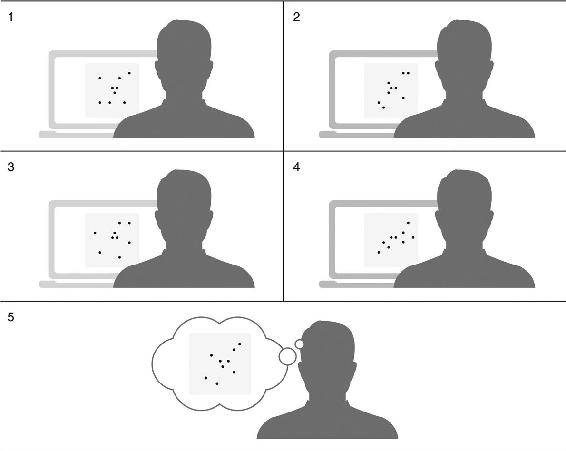
Figure 5-2: Inferring a “prototype” pattern (step 5) from examples (steps 1–4). Test subjects first saw a variety of 9-dot patterns on a 30×30 grid. They classified each pattern into one of two categories, A and B. This was called the “learning phase” of the experiment. Next, they classified more patterns, some old and some new, including the prototypes of categories A and B, which the subjects had never seen. Subjects easily categorized the prototypes but had a more difficult time with the other, new variants. That meant each subject’s brain must have constructed the prototypes despite not having seen them during the learning phase.
Goal-based concepts are super flexible and adaptable to the situation. If you’re in a pet shop to replenish your home aquarium and the salesperson asks, “What kind of fish would you like?” you might say “a goldfish” or “a black molly” but probably not “a poached salmon.” Your concept “Fish” in this situation serves a goal to purchase a pet, not to order dinner, so you’ll construct instances of the concept “Fish” that best suit your fish tank. If you’re on a snorkeling expedition, you will use “Fish” in service of a goal to find exciting wildlife, so the best instance might be a huge nurse shark or a colorful spotted boxfish. Concepts are not static but remarkably malleable and context-dependent, because your goals can change to fit the situation.
A single object can also be part of different concepts. For example, a car does not always serve the goal of transportation. Sometimes a car is an instance of the concept “Status Symbol.” In the right circumstances, a car can be a “Bed” for a homeless person, or even a “Murder Weapon.” Drive a car into the ocean and it becomes an “Artificial Reef.”
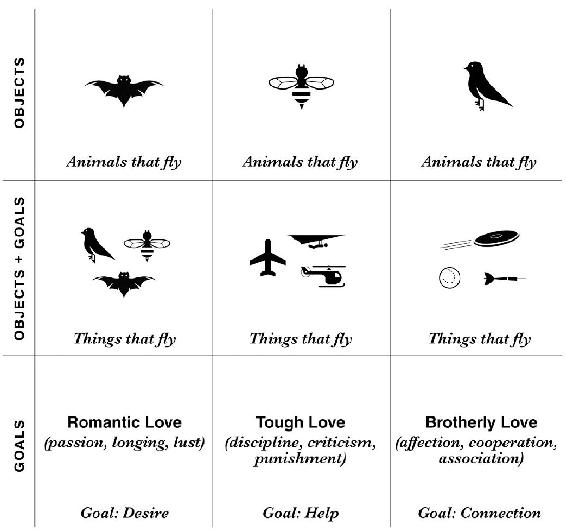
Figure 5-3: Concepts and goals. Row 1 illustrates concepts centered on a perceptual similarity, such as wings. Row 2 demonstrates that categories of objects can be goal-based. Bats, helicopters, and Frisbees share no perceptual features but can be described by a mental similarity: a common goal to move through the air. Row 3 illustrates similarity that is purely mental. The concept “Love” can be associated with different goals depending on context.
To see the real power of goal-based concepts, consider a purely mental concept such as “Things That Can Protect You from Stinging Insects.” Instances of the category are remarkably diverse: a flyswatter, a beekeeper’s suit, a house, a Maserati, a large trash can, a vacation in Antarctica, a calm demeanor, even a university degree in entomology. They share no perceptual features. This category is clearly and entirely a construction of the human mind. Not all instances work in every context: for example, when you’re gardening, whacking away at a bed of overgrown iris, and you accidentally disturb a bees’ nest and unleash a swarm in your direction, a nearby house would be far better protection than a flyswatter. Yet your brain lumps all these instances into the same category because they can achieve the same goal, safety from stings. In fact, the goal is the only thing that holds together the category.
When you categorize, you might feel like you’re merely observing the world and finding similarities in objects and events, but that cannot be the case. Purely mental, goal-based concepts such as “Things That Can Protect You from Stinging Insects” reveal that categorization cannot be so simple and static. A flyswatter and a house have no perceptual similarities. Goal-based concepts therefore free you from the shackles of physical appearance. When you walk into an entirely new situation, you don’t experience it based solely on how things look, sound, or smell. Your experience it based on your goal.
So, what’s happening in your brain when you categorize? You are not finding similarities in the world but creating them. When your brain needs a concept, it constructs one on the fly, mixing and matching from a population of instances from your past experience, to best fit your goals in a particular situation. And herein lies a key to understanding how emotions are made.17
Emotion concepts are goal-based concepts. Instances of happiness, for example, are highly variable. You can smile in happiness, sob in happiness, scream in happiness, raise your arms in happiness, clench your fists in happiness, jump up and down doling out high fives in happiness, or even be stunned motionless in happiness. Your eyes might be wide or narrowed; your breathing rapid or slow. You can have the heart-pounding, exciting happiness of winning the lottery or the calm, relaxed happiness of lying on a picnic blanket with your lover. You’ve also perceived many other people as happy in various ways. Altogether, this motley assortment of experiences and perceptions can involve different actions and inner-body changes, they may feel affectively different, and they can include different sights, sounds, and smells. To you, in the moment, however, these sets of physical changes are equivalent for some goal. Perhaps your goal is to feel accepted, to feel pleasure, to achieve an ambition, or to find meaning in life. Your concept of “Happiness” in the moment is centered on such a goal, binding together the diverse instances from your past.
Let’s unpack an example. Suppose that you are in an airport waiting for your close friend to arrive for a visit, her first one in a long time. As you stare at the exit gates and await her imminent arrival, your brain is busily issuing thousands of predictions based on your concepts, in milliseconds, all outside of your awareness. After all, there are a host of different emotions you might experience in such a situation. You could experience the happiness of seeing your friend, the anticipation that she’s about to appear, the fear that she won’t arrive, or worry that you might no longer have anything in common. You could also have a non-emotional experience, like the exhaustion of your long drive to the airport, or the perception of tightness in your chest as a symptom that you’re coming down with a cold.
Using this storm of predictions, your brain makes meaning of sensations based on your past experiences with airports and friends and illnesses and related situations. Your brain weighs its predictions based on probabilities; they compete to explain what caused your sensations, and they determine what you perceive, how you act, and what you feel in this situation. Ultimately, the most probable predictions become your perception: say, you are happy and your friend is walking through the gates right now. Not every instance of “Happiness” from your past matches the present situation, because “Happiness” is a goal-based concept composed of wildly diverse instances, but some of them had bits and pieces that matched well enough to win the competition. Do these predictions match the actual sensory input from the world and your body? Or is there prediction error that must be resolved? That’s a matter for your prediction loops to work out and, if necessary, to correct.
Let’s suppose your friend arrived safely, and later over coffee, she describes her turbulent plane flight that scared her out of her wits. She constructs an instance of “Fear” with the goal of communicating what it feels like to be strapped into the airplane seat, eyes closed, hot and queasy as the plane bumped up and down, her mind racing about her safety. When she says the word “frightened,” you also construct an instance of “Fear,” but it needn’t have exactly the same physical features as hers; you probably won’t squeeze your eyes shut, for example. Yet you can still perceive her fear and feel empathy for her. As long as your instances concern the same goal (detecting danger) in the same situation (a turbulent airplane ride), you and your friend are communicating clearly enough. On the other hand, if you constructed some other instance of “Fear,” such as the exuberant fear of riding a rollercoaster, you might have trouble understanding why your friend was so upset by the flight. Successful communication requires that you and your friend are using synchronized concepts.
Think back to Darwin’s ideas about the importance of variation within a species (chapter 1). Each animal species is a population of unique individuals who vary from one another. No feature or set of features is necessary, sufficient, or even frequent or typical of every individual in the population. Any summary of the population is a statistical fiction that applies to no individual. And most importantly, variation within a species is meaningfully related to the environment in which individuals live. Some individuals are more fit than others to pass their genetic material to the next generation. In a similar manner, some instances of concepts are more effective in a particular context to achieve a particular goal. Their competition in your brain is like Darwin’s theory of natural selection but carried out in milliseconds; the most suitable instances outlive all rivals to fit your goal in the moment. That is categorization.18
Where do emotion concepts come from? How can a concept like “Awe” have such diversity: awe of the vastness of the universe; awe of Erik Weihenmayer, who scaled Mount Everest while blind; and awe that a tiny worker ant can carry five thousand times its body weight? The classical view proposes that you are born with these concepts, or that your brain finds emotion fingerprints in people’s expressions and internalizes them as concepts. But we know that scientists haven’t found such fingerprints, and infants show no evidence of being born knowing “Awe.”
The human brain, it turns out, bootstraps a conceptual system into its wiring within the first year of life. This system is responsible for the wealth of emotion concepts that you now employ to experience and perceive emotions.
The newborn brain has the ability to learn patterns, a process called statistical learning. The moment that you burst into this strange new world as a baby, you were bombarded with noisy, ambiguous signals from the world and from your body. This barrage of sensory input was not random: it had some structure. Regularities. Your little brain began computing probabilities of which sights, sounds, smells, touches, tastes, and interoceptive sensations go together and which don’t. “Those edges form a boundary. Those two blobs are part of a bigger blob. That brief silence was a separator.” Little by little, but with surprising speed, your brain learned to resolve this ocean of vague sensation into patterns: sights and sounds, smells and tastes, touches and interoceptive sensations, and combinations thereof.19
Scientists have debated for hundreds of years over what you’re born with versus what you learn, and I won’t enter that debate. Let’s just say that one thing you’re born with is a fundamental ability to learn from regularities and probabilities around you. (In fact, you learn statistically even in utero, which makes it complicated to determine whether certain concepts are innate or learned.) Your prodigious capacity for statistical learning set you on the path toward the particular kind of mind, with the particular system of concepts, that you have today.20
Statistical learning in humans was first discovered in studies of language development. Babies have a natural interest in listening to speech, perhaps because the sounds occurred alongside body budgeting from birth, and even in utero. As they hear the sounds streaming along, they gradually infer the boundaries between phonemes, syllables, and words. From blobs of sound like its
Statistical learning is not the only way that humans acquire knowledge, but this learning begins very early in life and goes well beyond language. Studies show that babies easily learn statistical regularities in sound and vision, and it’s reasonable to assume the same for the rest of the senses plus interoceptive sensations. What’s more, babies can learn complex regularities that span multiple senses. If you fill a box with blue and yellow balls, and the yellow balls make a squeaking sound while the blue ones are silent, infants can generalize the association between color and sound.22
Babies use statistical learning to make predictions about the world, guiding their actions. Like little statisticians, they form hypotheses, assess probabilities based on their knowledge, integrate new evidence from the environment, and perform tests. In one creative study by the developmental psychologist Fei Xu, ten- to fourteen-month-old children first expressed a preference for pink or black lollipops, then were shown two candy jars: one containing more black lollipops than pink, and one with more pink than black. The experimenter then closed her eyes and drew one lollipop from each jar so infants could see only the stick, not the color. Each lollipop was placed into a separate, opaque cup with only the stick showing. Infants crawled to the cup that was statistically more likely to contain their preferred color, because it came from a jar where that color was in the majority. Experiments like this demonstrate that infants are not merely reactive to the world. Even from a very young age, they actively estimate probabilities based on patterns that they observe and learn, to maximize the outcomes they desire.23
Humans are not the only animals that learn statistically: non-human primates, dogs, and rats can do it, among others. Even single-celled animals engage in statistical learning and then prediction: they not only respond to changes in their environment but anticipate them. Human infants, however, do more than statistically learn simple concepts. They also quickly learn that some of the information they need about the world resides in the minds of the people around them.24
You might have noticed that young children assume that other people share their preferences. A one-year-old who likes crackers better than broccoli believes that everyone else in the world does too. She cannot infer mental states in others the way that Governor Malloy’s audience inferred that he was filled with sorrow during his speech about the Sandy Hook massacre. Even so, Xu and her students have successfully observed the rudiments of mental inference even in young children as they learn statistically. Sixteen-month-old children were shown two bowls, one containing boring white cubes and the other full of more interesting, colorful Slinky toys. When these toddlers were allowed to choose an object from either bowl, sure enough they chose a favorite Slinky for themselves and for the experimenter. But then the experimenter revealed a third bowl containing many Slinkys and only a few cubes, and in full view of the children, he chose five white cubes for himself. When the children were asked to pick from that bowl, they gave the experimenter a cube! In other words, the children were able to learn a subjective preference of the experimenter that was different from their own. This realization, that an object has positive value for someone else, is an example of mental inference.25
Going beyond preferences, babies can even infer other people’s goals statistically. They can tell the difference when an experimenter chooses a pattern of colored balls randomly versus with intent. In the latter case, they can infer that the experimenter’s goal is to choose particular colors, and they’ll expect that the experimenter will continue following it.* It seems as if infants automatically try to guess the goal behind another person’s actions; they form a hypothesis (based on past experience in similar situations) and predict the outcome that will occur several minutes later.26
Statistical learning alone, however, does not equip humans to learn purely mental, goal-based concepts whose instances share no perceptual similarities. Take the concept “Money,” for example. You can’t learn it simply by viewing a piece of colored paper, a gold nugget, a seashell, and a pile of barley or salt, each of which has been deemed currency by some society in history. Likewise, instances of an emotion category such as “Fear” don’t have enough statistical regularity—as demonstrated in chapter 1—to allow a human brain to build a concept based on perceptual similarities. To build a purely mental concept, you need another secret ingredient: words.
From infancy, little human brains have an affinity for processing speech signals and quickly realize that speech is one way to access the information inside other people’s minds. They’re particularly attuned to adult “baby talk” with a higher and more variable pitch, shorter sentences, and strong eye contact.27
Even before infants understand what words mean in a conventional sense, the sounds of the words introduce statistical regularity that speeds concept learning. The developmental psychologists Sandra R. Waxman and Susan A. Gelman, leaders in this area of research, hypothesize that words invite an infant to form a concept, but only when adults speak with intent to communicate: “Look, sweetie: a flower!”28
Waxman demonstrated this power of words in infants as young as three months. The infants first viewed pictures of different dinosaurs. As each image was shown, infants heard an experimenter speak a made-up word, “toma.” When these infants were later shown pictures of a new dinosaur and a non-dinosaur such as a fish, those who had heard the word could distinguish more reliably which pictures depicted a “toma,” implying that they had formed a simple concept. When the same experiment was performed with audio tones instead of human speech, the effect never materialized.29
Spoken words give the infant brain access to information that can’t be found by observing the world and resides only in the minds of other people, namely, mental similarities: goals, intentions, preferences. Words allow infants to begin growing goal-based concepts, including emotion concepts.
A little human brain, bathed in the words of others around it, accumulates simple concepts. Some concepts are learned without words, but words confer distinct advantages to a developing conceptual system. A word might begin as a mere stream of sounds to the infant, just one part of the whole statistical learning package, but it quickly becomes more than that. It becomes an invitation for the infant to create similarities among diverse instances. A word tells the infant, “Do you see all these objects that look different physically? They have an equivalence that is mental.” That equivalence is the basis for a goal-based concept.30
Fei Xu and her students have demonstrated this experimentally by showing objects to ten-month-old infants, giving the objects nonsense names like “wug” or “dak.” The objects were wildly dissimilar, including dog-like and fish-like toys, cylinders with multicolored beads, and rectangles covered in foam flowers. Each one also made a ringing or rattling noise. Nevertheless, the infants learned patterns. Infants who heard the same nonsense name across several objects, regardless of their appearance, expected those objects to make the same noise. Likewise, if two objects had different names, the infants expected them to make different noises. This is a remarkable feat for infants because they used the sounds of a word to predict whether objects made the same noise or not, learning a pattern that transcended mere physical appearance. Words encourage infants to form goal-based concepts by inspiring them to represent things as equivalent. In fact, studies show that infants can more easily learn a goal-based concept, given a word, than a concept defined by physical similarity without a word.31
I don’t know about you, but every time I think about this, I find it bloody amazing. Any animal can view a bunch of similar-looking objects and form a concept of them. But you can show human infants a bunch of objects that look different, sound different, and feel different, and merely add a word—a WORD—and these little babies form a concept that overcomes the physical differences. They understand that the objects have some kind of psychological similarity that can’t be immediately perceived through the five senses. This similarity is what we called the goal of the concept. The infant creates a new piece of reality, a thing called a “wug” with the goal “to make a ringing noise.”
From an infant’s perspective, the concept “Wug” did not exist in the world before an adult taught it to her. This sort of social reality, in which two or more people agree that something purely mental is real, is a foundation of human culture and civilization. Infants thereby learn to categorize the world in ways that are consistent, meaningful, and predictable to us (the speakers), and eventually to themselves. Their mental model of the world becomes similar to ours, so we can communicate, share experiences, and perceive the same world.
When my daughter, Sophia, was a toddler and I bought her a toy car, I didn’t realize I was helping to extend her goal-based categories, honing her conceptual system for creating social reality. She’d hold that car close to a toy truck, and they’d transform into “mama” and “baby” as she made them “kiss.” Sometimes our goddaughter, Olivia, would visit, who is the same age, and the two girls would climb into the bathtub and engage in elaborate, imaginary dramas for hours, imposing new functions on toys, bars of soap, towels, and various bathroom items as the props in their water opera. A defining moment of humanity occurs when one child becomes an all-powerful being by draping a washcloth over her head and brandishing a toothbrush, and the second child kneels before her in supplication.
When we, as adults, speak a word to a child, an act of great significance takes place without fanfare. In that moment, we offer the child a tool to expand reality—a similarity that is purely mental—and she incorporates it into the patterns that are being laid down inside her own brain for future use. In particular, as we shall now see, we hand her the tools to make and perceive emotions.
Infants are born unable to see faces. They have no perceptual concept of “Face” and so are experientially blind. They quickly learn to see human faces, however, from the perceptual regularities alone: two eyes up top, a nose in the middle, and a mouth.32
If we observe this through the lens of the classical view of emotion, we could tell a story that infants statistically learn emotion concepts the same way, from perceptual regularities in the instances of happiness, sadness, surprise, anger, and other emotion categories that exist in the body or in other people’s so-called emotional expressions. Many researchers, inspired by the classical view, have simply assumed that children’s emotion concepts are scaffolded onto an inborn or early-to-develop understanding of facial expressions. This supposedly explains how children learn emotion words and also the causes and consequences of emotions.33
The stumbling block for this whole idea, we have learned, is that consistent emotion fingerprints don’t exist in the face and body. Children must be gaining emotion concepts in some other way.
We’ve also just seen that words invite infants to equate wildly dissimilar objects. Words encourage infants to search for similarities beyond the physical, similarities that act like a mental glue for concepts. Babies could reasonably learn emotion concepts in this manner. Instances of “Anger” might share no perceptual similarities, but the word “angry” could be grouping them into a single concept, just as infants grouped “wugs” and “daks.” I’m speculating for the moment, but the idea fits the data we’ve discussed.
I try to imagine how my daughter, Sophia, might have learned emotion concepts when she was an infant, guided by the emotion words that my husband and I spoke to her intentionally. In our culture, one goal in “Anger” is to overcome an obstacle that someone blameworthy has put in your path. So, when a little friend would smack Sophia, sometimes she would cry and other times she’d swat back. When she didn’t like her food, sometimes she’d spit it out and other times she’d smile and tip the bowl onto the floor. These physical actions were accompanied by different facial movements, different changes in her body budget (to match her physical actions), and different interoceptive patterns. Within this ongoing stream of activity, her father and I would utter streams of sounds: “Sophie, sweetie, are you angry?” “Don’t be angry, honey.” “Sophie, you’re feeling angry.”34
At first, these noises must have been novel to Sophia, but over time, if my hypothesis is correct, she learned statistically to associate these diverse body patterns and contexts with the sounds “an-gry,” just like associating a squeaking toy with the sound “wug.” Eventually, the word “angry” invited my daughter to search for a way in which these instances were the same, even if on the surface they looked and felt different. In effect, Sophia formed a rudimentary concept whose instances were characterized by a common goal: overcoming an obstacle. And most importantly, Sophia learned which actions and feelings most effectively achieved this goal in each situation.
In this way, Sophia’s brain would have bootstrapped the concept “Anger” into its neural architecture. When we first used the word “angry” with Sophia, we constructed her experiences of anger with her. We focused her attention, guiding her brain to store each instance in all its sensory detail. The word helped her to create commonalities with all the other instances of “Anger” already in her brain. Her brain also captured what preceded and followed those experiences. All of this became her concept of “Anger.”35
In our earlier encounter with Connecticut Governor Malloy, I described how viewers inferred his emotional state—intense sadness—by observing his movements and voice in a certain context. I think children learn to do the same thing. As they learn a concept such as “Anger,” they can predict and give meaning to other people’s movements and vocalizations—smiles, shrugs, shouts, whispers, tightened jaws, widened eyes, even motionlessness—as well as their own bodily sensations, to construct perceptions of anger. Or, they can focus on predicting and giving meaning to their own interoceptive sensations, along with sensations from the world, to construct an emotional experience. As Sophia grew older, she extended her concept of “Anger” to people who slam doors, adding to her population of instances. And when she encountered a sneezing person and said, “Mama, that man is angry,” and I corrected her, she honed her concept of “Anger” yet again. Her brain gave sensations meaning, using concepts that fit the situation, to construct an instance of emotion.36
If I am correct, then, as children continue to develop their concept of “Anger,” they learn that not all instances of “Anger” are constructed for the same goal in every situation. “Anger” can also be for protecting oneself against an offense, dealing with someone who acted unfairly, desiring aggression toward another person, wanting to win a competition or to enhance performance in some way, or wishing to appear powerful.37
Following this line of reasoning, Sophia eventually would learn that anger-related words like “irritation,” “scorn,” and “vengeance” each referred to distinct goals that glued together variable populations of instances. And with this, Sophia developed an expert vocabulary of anger-related concepts that prepared her for the life of a typical American teenager. (For the record, she’s not much for experiencing scorn or vengeance on a regular basis, but the concepts come in handy with other adolescents.)
My guiding hypothesis, as you can see from my story of Sophia’s development, is that emotion words hold the key to understanding how children learn emotion concepts in the absence of biological fingerprints and in the presence of tremendous variation. Not the words in isolation, mind you, but words spoken by other humans in the child’s affective niche who use emotion concepts. These words invite a child to form goal-based concepts for “Happiness,” “Sadness,” “Fear,” and every other emotion concept in the child’s culture.
So far, my hypothesis about emotion words is only reasoned speculation because the science of emotion is missing a systematic exploration of this question. Certainly nothing like the creative studies of Waxman, Xu, Gelman, and other developmental psychologists has yet been conducted for emotion concepts and categories. But we have some compelling evidence that is consistent with this hypothesis.
Some of the evidence comes from careful testing of children in the lab, which suggests that they don’t develop adult-like emotion concepts like “Anger,” “Sadness,” and “Fear” until around age three. Younger children in Western cultures use words like “sad,” “scared,” and “mad” interchangeably to mean “bad”; they exhibit low emotional granularity, just like my graduate school test subjects for whom “depressed” and “anxious” meant nothing more than “unpleasant.” As parents, we may look at our infants and perceive emotions in their cries, wriggles, and smiles. Certainly infants feel pleasure and distress from birth, and affect-related concepts (pleasant/unpleasant) show up by three to four months of age. But there’s a lot of research to indicate that adult-like emotion concepts develop later. Just how much later is an open question.38
Other evidence for my hypothesis about emotion words comes from a surprising source: people who work with chimpanzees. Jennifer Fugate, a former postdoctoral fellow in my lab, collected photographs of chimpanzee facial configurations that some scientists treat as emotional expressions, including “play” faces, “scream” faces, “bared teeth” faces, and “hoot” faces. She tested chimp experts and novices to see if they could recognize these configurations, and at first, none of them could do it. So we performed an experiment similar to those used with infants: half of our experts and novices viewed pictures of chimp facial configurations alone, and half viewed them labeled with made-up words, such as “peant” for the play face and “sahne” for the scream face. In the end, only our subjects who learned the words could correctly categorize new chimp facial configurations, demonstrating that they had acquired the concepts for the face categories.39
As children grow up, they definitely form a whole conceptual system for emotion. This includes all the emotion concepts they’ve learned in their lives, anchored by the words that name those concepts. They categorize different facial and bodily configurations as the same emotion, and a single configuration as many different emotions. Variation is the norm. So where is the statistical regularity that holds together a concept like “Happiness” or “Anger”? In the words themselves. The most visible commonality that all instances of “Anger” share is that they’re all called “anger.”
Once children have the initial emotion concept, other factors besides words become important to their developing conceptual system for emotion. They come to realize that emotions are events that develop over time. An emotion has a beginning or cause that precedes it (“My mommy walked into the room”). Then there’s a middle, the goal itself that is happening now (“I am happy to see my mommy”). Then there’s an end, the consequence of meeting the goal, which happens later (“I’ll smile and my mommy will smile back and give me a hug”). This means that an instance of an emotion concept helps to make sense of longer continuous streams of sensory input, dividing them into distinct events.40
You see emotions in blinks, furrowed brows, and other muscle twitches; you hear emotions in the pitch and lilt of voices; you feel emotions in your own body, but the emotional information is not in the signal itself. Your brain was not programmed by nature to recognize facial expressions and other so-called emotional displays and then to reflexively act on them. The emotional information is in your perception. Nature provided your brain with the raw materials to wire itself with a conceptual system, with input from a chorus of helpful adults who spoke emotion words to you in a deliberate and intentional way.
Concept learning does not stop in childhood—it continues throughout life. Sometimes a new emotion word appears in your primary language, engendering a new concept. For example, schadenfreude, a German emotion word meaning “pleasure from someone else’s misfortune,” has now been incorporated into English. Personally, I’d like to add the Greek word stenahoria to English, which refers to a feeling of doom, hopelessness, suffocation, and constriction. I can think of a few romantic relationships where this emotion concept would have come in handy.41
Other languages commonly have emotion words whose associated concepts have no equivalent in English. For example, Russian has two distinct concepts for what Americans call “Anger.” German has three distinct “Angers” and Mandarin has five. If you were to learn any of these languages, you’d need to acquire these new emotion concepts to construct perceptions and experiences with them. You’ll develop these concepts faster if you live with native speakers of the new language. The new concepts are affected by the older ones from your primary language. Native speakers of English who learn Russian, for example, must learn to distinguish between anger at a person, called serdit’sia, and anger for more abstract reasons such as the political situation, known as zlit’sia. The latter concept is more similar to the English concept of “Anger,” but Russian speakers use the former more frequently; as a result, English speakers use serdit’sia more frequently as well and wind up misapplying it. This is not an error in a biological sense, since neither concept has a biological fingerprint, but in a cultural sense.42
New emotion concepts from a second language can also modify those of your primary language. A research scientist in my lab, Alexandra Touroutoglou, came from Greece to learn neuroscience. As she became more proficient at speaking English, her Greek and English emotion concepts began to blend. For example, Greek has two concepts for “Guilt,” one for minor infractions and another for serious transgressions. English covers both situations with the single word “guilty.” When Alex would speak with her sister who was still in Greece, Alex would use the “major” guilt word (enohi) when describing, say, that she ate too much pie at our lab’s beach party. To her sister, Alex came across as overly dramatic. In this case, Alex constructed her dessert experience using the English concept for guilt.43
I hope by now you appreciate the drama that is going on here. Emotion words are not about emotional facts in the world that are stored like static files in your brain. They reflect the varied emotional meanings you construct from mere physical signals in the world using your emotion knowledge. You acquired that knowledge, in part, from the collective knowledge contained in the brains of those who cared for you, talked to you, and helped you to create your social world.
Emotions are not reactions to the world; they are your constructions of the world.
Once your conceptual system is established in your brain, you need not explicitly recall or speak an emotion word to construct an instance of an emotion. In fact, you can experience and perceive an emotion even if you don’t have a word for it. Most of us who speak English were able to enjoy someone else’s misfortune long before the word schadenfreude entered our language. All you need is a concept. How do you get a concept without a word? Well, your brain’s conceptual system has a special power called conceptual combination. It combines existing concepts to create your very first instance of a novel concept of emotion.44
My friend Batja Mesquita is a Dutch cultural psychologist, and the first time I traveled to visit her in Belgium, she told me that we were sharing the emotion gezellig. Curled up in her living room, sharing wine and chocolates, she explained that this emotion means the comfort, coziness, and togetherness of being at home, with friends and loved ones. Gezellig is not an internal feeling that one person has for another but a way of experiencing oneself in the world. No single word in English describes the experience of gezellig, but once Batja explained it to me, I immediately experienced it. Her use of the word invited me to form a concept as infants do, but through conceptual combination—I automatically employed my concepts of “Close Friend,” “Love,” and “Delight,” with a touch of “Comfort” and “Well-Being.” This translation was not perfect, though, because in my American way of experiencing gezellig, I used emotion concepts that focus more on internal feelings than those that describe the situation.45
Conceptual combination is a potent capability of the brain. Scientists still debate on the mechanisms responsible for it, but they pretty much agree that it’s a basic function of the conceptual system. It allows you to construct a potentially limitless number of novel concepts from your existing ones. This includes goal-based concepts like “Things That Can Protect You from Stinging Insects,” in which the goal is short-lived.46
Conceptual combination is powerful, but it is far less efficient than having a word. If you asked me what I had for dinner this evening, I could say “baked dough with tomato sauce and cheese,” but this is much less efficient than saying “pizza.” Strictly speaking, you don’t need an emotion word to construct an instance of that emotion, but it’s easier when you have a word. If you want the concept to be efficient, and you want to transmit the concept to others, then a word is pretty handy.
Infants can benefit from this “pizza effect” before they can speak. For example, prelinguistic infants generally can hold about three objects in mind at a time. If you hide toys in a box while an infant watches, she can remember up to three hiding places. However, if you label several toys with a nonsense word like “dax” and several more with “blicket” before hiding them—assigning the toys to categories—the infant can hold up to six objects in mind! This happens even if all six toys are physically identical, strongly suggesting that infants gain the same efficiency benefits from conceptual knowledge that adults do. Conceptual combination plus words equals the power to create reality.47
In many cultures, you will find people who have hundreds, perhaps thousands of emotion concepts, that is, they exhibit high emotional granularity. In English, for example, they might have concepts for anger, sadness, fear, happiness, surprise, guilt, wonder, shame, compassion, disgust, awe, excitement, pride, embarrassment, gratitude, contempt, longing, delight, lust, exuberance, and love, to name a few. They’ll also have distinct concepts for interrelated words like “aggravation,” “irritation,” “frustration,” “hostility,” “rage,” and “disgruntlement.” This person is an emotion expert. A sommelier of emotion. Each word corresponds to its own emotion concept, and each concept can be used in the service of at least one goal, but usually many different goals. If an emotion concept is a tool, then this person has a gigantic toolbox fit for a skilled craftsperson.
People who exhibit moderate emotional granularity might have dozens of emotion concepts rather than hundreds. In English, they might have concepts for anger, sadness, fear, disgust, happiness, surprise, guilt, shame, pride, and contempt; perhaps not many more than the so-called basic emotions. For these folks, words like “aggravation,” “irritation,” “frustration,” “hostility,” “rage,” “disgruntlement,” and so on would all belong to the concept “Anger.” This person has your run-of-the-mill little red toolbox, filled with some pretty handy tools. Nothing fancy, but they get the job done.
People who exhibit low emotional granularity will have only a few emotion concepts. In English, they might have words in their vocabulary like “sadness,” “fear,” “guilt,” “shame,” “embarrassment,” “irritation,” “anger,” and “contempt,” but those words all correspond to the same concept whose goal is something like “feeling unpleasant.” This person has a few tools—a hammer and Swiss Army knife. Maybe this person gets along fine, but a few new tools wouldn’t hurt, at least if he or she lives in a Western cultural setting. (My husband jokes that before we met, he knew only three emotions: happy, sad, and hungry.)
When a mind has an impoverished conceptual system for emotion, can it perceive emotion? From scientific experiments in our own lab, we know that the answer is generally no. As you learned in chapter 3, we can easily interfere with people’s ability to perceive anger in a scowl, sadness in a pout, and happiness in a smile by impairing their access to their emotion concepts.
If people lack a well-developed conceptual system for emotion, what is their emotional life like? Will they feel only affect? These questions are difficult to test scientifically. Emotional experiences have no objective fingerprints in the face, body, or brain that would enable us to compute an answer. The best we can do is ask people how they feel, but they’d have to use emotion concepts to answer the question, defeating the purpose of the experiment!
The way around this conundrum is to study people who have a naturally impoverished conceptual system for emotion, a condition called alexithymia, which by one estimate affects about 10 percent of the world’s population. Its sufferers do have difficulty experiencing emotion, as the theory of constructed emotion would predict. In a situation where a person with a working conceptual system might experience anger, people with alexithymia are more likely to experience a stomachache. They complain of physical symptoms and report feelings of affect but fail to experience them as emotional. People with alexithymia have difficulty perceiving emotion in others as well. If a person with a working conceptual system saw two men shouting at each other, she might make a mental inference and perceive anger, whereas a person with alexithymia would report perceiving only shouting. People with alexithymia also have a restricted emotion vocabulary and have difficulty remembering emotion words. These clues provide further evidence that concepts are critical for experiencing and perceiving emotion.48
Concepts are linked to everything you do and perceive. And as you learned in the previous chapter, everything you do and perceive is linked to your body budget. Therefore, concepts must be linked to your body budget. And, in fact, they are.
When you were born, you couldn’t regulate your budget, so your caregivers did it for you. Each time your mother picked you up to feed you was a multisensory event with regularities: the sight of your mother’s face, the sound of her voice, her motherly aroma, her touch, the taste of her milk (or formula), and your interoceptive sensations associated with being held and cuddled and fed. Your brain captured the entire sensory context in the moment, as a pattern of sights, sounds, smells, tastes, touches, and interoceptive sensations. This is how concepts begin to form. You learn in a multisensory way. Your inner-body changes and their interoceptive consequences are part of every concept that you learn, whether you’re aware of it or not.49
When you categorize with your multisensory concepts, you’re also regulating your body budget. When you played with a ball as a baby, you categorized it not just by its color and shape and texture (and by the smell of the room, the feel of the floor against your hands and knees, the lingering taste of whatever you last ate, and so on), but also by your interoceptive sensations in the moment. This allowed you to predict your actions, like swatting the ball or putting it into your mouth, which influenced your body budget.
As an adult, when you learn that an event is an instance of some emotion, such as “Embarrassment,” you likewise capture the event’s sights, sounds, smells, tastes, touches, and interoceptive sensations together as your concept. And when you make meaning using that concept, your brain again takes into account your entire situation. For example, if you surface from under the ocean waves onto the beach and notice that your swimsuit has fallen off, your brain might construct an instance of “Embarrassment.” Your conceptual system samples instances of embarrassed nakedness from your past, which is more taxing on your body budget than the refreshed nakedness after stepping out of a sauna, or the comfortable nakedness after a passionate afternoon with your lover. Depending on the immediate circumstances, your brain might also sample fully clothed instances of “Embarrassment” where you felt exposed, like answering a question wrongly in class, but not more private embarrassment like forgetting your best friend’s birthday. Your brain samples from your larger conceptual system, as you’ve seen, according to your goal in a given situation. The winning instance guides you to regulate your body budget appropriately.50
All categorizations are based on probabilities. For example, if you are on vacation in Paris and you perceive a stranger frowning at you in a subway car, you might not have any past experience with that stranger or that subway, and you might not have visited Paris before, but your brain does have past experiences of other frowning people in unfamiliar places. Your brain can then construct a sample of concepts, based on past experience and probability, to use as predictions. Each added piece of context (Are you alone or is the car crowded? Is it a man or a woman? With raised or furrowed eyebrows?) allows your brain to hone the probabilities until it settles on the best-fitting concept that will minimize prediction error. This is categorization with emotion concepts. You aren’t detecting or recognizing emotion in someone’s face. You aren’t recognizing a physiological pattern in your own body. You are predicting and explaining the meaning of those sensations based on probability and experience. This happens each time you hear an emotion word or are faced with an array of sensations.51
All of this categorization, context, and probability may seem remarkably counterintuitive. When I’m walking through the woods and see a monstrous snake in my path, I certainly don’t say to myself, “Well, I actively predicted that snake from a population of competing concepts, which were constructed from the past and have some degree of similarity to this current set of sensations, thereby creating my perception.” I just “saw a snake.” And when I gingerly turn on my heels and run, I don’t think, “I honed my many predictions down to one winning instance of the emotion category ‘Fear,’ causing me to run away.” No, I just feel terrified with an urge to flee. The fear comes on suddenly and uncontrollably, as if a stimulus (the snake) triggered a little bomb (a neural fingerprint) causing the response (fear and running).
When I relate the snake story to my friends later, over coffee, I don’t tell them, “Having constructed an instance of the concept ‘Fear’ to fit my surroundings using my past experience, my brain changed the firing of my visual neurons before the snake appeared on the path, preparing me to see the snake and to run in the other direction, and once my prediction was confirmed, my sensations were categorized, and I constructed an experience of fear that explained my sensations in terms of a goal, and I made a mental inference to perceive the snake as the cause of my feelings, and the running away as their consequence.” No, my story is much simpler: “I saw a snake. I screamed and fled.”
Nothing about my encounter with the snake tells me that I was an architect of the whole experience. Nevertheless, I was that architect, whether I felt it or not, just as you were with the blobby bee. Even before I was aware of the snake, my brain was busy constructing an instance of fear. Or, if I am an eight-year-old girl hoping for a pet snake someday, I might construct an instance of excitement. If I am her parent who will allow a snake into my house over my dead body, I might construct an instance of irritation. The stimulus-response brain is a myth, brain activity is prediction and correction, and we construct emotional experiences outside of awareness. This explanation fits the architecture and operation of the brain.52
Simply put: I did not see a snake and categorize it. I did not feel the urge to run and categorize it. I did not feel my heart pounding and categorize it. I categorized sensations in order to see the snake, to feel my heart pounding, and to run. I correctly predicted these sensations, and in doing so, explained them with an instance of the concept “Fear.” This is how emotions are made.
Right now, as you read these words, your brain is wired with a powerful conceptual system for emotion. It began purely as an information-gaining system, acquiring knowledge about your world through statistical learning. But words allowed your brain to go beyond the physical regularities that you learned, to invent part of your world, in a collective with other brains. You created powerful, purely mental regularities that helped you control your body budget in order to survive. Some of these mental regularities are emotion concepts, and they function as mental explanations for why your heart thumps in your chest, why your face flushes, and why you feel and act the way you do in certain circumstances. When we share those abstractions with each other, by synchronizing our concepts during categorization, we can perceive each other’s emotions and communicate.
That, in a nutshell, is the theory of constructed emotion—an explanation for how you experience and perceive emotion effortlessly without the need for emotion fingerprints. The seeds of emotion are planted in infancy, as you hear an emotion word (say, “annoyed”) over and over in highly varied situations. The word “annoyed” holds this population of diverse instances together as a concept, “Annoyance.” The word invites you to search for the features that the instances have in common, even if those similarities exist only in other people’s minds. Once you have this concept established in your conceptual system, you can construct instances of “Annoyance” in the presence of highly variable sensory input. If the focus of your attention is on yourself during categorization, then you construct an experience of annoyance. If your attention is on another person, you construct a perception of annoyance. And in each case, your concepts regulate your body budget.
When another driver cuts you off in traffic and your blood pressure rises, your hands become sweaty, and you shout as you slam on the brakes and feel annoyed . . . this is an act of categorization. When your young child picks up a sharp knife and your breathing slows, your hands are dry, you smile, and you calmly ask her to put it down as you feel annoyed inside . . . this is an act of categorization. When you see another person staring at you oddly with wide eyes and perceive him as annoyed, this is also an act of categorization. In all these instances, your conceptual knowledge of “Annoyance” drives the categorization, and your brain makes meaning that is tied to context. My story in chapter 2 about the guy in graduate school who asked me to lunch, when I thought I felt attraction but in fact I had the flu, is another example of categorization. My body budget was disrupted by a virus, but I experienced the resulting change in affect as attraction to my lunch partner because I’d constructed an instance of infatuation. If I’d categorized my symptoms in a different context, I might have understood them as something that a few Tylenol and a couple of days’ rest could cure.
Your genes gave you a brain that can wire itself to its physical and social environment. The people around you, in your culture, maintain that environment with their concepts and help you live in that environment by transmitting those concepts from their brains to yours. And later, you transmit your concepts to the brains of the next generation. It takes more than one human brain to create a human mind.
What I have not yet explained, however, is how this all works inside the brain: the biology of categorization. What brain networks are involved? How is this process related to your brain’s intrinsic, predictive powers, and how does it affect your all-important body budget? That is what we’ll discuss next as you learn the final piece of the puzzle for how emotions are made in the brain.