7
If a tree falls in the forest and no one is present to hear it, does it make a sound? This clichéd question has been asked to death by philosophers and grade-school teachers, but it also reveals something critical about human experience and, in particular, how we experience and perceive emotion.
The common-sense answer to this riddle is yes, of course a falling tree makes a sound. If you and I were walking in the forest at the time, we would clearly hear the cracking of the wood, the rustling of the leaves, and the monstrous thud as the trunk slammed into the forest floor. It seems obvious that this sound would be present even if you and I were not.
The scientific answer to the riddle, however, is no. A falling tree itself makes no sound. Its descent merely creates vibrations in the air and the ground. These vibrations become sound only if something special is present to receive and translate them: say, an ear connected to a brain. Any mammalian ear will do nicely. The outer ear gathers changes in air pressure and focuses them on the eardrum, producing vibrations in the middle ear. These vibrations move fluid in the inner ear over little hairs that translate the pressure changes into electrical signals that are received by the brain. Without this special machinery, there is no sound, only air movement.
Even after the brain receives these electrical signals, its task is not complete. This wave must still be interpreted as the sound of a toppling tree. For this, the brain needs the concept of “Tree” and what trees can do, such as fall in a forest. This concept can come from prior experience with trees, or from learning about trees in a book, or from another person’s description. Without the concept, there is no crashing timber, only the meaningless noise of experiential blindness.
A sound, therefore, is not an event that is detected in the world. It is an experience constructed when the world interacts with a body that detects changes in air pressure, and a brain that can make those changes meaningful.1
Without a perceiver there is no sound, only physical reality. In this chapter, we explore another kind of reality that we humans construct, which exists only for those who are equipped to perceive it. Within this effortless ability lies an answer to the question, “What is an emotion?” It also explains how emotions are passed down through the generations without biological fingerprints.
Next, consider another question: “Is an apple red?” This is also a riddle, but less obviously so than the one about the falling tree. Again, the common-sense answer is yes, the apple is red (or yellow or green if you prefer). The scientific answer, however, is no. “Red” is not a color contained in an object. It is an experience involving reflected light, a human eye, and a human brain. We experience red only when light of a certain wavelength (say, 600 nanometers) reflects from an object (in the midst of other reflections at other wavelengths), and only while a receiver translates this contrasting array of light into visual sensations. Our receiver is the human retina, which uses its three types of photoreceptors, called cones, to convert the reflected light into electrical signals made meaningful by a brain. In a retina that’s missing a medium or long cone, light at 600 nanometers is experienced as gray. And in the absence of a brain, there is no experience of color at all, only reflected light in the world.2
Even with the right equipment in place (the eye and the brain), the experience of a red apple is not a done deal. For the brain to convert a visual sensation into the experience of red, it must possess the concept “Red.” This concept can come from prior experience with apples, roses, and other objects you perceive as red, or from learning about red from other people. (Even people who are blind since birth have a concept of “Red” that they learn from conversations and books.) Without this concept, the apple would be experienced differently. For instance, to the Berinmo people of Papua New Guinea, apples reflecting light at 600 nanometers are experienced as brownish, because Berinmo concepts for color divide up the continuous spectrum differently.3
These riddles about apples and trees invite us, as perceivers, to wrestle with two conflicting points of view. On one hand, common sense tells us that sounds and colors exist in the world beyond our skin, and we detect them with eyes and ears that carry the information to the brain. On the other hand, as we learned in chapters 4–6, we humans are architects of our own experiences. We do not passively detect physical changes in the world. We actively participate in constructing our experiences even though we are mostly unaware of that fact. An object might seem to transmit information about its color into your brain, but the information required for you to experience color comes mainly from your predictions, corrected by the light that your brain takes in from the world.
With prediction, you can “see” color in your mind’s eye on demand. Try right now to see the green colors of a verdant forest. The colors might not be as vivid as usual and the experience may be fleeting, but you can probably do it. And as you do, neurons in your visual cortex change their firing. You are simulating green. You can also imagine a crashing tree and hear the sound in your mind. Try it, and neurons in your auditory cortex will change their firing.
Changes in air pressure and wavelengths of light exist in the world, but to us, they are sounds and colors. We perceive them by going beyond the information given to us, making meaning from them using knowledge from past experience, that is, concepts. Every perception is constructed by a perceiver, usually with sensory inputs from the world as one ingredient. Only certain changes in air pressure are heard as trees falling. Only some of the wavelengths of light striking our retinas are transformed into the experience of red or green. To believe otherwise is naive realism, as if perceptions were synonymous with reality.
A third and final riddle is, “Are emotions real?” You might think this question is ridiculous, a classic example of academic indulgence. Of course emotions are real. Think about the last time you were thrilled or sad or furious. These were clearly real feelings. But in fact, this third riddle is like the falling tree and the red apple: a dilemma about what exists in the world versus in the human brain. The riddle forces us to confront our assumptions about the nature of reality and our role in creating it. But here, the answer is a bit more complex, because it depends on what we mean by “real.”
If you talk to a chemist, “real” is a molecule, an atom, a proton. To a physicist, “real” is a quark, a Higgs boson, or maybe a collection of little strings vibrating in eleven dimensions. They are supposed to exist in the natural world whether or not humans are present—that is, they are thought to be perceiver-independent categories. If all human life left this planet tomorrow, subatomic particles would still be here.4
But evolution has provided the human mind with the ability to create another kind of real, one that is completely dependent on human observers. From changes in air pressure, we construct sounds. From wavelengths of light, we construct colors. From baked goods, we construct cupcakes and muffins that are indistinguishable except by name (chapter 2). Just get a couple of people to agree that something is real and give it a name, and they create reality. All humans with a normally functioning brain have the potential for this little bit of magic, and we use it all the time.
If you doubt your power as a conjurer of reality, look at figure 7-1. This plant is daucus carota, better known as Queen Anne’s lace. Usually the outer blooms are white, but in rare cases they are pink (i.e., they reflect light at a wavelength that people in my culture experience as pink). My friend Kevin (“Uncle Kevin” from the previous chapter) once went to extraordinary lengths to purchase a pink Queen Anne’s lace, which he planted proudly at the center of his garden. One day, he and I were having tea in his yard when another friend stopped by. Kevin and I popped inside to get some tea for her. We returned just in time to watch the friend shake her head, stoop, and with deftness born from decades of experience, rip the Queen Anne’s lace out of the ground.
Nothing in the natural world indicates whether a plant is definitively a flower or a weed. Queen Anne’s lace is a flower to Kevin but a weed to his friend. The distinction depends on the perceiver. A rose is usually considered a flower, but it becomes a weed if you discover it in a field of vegetables. A dandelion is often considered a weed, but it transforms into a flower when placed in a bouquet of wildflowers or if it’s a gift from your two-year-old child. Plants exist objectively in nature, but flowers and weeds require a perceiver in order to exist. They are perceiver-dependent categories. Albert Einstein illustrated this point nicely when he wrote, “Physical concepts are free creations of the human mind, and are not, however it may seem, uniquely determined by the external world.”5
Common sense leads us to believe that emotions are real in nature and exist independent of any observer, in the same manner as Higgs bosons and plants. Emotions seem to be present in wiggling eyebrows and wrinkled noses, in sagging shoulders and sweaty palms, in racing hearts and squirts of cortisol, and in silence, screams, and sighs.
Science, however, tells us that emotions require a perceiver, just as colors and sounds do. When you experience or perceive emotion, sensory input is transformed into patterns of firing neurons. At the time, if you focus your attention on your body, you experience emotions as if they are happening in your body, just like you experience red color in the apple and sound in the world. If you’re instead focusing attention on the world, you experience faces and voices and bodies as if they express emotion for you to decode. But as we learned in chapter 5, your brain categorizes using emotion concepts to make these sensations meaningful. The result is that you construct instances of happiness, fear, anger, or other emotion categories.
Emotions are real, but real in the same manner of the sound of a tree falling, the experience of red, and the distinctions between flowers and weeds. They are all constructed in the brain of a perceiver.
You move your facial muscles all the time. Your eyebrows scrunch. Your lips curl. Your nose wrinkles. These actions are perceiver-independent and they help you sample the sensory world. Widening your eyes enhances your peripheral vision, so you can more easily detect objects surrounding you. Narrowing your eyes improves your visual acuity for objects right in front of you. Wrinkling your nose helps to block noxious chemicals. But these movements are not intrinsically emotional.6
Inside your body, your heartbeat, blood pressure, breathing, temperature, and cortisol level fluctuate throughout the day. These changes have physical functions to regulate your body in the world; they are perceiver-independent. They also are not intrinsically emotional.
Your muscle movements and bodily changes become functional as instances of emotion only when you categorize them that way, giving them new functions as experiences and perceptions. Without emotion concepts, these new functions don’t exist. There are only moving faces, beating hearts, circulating hormones, and so on, just as without color concepts, “red” and the sound of a falling tree would not exist. There’d be only light and vibrations.
Historically, scientists have debated whether emotion categories like fear and anger are real in nature or illusory. We learned in chapter 1 that those who adhere to the classical view believe that emotion categories are carved in nature, with every instance of (say) “Fear” sharing a common biological fingerprint. Emotion concepts in your head, they say, exist separately from those natural categories. Critics usually counter that anger, fear, and so on, are mere words from folk psychology and should be discarded for scientific endeavors. Early in my journey, I took this latter view, but I now think there’s another possibility that’s more realistic.7
The distinction between “real in nature” versus “illusory” is a false dichotomy. Fear and anger are real to a group of people who agree that certain changes in the body, on the face, and so on, are meaningful as emotions. In other words, emotion concepts have social reality. They exist in your human mind that is conjured in your human brain, which is part of nature. The biological processes of categorization, which are rooted in physical reality and are observable in the brain and body, create socially real categories. Folk concepts like “fear” and “anger” are not mere words to be discarded from scientific thought but play a critical role in the story of how the brain creates emotion.
Social reality is not just about trivial-sounding examples like flowers, weeds, and red apples. Human civilization is literally built with social reality. Most things in your life are socially constructed: your job, your street address, your government and laws, your social status. Wars are waged and neighbor slaughters neighbor, all for the sake of social reality. When Benazir Bhutto, the late prime minister of Pakistan, said that “You can kill a man, but not an idea,” she was proclaiming the power of social reality to reshape the world.
Money is a classic example of social reality. Given a rectangle of paper with a dead leader’s face printed on it, or a metal disk or a shell or some barley, a group of people categorized that object as money, and it became money. We exchange billions of dollars every day based on social reality called a stock market. We study economies scientifically with complicated mathematical equations. The disastrous effects of the financial crisis of 2008 were a product of social reality. In a matter of moments, a collection of mortgages—themselves constructs of social reality—went from valuable to worthless, hurling people into economic ruin. Nothing objective in biology or physics caused this to happen. It was just one collective and devastating change of imagination. And consider this: what is the difference between two hundred one-dollar bills and a silk-screened painting of two hundred one-dollar bills? The answer is, “about $43.8 million.” That’s the price paid in 2013 for Andy Warhol’s painting “200 One Dollar Bills.” The painting is exactly what its title sounds like, scarcely different from the currency it depicts. The colossal difference in value is entirely social reality. The price also fluctuates—the work sold for a mere $300,000 in the 1990s, a relative bargain—which also reflects social reality. If $43.8 million seems like a high price to you, then you’re a participant in this social reality.8
Make something up, give it a name, and you’ve created a concept. Teach your concept to others, and as long as they agree, you’ve created something real. How do we work this magic of creation? We categorize. We take things that exist in nature and impose new functions on them that go beyond their physical properties. Then we transmit these concepts to each other, wiring each other’s brains for the social world. This is the core of social reality.9
Emotions are social reality. We construct instances of emotion in exactly the same manner as colors, falling trees, and money: using a conceptual system that is realized within the brain’s wiring. We transform sensory inputs from the body and the world, which are perceiver-independent, into an instance of (say) happiness in the context of a concept, “Happiness,” found in many human minds. The concept imposes new functions on these sensations, creating reality where there was none before: an experience or perception of emotion.
Instead of asking, “Are emotions real?” the better question is, “How do emotions become real?” Ideally, the answer lies in building a bridge from the perceiver-independent biology of the brain and body, like interoception, to the everyday folk concepts that we live our lives around, like “Fear” and “Happiness.”
Emotions become real to us through two human capabilities that are prerequisites for social reality. First, you need a group of people to agree that a concept exists, such as “Flower” or “Cash” or “Happiness.” This shared knowledge is called collective intentionality. Most people barely think about collective intentionality, but it nevertheless is a foundation of every society. Even your own name is made real through collective intentionality.10
Emotion categories, in my view, are made real through collective intentionality. To communicate to someone else that you feel angry, both of you need a shared understanding of “Anger.” If people agree that a particular constellation of facial actions and cardiovascular changes is anger in a given context, then it is so. You needn’t be explicitly aware of this agreement. You don’t even have to agree whether a particular instance is anger or not. You just have to agree in principle that anger exists with certain functions. At that point, people can transmit information about that concept among themselves so efficiently that anger seems inborn. If you and I agree that a furrowed brow indicates anger in a given context, and I furrow my brow, I am efficiently sharing information with you. My movement itself does not carry anger to you, any more than vibrations in the air carry sound. By virtue of the fact that we share a concept, my movement initiates a prediction in your brain . . . a uniquely human brand of magic. It is categorization as a cooperative act.11
Collective intentionality is necessary for social reality but not sufficient. Certain non-human animals are capable of a rudimentary form of collective intentionality without social reality. Ants work together toward a common activity, as do bees. Flocks of birds and schools of fish move in synchrony. Certain troupes of chimpanzees use tools, such as sticks for retrieving and eating termites, and rocks for cracking nuts, whose uses are passed down to offspring. Chimps even appear to learn a concept of “Tool” by realizing that different-looking objects can be used for a common purpose—for instance, obtaining food with some sort of object that is held in the hands, like a wooden stick or a screw driver.
Humans are unique, however, because our collective intentionality involves mental concepts. We can look at a hammer, a chainsaw, and an ice pick and categorize them all as “Tools,” then change our minds and categorize them all as “Murder Weapons.” We can impose functions that would not otherwise exist, thereby inventing reality. We can work this magic because we have the second prerequisite for social reality: language.
No other animals have collective intentionality combined with words. A few other animal species do have symbolic communication of a sort. Elephants appear to communicate through low-frequency vocal rumblings that can travel over a mile. Certain great apes appear to use sign language in a limited way, on the order of a two-year-old human, usually linked in some way to securing a reward. But only human animals have both language and collective intentionality. The two abilities build on one another in complex ways, allowing a human infant to bootstrap a conceptual system into her brain, changing its wiring in the process. The combination also allows people to categorize cooperatively, which is the basis of communication and social influence.12
Words invite us to form concepts, as we learned in chapter 5, by grouping together physically dissimilar things for some purpose. A trumpet, a timpani, a violin, and a military cannon look nothing alike, but the phrase “musical instrument” allows us to treat them as similar to meet a goal, such as performing Pyotr Tchaikovsky’s 1812 Overture. The word “fear” groups together diverse instances that have greatly varied movements, interoceptive sensations, and events in the world. Even prelinguistic infants use words to form concepts about balls and noisemakers, as long as the words are spoken intentionally by live humans.
Words are also the most efficient shorthand we know for communicating concepts that are shared by a group. When I order a pizza, I never have a conversation like this one:
ME : Hello, I’d like to place an order, please.
VOICE ON TELEPHONE : Sure, what would you like?
ME : I’d like a lump of dough that’s been rolled flat and shaped into a circle or sometimes a rectangle with tomato sauce and cheese on top of it that’s been baked in a very hot oven long enough for the cheese to melt and the crust to brown. For eating.
VOICE : That’ll be $9.99. It’ll be ready when the big hand is on the twelve and the little hand is on the seven.
The word “pizza” would shorten this telephone call considerably because we have shared experience, and therefore shared knowledge, concerning pizza in our culture. I would describe the individual properties of a pizza only to someone who had never encountered pizza before, someone who would likewise labor to understand a pizza, feature by feature.
Words also have power. They let us place ideas directly into another person’s head. If I seat you in a chair, perfectly motionless, and say the word “pizza” to you, neurons in your brain will change their firing pattern automatically, making predictions. You might even salivate as you simulate the taste of mushrooms and pepperoni. Words give us our own special form of telepathy.
Words also encourage mental inference: figuring out the intentions, goals, and beliefs of others. Human infants learn critical information resides in the minds of other people, as we discussed in chapter 5, and words are a vehicle for inferring this information.
Words are not the only way to communicate a concept, of course. If I am married and want to indicate this to the world, I don’t have to walk around repeating, “I’m married, I’m married, I’m married.” I can just wear a ring, preferably with some very large diamonds in it. Or in northern India, I can wear a bindi (red dot) on my forehead. Likewise, if I’m happy, I don’t need words to communicate this. I can simply smile, and others around me understand through collective intentionality, as a torrent of predictions are unleashed in their brains. When my daughter was a preschooler, I only had to widen my eyes to warn her away from mischief. No words were required.
Nevertheless, you need a word to teach a concept efficiently. Collective intentionality requires that everyone in a group shares a similar concept, be it “Flower” or “Weed” or “Fear.” The instances of each of these concepts vary widely with few statistical regularities in their physical features, but all group members must learn the concepts somehow. For all practical purposes, this learning requires a word.
Which comes first, a concept or a word? This is an ongoing scientific and philosophical debate that we won’t solve here; however, it’s clear that people form certain concepts before knowing the word. Within a few days after birth, infants rapidly learn the perceptual concept of a face without knowing the word “face,” as we noted in chapter 5, because faces have statistical regularity: two eyes, a nose, and a mouth. Similarly, we distinguish the concepts “Plant” and “Human Being” without requiring words for them: plants photosynthesize and people do not. The difference is perceiver-independent, regardless of how the two concepts are named.13
On the other hand, certain concepts require words. Consider the category of “Pretend Telephones.” We’ve all seen children hold an object to their ear and converse into it, emulating their parents’ phone behavior. The choice of object varies broadly: it might be a banana, a hand, a cup, even a security blanket. These instances have no significant statistical regularities, and yet a father can hand a banana to his young son and say, “Ring, ring, ring, it’s for you,” and this shorthand is sufficient for a shared understanding of what to do next. On the other hand, if you did not know the concept “Pretend Telephone,” and you saw a two-year-old pressing a toy car against her ear and speaking, you would see only a talking child holding a toy to the side of her head.
Similarly, emotion concepts are most easily learned with emotion words. You’ve learned that emotion categories have no consistent fingerprint in the face, body, or brain. That means instances of a single emotion concept, like “Surprise,” need no physical similarity for your brain to group them together. And any two emotion concepts, like “Surprise” and “Fear,” need no consistent fingerprints to reliably distinguish them. So we, as a culture, introduce mental similarity using words. From childhood we hear people say “fear” and “surprise” in particular contexts. The sound of each word (or, later in life, the written form of each word) creates enough statistical regularity within each category, and statistical differences between them, to get us started. The words quickly prompt us to infer the goals to anchor each concept. Without the words “fear” and “surprise,” these two concepts would likely not spread from person to person. Nobody knows whether the concepts form before the words or vice versa, but it’s clear that words are vitally linked to the way we develop and transmit purely mental concepts.
Classical view theorists debate endlessly about how many emotions there are. Is love an emotion? How about awe? Curiosity? Hunger? Do synonyms like happy, cheerful, and delighted refer to different emotions? What about lust, desire, and passion: are they distinct? Are they emotions at all? From the standpoint of social reality, these debates are nonissues. Love (or curiosity, hunger, etc.) is an emotion as long as people agree that its instances serve the functions of an emotion.14
We’ve characterized some of these functions in previous chapters. The first stems from the fact that emotion concepts, like all concepts, make meaning. Suppose you find yourself breathing rapidly and sweating. Are you are excited? Afraid? Physically exhausted? Different categorizations represent different meanings: that is, different likely explanations for your physical state in this situation, based on your past experience. Once you’ve made an instance of emotion, by categorizing with an emotion concept, your sensations and actions are explained.
The second function of emotions stems from the fact that concepts prescribe action: If you’re breathing rapidly and sweating, what should you do? Should you grin broadly in excitement, run away in fear, or lie down for a nap? An instance of emotion, constructed from a prediction, tailors your action to meet a particular goal in a particular situation, using past experience as a guide.
The third function is related to a concept’s ability to regulate your body budget. Depending how you categorize your sweating, panting state, your body budget may be affected differently. A categorization of excitement might lead to a moderate release of cortisol (say, to raise your arms); a categorization of fear might lead to a greater release of cortisol (as you prepare to run away); whereas napping requires no additional cortisol. Categorization literally gets under your skin. Every instance of emotion involves some body budgeting for the immediate future.
These three functions have something in common: they’re about you alone. You don’t need any other people involved in the experience in order to make meaning, to act, or to regulate your body budget. But emotion concepts have two other functions that draw other individuals into your circle of social reality. One function is emotion communication, in which two people categorize with concepts in synchrony. If you see a man taking quick breaths and sweating, it communicates one thing if he’s wearing a jogging suit and something else entirely if he’s wearing a groom’s tuxedo. Categorization here communicates meaning and explains why the man acts as he does. The other function is social influence. Concepts like “Excitement,” “Fear,” and “Exhaustion” are tools for you to regulate other people’s body budgets, not just your own. If you can get someone else to perceive your panting, sweaty state as fear, you influence their actions in a way that mere quick breaths and damp brows cannot achieve on their own. You can be an architect of other people’s experiences.15
These latter two functions require that other people—the ones you are communicating with or influencing—agree that certain body states or physical actions serve particular functions in certain contexts. Without this collective intentionality, one person’s actions, no matter how meaningful they are to him, will be perceived by others as meaningless noise.
Suppose you and a friend are walking together when you see a man stamping his foot forcefully on the pavement. You categorize the man as angry. Your friend categorizes the man as dejected. The man himself believes he is just clomping some caked mud off his shoe. Does that mean you and your friend are wrong? Could the man be unaware of his own emotion in the moment? Who is correct in this case?
If this were a question of physical reality, you could settle the matter definitively. If I say that my shirt is made of silk and you say no, it’s made of polyester, we can perform a chemical test to discover the answer. With social reality, however, there is no such thing as accuracy. If I say my shirt is a thing of beauty and you say it’s hideous, neither of us is objectively correct. The same is true for perceiving emotion in the stamping man. Emotions have no fingerprints, so there can be no accuracy. The best you can do is find consensus. We can ask other people if they agree with you or with me about the shirt or the stamping man, or we can compare our categorizations to the norms of our culture.16
You, your friend, and the stamping man each construct a perception by prediction. The stamping man himself might be feeling unpleasant arousal, and he may categorize his interoceptive sensations, together with those he predicted from the outside world, as an instance of “Removing Mud from My Shoe.” You may construct a perception of anger and your friend a perception of dejection. Each construction is real, so questions of accuracy are unanswerable in a strictly objective sense. This is not a limitation of science: it is just the wrong question to be asking in the first place. There are no observer-independent measurements that can reliably and specifically adjudicate the matter. When you can’t find an objective criterion to compute accuracy and are left with consensus, this is a clue that you are dealing with social, not physical, reality.17
This point is easily and frequently misunderstood, so let me be clear. I am not saying emotions are illusions. They are real, but socially real in the manner of flowers and weeds. I’m not saying that everything is relative. If that were true, civilization would fall apart. I am also not saying that emotions are “just in your head.” That phrase trivializes the power of social reality. Money, reputation, laws, government, friendship, and all of our most fervent beliefs are also “just” in human minds, but people live and die for them. They are real because people agree that they’re real. But they, and emotions, exist only in the presence of human perceivers.
Imagine the feeling of reaching into a bag of potato chips and discovering that the previous chip you ate was the last one. You feel disappointed that the bag is empty, relieved that you won’t be ingesting any more calories, slightly guilty that you ate the entire bag, and yet hungry for another chip. I have just invented an emotion concept, and there is surely no word for it in the English language. And yet, as you read my prolonged description of this complex feeling, you most likely simulated the whole thing, right down to the crinkle of the bag and the cheerless little crumbs at the bottom. You experienced this emotion without a word for it.
Your brain accomplished this feat by combining instances of concepts you already know, such as “Bag,” “Chips,” “Disappointment,” “Relief,” “Guilt,” and “Hunger.” This powerful ability of your brain’s conceptual system, which we called conceptual combination in chapter 5, creates your very first instance of this new chip-related category of emotion, ready for simulation. Now if I name my new creation “Chiplessness” and teach it to our fellow citizens, it becomes every bit as real an emotion concept as “Happiness” and “Sadness.” People can predict with it, categorize with it, regulate their body budgets with it, and construct diverse instances of “Chiplessness” in different situations.
This brings us to one of the most challenging ideas in this book: you need an emotion concept in order to experience or perceive the associated emotion. It’s a requirement. Without a concept for “Fear,” you cannot experience fear. Without a concept for “Sadness,” you cannot perceive sadness in another person. You could learn the necessary concept, or you could construct it in the moment through conceptual combination, but your brain must be able to make that concept and predict with it. Otherwise, you will be experientially blind to that emotion.
I realize this idea might sound counterintuitive, so let’s start with a few examples.
You are probably unfamiliar with an emotion called liget. It’s a feeling of exuberant aggression experienced by a headhunting tribe from the Philippines, the Ilongot. Liget involves intense focus, passion, and energy while pursuing a hazardous challenge with a group of people who are competing against another group. The danger and energy instill a sense of togetherness and belonging. Liget is not just a mental state but a complex situation with social rules about which activities bring it on, when it is appropriate to feel, and how other people should treat you during an episode. To a member of the Ilongot tribe, liget is every bit as real an emotion as happiness and sadness are to you.
Westerners surely do experience pleasant aggression. Athletes feel it in the heat of competition. Videogame players cultivate it during first-person shooter games. But these people are not experiencing liget with all its meaning, prescribed actions, body-budget changes, communication, and social influence unless they can construct “Liget” using conceptual combination. Liget is the whole conceptual package, and if your brain cannot make this concept, then you cannot experience liget, although you can experience parts of it: the pleasant, high arousal affect; the aggression; the thrill of pursuing a risky challenge; or the feeling of brother- or sisterhood that comes from being part of a group.
Next, consider an emotion concept that’s more recently adopted by U.S. culture. In a recent meeting with my lab members, I learned that an acquaintance (call him Robert) failed in his bid to win a Nobel prize. Robert had treated me poorly in the past (which is polite scientist-speak for “he acted like an ass”), so when I heard the news, I have to admit that I had a complex emotional experience: I felt some empathy for Robert, plus a small measure of gratification about his misfortune, plus a large wave of guilt at my pettiness, as well as embarrassment that someone might discover my uncharitable feeling.
Imagine if I’d described my conceptual combination to my lab members: “Robert probably feels horrible about his failure, and I am pleased about that.” My words would have been highly inappropriate. No one else in my lab knew my history with Robert, nor my simultaneous guilt and embarrassment, so they wouldn’t have understood my perspective and might have viewed me as an ass myself. So instead, I said, “I am feeling a bit of schadenfreude,” and everybody in the room smiled and nodded with recognition. One word efficiently communicated my emotional experience and made it socially acceptable, because everyone else in the lab had the concept and could construct a perception of schadenfreude. We couldn’t have done that with mere pleasantly valenced affect at someone else’s misfortune.
The situation is exactly the same for a more familiar Western emotion like sadness. Any healthy human can experience low-arousal, unpleasant affect. But you cannot experience sadness with all of its cultural meaning, appropriate actions, and other functions of emotion unless you have the concept “Sadness.”
Some scientists argue that without an emotion concept, the emotion still exists but the affected person doesn’t realize it, implying a state of emotion outside of consciousness. I suppose this is a possibility, but I doubt it. If you had no concept of “Flower” and someone showed you a rose, you’d experience only a plant, not a flower. No scientist would claim that you’re seeing a flower but just “don’t realize it.” Similarly, the blobby image in chapter 2 does not have a hidden bee in it. You perceived the bee only because of conceptual knowledge. The same reasoning applies to emotions; without the concept “Liget” or “Sadness” or “Chiplessness” to categorize with, there is no emotion, only a pattern of sensory signals.
Think of how useful the concept of “Liget” could be in Western culture. When military cadets train in the art of war, a small percentage of them reportedly develop a feeling of pleasure in killing. They do not seek to kill to feel pleasure; they are not psychopaths. But when they do kill, they experience pleasure. Their stories of combat often depict intense feelings of pleasure from the thrill of the hunt, or from a job well-done with comrades-in-arms. In Western culture, however, killing with pleasure is considered terrible and shameful; it is difficult to empathize with or muster compassion for those who have experienced this feeling. So consider this: what if we taught the concept and the word liget to cadets, including a set of social rules for when liget is appropriate to feel? We could embed this emotion concept in our broader cultural context of values and norms, just like we did with schadenfreude. The concept might even allow servicepeople to flexibly cultivate the experience of liget when needed for their military duties. New emotion concepts like liget could broaden their emotional granularity, improving their unit’s cohesion and their job performance, all the while protecting mental health for these members of our armed forces, both in battle and when they come home from deployment.18
I realize I’m saying something provocative: that each of us needs an emotion concept before we can experience or perceive that emotion. This definitely doesn’t match common sense or everyday experience; emotions feel so built-in. But if emotions are constructed by prediction, and you can predict only with the concepts you possess, well . . . there you have it.
The emotions that you experience so effortlessly, and which feel built-in, most likely were also known in your parents’ generation, and their parents’ as well. The classical view explains this progression by proposing that emotions—separate from emotion concepts—are built into the nervous system through evolution. I have an evolutionary story to tell as well, but it’s about social reality, and it doesn’t require emotion fingerprints in the nervous system.
Emotion concepts like “Fear,” “Anger,” and “Happiness” are passed down from one generation to the next. This occurs not merely because we propagate our genes but because those genes allow each generation to wire the brains of the next one. Infants grow minds full of concepts as they learn the mores and values of their culture. This process goes by many names: Brain development. Language development. Socialization.
One of humanity’s major adaptive advantages—why we’ve flourished as a species—is that we live in social groups. This arrangement has allowed us to expand across the globe, creating livable habitats by feeding, clothing, and learning from each other in otherwise inhospitable physical conditions. We can therefore amass information across generations—stories, recipes, traditions, anything that we can describe—that helps each generation to shape the brain wiring of the next. This trove of intergenerational knowledge lets us actively shape the physical environment, rather than just adapt to it, and to create civilizations.19
Living in groups has some drawbacks, of course, particularly a major dilemma that every human must face: getting along versus getting ahead. Everyday concepts like “Anger” and “Gratitude” are critical tools for dealing with these two competing concerns. They are instruments of culture. They prescribe situation-specific actions, allow you to communicate, and influence the behaviors of others, all in the service of managing your body budget.
Just because fear appears generation after generation in your culture does not prove that fear is coded into the human genome, nor that it was sculpted by natural selection in our hominin ancestors millions of years ago on the African savanna. These single-cause explanations discount the enormous power of collective intentionality (not to mention copious evidence from modern neuroscience). Evolution surely allowed humans to create culture, and part of that culture is a system of goal-based concepts to manage ourselves and each other. Our biology allows us to create goal-based concepts, but exactly which concepts may be a matter of cultural evolution.20
The human brain is a cultural artifact. We don’t load culture into a virgin brain like software loading into a computer; rather, culture helps to wire the brain. Brains then become carriers of culture, helping to create and perpetuate it.
All humans who live in groups must solve common problems, so it’s not surprising to find some concepts that are similar across cultures. Most human societies, for example, have myths about supernatural beings: nymphs from ancient Greece, fairies from Celtic legends, leprechauns from Ireland, little people from Native American tales, Menehune from Native Hawaiian folklore, trolls from Scandinavia, the Aziza from Africa, the Agloolik from Inuit culture, the Mimis from Aboriginal Australia, the Shin from China, the Kami from Japan, and countless others. Tales of these magical creatures are an important part of human history and literature. They do not, however, mean that magical creatures actually exist or have ever existed in nature (no matter how much we wish we could attend Hogwarts). The category “Magical Creature” is constructed by human minds, and since it exists in so many different cultures, it probably serves some important function. In the same manner, “Fear” exists in many cultures (but not all, such as the !Kung people of the Kalahari Desert) by virtue of having important functions. As far as I know, no emotion concept is universal, but even if one were, universality itself does not automatically imply a perceiver-independent reality.21
Social reality is a driving force behind human culture. It’s perfectly plausible for emotion concepts, as elements of social reality, to be learned from others during infancy, or even much later when someone moves from one culture to another (more on this shortly). Social reality is therefore one conduit for transmitting behaviors, preferences, and meanings from ancestors to descendants via natural selection. Concepts are not merely a social veneer on top of biology. They are a biological reality that is wired into your brain by culture. People who live in cultures with certain concepts, or more diverse concepts, may be more fit to reproduce.22
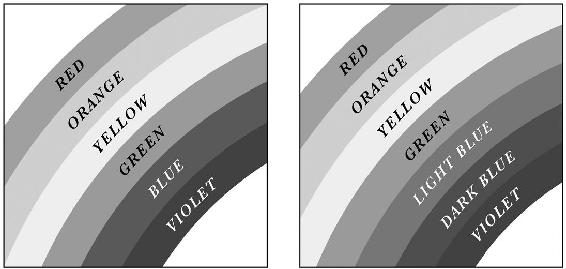
In chapter 5, we looked at the illusory stripes that we carve into a rainbow, as we categorize the wavelengths of light with our concepts for colors. If you visit the Russian Google (images.google.ru) and search for the Russian word for rainbow, радуга, you’ll see that Russian drawings contain seven colors, not six: the Western blue stripe has been subdivided into light blue and dark blue, as in figure 7-2:23
These pictures demonstrate that concepts of color are influenced by culture. In Russian culture, the colors синий (blue) and Голубой (sky blue to a Westerner) are different categories, as distinct as blue and green are to an American. This distinction is not due to inborn, structural differences in the visual system of Russians versus Americans, but to culture-specific, learned concepts of color. People raised in Russia are simply taught that light and dark blue are distinct colors with different names. These color concepts become wired into their brains, and so they perceive seven stripes.24
Words represent concepts, and concepts are tools of culture. We pass them down from parent to child, from one generation to the next, just like your great-great-grandmother’s candlesticks from the Old Country. “Rainbows have six stripes.” “Money is traded for goods.” “Cupcakes are a dessert and muffins are a breakfast food.”
Emotion concepts are also cultural tools. They come with a rich set of rules, all in the service of regulating your body budget or influencing someone else’s. These rules can be specific to a culture, stipulating when it’s acceptable to construct a given emotion in a given situation. In the United States, it’s appropriate to feel fear when you’re on a rollercoaster, or about to hear the results of a cancer screening, or if someone points a gun at you. In the United States, it’s not appropriate to feel fear each time you walk out of your house in a safe neighborhood: that feeling would be considered pathological, an anxiety disorder called agoraphobia.
My friend Carmen, who was born in Bolivia, was surprised when I told her that emotion concepts vary widely from culture to culture. “I thought everybody in the world has the same emotions,” she explained to me in Spanish. “Well, Bolivians do have stronger emotions than Americans. Más fuerte.” Most people have lived with one set of emotion concepts their whole lives, so like Carmen, they find this cultural relativity surprising. Yet, scientists have documented numerous emotion concepts around the world that don’t exist in English. Norwegians have a concept for an intense joy of falling in love, calling it “Forelsket.” The Danes have the concept “Hygge” for a certain feeling of close friendship. The Russian “Tocka” is a spiritual anguish, and the Portuguese “Saudade” is a strong, spiritual longing. After a little research, I located a Spanish emotion concept that has no direct equivalent in English, called “Pena Ajena.” Carmen described it to me as “sadness over another person’s loss,” but I’ve also seen it characterized as discomfort or embarrassment on someone else’s behalf. Here are a few more I find compelling:25
Gigil (Filipino): The urge to hug or squeeze something that is unbearably adorable.26
Voorpret (Dutch): Pleasure felt about an event before the event takes place.27
Age-otori (Japanese): The feeling of looking worse after a haircut.28
Some emotion concepts from other cultures are incredibly complicated, perhaps impossible to translate into English, yet natives experience them as a matter of course. The concept of “Fago” in Ifaluk (Micronesian) culture can mean love, empathy, pity, sadness, or compassion, depending on context. In Czech culture, the concept of “Litost” is said to be untranslatable but roughly “torment over one’s own misery combined with the desire for revenge.” The Japanese emotion concept “Arigata-meiwaku” is felt when someone has done you a favor that you didn’t want from them, and which may have caused difficulty for you, but you’re required to be grateful anyway.29
When I speak to audiences in the United States about emotion concepts as variable and culture-specific, and then suggest that our own English-language concepts are similarly local to our culture, some people are very surprised, as my friend Carmen was. “But happiness and sadness are real emotions,” they insist, as if the emotions of other cultures are not as real as our own. To this I usually say: you are exactly right. Fago, litost, and the rest are not emotions . . . to you. That’s because you don’t know these emotion concepts; the associated situations and goals are not important in middle-class American culture. Your brain cannot issue predictions based on “Fago,” so the concept doesn’t feel automatic the way that happiness and sadness do to you. To understand fago, you have to combine other concepts that you do know, performing conceptual combination and expending mental effort. But the Ifaluk do have this emotion concept. Their brains automatically predict with it. When they experience fago, it feels just as automatic and real as happiness or sadness does to you, as if fago just happens to them.
Yes, fago, litost, and the rest are just words made up by people, but so are “happy,” “sad,” “fearful,” “angry,” “disgusted,” and “surprised.” Invented words are the very definition of social reality. Would you say that your local currency is real money and the currencies of other cultures are just made up? To someone who has never traveled, it might seem that way, lacking the concept for another currency. But experienced travelers have the concept “Currency from Another Culture.” I’m asking you to learn the concept of “Emotion from Another Culture,” so you understand that its instances are just as real to others as your own emotions are to you.
If you’ve found these ideas challenging, try this one: some cherished Western emotion concepts are completely absent in other cultures. Utka Eskimos have no concept of “Anger.” The Tahitians have no concept of “Sadness.” This last item is very difficult for Westerners to accept . . . life without sadness? Really? When Tahitians are in a situation that a Westerner would describe as sad, they feel ill, troubled, fatigued, or unenthusiastic, all of which are covered by their broader term pe’ape’a. Someone who believes in the classical view of emotion would explain away this variability, saying that a frowning Tahitian really is in a biological state of sadness, whether he knows it or not. A constructionist does not have the luxury of such certainty, because people frown for many reasons such as while thinking, exerting effort, in humor, when censoring a thought, or when feeling pe’ape’a.30
Beyond individual emotion concepts, different cultures don’t even agree on what “emotion” is. Westerners think of emotion as an experience inside an individual, in the body. Many other cultures, however, characterize emotions as interpersonal events that require two or more people. This includes the Ifaluk of Micronesia, the Balinese, the Fula, the Ilongot of the Philippines, the Kaluli of Papua New Guinea, the Minangkabau of Indonesia, the Pintupi Aborigines of Australia, and the Samoans. More intriguingly, some cultures don’t even have a unified concept of “Emotion” for the experiences that Westerners lump together as emotional. The Tahitians, the Gidjingali Aborigines of Australia, the Fante and Dagbani of Ghana, the Chewong of Malaysia, and our friends the Himba from chapter 3 are a few well-studied examples.31
Most scientific research on emotion is conducted in English, using American concepts and American emotion words (and their translations). According to noted linguist Anna Wierzbicka, English has been a conceptual prison for the science of emotion. “English terms of emotion constitute a folk taxonomy, not an objective, culture-free analytic framework, so obviously we cannot assume that English words such as disgust, fear, or shame are clues to universal human concepts, or to basic psychological realities.” To make matters even more imperialistic, these emotion words are from twentieth-century English, and there’s evidence that some are fairly modern. The concept of “Emotion” itself is an invention of the seventeenth century. Before that, scholars wrote about passions, sentiments, and other concepts that had somewhat different meanings.32
Different languages describe diverse human experience in different ways—emotions and other mental events, colors, body parts, direction, time, spatial relations, and causality. The diversity from language to language is astonishing. The experiences of my friend Batja Mesquita, the cultural psychologist whom you met in chapter 5, provide an example. She was born and raised in the Netherlands and immigrated to America for her postdoctoral training. Over the next fifteen years, she married, raised a family, and was a professor at Wake Forest University in North Carolina. When living in the Netherlands, Batja felt that her emotions were, for lack of a better word, natural. After moving to the United States, however, she soon noticed her emotions were not a good fit for American culture. Americans struck her as unnaturally happy. We constantly spoke in an upbeat tone of voice. We smiled a tremendous amount. When Batja asked how people were doing, we would always answer positively (“I’m doing great!”). Batja’s own emotional responses seemed inadequate in the U.S. cultural context. When asked how she was feeling, she did not respond with sufficient enthusiasm or say she was “fabulous” or “wonderful.” I once heard her give a talk on her experiences, and I nodded through the entire thing, clapped vigorously at the end, and then walked up to her, gave her a hug, and said “excellent job!” It took me a moment to realize I had just confirmed every one of her observations.33
Batja’s experience is not unique. Our colleague Yulia Chentsova Dutton from Russia says that her cheeks ached for an entire year after moving to the United States because she had never smiled so much. My neighbor Paul Harris, a transplanted emotion researcher from England, has observed how American academics are always excited by scientific puzzles—a high arousal, pleasant feeling—but never merely curious, perplexed, or confused, which are low arousal and fairly neutral experiences that are more familiar to him. In general, Americans prefer high arousal, pleasant states. We smile a lot. We praise, compliment, and encourage each other. We give each other awards for all levels of accomplishment, even “Certificates of Participation.” It seems like every other week there is an awards show on television. I have lost count of how many books on happiness have been published in the United States in the last ten years. We are a culture of positivity. We like to be happy and to celebrate how great we are.34
The more time that Batja spent in America, the more her emotions became attuned to the American context. Her pleasant emotion concepts expanded and became more variable. She became more granular, experiencing the American style of happiness as distinct from satisfaction and contentment. Her brain bootstrapped new concepts for American norms and customs. This process is called emotion acculturation. From a new culture, you acquire new concepts, which translate into new predictions. Using those predictions, you become able to experience and perceive the emotions of your newly adopted home.
The scientist who discovered emotion acculturation is, in fact, Batja herself. She found that people’s emotion concepts not only vary from culture to culture but also transform. For example, situations that bring about anger in Belgium, like having your goals blocked by a coworker, in Turkey will also include feelings of (what Americans experience as) guilt, shame, and respect. But for Turkish immigrants in Belgium, their emotional experiences come to look more “Belgian” the longer they live there.35
A brain that is bathed in the situations of a new culture is probably somewhat like an infant’s brain: driven more by prediction error than prediction. Lacking the emotion concepts of the new culture, the immigrant brain soaks up sensory input and builds new concepts. The new emotional patterns don’t replace the old ones, though they may cause interference, as was the case for my research associate Alexandra from Greece whom you met in chapter 5. You can’t predict efficiently when you don’t know the local concepts. You must get by with conceptual combination, which can be effortful and yields only an approximate meaning. Or you will be awash in prediction error much of the time. The process of acculturation therefore taxes your body budget. In fact, people who are less emotionally acculturated report more physical illness. Once again, categorization gets under your skin.36
In this book, I am trying to acculturate you into a new way of thinking about emotion. Whether you realize it or not, you have a set of concepts about emotions: what they are, where they come from, and what they mean. Perhaps you began this book with classical view concepts such as “Emotional Reaction” and “Facial Expression” and “Emotion Circuit in the Brain.” If so, I’ve been slowly replacing them with a new set, including “Interoception,” “Prediction,” “Body Budget,” and “Social Reality.” In a sense, I am attempting to draw you into a new culture called the theory of constructed emotion. A new culture’s norms may seem odd, or even wrong, until you’ve lived there for a while and come to understand them . . . and I hope you already do, or you will. Ultimately, if I and other like-minded scientists are successful in substituting the new concepts for the old, well, that’s a scientific revolution.
The theory of constructed emotion explains how you experience and perceive emotion in the absence of any consistent, biological fingerprints in the face, body, or brain. Your brain continually predicts and simulates all the sensory inputs from inside and outside your body, so it understands what they mean and what to do about them. These predictions travel through your cortex, cascading from the body-budgeting circuitry in your interoceptive network to your primary sensory cortices, to create distributed, brain-wide simulations, each of which is an instance of a concept. The simulation that’s closest to your actual situation is the winner that becomes your experience, and if it’s an instance of an emotion concept, then you experience emotion. This whole process occurs, with the help of your control network, in the service of regulating your body budget to keep you alive and healthy. In the process, you impact the body budgets of those around you, to help you survive to propagate your genes into the next generation. This is how brains and bodies create social reality. This is also how emotions become real.
Yes, that’s a mouthful. And some details are still reasoned speculation, like the exact mechanisms of the concept cascade. But we can say confidently that the theory of constructed emotion is a viable way to think about how emotions are made. The theory accounts for all of the phenomena of the classical view, plus its anomalies such as the huge variability in emotional experiences, in emotion concepts, and in physical changes during emotion. It dissolves useless nature/nurture debates (e.g., what is hardwired versus what is learned) by using a single framework to understand both physical reality and social reality, moving us one step closer to a scientific bridge between the social and natural worlds. And this bridge, like all bridges, will lead us to a new place, as you’ll see in the next chapter: a modern origin story of what it means to be human.