CHAPTER 10
Building and Managing the Dividend-Value Portfolio
First, have a definite, clear practical ideal; a goal, an objective.
Second, have the necessary means to achieve your ends; wisdom,
money, materials, and methods. Third, adjust all your means to
the end.
—Aristotle
When I first began mapping out this book, my initial thought was that this would be the easiest chapter to write, as a good portion of each workday is directed toward research, analysis, stock selection, and portfolio management decisions. Now that I have reached this place in the book, I am beginning to think I was perhaps a little cavalier in that assessment.
Obviously I would hope at this point you realize it isn’t that I don’t have a grasp of the material. Much of this I do on an autonomic level just like breathing. The truth be told, after 25-plus years in this business, much of this process is so automatic for me I don’t have to stop and think about the order of analytical steps and the myriad variables to consider in the decision-making process; I just do it.
As there are no existing mechanisms that allow me to download the data that resides on the hard drive between my ears directly to yours, I am relegated to transcribing the data in as precise and complete a manner possible through the medium in your hands. Although a linear presentation will not appeal to readers whose modality is perhaps more abstract, my thought is that it is the most logical way to progress through the material.
As such I have divided the material into two distinct parts. The first is to lay the academic foundation to the approach that I advocate and follow—one might say the textbook part, which is what has been covered to this point. Although not particularly entertaining, the academics are of vital importance because one must have an intellectual framework to work from.
The second part is the equally if not more important aspect of practical application in the real world. Theory without application may be intellectually stimulating, but it does little in the way of building profits in a portfolio. It occurred to me, though, that the process of practical application is not a linear exercise that follows a sequential series of steps; each action must be filtered through the prism of experience, which can lead to a host of possibilities and further decisions.
In short, it is not possible to tell you exactly what I would do every time in a given situation. To use a sports analogy, with investing you often have to make some game-time decisions, which will vary based on the circumstances and situation of the moment.
Now that I have taken you over the hills and through the woods to grandmother’s house to make my point, I will summarize it for you this way. On an intellectual level I know it is impossible to remember and write about everything I have learned and pass it on to you so that you don’t make some of the same mistakes that I have. That just isn’t realistic. What I can do is to try and cover as much as possible the factors to consider as you go about implementing the concepts in this book into your investment decisions.
I appreciate your indulgence on this divergence. I am just so passionate about investing and our approach that I want to do everything possible to help be successful and to reach your goals and objectives.
In this chapter, we first consider various types of market climates. Next, we apply the concepts explained previously to the process of structuring a dividend-centered, value-based stock portfolio. This process will include examinations about how to monitor both the individual portfolio components as well as the portfolio as a whole, and how to make adjustments to the portfolio as both the individual components and the market progress through various cycles and phases of value.
For the purposes of this chapter, when I use the term portfolio, I am referring to that portion of your investment capital that you have allocated to the stock market.
Macro versus Micro
Whether by design or evolution, there are two sides to everything associated with stocks and the market: Bull and bear; long and short; fundamental and technical; overvalue and undervalue, and so on. It should come as no surprise then that there are two primary approaches to stock selection: top-down and bottom-up.
With the top-down approach, investors place a higher priority on identifying the trends in the macro economy before selecting the industries and the companies within those industries that have a tendency to benefit from those trends.
By example, if an investor thinks that inflation will remain low, he or she might consider the retailing industry, as consumer spending power is typically enhanced during periods of low inflation. Using that premise as a guide, the investor may look at Wal-Mart, Target, or other retailers and then try to determine which company has the best earnings prospects in the near term.
Staying with the example of inflation, another macro viewpoint would be the anticipation for a period of higher inflation, in which case the investor might then find the mining industry to be attractive. Once again using that premise as a guide, the investor may look at Barrick Gold, Freeport McMoRan, or other mining companies to determine which is better positioned to benefit from a trend of rising prices.
A more colloquial way of thinking about the top-down approach is that this type of investor is looking first at the forest and then at the trees. Such investors believe it is better to identify the major themes in the market first and then select individual companies second. The logic behind this line of thinking is that if current economic conditions are not supportive of the industry in which a company operates, it could prove to be difficult for the company to generate sufficient earnings to motivate investors to propel the stock price higher. The investor is vulnerable in this approach as he or she may overlook good companies that are still performing well, even in a depressed sector.
With the bottom-up approach investors place a higher priority on analyzing individual companies than the trends of the macro economy. The thought here is if the company’s fundamentals are strong and there is evidence of good value, cycles within the economy, the market, or the industry are transitory in nature and the fundamentals will eventually be recognized. Indeed, value investors as well as contrarians welcome the later stages of a market downturn as stocks are typically trading at depressed levels, which provide substantial upside potential once the market decline halts and reverses direction.
As such, the bottom-up investor may begin to acquire positions before trends in the macro economy show improvement or industry outlooks start to firm. The thought here is that, although an industry may be out of favor, investors who defer a purchase until confirmation of improving earnings may miss the opportunity to purchase a historically well-managed company with a long-term performance record for a price that is well below its intrinsic value. However, the investor is vulnerable in this approach because his or her investment capital may be exhausted too soon, before the end of the market decline.
As you can see, these two approaches to investing are quite different. Although proponents of both approaches can be overly zealous, the fact is that both approaches have something to offer. As the dividend-yield strategy marries aspects of both fundamental and technical analysis, it also utilizes aspects from both the bottom-up and top-down approaches.
From the top-down approach we believe it is prudent to be aware of the primary trend of the macro economy as economic activity does affect the way stocks behave. However, economic indicators have no value when determining when a stock is overvalued and should be sold or when it is undervalued and should be bought. That determination can only be made by comparing the current dividend yield against its historically repetitive boundaries, information one would gain from a company specific, bottom-up approach.
Observing how economic activity or inactivity affects the mood of the market can lead investors toward certain industry groups and away from others. These observations can also help investors gauge whether it is a propitious time to be taking new undervalue positions or perhaps time to raise cash by liquidating oversold positions.
This is not to suggest that we engage in market timing as a primary determinant in when and what to buy, sell, or hold. What we are trying to do is to take the myriad macro and micro factors that can affect stocks and the market into consideration for the purpose of refining the purchase of undervalued blue chips at a lower price or the selling of overvalued positions at a higher price. This is not to imply that we can buy every bottom and sell every top, but we can expand the meat in the middle. In the long run, if we can capture a few points in price here or there and lock down the highest dividend yields possible for a longer period of time, the miracle of compound returns can work its magic.
Expansion and Contraction
I don’t know if they are still around, but when I was a kid the Slinky was all the rage. For those too young to remember (or those in denial about their age), the Slinky is a helical spring that stretches and shrinks with the aid of gravity and its own momentum.
If I were to show it to one to my kids today, they would just look at me and then head off to play Wii or a computer game. How technology has changed the world!
The economy is much like the old Slinky; it expands and contracts. If it gets pulled too far, it snaps; without any tension it lies inert. The cycles of expansion and contraction vary in length, but on average each cycle lasts about four years.
Dividend Truth
These cycles of expansion and contraction in the economy are similar to the cycles in stock prices and dividend yields. The explanation for this fluctuation in both economic and stock cycles is the same primary force: simple supply and demand.
Kaboom and Kabust
If you think back to the latter half of the 1990s there was a tremendous demand for all things technological: computers, chips, monitors, bandwidth, and so forth. At the early stages of this demand, prices were high as supplies were scarce and earnings were through the roof. Not wanting to miss out on the action, everybody and their brother got into the tech and dot-com act, production was ramped up, and the next thing we knew we had a full blown boom on our hands.
As we all know, the tech and dot-com craze went to an extreme and eventually there was too much supply. To reduce inventories, producers slashed prices, and in so doing they also slashed their earnings. Unable to reduce inventories sufficiently, producers stopped producing, unemployment began to rise, and eventually the economy and the markets went into decline.
A variation of this theme played out with the housing industry in this decade, albeit with a slight twist. Whereas the technology boom was the result of demand for technology products and services, demand was created by government monetary policy (read stimulus), and the housing boom was the result.
When the Fed dramatically lowered the interest rate on Fed Funds, the interest rate on all fixed-income instruments declined as well, including mortgage-backed bonds. As a result, borrowers determined they could buy more expensive homes than their current one because the principal and interest payments were often equal to if not less than the payment on their current mortgages.
As if by some miracle, simultaneous to the decline in interest rates, the requirements to qualify for a mortgage were significantly relaxed, which allowed many more borrowers to qualify to purchase a home. With this new-found purchasing power, the demand for homes quickly erased the supply of existing homes, which motivated home builders to ramp up the construction of new homes across America.
With all booms come the inevitable groups of speculators who attempt to profit from the craze de jour. In the tech and dot-com bubble, we saw this with the day traders. In the housing boom, we saw this with the flippers. Whether a speculation is in stocks, real estate, or another asset, the principle is the same; get in and get out.
Getting in is always easy during the manic phase of a boom. When getting out becomes difficult or next to impossible, the party is over. Whether speculators understand it intellectually or not, the speculative game is played according to the greater fool theory; the boom will last to infinity as long as there is a greater fool to sell to. Unfortunately, at some point in every boom the music stops playing and someone is left without a chair. In the housing boom, the music stopped when prices reached unsustainable levels and there were no greater fools to sell to.
When a boom takes over an economy, such as tech did in the 1990s and housing did in this decade, it spawns massive growth in ancillary or supporting businesses. When the source of growth runs out of gas, so do these other businesses. As these businesses contract or fail altogether, employment drops and incomes fall.
Just as a boom can create rising profits, therefore rising stock prices, a contraction can have the opposite effect. If a contraction is severe and lasts for a prolonged period, the economy can slide into recession.
Recessions
The technical indicator of a recession is two consecutive quarters of negative economic growth as measured by a country’s Gross Domestic Product (GDP). GDP is the total market value of all final goods and services produced in a country in a given year.
A recession becomes official when announced by the National Bureau of Economic Research or NBER. However, most investors do not need an official announcement to know when a recession is underway. Often, but not always, a recession is preceded by the end of a bull market, rising unemployment, or a marked slowdown in consumer spending.
Over the past 60 years there have been 11 official recessions. All but one, in 1980, occurred within one year of the onset of a bear market. As mentioned previously, the stock market continually discounts future events as investors expect them to develop. In this regard, investors and the markets have proved to be rather prescient.
Although unpleasant, recessions are part of the natural order. When an economic boom or bull market reaches levels of excess, which they generally do, a recession is the corrective process that removes excesses from the system in order for the natural functions of supply and demand to return to normalcy.
It is generally deemed prudent to focus on noncyclical or so-called defensive stocks during a recession, things that are generally considered necessities: food; water, gas, and electric utilities; and personal items such as shampoo, soap, and toothpaste.
Although defensive stocks are not immune to the forces of a declining trend, the fact that these products and services are considered necessities provides for a more consistent stream of earnings and, therefore, protection for the dividends.
Recessions do not represent the end of the world, just a notice to change your focus.
Recovery
As night follows day, an economic rebound follows a recession. Where noncyclical stocks are the order of the day during recessions, cyclical industries and stocks are often the leaders out of the recovery gate.
Of the 11 most commonly recognized industry sectors, 9 are considered to be cyclical. These are transportation, capital goods, technology, financial, consumer cyclical, communications, basic materials, health care, and energy. The reason why they are called cyclical is because they move up or down due to the direction of businesses cycles. If a particular business is going up, then this sector is likely going up as well.
Cyclical industries are comprised of a wide range of products and services, which are in demand at various stages of the business cycle. As such they are commonly divided into three distinct categories: early cycle, midcycle, and late cycle.
Dividend Truth
It is important to remember that even though a sector or a company within that sector may be widely viewed as timely or favorable, these are subjective perceptions. Values can only be defined by repetitive patterns of dividend yield. Therefore, no stock should be purchased unless it represents historically good value as defined by its undervalued boundary of dividend yield.
Politics and Markets
I don’t remember who told me this, but allegedly many years ago, the late Richard Nixon was asked what he’d be doing if he weren’t president. He said that he’d probably be on Wall Street buying stocks. One old-time Wall Streeter chimed in that if Nixon weren’t president, he too would be buying stocks.
Public policy is important and can affect stocks and the market in numerous ways. Generally, however, these effects typically reveal themselves less in the manner conventional wisdom expects and more often through the law of unintended consequences. Depending on which side of the aisle your bread gets buttered, then, the public policy of the moment can be a good or bad thing. Since policy swings back and forth from election to election, everyone usually has something to be upset about, which means it all evens out in the wash.
Putting partisan politics aside, there does appear a propensity for the markets to have positive returns during presidential election years. The explanations for this phenomenon are varied, depending on whether they originate from academia or conspiracy theorists. In any event, as you can see in
Table 10.1, in the 21 presidential
| Election Year | S&P 500 Return, % |
|---|
| 2008 | -37.00 |
| 2004 | 10.90 |
| 2000 | -9.10 |
| 1996 | 23.10 |
| 1992 | 7.70 |
| 1988 | 16.80 |
| 1984 | 6.30 |
| 1980 | 32.40 |
| 1976 | 23.80 |
| 1972 | 19.00 |
| 1968 | 11.10 |
| 1964 | 16.50 |
| 1960 | 0.50 |
| 1956 | 6.60 |
| 1952 | 18.40 |
| 1948 | 5.50 |
| 1944 | 19.80 |
| 1940 | -9.80 |
| 1936 | 33.90 |
| 1932 | -8.20 |
| 1928 | 43.60 |
election years since 1928, the S&P 500 had a positive return in 17 of the 21 periods, or 81 percent of the time.
Don’t Fight the Fed
As my grandfather would often say, “money makes the mare go, son.” In Wall Street speak we would say that monetary conditions have enormous influence on stock prices. The fact is that liquidity is the lifeblood of the market. When liquidity is plentiful the market moves up; when liquidity is constrained, the market moves down.
The major determinant of the direction of interest rates is Federal Reserve policy, which all interest rates react to. In general, when interest rates are rising, it is bearish for stocks. Conversely, when interest rates are declining, it is bullish for stocks.
When interest rates are low or declining, the competition for stocks by other instruments, particularly short-term fixed-income investments such as T-bills, CDs, and money markets, are less attractive. Think about it; which would you prefer, a high-quality blue chip at undervalue prices yielding 4 percent, or a fixed-income instrument with a coupon of 2 percent or perhaps less? You don’t have to think too long about that one.
Also important is that when interest rates are low or declining, corporations can borrow at lower rates. Debt can be a costly expense, and when an expense is reduced, it clears the way for higher earnings. When Wall Street has an expectation for higher earnings, stock prices will generally be bid higher. In a high or rising-interest-rate environment, the exact opposite occurs and stock prices decline.
When the market declines because of a hike in interest rates or because of the perception that a rate hike is imminent, it isn’t so much that a quarter point will make all the difference in the world, it is what the rate hike signals to Wall Street—a change in trend. Once the trend changes from a low-to-declining environment to a rising-trend environment, Wall Street discounts that the upward trend will remain in place until the Fed achieves its goals, which generally is a slowdown in the economy, which generally results in lower earnings.
This will initially be most evident in interest-rate-sensitive stocks, such as banks, insurance companies, and utilities. Industrial companies with a high debt-to-equity ratio will also suffer because a slowing economy that results in lower earnings will put even more pressure on a debt-laden company.
Dividend Truth
Blue chips with low debt levels and higher returns on equity will be more stable in terms of share price during periods of rising interest rates.
A Yen for Dollars, or Pounds, or Euros
When you make an investment in a stock that trades in a foreign currency, the total return is based on two factors: the return in local currency plus any currency fluctuations. By example, let’s say you buy a stock in the Euro Zone and the price increases 10 percent in one year in terms of euros. If during that same year the euro increases in value by 5 percent as compared to the U.S. dollar, the total return would be 15 percent; 10 percent from investment return plus 5 percent from currency return. On the other hand, if the euro were to decrease in value by 5 percent against the dollar, the total return would be just 5 percent; 10 percent from investment return and -5 percent in currency return.
When the U.S. dollar declines compared to the other currency, the return on investment increases as more dollars are required to purchase the stock. An increase in the U.S. dollar compared to the other currency means the return on investment will be less.
Many U.S. companies are what we call multinationals, meaning that they have both domestic and foreign operations. The foreign operations will typically receive its revenues in the foreign currency, and, depending on when the currency is converted into dollars, the amount can be higher or lower, as just detailed.
Some investors attempt to offset the risk of these currency fluctuations through currency hedging, which entails using options, futures, or forward contracts. This is a specific skill set that the average investor may have trouble with because of the inherent complexities. Since Wall Street is nothing if not creative, mutual funds and ETFs are available that do the hedging for you and are referred to as being currency neutral.
We do not follow foreign stocks at Investment Quality Trends because most of the companies that meet our criteria have very complex dividend-conversion policies that make it difficult to pinpoint the dividend yield at any given time. As such, we have difficulty establishing undervalue and overvalue boundaries, which as you know is central to the dividend-value strategy.
Putting It All Together
It would be a wonderful coincidence if the current market environment was one with the investment winds at our back and a new bull market was underway. If that were the case I could write darn near anything and end up looking like a genius.
Sadly, this is not the case, so I will approach this section as if I were building a portfolio today to show you my thought process. Of course, there will be a few months’ lag time between the completion of this book and the time it reaches the bookshelves, so the environment could be very, very different.
Be that as it may, I would still approach the process in the same way, although the number of stocks and percentage of the portfolio invested might be different. Because it would border on the impossible to contemplate all the potential investment scenarios, I will nonetheless try to give you some guiding rules of thumb to follow.
What Is the Primary Trend?
The primary trend is down. When the Dow violated the 3 percent dividend-yield level and tumbled through and below the 10,000 level, a bear market was confirmed. Since March 2009, the Dow has been in a counter-trend rally, which is also known as cyclical bull market or a retracement.
Counter-trend rallies or retracements will typically recover one-third to one-half of the previous decline. In
Figure 8.3 in Chapter 8, however, we see that a counter-trend rally can recover the entire decline or in the case in 1973, even make a new high. Once a retracement has recovered 50 percent of the previous decline, though, I tend to become more cautious.
What Is the Current Phase of Value?
The Dow is in a declining trend. As the market is currently enjoying a counter-trend rally, many might think the Dow has entered into a rising trend. In order to enter a rising trend from the current level, the Dow would need to record a new high price.
What Is the Reading of the Blue Chip Trend Verifier?
As of the mid-September issue of Investment Quality Trends, the Undervalued category represents 30.8 percent of the Select Blue Chip universe. The percentage has declined significantly from the March 2009 reading of 72 percent, which was in line with the Dow having reached support at the 5.0 percent dividend-yield area.
That the current reading has declined significantly since March confirms that the secondary trend is bullish and a cyclical retracement is in force. If the current rally continues, we should see this reading drop to the 17 percent overvalue area.
What Is the Interest Rate Trend?
In response to the global financial crisis, the Federal Reserve has reduced the interest rate on Fed Funds to a level between 0 percent and 0.25 percent. In theory, the Fed could drop all pretenses and fix the rate at 0 percent, but it would hardly be worth the trouble and would probably cause more harm than good because the credit markets would panic. For all intents and purposes, this is the lowest Fed Fund rate we will ever see. Although it is unlikely the Fed will make any change in the Funds rate until midyear 2010, the next change in trend will definitely be up.
For purposes of our current analysis however, there is no investment competition from high-quality fixed-income instruments.
Expansion, Contraction, or Recession?
To date there has been no official announcement from the National Bureau of Economic Research that the recession that began officially in December 2007 has ended. Federal Reserve Chairman Ben Bernanke has opined that the recession is over, as have many economists and members of the financial media.
Although fears of an economic depression have subsided, there is no concrete evidence of sustainable economic growth without government assistance.
Portfolio Tactics
The first order of business is to summarize the preceding information into a big-picture point of view:
• The primary trend is down, but the secondary trend is in force. Depending on the index, however, the market has retraced close to or above 50 percent of the previous decline.
• The Dow is in a declining trend.
• The Blue Chip Trend Verifier shows a reading of 30.8 percent. This is above the overvalue area of 17 percent but well below the undervalue area between 70 percent and 80 percent.
• The interest rate environment is a positive for stocks and the market and should remain so for close to another year. The next change in trend will be up.
• The recession is most likely over, but the economy is still fragile. Without continued government assistance there is a possibility for a slide back into recession.
I have seen worse, but I have also seen much better. In my opinion the downside risks outweigh the upside potential, so I believe prudence and caution is the way to proceed. Defensive stocks make the most sense right now, so depending on your risk tolerance, I would allocate between 25 percent and 50 percent of capital, but I would be more comfortable with 25 percent.
No matter the investment climate, I always start investment considerations with the Undervalued category. Next, I want to find the stocks with the highest quality rankings, an outstanding track record for increasing dividends, a modest to lower payout ratio, low debt, a moderate P/E ratio, and a reasonable book value.
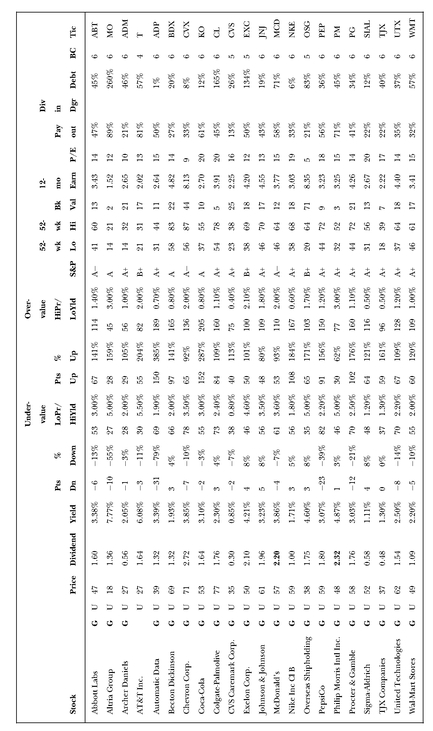
Figure 7.3 in Chapter 7 shows a listing of the Undervalued category from the mid-September 2009 issue of Investment Quality Trends. I have used this list to screen for stocks according to the preceding criteria, and have selected 22 stocks, which are listed in
Figure 10.1. We will use this list to build a sample portfolio.
The first stock is Abbott Labs (ABT): It has an A- quality ranking; the Investment Quality Trends “G” designation for average annual dividend increases of at least 10 percent per year for the last 12 years. The payout ratio and debt are less than 50 percent; and the P/E is 14. I’m not going to worry too much about the book value because it is difficult to value some of the intellectual property such as patents. As ABT is in the pharmaceutical sector, it is definitely a defensive position.
The next stock is Altria Group (MO): An A quality ranking; a “G”; the P/E is 12; uh oh, a payout ratio of 89 percent and a debt of 260 percent! I know, you think I’ve lost my mind. This is where you have to do some additional homework. You may not like this industry, but tobacco is a classic sin stock, and as such it will most likely always be in business.
MO is what we call a cash cow; they practically print money. The debt level seems outrageous until you learn they bought one of their major competitors, U.S. Tobacco, at the end of 2008. The beauty of the U.S. Tobacco acquisition is that it adds one of the fastest growing segments of the tobacco industry to the MO lineup—smokeless tobacco.
I know, you are thinking that is a great story but what about the numbers? Here is where you want to look at the return-on-equity or ROE. ROE is the amount of net income returned as a percentage of shareholders’ equity and is expressed as a percentage. Return on equity measures a corporation’s profitability by revealing how much profit a company generates with the money shareholders have invested. A business that has a high return on equity is more likely to be one that is capable of generating cash internally.
ROE is reported over various time frames, so you can see some volatility in the numbers. As a general rule of thumb, however, I like to see the longer-term measures show some signs of consistency. In the case of MO, the longer-term ROEs come in about 20 percent on average. This is a number I can more than live with.
As we move down the list, you can see the remaining stocks I have chosen: Archer-Daniels-Midland (ADM); AT&T, Inc. (T); I really like Automatic Data Processing (ADP), but it will do much better in a rising interest rate environment. So make a note of that and we will set this stock aside; Becton, Dickinson (BDX); Chevron (CVX); Coca-Cola (KO); Colgate-Palmolive (CO); CVS Caremark (CVS); Exelon (EXC); Johnson & Johnson (JNJ); McDonald’s (MCD); Nike, Inc. (NKE); Overseas Shipholding Group (OSG); PepsiCo (PEP); Philip Morris International (PM); Procter & Gamble (PG); Sigma-Aldrich (SIAL); TJX Companies (TJX); United Technologies (UTX); and Wal-Mart Stores (WMT). For this example then I have selected 21 companies, enough to find good diversification but below the 25 stock maximum.
Now, let’s see if we are too concentrated in any one industry. Abbott Labs (ABT) and Johnson & Johnson (JNJ) are both giant pharmaceuticals, but they focus on different areas. If the industry as whole were to take a hit, then both would probably decline as well, at least temporarily. As both are at historic levels of undervalue though, any declines should be minor because the dividends are well supported by earnings.
Becton, Dickinson (BDX) is also a healthcare related stock, but it does not manufacture drugs. Becton, Dickinson (BDX) is a medical technology company that makes and sells a range of medical supplies, devices, laboratory equipment, and diagnostic products used by healthcare institutions, life-science researchers, clinical laboratories, and the general public.
Sigma-Aldrich (SIAL) is a specialty chemical maker that makes the chemical building blocks that pharmaceutical, biopharma, and biotech companies need to make their medications and remedies. Sigma-Aldrich (SIAL) doesn’t need a giant drug to be successful; they just need to sell their chemical compounds, which they do better than any other chemical company.
CVS Caremark (CVS) fills prescriptions and provides related healthcare services through approximately 6,900 CVS/Pharmacy and Longs Drug retail stores. The company also provides pharmacy benefit management, one of the fastest growing segments in the industry.
Colgate-Palmolive (CO) and Procter & Gamble (PG) share some of the same space, as do Coca-Cola (KO) and PepsiCo (PEP). Pepsi, however, is also a snack-food company, which diversifies their earnings stream.
Chevron (CVX) is a major oil company, and Overseas Shipholding Group (OSG) is a bulk shipping company engaged primarily in the ocean transportation of crude oil and petroleum products. I like this combination—a producer and a transporter.
Exelon (EXC) is an electric utility; you always need one of those. McDonald’s (MCD) just flat out produces so I like that. Wal-Mart (WMT) and TJX Companies (TJX) are both retailers but in entirely different segments of that market. Nike, Inc.(NKE) rules the shoe world; we could be in a depression and kids would still find a way to buy a pair of Nike tennis shoes.
Everyone or nearly everyone owns a cell phone, so I like AT&T, Inc. (T) (not to mention the yield). United Technologies (UTX) has operations in six segments: elevators and escalators; heating, ventilation, and air conditioning; fire suppression; jet engines and turbines; aerospace; and helicopters. This leaves us with Archer-Daniels-Midland (ADM), which is a long-term commodity play, and the two tobacco companies, Altria Group (MO) and Philip Morris International (PM). Altria Group is domestic and Philip Morris is international so I like that diversification.
Alright, not too bad for a defensive portfolio. If the market heads lower, most of these should hold up nicely. If the market heads higher, there is still enough growth potential for capital appreciation. In either event we still have between 50 percent and 75 percent of our capital to work with.
Okay, now we need to think about the two most likely scenarios.
Scenario 1
Since the secondary trend is up, the market has an upward bias. Since I’m not the only one who knows this is a primary bear market, though, don’t be surprised to see some money rotate into more defensive sectors, like some of those represented by the stocks I just mentioned. As such, some of these stocks could move into rising trends.
If the market starts to break down and roll over, you need to make a decision. Do you keep your positions and add to them later, knowing you bought at historically repetitive areas of undervalue, or do you put in some stop loss orders, take your profits, and come back in at lower levels with a most likely larger universe to choose from?
Scenario 2
The market has retraced around 50 percent of the previous decline. As the primary trend is down, the Dow is in a declining trend, and the economy is still relatively weak, the rally could end tomorrow and head for a third leg down. We know most bear markets end when the Dow is yielding at or around the 6.0 percent dividend-yield level. We also know there is historical precedent for a halt and reversal at the 5.0 percent dividend-yield level, which could mean just a retest of the March 2009 lows.
Whether another leg down or a retest, what do you want to do? Your choices are to dollar-cost average down, sell outright, or do nothing. Once again, your decision should be based on your own tolerance for risk, your investment time horizon, your goals and objectives, and any potential tax consequences.
Dollar-cost averaging is the technique of buying a fixed dollar amount of a particular investment on a regular schedule, regardless of the share price. More shares are purchased when prices are low, and fewer shares are bought when prices are high. Eventually, the average cost per share of the security will become smaller and smaller. Dollar-cost averaging lessens the risk of investing a large amount in a single investment at the wrong time.
For example, you decide to purchase $100 worth of ABC each month for three months. In October, ABC is worth $33, so you buy three shares. In November, ABC is worth $25, so you buy four additional shares this time. Finally, in December, ABC is worth $20, so you buy five shares. In total, you purchased 12 shares for an average price of approximately $25 each.
As food for thought, here are a few things to consider:
1. This bear market is probably two-thirds over, but the last third could be rough.
2. When this market does bottom, it will probably represent the greatest buying opportunity of your lifetime.
3. Some stocks have probably already established bear-market lows; an equal number probably haven’t. Which ones? I can’t tell you; the market doesn’t always play fair.
4. Only liars pick the absolute tops and the bottoms. If you get the meat in the middle you will do just fine.
5. If you buy right but a position turns against you, don’t panic. This too shall pass.
Your decision should be based on your own tolerance for risk, your investment time horizon, your goals and objectives, and any potential tax consequences.