CHAPTER 7
Finding Undervalued and Overvalued Stocks
The real voyage of discovery consists not in seeking new landscapes, but in having new eyes.
—Marcel Proust
One need not be a market wizard to understand that for every stock there are optimum times to buy and sell. For the investor whose primary objective is to maximize capital gains and to capture as much dividend income and growth possible, it is imperative to establish the repetitive areas of undervalue and overvalue.
Although capital gains can be achieved in stocks that are not purchased at undervalued levels, the potential for upside is reduced and the downside risks are increased. In a rising market, an investor may get away with this practice for a time, but one too many trips to that well and investment capital can disappear in a hurry. That is to say, there is a higher probability for consistent growth of capital and income when the investor maintains a buying and selling discipline based on the understanding of values.
In our experience, the most reliable way to identify stocks that offer good values is to limit investment considerations to only the highest-quality stocks and then establish the repetitive patterns of dividend yield, which reveals the areas of undervalue and overvalue. For some, this process, which you know now as the dividend-value strategy, can be viewed as overly mechanical or perhaps even rigid, but there is a method to the madness. Even seasoned investors can be seduced by the energy and momentum of a fast-moving market and be tempted to follow the crowd.
Those are the instances when most investors make mistakes that can inflict long-lasting damage to a portfolio. With the calm objectivity that comes from an adherence to quality and value, however, investors can avoid the pitfalls that derail others from reaching their ultimate objective, building a pool of wealth from which to secure current and future cash needs.
Finding and buying a stock that is undervalued requires patience and fortitude. For the investor who can master these virtues, the rewards are well worth the time and effort. In this chapter, we focus on how to identify the four categories of value: Undervalued, the Rising Trend, Overvalued, and the Declining Trend. Although it is important to recognize and understand the rising and declining trends, the majority of this chapter is directed toward undervalue and overvalue. In later chapters, we discuss how to incorporate our understanding of these four categories of value into the dividend-value portfolio.
Dividend Truth
Technical: Charting repetitive extremes of dividend yield
Fundamental: The identification of blue chip stocks, as defined by the Criteria for Select Blue Chips
A Sophisticated Approach
As mentioned in previous chapters, most stock market analysis is conducted through either fundamental or technical analysis. The dividend-value strategy is a marriage between the two disciplines. Although the process of identifying historic parameters of value by charting the highs and lows of dividend yield is clearly technical, our insistence that explorations for value be limited to only those stocks worthy of Select Blue Chip status is rooted in the most basic of fundamentals, the dividend, which represents a spendable return on investment capital.
Each stock has its own profile of undervalue and overvalue dividend yield, which means each stock must be studied individually. Any investor can establish the dividend-yield profile of any stock that has paid a dividend over sufficient time to establish a pattern. To identify these patterns you must first compute the dividend yield over a decade or longer (15 to 25 years is optimum) and then chart the channels on a grid.
At Investment Quality Trends, we have a fairly sophisticated algorithm that identifies the low-price/high-yield areas and the high-price /low-yield areas. In the “old days” this process required mastery of a slide rule; for a period we rented time on the old Computer Data computers that were programmed by punch cards. Geraldine has often said that the greatest invention of all time was the hand-held calculator, which dramatically shortened the process. Today, we have the luxury of a computer workstation.
To explain this process in detail, we will use the chart found in
Figure 7.1. As with most stock charts, the price is found on the left (vertical) axis, and time is displayed along the bottom (horizontal) axis. The first step is to identify all the high-price extremes and the low-price extremes. In this example, we would note the highs in 1999, 2002, and 2007. For the lows we would note 2000 and 2008. The second step is to find the high price for each high-price year and the low price for each low-price year. These prices would be $49.25, $53.52, and $105.02 for the years 1999, 2002, and 2007, respectively. The data points for the low price areas in this example are $23 in 2000 and $50.71 in 2008. The third step is to find the dividend paid for each year of data points and then to calculate the dividend yield for each point. These would be 1.42 percent, 1.53 percent, and 1.41 percent for the highs and 3.21 percent and 3.47 percent for the lows.
Beginning with the high-price data points we add the three dividend yields together and then divide by three, finding an average of 1.45 percent. Unfortunately, due to space limitations in presenting the charts, what you don’t see in this example is that this stock in 1987 and 1992 recorded low yields of 1.60 percent. Since there is a divergence between 1.45 percent and 1.60 percent, we would like to find a confirmation of the low yields recorded in 1987 and 1992. By adding a fourth yield from the 2005 high price, which is 1.89 percent, then dividing by four, we find an average of 1.56 percent, which we will round up to 1.60 percent and, therefore, confirm that the 1.60 percent dividend yield is the repetitive low.
Now, turning to the low-price/high-yield data points, we note that there are three minor lows (2001, 2003, and 2005) between the major lows in 2000 and 2008. When we calculate the dividend yields for these periods we find a major divergence. Hence, we discard these three and focus on the two extremes in 2000 and 2008. By adding these two yields together and then dividing by 2 we find an average of 3.34 percent, which we will round down to 3.30 percent. Once again, by looking back to 1987, 1988/1989, and to 1990, we find additional instances where the 3.30 percent dividend yield has marked a halt in declining prices and the stock reversed course, confirming that this is the high-yield undervalue area for this stock.
Undervalued Stocks
Using the simplest definition, undervalue is a relatively high dividend yield that in the past has coincided with the bottom of a major price decline. The term can apply to an individual stock, a group of stocks, or the overall market. When these repetitive areas of high-dividend yield are plotted on a stock chart, it becomes visually apparent that the stock has a tendency toward halting and reversing a decline in the same relative area of dividend yield each cycle. By averaging these relative areas of high yield, a boundary for the bottom can be established.
To further illustrate this point, let’s consider the example of a company we will call Widgets “R” Us. In 1999, the stock recorded a 2.5 percent yield, which represented the top price for that cycle. In 2003, 2005, and 2007, the stock recorded low yields of 2.5 percent, 2.3 percent, and 2.7 percent, respectively. In 2002 a decline in the stock was halted and reversed at a 5.0 percent dividend yield, in 2004 at a 4.8 percent yield, and again in 2004 at a 5.2 percent dividend yield.
When we average these respective areas of high and low yield, it suggests that Widgets “R” Us has a tendency to halt and reverse a declining trend in the 5.0 percent dividend-yield area and a rising trend at the 2.5 percent dividend-yield area. Note that dividend yield is calculated from both price and dividend; as such the price of the stock at each of those turning points can vary depending on the dollar amount of the dividend.
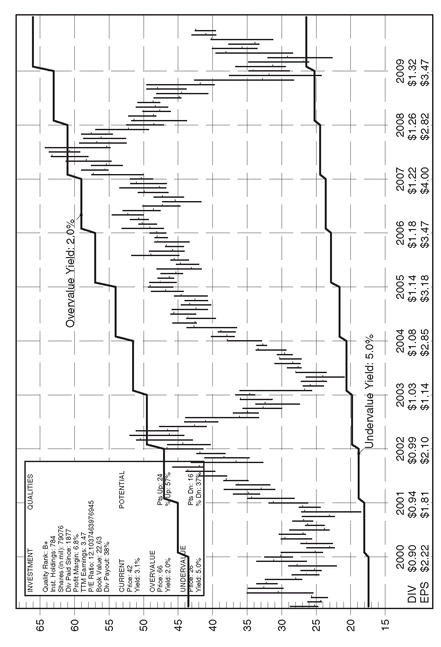
Now let’s take a look at a real-world example by examining the chart of The Stanley Works (SWK) in
Figure 7.2. As noted on the chart, The Stanley Works (SWK) offers good historic value when the dividend yield is at 5.0 percent. The stock reaches its historic level of overvalue when the price rises and the dividend yield declines to 2.0 percent.
In October of 2000, The Stanley Works (SWK) declined to a price of $18.80. Based on the annual dividend of $0.94, the dividend yield was 5.0 percent and the stock was historically undervalued, which is displayed in the following equation:
Dividend Price Yield
$0.94/$18.80 = 5.0 percent
A 5.0 percent dividend yield also identified historic good value in 2003, 2008, and 2009.
If there were one high yield that identified an undervalued price for every stock, it would make life ever so much simpler. Unfortunately, that just isn’t the case. Because each stock has a unique profile of value, based on its repetitive extremes of high and low dividend yield, undervalue is not simply a very low price; rather, it represents a relatively high yield in relation to a currently low price. This is what makes an undervalued stock a bargain—high-quality at good value at a low price.
Sources: Value Trend Analysis
To take full advantage of the dividend-yield strategy, you will have to put in some work, which at the very least means keeping track of the undervalue and overvalue boundaries on the stocks under investment consideration. Once a purchase is made, you must continue to monitor the stock as it winds its way through its cycle. When dividends are increased, the yields at undervalue and overvalue must be recalculated to avoid selling your position too soon or to add to the position if a short-lived dip in price provides another undervalued opportunity.
Dividend Rule
Some stocks are undervalued when their yields are 4 percent, 5 percent, or 6 percent. Others may be equally undervalued on the basis of their historic profiles of dividend yield when their yields are 1 percent, 2 percent, or 3 percent. The point is that each stock has established its own profile of value, its own individual parameters of dividend yield, and each stock must be evaluated individually.
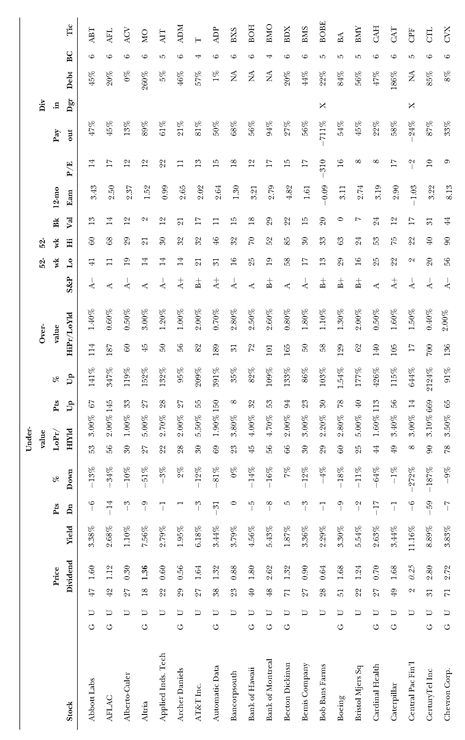
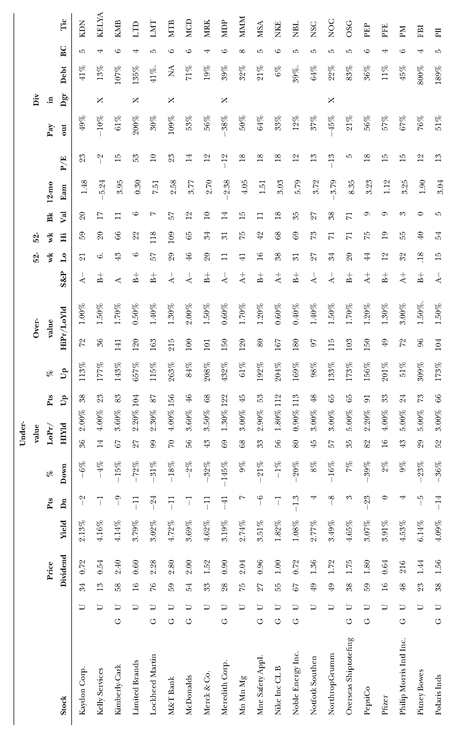
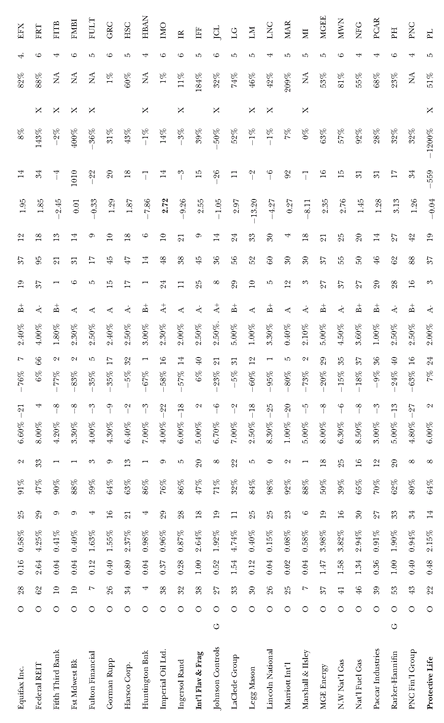
As we did with The Stanley Works (SWK) example, we have identified the Profiles of Value for 272 additional Select Blue Chips. Based on the current dividend yield, each of these stocks are categorized as Undervalued, in Rising Trends, Overvalued, or in Declining Trends. Beyond the respective category of value, the data tables display current prices, dividends, yields, trailing 12-month earnings, book values, and other fundamental information. The Undervalued category as of the mid-September issue of Investment Quality Trends can be observed in
Figure 7.3. In later chapters, we show how to filter through these data tables when making investment considerations.
Are the Numbers Chiseled in Stone?
An undervalued stock should never be purchased before considering other factors, particularly when the market is at or close to the top of its cycle. Upon further investigation, you may discover serious fundamental problems within the company that have forced the price to drop to undervalued levels. A high level of debt or an excessively high payout ratio may indicate the dividend is in danger. In general, however, if the stock is a blue chip and its dividend is well protected by earnings, a purchase at undervalued levels is definitely worthy of consideration.
When a high-quality stock such as SWK has declined to its undervalued area, the likelihood for a deeper decline in price is greatly reduced, but is by no means eliminated. Although the repetitive points of undervalue and overvalue are established over long periods of time, the prices designating undervalue and overvalue levels are not chiseled in stone.
Remember, the markets are a reflection of the thoughts, opinions, and emotions of millions of investors, who can display a wide range of behaviors at any given moment. Yes, Virginia, the markets are sometimes even irrational. As such, investors can drive prices above or below undervalue and overvalue areas by a few points or even to ridiculous extremes. Depending on how investors react to news and information, no power on earth can limit price movements between specific boundaries. If nothing else has been learned over the course of the present bear market, when sufficiently exercised, investors have the ability to move prices beyond logical norms and to speculative extremes.
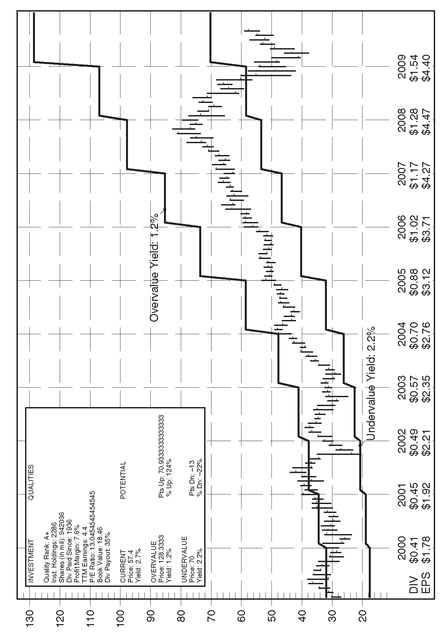
As a case in point, observe the chart of UTX in
Figure 7.4. Note that UTX offers good historic value when the dividend-yield is 2.2 percent and reaches its historic level of overvalue when the price rises and the yield declines to 1.2 percent. When the market reopened after the September 11, 2001 attacks, UTX declined along with broad market to just above $20 per share.
Based on the then-current dividend of $0.45, the dividend yield reached 2.2 percent and the stock offered good historic value. The following bar, which represents the month of October, illustrates that investors were motivated sufficiently to accumulate UTX, and the price rose until April, 2002 to within 10 percent of its historic level of overvalue. At this juncture, the broad market turned down to test the September 2001 lows, and UTX followed suit until October 2002, within 10 percent of the undervalue yield of 2.2 percent. Almost on cue, the stock reversed to the upside and entered a rising trend, which was aborted in February 2003 when the markets tested the October 2002 lows.
Source: Value Trend Analysis
In March 2003, the stock reached the undervalue yield of 2.2 percent and again reversed to the upside, quickly entering into a rising trend, which it sustained until October 2007, when the wheels began to fall off in the broad market. In July 2008, United Technologies Corporation had declined to the 2.2 percent undervalue yield and reversed course in line with its well-established pattern. In September 2008, the broad market began what is referred to as a waterfall, and it declined until the halt and reversal on March 9, 2009.
If you remember, it was in September 2008, when Lehmann Brothers filed for bankruptcy and the banking, credit, and investment markets were turned upside down. As is illustrated on this chart, investors reacted to this event and those that quickly followed suit in an extremely negative fashion, driving UTX well beyond its historically repetitive undervalue yield of 2.2 percent. The fact that UTX, a member of the DJIA with an A+ quality ranking, had an uninterrupted string of earnings and dividend increases for the previous 10 years and a much longer history of superior performance prior to those 10 years was completely ignored by investors in an emotion-driven panic. At the time of this writing in mid-September 2009, UTX is trading at just shy of $63 per share and appears on track to resume its long-established Profile of Value.
As illustrated in
Figure 7.4, in the vast majority of instances, overvalue and undervalue designations come within ten percent of the high or low in a major price move. As such, the Dividend-Yield Theory considers prices to be undervalued or overvalued when they are within the 10 percent range of their historic levels of high or low dividend yield.
The Market of Stocks
As mentioned previously, there is the stock market and there is the market of stocks. As such, good values can be found at virtually any phase of the stock market cycle. However, more undervalued stocks can be found at the end of a bear market or during a major correction in a bull market. Because the selection of undervalued stocks is likely to be large, it is a time that investors have an exceptional opportunity to diversify their holdings.
By example, in the mid-March 2009 issue of Investment Quality Trends, 177 or 65 percent of our 273 Select Blue Chips represented historic good values and were in the Undervalued category. An extraordinary number, too many to list, were trading at or below book values. Also extraordinary, as was illustrated in the UTX example, were the number of stocks investors had driven beyond long-established extremes of high dividend yield.
Although the Dividend-Yield Theory has accurately defined the repetitive levels of undervalue time and again over four decades, it cannot determine precisely when a stock purchased at undervalue will begin to rise in price. Nonetheless, it is clear that these stocks are bargains, and that high-quality stocks that have consistently proved their worth over the years will eventually garner investor attention.
As all experienced investors know, timing is almost impossible to nail down on a consistent basis. Even so, when the timing of an acquisition is not exactly in synch with that of the broad market trend, undervalued stocks have a propensity for maintaining their value and price, which can even be seen in a bear market. As my partner Mike frequently says, “With undervalued stocks it is a when and not an if.” If there is one thing knowledgeable investors cannot ignore for very long, it is a high-quality company that offers exceptional, historic value. Although all economic and business cycles eventually come to an end and the markets will respond with a period of contraction, the conditions that initiated the decline will improve, and animal spirits will gravitate toward undervalued stocks to realize excellent long-term capital gains.
The Overvalued Phase
Using the simplest definition, overvalue is a relatively low dividend-yield that in the past has coincided with the top of a major rising price trend. The term can apply to an individual stock, a group of stocks, or the overall market. When these repetitive areas of low-dividend yield are plotted on a stock chart, it becomes visually apparent that the stock has a tendency toward halting and reversing a rising trend in the same relative area of dividend-yield each cycle. By averaging these relative areas of low-yield, a boundary for the top can be established.
The process for identifying the historically repetitive areas of overvalue is identical to that for the historically repetitive areas of undervalue detailed earlier in this chapter. For a refresher, refer back to
Figure 7.1 and the accompanying text.
For an example of overvalue, refer back to the undervalued stocks section and review the examples for the fictitious Widgets “R” Us and the real-world example of The Stanley Works (SWK). The mechanics for identifying Undervalue and overvalue are the same; the only difference is with overvalue you are looking for tops rather than bottoms.
When a stock approaches the undervalue area it is a signal to investors that historic good value is in the offing. Conversely, when a stock approaches the overvalue area, it is a signal to investors that much of the historic value has been realized over the course of the rising trend. This is not to say that that an overvalued stock cannot continue to rise; our charts are replete with dozens of examples that prove otherwise. What is fundamental to the overvalue area, however, is any further upside potential is far outweighed by the downside risk. The only caveat to this is if an overvalued company increases its dividend, the price at overvalue will also rise, creating further upside potential for the continuation of the rising trend.
Any experienced investor with an ounce of self-honesty will admit to have engaged in speculative roulette at some point in his investment experience; anyone who has felt the energy and excitement of a rampaging stock or market knows exactly what I am referring to. Once euphoria sets in, however, it is much like unwanted company; hard to get rid of. Although everyone enjoys feeling on top of the world, for investors it can present a major problem because investment euphoria often masks the fact that the top of a cycle has been reached. For the investor with eyes to see, the overvalued area is the time to ring the bell and plant the flag, meaning that it’s time to harvest well-deserved profits.
The overvalue area also tends to coincide with the time that less sophisticated investors succumb to the allure of the large sums of money being made all around them, which all too often leads them to buy at the top. This phenomenon is most prevalent in the hot stock of the times, which perpetuates even more buying, which pushes stock prices beyond all measures of fundamental value. At some point, though, comes the inevitable correction; trees cannot grow to the sky.
When the broad market is overvalued, the risk level for all stocks is ratcheted higher. However, investment decisions should still be based on the specific values for individual stocks. Remember, each stock has its own distinctive level of overvalue. So, even when a bull market is in its latter stages, not all stocks are overvalued. For the ones that are overvalued, not all stocks are overvalued to the same extent.
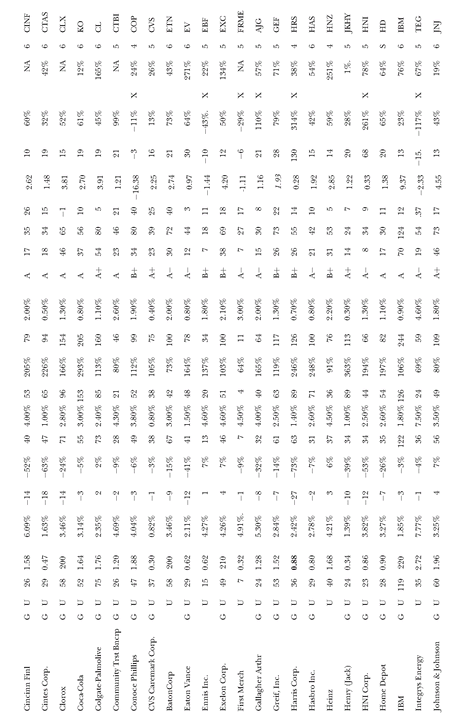
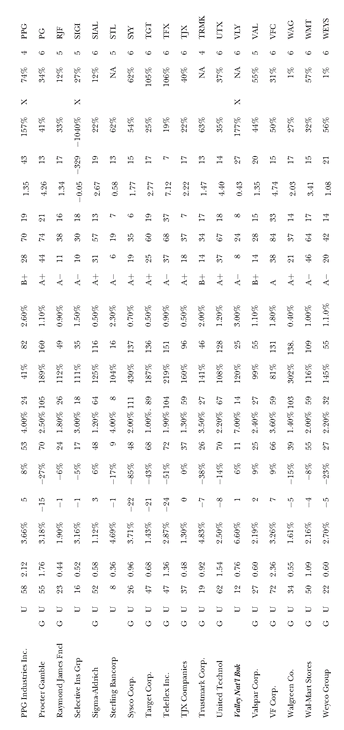
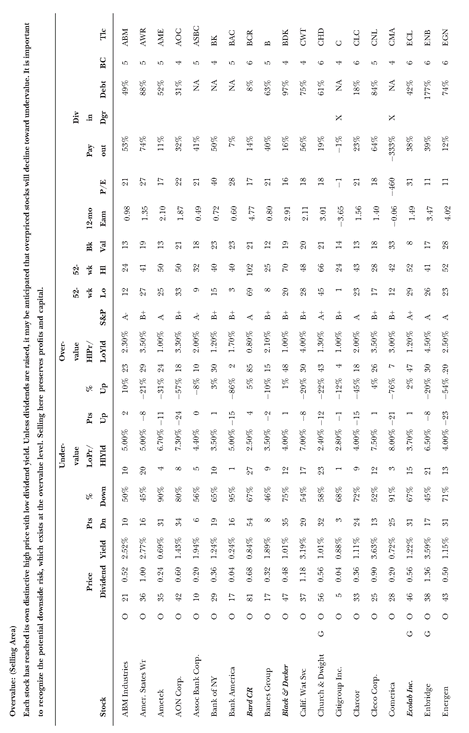
For these reasons, it is important to plot each stock’s dividend yield on a chart and make note of the yield area where the stock historically reverses course. In so doing, it is possible to identify the dividend yield at which it is overvalued. When a stock’s price is pushed to the upper channel line on the dividend-yield charts shown in this book, the yield is reaching a level at which the investor is overpaying for the dividend to be received. This is the textbook portrait for the historically repetitive area of overvalue. See
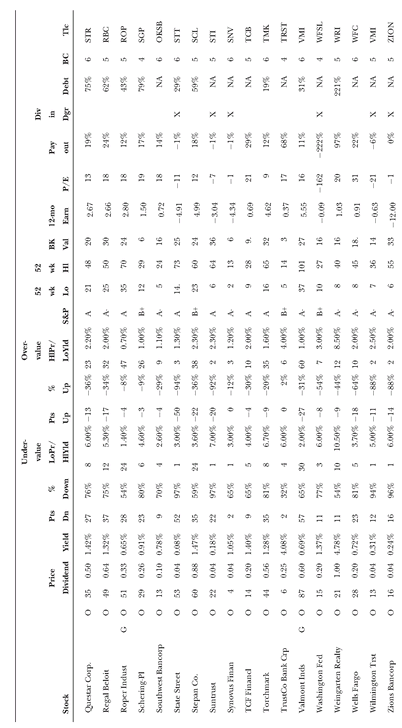
Figure 7.5 for a list of Overvalued stocks as of mid-September 2009.
No One Gets Bonus Points for Being a Hero
Of my grandfather’s many lessons, the one most constantly reinforced was “the gain is made on the buy, son.” Although most of my grandfather’s folksy quips of wisdom are immediately understood, whenever I share this one it almost always is met with a blank stare of confusion. “How do you establish a gain on the buy? You don’t know what you’ve made until you sell!”
In the accounting sense, this, of course, is correct. What my grandfather was teaching me though was a values-based mindset; when you buy right, the gains are almost assured. In IQ Trends speak we would say that when you focus on quality and value there is a higher probability that gains will follow. In either case, the point should be easy to understand: The maximum potential for capital appreciation and the highest dividend yields are secured when a stock is purchased at historically good value.
So what is buying right? According to the Dividend-Yield Theory, stocks trade between two channels of dividend-yield extremes: An area of low price/high yield (undervalue), and an area of high price/ low yield (overvalue). Therefore, purchases should be limited to shares that offer historically repetitive high dividend yields and low prices (undervalue), which offers the maximum upside potential and minimum downside risk. That is buying right.
The corollary to buying right is obviously selling right. When a stock or a market reaches its overvalue phase, investors should be planning their exit rather than searching for new acquisitions. Let’s be clear about one thing—the market isn’t going anywhere. If you’ve gone to the trouble of sifting through dozens of stocks to find the few that are worthy of your investment capital, bought right, and sat patiently through the rising trend until the historic level of overvalue is reached, you’ve done your job; now collect your rewards. That is selling right.
Value can always be found in the stock market. As Geraldine has told me many times, “stocks are like streetcars, another will come along soon.” It takes courage to purchase a stock at undervalue, it takes wisdom to sell it at overvalue.
The Rising Trend
Once a stock has moved up 10 percent or more off of its undervalued base, it has entered into a rising trend. As undervalue represents the buying area and overvalue represents the selling area, the rising trend can generally be characterized as the hold area. From the Investment Quality Trends perspective, a stock remains in a rising trend until it comes within 10 percent of its historically repetitive area of overvalue or falls back to within 10 percent of its undervalued area.
As any veteran market observer knows, stocks rarely move in a straight line from point A to point B. In fact, a stock may enter into a rising trend only to fall back to the undervalue area on a broad market decline. On the other hand, a stock can remain above its undervalue area in a rising trend for an extended period of time, moving sideways until the price breaks out and resumes its upward climb.
When making investment considerations, an investor should always look to stocks that are undervalued first because they represent historically repetitive extremes of low price and high dividend yield. In some cases, however, when a stock is near its undervalued area yet technically in a Rising Trend, there may still be a viable opportunity to make a profitable purchase.
Before making such a purchase decision though, there are two important things to take into consideration. The first is the primary trend of the broad market. Is it in a bull cycle or a bear cycle? In most cases it is best to avoid purchasing rising-trend stocks in a bear market because the overall wave of selling can engulf the stock, which will halt and reverse the upward trend. In this instance the stock can return to its undervalued area, which necessarily results in a loss to the investor.
Secondly, what is the upside potential to overvalue for the stock versus the downside risk back to undervalue for the stock? In this case, when the primary trend is up or in a bull cycle, stocks in a rising trend may still offer an attractive buying opportunity. The salient question at this point is how far into the rising trend the stock has traveled.
When the broad market is at undervalue or early in its rising trend and a stock is within 15 percent of its undervalued area, a purchase could still realize significant gains. This is particularly true if the stock has a long history of dividend increases. As referenced earlier, a dividend increase will lift the prices at undervalue and overvalue, which provides an additional layer of safety to the original investment. Also previously noted, dividend increases are a predictor for future price growth, not to mention the increased income, which can add momentum to the uptrend.
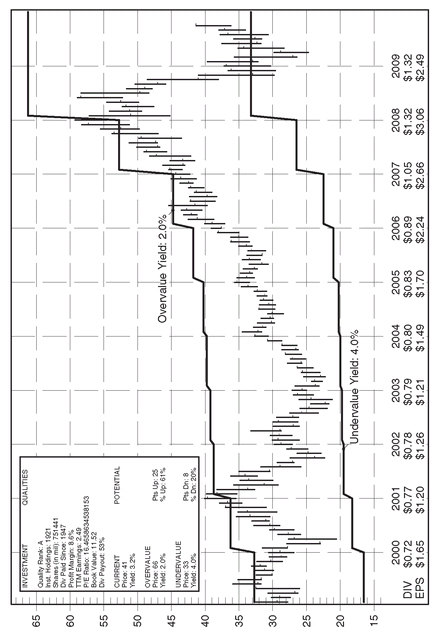
Figure 7.6 shows the chart for Emerson Electric (EMR). In October of 2002, a decline in EMR was halted within 10 percent of its undervalued yield of 4.0 percent, from which it entered into a rising trend. This advance was halted as the broad market moved lower in a test of the 2002 lows before reversing in March 2003 and resuming its upward move. Brief pullbacks in 2004 and 2005 offered additional buying opportunities as rising dividends moved the boundaries for undervalue and overvalue higher.
In 2006, EMR reached overvalue again and began the expected decline. However, the rising trend resumed as further dividend increases provided additional upside potential. In 2007, EMR breached the overvalue level on the strength of its dividend increases, and while it declined with the broad market in early 2008, investors pushed the stock into a rising trend one more time before the weight of the bear market broke its ascent and it declined to its undervalued area of 4.0 percent in 2009.
When the broad market stabilized and reversed course in March 2009, EMR followed suit. As of mid-September 2009, EMR has once again moved into a rising trend.
Source: Value Trend Analysis
When the broad market is in a rising trend, stocks that are in a rising trend can provide excellent short-term profit opportunities. A rising-trend stock in a rising-trend market has a greater chance to reach overvalue in a shorter period of time than an undervalued stock because it has a shorter distance to travel and it has the all-important force of market momentum at its back.