CHAPTER 8
Value, Cycles, and the Dow Jones Averages
Order and simplification are the first steps toward mastery of a subject.
—Thomas Mann
In the preceding chapters, I have attempted to lay out in a logical manner the importance of quality, value, cycles, and trends. To narrow our considerations to only the highest quality blue chips we use the Criteria for Select Blue Chips. To identify historically repetitive areas of undervalue and overvalue of dividend yield we use the Dividend-Yield Theory. By combining the fundamental qualities of the Criteria with the technical attributes of the Dividend-Yield Theory we have the components of the dividend-value strategy.
In addition to identifying the areas of undervalue and overvalue for individual stocks, the cyclical aspect of the Dividend-Yield Theory applies to the broad market, as measured by the Dow Jones Industrial Average (DJIA), in equal manner. By understanding the cyclic nature of value in the Dow, it allows the investor to further hone his buy, sell, and hold decisions. While many stocks will cycle through the phases of value contra to the primary trend of the broad market, it is no secret that it is easier to swim with the tide than against it.
In the next chapter, I combine what has been written through this chapter into a roadmap for building and managing the dividend-value portfolio. Central to that discussion is the primary trend of the Dow, which phase of value is currently in force, and how this information should be included in your buy, sell, and hold considerations.
Because there are so many references to the DJIA throughout this book, there are undoubtedly some critics who will suggest that another index, such as the S&P 500 or perhaps the Dow Jones/ Wilshire 5000, would be more appropriate as a proxy for the overall market. While the S&P and Wilshire are important comparative measurements (the S&P 500 in particular, as it is the most widely recognized benchmark that most equity managers compare performance to), the DJIA has more of the blue chip quality characteristics that we are interested in and is still the most widely recognized of all market indexes.
As understanding the primary trend and current phase of value of the Dow is so important to the dividend-value investor, in Chapter 5 I illustrated the historically repetitive patterns of dividend yield that marked areas of undervalue and overvalue for the DJIA between 1926 and 1995. Also noted in Chapter 5, between 1995 and 2008 there was a divergence in this pattern, which requires an explanation. It is my belief that the DJIA is now in the process of reverting back to the historic pattern prior to 1995. If my assumption is correct, I feel it is incumbent to discuss what this portends for the remainder of the present bear market and how to prepare for the bull market that will eventually follow.
Before we dive into this section however, I want to provide a brief history of Charles Henry Dow, the genesis of the Dow Jones indexes, and Dow’s contribution to value investing.
Charles H. Dow and the Dow Jones Averages
Charles Henry Dow was not an investment banker, a money manager, or a stockbroker. He was the son of a poor farmer who died when Charles was six years old. Wanting more than the hard farming life that killed his father, he struck out at the age of 16 to become a newspaper man, although he had no formal education in journalism or even much formal education to speak of.
Be that as it may, Charles managed to find work as a reporter for several newspapers, including the Springfield Daily Republican and the Providence Journal. He left Providence and moved to New York, where he was employed by the Kiernan News Agency, a company that gathered and disseminated the financial news of the day. Also employed by Kiernan was a fellow by the name of Edward D. Jones, who Dow had known in the newspaper business in Providence.
In 1882, Dow, Jones, and a third man named Charles Bergstresser formed Dow Jones & Company. In 1884 Dow Jones published its first average of U.S. stocks in the Customer’s Afternoon Letter, the forerunner to the Wall Street Journal. In 1886, Dow Jones published its first industrial average consisting of 12 companies that reflected a cross-section of industries.
The Index averaged the stocks of the following companies: American Cotton Oil, American Sugar, American Tobacco, Chicago Gas, Distilling & Cattle Feeding, Laclede Gas, National Lead, North American, Tennessee Coal, Iron and Railroad Company, U.S. Leather, U.S. Rubber, and General Electric. Of these original 12, the lone survivor is General Electric.
According to a book titled The Dow Jones Averages that was published by Barron’s in the early 1920s (another Dow Jones & Company publication), there are references to various stock averages, comprised of as few as 12 stocks to as many as 60 stocks, that Dow experimented with as far back as 1872. Unfortunately, there is no record for what Dow’s thinking was with these various averages, but one could conclude that he was searching for the appropriate mix of stocks that could reveal the primary trend of the market.
In any event, Dow must have found what he was looking for, and by 1897 there were dual Averages, the Industrial and the Railroad, the latter of which became the Transportation Average. In 1929, Dow Jones & Company introduced the Dow Jones Utility Average to track the utilities subset of the market.
Most of Dow’s writings are not available, but 16 editorials were published in The ABC of Stock Speculation in 1903, a year after Dow’s death, by S.A. Nelson. Although the conventional wisdom is that Dow was purely a technician (practitioner of technical analysis), which is obvious to the extent that Dow believed that his Averages, and the individual stocks from which they were comprised, were influenced by the cycles that coincided with bull and bear markets, he was also clearly cognizant of the importance of values.
These discussions of values, along with the works of Benjamin Graham, greatly influenced my predecessor and mentor Geraldine Weiss and me. From these two academic fathers came the underpinnings of the Dividend-Yield Theory and Geraldine’s original interpretation, which forms the approach outlined in this book and is promulgated by Investment Quality Trends.
If you refer back to the foreword to this book, Geraldine supplies the Dow quote that has graced the pages of our newsletter since inception and is one of our guiding principles: “The legendary Charles Dow has written, ‘To know values is to know the meaning of the market. And values, when applied to stocks, are determined in the end by the dividend yield.”’
Although the majority of Dow’s legacy is attributed to the Wall Street Journal and the Dow Theory that bears his name, it is clear he understood the importance of values and that dividends are the primary indicator of value.
The Dividend-Yield Theory and the Dow Jones Industrial Average
Just as parameters of value can be established for individual stocks, so, too, can good buying and selling areas be established for the DJIA. From the early days of the stock market, the DJIA fluctuated between dividend-yield extremes of 6.0 percent and 3.0 percent, which represent undervalue and overvalue, respectively (see the charts in
Figure 6.2). That profile of value guided the stock market through every bull and bear market from 1929 through 1995.
Prior to the current bear market, the worst bear market of modern times began in 1966 at an overvalue yield of 3.0 percent and was not completed until December, 1974 when the undervalue yield of 6.0 percent was reached. From 1975 to 1982 the market fluctuated between dividend yield extremes of 5.0 percent and 6.0 percent until a new bull market was launched.
The bull market that began at undervalue in 1982 rose to overvalue in 1992, remained there until 1995, and then a remarkable thing happened: For the first time in history the DJIA continued to ascend above its historically repetitive low yield and appeared to have formed a new profile of investment value. From the mid-1990s through September 2008, what formerly was the yield at overvalue (3.0 percent) became the new floor of undervalue and a dividend yield of 1.50 percent became the new selling area of overvalue.
In October 2008, however, the DJIA broke below 10,000 and eventually reached an intraday low price of 6440.08. Based on the composite dividend at that time, the dividend yield on the DJIA rose to 4.90 percent, a decisive violation of the undervalued dividend-yield floor of 3.0 percent.
A Long Blow-Off Top
When the long-term dividend-yield profile of the DJIA was violated in the early to mid-1990s, it came as a great shock. Intuitively, we knew something was amiss but we just couldn’t put our finger on it. Because the new pattern persisted, we had to report it, but now that it appears there is a reversion to the mean, it begs an important question. What convinced the global body of investors to change their behavior after 60-plus years of predictability? In the rear view mirror in which all post mortems are conducted, the evidence points to the financial equivalent of the perfect storm.
By the mid-1990s, the ascension of the personal computer, operating systems that the average person could learn, along with associated software applications that increased productivity, launched a modern-day Industrial Revolution. With technology at their fingertips that was previously available to only the wealthiest of companies or individuals, the average person could now access the Internet and the Information Age was born.
News and financial information that once took weeks if not months to be disseminated and synthesized was now available in real time, to everybody. Simultaneous to this explosion of information technology and the industries that grew from it, an era of fiscal responsibility (short-lived that it was) descended upon the halls of Congress. The promise of smaller government and balanced budgets lit a fire under the bond market. Interest rates, which had already declined significantly since 1982, continued their downward trajectory.
The Federal Reserve Open Market Committee (the FOMC or more simply, the Fed), which at the time was led by Chairman Alan Greenspan, fell in love with this new-found productivity and for the most part remained accommodative. Oversight and regulation of the financial industry and markets by the Congress and other regulators was virtually nonexistent. Corporate and personal income taxes were generally low, and favorable tax treatment was afforded to capital gains.
In retrospect, it is no wonder investors ignored the message of overvalue that a 3.0 percent dividend yield on the Dow represented. Who cares about values and the meaning of dividends when the powers that be are aligned with the speculative stars? With the investment winds at their back and a tax code designed to ignore dividends and embrace capital gains, investors said to heck with values and plunged in with both feet; hence the tech and dot-com markets.
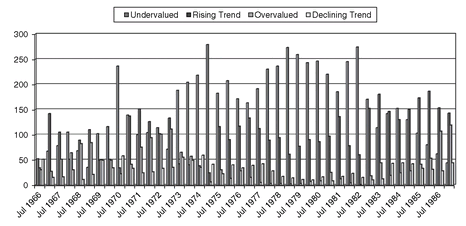
We should backtrack for a moment and revisit the environment from which the bull market that began in 1982 was launched. From 1966 through 1974 the market was decimated by a vicious bear cycle. By late 1974 the dividend yield on the Dow was 6.0 percent and our undervalued category was 80 percent of our Select Blue Chip universe. Between 1974 and 1982, the Dow fluctuated between dividend yields of 5 percent and 6 percent and our undervalued category fluctuated only slightly above and below the 80 percent level.
In
Figure 8.1 we display our Blue Chip Trend Verifier in bar-graph form to illustrate the incredible level of values during this period.
When the third and final leg down of the bear market began in 1973, the Undervalued category rose to dominance and remained there until the bull market began in 1982. As frustrated capital that had been pent up since the end of the bear in 1974 came rushing in, the Rising-Trends category eclipsed the Undervalued category as stock prices were pushed higher.
Figure 8.1 Select Blue Chips Percent Change by Category July 1966 to January 1987
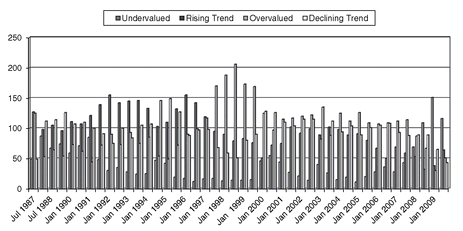
Figure 8.2 Select Blue Chips Percent Change by Category July 1987 to July 2009
Now look at the bar graph in
Figure 8.2 that illustrates the period from 1987 through July 2009 to see what happened to all of those historically good values.
On the far left edge of
Figure 8.2 is the reading from July 1987. Note that the Rising and Declining Trend categories are about even. The dividend yield on the Dow had breached the 3.0 percent overvalue yield at this point. The next set of bars represents the reading of January 1988. Here we can see that the crash on October 19, 1987 had moved the majority of stocks into declining trends and the dividend yield on the Dow had declined back to 4.0 percent. The readings from July 1988 and January 1989 depict similar levels of value to January 1988. By the January 1990 reading, the rising trends had reasserted their dominance and the dividend yield on the Dow had declined once again to the 3.0 percent overvalue area.
From mid-year 1994 through January 1995 the Declining-Trends category took center stage. There is really only one explanation for this: The majorities of Select Blue Chips had declined below overvalue and were moving toward their respective areas of undervalue. You can almost sense that investors knew intuitively the market was overbought and needed to retrench.
Then the perfect storm, as described earlier, kicked into gear. From mid-year 1995 until mid-year 1997 the rising trends returned to the fore. At that point the dividend yield on the Dow was so low that well diggers would have had trouble finding it. From that point through early 2000, the Overvalue category reigned supreme as investors thoroughly trashed whatever could be trashed until the first leg down of the present bear market took hold.
In 2000, the luster and allure of quick profits in companies that were created on a cocktail napkin began to wear off. When earnings failed to materialize and the reality that, in many cases, these companies were simply speculations, the tech and dot-com illusion came to a screeching halt. By late 2000 and early 2001 it was clear the economy was in recession and the markets began to tumble in earnest. When America was attacked on September 11, 2001, the selling accelerated and the markets continued to decline through November 2002.
In response to recession and the market seizure as a result of 9/11, the Federal Reserve embarked on an unprecedented easing of Fed Fund rates. The only pool of capital readily available was tied up in home equity and the only way to unlock it was to drive interest rates down to Depression-era levels and to hold them there.
In the name of market reform, the Tax Reform Act of 2003 was passed and income tax rates on dividends and capital gains were lowered dramatically to stimulate investor interest. This Act, along with the tech and dot-com bust fresh in their minds, not to mention the Enron, World Com et al. scandals, encouraged investors to rediscover value stocks and dividends. As a result, high-quality dividend-paying blue chip stocks that had been virtually ignored during the decade of the 1990s were once again embraced, and shares appreciated dramatically.
Returning to the graph in
Figure 8.2, we see that although investors had fallen in love with dividends again, in 2003 there was an obvious absence of anything that even remotely resembled historically good values. Also, when the first leg down bottomed in 2002 and retested in early 2003, the dividend yield on the Dow was still below its historically repetitive area of overvalue dividend yield!
At the risk of being redundant, I need to drive this point home. Since 1966, when the Undervalue category represented 17 percent or less of our select blue-chip universe, it has been coincident with major market tops. When the Undervalue category is between 70 percent and 80 percent of our universe, it has been coincident with major market bottoms. At the market top in 2000, our Undervalue category was 12 percent of our universe. When the first leg down bottomed in late 2002 our Undervalue category still represented only 16 percent of our universe! So after dropping 5,000 points, the Dow was still dramatically overvalued! By mid-year 2005, our undervalued stocks had fallen further to only 4 percent of our universe. Now consider this: With the previous as a backdrop, the market continued to move higher for two more years. At this point the terms overvalue and irrational exuberance have no meaning; we are talking sheer insanity. Isn’t it amazing what massive amounts of liquidity created by rock-bottom interest rates and the illusion of derivatives can create?
Obviously some segment of investors had recognized that the massive leverage and speculation that had been compounding since the end of World War II had finally reached a tipping point. How can I write this? The majority of stocks in the Undervalue category were banks and other financials.
The Walls Come Tumbling Down
When housing prices had reached unsustainable levels and buyers were no longer able to flip at higher prices, it became clear that many of these buyers/borrowers were unable to meet and carry the debt service.
Subsequently the mortgage-backed securities that had been formed from these mortgages became suspect as the value of the underlying properties began to deteriorate. Banks, brokerage firms, and hedge firms that were heavily invested in these securities now had to mark-to-market, and with no reliable metric to value these properties and securities, the entire structure began to fall apart. For all intents and purposes what ensued was one giant margin call as everybody needed liquidity to shore up their balance sheets.
When one receives a margin call there are two options: sell positions or deposit more cash. Unable to sell their mortgage-backed securities, the banks, brokers, and hedge funds had to sell whatever they could—blue chip stocks, oil, gold, commodities, you name it. As the selling became a waterfall, the investing public began to hear about derivatives, synthetic securities with names like collateralized debt obligations (CDOs) and credit default swaps, which actually had been in use since the mid-1990s.
Institutions that at one time were believed to be too big to fail like Bear Sterns were absorbed, and Lehman Brothers declared bankruptcy. Merrill Lynch was acquired by Bank of America. Washington Mutual, which had raised its dividend over 40 consecutive quarters, was taken over by the FDIC and sold to JP Morgan Chase for next to nothing.
The End Game
My thought is the market pattern that is developing is similar to that of the bear market from 1966 through 1974. This is not to say I expect the bear market to last for eight years, but that I suspect the Dow will go through a similar sequence of three down legs interspersed by two highly profitable counter-trend rallies until the dividend yield on the Dow declines to between 5.0 percent and 6.0 percent, which should set the stage for a new bull market.
For a point of reference, let’s look at the chart in
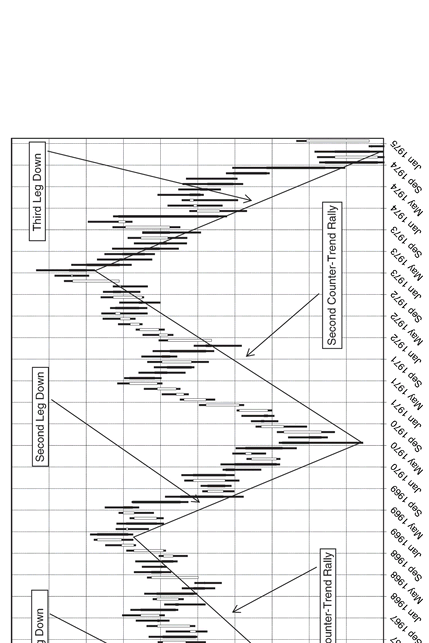
Figure 8.3, which illustrates the pattern described earlier in the 1966-1974 bear market.
The bear market began in 1966 when the dividend-yield on the Dow declined to its historically repetitive area of overvalue at 3.0 percent. The first leg down was completed later that year and reversed course when the dividend yield on the Dow reached 4.0 percent. The first counter-trend rally topped out in 1969 just below the 1966 high.
The second leg down commenced shortly thereafter and did not halt and reverse until the dividend yield reached 5.0 percent. The second counter-trend rally topped out in early 1973. Note that this counter-trend rally exceeded the 1966 and 1969 high-price areas. Coincidentally, the dividend yield on the Dow at the 1973 top was 3.0 percent. Many investors believed a new bull market was underway at this point due to the Dow eclipsing the 1966 high price. As you can see, however, the market rolled over into a third leg down, which was completed when the dividend yield on the Dow registered 6.0 percent in December, 1974.
Now let’s compare the this with the current bear market as depicted in
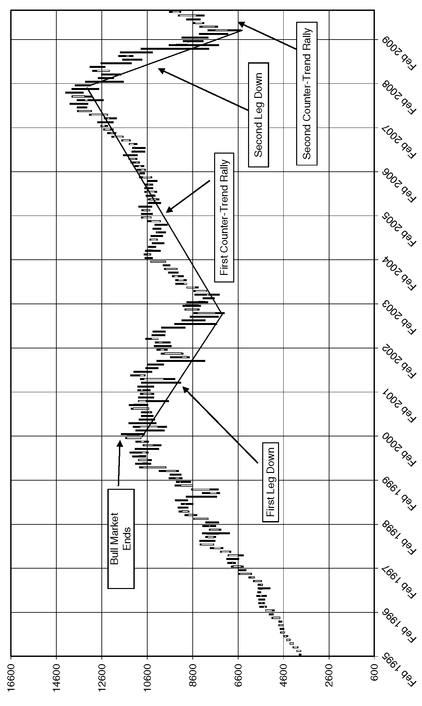
Figure 8.4.
If my analysis is accurate, the first leg down began in early 2000 and ended in October 2002. If you refer back to the Investment Quality Trends chart for the Dow in
Figure 6.2 in Chapter 6, note that at the bottom of the first leg down the dividend yield was below the 3.0 percent yield area. The counter-trend rally began in earnest in 2003 as the Greenspan Fed and the Bush administration unleashed the one-two punch of extremely low interest rates and relaxed federal tax rates on capital gains and dividends.
Figure 8.4 DJIA 1965 throught mio-September 2009 Bear Market
In late 2003 through the fall of 2007, we see what happens when massive amounts of home equity, never-before-seen degrees of leverage by speculators, and institutions using lethal doses of derivatives can do to the stock market. When the Dow eclipsed its 2000 high in 2006, investors believed, just as they did in 1973, that a new bull market was underway. And, just like 1973, the market rolled over into another leg down.
The second leg down bottomed intra-day on March 9, 2009, with the dividend yield on the Dow reaching 4.90 percent, 10 basis points (10 one-hundredths of 1 percent) within 5.0 percent. Simultaneously our Blue Chip Trend Verifier recorded that 72 percent of our select blue chips were in the Undervalue category, indicating that the potential for a counter-trend rally was high.
As we know, a very powerful counter-trend rally has developed. If the pattern of this bear market mirrors that of bear markets in the past, the counter-trend rally should retrace at minimum 50 percent of the previous down leg, which would approximate 10,300 on the Dow. As you know now, counter-trend rallies can also return to the old high as in 1969, or can even breach that level as in 1973 and 2006.
Knowledge of these patterns allows investors to initiate new undervalued positions at important reversal points such as the March, 2009 lows and to recoup some lost ground on older positions that may have been held through the previous decline. If and when the counter-trend peaks and begins to decline again, it is time to take profits on overvalued stocks, place stop losses on below-rising trend stocks that have advanced significantly, and raise cash in anticipation of the next halt and reversal.
The Next Bull Market
In the case of the present cycle, I believe one more down leg remains ahead of us. When the 3.0 percent dividend-yield area on the Dow was violated in late 2008 and declined to almost 5.0 percent, it became clear to me that the era of irrational exuberance had come to an end. As such, it would be completely logical for the Dow to return to its historically repetitive extremes of undervalue and overvalue at dividend yields between 3.0 percent and 6.0 percent, respectively. At the very minimum, I would anticipate at least a retest of the March 2009 lows.
However the end game plays out, as night follows day there will be a new bull market. It should be quite profitable over its life but it will be different than bull markets of the past as the wind will no longer be at our backs. The perfect storm of low interest rates, an accommodative Fed, friendly personal and corporate tax rates, cheap money and ready liquidity, lax regulation and oversight, not to mention irrational exuberance, will be absent.
Not to worry though, because quality and value will be plentiful, which for value investors is the best environment one could hope for. Although it won’t be as easy as in the past, it will be achievable. To quote the John Houseman line from the old Smith Barney commercials: “We make money the old-fashioned way. We earn it.” To modify the John Houseman line from the old Smith Barney commercial; “We’ll make money the old fashioned way, we’ll earn it.”