| CONCLUSION |
A second effect on performance of creating small, empowered units is to increase the likely speed of adaptation to new information.
—John Roberts, The Modern Firm
Software delivery in most organizations has been plagued by problems for many years—problems that new technology promises to solve but rarely (or never) does. These problems include disengaged teams, too many recurring surprises with changes in technology and markets, pushing against Conway’s law, software that has grown too big for teams, a confusing array of organization design options and delivery frameworks, teams pulled in many different directions, painful reorganizations every few years, and poor flow of change. Not every organization has all of these problems, but most have some and many have almost all, despite repeated attempts to avoid them. So, what is the cause of these ongoing problems?
The reason so many organizations experience so many problems with software delivery is because most organizations have an unhelpful model of what software development is really about. An obsession with “feature delivery” ignores the human-related and team-related dynamics inherent in modern software, leading to a lack of engagement from staff, especially when the cognitive load is exceeded.
The real implications of Conway’s law are almost completely ignored by most organizations, leading to, at best, happy accidents with architectural choices and, at worst, significant ongoing friction as the organization spends time and effort “fighting” the homomorphic force. Similarly, many organizations are unaware of how a poorly chosen “reorg” can destroy an organization’s strategic capability for innovation and sustainable software delivery.
There is an often bewildering range of team models and scaled delivery frameworks with apparently very little to distinguish them. Furthermore, the behavior patterns of teams are rarely specified, leaving teams without clear guidelines for effective interaction with other teams, resulting in either too-tight inter-team coupling or a kind of isolationist autonomy that doesn’t really scale.
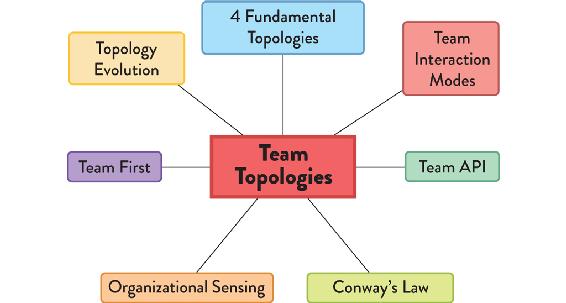
Team Topologies helps to address all these points by setting forth a team-first approach to software delivery predicated on four fundamental team types, three team interaction patterns, and ways of using difficulties in delivery that empower the organization to sense its surroundings. In effect, Team Topologies presents a well-defined way for teams to interact and interrelate that helps to make the resulting software architecture clearer and more sustainable, turning inter-team problems into valuable signals for the self-steering organization. This is summarized in Figure 9.1:
Figure 9.1: Core Ideas of Team Topologies
Four Team Types and Three Interaction Modes
Building and running a software system can be achieved using only four team types. Other team types can be actively harmful to an organization.
The four fundamental Team Topologies are:
The combination of these specific team types is all that’s needed for effective software delivery with fast flow. However, the interaction modes between these four fundamental team topologies are vitally important to understanding and nurturing effective software delivery:
Team interactions outside these three core interaction modes are wasteful and indicative of poorly chosen team responsibility boundaries and poorly understood team purposes.
Team-First Thinking: Cognitive Load, Team API, Team-Sized Architecture
To increase the clarity of purpose and define the boundary of responsibility of teams, choose a fundamental team type and an interaction mode. Team Topologies takes this “team first” approach several steps further by introducing some additional team-related guidelines that have strong outcomes for sustainable software delivery.
The Team Topologies approach treats the team as the fundamental means of delivery, where a team is not simply a collection of individuals with the same manager but an entity with its own learning, goals, mission, and reasonable autonomy. A team learns and delivers together because when this happens, the results far outperform mere collections of individuals. The team considers not just its code as part of its external “API” but also its documentation, onboarding processes, interactions with other teams in person and via chat tools, and anything else that other teams need in order to interact with its members.
To avoid software becoming ever larger and eventually overwhelming a team, the size of subsystems (or components) are limited to that manageable by a single team. Specifically, exceeding the maximum cognitive load that a team can deal with as a team is avoided, ensuring that the whole team is comfortable with the complexity and mental overheads. This “team-sized architecture” focuses on people first, and is a more sustainable and humane approach to software architecture than either monolithic or microservices architectures, both of which focus on the technology first.
Strategic Application of Conway’s Law
Back in 1968, Mel Conway offered superb insight into the relationship between the communication structure of the organization and the resulting system designs, and it has become a powerful enabler (and constraint) for today’s software-rich organizations: “Research which leads to techniques permitting more efficient communication among designers will play an extremely important role in the technology of system management.”1
In today’s context and terminology, the word “designers” can be replaced with “software teams.” In other words, restructuring teams and facilitating (or potentially deliberately limiting) communication between teams has a much better chance of building systems that work well in production and feel natural to evolve over time. The corollary here is that increased collaboration is not always the same as increased communication. That is, if we know we need to be able to deploy different parts of the system independently, with a short lead time, and we decide to use small, decoupled services in order to do so, we need to make our teams similarly small and decoupled, with clear boundaries of responsibility.
Even performance-oriented organizations might be hindering the adoption of effective technologies and practices due to their team organization. For instance, large, up-front designs by software architects are doomed to fail unless the designs align with the way in which the teams communicate.
Approaches to building and operating cloud software such as microservices accommodate the need for human-sized chunks of functionality alongside enhanced deployability. Teams have a greater chance of innovating and supporting a system if they can understand the constituent parts and feel a sense of ownership over the code, rather than being treated like workers on an assembly line. The use of approaches like promise theory (see Chapter 7) can help teams increase their day-to-day practical ownership of code and APIs. Organizations that develop and operate their own software systems must, therefore, set up their organizations radically differently from how it was done in the past. Team structures must match the required software architecture or risk producing unintended designs.
Evolve Organization Design for Adaptability and Sensing
Not only do organizations need to consider team structure at a single point in time, but team structures and communication pathways need to evolve with technological and organizational maturity. Periods of technical and product discovery typically require a highly collaborative environment (with fading team boundaries) to succeed. But keeping the same structures when discovery is done (established technologies and product) can lead to wasted effort and misunderstandings. In particular, organizations should expect teams to collaborate to discover new patterns and execution models, then push these down into the platform and supporting tooling.
Team Topologies is not static but capable of and expected to change as the situation changes. Multiple factors come into play when deciding which of the fundamental team topologies and interaction modes best fit the needs of the organization at a given point in time.
Team Topologies Alone Are Not Sufficient for IT Effectiveness
The Team Topologies approach to software systems represents a major step forward for many organizations around the world, providing insights into how and why different team combinations and interactions work and when to use them, along with practical advice and patterns to follow in specific circumstances.
However, Team Topologies alone will not produce an effective software-delivery and operations organization. Beyond the structures and dynamics suggested in this book, important additional ingredients of success include:
You can think of it like elements needed for creating and maintaining a garden: the Team Topologies approach acts like the instructions for placing the flowers and plants, along with patterns for pruning and training; whereas the cultural, engineering, and financial elements are like the soil, water, and fertilizer that helps the plants grow healthily.
Unhealthy cultures, poor engineering practices, and negative financial influences all act as poisons or growth inhibitors in this garden. Software cannot be expected to grow and thrive—even with excellent patterns for pruning and planting provided by Team Topologies—if the environmental conditions are hostile.
A lack of clarity in business vision is akin to asking a horticulture team to “create a garden” without any indication of the purpose of the garden. Should we grow fruit or vegetables? Should we aim for colorful flowers all year round or just in summer? Is the garden to be used for meditation or for another purpose? Likewise, clarity of purpose and vision in an organization helps to set the context for everyone in the organization to act in ways that address that purpose.
Next Steps: How to Get Started with Team Topologies
1: Start with the Team
First, as an organization ask yourself: What does the team need in order to:
Answering these questions honestly should lead to team-first approaches to office space, developer tooling, usability of platforms, realistic subsystem/domain splitting, team-friendly architecture, rich telemetry, and so forth.
Having started with the team, you can address other important aspects of fast flow for modern software: alignment to streams, the platform, and additional capabilities to support and enhance the work of teams.
2: Identify Suitable Streams of Change
Each organization needs to choose a set of change streams that act as “pipes” down which the most important changes flow. These streams are the main focus for flow within the organization, and all other work within the organization takes place to help flow within these streams (directly or indirectly). Exactly what is chosen for the streams depends very much on the nature of the organization, but some typical streams might be:
Stream-aligned teams should be aligned to the streams you identify. These high-level streams should match the “change pressure” from the core of your organization. If there is no clear or obvious set of change streams, then it is usually beneficial to identify these before going further.
3: Identify a Thinnest Viable Platform (TVP)
After you have identified the most relevant streams for your organization, identify the services needed to support a reliable, swift flow of change in those streams. In practice, these services will form the platform on which the streams depend, but as we noted in Chapter 5, a platform does not have to be a huge, expensive investment. On the contrary, a platform can be “just big enough” to meet the flow needs for the streams: anything from a set of documentation on a wiki that helps teams use the underlying services to a full, in-house, custom-technology solution built to meet the specialist needs of the stream-aligned teams.
Naturally, the platform will evolve over time as the technology ecosystem evolves. The platform teams may start off needing to build a custom solution for, say, infrastructure provisioning, but a few years later, may discard that work in favor of a newly available, open-source or cloud-provider solution that fits better with industry trends.
Remember: technology is only ever a part of the platform; roadmaps, guided evolution, clear documentation, a concern for DevEx, and appropriate encapsulation of underlying complexity are all key parts of an effective delivery platform for stream-aligned teams.
4: Identify Capability Gaps in Team Coaching, Mentoring, Service Management, and Documentation
Having a team-first approach based around core streams of change enabled by a platform is a great place for an organization to start; however, the capabilities and skills needed to make this setup work are more varied and less common than many organizations expect. As we have seen in previous chapters (especially Chapter 5 and Chapter 7), you need to ensure that your teams are populated not just with technologists focused on code or computer systems but also with people who have other skills. In particular, you need people who understand and practice:
We have deliberately omitted details of how to undertake large-scale transformations in an organization. For excellent patterns of organizational change, see the work of Mary Lynn Manns and Linda Rising. 2
These kinds of capabilities help teams within the organization to continually improve their practices, communicate, and interact with other teams, which, in turn, helps the whole organization to safely increase the rate of change flow. No serious sports team would consider not employing coaches and trainers, and no serious organization should be without coaches and trainers either.
5: Share and Practice Different Interaction Modes and Explain Principles behind New Ways of Working
Many people have never really experienced a team-first way of working, so it will feel strange to them. Take the time to explain and demonstrate the team-interaction modes. Explain why some teams are closer together and some teams are further apart. Explain the basics of Conway’s law, and how the conscious design of teams and intercommunications can help improve the software architecture of the systems being built by restricting the solution search space and saving time and effort for everyone.
Emphasize the humanistic aspects of Team Topologies: the focus on the team, the explicit limits on cognitive load, the reduction in noise and interruptions due to team-fist office space, and a limit on free-for-all communications. Identify the focus on fast flow of change for the core business streams, supported by a “thinnest viable platform” and related teams and coaching.
Above all, share how the Team Topologies approach makes for better outcomes for humans, software systems, and the organization itself.