Figure 8.1: Collaboration between Cloud and Embedded Teams
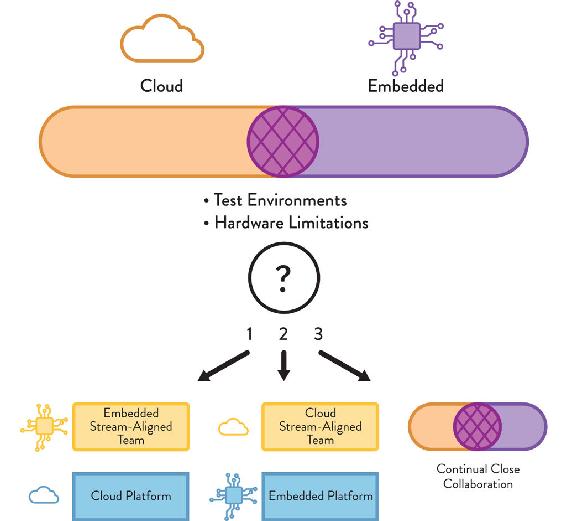
Two teams (“cloud” and “embedded”) collaborate to share practices and increase awareness. The results will include heightened awareness of the options for future team interactions: (1) treat the cloud software as a platform for the embedded team to use, (2) treat the embedded devices as a platform for the cloud team to use, or (3) continue with close collaboration.
The cloud team probably treats test environments as ephemeral and dynamic, and can help the embedded team take a more nimble approach to testing. In return, the embedded team can help the cloud team understand the memory and processing restrictions of the embedded IoT devices and tailor their code and protocols to better suit the limited hardware.
This collaboration period will also help the organization assess whether the cloud software or the embedded devices can and should be treated as a platform (in the sense used in this book) with the corresponding behaviors from the platform-providing team. The alternative is, of course, for the teams to continue to collaborate, possibly with an enabling team providing some mediation. As the collaboration continues, the teams may realize that their respective change cadences are increasingly aligning, in which case they may decide to form a “paired” set of teams, both stream aligned.
CASE STUDY: EVOLUTION OF TEAM TOPOLOGIES AT TRANSUNION (PART 2)
Dave Hotchkiss, Platform Build Manager, TransUnion
(Continued from Chapter 4)
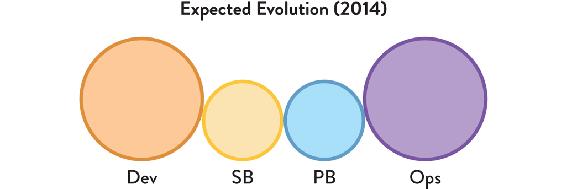
At the start of our transformation in 2014, we realized that the development (Dev) and operations (Ops) groups were separated by a large gap. We knew that a separate team of evangelists could help bring Dev and Ops closer together; but in our case, we decided to use two teams, because the gap was so wide.
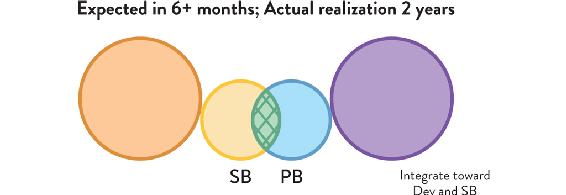
From the Dev group we created a system-build (SB) team, and from the Ops group we created a platform-build (PB) team. We then focused on getting SB and PB collaborating closely, which was a simpler problem to solve initially than getting all the Dev and Ops teams to collaborate (see Figure 8.2 on page 158).
Figure 8.2: System-Build and Platform-Build Team at TransUnion
A team from Dev (SB) and a team from Ops (PB) exploring close interactions.
We drew out a timeline of the team evolution, inspired by the DevOps Team Topologies patterns. We expected to need to focus on awareness or operability within Dev teams to begin with, so our initial team evolution had the SB team collaborating closely with the Dev teams and the PB team. This really helped improve things, like deployment automation, metrics, logging, and other operational aspects (see Figure 8.3 on page 158).
Figure 8.3: System-Build and Platform-Build Team Collaboration at TransUnion
The two teams, SB and PB, collaborating closely.
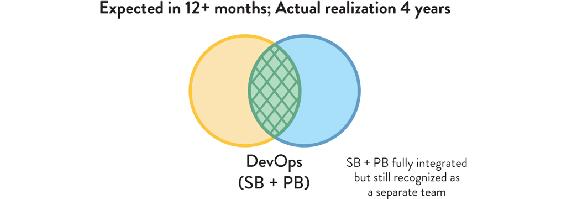
Back in 2014, we expected to have evolved the SB and PB teams to a nice enabling team within twelve months. As it happened, this transition took quite a bit longer than we initially thought (three years longer!) as we started to move our services to Azure; but by early 2018, we had made this work (see Figure 8.4 on page 158). The benefits to the business were really clear: safer, more regular production changes, fewer deployment mistakes, and better traceability of changes (essential in the highly regulated financial sector in which TransUnion operates).
Figure 8.4: System-Build and Platform-Build Teams Merged at TransUnion
The SB and PB teams merged, helping to bring Dev and Ops together.
By late 2018, we had gone even further, finally merging the SB team back into the Dev teams and PB into the Ops teams, bringing higher levels of operational awareness and accountability, and leaving Ops to manage the underlying platform, with some strategic infrastructure running in Azure Cloud (see Figure 8.5).