CHAPTER 11
The Stock Market and the Economy
You will go most safely by the middle way.
—Ovid
As written earlier, nobody has tomorrow’s newspaper, therefore, the future is uncertain. As a market observer, commentator, and money manager, however, prognostication, as futile as it may be, is nonetheless expected.
As opposed to staking out any hard and fast territory, what I offer in this chapter is a mixture of observations, some historical context, and an educated guess or two, which have been filtered through the prism of a career of study and experience. My intention is that these musings will provide you some grist for your own contemplation and analysis.
The Stock Market
As of late September 2009, the broad equity indexes have rallied close to or more than 50 percent above the March 2009 lows. This being the case, some believe a new bull market is underway. As this is the first major retracement of declines in the stock market since the high-price watermark was established in October/November 2007, it is of no surprise that this has become a popular position to adopt.
For reasons outlined clearly in earlier chapters, however, I am of the opinion we are merely experiencing a garden-variety bear market rally. Also, from all the research I have conducted, no bear market in history has ended in a V bottom. For readers who are not stock-chart aficionados, a V bottom is a pattern created when a decline at a steep angle halts, pivots, and starts to ascend at an equally steep angle, thus creating the shape of the letter V.
An excellent example of a V bottom can be found in
Figure 8.3 in Chapter 8. Note that the first and second down legs halted and reversed into a V-shaped pattern.
In the American lexicon there is a wonderful colloquial phrase that suggests there is a first time for everything. Just because no bear market in history has ever ended in a V bottom is not a guarantee that this one will not be the first; Mr. Market can do whatever he pleases. Considering the extreme levels of overvaluation the markets reached between the years 1995-2007, however, I wouldn’t want to bet the ranch the lows for this bear cycle have been established. I stand willing and able to cheerfully and graciously admit my error if I am proven wrong though, because it will mean that a new bull market and a period of rising equity prices is underway.
At the end of the last major bear market in 1974, the markets entered what was essentially a sideways, trading-range pattern between dividend-yield extremes of 5 percent and 6 percent on the Dow, until the next bull market was launched in 1982. Although it would be difficult to find widespread enthusiasm for a reprise of that period, it did allow for the creation of a tremendous pool of value as measured by low-price/high-dividend-yield extremes. Based on the extraordinary degree of excess that was built up over the aforementioned period between 1995 and 2007, a similar, albeit hopefully shorter, period of consolidation would not be a surprise to your author.
If this scenario does indeed develop, I would suggest it will represent the greatest buying opportunity for my and many of your lifetimes.
Industries and Stocks to Watch
As I stated in Chapter 9, the dividend-value strategy uses aspects of both the bottom-up and top-down investment approaches. As I peruse the Undervalued category from the mid-September 2009 edition of Investment Quality Trends, it is abundantly clear that the majority of these stocks would be considered to be in defensive industries.
Apparently investors have chosen to throw their lot in with more cyclical industries and stocks, which is entirely to be expected as the market is in the throes of a very strong rally. Little if any of the current affection for cyclical issues is based on historic good value; rather, it is based on speculation that the recession has ended and the earnings for cyclical stocks will rebound as the economy strengthens. We will know soon.
The largest group of defensive stocks at current levels of undervalue is those related to health care: pharmaceuticals and medical devices, instruments, and services. The obvious explanation for this is that the largest overhaul of the healthcare and medical insurance industries in history is currently being debated in Congress. Although speculation is rampant about what will emerge, if anything, from this debate, investors have obviously chosen to sit this one out until the view is significantly less murky.
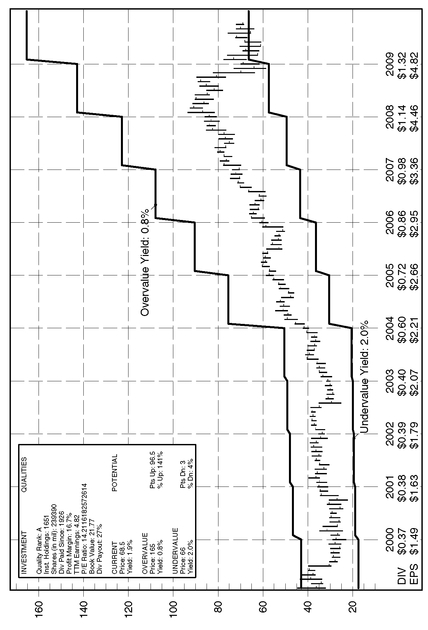
Based on our experience and the propensity for the dividend-value strategy to isolate opportunities when they are less obvious to the large majority of investors, I would suggest that regardless of what does or does not develop with healthcare overhaul, companies like Abbott Labs (ABT), Becton-Dickinson (BDX) (as shown in
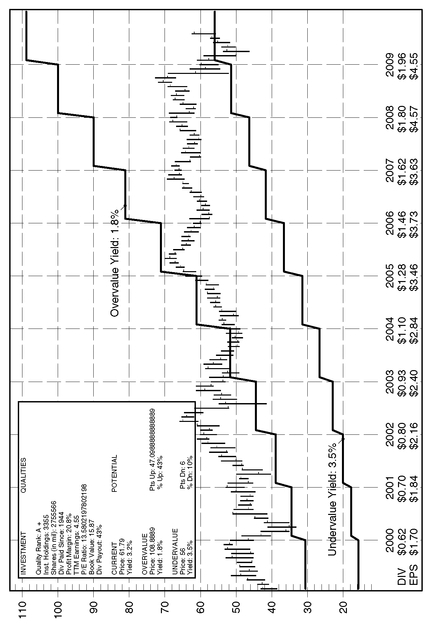
Figure 11.1), CVS Caremark (CVS), and Johnson & Johnson (JNJ) (as shown in
Figure 11.2) will not only survive but prosper. The largest demographic age group in America is still the babyboomers, and they have shown no signs of wanting to give up their medications, therapies, and ancillary healthcare services.
McDonald’s (MCD), which was highlighted in Chapter 3, announced another 10 percent dividend increase in 2009, which means the prices for its undervalue and overvalue boundaries will rise, again.
Tobacco giant Altria Group (MO) and its spinoff, Philip Morris International (PM), both offer historically good value and relatively rich dividend yields. Other blue chip stalwarts mentioned in various places throughout this book, such as AT&T, Inc.(T); Nike, Inc. (NKE); Sigma-Aldrich (SIAL); and Wal-Mart Stores (WMT) also represent historic good values. Stocks not previously mentioned, but nonetheless are of equal blue chip quality such as soft-drink icons Coca-Cola (KO) and PepsiCo (PEP), personal care products companies like Colgate-Palmolive (CO) and Procter & Gamble (PG), offer excellent historic value.
Source: Valut Trend Analysis
Source: Valut Trend Analysis
Dividend Truth
The companies listed previously may not enter rising trends in the coming weeks or months but they do offer the opportunity for long-term, real total returns, which is exactly what we want from stocks in our portfolio.
The Economy
According to no less an expert than current Federal Reserve Chairman Ben Bernanke, the recession that began officially in December 2007 is over. Not only is the recession over, but so is the global financial crisis; politicians, central bankers, economists, and mainstream market commentators have said so. You see, the equity markets are up 50 percent.
On the food chain of macroeconomic opinion, your author’s opinion comes in somewhere below the bottom. So, far be it for me, merely a lowly stock picker, to disagree with the powers that be; from my viewpoint, however, the global macroeconomic picture is nothing to write home about.
I must give credit where it is due though; so far, governments and central bankers have somehow miraculously circumvented the laws of supply and demand. As a result, the markets have rallied 50 percent from their lows, but this was always to be expected; no market can move in one direction forever. How long this market will continue to rally is anybody’s guess, but I have a suspicion we will see a display of Keynes famous observation that “markets can stay irrational for longer than you can stay solvent.”
I suspect that much of the current rally is attributable to fund managers moving their large stash of cash from the sidelines into the markets; no manager wants to miss out, even if their research and instincts tell them otherwise. Heaven forbid their performance is beneath that of their peers. I suspect, though, that this embrace of equities will be short-lived and will move elsewhere at the first hint of trouble.
There has been no real economic improvement aside from the results of government handouts and stimuli. Unless I have somehow missed it, I don’t recall that any major infrastructure investment and manufacturing capacity is still far below trend. As for job creation, there has been little except in the public sector.
The banks are making money due to the steep yield curve, but there are still land mines galore such as major credit-card defaults, adjustable-rate mortgage refinancing problems in tranches not related to subprime, and looming commercial property refinancing issues that could present a larger problem than that in the residential market.
Also disconcerting is the problem with the U.S. dollar. Our largest creditor, China, is getting squeamish about the depreciating value of its dollar-denominated assets and is beginning to diversify into other currencies and tangible assets. In particular, China has become enamored with gold and for the first time is actually encouraging its citizens to store a portion of their new-found wealth into coins and smaller weight bars.
The Chinese seem to be on to the fact that the United States in particular is facing some daunting economic times and has some very steep hills to climb. This isn’t the first time the United States has been challenged and it most certainly won’t be the last. America is a creative and resilient country, though, and has many assets and advantages that are still the envy of the world.
In short, the economy will present many challenges in the years ahead. The stock market, as it has always done, will create opportunities from these challenges. Our job will be to deal with the challenges and take advantage of the opportunities.