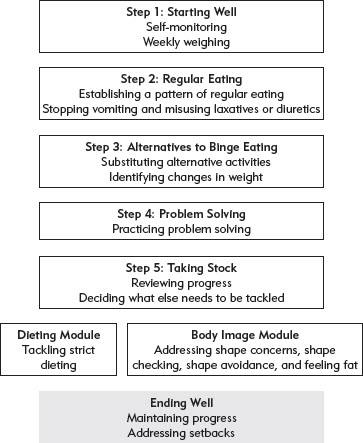
Now that you have nearly completed the program, it is time to take stock once again. It is possible that you still have a significant eating problem. If binge eating is continuing to interfere with your quality of life, you should seriously consider getting further help. The options were outlined at the beginning of the program. The fact that this program did not help, or did so only to a limited degree, does not mean that the problem cannot be overcome. Far from it. There are many treatment options. Do not give up.
On the other hand, things may have improved and may still be improving. If this is the case, then two final matters need to be considered:
1. How to maintain your progress.
2. How to deal with setbacks.
These two topics are the focus of this final module.
MAINTAINING YOUR PROGRESS
If your binge eating problem has improved slightly or markedly, then you should continue to employ those elements of the program that you found most helpful. In this way you are likely to continue improving. It is especially important to adhere to “regular eating,” possibly indefinitely. Keeping up problem solving can be helpful too. Also, you should continue to hold regular review sessions (over the next 3 or so months) to keep an eye on your progress.
There are components of the program you can drop, however. You can stop monitoring if your eating is stable and satisfactory. However, be wary of stopping because you don’t want to face up to ongoing difficulties.
Similarly, you can cease weekly weighing if your weight is stable and satisfactory. This said, as part of adopting a healthy lifestyle, it is a good idea to check your weight at regular intervals.
DEALING WITH SETBACKS
The Importance of Realistic Expectations
It is common for people who have stopped binge eating to hope that they will never binge again. While this hope is understandable, it is neither helpful nor realistic. You should regard your eating problem as your Achilles’ heel. You will still be prone to react this way at times of difficulty. Just as some people react to stress by becoming depressed or irritable, or by drinking too much, so people who have had an eating problem are liable to start eating differently.
The Triggers of Setbacks
Setbacks are inevitable, and they are especially likely during the weeks and months when you are emerging from an eating problem. They are less likely later on. However, they can occur at any time, even years or decades later. The most likely triggers are as follows:
Adverse events. Stressful events in general, especially those that threaten self-esteem.
Developing a clinical depression. Clinical depressions are particularly prone to trigger a setback.
Shape- or weight-related events. These include a significant increase in weight; an apparent increase in “fatness”; critical comments from others; shape and weight change following pregnancy; and loss of weight due to illness.
Eating-related events. These include restarting dieting, breaking a major remaining dietary rule, and binge eating (i.e., one binge triggering another).
While some of these events and circumstances are outside your control, the most major one is not. It is dieting. To minimize the chances that your binge eating problem will return, do your best not to diet and, most important of all, do not engage in strict dieting (see Chapter 4, “Strict versus Ordinary Dieting”).
Addressing Setbacks
Given that setbacks are inevitable, it is important to have a plan for dealing with them (even if you think this is not necessary in your case). Indeed, how you deal with your setbacks is central to the prevention of relapses.
It is particularly important to distinguish a “lapse” from a “relapse.” A lapse is a setback or slip, whereas a relapse is returning to square one. The two words have different connotations. Implicit in the notion of a lapse is the idea that there can be degrees of deterioration. On the other hand, the notion of a relapse suggests that one is either well or right back to square one. This type of thinking should be familiar by now; it is another example of all-or-nothing (dichotomous) thinking, a thinking style that is common among people who binge.
To minimize the chances of relapsing, it is essential not to mislabel any lapse (or setback) as a relapse because doing so is likely to affect your behavior. If you think you are having a lapse, you are likely to take active steps to get back on track, whereas if you regard yourself as having relapsed, you may well give up and as a result matters will get worse.
There are three aspects to dealing with a lapse:
1. Spot the problem early. This is important. The “head in the sand” approach only makes matters worse. If your binge eating has returned or become more frequent, you should act, and act as soon as you can. If you think there is a problem, it is best to assume that this is the case and take steps to do something about it. If you think you might be having a setback, almost certainly you are.
2. Do the right thing. Reinstitute the program in this book. Restart monitoring and weekly weighing; force yourself to eat at regular intervals; and engage in whatever other elements of the program that seem relevant. Be your own therapist. Reread the whole of Part II. And do your utmost to resist the temptation to cut back on your eating as this will only make you more prone to binge. And remember to review your progress every few days.
3. Identify and address the trigger of the setback. You need to think what has led to the setback. It may be obvious or it may not. Think long and hard about this. Once you have identified the likely trigger, address it. If relevant, use the problem-solving approach in Step 4.
With this three-pronged approach, you will find that you can nip most lapses in the bud, well before they get a hold. But if you are not succeeding, seriously consider seeking professional help. Guidance for doing so is provided in Appendix I.