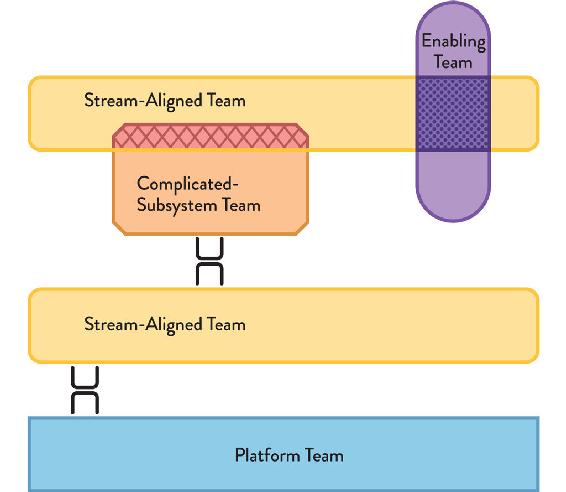
Figure 7.5: Primary Interaction Modes for the Four Fundamental Team Topologies
Stream-aligned teams use X-as-a-Service or collaboration; enabling teams use facilitation; complicated-subsystem teams use X-as-a-Service; platform teams use X-as-a-Service for teams that consume the platform.
The typical and occasional team interaction modes of the fundamental team topologies can be mapped to the essential team interaction modes as shown in Table 7.4.
Table 7.4: Team interaction modes of the fundamental team topologies
|
| Collaboration | X-as-a-Service | Facilitating |
| Stream-aligned | Typical | Typical | Occasional |
| Enabling | Occasional |
| Typical |
| Complicated-subsystem | Occasional | Typical |
|
| Platform | Occasional | Typical |
|
Table 7.4 provides a useful reminder of how different teams can expect to interact with other teams in the organization. For example, a stream-aligned team can typically expect to interact with other teams using either collaboration or X-as-a-Service, whereas a platform team mostly expects to interact using X-as-a-Service. This gives some further hints for the kinds of interpersonal skills likely to be needed for each type of team: platform teams will need strong product- and service-management expertise, whereas enabling teams will need people with strong mentoring and facilitating experience.
Choosing Basic Team Organization
With an understanding of the team interaction modes, we can choose an initial organization design that is likely to help produce the software architecture required. Expectations should be set with coworkers that the interaction modes and team structures will need to change at least a little as the organization “senses” whether the boundaries chosen are in fact the best boundaries.
CASE STUDY: TEAM INTERACTION DIVERSITY AT IBM AROUND 2014
Eric Minick, Program Director for Continuous Delivery, IBM
Since 2013, Eric Minick has led the introduction and dissemination of new practices across the worldwide IBM technical teams.
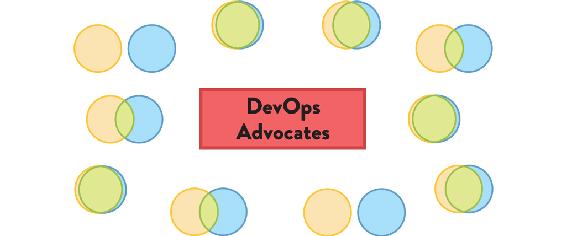
When I joined IBM in 2013, the enterprise software industry was going through some significant changes brought about by cloud technologies and ubiquitous automation. Part of my role at the time was to help bring then-new DevOps and Agile practices to 40,000 developers in several dozen locations (on six continents). There were many different kinds of team interactions happening, and so, to help encourage a shift to the newer ways of working, we had an “advocates” team (see Figure 7.6).
Figure 7.6: Team Interaction Modes at IBM around 2014
Team interaction modes at IBM around 2014, with a team of “DevOps advocates” coordinating and facilitating learning and team changes.
The advocates team included a handful of full-time people and some part-timers. It gathered successful patterns from various teams around the world to encourage and educate others, helping the ideas to diffuse through the organization at IBM. Its approach included formal training for teams and their executives. Meanwhile, there was a drumbeat of content like internal webinars that would draw an audience of thousands of technologists.
The advocates team probably doesn’t fit neatly as a team topology because we saw ourselves as a temporary team that should not be needed in a few years’ time, or as I said on Twitter at the time: The goal for a “DevOps Team” should be to put itself out of business by enabling the rest of the org.
Use the Reverse Conway Maneuver with Collaboration and Facilitating Interactions
When we undertake a reverse Conway maneuver (see Chapter 2), the homomorphic pull of self-similarity that Conway’s law identifies is anticipated: the organization is set up to match the communication paths needed in the software and systems architecture. However, a new architecture cannot be expected to emerge as soon as a new team structure has been devised and implemented. Precisely due to the forces behind Conway’s law, the existing software architecture will initially “push back” against the new team structures.
To help make the new organizational structure work—and to sense whether the new responsibility boundaries are actually correct—the reverse Conway maneuver should be used with temporary but explicit collaboration modes between the teams building the software, along with one or more enabling teams (and possibly other teams) acting in a facilitating mode. By using temporary, explicit collaboration across the new boundaries and by using a high degree of facilitating for the stream-aligned and complicated-subsystem teams, any problems with the new responsibility boundaries can be quickly identified, giving the team the opportunity to adjust the design earlier, before too much has been built.
The team responsibilities for software subsystems during the collaboration phase may need to be back to front to begin with so that the team ownership can be effective long term. For example, let’s say that a large software monolith needs to be split into separate segments (aligned to streams, components, or new aspects of a platform). Teams that “logically” own a higher-level component may need to work on the lower layer (platform) for a period of time in order to split out that code, especially if they wrote the too-coupled code in the first place. As the collaboration period progresses, the team that logically owns the lower layer can take on more responsibility from the original team until the new team takes full ownership of the lower layer.
Discover Effective APIs between Teams by Deliberate Evolution of Team Topologies
As we saw in Chapter 5, a dedicated architecture team is usually an anti-pattern to be avoided. However, a small group of software and systems architects can be hugely effective within an organization when the remit of architecture is to discover, adjust, and reshape the interactions between teams, and therefore, the architecture of the system.
This is because with Conway’s law in force within a system-building organization, the architecture of the organization is the architecture of the system. Or, as Ruth Malan puts it, “[t]he organizational divides are going to drive the true seams in the system.”8 Allan Kelly—longtime advocate of using the reverse Conway manuever to shape teams, says: “someone who claims to be an Architect needs both technical and social skills. . . . They also need a remit that is broader than pure technology—they need to have a say in business strategies, organizational structures, and personnel issues, i.e., they need to be a manager too.”9
The architect should be thinking: “Which team interaction modes are appropriate for these two teams? What kind of communication do we need between these two parts of the system, between these two teams?” The architect in an organization following the Team Topologies approach is therefore the designer of team APIs that anticipate the intended software architecture.
Effectively, instead of trying to rely entirely on individuals within teams to perform boundary spanning (which can be stressful and needs both good social and technical skills), use people skilled in API design to design the APIs between teams within the organization.
Choose Team Interaction Modes to Reduce Uncertainty and Enhance Flow
The different team interaction modes have different characteristics, making them suitable for different kinds of activities or goals. In this section, we identify which team interactions modes to use in different circumstances.
Use the Collaboration Mode to Discover Viable X-as-a-Service Interactions
The X-as-a-Service interaction mode can be highly effective in helping software-delivery teams achieve fast flow. However, as with any service, if the service boundaries are not well drawn and the service attempts to provide either too much or too little without enough flexibility, the X-as-a-Service interaction will not be effective; the service will not meet the needs of consuming teams.
To address the problem of poorly drawn service boundaries, the collaboration team interaction mode can be used to help redraw service boundaries in a new place, either contracting or expanding the remit of the service (or adding more flexibility) in order to make the service more suitable for consuming teams. In fact, ongoing, lightweight collaboration interactions at service boundaries should be expected to make sure that all services are as effective as they can be. We want “just enough” collaboration at the service boundaries to adjust the scope of the service to meet the needs of consuming and providing teams.
If an organization is trying to establish a new X-as-a-Service interaction, the same pattern applies: collaborate closely to establish viable “as a service” boundaries and then continue with lightweight collaboration to validate that the boundaries are effective.
The collaboration team interaction mode can be used to drive the rate of innovation of both application and platform/infrastructure, which is particularly useful for new and emerging products or service offerings.
TIP
Collaborate on potentially ambiguous interfaces until the interfaces are proven stable and functional.
Change the Team Interaction Mode Temporarily to Help a Team Grow Experience and Empathy
If the current mode of interaction between teams has been in place for some time and possibly needs some revitalization, changing the interaction mode temporarily can help team members refresh and grow their experience, and increase empathy for the other team. Evan Wiley of Pivotal describes how, for a team with a dependency on another team, “those teams may arrange to swap pairs, and somebody might go from one team to another team for a few days or a week to get the feature done.”10 As Heidi Helfand puts it, “when you deliberately plan out the [team changes] in your organization, you provide new learning opportunities for people.”11
It is vitally important that the changes are deliberate (and probably also temporary) with the full consent, understanding, and enthusiasm of the people involved. Dynamic Reteaming by Heidi Helfand provides many useful recommendations for making team changes as smooth as possible.
Use Awkwardness in Team Interactions to Sense Missing Capabilities and Misplaced Boundaries
The patterns of team interactions can be used to detect and respond to problems with the design of the system, potentially anticipating software problems before the code reaches production.
Let’s consider two examples:
In the first case, we know that the X-as-a-Service interaction should be low friction and should need only occasional or limited communication. If the stream-aligned team is spending many hours trying to use a component, this is a signal that something is amiss: Is the component boundary in the right place? Is the component API well specified? Is the component easy enough to use? Does the complicated-subsystem team have a missing capability within the team, such as UX or DevEx?
In the second example, the platform team is expecting significant communication with the stream-aligned team, because they are supposed to be using the collaboration interaction mode to discover new technology solutions together. In this case, the absence of inter-team communication is a sign that something is wrong in the stream-aligned team: Do they understand the value of adopting the collaboration mode at this point? Do they have enough skills to undertake this collaboration, or is another team better suited? Is the boundary that the teams are trying to bridge too ambitious?
As Don Reinertsen says, “We need to be alert for the white space between the roles, gaps that nobody feels responsible for.”12
TIP
Techniques from domain-driven design (DDD) such as event storming and context mapping can help accelerate awareness of appropriate boundaries. See Chapter 6 for more details on DDD.
Summary: Three Well-Defined Team Interaction Modes
An effective, modern organization building and running software is a product of the interactions between teams. Yet many organizations fail to define what good team interactions look like, resulting in confusion, annoyance, and ineffectiveness. Simply defining a set of teams with responsibility boundaries is not enough to produce an effective sociotechnical system; it is also necessary to define sensible and effective interactions between teams.
In this chapter, we’ve seen how three core team interaction modes provide the clarity needed for all team interactions within the organization:
The combination of well-defined team types and well-defined team interactions provides a clear and powerful way to promote team-based organizational effectiveness, avoiding the ambiguities and conflicts that many organizations experience.