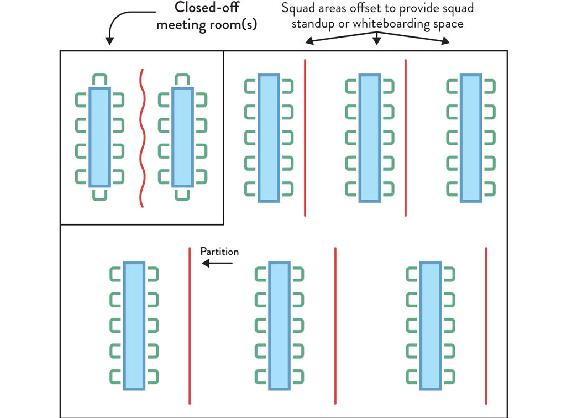
Figure 3.4: Office Layout at CDL
The size and growth of teams is also an important factor in design. Some teams may be smaller while others may need to grow fast. The bench arrangement allowed for easy growth, especially if you haven’t got supporting legs and pedestals in the way. Small teams could spread out while growing teams could squeeze up a bit. Of course, there is a limit on this. When the team is too big, we split it into two smaller teams, each taking functionally half of the backlog to make their own. The beauty of this is each team takes the culture of the old team with them, and they will diverge and grow themselves over time; but you can (with luck!) skip the “storming” and “norming” phases of starting a team from scratch. We deliberately have differing sizes of bays, where an extra table or two can be accommodated.
Initially, team benches were set centrally and symmetrically between the dividing whiteboard partitions, but we soon realized that an asymmetrical arrangement worked much better, where the bench was closer to one partition. This provided more space on one side to gather the team yet still allowed the opposite whiteboards to be used effectively.
We used what we had learned from this arrangement when it came to fitting out the top floor for our new digital teams. Our original partitions were expensive, heavyweight structures that could only be moved at some expense. For the new digital space, we opted for lots of large, portable, but still substantial, whiteboards. Teams could now reposition and make breaks as they organized themselves.
This design is by no means perfect. All spaces are compromised in one way or another. We get things wrong, but we continue to learn and adapt. One such experiment was to remove the small glass partitions running down the center of the team benches. Another was to have height-adjustable sections on the ends of each set of benches for standing or for people who needed extra legroom.
As the case study from CDL shows, the physical work environment has a significant effect on the ability of teams to interact in useful ways. Successful organizations make sure to spend time and money achieving a good physical environment for their staff.
For example, the bank ING Netherlands explicitly redesigned its office space as part of a major organizational change around 2015 to align teams to value streams.33 At ING, several stream-aligned “squads” working on similar products and services within a stream form a “tribe.” Each tribe has a separate area within the office, including multiple team-sized spaces, one for each squad. The thought-out design of the office layout means that people from other squads or tribes can easily recognize aspects of other teams’ work (such as kanban boards, WIP limits, status radiators, and so on) and rapidly learn new approaches. Some organizations have taken this even further, aligning entire floors of their office space to separate business streams, promoting high flow and easier collaboration within a stream.
Jeremy Brown from Red Hat Open Innovation Labs told us how they had everything on wheels (even plants!) in order to frequently reconfigure their physical environment for different types of work, and for teams to emerge and evolve their own space.34 In their 2012 book Make Space, Scott Doorley and Scott Witthoft present many other creative ideas for arranging physical space in ways that ignite creativity and useful team interactions.35
CASE STUDY: STREAM-ALIGNED OFFICE LAYOUT FOR FLOW-BASED COLLABORATION AT AUTO TRADER
Dave Whyte, Operations Engineering Lead, Auto Trader
Andy Humphrey, Head of Customer Operations, Auto Trader
Back in 2013, as we started to move from a print-based business with many different offices around the country to a 100% digital business, we began to look at ways we could improve collaboration and optimize for the flow of work. We reorganized from fifteen offices into three, with our main office in Manchester, UK, on only two floors. The working environment was created to be as open plan as possible, with all senior managers sitting with their teams and no private offices. This made it much easier for people to communicate with each other, and we finally started bridging the gap between “the business” and IT.
Our new offices were built for collaboration, from the way the desks could be laid out to the limits on the number of monitor screens that one person could have at their desk (to avoid people “hiding” behind screens). Over the past few years, we have experimented with different office layouts and seating plans to help the right teams communicate and to promote flow:
We now have all the people in a certain business division sitting together. For example, private advertising is one of our business areas, handling vehicle sales by private individuals, and everyone involved in this stream of business sits on the same floor: marketing people, sales people, developers, testers, product managers, and so on. This means that everyone in the same business stream can “feel the pain” together and all decisions are more jointly owned. We have found that you start seeing things from other people’s viewpoints when you sit with them.
Our office layout is quite deliberately designed to help flow and specific collaboration. We based our teams loosely on the model from Spotify, so we have squads of around eight people that build specific parts of a system, and collections of squads known as tribes. Each squad has its own team area located close to other squad areas from the same tribe. This enables squads from the same tribe to talk easily to each other—collaborating on similar parts of the system—while being physically separated from other tribes by walls and floors.
This layout helps teams focus on their business stream area, minimizing the need to talk with teams from other business areas to get their day-to-day work done. We bring teams together for cross-tribe learning by holding regular guild learning sessions and evening meetups.
The virtual environment is increasingly important as many organizations adopt a remote-first policy. The virtual environment comprises digital spaces such as a wiki, internal and external blogs and organization websites, chat tools, work tracking systems, and so forth. Effective remote work goes beyond having the necessary tools; teams need to agree on ground rules around working hours, response times, video conferencing, tone of communication, and other practical aspects that, if underestimated, can make or break a distributed team, even when all the right tools are available. In their 2013 book Remote: Office Not Required, Jason Fried and David Heinemeir Hansson go through how to address these and many other important aspects for remote teams.36
From an efficient-communication perspective, the virtual environment should be easy to navigate, guiding people to the right answer quickly. In particular, chat tools should have channel names or space names that are easy to predict and search for, with prefixes to group chats:
#deploy-pre-production
. . .
#practices-engineering
#practices-testing
. . .
#support-environments
#support-logging
#support-onboarding
. . .
#team-vesuvius
#team-kilimanjaro
#team-krakatoa
In a virtual environment, it can be useful to use naming conventions in usernames to make it easy for people to identify who’s in a particular team, especially if that team is a central X-as-a-Service team, providing a platform or component (more on this in Chapter 5). Instead of simply “Jai Kale” as the display name within the chat tool and wiki, use something like “[Platform] Jai Kale” to identify that Jai Kale is in the platform team.
Warning: Engineering Practices Are Foundational
At the end of the day, technology teams need to invest in proven team practices like continuous delivery, test-first development, and a focus on software operability and releasability. Without them, all the effort invested in a team-first approach to work and flow will be greatly undermined or at least underachieved.
Continuous delivery practices support hypothesis-driven development and automation, operability practices provide early and ongoing operational checks and discovery, testability practices and test-first development enhance the design and fitness for purpose of solutions, and releasability practices ensure delivery pipelines are treated as a first-grade product. All of them are critical for fast flow and require an ongoing effort by all engineering teams.
Summary: Limit Teams’ Cognitive Load and Facilitate Team Interactions to Go Faster
In a fast-changing and challenging context, teams are more effective than groups of individuals. Successful organizations—from the US military to corporations large and small—treat the team as the fundamental means of getting work done. Teams are generally small, stable, and long lived, allowing team members the time and space to develop their working patterns and team dynamics.
Importantly, due to limits on team size (Dunbar’s number), there is an effective upper limit on the cognitive load that a single team can bear. This strongly suggests a limit on the size of the software systems and complexity of domains that any team should work with. The team needs to own the system or subsystems they are responsible for. Teams working on multiple codebases lack ownership and, especially, the mental space to understand and keep the corresponding systems healthy.
The team-first approach provides opportunities for many kinds of people to thrive in an organization. Instead of needing a thick skin or resilience in order to survive in an organization that atomizes individuals, people in a team-first organization have the space and support to develop their skills and practices within the context of a team.
Crucially, because communication between individuals is de-emphasized in favor of communication between teams for day-to-day work, the organization supports a wide range of communication preferences, from those people who communicate best one to one to those who like large group conversations. Furthermore, the effect of previously destructive individuals is curtailed. This humanistic approach is a huge benefit of choosing teams first.