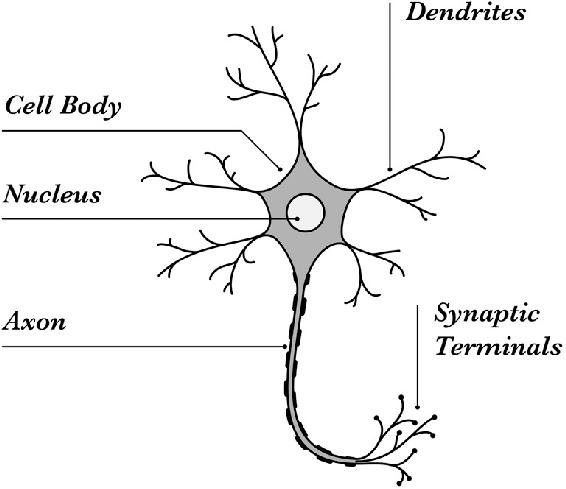
Figure AA-1: Neurons come in different shapes but they each have a cell body, one long axon, and dendrites.
Brain Basics
Every Halloween, I create a life-sized model of the brain out of gelatin. I pour boiling water into peach-flavored gelatin, add condensed milk to make the mixture opaque, and dribble in some green food coloring to turn the brain a jiggly gray. The brain is a prop for an elaborate haunted house that my family and lab have designed and run since 2004 as a charity event. Visitors who make it through the haunted house always exclaim (once they can speak normally again) how realistic the brain looks, which is interesting because a real brain is nothing like a uniform blob of gelatin. It is a massive network composed of billions of brain cells wired together to pass information back and forth.1
To get the most out of this book, you’ll need a few basic facts about the human brain. The most important type of brain cell for our discussion is the neuron. There are a wide variety of neurons, but in general, each one consists of a cell body, some branch-like structures on the top called dendrites, and one root-like structure on the bottom called an axon, which has axon terminals at its end, as in figure AA-1.
The axon terminals of one neuron are close to the dendrites of other neurons—usually thousands—forming connections called synapses. A neuron “fires” by sending an electrical signal down its axon to its axon terminals, which release chemicals called neurotransmitters into the synapses, where they are picked up by receptors on the dendrites of other neurons. The neurotransmitters excite or inhibit each neuron on the other end of a synapse, changing its rate of firing. Through this process, one individual neuron influences thousands of others, and thousands of neurons can influence one, all simultaneously. This is the brain in action.2
Figure AA-1: Neurons come in different shapes but they each have a cell body, one long axon, and dendrites.
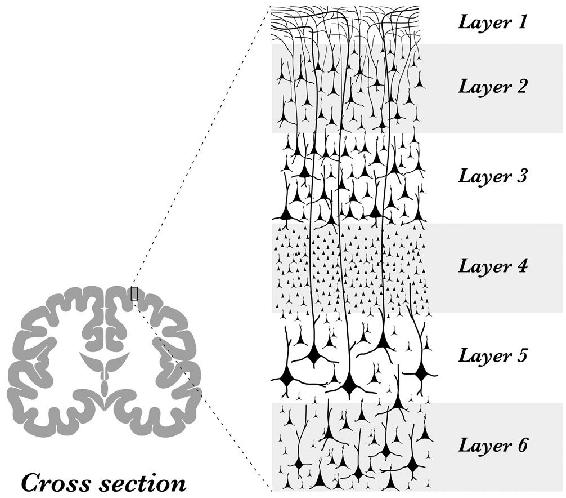
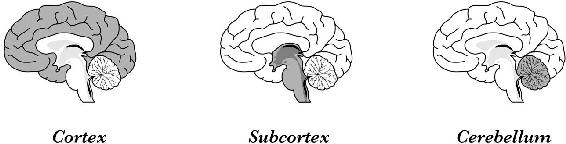
At a more macro level, the human brain can be divided, more or less, into three major parts based on how the neurons are arranged.* The cortex is a sheet of neurons arranged in layers, anywhere from four to six (see figure AA-2), wired into circuits and networks. A cross section of this sheet reveals that neurons are organized into columns; neurons within the same column of cortex form synapses with each other, and with neurons in other columns.3
The cortex is folded around the subcortical regions that, in contrast to the layered cortex, are organized as clumps of neurons, as depicted in figure AA-3. The ever-popular amygdala, for example, is a subcortical region.4
The third part of the brain, the cerebellum, is toward the bottom of the brain, at the back. The cerebellum is important for coordinating physical movements and making that information available to the rest of the brain.5
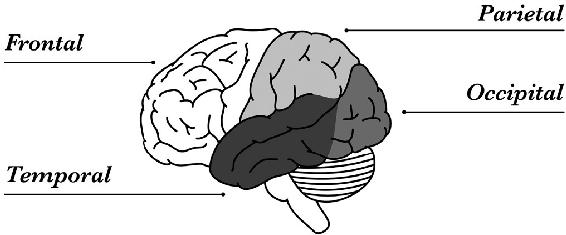
Scientists must point to different collections of neurons, that is, “brain areas,” so they have devised some terminology to help.* The cortex, which comes up repeatedly in this book, is divided into discrete areas called lobes, which are rather like continents in the brain (figure AA-4).
For navigating the entire brain, instead of using compass directions like east or northwest, scientists uses phrases like “dorsal anterior” (upper front) or “medial” (inner wall). Figure AA-5 shows the various road signs for finding your way around.
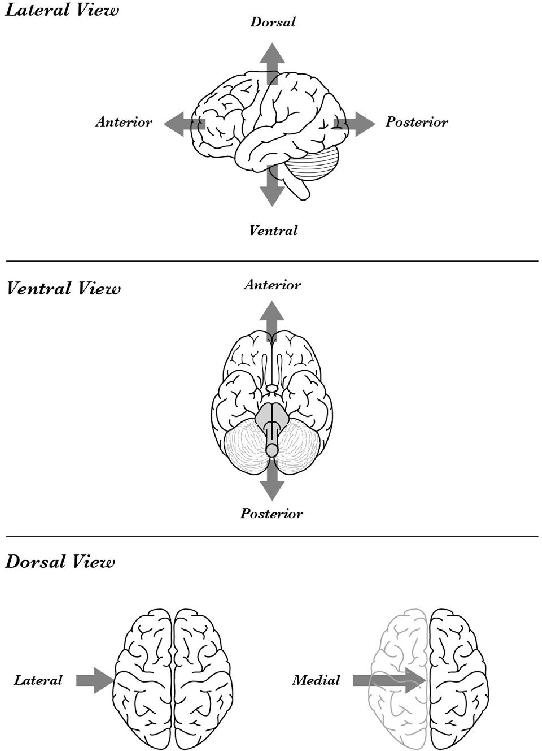
Figure AA-5: Road signs for the brain. Anterior = toward the front; posterior = toward the back; dorsal = toward the top; ventral = toward the bottom; medial = toward the midline or middle; and lateral = away from the midline toward the outside
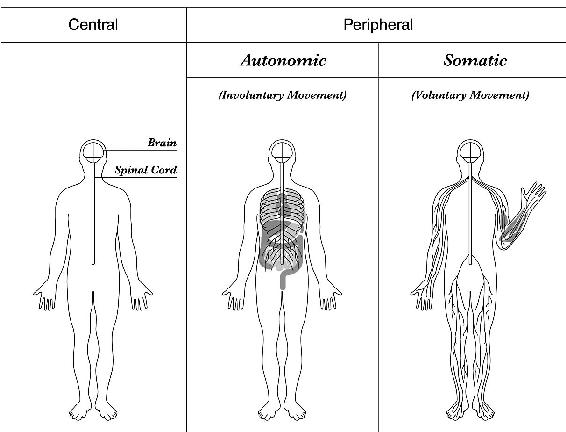
Your brain is part of your central nervous system, as distinct from the neurons that lace through your body, known as your peripheral nervous system. For historical reasons, not all of which make sense, they are usually studied as two separate systems. Your spinal cord (part of the central nervous system) carries information between your body and your brain.
Your autonomic nervous system is one avenue for your brain to regulate your body’s internal environment. It carries your brain’s commands to the body’s internal organs, known as the viscera, and sends sensations from the viscera back up to the brain. This process controls heart rate, breathing rate, perspiration, digestion, hunger, the dilation of your pupils, sexual arousal, and a host of other bodily functions. It is responsible for “fight or flight” responses that tell your body to spend its energy resources, as well as “rest and digest” that replenish those resources. The autonomic nervous system also helps to control your metabolism, water balance, temperature, salt, heart and lung function, inflammation, and other resources across all systems of the body, like a budget. The somatic nervous system gives the brain access to muscles, joints, tendons, and ligaments.6