It can be helpful to notice what triggers put you in danger of relapsing or acting on your addiction. Triggers might include painful mental states such as anxiety or anger, or social situations such as a birthday celebration. We call these high-risk situations, as they are often associated with strong craving. If you can identify your triggers, and especially if you can catch them early on, you have a better chance of avoiding the cycle of craving and getting caught up in your addiction. You may be able to find a more effective way to respond to the triggers.
Take this opportunity to look at the things that trigger your desires. See what is happening in your mind:
| • | Name your trigger. |
|
| • | Name what you feel when you see the trigger. |
|
| • | Name what you think. |
|
| • | Name what you do. |
You could also try this when you have picked up or distracted yourself with something external. Backtrack, and see what was going on in your mind. See if you can identify the point at which the thoughts become about using and picking up your choice of fix.
Craving for existence
Craving for existence is clinging to what we already have, like the dog who will not let go of the slipper. We fear losing what we have, and we are therefore in denial of impermanence. It is as if, by holding on tightly to what we have, we believe we can escape the inevitability of change. It is natural that we do not want to lose our loved ones or our prized possessions, but one day we will have to let go of absolutely everything. Unless we can find a wise way of coming into relationship with impermanence – something we will explore more in the next step – our fear of change will fuel craving and clinging, together with the suffering that goes with them.
Craving for existence also refers to pursuing a different state of being. It is natural to want to alleviate our suffering and to improve our lives so that we experience happiness. Unfortunately, our desire to make things better can fuel craving for a different experience – often a quick fix to escape from our suffering – which can keep us in the cycle of addiction. It is what we call misguided loving-kindness toward ourselves.
The act of turning to addictions for recovery from pain or difficult situations is deluded self-help. We are looking in the wrong place for happiness. This misguided kindness toward ourselves perpetuates a cycle of pain. In trying to become happier, we reach for things that bring temporary happiness. And then the chase begins. Chasing for that great high, that great experience we once had. The compelling urge to become wealthy, successful, to have everything we don’t have, is also part of the craving for existence that leads to more suffering.
Why can’t we desire these things? Well, of course we can. The issue is that, in desiring something, we begin to chase, crave, and cling to what we want. Instead of holding our desires and goals in a light way, we hold on to them tightly and end up being driven by them.
All of which creates suffering.
Craving for non-existence
When we are struggling with difficult emotions, such as fear, depression, or jealousy, we may crave being in a completely different state, as described above. Alternatively, we may just want it all to end: we may crave non-existence. Use of alcohol or heroin, for example, may be a way to dim our consciousness and dissolve our worries. People with addiction have a higher rate of suicide than the general population, and the allure of craving for non-existence may lead us to want to end our lives, to bring an end to our suffering.
However, there is hope. We do not need to be victims of craving. When we are, we risk becoming addicted and piling more suffering into our lives. Craving only has power over us for as long as we act on it and chase after the objects of our desire. Craving is energy, admittedly an uncomfortable energy, that wants to latch on to something so we can feel better. Often we panic when craving arises, especially if we are in recovery. We may think: “I should not be feeling this. I am in recovery.” Relax. It is inevitable that craving will still arise. What we are trying to do in recovery is meet the sensations of craving with a calm mind so that we don’t move into fear and become overwhelmed by it, spiraling into a relapse.
Craving and high-risk situations
Here are some questions to ask yourself about your craving:
| • | What does the energy of craving feel like in my body? |
|
| • | What do I crave right now? |
|
| • | Why am I reaching for it? |
|
| • | What would happen if I did not act on my craving? |
|
| • | What are my high-risk situations? |
Make a list.
Become aware of your feelings when these high-risk situations arise.
Become aware of your thoughts and emotions.
See if you can identify the point at which your thoughts turn to using and picking up your choice of fix.
When you slow down, you’ll notice what is going on. This can give you the opportunity to make a different choice next time you are in a high-risk situation.
We learn to trust that craving too will pass. If we remain calm when craving arises, and we don’t get caught up in it, it will cease. What often happens when we are determined to recover from our addictions, but find ourselves relapsing, is that we panic when the craving for our fix arises. In our panic we may lose all sense of awareness and pick up.
When craving arises, we stop what we are doing and take a few deep breaths. We become aware of our thoughts and say to ourselves: “Let them go. Let them go. Let them go.” Or just name it “craving,” accept that the sensation of craving has arisen, and don’t act on it. We trust that craving will cease if we don’t act on it. Instead of acting out of craving or identifying with the thoughts of craving, we can take this opportunity to have a three-minute breathing space, AGE.
The hungry ghosts: an image of craving
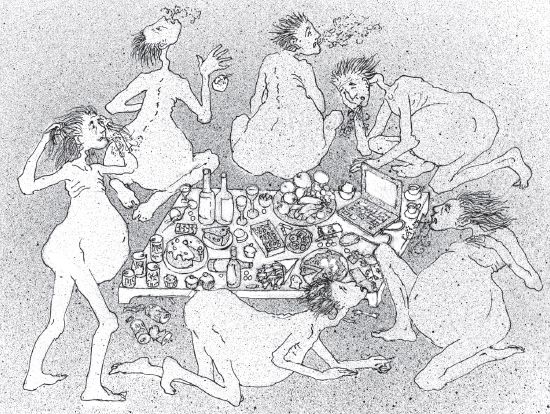
Fig 2: Hungry ghosts
In Buddhism, the hungry ghosts (see Figure 2) are depicted as having extended bellies, with tiny mouths and necks so thin that it is almost impossible for food to pass through. Any food they manage to ingest turns to fire or filth, causing pain and loathing. The hungry ghosts are an image of intense craving. In this state, what we consume is just not enough. Nothing will satisfy us, and our craving is insatiable.
A modern interpretation of the hungry ghost is the state of addiction.2 When we are trapped by addiction, we may have voracious craving, and have lost all capacity to do anything besides picking up and using, distracting ourselves whenever a whiff of suffering arises. We may be driven by greed, envy, jealousy, obsessions, and the addiction itself. We may never feel satisfied.
Caught up like this, we are unable to step off the path of suffering. We are unable to imagine life without our quick fix, despite the fact that our chosen self-medication doesn’t seem to work anymore, and our highs are heavily weighed down by frequent lows. We may be still chasing after that great high that occurred the first time we used twenty or more years ago, or just trying to cope with the consequences of our addiction. As for the hungry ghosts whose food turns to fire or filth, our addictive behavior may bring us more pain and leave us feeling ashamed.
Of course, not all addictions manifest in such an extreme way. Many of us have low-level acceptable addictions. We are able to function in the world and can think of life without a fix, but we may still be addicted.
In a sense we can all identify with the hungry ghosts, because we live in a culture where nothing is enough. Many of us crave to have more than we own. We want a bigger place to live in, a better job, more holidays, the latest technological gadget, the latest everything. Even if we don’t define ourselves as addicts, many of us use acceptable suppressants like food, the sociable drink, pharmaceuticals, sex, shopping, relationships, to deal with the emptiness in our lives. This all comes at a cost. Yes, of course, as we mentioned earlier, we may gain momentary happiness and contentment, but there can also be a cost to ourselves, our families, and our work.
This path that leads to more suffering can end with us losing everything, including our families and homes. We can end up living on the streets, in prison, in and out of rehab, isolated, or dead from our dis-ease of mind. We may think this is extreme and only happens to the alcoholic and the drug addict. But even the compulsive overeater can end up dead from the addiction. Many have died from illnesses related to obesity. Some gamblers have committed suicide because they could not face the pain of their debts.
There are high-functioning people living with addictions who somehow keep it all together. Their families have not given up on them or thrown them out. Some make it into old age and finally grow out of the addiction. However, there are casualties of their addictive behavior. Many people with addictions were brought up in such homes. The hungry-ghost syndrome is perpetuated from family to family and generation to generation.
How we practice this step
Turning toward difficult experience
In Step One, we introduced the idea of mindfulness as a way to begin to notice our suffering. In Step Two, we begin to identify our triggers. If we can catch the triggers early on, we have a better chance of responding in a different way and not acting on our craving. In this step, we take mindfulness further by learning to stay with our pain and suffering as it arises.
Every time we pick up and act on our addictions, we create more suffering. We often think that if we indulge in our addictive behavior, it will make things better. Momentarily it can, and then the suffering comes back. We have just increased our suffering by moving toward our addiction. By contrast, if we can stay with our difficulties, rather than trying to make them go away with our addiction, we are on the path to recovery.
Learning to be with difficult experiences, such as the loss of a loved one, the death of a child, a relationship breakup, or a terminal illness, is a practice of compassionate patience. These can all bring about emptiness in our lives, the meaningless, the unknown, and the questions of what life is about. How many of us are patient enough, prepared to sit still and reflect on these questions? It is easier to reach for something to put in our mouths or in front of our eyes, to distract ourselves from the fact that life is fleeting and out of our control. Distractions and mood-altering substances point us in the direction of the path of suffering, and the denial of impermanence leads to more suffering.
So how can we help ourselves to sit with the discomfort? This is a tough question. To sit with painful experience, rather than try to immediately get rid of it, goes against the grain. Our instincts may tell us to get away from pain as quickly as possible.
From our experience, we know that self-medicating to anesthetize ourselves from suffering is not the answer. One day we will have to face the suffering, so we have a choice: to face it now, and begin to lessen the suffering, or avoid it and multiply the suffering for years and years.
First of all, we need to recognize that avoiding all pain, whether through addiction or some other behavior, is not going to work. Pain is an inevitable part of life. It’s so tempting to try to push it away. It’s so easy to feel that there must be a way to avoid all pain, if only we were smart enough. The temporary relief that we may get from drugs, alcohol, or eating can convince us that a pain-free life is possible. We need to feel in our bones that avoiding pain doesn’t work. Or, at the very least, we need to take that seriously as a working hypothesis if we are going to make some real changes in our lives.
Bruce’s story
Enjoying the peace of walking at the beach, I stood for a time watching the waves. Deeply relaxed, I was startled by a dog that came up from behind me barking and snarling. I’ve had post-traumatic stress disorder and can have a high startle reflex. I politely asked the owner to get the dog under control, explaining that it scared me, which was not well received. As I walked away, I had the residue of the scare and our exchange of harsh words in my mind. Seconds later, I had the idea to order pizza that evening. Through non-dual mindful inquiry I had been learning to recognize the ghost image that flashes through the mind just before we have the compulsion to act. So I had been mindfully watching my mind and saw that, just before I had the idea of getting pizza, I had a flash of me opening the door to the delivery person, the rich, cheesy aroma of the pizza, and the feeling of comfort and safety that flooded over me.
What I really wanted was to feel safe, to settle after being scared. I have an inappropriate pairing equating pizza with safety and comfort. Through mindful inquiry, I’ve begun to unravel the Velcroed ball of emotions, thoughts, memories, and sensations that have led to compulsive behavior. As they peel away, I’m able to be present with what is coming up without feeling I need pizza to help me cope. It’s not a willpower issue. When the inappropriate pairing is seen through, it drops. There is still momentum in the mind and these thoughts will come up. Once I look directly at them, however, they lose their compulsive power. I was able to stay with the discomfort of my scare and enjoyed the rest of my walk before going home to a healthy, home-cooked meal.
When we try to avoid our pain, to avoid all the difficult feelings and thoughts that beset our minds, it is like pushing down a beach ball in a swimming pool and trying to keep it under water. It takes a lot of effort, and sooner or later the ball will bounce back up to the surface. Tell someone not to do something, and what are they doing when you turn your head? As soon as we try not to think about it, we are thinking about it. The very attempt not to have our painful experience only adds to it: we create tension in the effort to hold it out and we become overfocused on it, leaving little room in our lives for anything different.
The key to freedom from the trap of suffering is to realize that we are responsible for multiplying our suffering. We are the maestros of our own suffering. We can determine how much suffering we create for ourselves and how much we want to get lost on the path that leads to more suffering. It is possible to be happy without our addictions. It is possible to feel simplicity, contentment, and stillness in our lives if we are willing to sit with our minds and become aware of what is going on inside them.
Yes, there will always be external factors that cause us suffering, but we do not have to multiply it with our internal mental reactions. We can enable ourselves to have choice.
Often the people we have worked with have felt helpless, overwhelmed, and doomed, as if some external force had condemned them to destruction.
When I was in the throes of my addiction, I thought that somebody had jumped inside me and pushed me into the shop to buy the food. I felt I had no choice, as if I was completely out of control. And to an extent I was.
I was not able to see that letting myself be driven by my feelings of fear guaranteed that I would live a life of suffering. I could not see that fear was an obstacle of the mind, which was preventing my recovery. I had found a way to deal with my feelings at a big cost. The cost was remaining a bulimic anorectic for over twenty years and being unable to let go of my addiction.
Learning to be with our experience is not easy. It can feel counterintuitive, like the last thing one should sensibly do. Hearing our thoughts can be even scarier. It can help to recognize that we are not our thoughts, and that we don’t have to act out our thoughts. We don’t have to believe our thoughts. We don’t have to identify with our thoughts. If we can trust that our thoughts will arise and cease without us identifying with them, we will begin to find freedom from our thinking.
For example, a thought arises: “I am a failure.” If we take the thought at face value and believe it, we may soon be caught up in thinking about all the reasons why we are failures, or in trying to push the thought away, which will only make it more persistent. However, if we just watch the thought and let it be there, just as a thought, we may discover that some space opens up around it. In this space we can begin to do something different. This space between the thought arising and us grasping onto it (through ruminating on it or fighting it) is where the power to change lies. It’s the place where we can let go of the thought and not identify with it. It’s the place where we become separate from our thoughts, and create space around them. We can see that thoughts just pop into our heads – we are not our thoughts. As we learn to watch our thoughts come and go, we can decide which ones we may want to act on, and which ones to let go of.
When we are controlled by our thoughts, we make interpretations, believing our thoughts to be true. Based on those interpretations, we make decisions, which can have detrimental outcomes for our recovery. However, if we are able to let go of our thinking and see the facts of the situation more clearly, our decisions and the outcomes may be different.
For example:
| • | There is the trigger: someone has left a can of beer in the fridge. |
We move into interpretations – stories about the beer in the fridge:
| • | Interpretation: “The beer is speaking to me” or “This is a sign I can’t keep abstinent” or “Someone is trying to sabotage my recovery.” |
Based on the interpretations and stories we tell ourselves, we make a decision:
| • | Decision: we drink the beer. |
|
| • | Outcome: we relapse. |
However, if we stuck to the facts:
| • | There is the trigger: someone has left a can of beer in the fridge. |
If we are able to pause, we can connect to the facts without making interpretations:
| • | Fact: there is a can of beer in the fridge. |
Clearly seeing the facts, we can make a calmer decision:
| • | Decision: shut the fridge door. |
|
| • | Outcome: we don’t drink the beer – and don’t relapse. |
When we are able to see the facts more clearly and not move into interpretations, we can remain calm, take a breath and pause, and create the gap to act differently, rather than go into automatic-pilot mode. When a trigger like this occurs, the three-minute breathing space, AGE, can be a very helpful exercise. It can help us to see the true facts more clearly and not listen to our interpretations as if they were the true facts of a situation.
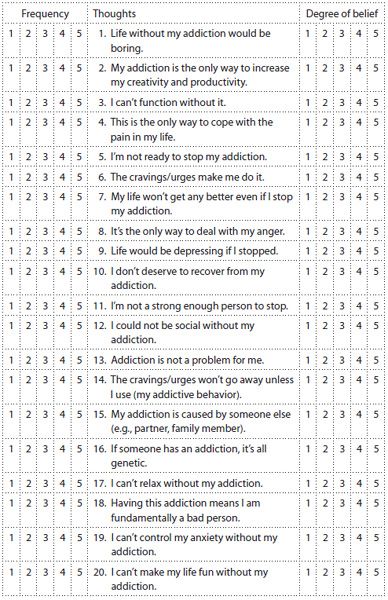
We can easily take the thoughts that appear in our minds for granted. We assume that they are true and believe that we must act on them. With mindfulness, we are trying to relate to our thoughts differently – not take them so seriously or buy into the stories they are telling us. To create this space around your thoughts, it can be helpful to write them down or to be able to recognize your “favorites” – the ones that regularly appear in your mind and that you get caught up in.
Listed opposite are a variety of thoughts that can pop into our heads. Read each thought and indicate how frequently, if at all, it occurred to you over the last week. Circle the appropriate answer on the sheet in the following way: 1 = “not at all”; 2 = “sometimes”; 3 = “moderately often”; 4 = “often”; and 5 = “all the time.”
Then indicate how strongly, if at all, you tend to believe that thought when it occurs. On the right-hand side of the page, circle the appropriate answer in the following way: 1 = “not at all”; 2 = “somewhat”; 3 = “moderately”; 4 = “very much”; and 5 = ‘“totally.”
If you wish, substitute the phrase “my addiction” with “smoking” / “drinking” / “(over)eating” / “drug use” / “gambling” / “(compulsive) sex,” etc., as appropriate.
After going through this list, you might like to asterisk the ones that are your personal “hot hits”: the ones that occur especially often or take you in. When they appear in your mind again, perhaps you can take a breath, even smile, and remind yourself they are just your “favorite” thoughts. In addition, having marked the frequency and strength of belief in these thoughts for the last week, you could mark the list of thoughts again (perhaps with an X) for a time when you were more deeply entrenched in your addiction. You could see if any of them have changed in intensity of belief or frequency of appearing in your mind. If there has been a change, it gives you an opportunity to see how your thoughts – which at times can feel completely true and require acting on – are just thoughts, not absolute truths.
Halfway through a Mindfulness-Based Relapse Prevention course, Darren reported a shift in his experience. Some friends had given him a dog to look after overnight. Unknown to him, the dog had a terminal illness. As the evening went on, Darren became aware that the dog was dying. He was upset by the dog’s plight, which led to feelings of anger in him. Why should he feel bad over a dog dying? He felt stupid for being upset. It wasn’t even his dog.
Anger was one of Darren’s main triggers for drinking. But this time, instead of reaching for the bottle, he put aside his judgments and allowed himself to feel upset. He cried – not something he would previously have let himself do. To his surprise, the feelings of anger passed and, as he related to the group with a sense of achievement, he didn’t drink.
Darren helped himself in two main ways. First, he did not take his judgments at face value – he recognized that, just because a thought appears in his mind, it is not necessarily true or helpful to treat it as though it were true. Second, he was willing to turn toward the feelings of upset.
One of the ways we can turn toward difficult feelings and emotions is to pay attention to bodily sensations. If we can stay with the bodily sensations, it helps us to let go of being caught up in the thoughts and stories around our feelings. We can begin to see this more clearly in the exercise above.
As we pay attention to our sensations – with an attitude of curiosity and kindness – we may find they keep changing, and the seemingly unbearable experience dissolves into an ever-changing flux of sensations. We can practice this approach in mindfulness meditation (see p.68). Even when the cause of our distress is physical pain, it can be helpful to pay attention to bodily sensations in this way.
Working with physical pain
Having a body means that we will inevitably have some physical pain. It’s the body’s way of telling us that something is wrong. There may be a straightforward way of alleviating the pain. For example, if we have strained a muscle, we could take a simple analgesic. Or, for more serious pain, we may need to seek medical advice. However, there are times when we are still going to be left with pain. Either the doctor can do no more for our pain, or we are in circumstances where we cannot immediately get relief.
If we can respond to the painful sensation by turning toward it, we can make the experience of physical pain easier to manage. If we surrender to the pain, it can be extraordinary to witness how the pain changes – how at times it throbs, at times it aches, and at other times it is thumping throughout the whole body. It is easy to get caught up in our ideas of what the pain is, and to believe it is just one unpleasant mass of pain, which we then label in our minds with a thought such as “This is totally unbearable” – which makes our experience worse. We may respond to the sensations of pain with aversion and ill will, perhaps becoming angry that they are there. This is likely to make us tense up around the pain, and again exacerbate our suffering.
However, as we learn to pay attention in more detail, we may discover that there is a whole range of physical sensations. The more we can stay with the raw sensations, the more we can let go of the unhelpful thoughts and other mental responses, such as ill will, that add to our suffering.
Kabat-Zinn, who pioneered using mindfulness to help with health problems, initially worked mostly with people who had severe chronic pain. His studies showed that people following his course had significant reductions in pain.3
The good news is that we can free ourselves of mental and emotional pain and, if we do that, our experience of physical pain will be different.