
Seeing how we create extra
suffering in our lives
The Buddha taught that one of the main ways we create suffering is through craving, and aversion, which is the flip side of craving. This is the second noble truth.
Craving is the urge to have a different experience from the one we are having now. It is the intense desire for a particular experience. It is the overwhelming sensations that arise in the body and manifest as an obsessive urge for things like food, drugs, sex, or any other experience. When we crave something, we are holding on to the desire for the pleasurable aspects of an experience, while denying or ignoring its painful and unpleasant aspects. Craving is inextricably linked to suffering. We can be abstinent and still crave the experience we have abstained from, which is why it is important for us to cultivate sobriety of mind: a mind that is free of craving, calm, and clear-sighted.
Aversion is wanting to push away an experience that we are having, especially a painful experience. It is the intense dislike of something and the avoidance of unpleasant and painful experiences. Aversion is also the separation of ourselves from the rest of the world.
Craving can take many forms: craving to have and control things; craving sensual pleasure; and craving fame. Aversion may be directed toward unpleasant sensations, whether physical pain or mental discomfort, such as fear, anger, or jealousy. Craving and aversion often arise as responses to pain, but, in seeking to escape our pain, we bring ourselves more suffering.
It is helpful to distinguish between unpleasant experiences that have already arisen, and the further discomfort we may cause by our response to them. We can call the former “pain,” and the results that follow from our response to pain “suffering.” The suffering we create is summed up succinctly by the American meditation teacher Shinzen Young, who says: “Suffering equals pain multiplied by resistance.”1 Therefore, the more we resist pain, the greater the suffering we create in our lives.
Given that pain and suffering are inevitable, at some point we need to develop different ways of responding to them.
For now, just notice how you respond when something painful happens in your life. Maybe there is something happening right now. Perhaps your shoulder is aching or you are thinking about a conflict you are in with a colleague or a neighbor. Or you could bring to mind a recent painful experience, such as a toothache, a big bill arriving in the mail, or being let down by a friend. Notice what your reaction is. Does your mind want to blame the other person or life in general? Do you want to hide away from the pain or make it vanish, perhaps with a drink, a snack, or watching TV? Do you feel self-pity, or find yourself thinking that things like this always happen to you? Do you notice any thoughts like “Life is not fair”? Is there a thought deep down that this should not be happening to you? Whatever the response, try to be curious; try to be willing to let it be there, just for now (since it is already here).
The common ways we deal with suffering
There are four common ways of dealing with suffering, which we may notice if we pay attention to how we react to painful experiences: we avoid or deny it; we blame other people; we blame ourselves; or we fall into self-pity.
Avoiding
Most of us want to get rid of our suffering: our fears, anxieties, anger, and jealousies, and all the painful thoughts that go with these emotions. So we may try to push them away and avoid them, or attempt a quick fix to make them go away. And why not? In the short term it can work. Sometimes it can be helpful to distract ourselves from our difficulties, especially if it is done consciously. We might decide that, just for now, we will watch a movie or read a novel to take our minds off something difficult.
Fig. 1: The vicious cycle of addiction
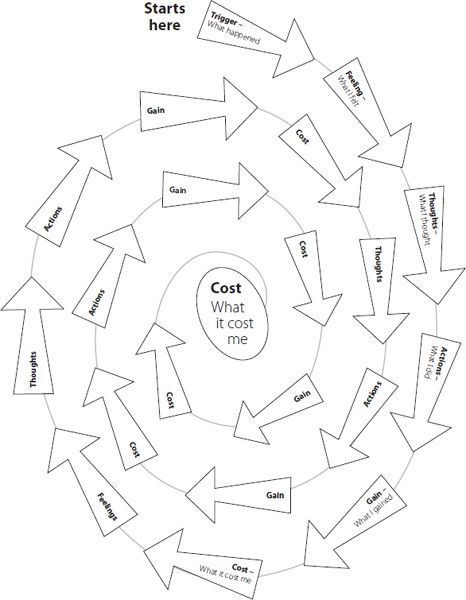
Once we have been triggered and are on the cycle, the trigger becomes irrelevant because we are in the feelings and thoughts, to the extent that we will go around and around, where in the end we will only be aware of the cost.
The problem is that pushing away painful thoughts and emotions usually makes them stronger if we never allow ourselves to face the pain. It’s like trying not to think of a pink elephant – the more we try not to think of one, the more pink elephants show up in our minds.
Addiction is one way to avoid suffering. When something difficult shows up, we have a drink, eat some chocolate, reach for something external like sex or gambling, or take a substance. Many of us try to brutally eradicate our thoughts and feelings with our choice of self-medication. And guess what? The feelings and thoughts just bounce back again once the medication has worn off.
One of the clients we have worked with was a compulsive eater. Her overeating began at age nine when her father died. People brought food every day for a month to comfort her and her mother. Thirty years later she was still eating away her feelings. She was still suffering the loss of her father. The only intimacy in her life was the food.
As our addiction grows, this behavior becomes more and more the default for any sort of discomfort. It becomes a vicious cycle, since the more we use the addiction to deal with difficulties, the less able we are to handle suffering in other ways, and so the more we resort to the addictive solution. It is like a nightmare in which the harder we try to escape our difficulties, the worse they become.
The vicious cycle can often look like the diagram in Figure 1.
And so the cycle continues.
Avoidance of pain doesn’t just happen through ingesting something; we can equally lose ourselves through burying our heads in work, mindless television, or surfing the Internet. One of our patients described how she was unable to part with articles that she had compulsively cut out of newspapers and magazines and stored in boxes. The act of cutting out stories and saving them had a mind-altering effect that took her away from any painful feelings. Some people find a way to phase out or go numb when suffering appears. Sometimes this can go on at quite a subtle level. We may find ourselves with discomfort in meditation that we thought we had acknowledged, only to later realize we had been tensing up around it, gritting our teeth until the end of a period of meditation.
Blaming others is a popular strategy for dealing with pain. For example, we can’t find something at home. An unpleasant feeling of frustration, upset, or anger arises, and we automatically move away from these feelings. Our mind jumps to blaming anyone who might have moved what we’re looking for, or even kicking the cat out of the way. This type of behavior can be very seductive. It can make us feel like the problem is no longer our fault and we get off squeaky clean, often with the full moral conviction that goes with righteous indignation. Blaming masks the uncomfortable feelings because, when we blame, we often feel in control of the situation and powerful.
So when we are rejected by a friend, or our partner leaves us, we blame them and make it their fault. That way we don’t have to look at ourselves, but in the end we can fall into the hole of self-pity. A parent dies, and it was because the medical profession didn’t do enough to keep them alive. We go into battle with the health-care system, which can drag on for years. Blame doesn’t allow us to grieve. We have not fully accepted the demise of our loved one. The sister failed to call when her nephew was in trouble with the police, and from then on her brother holds her at a frosty distance, which somehow displaces the discomfort about his son being in trouble. Or our boss at work is seen to be against us. We think that’s why we never get promoted, and we get sick with stress.
Of course, sometimes people do hurtful things, make mistakes, or are negligent. However, holding on to blame, without looking at our contribution and our response, keeps us stuck and unable to move on. It is as if we keep stoking a fire burning painfully within us.
Blaming ourselves
The other side – blaming ourselves – keeps us stuck just as much as blaming others. It’s not that we recognize our mistake, but that we won’t let it go and keep tormenting ourselves with it. The child blames herself for not standing up to protect her mother against a violent father, and continues to hold on to that blame as an adult. A son commits suicide and the father blames himself for something he said the last time they spoke. It is as though, by taking on all the blame, we have it under our control, as though there might be a magical way of changing the past. Blaming ourselves can also divert us from facing a pain beyond our control or, by getting there first, help us avoid the frightening prospect of other people blaming us.
Self-blame can keep us in addiction or lead us back to it. For example, one client we worked with was rear-ended in a car. He suffered whiplash. It wasn’t his fault. However, a day later he proceeded to beat himself up with phrases like: “I hate myself; how stupid of me – I should have pulled away faster.” This self-flagellation went on so much that he relapsed into his addiction. He couldn’t cope with all his negative and self-belittling thoughts.
We might experience the consequences of our self-blame when we try to get up in the morning. We may not be able to get out of bed because we have binged on our stimulant, or have gambled away so much money that we can’t bear to face the reality of our misdeeds.
Self-pity
Self-pity is another way we can keep ourselves stuck. For example, a friend cancels a meeting. We feel sad, and then fall into self-pity (perhaps thinking: “No one likes me”).
Self-hatred can be an aspect of self-pity. It’s as if we fall into a pit from which there is no way out. Although it’s a painful place to be, it can also be alluring because it can mean that there is nothing we have to do about it; we are helpless. We fall ill and sink into self-pity. This lets us off the hook of taking action about our illness and working with our mental responses to it. Or we stay in a destructive relationship. It’s unpleasant, we are full of self-pity, but we fail to do anything about it.
We can even become addicted to self-pity and self-hatred. Every time something painful arises in our lives, we can flee to the place of self-pity because it’s familiar, and we do not have to face up to what is happening in our lives.
Addiction can run alongside or alternate with any of the latter three responses. Our drinking is blamed on other people. We feel self-pity at the mess our lives are in from all the gambling debts. Or we blame ourselves for our lack of moral fiber in being unable to stop bingeing – which in turn just leads to more bingeing. The ex-wife is blamed for alienating the son from his father, which induces feelings of self-pity at the loss of contact with the son. Drinking is used to cope with the sorrow, and its effect on the new girlfriend leads to self-recrimination, which is blocked out with more drinking.
Blame may make us feel better, but it can also keep us angry. Blame can be the Band-Aid to keep our pain at bay. But that Band-Aid will not stick forever. We have a choice: we can remain angry for the rest of our lives, hold on to resentments and ill will; or we can begin to let go of our addiction, let go of blaming and create a space where we can feel our sorrow and let it go. Where there is sorrow there will be joy if we are patient, if we allow the law of cause and effect to take its natural time.
Craving as the cause of suffering
The Buddha said that craving is the chief cause of suffering. Craving is the default response to pain or pleasure. We have a visceral urge to move away from pain (that is, aversion) and to seek pleasure, or at least the alleviation of discomfort. This is a completely natural and understandable response. Our bodies and minds shrink from pain and the drive for pleasure is like an inbuilt thirst that cannot be tempered. The result is that most of us are searching for something outside of ourselves to make us happy, to complete us.
When we are addicted, we can often think: “If I have a drink, a line of coke, a meal, a quick fix of something, this will make me happy.” And for a moment it does. Once the brief moment of happiness has passed, however, we are likely to become dissatisfied and so it’s back to pain, again. We want the feeling of happiness never to end. It has been said that heroin is so addictive because, when people take it, all their troubles disappear. Every issue or problem just melts into the background. This appears to give users a reprieve, until they come down off the drug and feel absolutely rotten. So we go round and round, a cycle of craving, running after pleasure or being chased by pain.
The cycle of craving may come into being from an initial thought, such as: “I want a drink.” This thought can arise and cease, and cause us no more suffering at all. However, sometimes craving arises and manifests as thoughts that become a story or a rationalization. This story is often intoxicating. Craving and thinking feed each other. As each becomes stronger, we become more likely to act on our thoughts, and are in danger of using or relapsing. Beware of this stinking thinking.
We can think of wanting a drink, but not act on it. We may then fight against this thought. But when we fight it, we have not let go of the thought. We have identified with it, by listening to it and believing it, and this stinking thinking eats away at our resistance. We may think we have dealt with the thought because we did not act on it that same day. But beware. When our guard is down, we can be taken by surprise. Two days later we may well be reaching for that drink or that drug we thought we had control of. Our minds will play games with us.
A relapse may be caused by a strong identification with a thought, or a trigger that occurred through one of the senses two months ago. We may have mistakenly taken a sip of a drink, had a small slip with food, hung out with people who were taking drugs, had a small flutter with gambling, or glimpsed a piece of porn, and told ourselves that it didn’t make us relapse. We were fine the next day. Then one or two months later, we find ourselves in a relapse and can’t understand why.
We have to learn to let these thoughts arise and cease, without identifying with them, acting on them, or fighting them. Have the courage to sit with the discomfort of a thought about indulging in our addiction, without fear, trusting the thought will arise and cease on its own. Fear is often the anticipation of the danger of a relapse for many people with addictions. When we anticipate a relapse we are at risk, which is why it is important to be calm when the waves of craving arise and cease.
What makes craving such a problem?
To want pleasure and avoid pain is a natural human response. We might have a drink to help us relax, or feel more creative or more confident. If we could just have one glass of wine once a year when work was especially stressful or to celebrate an anniversary, that might not be a problem. However, if our relationship with alcohol is such that one glass leads to consuming the whole bottle, or if wine becomes our way of dealing with any difficult feeling and the only way to find pleasure, then we are on the path to creating more suffering. We get fixated on a particular way of managing pleasure and pain. We might believe that we can only be creative under the influence of a stimulant, and then our using can end up controlling our lives.
We all have strategies to help us feel OK about ourselves, or to deal with difficulties, that can end up running us. We might pursue wealth, power, fame, sex, or approval. The more we become fixated on our strategies, the more they take over our lives.
This attachment to a particular coping style means that we are less flexible in meeting what shows up in our lives. In the grip of our craving, we don’t see what is actually going on. If our only tool is a hammer, then all objects appear like a nail. If sex is our way of coping with difficulties, then all situations will be coloured by how they can be opportunities for obtaining sex.
Types of craving
According to the Buddha, there are three main types of craving. They are seductive and take our lives crashing onto the rocks. There is craving for sensual pleasure, craving for existence, and craving for non-existence. Every time we push away or flee from suffering, we create more suffering in our lives. This is what we must understand if we are to realize Step Two in recovery.
Experiencing pleasure and pain comes with having a body, with its five senses. Enjoying the pleasure of our senses, such as that of a warm bath, an uplifting piece of music, or a beautiful view, can bring us a feeling of ease and be beneficial. However, we can get so caught up in chasing pleasure that it creates difficulties. We can easily be lured by the craving of indulgence in all the senses in the pursuit of pleasure.
So many of us consciously or unconsciously seek to excite our senses. We can be on our way to an appointment. We walk along the road, and out of the corner of our eye we are distracted by something. We see a shop. The window display is full of candy, cakes, or clothes. Our eyes are excited. We may even salivate without realizing it. Before we know it, we are inside the shop buying something we saw in the window. In seconds, our desire has been retriggered. We have a feeling of excitement, we tell ourselves we want it, and we act out and buy it. The irony is that, once we have bought the item and we are walking out of the shop, the feeling of pleasure is already waning. These are the stages of the vicious cycle that we spoke about earlier.
If we are struggling with an addiction, we may have the strong desire and determination to stop using. Yet, if we are not aware of what is going on in the mind, we can be picking up in seconds as soon as we are retriggered. The trigger for someone with an addiction can be seeing someone else drinking, eating, or gambling. We become excited at the sight of their drug of choice. We may even experience a rush of pleasure in the body. Then, instantaneously, we are thinking: “I want it. I want what they have.” Before we know it, we are in a cycle of thinking, perhaps obsessively, of using, of how to get it, and next thing we know, we are in a relapse.