CHAPTER 9
Developing a Successful Stock Strategy
Chance favors only the mind that is prepared.
—Louis Pasteur
In the movie Wall Street, there is a scene in which the character Gordon Gekko tells the character Bud Fox that “a fool and his money are lucky to get together in the first place.” This is a fairly cynical worldview but not altogether surprising considering that the Gekko character was a cheat and that his success in the stock market was due in large part to trading on inside information.
In my experience, you don’t have to cheat to realize investment success. Investors also don’t have to be particularly talented, but they do have to be disciplined. At the end of the day, if you work hard and are smart enough to save money, then you are entirely capable of managing it.
To be sure, there are avenues other than stocks and the stock market to build wealth. I know many people who have built fortunes in real estate or in one or more businesses. I have friends who have never owned a share of stock in their lives, but who have been very successful in the options and commodities markets. One of my closest friends is flat-out brilliant as a fixed-income manager.
Based on the fact that I wrote this book, publish an investment newsletter, and run an investment management company, however, it should come as no surprise that my preferred vehicle for the long-term building of wealth is high-quality, blue chip stocks. In my experience they provide the most potential with the least risk to accumulate wealth over a lifetime.
Investing in blue chip stocks requires discipline and patience. Although there isn’t much I can do to help you in the patience department, in terms of discipline, there is a no more disciplined approach to value-based investing than the dividend-value strategy.
Whether you are young (or just feel young), single or married, kids or no kids, approaching retirement or already retired, the dividend-value strategy can be applied to any phase of life. You can use the strategy to identify fast-growing companies with lower dividend yields, more mature companies with higher dividend yields, or companies somewhere in between for overall total returns.
So no matter your station in life or your goals and objectives, the dividend-value strategy is geared to the most basic of investment fundamentals—getting a return on your investment dollar. Although the dividend-value strategy is not a short-term trading method, the discipline does have some short-term applications. From our experience, however, and from what other practitioners have shared with us, the primary appeal of the dividend-value strategy is that it rings true, it makes common sense, and it has worked for decades in every market environment imaginable.
In the final assessment, a portfolio that is built on a diversified selection of blue chip stocks that are purchased when they represent historically good value, held until they become overvalued, and then sold for a handsome profit makes the discipline and patience well worth the effort.
Take Care of Your Business
With investing, there is no such thing as one size fits all. Generic is something you buy at the drugstore. Just as every stock has its unique Profile of Value, each investor has his or her unique set of goals and objectives. Just as each stock must be evaluated individually, each investor must establish his or her specific goals and objectives based on individual needs.
If you haven’t yet figured out what your needs are then you need to do some work. If this part of the discussion sounds like a foreign language to you, then you probably could use some help, which is okay. Everybody can use a little guidance from someone with more training or experience now and then.
If you do use a professional however, stay in control of the process. One of the first things people are taught in the financial services industry is how to take client control. Now, to give the industry the benefit of the doubt, this is often required because clients who are out of their element often need the organization and structure a firm can bring to the process. Just keep them on track and let them know what you are specifically interested in: a current and/or retirement budget, perhaps some cash flow analysis, or maybe some help with a personal balance sheet. Many times they will want to plug you into their system, which sounds more attractive than “We need to do some extensive data gathering,” but they will need some information to get the ball rolling.
My partner and I knew a fellow who would gather vast amounts of personal and financial information from a potential client under the guise of “determining whether I can be of assistance to you before we enter into an agreement.” He would then pore over everything in detail to find the most innocuous items and then in the follow-up interview ask the prospective client if he or she was aware of these issues and then would close in for the kill with this question: “Doesn’t that concern you?”
Most professionals would never dream of using such tactics, but there are rotten apples in every barrel. Just remember three guiding principles: No one cares as much about you as you do; no one knows your personal situation better than you, so you should establish your investment goals and objectives; and no one will care for your assets greater than you will.
Plan today and tomorrow will work out.
Investment Goals
The dividend-value strategy is the big-picture part of the investment process. Now that you know how to identify quality and value, we need to discuss how to narrow your stock selections down further to a more goal-centered level.
The range of goals and objectives are probably as numerous as there are investors. Once after an educational presentation I gave at The MoneyShow, a fellow approached me and said: “Kelley, I think I have hit on the perfect stock.” “What would that be?” I asked. “It’s a stock that always goes up, increases its dividend every year, the gains and dividends are tax free, and it is completely liquid.” “I think you are right,” I responded. “You wouldn’t be willing to share the name of this stock with me, would you?” I asked. “I would be happy to, if I knew of such a stock,” he said, “but I don’t think it exists.” I smiled and thanked the man and assured him he was correct on both fronts; he had indeed described the perfect stock but no, such a stock does not exist.
I share this vignette with you because it illustrates an important point. The attributes of the stock this man described encapsulate quite nicely the primary goals most investors are interested in: preservation of capital, growth of capital, income, growth of income, tax advantages, and liquidity.
Outside of a qualified retirement plan such as a 401-(k) or an Individual Retirement Account (IRA), there are limited tax advantages for common stocks. Under current law, dividends and capital gains do receive preferential tax treatment, but these are subject to the current whims of Congress, so we will put the tax issues aside.
Of the other attributes listed previously, the one that most investors will agree on is the need for liquidity (the ability to quickly convert an asset into cash). Even for the long-term investor, liquidity is an important attribute. Heaven forbid you find yourself in a situation in which you need to go to cash and you have no market to sell to.
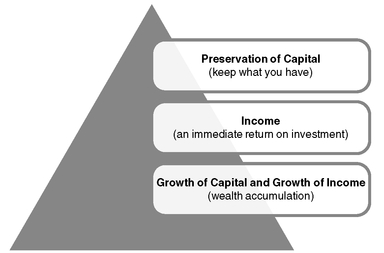
Depending on the stage or circumstance of one’s life, most investors will tend to focus on one or a combination of the other referenced attributes. At IQ Trends Private Client we have a hierarchy of investment goals as a firm that seems to attract a specific type of clientele. Although not every reader will appreciate our priorities, it nonetheless serves as an example of how to establish an orderly succession of goals.
As laid out in Chapter 3 in the section on the Criteria for Select Blue Chips, one of the six criteria is at least 5,000,000 shares outstanding. If you remember, I wrote that this relates to liquidity; we don’t want to make an appointment to buy or sell a stock.
The following profiles of investors are presented to help readers think through investment goals. This is by no means an exhaustive list. Rather it is a collection of sketches designed to capture a broad range of investment objectives, which not everyone will identify with. Investing is nothing if not a highly personal endeavor, and each investor is entitled to his or her own unique attitude and approach.
Dividend Truth
In addition to liquidity, our hierarchy of investment goals is:
The Investor Who Needs to Preserve Capital
For some, to even talk about stocks and preservation of capital in the same breath is an oxymoron. It is easy to understand this line of thinking when you understand that stocks can and will fluctuate, sometimes to extremes. But preservation of capital is more than just avoiding price fluctuations. In the truest sense it is preserving what the capital can buy. In this vein, stocks are more likely to preserve purchasing power over long periods of time than will bonds or cash and cash equivalents.
In general terms, the investor who seeks capital preservation is retired or close to retirement age or perhaps is someone who has received a large, one-time lump sum of capital from an insurance settlement, an inheritance, or some other largess. Endowments and foundations or other entities that are the responsible party for other people’s money (OPM) must take great care in preserving not only the original principal but for what that original principal will be able to purchase for extended periods of time.
This type of investor should pay strict adherence to the Criteria for Select Blue Chips and consider only the highest quality stocks with the best track records for long-term performance. Great pains should also be taken to buy these stocks when they are at depressed areas of undervalue for the maximum downside protection, maximum upside potential, and the highest historically repetitive dividend-yields.
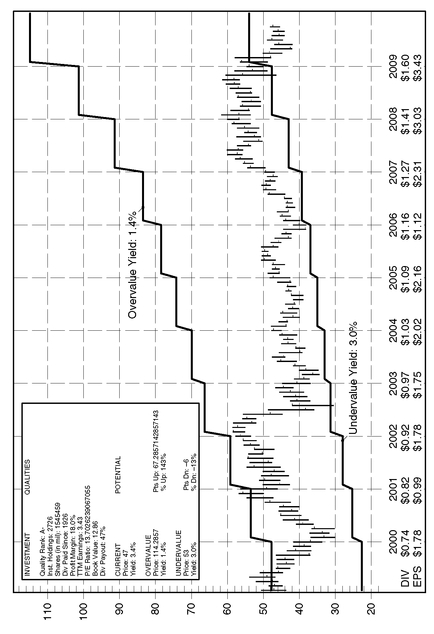
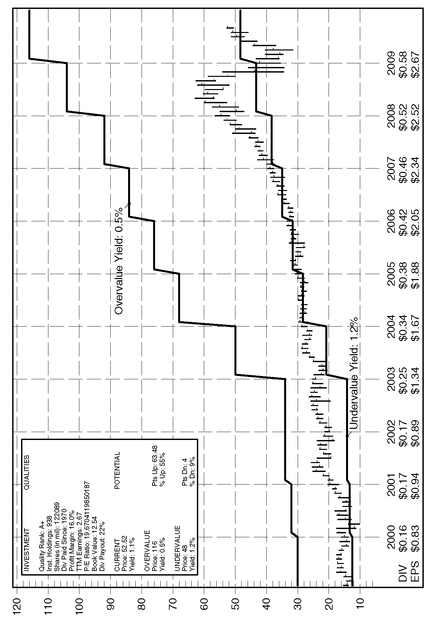
The chart for Abbott Labs (ABT) in
Figure 9.2 reflects a high-quality stock with an excellent long-term track record for performance in the traditionally defensive pharmaceutical industry. After reaching its historically repetitive area of overvalue in late 2000 and again in early 2002, the stock declined to its historically repetitive area of undervalue and has remained in a fairly consistent range between undervalue and a rising trend, offering several opportunities to add to the position and to compound the growing dividend stream. Even during the declining waterfall period the stock has remained above the lows in 2002, 2006, and has returned to the lows of 2008.
The Investor Who Needs Income
It is no secret that the stock market prefers lower interest rates than higher ones because a lower cost of capital is better for the bottom line, and, therefore, for earnings.
For the income investor, however, low interest rates results in lower coupons from more traditional income sources such as bonds. Certain investors, typically those with no employment or other income source, will necessarily turn to higher-yielding dividend stocks for current income.
Traditionally, investors will turn to stocks of gas and electric utilities or perhaps one of the legacy telecom companies for these higher yields.
Source: Value Trend Analys
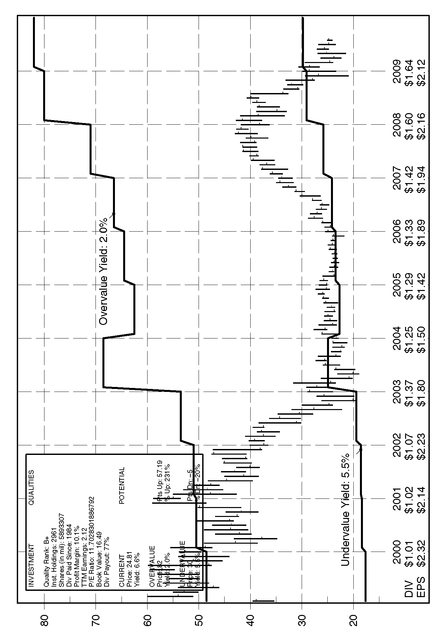
Figure 9.3 of AT&T, Inc. (T) from late June 2009 reflects the type of higher-yielding stock an income investor would look for. As an aside, it is ironic that the U.S. government spent years tearing the old Ma Bell apart. Today, the old gal is stronger than she ever was.
The Growth Investor
This sketch covers a wide swath as there are multiple objectives that typically fit into this genre. For tax purposes, investors in a higher income tax bracket may find shares of low-yield/high-growth stocks more attractive than shares with higher dividend-yields. With these types of stocks there is the wealth-building component of rising stock prices, but the dividends are not sufficiently high to catapult the investor into a higher tax bracket.
Another investor who would be more inclined toward growth would be someone who might not yet have reached the level of affluence but who, nonetheless, is in his or her peak earning years; someone who decides to forgo current income in favor of capital gains, which will build wealth for the retirement years.
The Young Investor
Last is the younger investor who has yet to reach his peak earning potential, has a long-term investment horizon, and has a higher risk tolerance than does an older investor. This investor may opt for more aggressively growing companies with higher P/E ratios and lower dividend payouts to accumulate capital gains in the early years, and then move toward higher-dividend-yielding stocks in the later years as retirement looms closer.
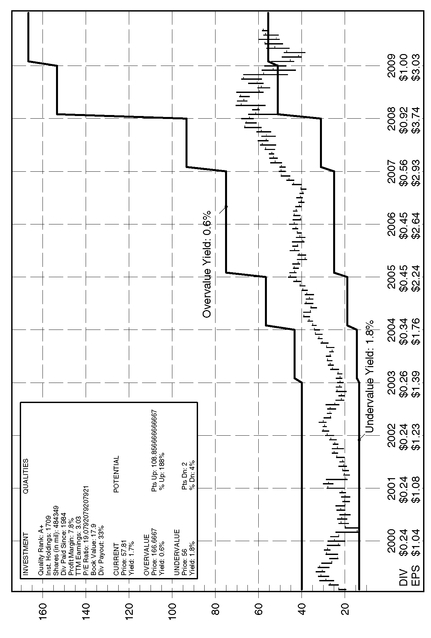
Figure 9.4 for Nike, Inc. (NKE) from mid-August 2009 illustrates a stock that would be attractive to the growth investor. Since declining to the historically repetitive area of undervalue in 2000, NKE has remained in a steady rising trend due to smaller but consistent dividend increases. An excellent opportunity to add to positions occurred between October 2008 and the present. Note that NKE must rise considerably before reaching the overvalue level. If the company continues to raise dividends at the same incremental pace, the overvalue area will continue to move higher, which could result in the stock remaining in a rising trend for a considerable period of time.
Source: Valut Trend Analysis
Source: Valut Trend Analysis
Know Your Limitations
I am going to go out on a limb here and guess this quote from Dirty Harry, A man’s got to know his limitations, was not in reference to the stock market. That being said, the quote is apt when the topic turns to risk as it pertains to stock strategy.
Everybody is wired differently. What one investor would classify as risk may be totally dismissed by another. The reasons or motivations that compel an investor to embrace or reject risk could keep an army of psychotherapists busy until the end of time.
Since I have a deadline to meet, I am going to cut to the chase. If you are feeling pain, you have a risk problem. When Mike and I talk to clients about risk tolerance, we like to invoke the pillow test; if the last thought you have at night when your head hits the pillow is your investment portfolio, then you haven’t passed the pillow test; you need to make some changes.
Risk tolerance can cut both ways; a portfolio producing insufficient growth of capital and income to meet future cash needs is as anxiety producing as a portfolio that contains too much short-term volatility for an investor with more immediate cash needs. This is why it is imperative to understand who, what, why, and when the portfolio is being created for. If you get this part wrong you can be the greatest stock picker the world has ever known and it can all come to naught.
The chart of Sigma-Aldrich (SIAL) in
Figure 9.5 is about as close to value-stock Nirvana that an investor could find. Note how the stock price hugs the undervalue line as the dividends have been systematically increased. At first glance many investors might overlook this stock due to its relatively low-yield at undervalue. Oops, a very big mistake. Let me tell you why.
SIAL not only has an A+ quality ranking, it has also earned the IQ Trends “G” designation for outstanding dividend growth. Subscribers to IQ Trends who purchased SIAL at undervalue in 1999 at $11 per share are enjoying a 5.25 percent dividend-yield on cost today, not to mention close to 400 percent in price appreciation.
No matter what your investment goals and objectives, or whether you are concerned with too much volatility or too little growth, this is the type of stock all value investors should look for.
Source: Valut Trend Analysis
Ideal Portfolio Size
Prior to the advent of the discount brokerage firm and the deregulation of trading commissions, the question of how many stocks should be in a portfolio was directly related to how much money an investor had to work with. When commissions were in the hundreds of dollars for a round lot (100 shares) or even more for an odd lot (less than 100 shares), it dramatically affected how many stocks one could hold in a portfolio.
Today most of the electronic brokers offer trading commissions between $7 and $20 per trade, depending on the amount of money in the account and/or the average number of trades per year. This is a significant development in the investment industry as minimizing trading costs can provide a meaningful boost to overall portfolio returns over the long-term.
Also, as investors are no longer penalized for trades of less than 100 shares, even an investor with a modest amount of capital can create a diversified portfolio of stocks. It wasn’t all that long ago that an investor with a modest amount of capital was forced to use mutual funds to achieve adequate diversification. Thankfully, those days are behind us.
The number of stocks in a portfolio is subject to a number of variables such as the investment time horizon, the amount of capital available to invest, investor goals and objectives, and economic and market conditions.
When the Dow is overvalued or the primary trend is down, it may be prudent to hold a smaller number of stocks in anticipation of greater selection and values when the Dow represents good historic value or there are a greater number of stocks that represent good historic values.
When the Dow is undervalued or in an early rising trend, the number of stocks can be increased for more broad participation in the expanding economy. As a general rule of thumb, however, we suggest limiting a portfolio to 25 stocks.
25 stocks is a sufficient number to allow for wide diversification, but it is not too many to track effectively. Also, by limiting the portfolio to 25 excellent stocks, there is a higher probability for outperforming the broad market. This is an important advantage of the dividend-value strategy you don’t want to give up; if you hold too many stocks you might as well own an index fund.
By example, in the First January 2000 issue of Investment Quality Trends, we introduced a portfolio of 13 stocks to aid subscribers in the portfolio construction process. The text below is taken directly from the IQ Trends web site that describes this portfolio:
Investment Quality Trends provides information targeted toward subscribers with varying levels of investment experience and portfolio construction. Unlike many other newsletter services, we do not construct and maintain model portfolios. Because we follow such a wide variety of companies that are dynamically moving in price, along with a steady influx of new subscribers, such an approach would be impractical for our particular application.
For tracking purposes, however, The Hulbert Financial Digest has maintained a portfolio for Investment Quality Trends since 1986. This portfolio consists of all the companies in the Undervalued and Rising-Trend categories, which, at any given time, could total as many as 100 companies or more; clearly too large a number to be practical.
Additionally, many studies have shown that the optimum number of stocks for an individual portfolio is 25. That number is appropriate for diversification while not allowing the portfolio to become unwieldy. Accordingly, investors must be selective and fashion a diversified portfolio of Undervalued and Rising-Trend stocks based on personal preferences, investment objectives, financial conditions, and tolerance for risk.
To assist subscribers in this endeavor (and at popular urging), we decided in January of 2000 that instead of engaging in the traditional (albeit generally futile) attempt to forecast the year ahead, to construct a portfolio of stocks that offered extraordinary value for your investment consideration.
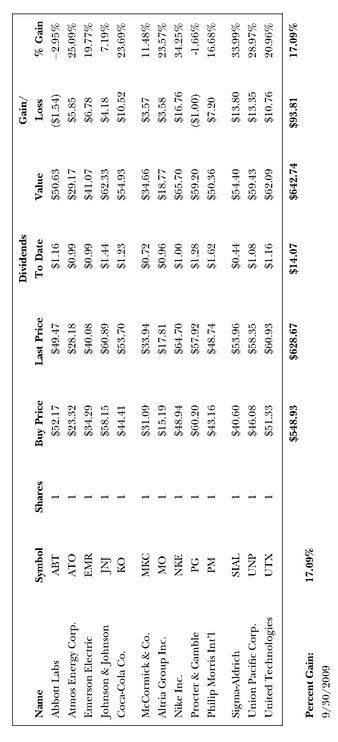
The portfolio, which has become known affectionately as The Lucky 13, as shown in
Figure 9.6, was designed to emphasize sectors of the market that, while perhaps were currently out of favor, nonetheless offered exemplary fundamentals and attractive dividend yields. Thirteen stocks were also sufficient to establish the foundation for a portfolio while leaving room for expansion when opportunities become available throughout the year.
Since its inception in January 2000, through year-end 2008, the Lucky 13 has had an average annual total return of 10.88 percent, as shown in
Figure 9.6, which is a marked premium above the major indexes. So even a smaller portfolio, when properly configured, can provide excellent total returns.
Diversify, Diversify, Diversify
Throughout this book I have emphasized the importance of the twin pillars of quality and value. At this juncture I have to add a third leg to the investment stool: diversification.
If you do everything right, have well-defined goals and objectives, choose asset classes that are appropriate for your time horizon and risk tolerance, select only the highest-quality stocks that represent historically good value, but fail to diversify across a broad number of industries and/or sectors, it can totally negate all of your preparation and hard work.
Throughout the history of the stock market there are cycles where various industries and sectors have suffered major declines due to an exhausting list of reasons. Although there is often fair warning that trouble may be looming on the horizon for an industry or group of industries, there is an equal number of instances in which trouble has appeared out of the blue.
Although limiting investment considerations to high-quality blue chips that represent historically good values can often reduce any downside to a relatively minor degree for a short amount of time, there are instances, such as the complete meltdown of the financial sector over the last 18 months, that no system of value identification could anticipate or predict. As such, it is important to limit your exposure to any one industry or sector.
In a perfect world, a portfolio of 25 stocks diversified across 25 separate industries or sectors would limit the overall portfolio exposure to only 4 percent in any one industry or sector. Under this scenario an investor could suffer a total loss (an improbable but not impossible occurrence) in any one position and emerge relatively unscathed.
Of course, we don’t live in a perfect world and it isn’t always possible to diversify across that many industries or sectors because they may not all offer simultaneous good historic values. By example, let’s say the utilities sector offers historically good value and there are six or seven that are currently undervalued. As utility stocks tend to have higher dividend-yields, particularly at undervalue, an investor might be tempted to snap up all six or seven. What would be more prudent though is to choose perhaps one gas utility and one electric utility that are based in different geographic regions. In this example the investor has gained exposure to the sector but he has diversified by type of utility and by region.
Of course, there won’t always be such a clear-cut distinction by type and region as there is in the utilities example. Among individual investors and in the professional community there are some age-old battle lines drawn when it comes to certain industries and companies: Procter & Gamble versus Colgate-Palmolive, Coca-Cola or Pepsi, Wal-Mart or Target, and so forth.
In these situations investors must return to individual analyses and compare the fundamentals and strengths: Are they both at undervalue; what are the quality rankings; does one offer a more attractive price or dividend yield; does one have a lower payout ratio or debt level; and so forth. Often times one company will stand out over the other; in an equal number of cases there may be a draw. At the end of the day an investor may choose the course of Solomon and divide the allocation among both companies.
In any event and no matter the decision, the fundamental concept behind diversification is to spread overall portfolio risk as far as is reasonably possible so that the unexpected will not cause irreparable harm to the value of the portfolio.