CHAPTER 5
Value and Blue Chip Stocks
Nowadays people know the price of everything and the value of nothing.
—Oscar Wilde
Recognizing quality is an essential component of the dividend-value strategy, but quality and value are entirely different measurements. The Select Blue Chips listed within the pages of Investment Quality Trends are all high-quality companies, but not all of them represent current good value. That is, even the highest-quality stock can be overpriced. Accordingly, once investors have established the qualitative bona fides for a blue chip stock, the measures of good value should be applied to maximize both the safety of capital and the potential for real total return.
Finding Good Value
If I had to choose just one factor as the key to investment success, it would be the ability to recognize and appreciate good value, which leads to two important questions: How is value measured in the stock market, and how does an investor know when the price of a stock represents good value?
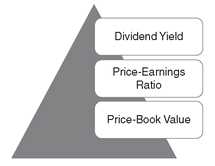
There are three fundamental tools that investors use to establish value in the stock market: dividend yield, price-earnings ratio (P/E), and price-book value ratio (P/B), as shown in
Figure 5.1.
Of the three measures, the primary measure of value in the stock market is the receipt of dividends, which is expressed as dividend yield. Dividend yield cuts to the chase; when all else is stripped from the bone it is the dividend yield that reveals the true value of a company’s stock.
This is not to suggest that price-to-earnings (P/E) ratios or price-to-book-value (PB) ratios are unimportant. As primary measures of value, both ratios are less than perfect; however, as confirmation measures for the value the dividend represents, both can be quite useful.
Price-Earnings Ratio
The price-earnings or P/E ratio is probably the first analytical tool most investors learn about because it is the most commonly used measure of value. In brief, the ratio expresses the stock’s price in relation to the company’s trailing 12-month earnings. The ratio is calculated by dividing the earnings per share into the price of the stock. The resulting figure produces a ratio of the price to the earnings.
By example, if a company’s trailing 12-month earnings are $1.95 per share and the current stock price is $24 per share, by dividing $1.95 into $24, the result is 12.30, which we round down to 12. When expressed as a ratio we would say the P/E is 12 to 1. Depending on current economic and market conditions, 12 to 1 could be high, low, or somewhere in the middle.
When earnings, stock prices, and interest rates are depressed, as they typically are in a bear market, it is not uncommon for P/E ratios to fall into the single digits. Conversely, when earnings, stock prices, and interest rates are robust, as they typically are during periods of expansion, it is not uncommon for P/E ratios to rise well into the teens and twenties.
In general, depending on the overall growth rate within any stock industry group, any ratio below 15 to 1 is believed to represent fair value. In like fashion, a P/E ratio above 20 to 1 suggests that the stock price may be overvalued. However, stocks have their own personalities, and a high P/E ratio for one stock may be an acceptable ratio, depending on the company’s growth characteristics. The market will also often grant higher valuations to a particular stock or industry that captures its fancy. Our personal preference as a firm is a P/E ratio that is closer to 10 to 1.
As you can tell, there is a certain amount of subjectivity when it comes to P/E ratios, another reason why identifying the repetitive extremes of undervalue and overvalue dividend yield is so important.
Price-Book Value Ratio
In accounting terms, book value is all of a company’s tangible assets (what you can see and touch), minus debt, minus preferred stock, and minus intangible assets (such as patents and goodwill). For normal people, book value is what is left if the company were to go out of business, liquidate all of its assets, and pay off all its debts. This figure is then divided by the total common shares outstanding to determine the book value per share.
The P/B ratio compares the market’s valuation of a company (price per share) to the value indicated on its financial statements (book value per share). By example, if a company’s stock price is $20 per share and the most recent book value is $10 per share, by dividing $20 by $10 the result is 2. When expressed as a ratio we would say the P/B is 2 to 1.
When the P/B ratio is one (1 to 1), it means the market value is in sync with what the company is reporting on its financial statement. When the ratio is greater than one, it means the market is willing to pay a premium above what the company reports on its financial statements. When the ratio is less than one, it can mean one of two things: The market is nervous about the value of the company and is unwilling to pay full price, or investors have incorrectly valued the stock.
For some analysts, to question the validity of book values is to commit heresy. For the truly objective analyst, however, it is difficult to overlook the obvious deficiencies in book values for making accurate valuations. For one, how assets and liabilities are valued leaves room for creative interpretation, as we have discovered recently with financial companies. Another is that some companies, such as those in the technology and service sectors, have hidden (intangible) assets such as intellectual property that are of great value, but are not reflected in the book value. Lastly, most accounting procedures fail to account for the effects of inflation on asset prices. Book value figures, therefore, can just as easily be understated as overstated.
Even the great Benjamin Graham, whose work I credit for much of my academic/intellectual development, and whose favorite measure for value identification was book values, cautioned investors that a stock does not necessarily represent good value simply because it can be purchased at or close to book value. In his book The Intelligent Investor, Graham advises investors to be cognizant, too, of the price the market is placing on shares, to know how many dollars are on hand for each dollar of short term debt, and to know that the dividend is well protected.
As is the case with earnings and the P/E ratio, book values and the P/B ratio cannot be dismissed. They are important measures of value as they can confirm the message of the dividend-yield trend.
Dividend Yield
We believe that the most important measure of investment value is the dividend yield. We believe this to be true because of three factors:
1. Dividends are the result of earnings.
2. A rising dividend trend is a predictor of growth.
3. Repetitive dividend-yield extremes establish reliable areas for undervalue and overvalue prices.
Enlightened investors have learned there is generally one catalyst—higher earnings or management’s reasoned expectations for higher earnings—that justifies a dividend increase. Think about it. No management, particularly that of a blue chip company, wants to suffer the public embarrassment of a bad call. Before the decision to raise a dividend is made, then, management has to believe the prospects for improved earnings, now as well into the future, must be strong. No manager with a lick of sense will raise the dividend if there is any doubt about future earnings.
Throughout this book, you will read the terms undervalue and overvalue. In our lexicon, these are historically repetitive extremes of low-price/high-yield and high-price/low-yield, which we call Profiles of Value. There is no one Profile of Value that can be applied to every stock. Each stock has it unique Profile of Value that must be analyzed and evaluated individually.
Dividend Truth
Measures of good value include the following:
Rule 1. A dividend yield that is historically high for that particular stock, and has repeatedly signaled the bottom of a major declining trend in the price of that stock.
Rule 2. A P/E ratio that is historically low for that particular stock, and is below the multiple for the Dow Jones Industrial Average. The only exception to this rule would be growth stocks with consistent records of rising earnings that are advancing faster than the market average and, therefore, can command higher-than-average P/E ratios.
Rule 3. A strong financial position with a ratio of current assets to current liabilities of at least two to one, and a debt-to-equity ratio of no more than 50 percent debt to equity.
Rule 4. A price that is no higher than one-third above the book value of the company—and the closer to book value, the better. Again, this fourth rule can be broken in the case of companies with proven, superior, long-term growth characteristics.
The Bluest of the Blue Chips
Even among blue chips, some stocks are more blue chip than others. These are stocks that have both an A+ quality ranking and the Investment Quality Trends “G” designation. A stock is awarded the “G” designation when the company achieves average annual dividend growth of 10 percent or greater over the past 12 years.
Figure 5.2 Royal Blue Chips—Highest Investment Quality (A+)
| Company | Symbol |
|---|
| Archer-Daniels-Midland | ADM |
| Automatic Data Processing | ADP |
| Caterpillar, Inc. | CAT |
| Cintas, Corp. | CTAS |
| Colgate-Palmolive | CL |
| CVS Caremark Corp. | CVS |
| Jack Henry & Associates | JKHY |
| Nike, Inc. Class B | NKE |
| PepsiCo, Inc. | PEP |
| Philip Morris International | PM |
| Sigma-Aldrich | SIAL |
| Sysco Corp. | SYY |
| Target Corp. | TGT |
| TJX Companies | TJX |
| United Technologies | UTX |
| Walgreen Company | WAG |
| Wal-Mart Stores, Inc. | WMT |
Companies that meet this threshold and offer current good value (Undervalued) are shown in
Figure 5.2.
The Faded Blues
The Select Blue Chips listed in Investment Quality Trends are an elite representation of the highest-quality publicly traded companies in America. Achieving Select Blue Chip status is not a one-time event, however; the designation must be continuously earned.
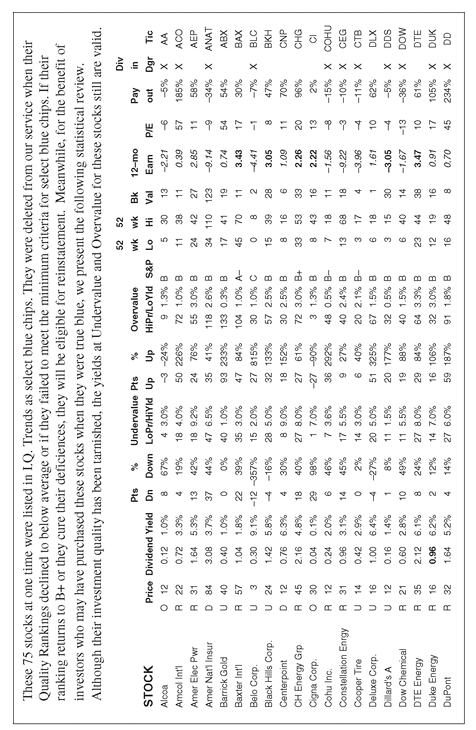
For varying reasons, more than 100 stocks have been deleted from our blue-chip-stock list over the last 44 years. Many were deleted because they were acquired by another company, some because they eliminated their dividend. On occasion, a Select Blue Chip can run into temporary or cyclical difficulties and their S&P Quality Ranking may be downgraded to “B,” which signifies below- average quality. Even if they meet the five remaining criteria, we feel compelled to delete the stock from our blue chip roster and transfer it to our list of faded blues.
Figure 5.3 shows our list of approximately 75 stocks that are faded blues. They will be eligible for blue chip reinstatement if their quality rankings return to “B+”(above average) or cure other criteria deficiencies.
Back to Basics
It has been said that an investor can find whatever he is looking for in the stock market. If questioned, most investors will tell you they want to make money. Although all investors like to make money, some are really interested in the excitement or being entertained. Others, believe it or not, use the stock market to work out deep-rooted psychological issues. Some simply want to commiserate with their friends or neighbors about how the stock market stuck it to them again and there is no way the little guy can beat the big boys at their game.
Investing is a business, and most businesses that are successful are the result of the owner’s willingness to do things that others don’t want to do or won’t do. Accordingly, identifying high-quality stocks that represent historical good value and giving them time to reach their full potential may not appeal to the investor looking for fireworks and immediate gratification. However, patience, in the stock market, is indeed a virtue.
In 1974, Geraldine conducted an interview with Benjamin Graham, which was later published in what at the time was the San Diego Union. In that interview Graham offered an interesting perspective on the value of patience:
It’s hard enough to find good values. When a stock rises slowly, intrinsic value can keep pace with the gradual increase in the price of the stock. However, when the price escalates quickly, faster than the fundamental development of the company, then the stock must be sold and a new investment decision made. Every new investment decision bears the risk of being a mistake.
Although the approach outlined in this book may not be entertaining or exciting enough for some, for the serious investor whose goal is developing wealth to meet his current and future cash needs, the dividend-value strategy has delivered time and again over the course of the last 40-plus years. For the enlightened investor, the growth of wealth is sufficient award to make patience well worth the effort.
Now that you know how to identify quality and value, we can turn our attention to understanding how cycles and trends impact both stocks and the stock market.