CHAPTER 3
The Dividend-Value Strategy
If you don’t know where you are going, any road will get you there.
—Lewis Carroll
Any serious student of the stock market and investment history is undoubtedly aware of the vast collection of colorful characters that have achieved either fame, infamy, or both for their spectacular successes and/or even more spectacular failures. Many of these stories are true; an equal number, perhaps more, are myths.
Whether these stories are true is unimportant, what these characters represent is: winning and losing. Everybody loves a winner and more often than not we in the United States turn them into heroes. When it comes to investing in the stock market, however, many investors can more readily identify with the losers than the winners, which is unfortunate.
Losing money hurts more than just the pocketbook; it vexes the soul. When you take a loss in the stock market, it is not uncommon to feel a variety of emotions: anger, guilt, perhaps humiliation. The fact is that, if you invest long enough, you are going to take your share of losses; nobody gets a free pass.
No matter your level of intelligence, success in the stock market can be elusive and transitory. Over the course of my career I have met many people who were flat out brilliant in their field of endeavor, yet who were completely hapless when it came to investing in the stock market. In many cases, these brilliant people, who in the rest of their life have experienced nothing but success, have chosen to throw in the towel and just give up, which was unfortunate and entirely unnecessary.
What few investors understand is that the stock market is the grandest of competitions, the game of all games, played out on a global scale. As anyone who has ever competed on any level knows, every game has its rules! In the stock market, as in any other competitive situation, the best players—the winners—are those who have knowledge and a strategy. Winning, not surprisingly, is much easier with the right strategy.
Obviously there are some major differences between investing in the stock market and a simple pastime. For one, the stakes are higher—the potential loss of hard-won earnings, savings, and security both now and in the future.
But for the winner, the rewards are also higher. Beyond the gain in wealth, few things are more satisfying than the thrill of the hunt, the joy of discovery, and the lasting satisfaction of a victory that is heightened because of the importance of this endeavor. And winning is much easier with the right strategy.
The Two Paths of Stock Return
Most investors who buy stocks do so with the hope of realizing a good rate of return. Hope, however, is not a strategy. For the investor who chooses the stock market as the avenue to grow their wealth, it is important to understand the elements that comprise the return on investment in stocks. More often than not, the most tangible element of return, the dividend, goes underappreciated.
All stock investors want the price of their stocks to increase, but stock prices don’t rise because of simple desire; they need a catalyst, a reason for investors to buy and push the price higher. The underlying premise of the dividend-value strategy is that the dividend yield is the major driver for the price of a stock. Think about it: All things being equal, when is a stock most attractive to investors? When its dividend yield is high.
An attractive dividend and high-yield is all but impossible for savvy investors to ignore. As the lure of securing a high yield attracts investors, the price of the stock begins to move higher. As price and yield have an inverse relationship, climbing stock prices result in declining yields. When the yield declines to a level where it is no longer enticing, investor interest, and therefore buying, disappears. Without investor demand, the price of the stock will begin to decline until it reaches a price point where the yield is again sufficient to attract new buying interest.
When compared to the analytical systems that focus on price patterns, a company’s products and services, price/earnings to growth (PEG) ratios, earnings yield, or a host of other measures, the elegant simplicity of focusing on the dividend yield emerges. That is, knowing that a stock is attractive when the dividend yield is high and unattractive when it is low provides the investor an objective measure of whether a stock’s price is high, low, or somewhere in between. Because the relationship between price and yield is the centerpiece of the dividend-value strategy, it makes sense to flesh out the related concepts in detail.
There are two components that comprise the return on a stock market investment. Not surprisingly, the one most investors focus on is capital or price appreciation; everyone wants to sell a stock for a profit. The other component is the dividend, which represents an immediate return on investment. When combined into one measure, the two components become what is known as the total return.
I think it is fairly safe to say that every time an investor buys a share of stock he does so with the absolute certainty that he will sell it later at a profit. Over time, after the inevitable loss or losses, the illusion of certainty is replaced with the wisdom that is gained only through experience; namely, in the stock market, nothing is certain. What isn’t illusory, though, is the dividend. Once received the dividend is yours to keep, a tangible return on investment that the market can’t snatch away from you as it can a paper profit.
Dividend Truth
A dividend is the portion of a company’s earnings that is distributed to its owners, the shareholders. The dividend is most often quoted in terms of the dollar amount each share receives (dividends per share). It can also be quoted in terms of a percent of the current market price, referred to as dividend yield. Dividends are most often paid in cash or additional shares of stock, though they could be paid in scrip, company products, or property. The board of directors decides on the form and amount; ordinarily, dividends are paid quarterly.
Now that you understand what a dividend is and how to calculate the return in terms of yield, let’s look closer at the relationship between price, yield, and value. Let’s take two stocks, one priced at $10 a share that pays a $.50 dividend and one priced at $20 that pays a $1 dividend.
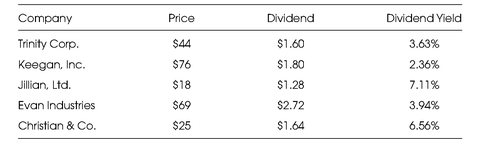
Beyond the fact that $20 is twice that of $10 and $1 is twice that of $.50, they have equal value in terms of dividend yield; both pay 5.0 percent dividends. Because stock prices and dividends rarely fall into such easy-to-calculate round numbers as in the previous example, let’s look at some more examples of how the dividend yield is calculated. Remember, yield is calculated on the price paid for the stock, so unless there is a change in the dividend, the yield on purchase remains constant no matter what the stock’s current price is.
Table 3.1 shows further information on dividend yield. The company names in this example are fictitious.
Whether dividends or capital appreciation is your favored component of return, you still need a means by which to define and identify the value for any stock under investment consideration.
Measures of Value
Traditionally there are three fundamental measurements of value: price-to-earnings ratio (P/E), price-to-book ratio (PB), and dividend yield. What is immediately apparent with the two ratios is that they are centered on price. Price, without substantive context, is meaningless. Of the three measures, the dividend yield is the only one related to an actual return on investment—the dividend payment. So beyond the value of the income to the investor, dividends provide tangible evidence that the company is actually making money, which is something that an earnings statement or book values cannot prove.
Dividend Truth
The three fundamental measures of value are:
1. Dividend yield
2. Price/earnings ratio
3. Price/book-value ratio
Quality of Earnings
Earnings are the lifeblood of every company and the sole reason the company exists—to generate a profit. With earnings, however, what is real and what is reported can be two entirely different things. That is, a corporate earnings statement can be a labyrinth to navigate through, with its seemingly endless collection of footnotes, exceptions, and variables. In simple terms, earnings can be sliced and diced to the point where they are often unintelligible. Why is this? To be fair, a company’s earnings can be impacted by myriad events ranging from the simple to very complex. A change in company leadership, for example, can lead to asset sales or a string of acquisitions. All these things must be duly noted; however, a recurring pattern of revisions and restatements might be indicative of less than forthright reporting. That earnings can be manipulated is not in question; it happens frequently to varying degrees for varying reasons. To some this may appear cynical, but when you get down to the bottom line, earnings are often what a financial officer says they are.
Rising Dividends Boost Share Price
With the preceding text as a frame of reference, we see why dividend-yield trends are a more predictive indicator for stock price appreciation/depreciation. When a dividend is increased, the price of a stock (which generally represents current value) typically rises to reflect the increased value of the investment. Conversely, when a dividend is lowered, the stock price typically declines to reflect reduced investment value and expectations for further reductions in earnings, not to mention the loss of anticipated income to the investor. The only variable in this equation is the amount of time for the market to realize the increase/decrease in value and adjust the price accordingly.
Why Dividends Are So Important
“The proof is in the pudding boy,” was one of my grandfather’s many folksy colloquialisms to make a point or teach a lesson. When applied to dividends, it underscores the point that they are tangible proof of a return on investment. When a company has a long-term track record for consistent and rising dividend payments, there is simply no better indicator about the state of the company’s financial health. Dividends are real money; the check either clears or it doesn’t. Dividends prove the company is making money; you can’t pay what you don’t have. So instead of trying to determine profitability by studying a company’s earnings, study its dividend history. At the end of the day dividends are the surest confirmation of a company’s profitability, since dividends can arise only from the reality of earnings.
Now let’s take this a step further. If you stop and think about it, there is really only one reason a company’s management and board of directors votes for a dividend increase—higher earnings or the reasonable expectation for higher earnings. Once again, the only variable is the amount of time it takes for the market to realize the increased value to the stock because of the dividend increase to push the price higher. This is where the virtue of patience is paramount.
Even if an investor doesn’t require immediate income from his stocks, he can still appreciate that dividends provide a floor of safety under the price of a stock. From experience, we know that savvy market observers pay close attention to dividend yield, and when the price of a stock falls to a level that creates an attractive return, investment capital will flow into the stock and halt the decline. A stock that pays no dividend has no such downside protection for its price.
Total Return Revisited
Although this concept was addressed earlier in Chapter 2, it is central to the dividend-value strategy and the underlying justification for investing in the stock market. The primary advantage of a stock investment is the potential for total return:
Dividend yield + capital gains = total return
From the Dividend-Yield Theory comes another factor to add to that equation: dividend growth.
Dividend yield + dividend growth + capital gains = real total return
The idea of real total return is, has been, and always will be the underlying reason why investors are willing to risk their capital in common stocks. It has been the fundamental attraction of stock market investments since they began.
Although the bond market can offer a fixed return and, depending on the trend in interest rates, some potential for capital gains, the growth of dividend income is only available in the stock market. As detailed earlier, dividend growth is the catalyst for and most accurate predicator of rising stock prices.
Over the course of the past 44 years there are untold examples of stocks that realized rates of real total return that would have been virtually impossible to obtain in any other investment vehicle with a commensurate degree of risk. These stocks had been held for several years, during which time there were consistent dividend increases, which precipitated consistent price increases. Here’s an example to illustrate the point.
One of the world’s most widely recognized brand names is that of McDonald’s (MCD), which virtually created the quick-service restaurant industry and today operates and franchises about 32,000 restaurants in 118 countries.
Despite its history and status as the American icon company, McDonald’s struggled during the late 1990s and early 2000s. Derided in some analytical corners as a relic of the past and a dying industry, McDonald’s in many ways epitomized the shift in consumer attitudes away from the old-school brick-and mortar model to the new school of hip-slick-and-cool, as represented by Starbucks.
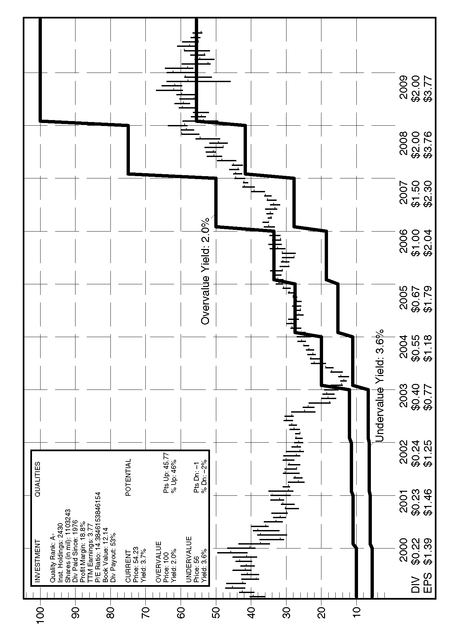
In 2003, McDonald’s management decided it would not go quietly into the night and initiated a corporate strategy to put the luster back into the Golden Arches. Part of the strategy was a commitment to shareholders to increase the value of their investment through a combination of share buybacks and dividend increases; were they ever serious! In 2002 McDonald’s (MCD) dividend was $0.06 per quarter or $0.24 per year. By the end of 2003 the dividend had been increased by 60 percent to $0.10 a quarter or $0.40 per year. The dividend has been consistently raised each year since, and through August 2009, the dividend was $.50 per quarter or $2.00 per year.
The first incremental dividend increase in 2003 put MCD into our undervalued area and on our radar screen. Our initial purchases were made at $15 per share and again at $19 per share. At the time of this writing, the stock is trading at $57, just shy of a 300 percent capital gain. More importantly, though, our initial dividend has increased by almost 1,000 percent and our yield on purchase is approximately 10 percent.
Some readers are undoubtedly wondering why we haven’t sold this stock to harvest the gains. As will be explained more thoroughly in later chapters, MCD still represents good historic value due to the frequency and size of dividend increases.
Figure 3.1 shows a graphic display of this fundamental value in the accompanying chart. As you can see, the stock still has considerable upside potential.
With the potential for real total returns, such as those illustrated by the example of McDonald’s, you begin to see how a stock that is held long enough for the concept to work can outpace the twin evils of taxes and inflation.
Dividend Truth
The reasoning behind real total return is a long-term investment concept that will not appeal to short-term traders. It deals with averages—an average dividend yield, average dividend growth, and average annual price appreciation.
To be fair, we cannot be sure that dividends will rise in each and every year. We cannot be sure when and to what extent stock prices will rise. Indeed, since October 2007 the markets have been undergoing the corrective process known as a bear market. However, if stocks are purchased at historically undervalued price levels, and if those stocks have a long, uninterrupted history of dividend payments and of frequent dividend increases, then over a period of years the real total return on that investment is likely to outperform the total return on any other kind of investment.
Source: Value Trend Analysis
Quality Tells
Although the dividend-value strategy can be implemented with any company paying dividends long enough to establish a pattern, the chances for success are greater with blue-chip stocks. Forty-four years of market research show that the dividend-value strategy, when implemented through high-quality stocks with long track records for consistent dividend increases, provides a powerful tool for building wealth. In the end, it is the building of wealth, both capital and income to meet the present and future cash needs of the investor, that is most important.
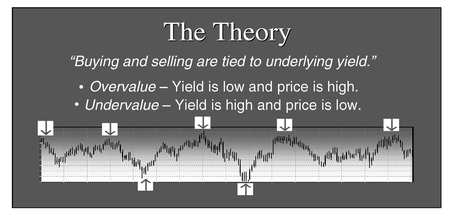
Figure 3.2 illustrates the concept of the Dividend-Yield Theory and its practical application through the dividend-value strategy in generic terms. The simple premise is that a decision to buy or sell a stock at a certain price is tied to the underlying value of its dividends as expressed by the dividend yield.
The Holy Grail for all stock investors is to buy low and sell high. Unfortunately, for most investors, high and low are typically references for price. As stated previously, though, price without substantive context is meaningless. In 2003 McDonald’s was undervalued at $15, but also at $19, because its dividend yield represented historically good value. The same was true in 2004 at $40 and again in 2009 at $57. So without a way to measure value, high and low are nothing but nebulous concepts.
Source: Investment QualityTrends.
From our perspective, this is fairly simple stuff; the theory and strategy are pretty basic to investing. Maybe it’s too basic, because the simplicity often confuses investors who seem determined to find a more complicated method for growth of capital and income and, ultimately, financial security. For over 44 years though, when the concept is applied to high-quality dividend trends, it can help the investor to:
• Minimize downside risk in the stock market
• Maximize upside potential for capital gains
• Maximize growth of dividend income, which allows investors to keep pace with inflation
Dividend Truth
As a general rule, a stock is overvalued when it has a relatively high price and a low dividend yield. It is undervalued when it has a relatively low price and a high dividend yield.
The Natural Order
The Tax Reform Act of 2003 dramatically lowered the rate of federal income tax levied against dividends received from qualifying companies. For those who believe dividends are a waste of corporate capital, the commonly heard refrain since passage of the Act is “watch what happens to dividend-paying stocks when Congress returns the tax rate to pre-Act levels.”
The fact of the matter is that Congress is continually tinkering with the tax code. Depending on the administration and your philosophical side of the aisle, these adjustments can be perceived as positive, negative, or neutral. However, some fail to remember that the markets are dynamic, constantly adjusting to economic fluctuation, legislation, taxation, and innovation; in short, the markets adjust.
Detractors also forget that investors have flocked to dividends since investment records have been kept, so the philosophy that the dividend yield of a quality company can reveal volumes about a stock’s future performance is not dependent on a certain tax environment or a particular market cycle. It is a basic principle, one that serves as a consistent guide through even the most frustrating market phases.
“The underlying principles of sound investment should not alter from decade to decade,” writes Benjamin Graham in his classic work, The Intelligent Investor, “but the application of these principles must be adapted to significant changes in the financial mechanisms and climate.”
Dividend Truth
To get the most benefit from the dividend-yield philosophy and adapt it to any stock market “mechanisms and climate” requires the mastering of several illuminating concepts. An investor must
• Confirm the value of a stock
• Identify quality
• Grasp the significance of cycles
Dividends Still Don’t Lie
A lot of water has passed beneath the bridge since Geraldine Weiss first wrote Dividends Don’t Lie in 1988. Investment theories have come and gone, various trading techniques and alternative investment vehicles have enjoyed a brief moment in the investment sun only to be abandoned when proven imperfect or ineffective, and investors have flocked to and fled from myriad fads, phenomena, and false hope.
Through it all, one thing has remained constant—the dividend. Dividends are still the most reliable component of investment return because dividends are still real money. Balance sheets and earnings statements can weave visions of grandeur but they don’t put money in your pocket. When a company pays a dividend, it can’t be revised or restated. Once a dividend leaves the company bank, it is irretrievable. No number of adjustments, schemes, or tricks can be used to fudge a dividend payment; it’s either paid or it isn’t. In short, dividends tell a truth that no company report can.
Source: Reprinted with permission.
In the wake of the Enron and World-Com scandals at the start of the decade and the more recent meltdowns in the banking and credit industries, corporate management and boards of directors are under greater scrutiny than in any previous period in financial market history. As such, ever-greater care and deliberation is being given to the declaration and payment of dividends.
Even without this heightened scrutiny, the management and directors of quality corporations know far better than anyone else the financial condition of their company and the likely direction that future earnings will take. Given the apparent ramifications of pending legislation alongside those existing in Sarbanes-Oxley, competent, well-managed blue chip companies with long track records of excellence and performance are not going to pay or increase a dividend unless the payout is fiscally justified and sound. For these reasons, a trend of consistently rising dividends is more indicative of a company’s health and well being than any other measure. For the investor seeking a reliable return on investment from a predictable stream of dividends, there is an added bonus: A trend of rising dividends is also a reliable predictor for future capital growth.
At this juncture, you should have a solid grasp on the concepts that dividends and dividend yields are a component of return, a measure of value, and a predictor of growth. Going forward we explain how to apply these concepts to the process of building a portfolio, managing the portfolio through various market cycles, and anticipating future share price and market directions.