CHAPTER 2
The Case for Investing in Stocks
October. This is one of the peculiarly dangerous months to speculate in stocks. The others are July, January, September, April, November, May, March, June, December, August, and February.
—Mark Twain
As detailed extensively in Chapter 1, we all have practical living needs that generally must be purchased with cash. At some point, typically in retirement, you will need a pool of cash to supplement your other sources of income. Unless you are independently wealthy, hit the lottery, or inherit a fortune from Great Aunt Sally, your options for growing wealth are fairly limited; in short, you will have to invest. As with any major venture, those who begin with achieving a specific goal or outcome have a much greater chance for success. Investing is no different.
The biggest mistake investors make is committing hard-earned money to investments, with absolutely no idea of why they are making those investments. Some of you are no doubt saying to yourself, “This guy must be thick. People invest to make money!” Let’s agree among ourselves that that is a given. Now let’s drill down to the heart of the issue: Money for what; money for whom; and, money for when?
Investment Needs
These questions are important; the answers are critical to your success. Simply plunging half-cocked into the markets with only a nebulous concept of making as much money as possible is an invitation to disaster. Minimally, you need to know two things: how much and when. Knowing how much you will need and when you will need it will allow you to devise a strategy, not just any strategy but a personal strategy to meet your specific individual needs. Trust me, without this base level of understanding you will do one of two things: shoot for the moon by assuming more risk than necessary to reach your goals and objectives; or play it too close to the vest and fall short of your goals and objectives.
When it comes to needs, there is no one-size-fits-all. Every investor is an individual with unique needs and objectives. You may have more than one objective; you may even have to prioritize among competing objectives such as education, retirement, big-ticket purchases, or even possible elder or special needs care. These objectives could be near term, long term, or a combination of the two. Your objectives may also need to be approached separately because there may be different factors to consider. If you can clearly answer these questions you will be in a much stronger position to meet your needs.
Once you have the end in mind there is only one thing you need to understand about investing: The sole purpose of investing is to grow your capital and income base to meet a current or future cash need. If you believe you might not meet your cash goals and objectives you will panic and take unnecessary risks, which generally result in loss and disappointment. So in simple terms, investing is about meeting needs, not hitting the lottery.
Stocks, Bonds, or Cash?
An entire book can be written (indeed, many already exist) on this subject alone. For our purposes I want to keep this simple: For most investors the majority of their investments will be made in the three primary asset classes: stocks, fixed-income (bonds), and cash or cash equivalents.
Cash and cash equivalents (short-term instruments that can be liquidated quickly with little to no loss of principal) serve several purposes. One purpose is to provide liquidity to meet current obligations; another is to temporarily hold interest and dividends that are earmarked for reinvestment; lastly, cash is a short-term, low-risk alternative to stocks and bonds during periods of extreme market volatility.
As an asset class, stocks can be divided into many subsets: domestic and international; growth and value; large-cap, mid-cap, small-cap; developed and emerging markets, and so forth. The same is true for fixed-income instruments: taxable; tax-exempt; Treasuries; government agencies; mortgage-backed; high-yield; international; emerging markets, and so forth.
In addition to the common asset classes just listed, the contemporary financial marketplace also consists of alternative asset classes such as hedge funds, private equity, venture capital, direct real estate, precious metals and gemstones, art and antiquities, and, of course, futures and options contracts on almost everything. The list can go on forever.
Perhaps this is part of the problem: The investment landscape has become so cluttered and sophisticated that investors have lost site of the basics. When distilled down to the most basic level, however, there are two primary choices for investment capital: to loan or to own.
In the simplest of terms, when you invest in a fixed-income instrument—a CD, a T-Bill, a T-Bond, a corporate bond, a municipal bond—whatever the case, you are making a loan of your capital to the issuer. For the right to use your capital, the issuer promises to pay you a fixed rate of interest over the agreed upon period of the loan and to return your capital, in whole, at the end of the loan period, otherwise known as maturity.
When an investor buys shares of stock, he buys part ownership of a corporation. The return on a stock investment comes in two forms: capital appreciation (an increase in share price) and dividends, which we will discuss in greater detail shortly. Unlike a fixed-income investment, common stocks pay no fixed rate of interest and offer no guarantees for the return of capital.
The asset allocation decision (the percentage of capital allocated to stocks, bonds, and cash in a portfolio) is one of the basic yet most often confusing decisions an investor must make. Generally, the role of stocks is to provide long-term total returns (a combination of price appreciation and dividends). The role of bonds is to provide an income stream.
When considering the respective risks and rewards of stocks versus fixed-income, stocks, in theory, have unlimited appreciation potential. That is, there is no upper limit on how high the price of a stock may go.
A fixed-income investor, on the other hand, generally knows the maximum return potential for a fixed-income investment, especially if it is held to maturity. Although it is true that a fixed-income instrument can sell at a premium, prior to maturity, the potential for price appreciation is significantly lower than the potential for price appreciation in stocks.
This brings us to one of the major areas of disagreement among investors, financial academics, and the investment industry: What is risk? Before I address that question, a long-held tenet of investing is that risk goes hand-in-hand with reward: no risk, no reward. Based on your definition and understanding of risk, this may or may not be true.
My belief is that, if you ask the average investor (not a professional or academic) how they define risk, they would tell you it is the possibility of losing money on an investment, meaning a partial or total loss of the original investment principal. Financial academics—and the investment industry in general—define risk as the short-term (annual, monthly, or daily) volatility of returns. The volatility of returns is measured by variance or standard deviation; think fluctuation.
Without opening a huge can of worms, what is a loss? Is it a realized loss (selling an investment for less than the original outlay) or a paper loss (holding an investment with a current market value below the purchase price)? Don’t laugh; you won’t believe how people can get all tied up in knots over this.
For the short-term investor who may need the use of funds today, next week, or next month, there isn’t much to argue here; any definition of loss means they have less money to work with and are feeling pain. For the long-term investor who has a 20-year time horizon, it might make strategic sense to take a quick realized loss on an investment gone awry because they have time to make up the difference and then some. On the other hand, if the investment is sound but just temporarily depressed (paper loss), why get shook up over short-term market fluctuations?
For the short-term investor, then, risk is not having sufficient liquid or near liquid funds to meet cash needs at the present and out to five years. If this applies to your situation, then you don’t need to be anywhere near investments that can and will fluctuate significantly over the short-term, period.
As investment instruments, both stocks and bonds have apparent risks. Stocks may not have a theoretical ceiling, but they do have a bottom: Stocks can fall to zero and become worthless. With fixed-income investments, there is the possibility of a decline in the market value due to an increase in interest rates. There is also the possibility the issuer will be unable to make interest or principal payments on time or at all, effectively defaulting on the loan.
For the long-term investor, though, fixed-income investments have a whopper of a risk that is subtle to the eye yet very dangerous; that is, inflation risk. Inflation risk is the possibility that the stream of income payments and eventual return of principal will decline in purchasing power (not keep pace with inflation).
For the long-term investor, then, neither the average-investor definition nor the academic/industry definition adequately addresses risk. With regard to the average-investor definition, much of the risk can be mitigated through education about appropriate investment time horizons and limiting investment considerations to high-quality investments that offer historic good value.
With regard to the academic/industry definition of risk, short-term (annual or even less frequent) price fluctuations (volatility) aren’t as relevant to the long-term investor with a 20-year time horizon as is building sufficient long-term wealth to meet future cash needs. Secondly, this focus on volatility is almost always based on nominal returns, which ignores the loss of purchasing power caused by inflation.
For short-term investors inflation isn’t such a big concern but for long-term investors the impact can be huge.
The Case for Stocks
As the editor of a stock investment newsletter and portfolio manager that specializes in blue chip stocks, I am obviously an advocate of investing in stocks. Let me tell you why.
Most investors are familiar with the concept of total return: capital gains (price appreciation) plus dividend yield. As a formula we would write it like this:
Capital gains + dividend yield = total return
Let’s use an example. You buy a stock for $25 per share and at the end of three years the price has increased to $50 per share. The capital gain is $25 per share or 100 percent. Let’s assume the stock paid a $1 per share dividend the first year, a $1.10 dividend per share the next year, and $1.21 per share in dividends the third year. By adding the $3.31 in dividends to the $25 capital gain, the total gain equals $28.31.
To find the percentage return, we divide the total gain ($28.31) by the purchase price ($25), which is 113 percent. This represents the total return on investment for the three years. On a simple basis, the average annual return equals 37 percent per year.
Dividend Truth
Stocks are the best investment for the investor who:
• Desires growth of capital and income
• Ignores the “noise” of the markets
• Recognizes and appreciates good value
• Has the courage to buy at undervalue
• Has the patience to hold until the value is fully recognized
• Has the wisdom to sell at overvalue
The IQ Trends dividend-value strategy adds another component to the concept of total return, namely, dividend growth.
Capital gains + dividend yield + dividend growth = real total return
The growth potential of real total return is the underlying reason and really, the only viable reason for investors to invest in stocks.
Although fixed-income investments offer a fixed return, it is only in a declining interest rate environment that fixed-income investments offer the potential for capital gains. Growth of dividends, however, is only achievable in the stock market. In later chapters we delve deeper into the importance of dividends and dividend growth to stock prices, but for now, know that only in the stock market can you achieve real total return.
In the final analysis, the true benefit of real total return is only understood when you consider the damage inflicted on capital by the twin evils of taxes and inflation. That is, if nothing is left to spend or reinvest after taxes and inflation, you have nothing to show for the risk you assumed. If you are putting your hard-earned money at risk, then shouldn’t it be in the area with the highest probability of leaving you with something to show for your efforts?
The Growth Rates of Stocks
For the 83-year period from 1926-2008, the nominal, compound average rate of return for stocks (the S&P 500) was 9.60 percent. Twenty-year government bonds returned 5.70 percent and 30-day Treasury Bills 3.70 percent. Adjusting for a compound average rate of inflation at 3.0 percent, the real returns were 7.10 percent, 2.20 percent, and 0.50 percent, respectively.
Dividend Truth
When considering rates of returns, it is important to understand the difference between nominal returns and real returns. What you make is the nominal return; what you keep is the “real” or after-inflation return.
A simple example of nominal return is a fixed-income instrument with a 5 percent coupon. There are different ways of measuring this, but the 5 percent basically means for every $100 you invest you will earn about $5 per year.
Real return is what you earn after subtracting the rate of inflation. Using the above example, if your fixed instrument pays you a nominal rate of 5 percent, and inflation, or the annual increase in the cost of living, is about 3 percent, your real return is about 2 percent. It is the real return that you can spend or reinvest.
After you factor in taxes, 30-day Treasury Bills are a virtual wash and 20-year Treasury Bonds are only slightly better. Only stocks have historically provided real, long-term growth of capital.
Now to be fair, nobody has an 83-year investment time horizon. There is also the argument that historical returns are irrelevant because those economic conditions are not applicable to today’s—maybe, maybe not. What I know about the stock market though is that it takes everything into consideration: the past, present, and as a discounting mechanism, the future.
Without the benefit of clairvoyance, we have to look at what we do know, and that is the past. Although the past guarantees nothing, it does provide insight into how investments have performed under various economic conditions over varying time frames.
The common trap when looking at the past, however, is to cherry-pick the data that supports the thesis. Indeed, there is an entire body of investment theory that is based on torturing the data until it confesses; I won’t be a party to that and you deserve better. That being said, it is reasonable to review holding periods that are representative of those of the average investor so we can find some commonality for returns.
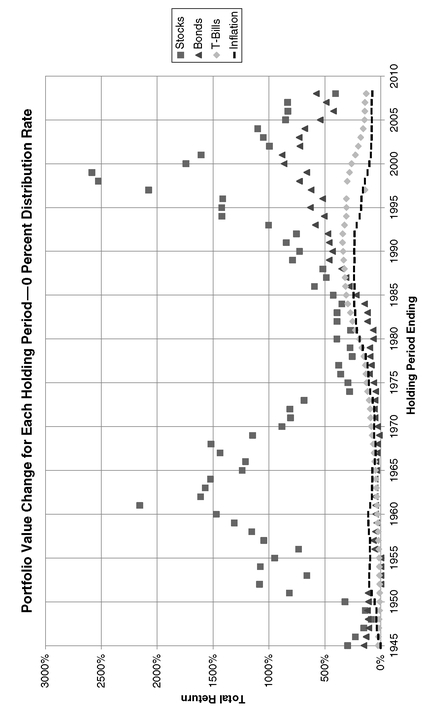
Let’s start with a very reasonable time-frame of 20 years as shown in
Figure 2.1. In the 64 rolling 20-year holding periods from 1926 through 2008, stocks (the S&P 500) outperformed fixed-income (20-year government bonds) in each instance except two: the 20 years from 1929-1948 and 1989-2008. Let’s put that into perspective: Stocks outperformed bonds in 62 of 64 20-year periods, or 96.8 percent of the time.
That is a pretty high batting average, which almost begs the question of what happened in the two periods when stocks underperformed bonds. For the period beginning in 1929 the answer is fairly simple—the Great Crash of 1929. By the time it ended in 1932, stocks had declined by almost 90 percent. It takes a while to dig out of a hole that deep.
For the 20-year period beginning in 1989 the story is a little different. Instead of stock prices declining at the beginning of the period, as in 1929-1932, the declines came at the end of the period: 2000-2002 and October 2007 through the end of 2008.
Per the norm, analysts and economists disagree about the reasons for the declines in these two periods. In the final analysis, the only opinion that matters is that of the investors who did the buying and selling. In both periods, however, there is a strong argument that valuations were excessive. From 1926 through 1928 stocks increased by 120.40 percent on a nominal basis, a simple average annual return of 40 percent per year. From 1989-1999 stocks increased by 221.40 percent on a nominal basis, a simple average annual return of 20.12 percent per year. A 20 percent return in any given year is not out of the ordinary—to average that for 11 consecutive years, however, is extraordinary. We deal with values and valuations thoroughly in later chapters, but there was some commonality in the two periods. The dividend-yield for the Dow Jones Industrial Average was at historically repetitive areas of overvalue. Understanding the connection between dividend-yield and values will help you to avoid periods of overvaluation both in individual stocks and in the broad market.
Figure 2.1 Rolling 20-Year Holding Periods from 1926-2008
Source: Stocks Bills and Inflation Yearbook, 2008, Ibbotson Associates
That bonds outperformed in these two periods is also easy to understand; both were periods of declining interest rates, when bonds tend to enjoy price premiums. With current bond yields at or near historic lows and stocks having corrected significantly, you have to consider which asset class offers the greater potential moving forward.
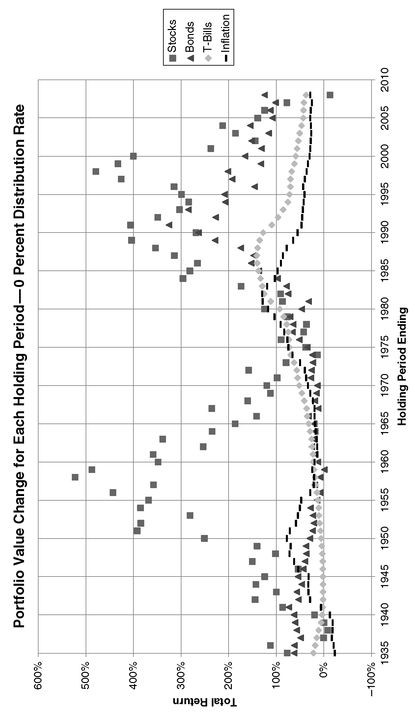
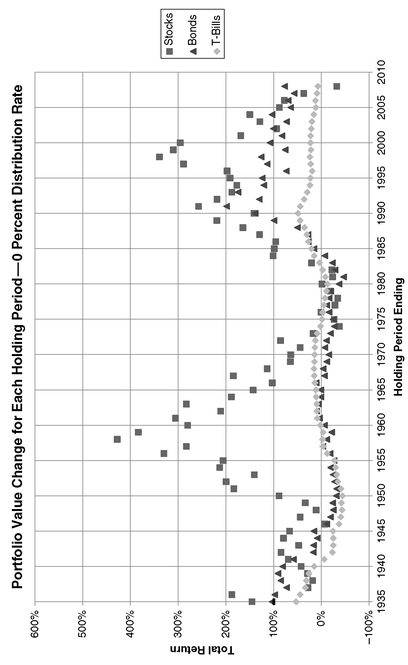
If 20 years strikes you as too long a period,
Figure 2.2 shows that in the 74 rolling 10-year holding periods from 1926-2008, stocks (the S&P 500) outperformed fixed-income (20-year government bonds) in 64 periods or 86 percent of the time. What is immediately apparent is that, when the holding period decreases (20 years to 10 years) the percentage of time that stocks outperformed bonds also decreases, which lends support to the argument that the longer the holding period the greater probability stocks will outperform bonds.
Once again, 86 percent is a pretty high batting average. As we did with the 20-year periods above, what can we learn by looking at the 10 periods when stocks underperformed bonds? The first four 10-year rolling periods were the ones that ended in 1937, 1938, 1939 and 1940. Obviously these periods were impacted by the Great Crash. The next three 10-year rolling periods are also interrelated: 1974, 1977 and 1978. These three rolling periods encompassed much of the bear market that ran from 1966 through year-end 1974.
In 2000 one of the longest bull market runs in history came to an end with the tech and dot-com meltdowns. The declines over the three years between 2000 and year-end 2002 were so severe that the 10-year rolling period ending in 2002 became the eighth 10-year rolling period of 10 where stocks underperformed bonds. The last two rolling 10-year periods should come as no surprise: 2007 and 2008. As the bear sank his teeth into the markets much of the gains from the latter part of the 1990s were washed away in a sea of red.
Figure 2.2 Rolling 10-Year Holding Periods from 1926-2008
Source: Stocks, Bonds, Bills and Inflation Yearbook, 2008, Ibbotson Associates
What should be obvious at this point is that any period when a bear market is in force necessarily results in a period of under-performance for stocks. As noted previously, much of this can be avoided through an understanding of values and valuations.
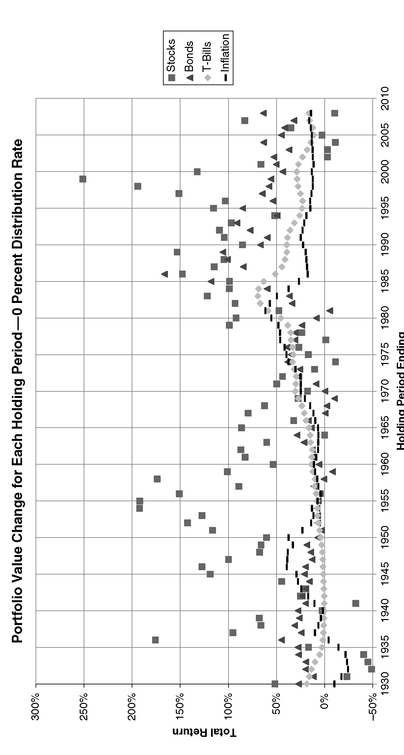
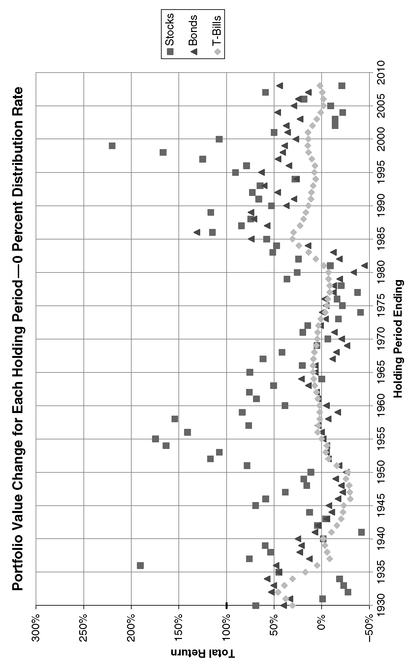
The final segments of returns we will review are shown in
Figure 2.3 and review the 79 rolling 5-year periods from 1926- 2008. Stocks (the S&P 500) outperformed fixed-income (20-year government bonds) in 58 of 79 periods or 73.41 percent of the time. Once again we see that when the holding period decreases (10 years to 5 years) the percentage of time that stocks outperformed bonds also decreases.
Although the percentage of periods when stocks outperformed bonds decreases when the number of years in the holding period decreases, 73 percent is still a relatively high number. As we found with the returns for the rolling holding periods for 10 and 20 years, the returns for the 5-year rolling periods when stocks underperformed bonds consisted wholly or in part of years that fell within a bear market.
Knowing investor psychology the way I do, some of you are undoubtedly thinking “73.41 percent is darn near three out of four; those are odds I can live with. Maybe five years is a sufficient holding period for stocks.”
Ultimately you will have to make that call. Before you do, though, consider this: On a real return basis, stocks have had four calendar year losses of over 30 percent in the 83 years from 1926-2008. In two of the four instances, 1931 and 1974, the calendar year preceding each also recorded losses. In these two instances the consecutive calendar year losses totaled over 50 percent. There’s simply no way to put lipstick on that pig. If two of the five years in your investment time horizon is that one out of four when stocks go south, you aren’t going to think three out of four is so great.
As I suggested previously, where the rubber really meets the road for the long-term investor is the real (after-inflation) return. As such, let’s look at the 20-, 10-, and 5-year rolling holding periods after adjusting for inflation.
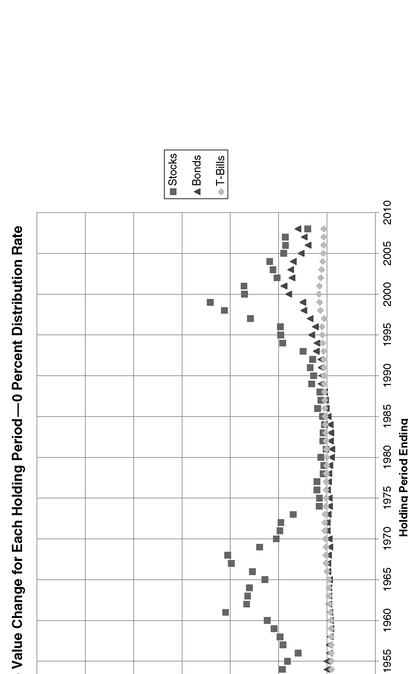
In the 64 rolling 20-year holding periods from 1926-2008, as shown in
Figure 2.4, stocks (the S&P 500) outperformed fixed-income (20-year government bonds) in each instance except one: the 20 years from 1989-2008. Sixty-three of 64 periods is 98.43 percent.
Figure 2.3 Rolling 5-Year Holding Periods from 1926-2008
Source: Stocks, Bonds, Bills and Inflation Yearbook, 2008, Ibbotson Associates
Figure 2.4 Inflation Adjusted Rolling 20-Year Holding Periods from 1926-2008
Source: Stocks, Bonds, Bills and Inflation Yearbook, 2008, Ibbotson Associates
In the 74 rolling 10-year holding periods from 1926-2008 as shown in
Figure 2.5, stocks (the S&P 500) outperformed fixed-income (20-year government bonds) in 63 periods or 85 percent of the time; that is one less period than on a nominal basis.
In the 79 rolling 5-year holding periods from 1926-2008, as shown in
Figure 2.6, stocks (the S&P 500) outperformed fixed-income (20-year government bonds) in 58 of the 79 periods or 73.41 percent of the time; these are identical to the results on a nominal basis.
Knowledge, Strategy, and Tactics
We have covered a lot of ground in this chapter, so let me summarize the most salient points. Inflation is a constant in our capital system. As such, the cost of the practical necessities will probably continue to increase over time. In the event you don’t earn, inherit, or win a fortune, you will necessarily need to set aside and invest a portion of your capital to build a pool of cash and stream of income to meet your future needs.
The major risk for the short-term investor is a capital loss. The major risk for the long-term investor is inflation and insufficient capital growth.
Of the myriad asset classes available for investment, most of your investment decisions will be centered on the allocation of your investment capital into the three primary asset classes of stocks, bonds, and cash.
Bonds provide for a specific rate of return over a specified period and a return of investment principal upon maturity. With the exception of a period of declining interest rates, the potential for capital appreciation is minimal. The apparent investment risks for bonds are interest rate fluctuations and credit risk. The less apparent risk for bonds is the long-term loss of purchasing power due to inflation.
Stocks do not provide for a specific rate of return over a specific period nor for a return of investment principal. Theoretically, stocks have unlimited potential for capital appreciation, but they also have a bottom; they can go to zero and become worthless. The obvious risk for stocks is short-term volatility or price fluctuation. Last and most important, stocks are the only investment vehicles that offer the potential for real total return: capital gains + dividends + dividend growth.
Figure 2.5 Inflation Adjusted Rolling 10-Year Holding Periods from 1926-2008
Source: Stocks, Bonds, Bills and Inflation Yearbook, 2008, Ibbotson Associates
Figure 2.6 Inflation Adjusted Rolling 5-Year Holding Periods from 1926-2008
Source: Stocks, Bonds, Bills and Inflation Yearbook, 2008, Ibbotson Associates
No one has tomorrow’s newspaper, so the future is uncertain. What we do have is historical data, which may or may not be applicable to today’s economic environment. We know, however, that the markets are a discounting mechanism that takes both past history and current conditions into consideration in an attempt to discern the future.
Although the review of various rolling holding periods indicates that, in the overwhelming majority of instances, stocks significantly outperform bonds on a nominal and after-inflation basis, stocks can and have suffered significant losses on a calendar-year basis.
In short, there is no free lunch. When you put your money to work in the financial markets, it will be exposed to risk. However, risk, when properly understood, can be used to your advantage. The difference between success and failure in the stock market ultimately comes down to three things: knowledge, strategy, and tactics.
When you understand the differences between stocks and bonds, the advantages and disadvantages, the risks and rewards, that is knowledge. With knowledge you can devise a plan of attack, which is a strategy. Confident in your knowledge and with a proven strategy at the ready, you are prepared to initiate the procedures to implement your strategy. Those are tactics.
In the next chapter I detail the dividend-value strategy that we advocate in Investment Quality Trends and utilize at Private Client.