22
INFORMATION SECURITY IS EVERYONE’S JOB EVERY DAY
One of the top objections to implementing DevOps principles and patterns has been: “Information Security and Compliance won’t let us.” And yet, DevOps may be one of the best ways to better integrate information security into the daily work of everyone in the technology value stream.
When Infosec is organized as a silo outside of Development and Operations, many problems arise. James Wicket, one of the creators of the Gauntlt security tool and organizer of DevOpsDays Austin and the Lonestar Application Security conference, observed:
One interpretation of DevOps is that it came from the need to enable developer’s productivity, because as the number of developers grew, there weren’t enough Ops people to handle all the resulting deployment work. This shortage is even worse in Infosec—the ratio of engineers in Development, Operations, and Infosec in a typical technology organization is 100:10:1. When Infosec is that outnumbered, without automation and integrating information security into the daily work of Dev and Ops, Infosec can only do compliance checking, which is the opposite of security engineering—and besides, it also makes everyone hate us.1
James Wickett and Josh Corman, former CTO of Sonatype and respected information security researcher, have written about incorporating information security objectives into DevOps, a set of practices and principles termed Rugged DevOps.2*
Throughout The DevOps Handbook, we have explored how to fully integrate QA and Operations objectives throughout our entire technology value stream. In this chapter, we describe how to similarly integrate Infosec objectives into our daily work, where we can increase our safety and security while maintaining developer and operational productivity.
Integrate Security into Development Iteration Demonstrations
One of our goals is to have feature teams engaged with Infosec as early as possible, as opposed to primarily engaging at the end of the project. One way we can do this is by inviting Infosec to the product demonstrations at the end of each development interval so that they can better understand the team goals in the context of organizational goals, observe their implementations as they are being built, and provide guidance and feedback at the earliest stages of the project, when there is the most amount of time and freedom to make corrections.
Justin Arbuckle, former Chief Architect at GE Capital, observes,
When it came to information security and compliance, we found that blockages at the end of the project as much more expensive than at the beginning—and Infosec blockages were among the worst. ‘Compliance by demonstration’ became one of the rituals we used to shift all this complexity earlier in the process. . . .4
By having Infosec involved throughout the creation of any new capability, we were able to reduce our use of static checklists dramatically and rely more on using their expertise throughout the entire software development process.5
This helped the organization achieve its goals. Snehal Antani, former CIO of Enterprise Architecture at GE Capital Americas, described their top three key business measurements as “development velocity (i.e., speed of delivering features to market), failed customer interactions (i.e., outages, errors), and compliance response time (i.e., lead time from audit request to delivery of all quantitative and qualitative information required to fulfill the request).”6
When Infosec is an assigned part of the team, even if they are only being kept informed and observing the process, they gain the business context they need to make better risk-based decisions. Furthermore, Infosec is able to help feature teams learn what is required to meet security and compliance objectives.
Integrate Security into Defect Tracking and Post-Mortems
When possible, we want to track all open security issues in the same work tracking system that Development and Operations are using, ensuring the work is visible and can be prioritized against all other work. This is very different from how Infosec has traditionally worked, where all security vulnerabilities are stored in a GRC (governance, risk, and compliance) tool that only Infosec has access to. Instead, we will put any needed work in the systems that Dev and Ops use.
In a presentation at the 2012 Austin DevOpsDays, Nick Galbreath, who headed up Information Security at Etsy for many years, describes how his team treated security issues: “We put all security issues into JIRA, which all engineers use in their daily work, and they were either ‘P1’ or ‘P2,’ meaning that they had to be fixed immediately or by the end of the week, even if the issue is only an internally facing application.”7
Furthermore, he states, “Any time we had a security issue, we would conduct a post-mortem, because it would result in better educating our engineers on how to prevent it from happening again in the future, as well as a fantastic mechanism for transferring security knowledge to our engineering teams.”8
Integrate Preventive Security Controls into Shared Source Code Repositories and Shared Services
In Chapter 20, we created a shared source code repository that makes it easy for anyone to discover and reuse the collective knowledge of our organization—not only for our code but also for our toolchains, deployment pipeline, standards, etc. By doing this, anyone can benefit from the cumulative experience of everyone in the organization.
Now we will add to our shared source code repository any mechanisms or tools that help enable us to ensure our applications and environments are secure. We will add libraries that are pre-blessed by security to fulfill specific Infosec objectives, such as authentication and encryption libraries and services.
Because everyone in the DevOps value stream uses version control for anything they build or support, putting our information security toolchain and approved libraries there makes it much easier to influence the daily work of Dev and Ops, because anything we create is available, searchable, and reusable. Version control also serves as an omni-directional communication mechanism to keep all parties aware of changes being made.
If we have a centralized shared services organization, we may also collaborate with them to create and operate shared security-relevant platforms, such as authentication, authorization, logging, and other security and auditing services that Dev and Ops require. When engineers use one of these predefined libraries or services, they won’t need to schedule a separate security design review for that module; they’ll be using the guidance we’ve created concerning configuration hardening, database security settings, key lengths, and so forth.
To further increase the likelihood that the services and libraries we provide will be used correctly, we can provide security training to Dev and Ops, as well as review what they’ve created to help ensure that security objectives are being implemented correctly, especially for teams using these tools for the first time.
Ultimately, our goal is to provide the security libraries or services that every modern application or environment requires, such as enabling user authentication, authorization, password management, data encryption, and so forth. Furthermore, we can provide Dev and Ops with effective security-specific configuration settings for the components they use in their application stacks, such as for logging, authentication, and encryption. We may include items such as:
•code libraries and their recommended configurations (e.g., 2FA [two-factor authentication library], bcrypt password hashing, logging)
•secret management (e.g., connection settings, encryption keys) using tools such as Vault, sneaker, Keywhiz, credstash, Trousseau, Red October, etc.†
•OS packages and builds (e.g., NTP for time syncing, secure versions of OpenSSL with correct configurations, OSSEC or Tripwire for file integrity monitoring, syslog configuration to ensure logging of critical security into our centralized ELK stack)
By putting all these into our shared source code repository, we make it easy for any engineer to correctly create and use logging and encryption standards in their applications and environments, with no further work from us.
We should also collaborate with Ops teams to create a base cookbook or base image of our OS, databases, and other infrastructure (e.g., NGINX, Apache, Tomcat), showing they are in a known, secure, and risk-reduced state. Our shared repository not only becomes the place where we can get the latest versions but also becomes a place where we can collaborate with other engineers and monitor and alert on changes made to security-sensitive modules.
Now that Docker-based systems are ubiquitous, organizations should use a container registry to hold all base images. In order to secure the software supply chain, these source versions should be stored along with a secure hash of the image created. This hash must be validated whenever the image is used or deployed.
Integrate Security into Our Deployment Pipeline
In previous eras, in order to harden and secure our application, we would start our security review after development was completed. Often, the output of this review would be hundreds of pages of vulnerabilities in a PDF, which we’d give to Development and Operations, which would be completely unaddressed due to project due date pressure or problems being found too late in the software life cycle to be easily corrected.
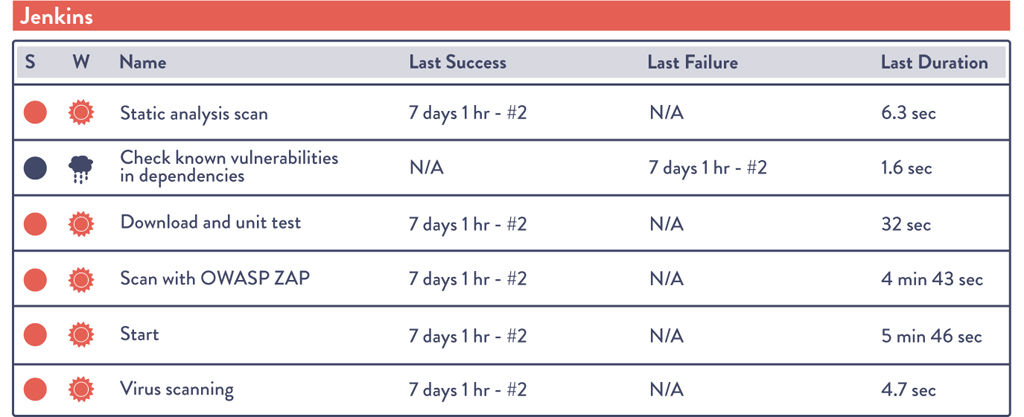
In this step, we will automate as many of our information security tests as possible, so that they run alongside all our other automated tests in our deployment pipeline, being performed (ideally) upon every code commit by Dev or Ops, and even in the earliest stages of a software project.
Our goal is to provide both Dev and Ops with fast feedback on their work so that they are notified whenever they commit changes that are potentially insecure. By doing this, we enable them to quickly detect and correct security problems as part of their daily work, which enables learning and prevents future errors.
Ideally, these automated security tests will be run in our deployment pipeline alongside the other static code analysis tools.
Tools such as Gauntlt have been designed to integrate into the deployment pipelines, which run automated security tests on our applications, our application dependencies, our environment, etc. Remarkably, Gauntlt even puts all its security tests in Gherkin syntax test scripts, which is widely used by developers for unit and functional testing. Doing this puts security testing in a framework they are likely already familiar with. This also allows security tests to easily run in a deployment pipeline on every committed change, such as static code analysis, checking for vulnerable dependencies, or dynamic testing.
By doing this, we provide everyone in the value stream with the fastest possible feedback about the security of what they are creating, enabling Dev and Ops engineers to find and fix issues quickly.
Ensure Security of the Application
Often, Development testing focuses on the correctness of functionality, looking at positive logic flows. This type of testing is often referred to as the happy path, which validates user journeys (and sometimes alternative paths) where everything goes as expected, with no exceptions or error conditions.
On the other hand, effective QA, Infosec, and fraud practitioners will often focus on the sad paths, which happen when things go wrong, especially in relation to security-related error conditions. (These types of security-specific conditions are often jokingly referred to as the bad paths.)
For instance, suppose we have an e-commerce site with a customer input form that accepts credit card numbers as part of generating a customer order. We want to define all the sad and bad paths required to ensure that invalid credit cards are properly rejected to prevent fraud and security exploits, such as SQL injections, buffer overruns, and other undesirable outcomes.
Instead of performing these tests manually, we would ideally generate them as part of our automated unit or functional tests so that they can be run continuously in our deployment pipeline.
As part of our testing, we will want to include the following:
Static analysis: This is testing that we perform in a non-runtime environment, ideally in the deployment pipeline. Typically, a static analysis tool will inspect program code for all possible run-time behaviors and seek out coding flaws, back doors, and potentially malicious code (this is sometimes known as “testing from the inside out”). Examples of tools include Brakeman, Code Climate, and searching for banned code functions (e.g., “exec()”).
Dynamic analysis: As opposed to static testing, dynamic analysis consists of tests executed while a program is in operation. Dynamic tests monitor items such as system memory, functional behavior, response time, and overall performance of the system. This method (sometimes known as “testing from the outside in”) is similar to the manner in which a malicious third party might interact with an application. Examples include Arachni and OWASP ZAP (Zed Attack Proxy).‡ Some types of penetration testing can also be performed in an automated fashion and should be included as part of dynamic analysis using tools such as Nmap and Metasploit. Ideally, we should perform automated dynamic testing during the automated functional testing phase of our deployment pipeline, or even against our services while they are in production. To ensure correct security handling, tools like OWASP ZAP can be configured to attack our services through a web browser proxy and inspect the network traffic within our test harness.
Dependency scanning: Another type of static testing we would normally perform at build time inside of our deployment pipeline involves inventorying all our dependencies for binaries and executables and ensuring that these dependencies, which we often don’t have control over, are free of vulnerabilities or malicious binaries. Examples include Gemnasium and bundler audit for Ruby, Maven for Java, and the OWASP Dependency-Check.
Source code integrity and code signing: All developers should have their own PGP key, perhaps created and managed in a system such as keybase.io. All commits to version control should be signed—that is straightforward to configure using the open-source tools gpg and git. Furthermore, all packages created by the CI process should be signed, and their hash recorded in the centralized logging service for audit purposes.
Furthermore, we should define design patterns to help developers write code to prevent abuse, such as putting in rate limits for our services and graying out submit buttons after they have been pressed.
OWASP publishes a great deal of useful guidance such as the Cheat Sheet series, which includes:9
•how to store passwords
•how to handle forgotten passwords
•how to handle logging
•how to prevent cross-site scripting (XSS) vulnerabilities
Static Security Testing at Twitter (2009)
The “10 Deploys per Day: Dev and Ops Cooperation at Flickr” presentation by John Allspaw and Paul Hammond is famous for catalyzing the Dev and Ops community in 2009. The equivalent for the information security community is likely the presentation that Justin Collins, Alex Smolen, and Neil Matatall gave on their information security transformation work at Twitter at the AppSecUSA conference in 2012.
Twitter had many challenges due to hyper-growth. For years, the famous Fail Whale error page would be displayed when Twitter did not have sufficient capacity to keep up with user demand, showing a graphic of a whale being lifted by eight birds. The scale of user growth was breathtaking—between January and March 2009, the number of active Twitter users went from 2.5 million to 10 million.10
Twitter also had security problems during this period. In early 2009, two serious security breaches occurred. First, in January the @BarackObama Twitter account was hacked. Then in April, the Twitter administrative accounts were compromised through a brute-force dictionary attack. These events led the Federal Trade Commission to judge that Twitter was misleading its users into believing that their accounts were secure and issued an FTC consent order.11
The consent order required that Twitter comply within sixty days by instituting a set of processes that were to be enforced for the following twenty years and would do the following:12
•Designate an employee or employees to be responsible for Twitter’s information security plan.
•Identify reasonably foreseeable risks, both internal and external, that could lead to an intrusion incident and create and implement a plan to address these risks.§
•Maintain the privacy of user information, not just from outside sources but also internally, with an outline of possible sources of verification and testing of the security and correctness of these implementations.
The group of engineers assigned to solve this problem had to integrate security into the daily work of Dev and Ops and close the security holes that allowed the breaches to happen in the first place.
In their previously mentioned presentation, Collins, Smolen, and Matatall identified several problems they needed to address:13
•Prevent security mistakes from being repeated: They found that they were fixing the same defects and vulnerabilities over and over again. They needed to modify the system of work and automation tools to prevent the issues from happening again.
•Integrate security objectives into existing developer tools: They identified early on that the major source of vulnerabilities were code issues. They couldn’t run a tool that generated a huge PDF report and then email it to someone in Development or Operations. Instead, they needed to provide the developer who had created the vulnerability with the exact information needed to fix it.
•Preserve trust of Development: They needed to earn and maintain the trust of Development. That meant they needed to know when they sent Development false positives, so they could fix the error that prompted the false positive and avoid wasting Development’s time.
•Maintain fast flow through Infosec through automation: Even when code vulnerability scanning was automated, Infosec still had to do lots of manual work and waiting. They had to wait for the scan to complete, get back the big stack of reports, interpret the reports, and then find the person responsible for fixing it. And when the code changed, it had to be done all over again. By automating the manual work, they removed “button-pushing” tasks, saving time and enabling them to use more creativity and judgment to solve new problems.
•Make everything security related self-service, if possible: They trusted that most people wanted to do the right thing, so it was necessary to provide them with all the context and information they needed to fix any issues.
•Take a holistic approach to achieving Infosec objectives: Their goal was to do analysis from all the angles: source code, the production environment, and even what their customers were seeing.
The first big breakthrough occurred during a company-wide hack week when they integrated static code analysis into the Twitter build process. The team used Brakeman, which scans Ruby on Rails applications for vulnerabilities. The goal was to integrate security scanning into the earliest stages of the Development process, not just when the code was committed into the source code repo.14
The results of integrating security testing into the development process were breathtaking. Over the years, by creating fast feedback for developers when they write insecure code and showing them how to fix the vulnerabilities, Brakeman has reduced the rate of vulnerabilities found by 60%,15 as shown in Figure 22.2. (The spikes are usually associated with new releases of Brakeman.)
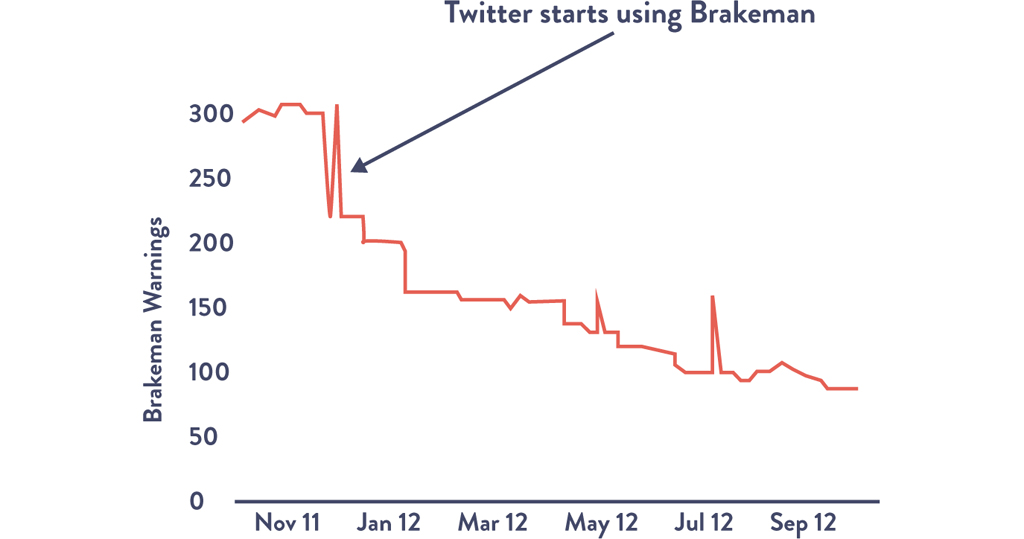
Figure 22.2: Number of Brakeman Security Vulnerabilities Detected
This case study illustrates just how necessary it is to integrate security into the daily work and tools of DevOps and how effectively it can work. Doing so mitigates security risk, reduces the probability of vulnerabilities in the system, and helps teach developers to write more secure code.
Ensure Security of Our Software Supply Chain
Josh Corman observed that as developers “we are no longer writing customized software—instead, we assemble what we need from open source parts, which has become the software supply chain that we are very much reliant upon.”16 In other words, when we use components or libraries—either commercial or open source—in our software, we not only inherit their functionality, but also any security vulnerabilities they contain.
In the 2020 State of the Octoverse report, Dr. Nicole Forsgren and her team conducted a deep dive on open source and their dependencies in the Securing Software section of the report. They found the most frequent use of open-source dependencies in JavaScript (94%), Ruby (90%), and .NET (90%).17
Their research also found that when teams used automation to generate a pull request patch for detected vulnerabilities, it accelerated their supply chain security thirteen days sooner, or 1.4 times faster, than those who didn’t. This shows the effectiveness of shifting left and integrating security into our development and operations workflows.18
When selecting software, we detect when our software projects are relying on components or libraries that have known vulnerabilities and help developers choose the components they use deliberately and with due care, selecting those components (e.g., open-source projects) that have a demonstrated history of quickly fixing software vulnerabilities. We also look for multiple versions of the same library being used across our production landscape, particularly the presence of older versions of libraries that contain known vulnerabilities.
Examining cardholder data breaches shows how important the security of open-source components we choose can be. Since 2008, the annual Verizon PCI Data Breach Investigation Report (DBIR) has been the most authoritative voice on data breaches where cardholder data was lost or stolen. The 2014 report studied over eighty-five thousand breaches to better understand where attacks were coming from, how cardholder data was stolen, and factors leading to the breaches.
The 2014 DBIR found that ten vulnerabilities (i.e., CVEs) accounted for almost 97% of the exploits used in studied cardholder data breaches in 2014. Of these ten vulnerabilities, eight of them were over ten years old.19
In 2021, the authors of the DBIR analyzed the vulnerabilities on all the internet-facing assets for eighty-five organizations and found that most had vulnerabilities that were from 2010 or before. They wrote, “one might think that more recent vulnerabilities would be more common. However, as we saw last year, it is actually the older vulnerabilities that are leading the way.”20
The 2019 Sonatype State of the Software Supply Chain Report, coauthored by Dr. Stephen Magill and Gene Kim, described the analysis of the Maven Central repository, which stores software components for the Java ecosystem (similar to what NPM does for JavaScript, PyPi for Python, or Gems for Ruby). In 2019, Maven Central contained over four million versions of 310,000 components, servicing over 146 billion download requests (68% year-over-year growth). In the study, the authors analyzed 4.2 million JAR artifacts (Java archive files) and 6,952 GitHub projects where they resided.21
The report included these startling findings:22
•9% of components had at least one vulnerability associated with them.
•When the component and all of its transitives are analyzed, 47% of components have at least one vulnerability.
•The median time for software components to remediate software vulnerabilities was 326 days.
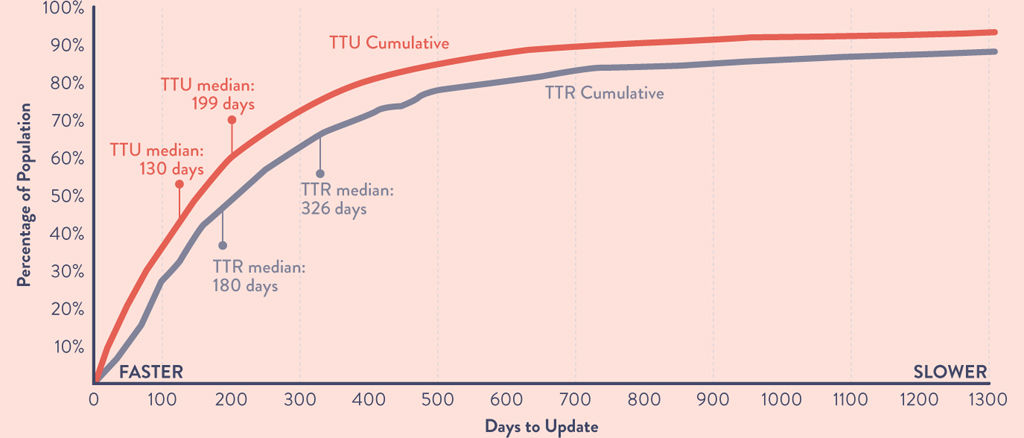
Figure 22.3: Time to Remediate vs. Time to Update Dependencies (TTU)
Source: Sonatype, 2019 Software Supply Chain Report.
The 2019 report also showed that when analyzing software components, the time required for those projects to remediate their security vulnerabilities (TTR) was correlated with the time required to update any of their dependencies (TTU).23 In other words, projects that update more frequently tend to remediate their security vulnerabilities faster.
This fact motivates why Jeremy Long, founder of the OWASP Dependency Check project, suggests that the best security patching strategy is to remain current on all dependencies.24 He speculates that “only 25% of organizations report vulnerabilities to users, and only 10% of vulnerabilities are reported as Common Vulnerabilities and Exposures (CVE).”25 Furthermore, the publication of a CVE is often for a vulnerability that was fixed in an earlier version of a component.
For example, the PrimeFaces CVE-2017-1000486 was published January 3, 2018, which cryptominers then started exploiting. However, the vulnerability was actually fixed in February 2016. Those who had already updated to a newer version were unaffected.26
The 2019 study also found that the “popularity” of a software project (e.g., number of GitHub stars or forks or the number of Maven Central downloads) is not correlated with better security characteristics.27 This is problematic because many engineers select open-source components based on the project’s popularity. However, project popularity has not been shown to correlate with their TTU (time to update their dependencies).28
The 2019 Sonatype study found five behavioral clusters for open-source projects:29
•Small exemplar: small development teams (1.6 devs), exemplary MTTU.
•Large exemplar: large development teams (8.9 devs), exemplary MTTU, very likely to be foundation supported, 11x more popular.
•Laggards: poor MTTU, high stale dependency count, more likely to be commercially supported.
•Features first: frequent releases but poor TTU, still reasonably popular.
•Cautious: good TTU but seldom completely up to date.
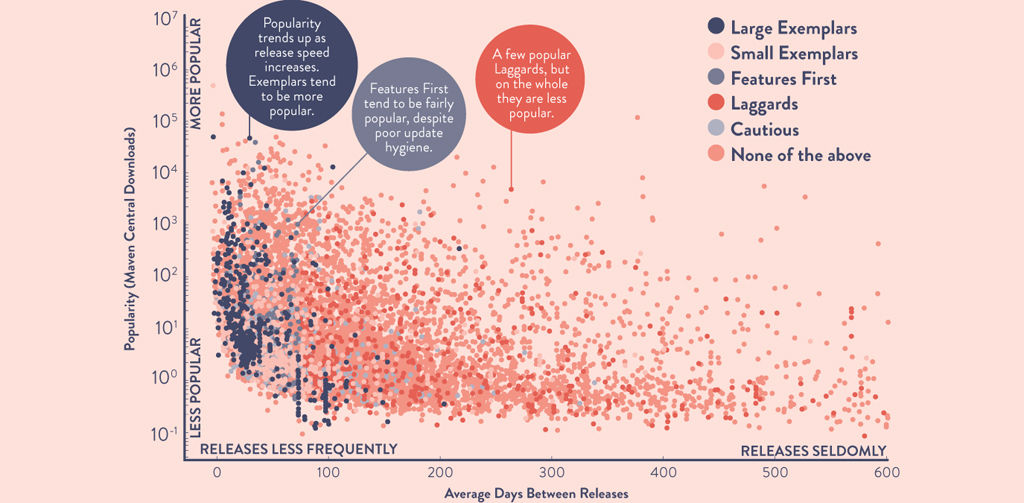
Figure 22.4: Five Behavioral Clusters for Open-Source Projects
Source: Sonatype, 2019 Software Supply Chain Report.
The 2020 State of the Software Supply Chain Report surveyed developers to determine what practices help achieve developer productivity and security objectives. When comparing the high-performing versus low-performing clusters (as measured by developer productivity and security outcomes), they found that high performers had these properties:30
Confidence of Changes:
•15x more frequent deployments
•4.9x less likely to have dependencies break application functionality
•3.8x more likely to describe updating dependencies as easy (i.e., not painful)
Security of Components:
•26x faster detection and remediation of vulnerable OSS components
•33x more likely to be confident that OSS dependencies are secure (i.e., no known vulnerabilities)
•4.6x more likely to be confident that OSS licenses of dependencies are compliant with internal requirements
•2.1x more likely to have access to newer OSS component versions where prior defects have been fixed
Productivity:
•5.7x less time required to developers to be productive when switching teams
•26x less time to approve a new OSS dependency for use
•1.5x more likely for employees to recommend their organizations as a great place to work
When comparing the practices between these clusters, performance differences can be explained by the degree to which governance objectives are automated and integrated into the processes that developers use in their daily work. High performers were:31
•77% more likely to automate approval, management, and analysis of dependencies
•59% more likely to be using software composition analysis (SCA) tools
•28% more likely to enforce governance policies in Continous Integration (CI)
•56% more likely to have centrally managed CI infrastructure (where information security governance policies can be enforced)
•51% more likely to maintain a centralized record of all deployed artifacts, supporting the collection of a Software Bill of Materials (SBOM) for each application
•96% more likely to be able to centrally scan all deployed artifacts for security and license compliance
Another study that confirms these statistics is by Dr. Dan Geer and Josh Corman, which showed that of the open-source projects with known vulnerabilities registered in the National Vulnerability Database, only 41% were ever fixed and required, on average, 390 days to publish a fix. For those vulnerabilities that were labeled at the highest severity (i.e., those scored as CVSS level 10), fixes required 224 days.32¶
The 2020 State of the Octoverse report showed open-source vulnerability timelines: Across GitHub, a vulnerability typically takes 218 weeks (just over four years) before being disclosed; then it takes about 4.4 weeks for the community to identify and release a fix. From there, it takes ten weeks to alert on the availability of a fix. For the repos that do apply the fix, it typically takes one week to resolve.33
Two very prominent security breaches in recent years, SolarWinds and Codecov, involved attacks on the software supply chain. In spring 2020, a malicious payload was added to an update to the SolarWinds Orion network management software, which then affected over 18,000 of their customers. The payload used the privileged accounts to corporate network infrastructure to gain unauthorized access, ranging from reading emails to planting something far more destructive.34
In April 2021, a “CI poisoning attack” was discovered in Codecov, a code coverage analysis tool. A malicious payload was added to the Codecov docker image and bash uploader, which stole the credentials from the CI environment. This likely impacted a significant number of their reported 29,000 customers.35
Both of these attacks show how reliant organizations have become on automated updates, how any CI/CD pipeline can be compromised to insert malicious payloads (this is addressed later in the book), and how new risks can emerge as new development practices are adopted. This serves as another example of how information security must continually examine threats presented by a thinking adversary.
Ensure Security of the Environment
In this step, we should do whatever is required to help ensure that the environments are in a hardened, risk-reduced state. Although we may have created known, good configurations already, we must put in monitoring controls to ensure that all production instances match these known good states.
We do this by generating automated tests to ensure that all appropriate settings have been correctly applied for configuration hardening, database security settings, key lengths, and so forth. Furthermore, we will use tests to scan our environments for known vulnerabilities.**
Another category of security verification is understanding actual environments (i.e., “as they actually are”). Examples of tools for this include Nmap, to ensure that only expected ports are open, and Metasploit, to ensure that we’ve adequately hardened our environments against known vulnerabilities, such as scanning with SQL injection attacks. The output of these tools should be put into our artifact repository and compared with the previous version as part of our functional testing process. Doing this will help us detect any undesirable changes as soon as they occur.
18F Automating Compliance for the Federal Government with Compliance Masonry (2016)
US Federal Government agencies were projected to spend nearly $80 billion on IT in 2016, supporting the mission of all the executive branch agencies.
Regardless of agency, to take any system from “dev complete” to “live in production” requires obtaining an authority to operate (ATO) from a designated approving authority (DAA).
The laws and policies that govern compliance in government are composed of tens of documents that together number over four thousand pages, littered with acronyms such as FISMA, FedRAMP, and FITARA. Even for systems that only require low levels of confidentiality, integrity, and availability, over one hundred controls must be implemented, documented, and tested. It typically takes between eight and fourteen months for an ATO to be granted following “dev complete.”36
The 18F team in the federal government’s General Services Administration has taken a multipronged approach to solving this problem. Mike Bland explains, “18F was created within the General Services Administration to capitalize on the momentum generated by the Healthcare.gov recovery to reform how the government builds and buys software.”37
One 18F effort is a platform as a service called Cloud.gov, created from open-source components. Cloud.gov runs on AWS GovCloud in 2016. Not only does the platform handle many of the operational concerns delivery teams might otherwise have to take care of, such as logging, monitoring, alerting, and service life cycle management, it also handles the bulk of compliance concerns.
By running on this platform, a large majority of the controls that government systems must implement can be taken care of at the infrastructure and platform level. Then, only the remaining controls that are in scope at the application layer have to be documented and tested, significantly reducing the compliance burden and the time it takes to receive an ATO.38
AWS GovCloud has already been approved for use for federal government systems of all types, including those which require high levels of confidentiality, integrity, and availability. Cloud.gov has been approved for all systems that require moderate levels of confidentiality, integrity, and availability.††
Furthermore, the Cloud.gov team has built framework to automate the creation of system security plans (SSPs), which are “comprehensive descriptions of the system’s architecture, implemented controls, and general security posture . . . [which are] often incredibly complex, running several hundred pages in length.”39 They developed a prototype tool called compliance masonry so that SSP data is stored in machine-readable YAML and then turned into GitBooks and PDFs automatically.
18F is dedicated to working in the open and publishes its work open source in the public domain. You can find compliance masonry and the components that make up Cloud.gov in 18F’s GitHub repositories—you can even stand up your own instance of Cloud.gov. The work on open documentation for SSPs is being done in close partnership with the OpenControl community.
This case study demonstrates how an organization—even one as monolithic as the federal government—can use a PaaS to generate automated tests and still meet compliance.
Integrate Information Security into Production Telemetry
Marcus Sachs observed in 2010, that
year after year, in the vast majority of cardholder data breaches, the organization detected the security breach months or quarters after the breach occurred. Worse, the way the breach was detected was not an internal monitoring control but was far more likely someone outside of the organization, usually a business partner or the customer who notices fraudulent transactions. One of the primary reasons for this is that no one in the organization was regularly reviewing the log files.40
In other words, internal security controls are often ineffective in successfully detecting breaches in a timely manner, either because of blind spots in our monitoring or because no one in our organization is examining the relevant telemetry in their daily work.
In Chapter 14, we discussed creating a culture in Dev and Ops where everyone in the value stream is creating production telemetry and metrics, making them visible in prominent public places so that everyone can see how our services are performing in production. Furthermore, we explored the necessity of relentlessly seeking ever-weaker failure signals so that we can find and fix problems before they result in a catastrophic failure.
Here, we deploy the monitoring, logging, and alerting required to fulfill our information security objectives throughout our applications and environments, as well as ensure that it is adequately centralized to facilitate easy and meaningful analysis and response.
We do this by integrating our security telemetry into the same tools that Development, QA, and Operations are using, giving everyone in the value stream visibility into how their application and environments are performing in a hostile threat environment where attackers are constantly attempting to exploit vulnerabilities, gain unauthorized access, plant backdoors, commit fraud, perform denials of service, and so forth.
By radiating how our services are being attacked in the production environment, we reinforce that everyone needs to be thinking about security risks and designing countermeasures in their daily work.
Creating Security Telemetry in Our Applications
In order to detect problematic user behavior that could be an indicator or enabler of fraud and unauthorized access, we must create the relevant telemetry in our applications. Examples may include:
•successful and unsuccessful user logins
•user password resets
•user email address resets
•user credit card changes
For instance, as an early indicator of brute-force login attempts to gain unauthorized access, we might display the ratio of unsuccessful login attempts to successful logins. And, of course, we should create alerting around important events to ensure we can detect and correct issues quickly.
Creating Security Telemetry in Our Environment
In addition to instrumenting our application, we also need to create sufficient telemetry in our environments so that we can detect early indicators of unauthorized access, especially in the components that are running on infrastructure that we do not control (e.g., hosting environments, in the cloud).
We need to monitor and potentially alert on items, including the following:41
•OS changes (e.g., in production, in our build infrastructure)
•security group changes
•changes to all our production configurations (e.g., OSSEC, Puppet, Chef, Tripwire, Kubernetes, network infrastructure, middleware)
•cloud infrastructure changes (e.g., VPC, security groups, users and privileges)
•XSS attempts (i.e., cross-site scripting attacks)
•SQLi attempts (i.e., SQL injection attacks)
•web server errors (e.g., 4XX and 5XX errors)
We also want to confirm that we’ve correctly configured our logging so that all telemetry is being sent to the right place. When we detect attacks, in addition to logging that it happened, we may also choose to block access and store information about the source to aid us in choosing the best mitigation actions.
Instrumenting the Environment at Etsy (2010)
In 2010, Nick Galbreath was director of engineering at Etsy and responsible for information security, fraud control, and privacy. Galbreath defined fraud as when “the system works incorrectly, allowing invalid or un-inspected input into the system, causing financial loss, data loss/theft, system downtime, vandalism, or an attack on another system.”42
To achieve these goals, Galbreath did not create a separate fraud control or information security department; instead, he embedded those responsibilities throughout the DevOps value stream.
Galbreath created security-related telemetry that was displayed alongside all the other more Dev and Ops oriented metrics, which every Etsy engineer routinely saw:43
•Abnormal production program terminations (e.g., segmentation faults, core dumps, etc.): “Of particular concern was why certain processes kept dumping core across our entire production environment, triggered from traffic coming from the one IP address, over and over again. Of equal concern were those HTTP ‘500 Internal Server Errors.’ These are indicators that a vulnerability was being exploited to gain unauthorized access to our systems, and that a patch needs to be urgently applied.”44
•Database syntax error: “We were always looking for database syntax errors inside our code—these either enabled SQL injection attacks or were actual attacks in progress. For this reason, we had zero tolerance for database syntax errors in our code, because it remains one of the leading attack vectors used to compromise systems.”45
•Indications of SQL injection attacks: “This was a ridiculously simple test—we’d merely alert whenever ‘UNION ALL’ showed up in user-input fields, since it almost always indicates a SQL injection attack. We also added unit tests to make sure that this type of uncontrolled user input could never be allowed into our database queries.”46
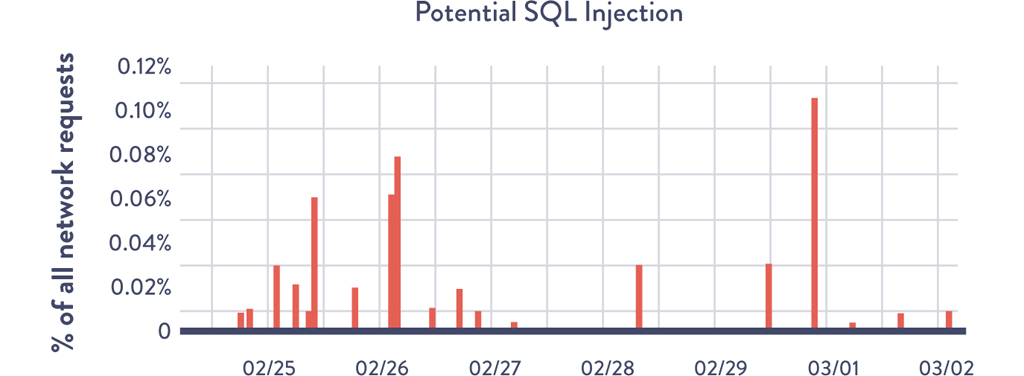
Figure 22.5 is an example of a graph that every developer would see, which shows the number of potential SQL injection attacks that were attempted in the production environment.
As Galbreath observed, “Nothing helps developers understand how hostile the operating environment is than seeing their code being attacked in real time.”47 Galbreath continued, “One of the results of showing this graph was that developers realized that they were being attacked all the time! And that was awesome, because it changed how developers thought about the security of their code as they were writing the code.”48
Presenting security-related telemetry brought security into developers’ daily work and made vulnerabilities more visible to everyone.
Protect Our Deployment Pipeline
The infrastructure that supports our continuous integration and continuous deployment processes also presents a new surface area vulnerable to attack. For instance, if someone compromises the servers running the deployment pipeline that has the credentials for our version control system, it could enable someone to steal source code. Worse, if the deployment pipeline has write access, an attacker could also inject malicious changes into our version control repository and, therefore, inject malicious changes into our application and services.
As Jonathan Claudius, former Senior Security Tester at TrustWave SpiderLabs, observed, “Continuous build and test servers are awesome, and I use them myself. But I started thinking about ways to use CI/CD as a way to inject malicious code. Which led to the question: Where would be a good place to hide malicious code? The answer was obvious: in the unit tests. No one actually looks at the unit tests, and they’re run every time someone commits code to the repo.”49
This demonstrates that in order to adequately protect the integrity of our applications and environments, we must also mitigate the attack vectors on our deployment pipeline. Risks include developers introducing code that enables unauthorized access (which we’ve mitigated through controls such as code testing, code reviews, and penetration testing) and unauthorized users gaining access to our code or environment (which we’ve mitigated through controls such as ensuring configurations match known, good states and through effective patching).
However, in order to protect our continuous build, integration, or deployment pipeline, our mitigation strategies may also include the following:
•hardening continuous build and integration servers and ensuring we can reproduce them in an automated manner, just as we would for infrastructure that supports customer-facing production services, to prevent our continuous build and integration servers from being compromised
•reviewing all changes introduced into version control, either through pair programming at commit time or by a code review process between commit and merge into trunk, to prevent continuous integration servers from running uncontrolled code (e.g., unit tests may contain malicious code that allows or enables unauthorized access)
•instrumenting our repository to detect when test code contains suspicious API calls (e.g., unit tests accessing the file system or network) is checked into the repository, perhaps quarantining it and triggering an immediate code review
•ensuring every CI process runs on its own isolated container or VM, and ensuring this is recreated from a known, good, verified base image at the start of every build
•ensuring the version control credentials used by the CI system are read-only
 CASE STUDY: NEW TO THE SECOND EDITION
Shifting Security Left at Fannie Mae (2020)
Fannie Mae has a more than $3 billion balance sheet and helps finance approximately one in four homes in the US as of 2020.50 At Fannie Mae, safety and soundness is part of their mission.
They’ve experienced crises before. With a low risk tolerance, their challenge was ensuring that security strengthened everything they did. DevOps provided a solution to learn from chaos engineering to improve security, put security in the pipeline, and weave security transparently into the fabric of everything they did.
Chris Porter, Fannie Mae’s CISO, and Kimberly Johnson, the Executive Vice President and COO, talked about their evolution at the 2020 DevOps Enterprise Summit. It boiled down to two key changes: changing culture and changing the way security communicated with Dev teams and how they integrated security tools.51
In the old way, Dev would hand off code that was ready for production. Security would conduct their own tests and send back a list of vulnerabilities that the Dev team would have to correct. It was inefficient and no one liked it. They needed to learn to shift security left.
They did this by relinquishing control over their security tools, making them more self-service, making them API-based, and integrating them with Jira and Jenkins. They trained developers to run the tools and to learn what the results meant, and they had to change their own nomenclature (instead of vulnerabilities, they talked about defects).52
They also had to fully integrate all security tests within the CI/CD pipeline so that every time code was checked in they were running a test. Ultimately, this made it easier for developers to know what to do. They could see a test fail, understand why, and fix the problem.53
“I call this the paved road. If you follow the paved road and you use the CI/CD pipeline, which has all the checks integrated into the pipeline, then it will be easier for you to deploy code,” says Chris Porter.54
This was treated like an Andon cord. If the test didn’t pass, then it broke the line and had to be fixed before the line could continue. If you didn’t use the paved road, it was a much slower, bumpier journey.
According to Porter, a mindset change is needed from development and security. In the past, security’s mindset had been to protect developers from themselves. But in a DevOps model, the work has moved to “you build it, you own it.”55 Everyone has shared accountability, and security is baked into the code instead of being inserted later.
As Kimberly Johnson put it:
In the old way, with Dev handing off production-ready code to Security for testing, we had a major bottleneck in the throughput of the Security team. For large organizations that operate at scale, it can be really hard to find enough Security talent to continually test everything that is developed. Building the security tests into the development pipeline unlocked a lot more productivity for us and reduced our dependence on Security personnel for standard testing and routine deployments.
In addition to reducing our reliance on the Information Security team, shifting left and automating our testing has yielded better business results. Our deployment frequency has increased by 25% in the last year, and our deployment failure rate has fallen by about the same amount. We are getting critical business changes into production much faster, with fewer errors, using fewer resources, and generating less rework. Moving to DevSecOps has been a win-win-win for us.56
By shifting security left, Fannie Mae was able to maintain security and soundness of their code without sacrificing speed, efficiency, and the happiness of their teams.
Conclusion
Throughout this chapter, we have described ways to integrate information security objectives into all stages of our daily work. We do this by integrating security controls into the mechanisms we’ve already created, ensuring that all on-demand environments are also in a hardened, risk-reduced state—by integrating security testing into the deployment pipeline and ensuring the creation of security telemetry in pre-production and production environments. By doing so, we enable developer and operational productivity to increase while simultaneously increasing our overall safety. Our next step is to protect the deployment pipeline.
* |
Rugged DevOps traces some of its history to Visible Ops Security, written by Gene Kim, Paul Love, and George Spafford. Similar ideas were created by Dr. Tapabrata Pal, former Sr. Director and Platform Engineering Technical Fellow at Capital One, and the Capital One team; they describe their processes as DevOpsSec and described it as a set of processes where Infosec is integrated into all stages of the SDLC.3 |
† |
Note that all major cloud providers now operate cloud-based secret management systems that provide a good alternative to running your own. |
‡ |
The Open Web Application Security Project (OWASP) is a nonprofit organization focused on improving the security of software. |
§ |
Strategies for managing these risks include providing employee training and management; rethinking the design of information systems, including network and software; and instituting processes designed to prevent, detect, and respond to attacks. |
¶ |
Tools that can help ensure the integrity of our software dependencies include OWASP Dependency Check and Sonatype Nexus Lifecycle. |
** |
Examples of tools that can help with security correctness testing (i.e., “as it should be”) include automated configuration management systems (e.g., Puppet, Chef, Ansible, Salt), as well as tools such as ServerSpec and the Netflix Simian Army (e.g., Conformity Monkey, Security Monkey, etc.). |
†† |
These approvals are known as FedRAMP JAB P-ATOs. |