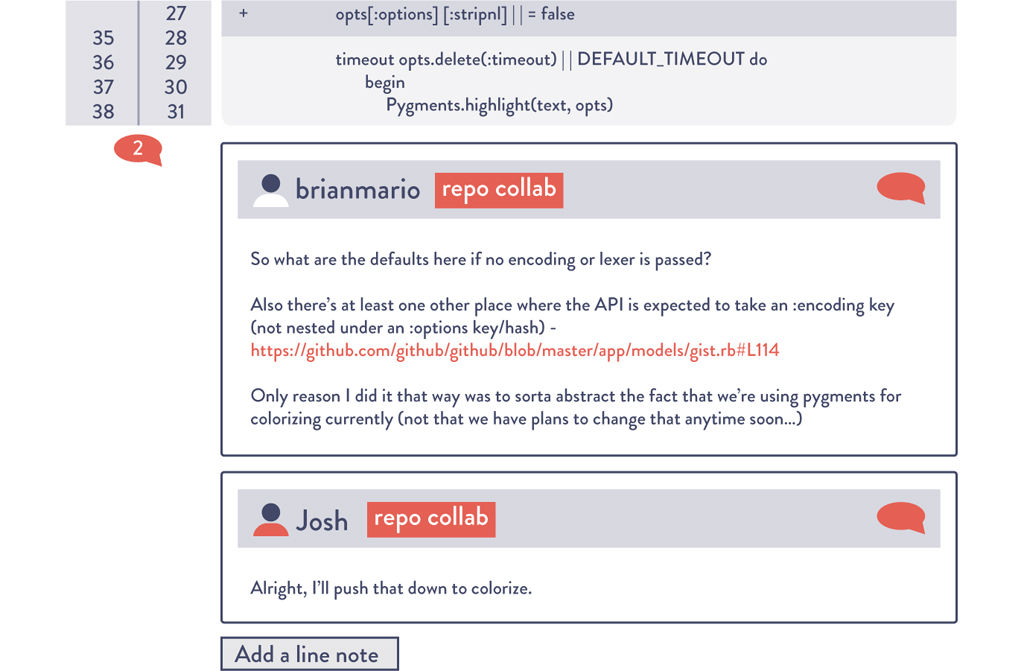
Figure 18.1: Comments and Suggestions on a GitHub Pull Request
Source: Scott Chacon, “GitHub Flow,” ScottChacon.com, August 31, 2011, http://scottchacon.com/2011/08/31/github-flow.html.
18
CREATE REVIEW AND COORDINATION PROCESSES TO INCREASE QUALITY OF OUR CURRENT WORK
In the previous chapters, we created the telemetry necessary to see and solve problems in production and at all stages of our deployment pipeline and created fast feedback loops from customers to help enhance organizational learning—learning that encourages ownership and responsibility for customer satisfaction and feature performance, which help us succeed.
Our goal in this chapter is to enable Development and Operations to reduce the risk of production changes before they are made. Traditionally, when we review changes for deployment, we tend to rely heavily on reviews, inspections, and approvals just prior to deployment. Frequently, those approvals are given by external teams who are often too far removed from the work to make informed decisions on whether a change is risky or not, and the time required to get all the necessary approvals also lengthens our change lead times.
Peer Review at GitHub (2011)
The peer review process at GitHub is a striking example of how inspection can increase quality, make deployments safe, and be integrated into the flow of everyone’s daily work. GitHub pioneered the process called pull request, one of the most popular forms of peer review that span Dev and Ops.
Scott Chacon, CIO and co-founder of GitHub, wrote on his website that pull requests are the mechanism that lets engineers tell others about changes they have pushed to a repository on GitHub. Once a pull request is sent, interested parties can review the set of changes, discuss potential modifications, and even push follow-up commits if necessary. Engineers submitting a pull request will often request a “+1,” “+2,” or so forth, depending on how many reviews they need, or “@mention” engineers that they’d like to get reviews from.1
At GitHub, pull requests are also the mechanism used to deploy code into production through a collective set of practices they call “GitHub Flow”—it’s how engineers request code reviews, gather and integrate feedback, and announce that code will be deployed to production (i.e., “master” branch).
Figure 18.1: Comments and Suggestions on a GitHub Pull Request
Source: Scott Chacon, “GitHub Flow,” ScottChacon.com, August 31, 2011, http://scottchacon.com/2011/08/31/github-flow.html.
GitHub Flow is composed of five steps:
1.To work on something new, the engineer creates a descriptively named branch off of master (e.g., “new-oauth2-scopes”).
2.The engineer commits to that branch locally, regularly pushing their work to the same named branch on the server.
3.When they need feedback or help, or when they think the branch is ready for merging, they open a pull request.
4.When they get their desired reviews and get any necessary approvals of the feature, the engineer can then merge it into master.
5.Once the code changes are merged and pushed to master, the engineer deploys them into production.
These practices, which integrate review and coordination into daily work, have allowed GitHub to quickly and reliably deliver features to market with high quality and security. For example, in 2012 they performed an amazing 12,602 deployments. In particular, on August 23rd, after a company-wide summit where many exciting ideas were brainstormed and discussed, the company had their busiest deployment day of the year, with 563 builds and 175 successful deployments into production, all made possible through the pull request process.2
Throughout this chapter, we will integrate practices, such as those used at GitHub, to shift our reliance away from periodic inspections and approvals and move to integrated peer review performed continually as a part of our daily work. Our goal is to ensure that Development, Operations, and Infosec are continuously collaborating so that changes we make to our systems will operate reliably, securely, safely, and as designed.
The Dangers of Change Approval Processes
The Knight Capital failure is one of the most prominent software deployment errors in recent memory. A fifteen-minute deployment error resulted in a $440 million trading loss, during which the engineering teams were unable to disable the production services. The financial losses jeopardized the firm’s operations and forced the company to be sold over the weekend so they could continue operating without jeopardizing the entire financial system.3
John Allspaw observed that when high-profile incidents occur, such as the Knight Capital deployment accident, there are typically two counterfactual narratives for why the accident occurred.4*
The first narrative is that the accident was due to a change control failure, which seems valid because we can imagine a situation where better change control practices could have detected the risk earlier and prevented the change from going into production. And if we couldn’t prevent it, we might have taken steps to enable faster detection and recovery.
The second narrative is that the accident was due to a testing failure. This also seems valid: with better testing practices we could have identified the risk earlier and canceled the risky deployment or we could have at least taken steps to enable faster detection and recovery.
The surprising reality is that in environments that have low-trust and command-and-control cultures the outcomes of these types of change control and testing countermeasures often result in an increased likelihood that problems will occur again, potentially with even worse outcomes.
Gene Kim (co-author of this book) describes his realization that change and testing controls can potentially have the opposite effect than intended as “one of the most important moments of my professional career. This ‘aha’ moment was the result of a conversation in 2013 with John Allspaw and Jez Humble about the Knight Capital accident, making me question some of my core beliefs that I’ve formed over the last ten years, especially having been trained as an auditor.”
He continues, “However upsetting it was, it was also a very formative moment for me. Not only did they convince me that they were correct, we tested these beliefs in the 2014 State of DevOps Report, which led to some astonishing findings that reinforce that building high-trust cultures is likely the largest management challenge of this decade.”
Potential Dangers of “Overly Controlling Changes”
Traditional change controls can lead to unintended outcomes, such as contributing to long lead times and reducing the strength and immediacy of feedback from the deployment process. In order to understand how these unintended outcomes happen, let us examine the controls we often put in place when change control failures occur:
•Adding more questions to the change request form.
•Requiring more authorizations, such as one more level of management approval (e.g., instead of merely the VP of Operations approving, we now require that the CIO also approve) or more stakeholders (e.g., network engineering, architecture review boards, etc.).
•Requiring more lead time for change approvals so that change requests can be properly evaluated.
These controls often add more friction to the deployment process by multiplying the number of steps and approvals, as well as increasing batch sizes and deployment lead times, which we know reduces the likelihood of successful production outcomes for both Dev and Ops. These controls also reduce how quickly we get feedback from our work.
One of the core beliefs in the Toyota Production System is that “people closest to a problem typically know the most about it.”5 This becomes more pronounced as the work being performed and the system the work occurs in become more complex and dynamic, as is typical in DevOps value streams. In these cases, creating approval steps from people who are located further and further away from the work may actually reduce the likelihood of success. As has been proven time and again, the further the distance between the person doing the work (i.e., the change implementer) and the person deciding to do the work (i.e., the change authorizer), the worse the outcome.
Continuous Learning
Research shows that elite organizations do change approvals quickly, with clarity, and without friction—and that this contributes to better software delivery performance. DORA’s 2019 State of DevOps Report found that a clear, lightweight change process, where developers are confident they can go from “submitted” to “accepted” for all typical approvals, contributes to high performance.6 In contrast, heavyweight change processes, where an external review board or senior manager is required for significant changes, has a negative impact on performance.7 This echoes findings from the 2014 Puppet State of DevOps Report, which found that high-performing teams relied more on peer review and less on external approval of changes.8
In many organizations, change advisory boards serve an important role in coordinating and governing the delivery process, but their job should not be to manually evaluate every change, nor does ITIL mandate such a practice. To understand why this is the case, consider the predicament of being on a change advisory board, reviewing a complex change composed of hundreds of thousands of lines of code changes and created by hundreds of engineers.
At one extreme, we cannot reliably predict whether a change will be successful either by reading a hundred-word description of the change or by merely validating that a checklist has been completed. At the other extreme, painfully scrutinizing thousands of lines of code changes is unlikely to reveal any new insights. Part of this is the nature of making changes inside of a complex system. Even the engineers who work inside the codebase as part of their daily work are often surprised by the side effects of what should be low-risk changes.
For all these reasons, we need to create effective control practices that more closely resemble peer review, reducing our reliance on external bodies to authorize our changes. We also need to coordinate and schedule changes effectively. We explore both of these in the next two sections.
 CASE STUDY: NEW TO THE SECOND EDITION
From Six-Eye Principle to Release at Scale at Adidas (2020)
In November of 2020, after a tiring year dealing with the impacts of the Covid-19 pandemic and just before their peak sales period, Adidas found themselves in crisis mode. After experiencing five really bad outages, it was clear they had reached their limit. They no longer had things under control.9
In the year before the crisis, Adidas had experienced 10x growth, increasing digital business revenue by almost 50%. This growth also meant that they experienced two to three times more visitors to their platforms and tracked exponentially more data from them. This created 10x more technical traffic and load. Along with this growth, the number of technical teams and capabilities was constantly growing, as well as the dependencies among them per Brooke’s Law.10
On a peak day, order rates were reaching three thousand orders per minute, and Adidas was sending out 11 billion touchpoints every day. But their strategy was to double that rate. For hype drop products (special product releases), they were shooting for 1.5 million hits per second.11
Going back to November 2020, after years of growth and freedom, Adidas had found themselves in the nightmarish situation where they had to bring three VPs into a room to approve every single change or release during the two-month peak sales period.12
Fernando Cornago, Vice President Digital Tech, was one of those VPs in the room. “I can tell you the reality of how clueless at the end we were on some of the details.”13
At that time, Adidas had more than 550 million lines of code in their ecosystem and almost two thousand engineers. By the end of the crisis, it was clear they had to change.14 Thus began a new wave of handling operations and release management for readiness.
They began by asking three questions on stability:
•How do we detect interruptions as fast as possible?
•How do we fix interruptions fast?
•And, how do we make sure interruptions don't even land in the production environment?
They brought in ITIL and SRE practices to help them answer these questions. And what they began to see was that interruptions were not affecting only one product. “And that’s where we realized that everything is connected,” explains Vikalp Yadav, Senior Director—Head of Digital SRE Operations.15
They realized they had to look at the value stream as a thought process. By doing so, they developed the “%revenue bleed versus net sales” KPI, which measured the larger impact of an outage. Finally, to ensure they achieved observability, resilience, and release excellence, they adopted what they called: release fitness.16
Adidas’s environment had become huge, and the complexity had grown as well. “Now, it’s not only about how my system is but also how is the whole ecosystem?” Andreia Otto, SRE Champion WnM Services, explains.17 Release processes needed to be standardized.
They worked with the product teams and service management team to find a set of KPIs or factors to check before any release. It began as an Excel spreadsheet. Each team had to fill out the spreadsheet before each release to check to see if they had a go or no-go.
Obviously, this wasn’t a sustainable or well-received option. Manually filling out a spreadsheet for every release was tedious and time-consuming. They knew they needed to find a way to automate the assessment, which is exactly what they did.
They developed a dashboard that looked at every release from three different angles: system level (how my product is), value stream (upsteam/downstream dependencies, etc.), and environment (platform, events, etc.). Checking across these three angles, the dashboard gives a clear go/no-go for release.18
Before anything is released into production, this automated check is completed. If everything is fine, it goes into production. If not, the release is stopped and the team responsible checks the dashboard to see what the problem is. There might be an event, like Adidas’ hype drop days where no changes are allowed, or it might be the team doesn’t have any more error budget, etc.
With their release fitness program, Adidas was able to build a system that is able to self-adjust and self-regulate. On the one hand, they have strict release guidelines. But on the other hand, they have automated checks and error budgets telling any of their developers if they can deploy or not. They no longer need three VPs in a room to approve every change. Last but not least, in a growing ecosystem where Adidas onboards approximately one hundred new engineers on a monthly basis, the release fitness automation massively reduces their onboarding time
Adidas automated change reviews, ensuring the quality of the code across numerous dependencies, without the need for costly and slow review boards.
Enable Coordination and Scheduling of Changes
Whenever we have multiple groups working on systems that share dependencies, our changes will likely need to be coordinated to ensure that they don’t interfere with each other (e.g., marshaling, batching, and sequencing the changes). In general, the more loosely coupled our architecture, the less we need to communicate and coordinate with other component teams—when the architecture is truly service oriented, teams can make changes with a high degree of autonomy, where local changes are unlikely to create global disruptions.
However, even in a loosely coupled architecture, when many teams are doing hundreds of independent deployments per day, there may be a risk of changes interfering with each other (e.g., simultaneous A/B tests). To mitigate these risks, we may use chat rooms to announce changes and proactively find collisions that may exist.
For more complex organizations and organizations with more tightly coupled architectures, we may need to deliberately schedule our changes, where representatives from the teams get together, not to authorize changes, but to schedule and sequence their changes in order to minimize accidents.
However, certain areas, such as global infrastructure changes (e.g., core network switch changes) will always have a higher risk associated with them. These changes will always require technical countermeasures, such as redundancy, failover, comprehensive testing, and (ideally) simulation.
Enable Peer Review of Changes
Instead of requiring approval from an external body prior to deployment, we may require engineers to get peer reviews of their changes. In Development, this practice has been called code review, but it is equally applicable to any change we make to our applications or environments, including servers, networking, and databases. The goal is to find errors by having fellow engineers close to the work scrutinize our changes. This review improves the quality of our changes, which also creates the benefits of cross-training, peer learning, and skill improvement.
A logical place to require reviews is prior to committing code to trunk in source control, where changes could potentially have a team-wide or global impact. At a minimum, fellow engineers should review our change, but for higher risk areas, such as database changes or business-critical components with poor automated test coverage, we may require further review from a subject matter expert (e.g., information security engineer, database engineer) or multiple reviews (e.g., “+2” instead of merely “+1”).†
The principle of small batch sizes also applies to code reviews. The larger the size of the change that needs to be reviewed, the longer it takes to understand and the larger the burden on the reviewing engineer. As Randy Shoup observed, “There is a non-linear relationship between the size of the change and the potential risk of integrating that change—when you go from a ten line code change to a one hundred line code, the risk of something going wrong is more than ten times higher, and so forth.”19 This is why it’s so essential for developers to work in small, incremental steps rather than on long-lived feature branches.
Furthermore, our ability to meaningfully critique code changes goes down as the change size goes up. As Giray Özil tweeted, “Ask a programmer to review ten lines of code, he’ll find ten issues. Ask him to do five hundred lines, and he’ll say it looks good.”20
Guidelines for code reviews include:
•Everyone must have someone to review their changes (e.g., to the code, environment, etc.) before committing to trunk.
•Everyone should monitor the commit stream of their fellow team members so that potential conflicts can be identified and reviewed.
•Define which changes qualify as high risk and may require review from a designated subject matter expert (e.g., database changes, security-sensitive modules such as authentication, etc.).‡
•If someone submits a change that is too large to reason about easily—in other words, you can’t understand its impact after reading through it a couple of times, or you need to ask the submitter for clarification—it should be split up into multiple, smaller changes that can be understood at a glance.
To ensure that we are not merely rubber-stamping reviews, we may also want to inspect the code review statistics to determine the number of proposed changes approved versus not approved, and perhaps sample and inspect specific code reviews.
Code reviews come in various forms:
•Pair programming: Programmers work in pairs (see section below).
•“Over the shoulder:” One developer looks over the author’s shoulder as the latter walks through the code.
•Email pass-around: A source code management system emails code to reviewers automatically after the code is checked in.
•Tool-assisted code review: Authors and reviewers use specialized tools designed for peer code review (e.g., Gerrit, GitHub pull requests, etc.) or facilities provided by the source code repositories (e.g., GitHub, Mercurial, Subversion, as well as other platforms such as Gerrit, Atlassian Stash, and Atlassian Crucible).
Close scrutiny of changes in many forms is effective in locating errors previously overlooked. Code reviews can facilitate increased code commits and production deployments, and support trunk-based deployment and continuous delivery at scale, as we will see in the following case study.
CASE STUDY
Code Reviews at Google (2010)
As noted earlier in this book, Eran Messeri described that in 2013 the processes at Google enabled over thirteen thousand developers to work off of trunk on a single source code tree, performing over fifty-five hundred code commits per week, resulting in hundreds of production deployments per week.21
In 2016, Google’s twenty-five thousand develpers worldwide were committing sixteen thousand changes into trunk on a typical workday, with a further twenty-four thousand changes per day committed by automated systems.22
This requires considerable discipline from Google team members and mandatory code reviews, which cover the following areas:23
•code readability for languages (enforces style guide)
•ownership assignments for code sub-trees to maintain consistency and correctness
•code transparency and code contributions across teams
Figure 18.2 shows how code review lead times are affected by the size of the change. On the x-axis is the size of the change and on the y-axis is the lead time required for the code review process. In general, the larger the change submitted for code reviews, the longer the lead time required to get the necessary sign-offs. And the data points in the upper-left corner represent the more complex and potentially risky changes that required more deliberation and discussion.
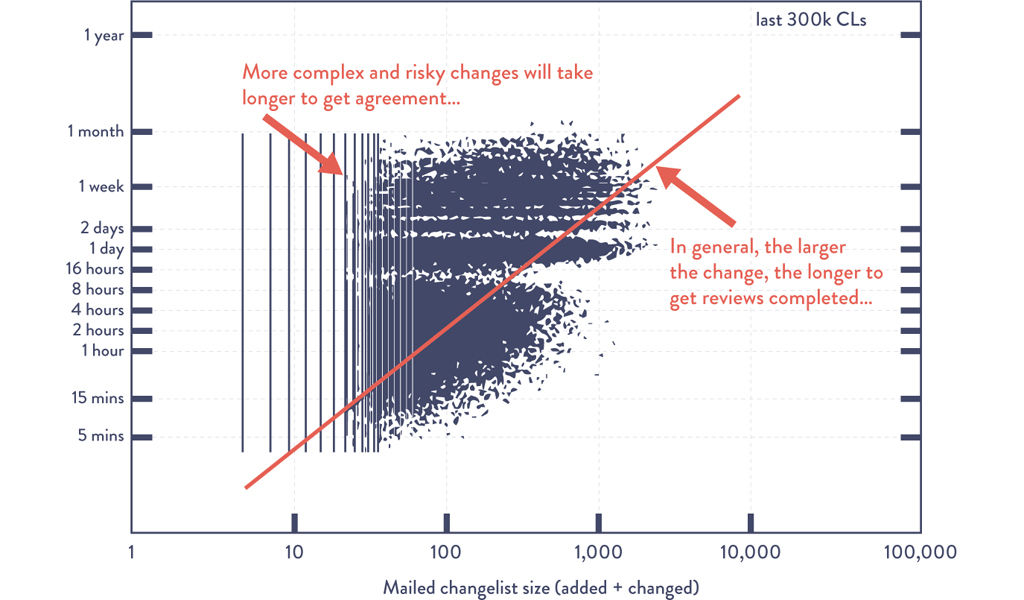
Figure 18.2: Size of Change vs. Lead Time for Reviews at Google
Source: Ashish Kumar, “Development at the Speed and Scale of Google,” presentation at QCon, San Francisco, CA, 2010, qconsf.com/sf2010/dl/qcon-sanfran-2010/slides/AshishKumar_DevelopingProductsattheSpeedandScaleofGoogle.pdf.
While he was working as a Google engineering director, Randy Shoup started a personal project to solve a technical problem that the organization was facing. He said,
I worked on that project for weeks and finally got around to asking a subject matter expert to review my code. It was nearly three thousand lines of code, which took the reviewer days of work to go through. He told me, “Please don’t do that to me again.” I was grateful that this engineer took the time to do that. That was also when I learned how to make code reviews a part of my daily work.24
Google is an excellent example of a company that employs trunk-based development and continuous delivery at scale through the use of code reviews.
Potential Dangers of Doing More Manual Testing and Change Freezes
Now that we have created peer reviews that reduce our risk, shortened lead times associated with change approval processes, and enableed continuous delivery at scale, such as we saw in the Google case study, let us examine the effects of how testing countermeasures can sometimes backfire. When testing failures occur, our typical reaction is to do more testing. However, if we are merely performing more testing at the end of the project, we may worsen our outcomes.
This is especially true if we are doing manual testing, because manual testing is naturally slower and more tedious than automated testing and performing “additional testing” often has the consequence of taking significantly longer to test, which means we are deploying less frequently, thus increasing our deployment batch size. And we know from both theory and practice that when we increase our deployment batch size, our change success rates go down and our incident counts and MTTR go up—the opposite of the outcomes we want.
Instead of performing testing on large batches of changes that are scheduled around change freeze periods, we want to fully integrate testing into our daily work as part of the smooth and continual flow into production and increase our deployment frequency. By doing this, we build in quality, which allows us to test, deploy, and release in ever smaller batch sizes.
Enable Pair Programming to Improve All Our Changes
Pair programming is when two engineers work together at the same workstation, a method popularized by Extreme Programming and Agile in the early 2000s. As with code reviews, this practice started in Development but is equally applicable to the work that any engineer does in our value stream.§
In one common pattern of pairing, one engineer fills the role of the driver, the person who actually writes the code, while the other engineer acts as the navigator, observer, or pointer, the person who reviews the work as it is being performed. While reviewing, the observer may also consider the strategic direction of the work, coming up with ideas for improvements and likely future problems to address. This frees the driver to focus all of their attention on the tactical aspects of completing the task, using the observer as a safety net and guide. When the two have differing specialties, skills are transferred as an automatic side effect, whether it’s through ad hoc training or by sharing techniques and workarounds.
Another pair programming pattern reinforces test-driven development (TDD) by having one engineer write the automated test and the other engineer implement the code.
Jeff Atwood, one of the founders of Stack Exchange, wrote, “I can’t help wondering if pair programming is nothing more than code review on steroids. . . . The advantage of pair programming is its gripping immediacy: it is impossible to ignore the reviewer when he or she is sitting right next to you.”25
He continued, “Most people will passively opt out [of reviewing code] if given the choice. With pair programming, that’s not possible. Each half of the pair has to understand the code, right then and there, as it’s being written. Pairing may be invasive, but it can also force a level of communication that you’d otherwise never achieve.”26
Dr. Laurie Williams performed a study in 2001 that showed
paired programmers are 15% slower than two independent individual programmers, while “error-free” code increased from 70% to 85%. Since testing and debugging are often many times more costly than initial programming, this is an impressive result. Pairs typically consider more design alternatives than programmers working alone and arrive at simpler, more maintainable designs; they also catch design defects early.27
Dr. Williams also reported that 96% of her respondents stated that they enjoyed their work more when they programmed in pairs than when they programmed alone.28¶
Pair programming has the additional benefit of spreading knowledge throughout the organization and increasing information flow within the team. Having more experienced engineers review while the less experienced engineer codes is also an effective way to teach and be taught.
CASE STUDY
Pair Programming Replacing Broken Code Review Processes at Pivotal Labs (2011)
Elisabeth Hendrickson, VP of Engineering at Pivotal Software, Inc. and author of Explore It!: Reduce Risk and Increase Confidence with Exploratory Testing, has spoken extensively about making every team responsible for their own quality, as opposed to making separate departments responsible. She argues that doing so not only increases quality, but significantly increases the flow of work into production.29
In her 2015 DevOps Enterprise Summit presentation, she described how in 2011, there were two accepted methods of code review at Pivotal: pair programming (which ensured that every line of code was inspected by two people) or a code review process that was managed by Gerrit (which ensured that every code commit had two designated people “+1” the change before it was allowed into trunk).30
The problem Hendrickson observed with the Gerrit code review process was that it would often take an entire week for developers to receive their required reviews. Worse, skilled developers were experiencing the “frustrating and soul-crushing experience of not being able to get simple changes into the codebase because we had inadvertently created intolerable bottlenecks.”31
Hendrickson lamented that
the only people who had the ability to “+1” the changes were senior engineers, who had many other responsibilities and often didn’t care as much about the fixes the more junior developers were working on or their productivity. It created a terrible situation—while you were waiting for your changes to get reviewed, other developers were checking in their changes. So for a week, you would have to merge all their code changes onto your laptop, re-run all the tests to ensure that everything still worked, and (sometimes) you’d have to resubmit your changes for review again!32
To fix the problem and eliminate all of these delays, they ended up dismantling the entire Gerrit code review process, instead requiring pair programming to implement code changes into the system. By doing this, they reduced the amount of time required to get code reviewed from weeks to hours.
Hendrickson is quick to note that code reviews work fine in many organizations, but it requires a culture that values reviewing code as highly as it values writing the code in the first place.33
This case study illustrates just one form of code review. Particularly when the culture is not yet in place, pair programming can serve as a valuable interim practice.
Evaluating the Effectiveness of Pull Request Processes
Because the peer review process is an important part of our control environment, we need to be able to determine whether it is working effectively or not. One method is to look at production outages and examine the peer review process for any relevant changes.
Another method comes from Ryan Tomayko, CIO and co-founder of GitHub and one of the inventors of the pull request process. When asked to describe the difference between a bad pull request and a good pull request, he said it has little to do with the production outcome. Instead, a bad pull request is one that doesn’t have enough context for the reader, having little or no documentation of what the change is intended to do—for example, a pull request that merely has the following text: “Fixing issue #3616 and #3841.”34**
That was an actual internal GitHub pull request, which Tomayko critiqued,
This was probably written by a new engineer here. First off, no specific engineers were specifically @mentioned—at a minimum, the engineer should have mentioned their mentor or a subject matter expert in the area that they’re modifying to ensure that someone appropriate reviews their change. Worse, there isn’t any explanation of what the changes actually are, why it’s important, or exposing any of the implementer’s thinking.35
On the other hand, when asked to describe a great pull request that indicates an effective review process, Tomayko quickly listed off the essential elements: there must be sufficient detail on why the change is being made, how the change was made, as well as any identified risks and resulting countermeasures.36
Tomayko also looks for good discussion of the change, enabled by all the context that the pull request provided—often, there will be additional risks pointed out, ideas on better ways to implement the desired change, ideas on how to better mitigate the risk, and so forth. And if something bad or unexpected happens upon deployment, it is added to the pull request, with a link to the corresponding issue. All discussion happens without placing blame; instead, there is a candid conversation on how to prevent the problem from recurring in the future.
As an example, Tomayko produced another internal GitHub pull request for a database migration. It was many pages long, with lengthy discussions about the potential risks, leading up to the following statement by the pull request author: “I am pushing this now. Builds are now failing for the branch, because of a missing column in the CI servers. (Link to Post-Mortem: MySQL outage).”37
The change submitter then apologized for the outage, describing what conditions and mistaken assumptions led to the accident, as well as a list of proposed countermeasures to prevent it from happening again. This was followed by pages and pages of discussion. Reading through the pull request, Tomayko smiled, “Now that is a great pull request.”38
As described above, we can evaluate the effectiveness of our peer review process by sampling and examining pull requests, either from the entire population of pull requests or those that are relevant to production incidents.
Fearlessly Cut Bureaucratic Processes
So far, we have discussed peer review and pair programming processes that enable us to increase the quality of our work without relying on external approvals for changes. However, many companies still have long-standing processes for approval that require months to navigate. These approval processes can significantly increase lead times, not only preventing us from delivering value quickly to customers, but potentially increasing the risk to our organizational objectives. When this happens, we must re-engineer our processes so that we can achieve our goals more quickly and safely.
As Adrian Cockcroft observed, “A great metric to publish widely is how many meetings and work tickets are mandatory to perform a release—the goal is to relentlessly reduce the effort required for engineers to perform work and deliver it to the customer.”39
Similarly, Dr. Tapabrata Pal, technical fellow at Capital One, described a program at Capital One called Got Goo?, which involves a dedicated team removing obstacles—including tools, processes, and approvals—that impede work completion.40
Jason Cox, Senior Director of Systems Engineering at Disney, described in his presentation at the DevOps Enterprise Summit in 2015 a program called Join the Rebellion that aimed to remove toil and obstacles from daily work.41
At Target in 2012, a combination of the Technology Enterprise Adoption Process and Lead Architecture Review Board (TEAP-LARB process) resulted in complicated, long approval times for anyone attempting to bring in new technology. The TEAP form needed to be filled out by anyone wanting to propose new technologies to be adopted, such as a new database or monitoring technologies. These proposals were evaluated, and those deemed appropriate were put onto the monthly LARB meeting agenda.42
Heather Mickman and Ross Clanton, Director of Development and Director of Operations at Target, Inc., respectively, were helping to lead the DevOps movement at Target. During their DevOps initiative, Mickman had identified a technology needed to enable an initiative from the lines of business (in this case, Tomcat and Cassandra). The decision from the LARB was that Operations could not support it at the time. However, because Mickman was so convinced that this technology was essential, she proposed that her Development team be responsible for service support as well as integration, availability, and security, instead of relying on the Operations team.43 Mickman observed,
As we went through the process, I wanted to better understand why the TEAP-LARB process took so long to get through, and I used the technique of “the five why’s”. . . . Which eventually led to the question of why TEAP-LARB existed in the first place. The surprising thing was that no one knew, outside of a vague notion that we needed some sort of governance process. Many knew that there had been some sort of disaster that could never happen again years ago, but no one could remember exactly what that disaster was, either.44
Mickman concluded that this process was not necessary for her group if they were responsible for the operational responsibilities of the technology she was introducing. She added, “I let everyone know that any future technologies that we would support wouldn’t have to go through the TEAP-LARB process, either.”45
The outcome was that Cassandra was successfully introduced inside Target and eventually widely adopted. Furthermore, the TEAP-LARB process was eventually dismantled. Out of appreciation, her team awarded Mickman the Lifetime Achievement Award for removing barriers to get technology work done within Target.46
Conclusion
In this chapter, we discussed how to integrate practices into our daily work that increase the quality of our changes and reduce the risk of poor deployment outcomes, reducing our reliance on approval processes. Case studies from GitHub and Target show that these practices not only improve our outcomes but also significantly reduce lead times and increase developer productivity. To do this kind of work requires a high-trust culture.
Consider a story that John Allspaw told about a newly hired junior engineer: The engineer asked if it was okay to deploy a small HTML change, and Allspaw responded, “I don’t know, is it?” He then asked “Did you have someone review your change? Do you know who the best person to ask is for changes of this type? Did you do everything you absolutely could to assure yourself that this change operates in production as designed? If you did, then don’t ask me—just make the change!”47
By responding this way, Allspaw reminded the engineer that she was solely responsible for the quality of her change—if she did everything she felt she could to give herself confidence that the change would work, then she didn’t need to ask anyone for approval, she should make the change.
Creating the conditions that enable change implementers to fully own the quality of their changes is an essential part of the high-trust, generative culture we are striving to build. Furthermore, these conditions enable us to create an ever-safer system of work, where we are all helping each other achieve our goals, spanning whatever boundaries necessary to get there.
Counterfactual thinking is a term used in psychology that involves the human tendency to create possible alternatives to life events that have already occurred. In reliability engineering, it often involves narratives of the “system as imagined” as opposed to the “system in reality.” |
|
In this book, the terms code review and change review will be used interchangeably. |
|
Incidentally, a list of high-risk areas of code and environments has likely already been created by the change advisory board. |
|
In this book, we will use the term pairing and pair programming interchangeably to indicate that the practice is not just for developers. |
|
Some organizations may require pair programming, while in others, engineers find someone to pair program with when working in areas where they want more scrutiny (such as before checking in) or for challenging tasks. Another common practice is to set pairing hours for a subset of the working day, perhaps four hours from mid-morning to mid-afternoon. |
|
Gene Kim is grateful to Shawn Davenport, James Fryman, Will Farr, and Ryan Tomayko at GitHub for discussing the differences between good and bad pull requests. |