The International Lender of Last Resort
The primary argument for an international lender of last resort is the historical record of the transmission of deflationary pressure from one country to others, which often has been associated with changes in currency values, both with devaluations when currencies have been pegged and with depreciations when they have been floating. The devaluation of the Finnish markka in 1992 transmitted deflationary pressure to Sweden, one of its major competitors in the production and sale of timber and other products. The depreciation of the Thai baht, the Malaysian ringgit, and the South Korean won in the second half of 1997 transmitted a massive deflationary impulse to the United States; the exports of these countries surged relative to their imports which led to a counterpart increase in the US trade deficit. The increase in the Japanese trade surplus in the 1990s after its asset price bubble imploded had a deflationary impact on its major trading partners and especially on the United States, whose trade deficit increased sharply. The sharp increase in China’s trade surplus after 2002 led to counterpart increases in the trade deficits of its trading partners and especially in the US trade deficit.
An international lender of last resort has a problem that has no domestic counterpart; as long as there are separate national central banks each with its own money, changes in currency values are inevitable. Some of these changes will be necessary, especially when a country has not been as successful as its major trading partners in achieving a low inflation rate; a reduction in the value of a country’s currency may be a less costly way to achieve a satisfactory trade balance than relying on declines in costs and prices. Some of these changes in currency values may be necessary because of a major structural shock, including the loss of an export market because of technological changes, the depletion of raw materials, and the productive gains in countries that are in earlier stages of industrialization. Some of the changes in currency values may not have been necessary, but instead were adopted because a low value for the currency was viewed as the preferred way to stimulate domestic employment and economic growth.
Changes in currency values can be an unnecessarily costly form of adjustment to a shock; the ‘overshooting’ of a country’s currency as its market price increases relative to its long-run equilibrium value has almost always had a deflationary impact on the country’s tradable goods sector as imports increase relative to exports. Conversely the ‘undershooting’ of a country’s currency as its market price declines relative to its long-run equilibrium value can trigger a surge in the inflation rate and in domestic interest rates. Moreover sharp real depreciations have often led to widespread failures of business firms and banks.
The episodes of massive currency undershooting have often been preceded by significant overshooting of the same currencies. The Mexican peso was significantly overvalued in the first half of 1994, and significantly undervalued in the first half of 1995. The sudden reversal in relative values has almost always occurred as a result of a sudden turnabout in the direction of cross-border movement of money. Institutional arrangements and policy innovations that dampen or reduce the scope of overshooting and undershooting would enhance economic welfare.
The primary responsibility of a domestic lender of last resort is to reduce the likelihood that a shortage of domestic liquidity will cascade into a solvency problem and cause bankruptcies that would not have occurred in the absence of distress and precautionary selling. The domestic lender of last resort walks a tightrope between avoiding saving financial institutions that are already bankrupt because of their risky investments or bad business decisions and saving their healthier competitors from insolvency that would occur if the price level declines and deflation follows. The primary responsibility of an international lender of last resort is to provide liquidity to ameliorate the necessary changes in currency values and obviate those changes that are not consistent with the economic fundamentals.
International credits that have been extended for at least four centuries have enabled countries to dampen swings in currency values both when governments have borrowed abroad, and when private banks in one country have relied on their counterparts in other countries for assistance to meet a sudden withdrawal of funds. In the 1920s the first concerted concern with a shortage of international liquidity – and more precisely of monetary gold – developed in response to the view that the increases in national price levels during and immediately after World War I would lead to both a decline in gold production and increases in both the official and the private demand for gold. The financial authorities in the major countries were concerned that the gold shortage would be more intense because the establishment of new central banks in what had been the Austro-Hungarian empire would lead to an increase in the demand for monetary gold. Several conferences sponsored by the League of Nations in the 1920s recommended that central banks hold a larger proportion of their international reserve assets in the form of liquid securities denominated in the British pound and the US dollar.
The International Monetary Fund was established in the 1940s to provide a formal arrangement for the extension of credit among national governments and to assist countries in coping with currency crises; the motivation was the belief that much of the destructive competitive behavior among countries in the interwar period that contributed to World War II had resulted from a shortage of international credit. Countries allowed their currencies to depreciate to increase their exports and stimulate domestic employment. The fallacy of composition was relevant and the policies that might have been successful for an individual country were costly for all countries as a group. When a country became a member of the IMF, it agreed to limit the movement in the value of its currency around its parity; the country also agreed to seek the approval of the IMF before it changed its parity by more than a modest amount. The IMF was endowed with a pool of gold and currencies from the capital subscriptions of its members. A member country could borrow from this pool to help finance a payments deficit.
A devaluation of a country’s currency should almost always lead to an improvement in its international competitive position and a reduction in its trade deficit. The scope of the improvement is time-dependent and increases in the long run as firms within the country increase their exports and export capacity and their ability to produce import-competing goods. Thus the country’s currency could depreciate sharply in the short run before the supply and demand structures changed and the country’s trade deficit declined to a new and sustainable value. While these adjustments occurred and before they have been completed, momentum-oriented traders might induce an even sharper depreciation of the country’s currency.
Undershooting and overshooting are inevitable developments in response to changes in cross-border money flows. The scope of undershooting and overshooting often expands as currency traders follow the canard that ‘the trend is my friend’. In recent years the cliché of the ‘vicious and virtuous cycle’ was applied as the descriptive of this currency market behavior. An earlier generation of economists used the term ‘destabilizing speculation’ for the same pattern of currency transactions.
At times these adjustments in currency values may occur in propitious circumstances, but at other times the circumstances are less than propitious. Thus in 1994 and 1995, the Mexican trade deficit was much too large and the adjustment to a sustainable value would require a lower value for the peso. Mexico needed a decline of 3 to 4 percent in the ratio of its current account deficit to its GDP. This necessary and inevitable decline would have dramatic impacts on Mexican saving, the fiscal position of the Mexican government, and Mexican GDP. When the shock occurred, there was a surge in the outflow of money from Mexico, the peso lost half of its value and the change in the ratio of Mexico’s current account balance to its GDP exceeded 10 percent. The shock to the Mexican economy was immense.
Similar statements can be made about the depreciation of the Argentinean peso in 2001. The South Korean won lost nearly one-half of its value in December 1997; prior to the crisis the country’s current account deficit was 1 percent of its GDP and afterward the country developed a current account surplus of 3 percent. The scope of the overshooting of the Indonesian rupiah before the Asian crisis was large; the undershooting after the crisis was much larger.
While overshooting and undershooting are transitional phenomena associated with changes in the direction and scope of international money flows, they have extremely powerful real effects on the domestic economies and some of these effects are permanent. One reason analysts have underestimated the extent of the changes in currency values associated with the move to new equilibrium values is that they have tended to ignore the permanent effects of overshooting and, especially, of undershooting.
An international lender of last resort would help countries moderate the deviations of the market values of their currencies from long-run equilibrium values. One inference from financial history is that in the absence of an international lender of last resort the economic depression that follows a financial crisis can be long and drawn out, as in 1873 and 1890 and the early 1930s.
One problem in developing an international lender of last resort is formulating the legal framework and the set of rules that would govern its activities and especially the rules and procedures for the allocation of its credits. In the absence of a world currency, the international lender of last resort would lend the currency of one or several countries – most probably those of the countries with large holdings of international reserve assets or large payments surpluses. The historical record suggests that the lender of last resort would supply the currency of the country that is the leading financial center perhaps together with the currencies of a few other countries.
The debt-deflation cycle of the 1930s involved a feedback loop that encompassed business failures, bank failures, and declines in consumer price levels. When businesses failed, their inventories were sold, which depressed the price level and reduced the net worth of other firms in the same industries. The increase in business failures led to larger bank loan losses and the banks become less eager lenders; they refused to renew some maturing loans because some of these borrowers might be on the proverbial slippery slope. Even though nominal interest rates were low, real interest rates were high because of the declines in the consumer price level, and investment spending was depressed.
Japan was in the throes of a very modest debt-deflation cycle at the end of the 1990s as its price level declined by 1 percent a year which led to an exceptionally high level of business failures. Hong Kong was in a debt-deflation cycle for six years following the Asian Financial Crisis; the depreciation of the currencies of virtually all the other Asian countries meant that the international competitive positions of firms producing in Hong Kong were declining.
The environment for the international lender of last resort differs from that of the domestic lender in two basic ways – one is that liquidity crises are often associated with changes in currency values and the other is that the rule of law is more fragile in the international context. The international lender of last resort also walks a tightrope between providing liquidity to countries so that unnecessary changes in currency values are avoided and minimizing the likelihood that its provision of liquidity would enable countries to postpone the necessary changes in the values of their currencies. In 1999 and 2000, Argentina would have borrowed and borrowed some more to delay the adjustments that were necessary to reduce its trade deficit. (After the devaluation, Argentina snubbed its foreign creditors and wanted them to settle for 25 or 30 cents on the dollar.) Moreover, even when a change in the value of a country’s currency is necessary, the extension of credit from the international lender may reduce the undershooting of its currency in the move to a new equilibrium value. Finally, there are times when the determination of whether there is a need for a change in the value of a country’s currency is a judgment call; the country’s payments deficit might be reversed by developments in the business cycle or by changes in commodity prices – or there might be a miracle or just good luck.
The analogy between the domestic lender of last resort and the international lender breaks – or at least bends sharply – because there is no good domestic counterpart to the changes in the values of national currencies. Normally, a domestic lender of last resort would not lend to an insolvent institution – except perhaps temporarily until losses or capital shortages have been made good by a deposit guarantee agency or some other governmental group. Many international financial crises have involved changes in currency values that have become seriously overvalued. The problem is to determine when a country should change the value of its currency because of a fundamental dis-equilibrium – a term popularized by the IMF when countries adhered to the adjustable parities arrangement. As long as countries retain the ability to change the values of their currencies, the international lender of last resort would have to determine when access to its funds would enable a country to delay the necessary change in the value of its currency and when such access would enable a country to avoid a change that is not necessary.
The number and severity of financial crises in the last thirty-five years have been significant. These crises often have followed from large changes in currency values. An effective international lender of last resort could have moderated the tumultuousness in financial markets. Consider some of the major currency crises of this period:
• Mexico, Brazil, and Argentina in 1982
• The British pound, the Italian lira, and other European currencies in 1992
• The Mexican peso in 1994
• The Thai baht, the Malaysian ringgit, and other Asian currencies in 1997
• The Russian ruble in 1998
• The Brazilian real in 1999
• The Argentinean peso in 2001
• The Icelandic krona in 2008
The United States cobbled together a financial assistance package for Mexico in 1995. Thailand, South Korea, Indonesia, and the Philippines received large credits from the IMF after their currencies had depreciated sharply. Russia received a large credit from the IMF in the spring of 1998, even though the devaluation of the ruble seemed inevitable; similarly Argentina received a large credit from the IMF in the early autumn of 2000 even though a major miracle would have been necessary to maintain the parity of the peso with the US dollar. (In both cases some member countries leaned on the IMF to extend the credits.)
A historical view of international financial crises
Often analysts have distinguished an internal drain that involves an increase in the domestic demand for currency or gold from an external drain that involves a flow of gold or other reserve assets to foreign countries. An external drain could generally be reversed by an increase in interest rates; hence the quip that an increase in the Bank of England’s discount rate of 1 percent would ‘draw gold from the moon’, although often there was a lag before the higher interest rates would lead to the desired improvement in the country’s gold holdings. If investors viewed the increase in the discount rate as a sign of weakness and sold the currency, the external drain would increase, and the central bank would need to raise interest rates further. At times the increase in interest rates would not be adequate to correct the imbalances – perhaps because the lags were long and the time limited – and the central bank would need to borrow to avoid a sharp depreciation. A central bank might borrow from other central banks. Domestic firms that owned foreign assets might sell them and remit the proceeds.
What is the appropriate public policy to reduce the likelihood of international financial crises and to ameliorate their impacts? During the financial crisis of 1846–48, when bond prices all over Europe were plummeting, some by as much as 75 percent, and the Rothschild houses in Paris, Vienna, and Frankfurt were threatened with bankruptcy, Nathan Rothschild in London, with the help of Auguste Belmont, the Rothschild representative in New York, helped privately. Belmont shipped silver from New York to London that was then shared among the Rothschild brothers. Central banks helped by keeping interest rates low, but Nathan, as the effective lender of last resort, saved the day with the assistance from New York.1 In the 1930s, Paul and Felix Warburg of Kuhn, Loeb in New York served in the same capacity for their brother, Max Warburg, then in Hamburg, with a credit of more than $9 million.2
Last resort lending centers on central banks as the providers of cash. In 1694 the Bank of England borrowed 2 million guilders from the States General in Holland to assist the British Exchequer in remitting funds to the Continent to support British troops and allies during the Nine Years’ War.3
In the years that followed (1695–97) Amsterdam assisted the Bank of England by taking over its protested bills of exchange on the Continent; the Dutch charged 10 percent for the service – a penalty rate in Bagehot terms, but it was, after all, business, not the provision of a public good.4
In the crisis of 1763 the Bank of England and London private bankers rescued their Dutch correspondents by granting, in distress, credits larger than those previously given in periods of prosperity. Five consignments of gold were shipped in August and two in September. In addition, the Bank of England and other banks delayed presenting bills for payment. Wilson comments that none of this was pure altruism. Instead, it represented a practical policy based on the knowledge that British prosperity was intimately associated with Dutch prosperity and that the intensification of the Dutch crisis would cut off a source of money for Britain.5
As the 1772 crisis reached a peak in January 1773, Anglo-Dutch trade was paralyzed. Amsterdam was helpless, and only the Bank of England, Wilson says, could rescue the city. On 10 January, a Sunday, the Bank opened its windows and allowed specie to be drawn against presentation of notes and government bonds. Loads of bullion were sent on the first packet boat, and one Dutch banker was said to have drawn £500,000. At the same time, the Bank refused to discount doubtful paper, which had the effect of breaking many Jewish-owned banks in Amsterdam.6 In the same crisis, Catherine the Great of Russia helped her best customers, the British merchants, in the first of a number of crises when czarist Russia assisted Western Europe.7
In the crisis of 1825 there was a rumor that the Bank of France was trying to add to the Bank of England’s difficulties. Clapham insisted that instead France participated in an early example of international financial cooperation by shipping gold to London in exchange for silver.8 That the price of gold in terms of silver was higher in London than in Paris (15.2 to 1 compared with 14.625 to 1) favored the exchange,9 but the arrival via the Rothschild banks of £400,000 (mostly in sovereigns) from Paris on Monday 19 December 1825 helped because the Bank of England coffers were virtually empty after the run on the previous Saturday.
Twice during the extended crisis of 1836 to 1839 the Bank of England sought help from the Bank of France and the city of Hamburg to maintain its liquidity. The first time the Bank of England drew bills on Paris for £400,000. In 1838 the Bank of England arranged for a line of credit and in 1839 drew on this line for £2 million, using Baring Brothers and ten Paris banks as intermediaries. A similar line of credit with Hamburg brought in £900,000 in gold, an arrangement possibly designed also to help Hamburg, which needed silver.10 In 1838 the Bank of England, not the most usual of gold dealers, sent nearly 700,000 sovereigns to the United States. Clapham said the operation was without precedent, and damaging insofar as it encouraged American bankers to issue more securities in the British markets in 1838 and 1839, but he acknowledged that the Bank was wise to recognize the interlocking interests of Britain and the United States.11
The Bank of France borrowed 25 million francs from British capitalists in the second half of 1846, according to French sources;12 a British source states that the sum was borrowed from the Bank of England in January 1847.13 At that point, the emperor of Russia offered to buy 50 million francs of the French 3 percent rente to assist in financing the imports of wheat that France and Britain needed. Britain benefited since the French used half the money to repay the British advance.14 Palmer, then governor of the Bank of England, testified before the Select Committee of Parliament that it was preferable to have an understanding with the principal banks in the United States, Hamburg, Amsterdam, and Paris than to ship gold.15
Central bank cooperation was not universally applauded. Viner wrote that the Bank of England in 1836 found itself obliged to appeal to France for help ‘no doubt reluctantly’ and added that the necessity was regarded in Britain as humiliating because it came at a time when relations between the two countries were not particularly cordial, ‘especially as it was reported that the followers of M. Thiers were boasting of the generosity of Frenchmen ... while recommending that under no circumstances should such liberality be repeated in future’.16 Thomas Tooke thought the loan a ‘discreditable expedient’, a ‘circumstance of almost national humiliation’.17 The Bank of France was criticized in Paris by some who thought it irresponsible to profit from the British arrangement rather than aid those at home who sought its help.18
In the 1850s there was less international cooperation in crisis periods. Clapham wrote that the Bank of England contemplated joint action with the Bank of France in November 1857, but he did not indicate what the action was and said little beyond that ‘nothing came of it’.19 Perhaps the most interesting operation was the December Silberzug in Hamburg. Hamburg was at the end of the line of the rolling crisis that swept from Ohio to New York to Liverpool and then to the Continent, particularly to Scandinavia. On 4 December the Hamburg Senate voted a 15 million mark banco fund composed of 5 million in Hamburg bonds and 10 million in silver that would be obtained by borrowing abroad. The next task was to borrow the money. Appeals for a loan were made to Rothschilds, Baring, and Hambros in London, to Fould in Paris, and to various political and financial bodies in Amsterdam, Copenhagen, Brussels, Berlin, Dresden, and Hanover. Each request was turned down. From Fould came this answer: ‘Your message is not sufficiently clear.’ From Berlin: ‘Bruck and the Kaiser are not financially ambitious.’ On 8 December when every bank in Hamburg except Heine’s was threatened with bankruptcy, and when captains of ships were unwilling to unload their cargoes because they were concerned that they would not be paid, word came from Vienna that it would provide all the money that was needed. A train bearing the silver (the Silberzug) arrived shortly.20
The silver was removed from the train, and loans in silver were made to Merck, Godeffroy, and Berenburg, Gossler and Co., among the leading bankers, plus five smaller ones. The panic ended on 12 December when it became known that there was enough silver. Some firms, like Donner & Co., which had initially been allotted 700,000 marks banco, turned out not to need any when confidence was restored. Böhme, who gave the most detailed account of the crisis, said that for years the episode kept coming up whenever Hamburgers and non-Hamburgers talked about currencies.21 The political aspects of the rescue operation were revealed in British diplomatic dispatches. The British consul in Hamburg noted that it was fortunate for Britain that Austria and not Prussia had brought the aid, since there would then be no pressure on Hamburg to join the Zollverein.22 From Berlin on 29 December came a dispatch with a translation of Baron Manteuffel’s statement to Hamburg that explained why Berlin had been unable to help. Lack of ambition gave way to a series of lame explanations that underlined that Berlin had ‘missed an opportunity’.23
The distress in Scandinavia was relieved as the panic in Hamburg subsided. A positive item of international official aid, however, was a loan on 18 December by the Bank of England on promissory notes of the Norwegian government in support of overdue bills the bank held from Norwegian houses.24
At the outbreak of the Civil War in November 1861, panic in New York drew specie from Paris and London. French reluctance to raise the discount rate and the increasing departure of the French gold-silver ratio from the ratio in the market led France to exchange £2 million in silver for £2 million in gold with the Bank of England. The funds made available by this transaction failed to remedy the situation, so in 1861 the French bought gold in London at a price above the export point. The Bank of France then arranged through Rothschild and Baring to draw £2 million of bills on London.25
There was no international cooperation during the crisis of 1873 but there were two aspects that underline the sensitive political nature of central bank transactions. In the letter books for 1872–73 the Bank of England refers to and denies a ‘ridiculous rumor’ that it had thought of applying for a loan from the Bank of France. And in the second week of November the governor of the Bank of Prussia – a predecessor of the Reichsbank, which was not established until 1875 – wrote a letter to the Bank of England offering a loan in gold now or at any future time. (Clapham commented earlier that Germany was half drunk with victory and that Berlin had swelled up like Aesop’s frog.) The Bank of England politely but curtly declined the offer: ‘The Bank is not, nor has it been in want of such aid and need not avail itself of the arrangement you so kindly suggest.’ Clapham adds that this suggestion from the nouveau riche would have seemed impertinent to the governor.26
In 1890 William Lidderdale, then the Governor of the Bank of England, prepared on two fronts for the crisis that would follow the revelation of Barings’ weakened position. In addition to the domestic guarantee, he arranged for the Russian government not to draw its £2.4 million deposit from Barings, and for loans of £3 million from the Bank of France and £1.5 million from the State Bank of Russia, both in gold. Lidderdale told the governor of the Bank of France that the ordinary operations of bank rate would have brought the gold in time and that there was nothing discreditable in using exceptional measures to meet an unusually sudden storm. Nonetheless, Lidderdale and the City were uneasy about asking the French and the Russians for help. Clapham put it this way: ‘Suppose for some political-financial reason they had been unwilling to oblige?’27
The sensitive character of such international assistance prior to World War I is revealed in the 1906–07 incidents, when much discussion was devoted not to whether the Bank of France helped the Bank of England – which it clearly did – but whether the Bank of England had asked for such help or, if it did not, whether the steps taken by the Bank of France were largely in its own interest. In Sayers’ account of the Bank from 1890 to 1914, in a chapter titled ‘Supposed Continental Support of the Bank’, he concluded that the Bank of England did not ask for help. Sayers quotes The Economist in September 1906:
Some talk of the Bank of France helping the Bank of England cope with the American demand for gold ... but it would not for a minute be supposed that the Bank would really put itself in so humiliating a position merely in order to permit American speculators getting gold here on easy terms.
Again in the autumn of 1907, the Bank of France forwarded 80 million francs in US gold eagles to London. The Bank of France report for 1907 refers to both incidents in its decisions. French journals cite the alleged reason: to relieve the Bank of England of the need to raise its discount rate, which implies that the Bank of England requested help. British sources emphasize that there was no announcement on the British side, as there was in 1890, and that the French did not want the Bank to increase its discount rate. Hartley Withers, financial editor of The Times, wrote later:
The determination it [the Bank of England] showed finally compelled the Bank of France to take some share in the international burden, and to send three millions of its gold, not to America but to London, whence it knew it could rely on getting it back. It is commonly supposed the Bank of England asked it to carry out this operation, but this is quite untrue.28
Another view is that when the Bank of France entered into transactions in sterling bills in London in 1906, 1907, 1909, and 1910, it was involved in open market operations, which it did not undertake in Paris until 1938.29
London vs Paris as the world financial center
The general view among Anglo-Saxon students of economic history is that London was the world’s financial center from the beginning of the nineteenth century until 1914, and that Paris, Berlin, Frankfurt, New York, and Milan were satellites.
According to a German observer, ‘England had a monopoly of capital exports to 1850. Then France moved in, largely for gloire, undertaking capital exports in the service of national policies, expansionary commercial interests, and the opening of new markets.’30 In the 1850s Paris had a central role in international monetary relationships. Van Vleck wrote about the panic of 1857: ‘Just as France was the political nerve center of Europe during the first half of the nineteenth century, so during the years from 1850 to 1857, it was the center from which fluctuations in the economic cycle radiated.’31
The center for the economic cycle is not necessarily the pivot of the international financial system. Between 1820 and 1840 Paris assisted in clearing London’s foreign payments in the Baltic, Russia, China, Latin America, and the United States and then between 1850 and 1870 became the ‘first place in Europe for foreign exchange’.32 If this view were correct, the situation was changed by the Franco-Prussian War. According to Bagehot:
Since the Franco-German war, we may be said to keep the European reserves ... All great communities have at times to pay large sums in cash, and of that cash a great store must be kept somewhere. Formerly there were two such stores in Europe; one was the Bank of France, and the other the Bank of England. But since the suspension of specie payments by the Bank of France, its use as a reservoir of specie is at an end. No one can draw a cheque on it and be sure of getting gold or silver for that cheque. Accordingly the whole liability for such international payments in cash is thrown on the Bank of England ... all exchange operations are centering more and more in London. Formerly for many purposes, Paris was a European settling-house, but now it has ceased to be so ... Accordingly London has become the sole great settling-house in Europe, instead of being formerly one of two. And this pre-eminence London will probably maintain, for it is a natural pre-eminence ... The pre-eminence of Paris partly arose from a distribution of political power, which is already disturbed; but that of London depends on the regular course of commerce, which is singularly stable and hard to change.33
Sprague echoed this view from the United States in 1910, when he explained that the Bank of England raised its discount rate in 1907 to secure payment from other countries of money they owed the United States rather than to check the flow of gold to New York. London was the central money market in the world and its interest rates were increased to avoid having to finance all the payments flowing to the United States.34
In contrast, Bonelli asserted that Paris was the center that regulated world liquidity when he discussed Italy’s links to the 1907 crisis.35 One of the most penetrating students of pre-World War I finance stated that ‘Paris emerges in this study as the strongest [italics in original] financial center in the world before 1914, if the fact that its short-term rate was relatively the lowest is an indication of strength. This conclusion seems to contradict the generally held opinion that London was the world’s money center.’ Morgenstern attempted to reconcile these statements by distinguishing the abundance of funds in Paris and the ‘machinery’ in London for setting funds into motion.36 The distinction seems forced. Each center had its own particular clients: Italy and Russia for Paris, the United States and the British colonies for London. Belgium, the Netherlands, and Germany were more closely linked to London than to Paris. Moreover London lent funds on a worldwide basis while Paris lent funds to a smaller number of countries.
The lender of last resort after World War I
There was no international lender of last resort in the 1920–21 crisis. Part of the slack was taken up by the depreciation of the various European currencies. In a crisis caused by balance-of-payments weakness and money outflows, the depreciation of a country’s currency led to increases in the domestic prices of tradable goods (those goods and services that are exported and imported, and those capable of being exported and those that compete with imports). A sharp inflationary shock may produce another kind of crisis – out of money into goods – leading to hyperinflation, as happened in Eastern and Central Europe in 1923 in the newly independent countries that had been part of the Austro-Hungarian Empire and were coping with new boundaries and the lack of mechanisms for the collection of taxes.37 The scenario is similar to that of Paul Erdman’s thriller The Crash of ’79, in which the financial crisis is handled by printing massive amounts of currency and letting the US dollar float, which led to a surge in the demand for goods.38
Most governments in Western Europe in the early 1920s sought to stabilize their currencies at their 1914 parities for gold because of tradition – restoring the status quo ante bellum. These countries often used stabilization loans, similar in some respects but not identical to loans from a lender of last resort, to dampen the depreciation of their currencies. The French franc was subject to a speculative attack in 1924. Many foreigners bought francs as the currency depreciated in 1919–20 in anticipation of large revaluation gains from the subsequent appreciation toward its pre-war parity – but they eventually gave up and sold.39 Speculators in Amsterdam, Vienna, and Berlin (perhaps stimulated by the German government) sold francs in anticipation that they would be able to purchase them later at much lower prices.40 The story was that speculators who had profited from their short positions in the German mark as it depreciated sharply in the hyperinflation of 1923–24 then turned their attention to the French franc. Hundreds of thousands of Frenchmen with liquid securities denominated in the franc watched signals like the advances from the Bank of France to the French government approach the legal ceiling.
On 4 March 1924 panic broke out. The franc, which had been 98 to the pound on 17 February and 104 on 28 February, went to 107 on 4 March. The French government and the Bank of France met in emergency sessions. J.P. Morgan & Co. was willing to help if certain conditions were satisfied. The loan, a six-month revolving credit, would be for $100 million, not $50 million, which the bank, represented by Thomas W. Lamont, judged too small. The Bank of France resisted pledging its gold as collateral, and yielded only after a face-saving formula was found. In turn, the Bank regents, including Rothschild and de Wendel, exacted a conservative financial program from the government. The program was worked out on Sunday 9 March and within three days the rout of the speculators began. The franc appreciated from 123 francs to the pound to 78 by 24 March. The Bank of France then intervened to limit further appreciation. The squeeze against the speculators was successful.41 Lamont wrote that ‘there has never been an operation that has given us more satisfaction’.42
Success was short-lived. In 1926 there was another attack on the franc, and the currency depreciated to 240 francs to the pound in July 1926. Subsequently the franc appreciated to 125 in response to conservative Poincaré reforms and a surge in interest rates that was designed to reassure the French holders of wealth and induce them to bring their money back to Paris.
Stabilization loans were arranged in the 1920s for Austria and Hungary under League of Nations auspices, and for a number of new central banks in Eastern Europe under arrangements with lenders in London, Paris, and New York. The most widely known were the Dawes and Young loans undertaken to recycle German reparations. The Dawes loan stimulated US purchases of foreign bonds. During the 1930s the suggestion was frequently put forward, with only partial irony, that what France needed was a stabilization loan in gold, since the French franc and the currencies of the other gold bloc countries had become overvalued as a consequence of successive devaluations of the British pound, the Japanese yen, and the US dollar, and the imposition of exchange controls on foreign payments by Germany and Austria. The gold, it was said, should be mounted in a vehicle like a glass hearse and paraded through the streets of every town and village in France to convince the people that the authorities had an abundance of gold and thereby encourage them to dishoard from the bas de laine (wool sock) in which they kept their louis d’or.
The rolling deflation of 1931 underlines the need for an international lender of last resort in a way that differs in scale and therefore in kind from previous episodes. The issues involved included the need for loans of the appropriate magnitude, the political character of the transactions, and the need for some country or group of countries to accept responsibility for the stability of the system.43 Those who wrote along similar lines included Jørgen Pedersen and R.G. Hawtrey and other British economists whose advice to their government is set out in Susan Howson and Donald Winch’s The Economic Advisory Council, 1930–1939.
Hawtrey presented a cogent analysis:
The crisis of 1931 differed from earlier crises in its international character. Earlier crises were international in that the fall of prices and forced sales affected world markets. But only an unimportant part of debts were due to foreign creditors. In 1931 the outstanding characteristic of the panic was that foreign creditors of Germany and Eastern European debtors feared that the foreign exchange market would break down even if the debtors remained solvent. Against a panic-stricken withdrawal of foreign balances from London, it [raising Bank rate] was too tardy a remedy. Such a panic-stricken withdrawal had never occurred before ... the underlying cause of the trouble has been monetary instability. The industrial depression, the insolvencies, the bank failures, budget deficits and defaults, are all the natural outcome of a falling price level ... The need arises for an international lender of last resort. Perhaps some day the Bank for International Settlements ... But as things are, the function can only be undertaken by a foreign central bank or by a group of foreign central banks in co-operation.44
Hawtrey’s theoretical insight into the wisdom of limits on these stabilization loans was penetrating:
As a general rule, if credits are to be granted to a central bank in difficulties at all, they should be granted up to the full amount needed. There should be no limit. If the amount is inadequate and the exchange gives way after all, the sums lent are completely wasted ... It can be argued in favor of unlimited credits, that if they had been granted, there would have been no withdrawal of funds at all ... either no credits to the Bank of England or unlimited. But there is some risk. Unlimited credits would have enabled the country to remain on the gold standard, prolonging conditions that were rapidly becoming intolerable ... the lesson: if the country can maintain the monetary standard without undue strain, then grant unlimited credits; but if the effort of maintaining parity is excessive, no credits and allow the currency to depreciate.45
Howson and Winch set out a series of reports written by British economists to their government in the 1930s, including one from a Committee of Economists chaired by J.M. Keynes that included Hubert Henderson, Alfred Pigou, Lionel Robbins, and Sir Josiah Stamp as members, with Hemming and Richard Kahn as secretaries. The reports advocated cooperation among central banks, preferably through the Bank for International Settlements, both to fund short-term claims and to form a pool of currencies for loans that could be used to prevent currency debacles like those experienced in the early 1920s and to restore ‘confidence in the financial stability of those many countries which are now the subject of distrust’.46
In July 1932, after Britain had gone off gold but before the World Economic Conference of 1933, the Cabinet Committee on Economic Information chaired by Stamp and including Citrine, Cole, Keynes, Sir Alfred Lewis, and Sir Frederick Leith-Ross as members, with Henderson and Hemming as secretaries, issued a report that discussed the ‘international financial crisis’. The document quoted Bagehot, cited the crises of 1825 and 1847, and noted that Britain could no longer act as a lender of last resort; the report recommended that this function be performed by the Bank for International Settlements by the issue of ‘paper gold’, to be called International Certificates.47
The first opportunity to halt the international disintermediation came in May 1931 with the collapse of the Credit Anstalt, the leading Austrian bank. The Austrian central bank had maintained high interest rates to keep money in Vienna which in turn contributed to the softness in the economy and large losses as asset prices declined. The publication of the Credit Anstalt’s statement on 11 May revealed that it had lost 140 million schillings, about three-fourths of its capital. The Austrian government asked the League of Nations for financial assistance because the League had organized the stabilization loans in the 1920s and the League turned to the new Bank for International Settlements that had been established under the Young Plan of 1930 to assist in the transfer of German reparations. The Austrian government wanted to borrow 150 million schillings ($21 million). During the last two weeks of May the BIS arranged for a loan of 100 million schillings from eleven central banks. By 5 June the money from the loan were exhausted, and the Austrian National Bank requested another loan which was arranged by 14 June, subject to the condition that the Austrian government get a two- to three-year loan of 150 million schillings. The French demanded that the Austrian government renounce its customs union agreement with Germany that had been announced two months earlier, but the Austrian government refused and fell. The Bank of England then offered a loan of 50 million schillings ($7 million) for a week. The Austrian government then stopped pegging the schilling to gold, and the currency depreciated.
The run shifted to Germany. The German banking position was weakened by excessive speculation, large loan write-offs, fraud, quarrels among the bankers, banks that had been buying their own shares and depleted liquid reserves – the full range of classic troubles.48 The outsider was Jacob Goldschmidt of the Danatbank,49 the product of the merger of the Darmstädter and the National banks. Other bankers, including Oskar Wasserman of the Deutsche Bank, detested Goldschmidt and his aggressive tactics. In 1927 the Berlin Handelsgesellschaft had stopped making loans to the Norddeutsche-Wolkämmerei (Nordwolle), an aggressive firm in the woolen industry. The Danatbank took on Nordwolle as a client. Nordwolle’s failure, on 17 June 1931, brought down Danatbank; other bankers were unwilling to support the bank because of their dislike of Goldschmidt. There were political complications, and the internal financial turmoil led to massive withdrawals that were only briefly interrupted by the Hoover moratorium. On 25 June a loan for $100 million was arranged, including $25 million each from the Bank of England, the Bank of France, the Federal Reserve Bank of New York, and the Bank for International Settlements, for the period to 16 July. Hans Luther, president of the Reichsbank, had wanted a larger loan and had asked that the exact amount of the loan be concealed, so the communiqué said only that discount facilities had been arranged in sufficient amount. When the amount of the loan became known and the Reichsbank’s statement of 23 June showed that its reserve cover was at 40.4 percent, just above the minimum requirement of 40 percent, the motto became ‘Devil take the hindmost’.50
New loans were discussed but were not forthcoming. The Germans wanted to borrow $1 billion. The French were willing to consider a loan of $500 million, but they wanted to impose political conditions. The US government was worried about its prospective budget deficit of $1.6 billion and thought it highly unlikely that the US Congress would approve lending more money to Germany. The US government was willing to consider stabilization of existing loans to Germany, which the Reichsbank wanted as well as a further loan. In Britain the foreign secretary Arthur Henderson was attracted to the idea of a loan but Montagu Norman, then the governor of the Bank of England, held that the Bank had ‘already lent quite as much as is entirely convenient’.51 One argument against foreign loans was that the crisis was believed to have been caused by a flight of domestic capital rather than by withdrawals of funds by foreign investors. By 20 July the idea of a loan had been tacitly abandoned, ‘brushed aside as impractical’.52 Instead, the Germans relied on internal measures to halt the disintermediation at home and on a Standstill Agreement, imposed upon reluctant foreign bankers, to halt the external drain.
The speculative pressure then turned to Britain. The run began in mid-July 1931, stimulated partly by losses on the Continent, but also fed by the May and Macmillan reports of the large prospective domestic budget deficits and the unexpectedly high estimate of foreign money in London that might be withdrawn. Since 1927 the Bank of France had converted British pounds to gold by a roundabout device; British pounds were sold in the spot foreign exchange market, and bought in the forward foreign exchange market, and then the Bank of France asked for gold on the dates when the forward exchange contracts matured.53 The idea was to make it seem that the Bank of France was converting only its newly acquired British pound balances into gold, not its previously acquired balances. In the summer of 1931, the Bank of France cooperated fully and did not sell any of its British pound deposits and securities. At the end of July, the Federal Reserve Bank of New York and the Bank of France each loaned $125 million to the Bank of England. When these funds were depleted, the British government contemplated a one-year loan from the New York and Paris markets. The Bank of England reported that foreign bankers would not lend funds to Britain while it had such a large budget deficit. The British trade unions opposed a reduction in relief payments to the unemployed and withdrew support from the Labour government, which fell on 24 August. Four days later, after the formation of a new ‘national government’ with Ramsay MacDonald again prime minister and Philip Snowden as Chancellor of the Exchequer, $200 million was borrowed from a Morgan syndicate in New York and another $200 million from a French syndicate in Paris. On one showing, the bankers held up the British government; their own explanation, echoing the Morgan statements to the French in the 1920s, was that they were not imposing political conditions but instead indicating the economic circumstances in which they felt they were justified in risking their own and their depositors’ money.
On 5 August 1931, Keynes wrote to Prime Minister MacDonald, at the latter’s request, to present a series of proposals for devaluation of the British pound and for the formation of a gold-based, fixed-exchange currency unit at least 25 percent below the current parity, which all member countries of the British empire, together with South America, Asia, Central Europe, Italy, and Spain – in fact, all countries – would be invited to join. The letter pointed out that if the British pound could not be successfully defended, it would be foolish to continue to borrow foreign currencies to support it.54
Loans of $400 million in addition to the $250 million were not enough, and the British stopped supporting the pound on 21 September. The Bank of France did not show the restraint towards the United States that they had shown to the British, and together with other members of the gold bloc converted $750 million of US dollar deposits into gold. The deflationary pressure exerted by this reduction in US gold holdings, and by the depreciation of the British pound and of the currencies pegged to the pound, weakened the US banking system. The New York Fed did not ask for help or even for forbearance in the conversion of US dollar deposits into gold. The code of the central banker calls for a stiff upper lip, reminiscent of Walter Mitty refusing the blindfold before the firing squad. In 1929, when Harrison asked Norman whether the pounds that the Federal Reserve Bank of New York had bought would be convertible into gold, he received the curt reply: ‘Of course, the sterling is repayable in gold. This is the gold standard.’55 In 1931 Harrison in turn offered to assist Moreau in converting any or all of the Bank of France’s dollars into gold.56
Five aspects of the 1931 story are especially striking: (1) the inability of Britain to act as a lender of last resort; (2) the unwillingness of the United States to act as a lender of last resort apart from the (inadequate) loan to Britain (the country of the ‘special relationship’); (3) the desire of France to advance its political objectives with respect to Austria and Germany; (4) the paranoia of Germany after 1923, preferring anything to a hint of inflation; and (5) the irresponsibility of the smaller countries.
This analysis has been questioned in a number of quarters. One analyst thought that something more far-reaching was required to restore stability to the world economy after World War I, perhaps something on the order of the Marshall Plan after World War II.57 Another considered that the German economy could not have been righted by a lender of last resort in 1931 since the authorities were determined to undo the Versailles Treaty and especially its reparations clauses.58
Bretton Woods and the international monetary arrangements
There was an extended debate in the early 1940s about the design of multi-lateral economic institutions that would provide for greater economic stability than in the twenty years after World War I. An international credit institution would be established to help countries finance short-term balance of payments deficits, which became the International Monetary Fund. Another lending agency would be established to help countries finance their economic rebuilding, which became the International Bank for Reconstruction and Development (IBRD or World Bank). An international trade organization would be established to resolve trade disputes and provide a forum for the reduction of tariffs and other trade barriers. The advent of the planned international trade organization was long delayed, but its preamble, the General Agreement on Tariffs and Trade (GATT), provided the basis for an organization to deal with trade policy issues in a less ambitious way. Eventually, more than fifty years later, the GATT morphed into the World Trade Organization (WTO).
The debate about the international credit institution that became the International Monetary Fund (IMF) was primarily between the British and the Americans, who held different views about both its financial structure and its financial resources. The ‘Keynes plan’ provided for an institution that would have its own money or unit of account. Member countries would be endowed with deposits in this institution which they could transfer to other countries to finance their payments deficits. The American view, the ‘White plan’, was that each member country would transfer gold and its own currency to the institution to endow its capital. Each member country would have a quota based on the volume of its trade and its gold holdings; each member’s quota would determine its capital subscription and the amounts of gold and of its own currency that it would transfer to the institution as part of this subscription. A member country that wanted to finance a balance of payments deficit would ‘buy’ one of the currencies owned by the institution with its own currency; the amount of currencies that the member could buy would depend on its quota.
The Americans had all the money, and the US view prevailed. The British got the Americans to agree to double the initial capital of the institution.
The Fund’s Articles of Agreement contained a set of rules for the management of the values of member country currencies. Each member country would be required to state a parity for its currency either in terms of gold or in terms of the US dollar; each would be required to limit the variation in the value of its currency to a narrow band around its parity; and each would be required to obtain the approval of the IMF before changing the value of its parity by more than 10 percent relative to its initial parity.
Despite the motivation to establish a credit institution that would help avoid a repetition of the experiences of the 1930s, the structure of the Fund meant it could not act as a lender of last resort because it did not have its own money. Instead the IMF could lend money to countries to help them finance their current account deficits. Countries could retain exchange controls to limit capital flows that might complicate their ability to retain their parities. Loans from the IMF would have to be repaid. There were narrow limits on the amount of loans to each country set by country quotas; the quota was divided into four tranches and no more than one tranche could be drawn on in a given twelve-month period. Drawing on the first tranche was more or less automatic. Thereafter access to credit was a matter of grace on the part of the IMF rather than a matter of right as Keynes’s plan had proposed.
During the first ten to fifteen years after the end of World War II, the IMF and the World Bank were on the sidelines because most of the finance for economic reconstruction was provided under the Marshall Plan, and primarily in the form of grant aid. The Bretton Woods system did not come into full operation until 1958, after the British pound was convertible into other currencies on capital account, and restrictions on money flows were abandoned.
The inattention to financial flows soon had to be modified. It proved impossible to maintain convertibility on current accounts and controls over capital movements, since large money transfers could take place through changes in the ‘leads and lags’, changes in the timing of payments associated with exports and imports. A country called upon to pay cash for imports instead of getting three months’ credit, and forced to extend six months’ credit for exports instead of three months, could quickly lose international reserve assets that would be equal to the value of six months of the average of its exports and imports.
In 1960 the General Arrangements to Borrow (GAB) was adopted to increase the funds available to the IMF; ten large financial economies, the Group of Ten, pledged a total of $6 billion that the Fund could use when its own resources proved too small to finance the payments deficits of its members. Many countries believed the Fund resources would still be too small. Moreover, the IMF’s decision-making was ponderous and time-consuming. Decisions were taken by weighted voting by directors, many of whom represented more than one country. To frame a proposal, obtain instructions, and arrive at a decision to help a country in crisis could take three weeks.
Cross-border money flows increased in the 1950s and the 1960s. Economic distance was declining because of technological developments and the sharp declines in the costs of communication and storing information. Richard Cooper emphasized this development:
A crude quantitative indicator of these developments is provided by contrasting the maximum daily speculation of under $100 million against the pound sterling, in the ‘massive’ run of August 1947, with the maximum daily speculation of over $1.5 billion in favor of the German mark in May 1969, and the movement of over $1 billion into Germany in less than an hour in May 1971. Moreover, as the barriers of ignorance fall further, there is no reason why $1.5 billion should not rise to $15 billion, or even $50 billion a day.59
The daily turnover in the currency market had reached $1 trillion by the late 1990s. The increase in the transactions in the currencies of the emerging market economies had been even more rapid.60
The increase in international money flows challenged the ability of central banks to retain their parities. Some central banks experimented by selling their currencies in the forward foreign exchange market, which enabled them to maintain their parities without depleting their reserves – at least not until the forward exchange contracts matured. And on those dates the central banks might ‘roll over’ or renew these contracts. A few observers believed that these forward exchange transactions would relieve central banks of the need to hold international reserve assets or at least reduce the amount of reserves they would hold. The experience of the Bank of England from 1964 to 1967 suggests the limits to this view; by late 1967 its commitments to deliver US dollars in the spot foreign exchange market on the dates that the forward exchange contracts matured were several times larger than its holdings of international reserve assets, and market participants became increasingly reluctant to renew maturing forward exchange contracts. In 1964 the British had been able to postpone the devaluation of the British pound, but the devaluation became inescapable in 1967.
One of the major international financial innovations in the 1960s was the Basel Agreement, which established a network of currency swaps among central banks. The United States had taken a leadership role in the development of this network, which was a series of bilateral credit lines between pairs of central banks – each central bank wrote up an amount of foreign currency as an asset and an equivalent amount of its own currency as a liability. Once the swap lines had been established the foreign currency would be immediately available, although the money drawn under the swap lines would have to be repaid. The first swap involved $50 million between the Bank of France and the Federal Reserve Bank of New York in March 1962. In June the New York Fed entered into $50 million swaps with both the Dutch and Belgian central banks and a $250 million swap with the Bank of Canada. In July the New York Fed established a $250 million line with the Swiss National Bank. By October 1963 the swap network had been increased to $2 billion, by March 1968 to $4.5 billion, and by July 1973 to $18 billion.61
In 1961, when the British pound was under attack, representatives of the major central banks at a meeting of the Bank for International Settlements committed a total of $1 billion for credits. Charles Coombs, a senior vice-president of the Federal Reserve Bank of New York, called this development a major breakthrough in international postwar finance.62 The number was large enough to convince speculators that they could not break the parity of a currency. Most of the loan would be repaid with the funds obtained from the repatriation of flight capital.
The money available under the swap lines would be a country’s first line of defense; the second line would be access to money from the IMF. A number of countries used their swap lines: Canada used more than $1 billion in June 1962; Italy $1 billion in March 1963; and Britain $2 billion in the autumn of 1964. A $1.3 billion package was available for France in July 1968, which would have been extended to $2 billion in November for the defense of the devalued franc.63 The French decision not to help the British in September 1965 has been characterized as a ‘shocking repudiation of the central-banking free masonry’. The pressure to conform to the club, and the will to be different as a matter of foreign policy, were doubtless both intense. ‘It cut no ice. The British got the support they wanted.’64
The approximate cause of the breakdown of the Bretton Woods arrangements were the efforts by the Federal Reserve and the Bundesbank to follow divergent monetary policies, even though their money markets were closely linked through the offshore deposit market. Any effort to follow divergent monetary policies would lead to massive money flows. The Federal Reserve embarked on a policy of monetary expansion six to eight months before the presidential election of 1972, while the Bundesbank maintained high interest rates. There was a massive shift of money from the dollar area to the mark area.
The decline in interest rates on US dollar securities led to the relaxation of lending standards, as in 1825, 1853, 1871, and 1885. Banks headquartered in New York, London, Tokyo, and other financial centers began to lend freely to Mexico, Brazil, Argentina, and other developing countries as well as to the Soviet Union and the countries in the Eastern bloc.
Further, the large flow of funds from New York to Germany and elsewhere made it impossible to sustain the pegged currency arrangement. The United States made no effort to defend the new parity for the US dollar that had been set in the Smithsonian Agreement. By February 1973 speculation that the mark would be revalued led to increasingly large money flow to Frankfurt; the Bundesbank stopped buying the US dollar, and the mark immediately appreciated.
Most economists had thought that the adoption of floating exchange rates would severely dampen the movement of interest-sensitive money and that once currencies were floating central banks would be able to follow independent monetary policies without any untoward external effects. Economists differed about whether speculative money movements would be stabilizing or, occasionally, destabilizing in a serious way; the general view was that fear of currency losses would deter cross-border money flows. That view proved mistaken; many banks regarded currencies as a new asset class that could be profitably traded.
Under these new circumstances, the initial need for a lender of last resort proved to be domestic, though related to international finance – at least for a time. The changes in currency values encouraged speculators, including some who worked for banks. The Herstatt Bank of Cologne and the Franklin National Bank of New York lost money trading currencies and each failed in June 1974. The closing of the Herstatt in the middle of the trading day created a new problem because Herstatt had collected the money due to it on currency transactions but was closed before it had paid out the German mark counterpart that was due the other banks. For a time, the consortium that guaranteed its liabilities was interested only in domestic German obligations and was prepared to let the sums due to foreign banks go unrequited. Second thoughts prevailed, however: the total liabilities of the bank were covered, foreign as well as domestic, and there was no shockwave felt abroad. The Federal Deposit Insurance Corporation took over Franklin National deposits up to the limit of $40,000, and the Federal Reserve System, acting as lender of last resort, guaranteed the remaining liabilities.
The arrangements worked out at the Bank for International Settlements in the so-called Basel Protocol of March 1975 were supposed to settle the issue of national responsibility in the case of bank failure. A new problem developed in 1982 when the Luxembourg subsidiary of the Banco Ambrosiano of Milan defaulted on $400 million of liabilities to other European banks. The Bank of Italy refused to make good on these liabilities on the legal ground that the Luxembourg unit of Ambrosiano was a subsidiary of the Milan bank which was incorporated under Luxembourg law and so its assets and liabilities were distinct from those of the bank’s head office. This placed the Basel Protocol under a cloud.
The sharp increases in the price of oil in 1973 and again in 1979 led to a surge in the export earnings of the oil-producing countries and in their holdings of international reserve assets. The export earnings of the developing countries as a group increased sharply, and their growth rates trended up. Bank loans to the developing countries surged.
The combination of the increase in oil production in the North Sea and Mexico and elsewhere and the decline in demand due to the global recession in the early 1980s led to reductions in oil prices. By mid-1982 Mexico and many of the smaller oil-producing countries were in financial difficulties.
Credits under the swap agreements were limited to the major industrial countries and were not available to the developing countries which depended on credits from the IMF when they incurred financial crises. But since many of these countries had a strong aversion to the conditions demanded by the IMF, they attempted to reschedule debt with the lending banks. It was a bit like Catch-22; often these banks insisted that the developing countries obtain a seal of approval from the IMF before they would re-finance maturing loans. When financial conditions became acute, a ‘bridge’ loan might help the borrower during the period of negotiation.
The Federal Reserve Bank of New York extended a $1 billion bridge loan to Mexico in 1982, and the US Treasury bought a billion dollars’ worth of oil with current payments for future delivery to the US Strategic Petroleum Reserve. These ad hoc loans enabled Mexico to muddle through and avoid default. The debtors liked this arrangement because otherwise they would have been cut off from international capital markets for a generation (if indications from history were any guide) and because they wanted more foreign capital to enhance their rates of economic growth. The creditors liked these arrangements because otherwise defaults by the borrowers would force them to write off the loans and recognize large loan losses. Whereas default in earlier periods was less of a concern to the credit system of developed countries, since it affected bonds held by individuals and not loans extended by banks, default on Third World debt in the 1980s might led to runs on the major international banks because of concern about the adequacy of their capital.
The populist view is that the IMF has been excessively restrictive about the choice of monetary policies and fiscal policies by the emerging-market countries. Most lenders, both domestic and international, stipulate conditions on their loans. Some French analysts were irked by the requirements laid down by J.P. Morgan & Co. in its 1924 stabilization loan,65 although the standard response is that the lenders have an obligation to their depositors to ensure that their loans can be repaid. French conditions for loans to Austria and to Germany in 1931 were political. American and French loans to Britain later that summer were regarded by the Labour Party as a ‘bankers’ ramp’ (in American, ‘racket’) as the lenders thought that the recommendations of the British May Committee to balance the budget and reduce unemployment benefits should be carried out.
Conditions have not been attached to the credits extended under swaps although there are ‘understandings’. When the Bank for International Settlements makes a loan to Hungary under a swap, it knows that Hungary will obtain the funds to repay the loan from access to credit at the IMF. Conditions will be attached to that loan. When a G-7 member borrows from the IMF, as Britain did in 1976, conditions also apply.66
The Mexican financial crisis of 1994 began with a peasant revolt in January and the assassination of the leading presidential candidate of the dominant political party. The inflow of foreign money slowed dramatically, and the ability of the Bank of Mexico to support the peso in the currency market to finance the large current account deficit rapidly became exhausted.67 In April 1994, the United States and Canada came to the rescue, largely because of the ‘special relationship’ involved in the North American Free Trade Agreement Act of November 1993. A credit line of $6.7 billion was put together – the United States provided $6 billion, Canada $700 million. Mexican troubles continued. There was another attack on the peso in December 1994, partly the flight of Mexican money and partly the withdrawal of money by disenchanted American and other foreign investors. In January 1995, the US Treasury organized a $50 billion rescue fund including $20 billion from the US Exchange Stabilization Fund, $18 billion from the IMF, $10 billion from European central banks organized by the BIS, and $2 billion from Canada.68 The amount proved persuasive. The capital outflows stopped and money began to flow back to Mexico. Only $12.5 billion of the US credit line was drawn, and in the fall of 1995 repayment started with the help of money loans placed privately.
Several questions remain about the Mexican rescue operation in 1994–95. One is whether the loans made in the early 1980s led the Mexicans to believe that they would be helped if they again encountered difficulties – the moral hazard question. Another is whether the large amounts of the credits created a precedent that would lead to future problems. Moreover, did the financial authorities forestall contagion and prevent the crisis from spreading to Brazil and Argentina, as contagion had spread from Austria in May 1931?
Bagehot enunciated the prescription that a lender of last resort should lend freely because low limits excite. Loans on a scale that seems beyond any possible need can be seen as lending freely.
The financial crisis in East Asia that started in July 1997 involved euphoric lenders in developed countries keen on diversifying their portfolios, and developing-country borrowers that wanted to increase their investments and their growth rates and that had been pushed by industrial countries to deregulate their financial markets. Other factors included crony capitalism in Indonesia, weak government in Thailand, enormous conglomerates (chaebol) in South Korea, and many bad bank loans. The catatonic state of economic policy in Japan robbed the area of what had been a strong source of demand, and the expansion of Japanese direct investment into lower-wage areas and of Japanese bank loans contributed to the increases in the current account deficits in these countries. European banks also increased their loans. The currencies of most of the countries had become overvalued in response to these money inflows – and countries with large current account deficits and overvalued currencies are vulnerable to any shock that leads to a decline in money inflows.
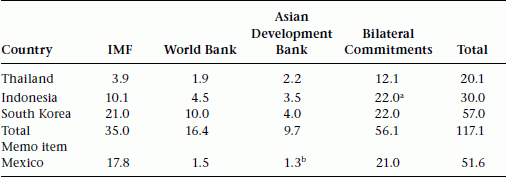
Table 12.1 Official finance commitments (last-resort lending) ($US billions)
a Including the use of a $5 billion Indonesian contingency reserve.
b InterAmerican Development Bank.
The devaluation of the Thai baht in early July 1997 triggered the contagion effect, and the flow of money to other Asian countries slowed and then was reversed. The President of Malaysia, Dr Mahathir, blamed foreign speculators and specifically George Soros in the United States, who in turn asserted that he had not sold the ringgit short while Malaysia was constructing two new buildings taller than those anywhere else in the world. Malaysia did not seek loans from the IMF but instead imposed controls on outflows of money and interest payments to foreign creditors. Thailand, Indonesia, and South Korea borrowed from the IMF. The amounts, on top of that for Mexico in 1994–95, are set forth in Table 12.1 from the Bank for International Settlements.69
The report of the Bank for International Settlements noted that the $50 billion credit lines for Mexico had a ‘psychological impact on the markets’ and halted the erosion of domestic confidence.70 These credit commitments also depleted the funds available for rescue operations in the future. At the end of 1998, the US Congress agreed to the proposal of the Clinton Administration to increase IMF quotas and capital. The IMF was thus able to help Brazil when it needed assistance.
The IMF is not a central bank and hence it cannot create money; instead it can lend the money it has obtained from the capital subscriptions of its members and its own borrowing.
A world central bank would be a more efficient lender of last resort than the IMF, but an improbable one. Outside the European Monetary Union, most large countries regard the issue and control of money as a mark of sovereignty; in the United States, these functions are enshrined in the Constitution.
The United States and the dollar
The United States took the lead in the 1940s, the 1950s, and the 1960s in establishing new international financial arrangements – the IMF and the World Bank, the General Arrangements to Borrow, the Special Drawing Rights, the swap network, and the gold pool. Moreover the United States took the initiative at the end of the 1980s in assisting developing countries to write down the value of their loans to major international banks so they might again be creditworthy. And the United States took a leadership role when individual countries like Mexico and Russia and South Korea had major international payments problems.
One of the major surprises at the beginning of the 1980s was the development of a persistent US trade deficit, after one hundred years of trade surpluses. The persistent US trade deficit that began about 1980 led to a dramatic change in the US international financial position. In 1980, the United States was the world’s largest creditor country; its net creditor position was larger than the combined positions of all other net creditor countries. By 2000 the United States had become the world’s largest debtor, and its net debtor position was larger than the positions of all other net debtors as a group. The US net debtor position has continued to increase.
There is an analogy between the persistent US payments deficit in the 1950s and the 1960s and the persistent US trade deficit in the 1980s and the 1990s and subsequently. The US payments deficit developed because the demand for international reserve assets on the part of other countries was larger than the increases in the supply of new reserve assets from non-US sources. The United States developed a persistent trade deficit because of the demand in other countries for US dollar securities and US real assets.
At the end of the 1960s and throughout the early 1970s, the willingness of foreign official institutions to acquire reserve assets declined, which might reflect, if present indications are correct, the crises of the last two-thirds of the 1990s. The US had also been the most successful economy during the 1990s, with some economic analysts suggesting that with low inflation, low unemployment, government budget surpluses in the making, and technical progress, it had entered a ‘New Era’ in which the business cycle has been dampened and financial crises, with rapid Federal Reserve responses to trouble, tamed. Not all was completely solid, however. Prosperity relied on increases in US consumer spending and a decline in the household saving rate, and after 2002, a bubble in the housing market. Credit card debt reached new heights. So did household bankruptcies. The increase in US net international indebtedness may pose problems if foreign confidence in the value of the US dollar declines. A strong, perhaps overstated warning by a British economist is entitled ‘Seven Unsustainable Processes’, although the author is unwilling to discuss timing beyond saying that downturns are likely within the next five to fifteen years.71 There is a possibility that the United States and its dollar may lose their positions in ‘world economic and financial primacy’.72
Some political scientists place faith in what they call ‘regimes’, habits of cooperation built up during periods of leadership (that they in turn call ‘hegemony’).73 Such cooperation worked remarkably well in the 1980s, especially under the initiatives of Secretary of the Treasury James Baker, who abandoned the policy of benign neglect of the value of the dollar and worked out the Plaza Agreement of September 1985 and the Louvre Agreement of January 1987. Few observers placed much reliance on the system of summit meetings among the G-7. These had strong overtones of ceremony and posturing. More suited to the working out of effective agreements was the G-5 among France, Germany, Japan, Britain, and the United States.
Can the IMF and the World Bank offer an alternative to declining US leadership? These institutions, established at Bretton Woods not to help the United States but to solve the problems of others, work slowly, a disability in a time of crisis that may require decisions in hours, not weeks. Moreover their funds may still prove to be too small to cope with market forces when those markets get the bit between their teeth and need the supplement of those of the G-7 central banks. This is particularly the case if the currency in difficulty is the dollar, rather than the euro, the pound, or the yen, with smaller financial markets.
While the dollar has troubles, it continues to be used as a world unit of account, if decreasingly as a medium of exchange, for lack of an adequate substitute. Japan and Germany were good followers of the American lead, but held back from challenging it. Under President de Gaulle, France continually challenged US policies and the dominance of the dollar without, however, great success, and is now fully involved with domestic, European and other international issues. The European Union may grow in economic and financial strength and take over world economic primacy. At the moment, however, the world depends on US leadership for lack of a better alternative; but the United States is holding back, preoccupied with its own political and economic problems, and reluctant to pay the cost of providing international public goods. Regimes work smoothly in quiet times, but something more decisive in the way of leadership is called for in crisis, and the likelihood of escaping economic and financial crises in the years ahead seems small.