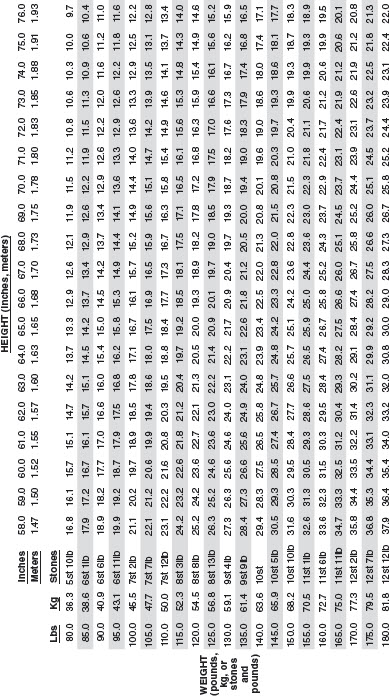
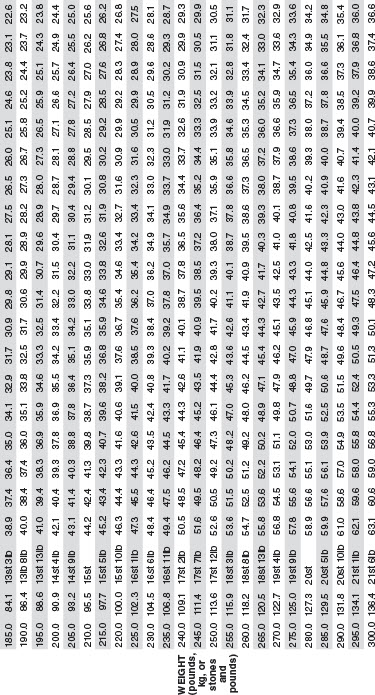
FIGURE 33. BMI chart.
The body mass index (BMI) is a useful way of determining whether someone is underweight, normal weight, or overweight. It is simply a number representing a person’s weight adjusted for his or her height. Specifically it is weight in kilograms divided by height in meters squared—that is, weight/(height × height). In general, the BMI applies to adults of both sexes between the ages of 18 and 60, an exception being those with a particularly large muscle mass (e.g., many athletes).
The chart on the following pages (see Figure 33) can be used to identify your BMI. Look along the top to find your height and then look down the left-hand column to find your weight. Where your height and weight intersect in the table is your BMI.
Alternatively, you can use one of the many BMI calculators on the Internet (e.g., www.cdc.gov/healthyweight/assessing/bmi).
The following BMI thresholds are used to classify people as underweight, healthy weight, overweight, or having obesity.
| Underweight | Below 18.5 |
| Healthy weight | 18.5 to 24.9 |
| Overweight | 25.0 to 29.9 |
| Obese | 30.0 and above |
Note that these thresholds are based on health risks, not appearance.
If your BMI is 25.0 or above, you are at increased risk of a wide range of health problems, the main ones being the following:
Diabetes
Heart disease and high blood pressure
Stroke
Certain cancers
Osteoarthritis
Pregnancy complications
In Appendix III I discuss what to do if your BMI is 25.0 or above (i.e., if you are overweight) and you have a binge eating problem.