18.6 Social Networks
Social networks are web-based systems designed to bring people together by facilitating the exchange of text snippets, photos, links, and other content with other users. Famous networks include Facebook, Twitter, MySpace, and LinkedIn, among a sea of others. Each platform aims to become the ubiquitous social network everyone uses, but each offers different features and implements things differently. Social networks allow websites to gain traffic through people’s networks, rather than through search alone.
18.6.1 How Did We Get Here?
Social networks are an area of study that predate digital social networking platforms and even the WWW. The study of the interactions between people, and even societies, takes inspiration from many disciplines to provide context for the study of human relationships. Understanding that humans are social creatures with social connections (that can be viewed as networks) helps explain the success of digital social networking, since it is a digital manifestation of an existing social construct.
The famous six degrees of separation concept that states we are all connected to one another by at most six introductions, originates not in computer science but in the mind of psychologist Stanley Milgram.8 The modern study of social networks draws from psychology, sociology, graph theory, and computer science to build social network analysis tools that can be used to study complex relationships in the real world, including the degrees of separation question.
Early Digital Networking
Recalling all the way back to Chapter 1, you learned that the telegram, mail, and telephone were used by people long before the invention of the computer networks. While social networking existed in those times, it had to be done in person, or through the aforementioned media of private correspondence, telegraph, and telephone.
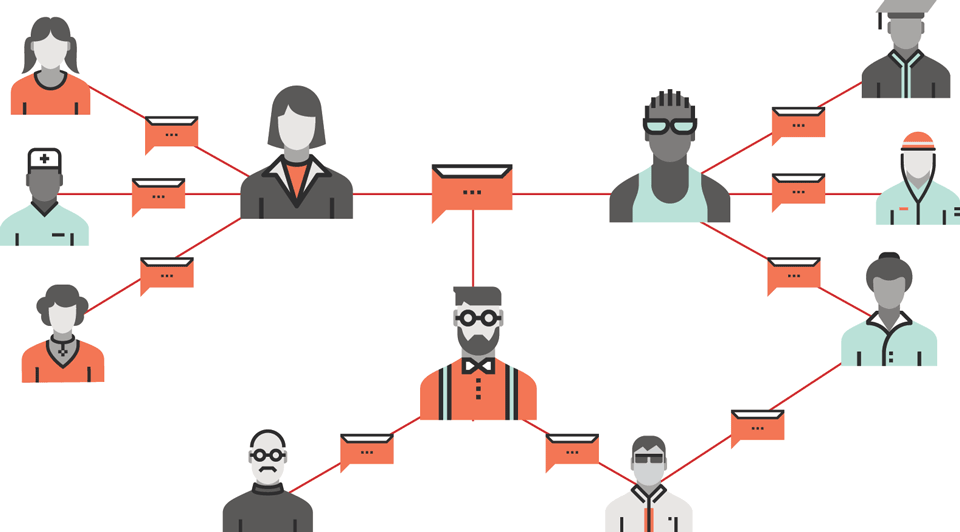
Email, the most popular and long-standing new communication technique, is relatively private, with the management of your email social network done through the management of conversations. Additional mechanisms such as CC fields and mailing lists introduce more social aspects (as illustrated in Figure 18.11), but being private correspondents, your contacts are not visible to people you email. Surviving to this day, email remains an essential tool for the human social networker but does not lend itself well to sharing, since you would not normally want to share all your private correspondence.
Figure 18.11 Illustration of email social networks
The first open-spirited means of digital communication were bulletin board systems (BBS). BBS existed either as dial-up systems you could log in to or the popular USENET groups, which allowed people to upload comments to a thread, which other users could then download and respond to. Unlike email, these systems were wide open and all communication was visible to anyone, akin to the post-it boards they aimed to duplicate. BBS are still popular today with open-source PHP-based tools like phpBB, but lack any privacy from the world as a whole. Certainly there are some things you would write in a private email you would not share on a public board.
The problem with the networks of email and bulletin board is that neither approximates the real-world networks we naturally maintain. That is, in a natural social network, I might come to know my friends’ friends by happenstance, whereas neither BBS nor email supports that type of accidental interaction in a social context. Introductions of friends to other friends are deliberate in email (done via a CC, for example). Conversely, bulletin boards are too public and do not simulate real networks where there are opportunities for privacy.
The Evolution of Social Networks
Between public services like BBS and private systems, such as email, there is a gap in services, which social networking sites aim to fill. The idea was seized upon by many companies and continues to be a busy space for competitive new startups. Like email-enabled social networks, connections exist as messages, but also as pictures, comments, links, and other objects as shown in Figure 18.12.
Figure 18.12 Social network connection via multiple media, categories, and public broadcasts
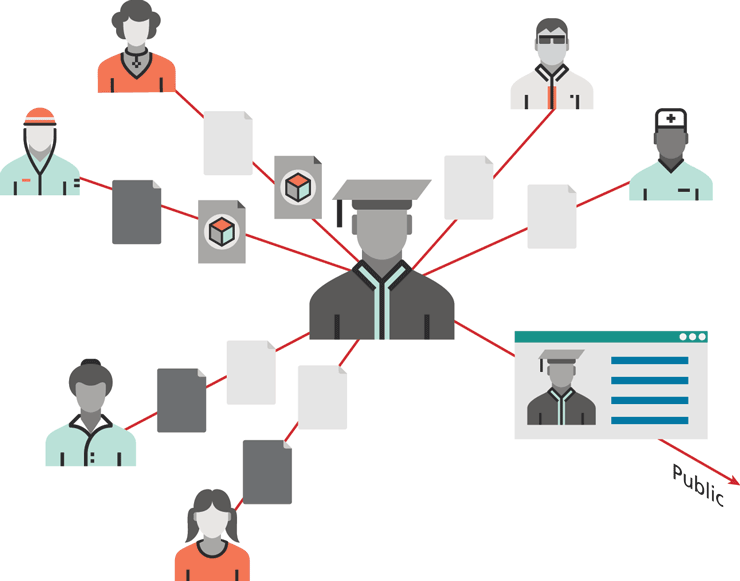
Social networks also allow relationships with no communication, and a public area for unrestricted broadcast messages from anyone (which might manifest as public comments on a website, for example). In addition, your contact lists are normally visible to everyone you know since that’s the essence of how you find new connections.
Early social networks adopted the concept of the user profile, and some ability to manage collections of contacts. Friendster, MySpace, LinkedIn, and Bebo all launched in the early 2000s, and by 2004 Flickr, Digg, and Facebook were in existence. The gold rush started in 2005 when MySpace was sold for $580 million. The next few years saw an explosion in social sites including Tumblr, Twitter, WordPress, Reddit, Yammer, Google+, and Pinterest, to name but a few. Even as you read this sentence, someone is no doubt working on the next big social network since the stakes are so high.
As of July 2020, Facebook claims to have over 2.6 billion unique users and several other services have hundreds of millions. With each edition of this book, we must update the list of social networks. Google+, for instance, has now been discontinued, while meanwhile new platforms are emerging every few months. The rapid changes in this space have convinced the authors to omit code snippets for social networks in this edition of the book, referring instead to general principles.