1.4 Where Is the Internet?
It is quite common for the Internet to be visually represented as a cloud, which is perhaps an apt way to think about the Internet given the importance of light and magnetic pulses to its operation. To many people using it, the Internet does seem to lack a concrete physical manifestation beyond our computer and cell phone screens.
But it is important to recognize that our global network of networks does not work using magical water vapor but is implemented via millions of miles of copper wires and fiber optic cables connecting millions of server computers and probably an equal number of routers, switches, and other networked devices, along with hundreds of thousands of air conditioning units and thousands of specially constructed server rooms and buildings.
A detailed discussion of all the networking hardware involved in making the Internet work is far beyond the scope of this text. We should, however, try to provide at least some sense of the hardware that is involved in making the web possible.
1.4.1 From the Computer to Outside the Home
Andrew Blum, in his eye-opening book, Tubes: A Journey to the Center of the Internet, tells the reader that he decided to investigate the question “Where is the Internet” when a hungry squirrel gnawing on some outdoor cable wires disrupted his home connection, thereby making him aware of the real-world texture of the Internet. While you may not have experienced a similar squirrel problem, for many of us, our main experience of the hardware component of the Internet is that which we experience in our homes. While there are many configuration possibilities, Figure 1.19 illustrates a typical home Internet configuration and the beginnings of its connection to the outside world. In it, you can see the importance of mundane cable to the workings of the internet, which are detailed in the nearby Dive Deeper on cables.
Figure 1.19 Internet hardware from the home computer to the local Internet provider
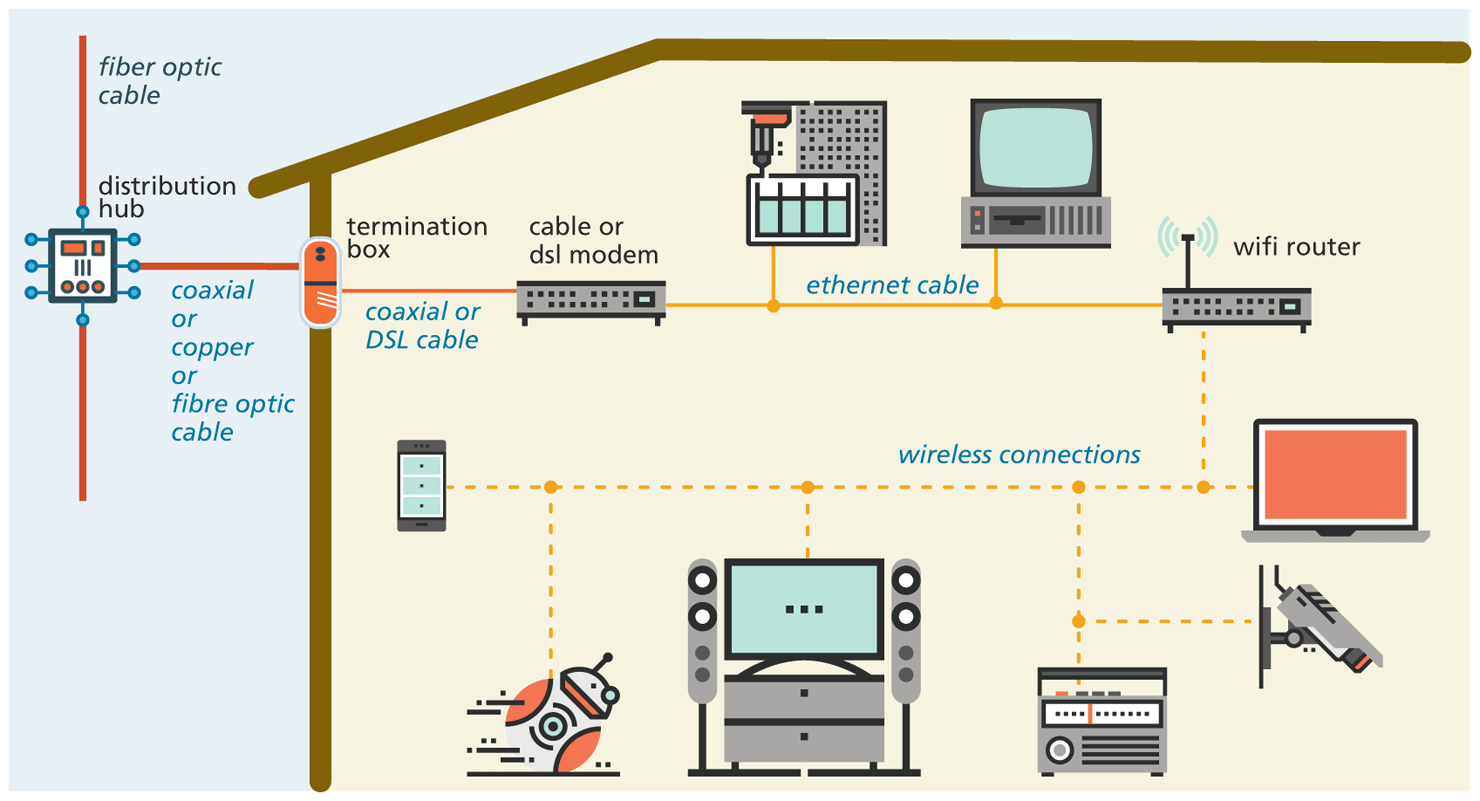
The broadband modem, also called a cable modem or DSL (digital subscriber line) modem, is a bridge between the network hardware outside the house (typically controlled by a phone or cable company) and the network hardware inside the house. These devices are often supplied by the ISP.
The wireless router is perhaps the most visible manifestation of the Internet in one’s home, in that it is a device we typically need to purchase and install (although many companies will provide and install these as part of the setup process). Routers are in fact one of the most important and ubiquitous hardware devices that make the Internet work. At its simplest, a router is a hardware device that forwards data packets from one network to another network. When the router receives a data packet, it examines the packet’s destination address and then forwards it to another destination.
1.4.2 From the Home to the Ocean’s Edge
Once we leave the confines of our own homes, the hardware of the Internet becomes less visible and thus a bit more mysterious. Figure 1.21 illustrates the journey from our homes to the Internet Service Provider (ISP) and beyond. Various neighborhood broadband cables (which are typically using copper, aluminum, or other metals) are aggregated and connected to fiber optic cable via fiber connection boxes. Fiber optic cable (or simply optical fiber) is a glass-based wire that transmits light and has significantly greater bandwidth and speed in comparison to metal wires. In some cities (or large buildings), you may have fiber optic cable going directly into individual buildings; in such a case, the fiber junction box will reside in the building.
Figure 1.21 From the home to the ocean’s edge
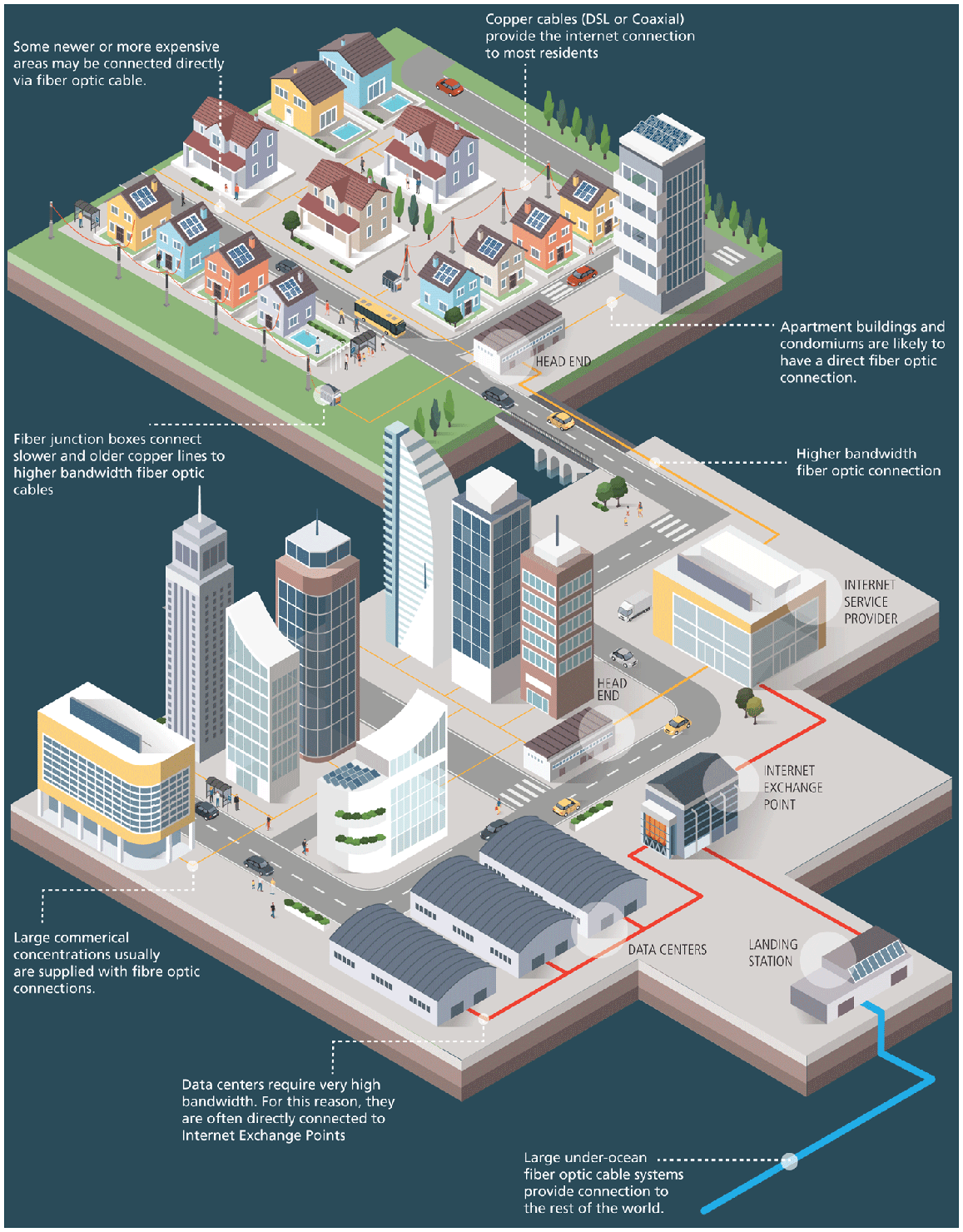
These fiber optic cables eventually make their way to an ISP’s head-end, which is a facility that may contain a cable modem termination system or a digital subscriber line access multiplexer in a DSL-based system. This is a special type of very large router that connects and aggregates subscriber connections to the larger Internet. These different head-ends may connect directly to the wider Internet, or instead be connected to a master head-end, which provides the connection to the rest of the Internet.
Eventually your ISP has to pass on your requests for Internet packets to other networks. This intermediate step typically involves one or more regional network hubs. Your ISP may have a large national network with optical fiber connecting most of the main cities in the country. Some countries have multiple national or regional networks, each with their own optical network. Canada, for instance, has three national networks that connect the major cities in the country as well as connect to a couple of the major Internet exchange points in the United States. There are also several provincial networks that connect smaller cities within one or two provinces. Alternatively, a smaller regional ISP may have transit arrangements with a larger national network (that is, they lease the use of part of the larger network’s bandwidth).
Eventually, international Internet communication will need to travel underwater. The amount of undersea fiber optic cable is quite staggering and is growing yearly. There are over 250 undersea fiber optic cable systems operated by a variety of different companies span the globe. For places not serviced by undersea cable (such as Antarctica, most of the Canadian Arctic islands, and other small islands throughout the world), Internet connectivity is provided by orbiting satellites. It should be noted that satellite links (which have smaller bandwidth in comparison to fiber optic) account for an exceptionally small percentage of oversea Internet communication.
1.4.3 How the Internet Is Organized Today
The Internet today is a series of overlapping, somewhat hierarchical, network of networks. That is, the Internet is a conglomeration of many different physical networks that are able to communicate thanks to the use of common connection protocols.
As the previous pages have made clear, the Internet is built on top of a massive amount of telecommunications infrastructure, some initially government-funded, but most of it privately owned.
The most important infrastructure belongs to what are commonly called Tier 1 Networks or Tier 1 ISPs. When someone talks about the “Internet Backbone” they are talking about Tier 1 networks. About 16 different companies are considered to be Tier 1 networks, and include Level 3, Tata Communications, NTT, AT&T, and Verizon. The Tier 1 networks agree to peer (share and interconnect) data transmit among themselves, but charge smaller networks for data transit.
Tier 2 Networks may peer for free with some networks but must pay to access at least some other Tier 1 networks (referred to as buying transit). Many regional networks are Tier 2. Some examples include Comcast, British Telecom, and Vodaphone.
Tier 1 Networks make use of very fast fiber optic cable, usually 100G with a speed of 100 Gbits/sec (gigabits/sec) or OC-768 (40 Gbit/sec). These optical cables often make use of multiplexing to boost bandwidth up to 10,000 Gbit/sec (that is,10 Tbit/sec). Regional networks have traditionally used less speedy infrastructure (OC-48 at 2Gbit/sec), though this is rapidly changing as prices of optical hardware decreases. Figure 1.22 illustrates how these different networks interconnect globally.
Figure 1.22 The figure describes global network infrastructure.
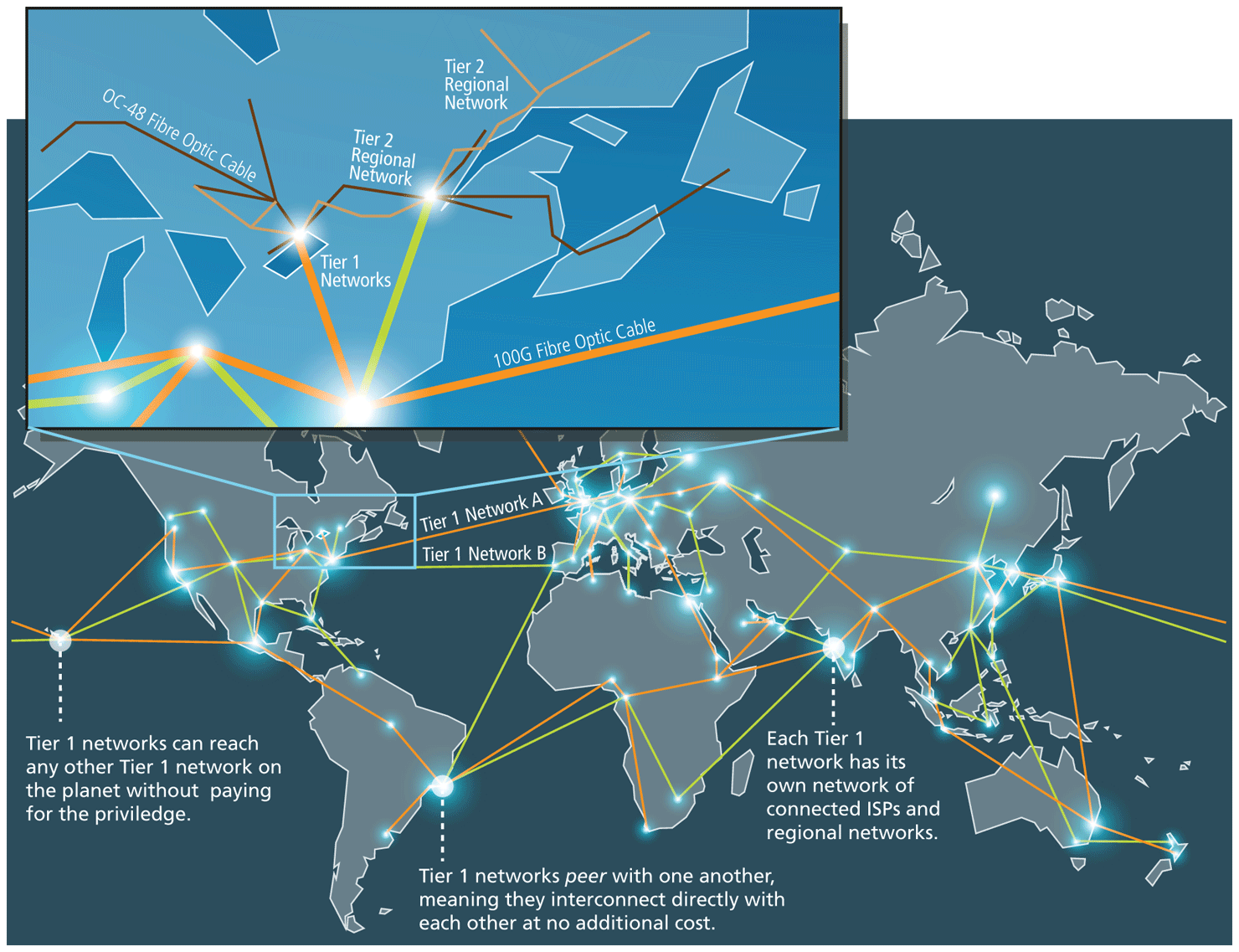
Since the Internet is composed of many interconnected, but independent networks, there needs to be mechanisms for creating those interconnections. For instance, in Figure 1.22 you can see that there are numerous locations where different networks connect together.
You can conceive of these Tier 1 and Tier 2 networks as a series of overlapping cones, as shown in Figure 1.23. Each ISP can be classified by its customer cone size (in Figure 1.23, ISP A is larger than ISP B which is larger than ISP d). The largest Tier 1 networks have cone sizes that encompass over 500 million IP addresses. Many Tier 2 Networks have transit relationships with multiple Tier 1 Networks (as shown here by ISP m).
Figure 1.23 The figure illustrates a relationship between networks.
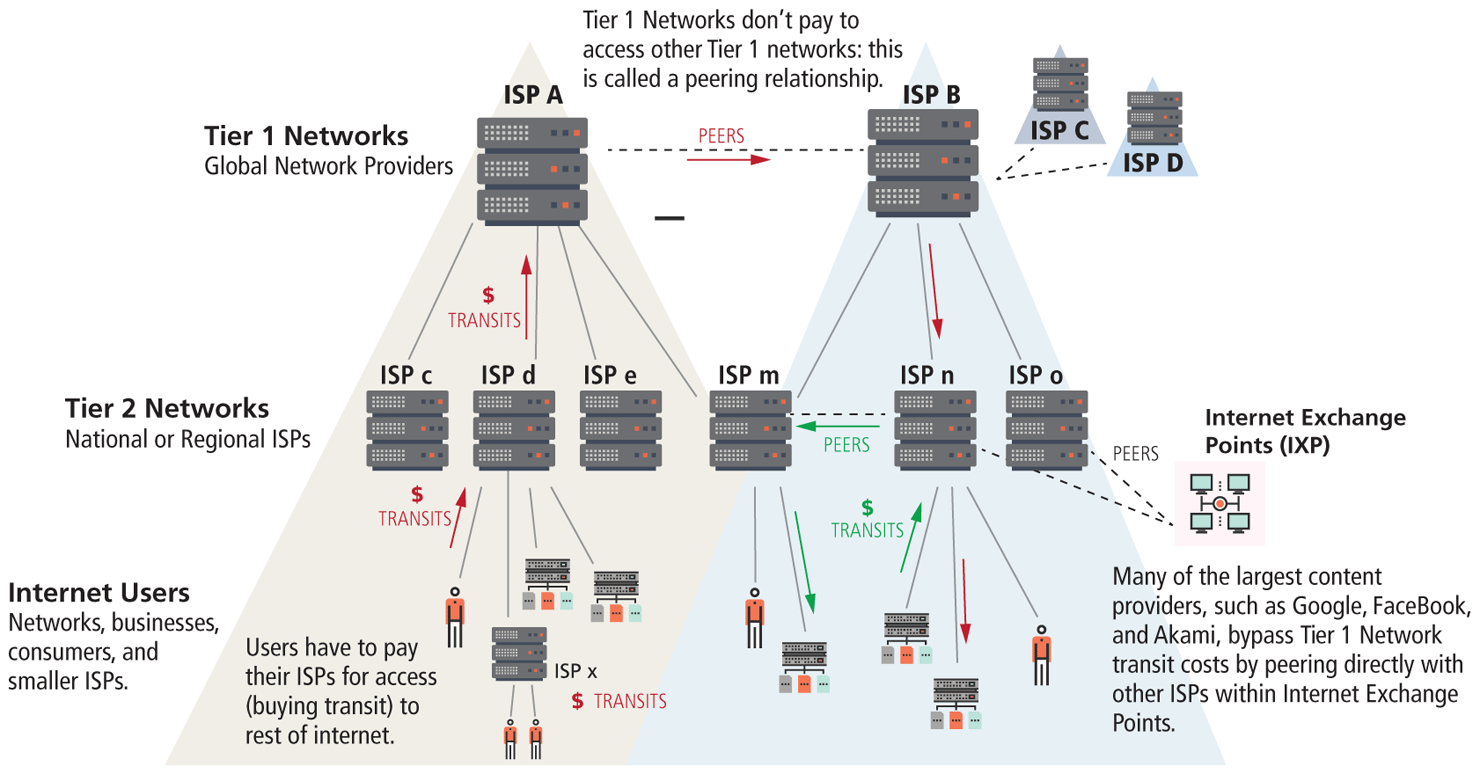
In order to improve performance among themselves, and also to eliminate Tier 1 transit charges, many networks and large content providers are now using Internet Exchange Points (IXPs). An Internet Exchange Point is a physical location where different IP networks and content providers meet to exchange local traffic with each other (that is, peer) via a switch, as shown in Figure 1.24. IXPs tend to be close to Tier 1 network infrastructures, and often interconnect hundreds of different networks. For instance, TorIX, in Toronto, Canada, has over 200 peers that interconnect using a device known as a switch. A switch is a network device that interconnects multiple devices or networks. Large IXPs, such as at Palo Alto (PAIX), Amsterdam (AMS-IX), Frankfurt (CE-CIX), and London (LINX), allow many hundreds of networks and companies to interconnect and have throughput of over 1000 gigabits per second.
Figure 1.24 Sample ISP peering
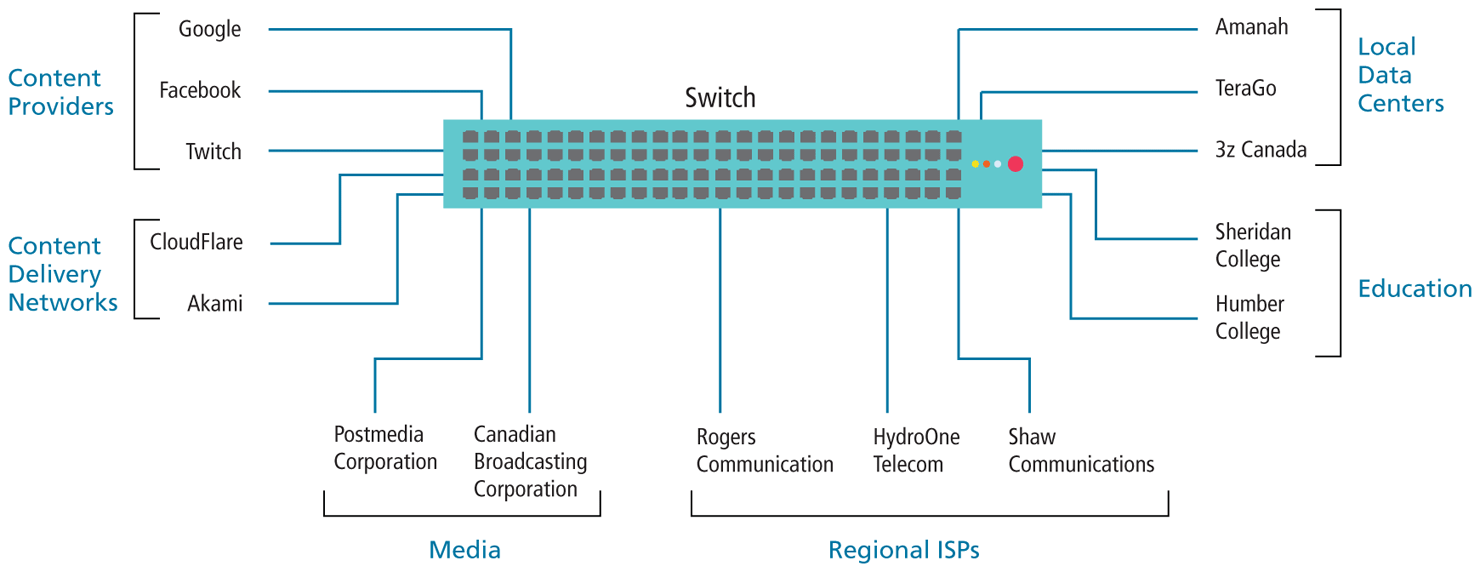
Figure 1.24 illustrates some of the companies who, at the time of writing, are peering at TorIX. Thanks to the connection to a series of switches, each of these networks are directly connected to each other, thereby improving the speed of interconnection between each peer partner.