Long description
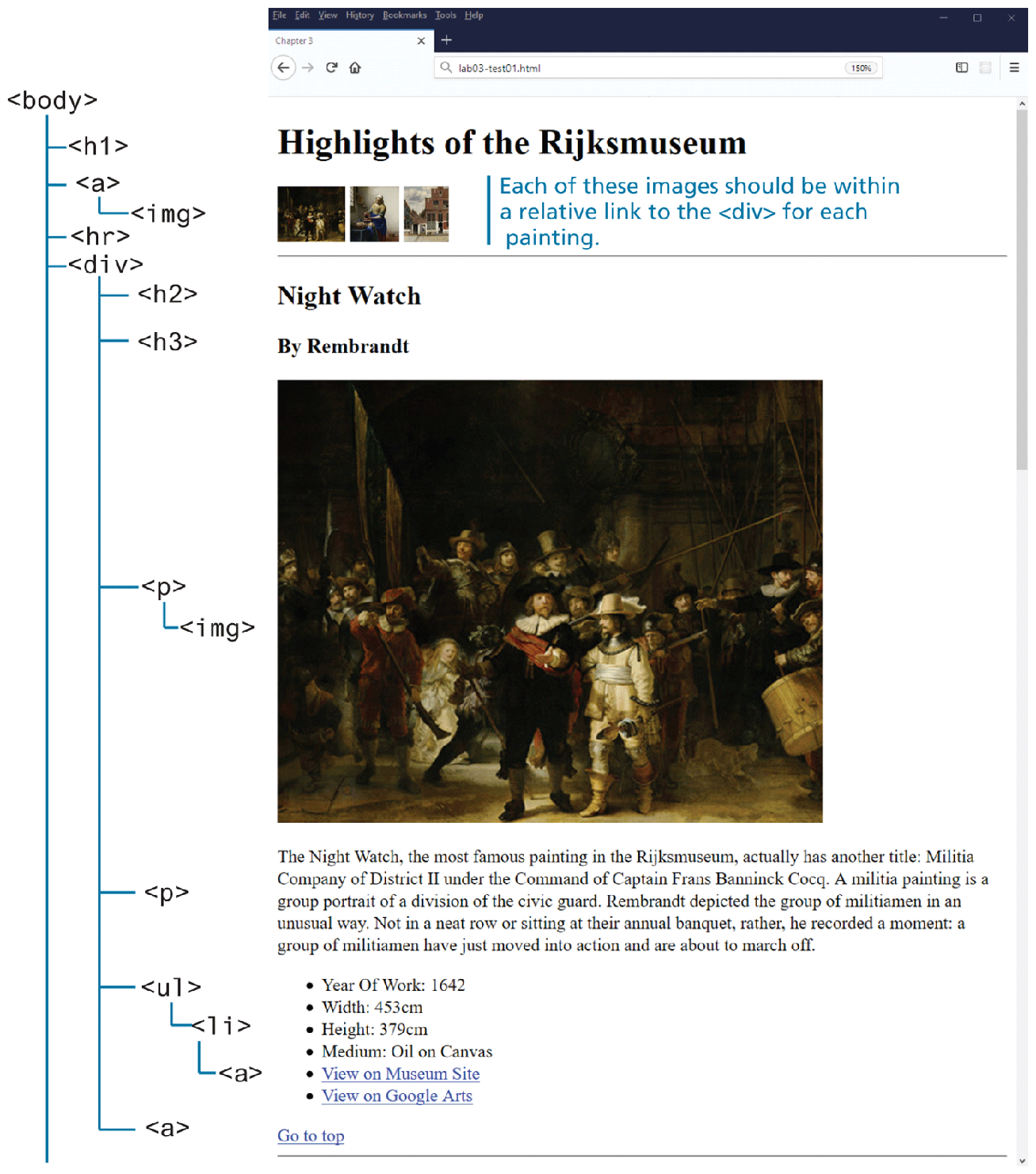
The block structure is placed at the left of the browser window such that each tag in the structure corresponds to the placement of the elements in the browser window. The block structure reads as follows. open angle bracket body close angle bracket at indentation level 0. open angle bracket h 1 close angle bracket at indentation level 1. open angle bracket “a” close angle bracket at indentation level 1. open angle bracket i m g close angle bracket at indentation level 2. open angle bracket h r close angle bracket at indentation level 1. open angle bracket div close angle bracket at indentation level 1. open angle bracket h 2 close angle bracket at indentation level 2. open angle bracket h 3 close angle bracket at indentation level 2. open angle bracket p close angle bracket at indentation level 2. open angle bracket i m g close angle bracket at indentation level 3. open angle bracket p close angle bracket at indentation level 2. open angle bracket u l close angle bracket at indentation level 2. open angle bracket l i close angle bracket at indentation level 3. open angle bracket a close angle bracket at indentation level 4.
open angle bracket "a" close angle bracket at indentation level 2.
The browser window has a tab that reads, Chapter 3. The address bar reads, lab 03 hyphen test 01 dot h t m l. The browser contains a level-1 heading at the top left that reads, Highlights of the Rijksmuseum. There are three small images placed side-by-side below the heading. The images are aligned to the left. A text that reads, Each of these images should be within a relative link to the open angle bracket div close angle bracket for each painting is written at the right of the images. A horizontal line is placed below the images that separates the rest of the browser window. A level-2 heading that reads, Night Watch is placed below the horizontal line. A level-3 heading that reads, By Rembrandt is placed below the level-2 heading. The headings are aligned to the left. A large image of a painting is placed below the level-3 heading. A paragraph is placed below the image that reads, The Night Watch, the most famous painting in the Rijksmuseum, actually has another title: Militia Company of District Roman number 2 under the Command of Captain Frans Banninck Cocq. A militia painting is a group portrait of a division of the civic guard. Rembrandt depicted the group of militiamen in an unusual way. Not in a neat row or sitting at their annual banquet, rather, he recorded a moment: a group portrait have just moved into action and are about to march off.
A bulleted list of six items is shown below the paragraph. Item 1: Year Of Work: 1642. Item 2: Width colon 453 c m. Item 3: Height: 379 c m. Item 4: Medium colon Oil on Canvas. Item 5:View on Museum Site. Item 6: View on Google Arts. The items 5 and 6 are in blue and are underlined, indicating them as links. A text that reads, Go to top is written below the bulleted list. The text is in blue and is underlined, indicating it as a link. The text is aligned to the left. A horizontal line is placed below the text.
Back