Long description
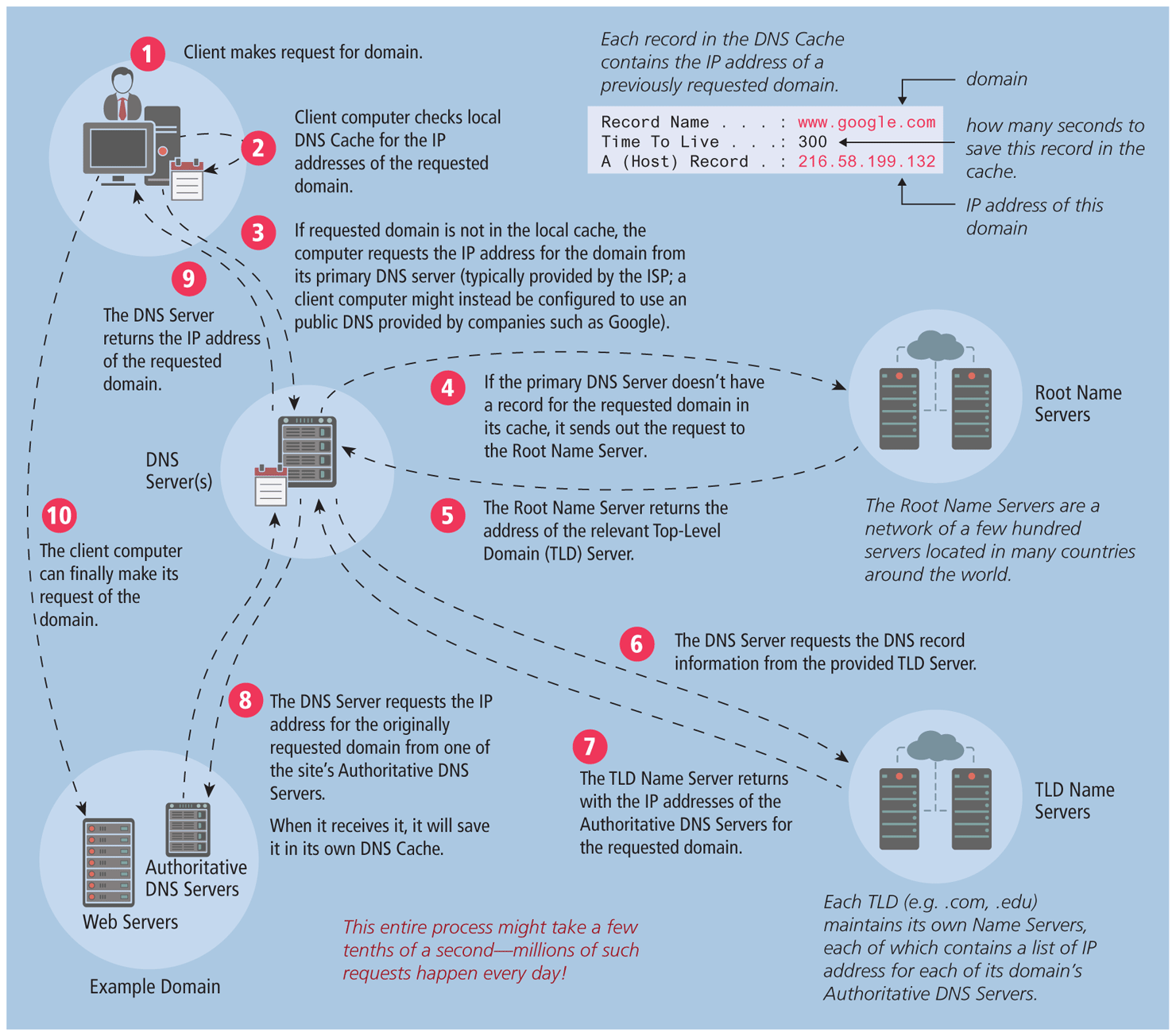
Step 1: Client makes request for domain.
Step 2: Client computer checks local D N S Cache for the I P addresses of the requested domain.
Each record in the D N S Cache contains the I P address of a previously requested domain. The D N S cache is shown as a rectangular box that contains Record Name: w w w dot google dot com, which is the domain, Time to Live: 300, which shows the number of seconds to save this record in the cache, and A open parenthesis Host close parenthesis Record: 216 dot 58 dot 199 dot 132, which is the I P address of this domain.
Step 3: If the requested domain is not in the local cache, the computer requests the I P address for the domain from its primary D N S server open parenthesis typically provided by the I S P; a client computer might instead be configured to use a public D N S provided by companies such as Google close parenthesis.
Step 4: If the primary D N S Server does not have a record for the requested domain in its cache, it sends out the request to the Root Name Servers.
Step 5: The Root Name Server returns the address of the relevant Top-Level Domain open parenthesis T L D close parenthesis Server.
Note: The Root Name Servers are a network of a few hundred servers located in many countries around the world.
Step 6: The D N S Server requests the D N S record information from the provided T L D Server.
Step 7: The T L D Name Server returns with the I P addresses of the Authoritative D N S Servers for the requested domain.
Note: Each T L D open parenthesis example dot com, dot edu close parenthesis maintains its own Name Servers, each of which contains a list of I P address for each of its domain’s Authoritative D N S Servers.
Step 8: The D N S Server requests the I P address for the originally requested domain from one of the site 's Authoritative D N S Servers. When it receives it, it will save it in its own D N S Cache.
Step 9: The D N S Server returns the I P address of the requested domain from the Authoritative D N S Servers.
Step 10: The client computer can finally make its request of the domain to the Web Servers.
Note: This entire process might take a few tenths of a second millions of such requests happen every day!
Back