Round Two: Spotting the Detail
Morale is the muesli of memory, so to speak – the source of slow-release energy that keeps your remembering fresh and energetic, capable of pushing on forward. For this reason, before you take on this second geeky section (where we’ll be filling in some of the historical detail to go with our kings and queens), you need to make sure you’re feeling pretty good about what you’ve learnt already.
The best way to feel good is to astonish someone, and, where possible, to win some money from them as you do so. Before you pile into this section, therefore, I recommend accosting a relative, a co-worker or perhaps a pedestrian and betting a fiver on your ability to recite the chronology of kings and queens – backwards, if necessary.
Having collected the money, retire to a warm, dry place and get stuck into this, our second pass over the same monarchs as before. The aim of the game is to learn a few choice facts and something of the character of all the monarchs. The rules are the same – if you imagine what happens vividly, you won’t forget it in a hurry.
1
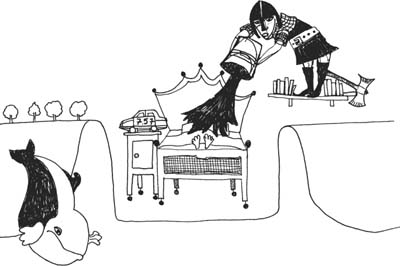
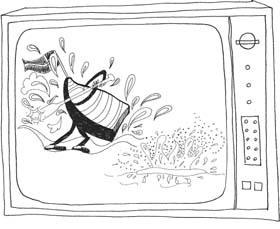
So, off we go, then. We’ll begin again in our royal bed, with King Offa of Mercia dumping his bucket of offal on our faces. What’s to add? Well, look here how a mud wall, running through the bedroom, divides it in two and how, up against this mud dyke, a poor whale’s been spectacularly beached.
This is a smaller version of the historical Offa’s Dyke, which to this day runs along most of the border between Mercia and Wales.
2
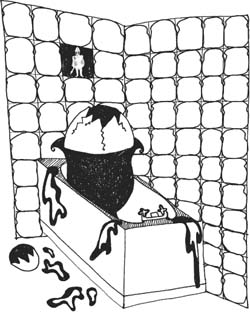
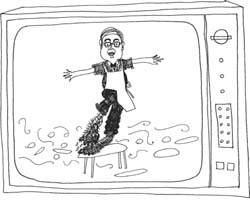
Continuing on into the House of Wessex and the bathroom, look how the tiles round Egbert’s bath are actually squares of corn bread that have been neatly stuck together, covering the wall. This bathroom’s clearly been bread-walled – a neat reminder of Egbert’s self-proclaimed title: bretwalda, which means ‘ruler of Britain’ in Anglo-Saxon.
And fancy this – one of those bread tiles is falling down on a hinge made from stone, a secret door! Out of this door a Viking pops, followed soon after by his warlike pals. But they’ve timed their invasion poorly – the bursting egg covers them in yolk before they’ve taken even three steps. Note how the exact time of the egg burst is 8.38 a.m.
What does this all mean? Well, Vikings being destroyed at 8.38 a.m. in the Cornwall when the hinge-o’-stone’s down reminds us of how Egbert’s great military victory against the Vikings was at Hingston Down in Cornwall in the year 838.
3
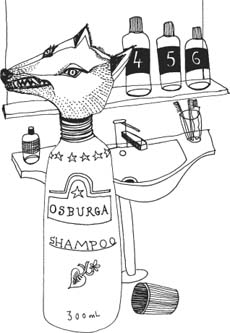
Over to the sink, where the shampoo in Aethelwulf’s bottle is Os-burga brand, shampoo to kings, no less. It’s been made from liquefied ostrich burgers, very fragrant. Please don’t ask what they put in ninth-century conditioners. Osburga is also the name of Aethelwulf’s first wife, by the way, and mother of the next four kings.
4, 5+6
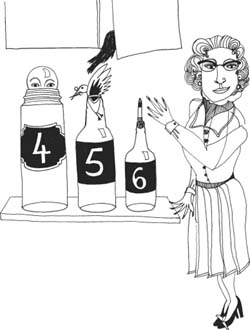
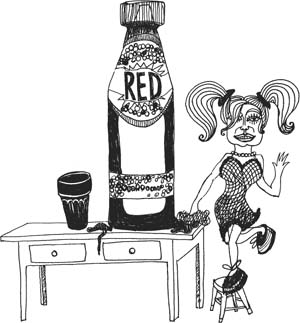
The three Aethels in their bottles on the shelf (Aethelbald, Athelbert and Aethelred) have been numbered in order – Baldy is 4, Bertie is 5 and Red is 6.They are our fourth, fifth and sixth kings, and they reigned for four, five and six years respectively. All very neat.
If you look more closely at the mirror above the sink, you’ll notice it doubles as a cupboard door. Opening it up, a massive pile of flesh slobbers out (about 865 pounds of it) and crushes, or perhaps engorges is the word, our poor Aethelbert. This flesh-pile is Ivor the Boneless, leader of the AD 865 Viking invasion in which Aethelbert was killed.
At this point Mrs Merton appears at the sink. A cross-dresser, she needs some lipstick. She grabs Aethelred and slathers on so much of him that soon nothing remains of the poor king.
And indeed overworked Aethelred died fighting against the invading Danes in AD 871 – at the Battle of Merton.
7
If kings four, five and six lasted four, five and six years, you would think that Alfred, our seventh, would last seven, wouldn’t you? But not a chance! He’s four times greater than that, and will last for twenty-eight years. Let’s take a closer look at him.
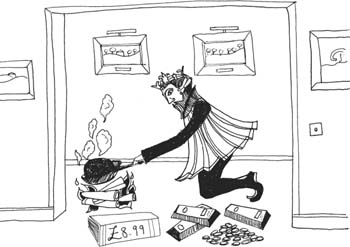
He is still on the landing, of course, cooking breakfast. He’s frying up a cake on a roaring fire whose golden flames can mean only one thing: it’s being fed with gold. Alfred found that bribing the Vikings with gold was the best way to get them to clear off. But something must be on his mind – it’s been so long since he turned his cake that it’s fizzing, spluttering and beginning to let off black smoke. He must be making a name for himself as the ‘king who burnt the cakes’.
You may be thinking that the hefty tome of philosophy at Alfred’s side is a bit showy, but, on the contrary, Alfred is quietly making a translation (available at all good bookshops priced £8.99). He spent his old age producing such works, and died as ‘the wisest of kings’ in AD 899.
8
The thought of cornflakes ushers us onwards to the top of the stairs.
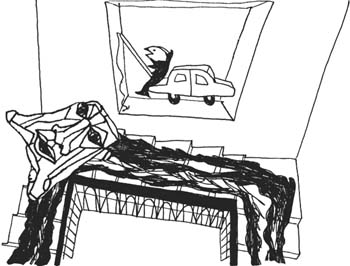
As we rocket down the elderflower rapids, clinging to the wooden head, a fishhook catches our shirt. Who could be angling on the stairs at this time of the morning?
It’s the last thing you’d expect! A whale is fishing out of the back of his Mercedes, which the silly mammal’s parked on a window sill above the stream. Fortunately, Edward and our combined momentum are too much for the angling whale, and we pull him, Merc and all, into the water behind us.
Just so were Mercia, East Anglia and parts of Wales pulled by Edward the Elder into his kingdom.
9
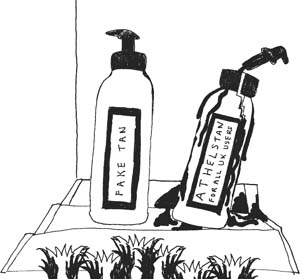
The 920s was the first point in England’s history where there was any unity of fashion: everyone in England was wearing this fake tan. The nation went orange. But this was inevitable, I suppose, because Aethelstan was the first king of all of current-day England.
10
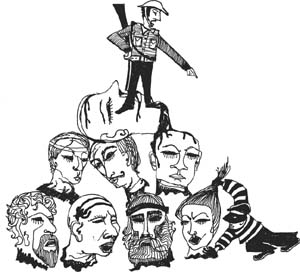
Onwards to the kitchen where it’s good to see that Edmund the Magnificent is wearing WWII army gear on his head-mound. He reigned from 939 to 946, so he was exactly a thousand years ahead of his time.
And look – there’s a thief trying to nick one of the female heads from his mound. ‘Lay off her!’ Edmund shouts. But the thief Leofa takes her anyway, causing the whole mound to collapse – burying both himself and the king. Edmund and this thief, Leofa, killed each other in a fight at Pucklechurch.
11
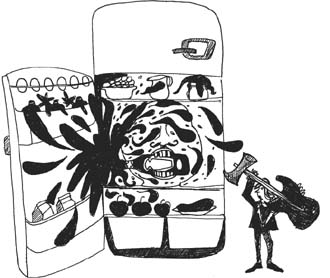
There’s more violence afoot by the fridge: Eric Clapton is creeping up on the open door, intending to hack Edred to death with his guitar-cum-axe. At the last moment, though, Edred knocks the axe from Eric’s hand with a well-aimed spurt of ketchup (or is it blood?) and Eric, whose white shirt is stained more than he can bear, collapses in a lifeless heap, his axe covered in blood. This is none other than Eric Bloodaxe, whom Edred had killed at the battle of Stainmore in 954.
12
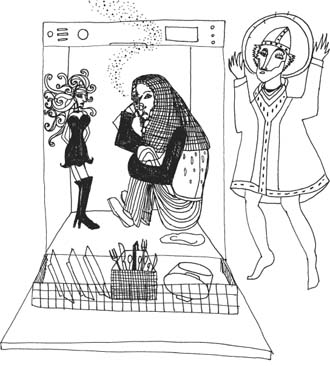
Reopening the dishwasher, we find Eadwig has been joined in his cloud of steam by a pretty young girl; they’re having a party. It’s ravetastic. But he knows he should really be at his coronation banquet.
‘If I’m not back soon, they’ll never forgive me,’ he explains to his love interest.
‘I’ll forgive you,’ says Aelfgifu, pushing him playfully against the cutlery holder. Rather disappointingly for those of us who feel this is leading somewhere, a bishop blunders in, ruining the moment.
‘I don’t understand,’ splutters the bishop. ‘I just dun’stan’ why you’re here and not eating with the nobles.’ This is Bishop Dunstan, by the way, this man who doesn’t understand and disapproves of King Edwy. The cheeky Edwy responds to the interruption by weeing in the general direction of the bishop, offending Dunstan so deeply that he runs off.
13
Dunstan wouldn’t return to England after this till the reign of Edgar.
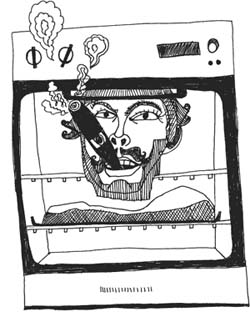
On the subject of whom – here Edgar is again, thoughtfully carving up a cake of Great Britain into amusing new shapes as he smokes away in the oven.
This reminds us how the historical Edgar realigned the county boundaries, and baked them in so thoroughly that they lasted for 1,000 years until 1974.
14
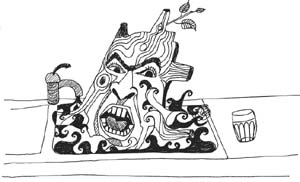
In the frothing sink is Edward the Martyr – imagine this, he’s being drowned by an elf in the froth! This imaginary elf is Elfthryth, Aethelred’s mother.
15
Elfthryth had Edward murdered so that her own son, Aethelred, could become king. Although a very large bottle – 38 litres – her son Aethelred is unfortunately leaking his red liquid everywhere. There won’t be much left if he carries on like this.
And during his disastrous thirty-eight years on the throne Aethelred did indeed disperse the entirety of what had been a stable and prosperous kingdom – into the hands of the Vikings.
Aethelred’s wife, Baby Spice as it happens, is doing her best to mop up after him. To do so, she’s standing on a footstool mopping up with a yellow cloth.
Now it’s good we get to meet Emma (of Normandy) because she was wife to two kings, mother to two and stepmother to two. For those readers who secretly harbour the intention to marry one of our eligible young royals, Emma stands as a shining example of what can be achieved with hard work, focus and, they say, almost insane levels of beauty.
From now on we’ll have the following code: if you see Emma herself, that means the king she is with is her husband. Where there’s a footstool to step on, well, that’s her stepson, and where there’s conspicuous sunshine, that’s her son shining.
16
Onwards to the House of Denmark!
Sweyn’s still stuck on the sofa, making an emergency call on his mobile phone. It’s a Bluetooth-enabled phone, made by Ericsson of course: Sweyn Forkbeard was the son of the Danish warrior-king Bluetooth.
17
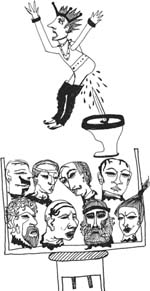
Edmund II Ironside, meanwhile, has the misfortune of needing the toilet. For an assassin is hidden in the latrine, and takes the opportunity to launch his sword up the king’s backside. Spillage resulted. The remarkable thing is that King Edmund’s death, skewered like this while on the toilet, isn’t even the most horrible in English history. For that, you’ll have to wait.
18
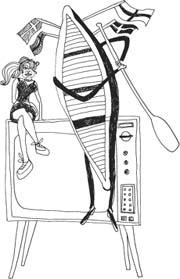
Pass your attention now to our telly-top canoe, where Emma Bunton has joined Canute (Emma of Normandy married him, after all). Fluttering in the breeze on the back of the canoe are the flags of Norway, Sweden, Denmark and England. He’s earned such varied nationality, to be sure: Canute was king of all these countries, and ruled more lands besides.
19
The situation on Neighbours, meanwhile, is that Harold’s taken the crown because Harthacanute is stuck fighting in Denmark on the other side of the river.
Let’s rejoin the action. Harold’s waiting nervously on his footstool in the river (he’s Emma’s stepson, you see) as half a canoe struggles across from the battlefields of Scandinavia to claim his crown – by force. The sun shines brightly on Harthacanute’s yellow canoe; he’s Emma’s son.
20
Unfortunately for the viewing public, just at the moment where Harthacanute arrives, when we can reasonably expect a bit of juicy violence, Harold has (or fakes – how’s one to know?) an epileptic fit and topples dead into the water – splosh! – depriving us of the fight scene we deserve. There wasn’t even contact between the two of them. Lame.
21
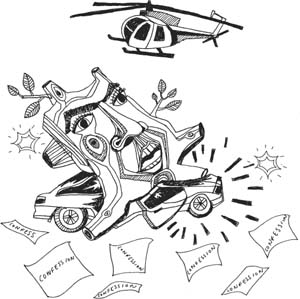
Outside, Edward the Confessor seems to fall from the sky like a fireball, such is the glare that shines off his polished face from the bright morning sun (he’s another of Emma’s sons). And, as you can see from this car wreck, he was responsible during his reign for a massive breakdown (in royal power, style and prestige).
22
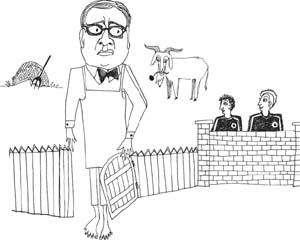
By the gate, it’s quite fun watching Harold vainly trying to deal with the people who keep crashing his garden. First up, a couple of kids in Chelsea football kit. Harold agrees to take them on in a game of football; he’s really got no choice. He wins comfortably. Hurrah! This is the Battle of Stamford Bridge of 1066.
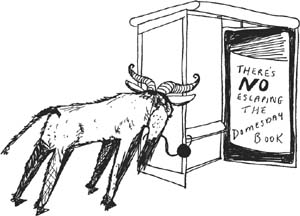
But poor Harold has such terrible luck – he’s still puffed out when the big billy goat shows up, demanding to be let in. Harold tries to stop him, but the goat whacks him in the eye with the conker, and Harold staggers back, collapsing into a convenient haystack. This is the Battle of Hastings, where Harold and his army (exhausted after Stamford Bridge) were defeated, alas, by William the Conqueror.
23
Over by that normal bus stop, the House of Normandy, where William the Conqueror is bashing the bus stop, there’s an advert for a new bestseller, with the catchy caption ‘There’s no escaping the Doomsday Book’. Accurate advertising: it being true that everyone had to report exactly what they owned for that vast national database.
24
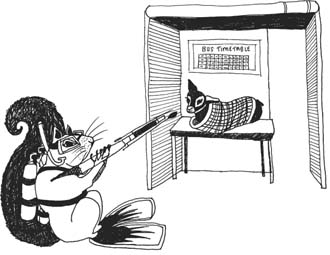
And, inside the shelter, our vulnerable, roofless William II Rufus is being stalked by a squirrel with snorkel, flippers and harpoon. It is a hunting aquatic squirrel – this water squirrel is Walter Tirel. But no! Poor William Rufus! See now as Tirel the squirrel shoots him in the head with his harpoon! Hear that gruesome crunching sound!
William Rufus was murdered by Walter Tirel, a friend of Henry I, in a ‘hunting accident’ in the New Forest.
25
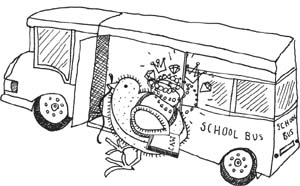
Just then, the school bus pulls up and our fluffy white chick tries to clamber on board. But either that rucksack full of treasure is just too heavy for him, or he’s been eating too much. Oh dear – as he falls, a tumble of eel-like fish spills from his beak. Greedy Henry I is the only king to die from an addiction to lampreys, of which ‘he ate a surfeit’.
The treasure, meanwhile, reminds us that this king was also responsible for important developments in the treasury.
26
The bus driver, Stephen Fry, is Henry’s cousin. ‘Are you OK, coz?’ he asks the overfed chick before him, but gets no response.
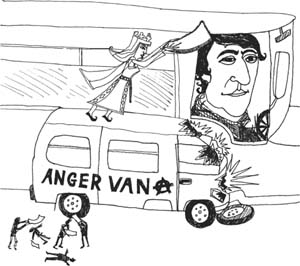
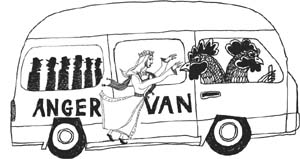
At exactly this moment, Matilda’s anger-van (which has a big anarchy symbol on the side) rams the side of the bus. The ensuing argument with Matilda quickly spreads: all down Norman Street people are taking up their doormats to whack each other on the head.
27
This civil war, splendidly known as ‘The Anarchy’ (1135–54), of course finally lands Matilda’s son Henry II in the driving seat (of the anger-van) as the first king of the House of Angevin.
Henry II immediately puts the pedal to the metal while his beautiful wife, Eleanor of Aquitaine, leans across him to light his cigarette. She doesn’t smoke herself – she’s quit, and she’s looking leaner for it, is old Eleanor of Aquitaine.
The back of the school bus is usually the coolest place to sit but not on this one – twelve angry men are arranged round a table debating someone’s guilt: it’s a jury, a legal implement Henry II introduced to England in 1166.
28+29
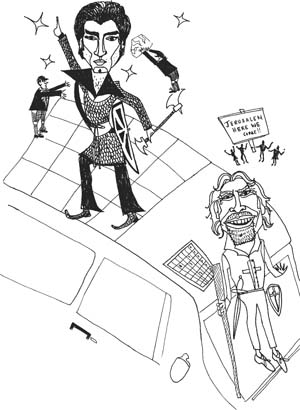
Richard is meanwhile sitting directly above the driver on the roof, now filling in his year planner. Looking at his busy schedule, he notes that he’ll mainly be raiding Jerusalem this year, like the last.
In his ten years on the throne, Richard the Lionheart spent just ten months in England whilst most of his time was spent crusading in the Middle East.
John Travolta, meanwhile, at the back of the roof, is being bullied by some other boys. They are making him sign a piece of paper that says he’s a loser good-for-nothing king, the kind of king bound by the rule of law. He’s signing away his basic rights as king in the Magna Carta of 1215.
But he’s soon laughing at them, saying he was crossing his fingers behind his back all along. They’re furious, of course, which will no doubt remind you of the troubles that followed John’s rejection of the very power-limiting document he’d himself signed.
30
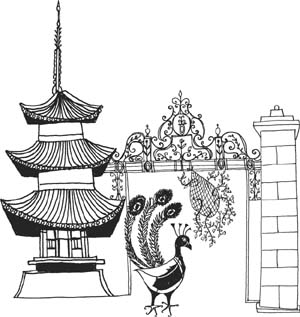
Enough of this, the van has come to a halt at the three-level pagoda that represents the school gates.
We may as well check out what goes on inside. On the first floor we find a room covered in the plans for various English cathedrals – a kind of architect’s cubby-hole.
Up on the second level, we disturb the entrance exams for Oxford University and tiptoe out, mumbling our apologies.
Up at the top, noisy adults sit on green benches jeering at each other – we’re in an early parliament.
These three levels reflect the grand achievements of Henry III’s kingship: the building of vast cathedrals, the foundation of Oxford University and the beginnings of the Houses of Parliament.
Clambering down the fifty-six steps (one for each year in Henry III’s reign), we slip through the school gates and into the Plantagenet playground.
31–3
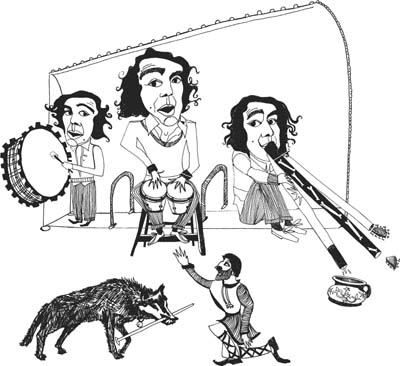
The bike-shed concert is still going strong. The three Eds are really letting fly, though each seems to be playing his own tune.
Edward I is hammering hard on his tartan drum, trying to bring down the walls of Jericho by the sounds of things. The ‘Hammer of the Scots’ was a great wall-builder in his own right, constructing hundreds of castles during his reign.
Edward II has been joined at the bongos by a boy whose nose has been pierced by a carved stone, a guy called Piers Gaverstone. The two of them look like they’re in love.
This surely won’t please Eddie II’s girlfriend, Isabella, who’s known in school as the ‘she-wolf’ for her vicious temper.
Is that a bell I hear? It is! See how Isabella the she-wolf pads in now with a bell tinkling on her neck and a red-hot poker between her jaws. With breathtaking brutality she thrusts the red-hot poker, I’m afraid, into Ed II’s bottom. It is rumoured that Edward II’s wife, Isabella, ordered his brutal murder in this fashion – I think this outdoes Edmund II’s demise for gruesome splendour, no?
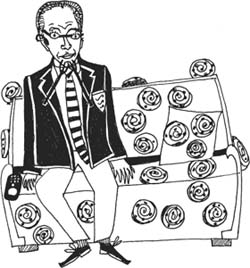
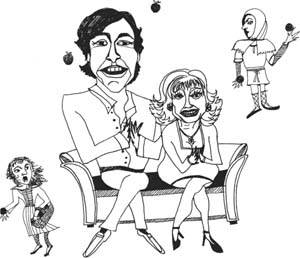
Edward III’s three didgeridoos point out towards Richard and Judy on their sofa.
Cress sandwiches tumble from the first instrument while the middle one, painted black, is rattling alarmingly with the sound of human bones. The third didgeridoo, meanwhile, has been placed in a potty to collect all the saliva dribbling from it. Nice.
The black one with its rattling bones reminds us of the Black Death of 1348. The cress and the potty remind us of Ed’s two great victories at Crécy (1346) and Poitiers (1356) – against the French.
The combined sound of these didgeridoos will reverberate for the next century as these battles set in motion the Hundred Years’ War for the French throne. Right up until the middle of the penguins’ reign, we’ll be able to hear this lugubrious droning sound.
34
Richard and Judy don’t have the necessary peace and quiet to enjoy the music, sadly, for some revolting peasants are pelting them with rotten fruit and veg. King Richard II tells them to calm down, quite effectively actually, for they troop off home, allowing Richard to concentrate on the important business of inventing the handkerchief.
35
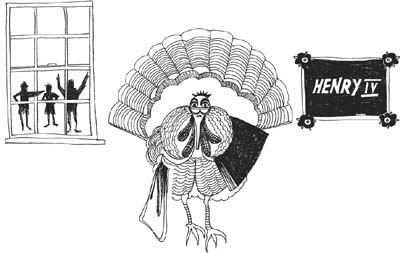
Henry IV, the four-ton turkey who does the register, looks like he’s been waiting for class to settle down forever. But he’s actually been scheming himself. I don’t know if you saw this, but he recently murdered Rich and Judy by suffocating them beneath a tea towel. He still has the murder implement to hand (it’s got the London tube map printed on it).
This tea towel of London stands for the Tower of London, that dungeon of horrors. Since the Tower of London features quite a lot in English history, we’ll be seeing this tea towel again. So make a note: tea towel means tower.
So Henry IV deposed Richard II, and threw him in the Tower of London – where he was later murdered, or possibly just starved to death, in the year 1400. Back in the classroom, Henry IV’s register is continually interrupted by crowds of rebellious kids leaning in the window to heckle him. These girls and boys still believe that Richard and Judy are alive, and that Henry shouldn’t be king. (Rich and Judy are dead, of course; it’s just that their pre-recorded programme continues to air each morning.)
Just so did Henry IV spend much of his time dealing with insurrections and rebellions, with many of his citizens still believing that Richard II remained alive. This hullabaloo is making it impossible to maintain discipline in the classroom, and isn’t helped by the sound of that Hundred Years’ War didgeridoo still droning away in the bike shed.
36
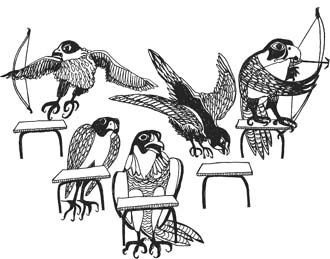
Henry V, our V-formation of peregrine falcons, now adds to the mayhem by reliving yesterday’s match against the French at the Battle of Agincourt.
Out come their longbows as they pepper the wall with arrows, exchanging high fives as they reminisce over their acts of derring-do. ‘There were thousands of them, but we sure as heck nailed the lot of them.’
Unfortunately, after only a few minutes of this, all the falcons die suddenly of dysentery.
How unfortunate that the king of de century, the legendary king who won us the Battle of Agincourt, should die of dysentery.
37
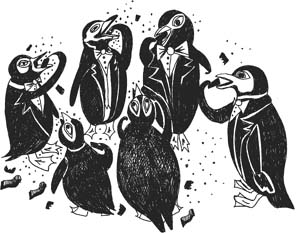
Our huddle of Henry VIs at the back look remarkably like they’re dressed in the Eton school uniform, don’t they? But this should come as no surprise, because Henry VI founded Eton College (and King’s College, Cambridge, with it) during his reign.
But let’s follow the penguins now, as they march in single file for double science. As we go along, the sound of the didgeridoo and the Hundred Years’ War fades away (after 116 years).
38
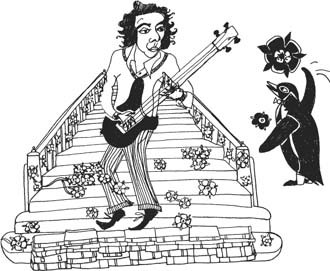
At the stairs of York, the sound of a bass guitar immediately flumps into our ears; bass guitarist Edward IV is blocking our way. He’s made an obstacle of himself, erecting a stage from thousands of books – they’re suddenly two a penny since England’s first printing press got into operation during his reign.
Our penguin guide, a great believer in flower power, starts launching red roses aggressively at the bassist. Edward IV returns fire with some white ones. Yes, people, we are in the War of the Roses. When Edward loses patience with the ineffective rose weapon, he lobs a giant tea towel over the heads of our penguin huddle.
That’s right: Edward IV resorted to the tea-towel treatment when reclaiming his throne, throwing his adversary Henry VI to a nasty death in the tower.
39
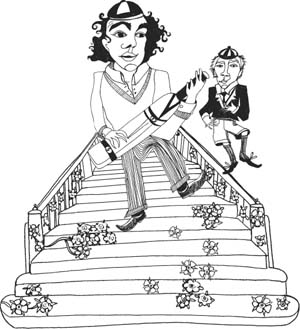
Just behind this chaotic scene, Edward V is still air-guitaring away. He’s actually on the way to recruiting a whole (pretend) band, if you look – what with his little brother, Little Richard, miming along beside.
40
But three-legged Richard III, hunchbacked Ricky Gervaise, is creeping down from the stairs towards Edward V and his brother – and is that another tea towel in his hands? Indeed it is.
Ricky III has swooped up Edward V and his brother Richard in the towel, smuggling them to their death in the tower. These were then the so-called Princes in the Tower, rumours of whose disastrous fate still echo to this day.
41
Phew! We’re off the staircase and into double science. Inscribed above the two doors of the House of Tudor, the date reads 1485.
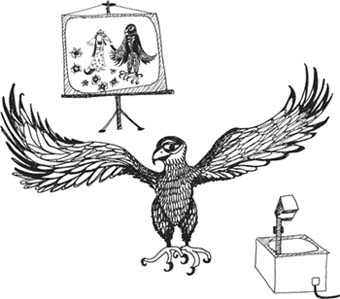
At the front of the class, Henry VII is making good use of the overhead projector to show us his wedding snaps. He’s obviously chuffed with his new lizard bride, whose beautiful dress is made entirely from white rose petals. This lizard of York is Elizabeth of York, and her white petals mix beautifully with his Lancastrian red to make the red-and-white Tudor rose.
One very entertaining picture is of the married couple cutting their cake, which is a Simnel cake. At the moment they jointly push down, you can see Lambert Simnel, pretender to the throne, bursting out of the middle, playing air-guitar and shouting, ‘I’m King Edward V.’ Very funny.
Henry VII quite stylishly ordered Simnel to work in the royal kitchens after he tried to steal the crown by pretending to be Edward V. It was in these kitchens that he’s rumoured to have invented the Simnel cake.
The lesson gets underway.
42
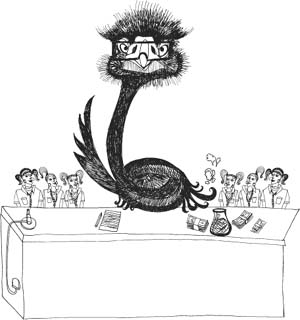
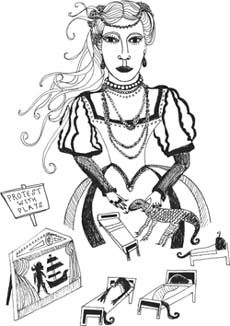
In the front row, Henry VIII, our eight-foot ostrich, is not alone: six of his girlfriends join him there, three to either side. But you know that Henry VIII had six wives.
More interestingly, look at this – Henry has rebelliously taken a jar of acid and he’s dissolving wads of money in the fizzing liquid. This is some kind of protest, and by his dissolution of the monasteries, Henry VIII created the Protestant Church of England.
Since the ensuing history of the royal household is dominated by infighting within the Christian church, we need to be able to recognize our Protestants from our Catholics: where we have someone protesting in some way, they are a Protestant. Catholics will be spotted by a cat licking at them.
43
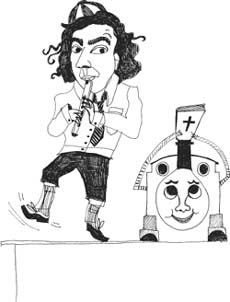
At the back, then, Ed VI, a ten-year-old, is tooting away on his recorder, playing protest songs. Think about it… Next to him you can see how his mate Thomas the Tank Engine is cramming copies of the newly released Book of Common Prayer into his funnel.
During the young Edward VI’s brief reign, Thomas Cramner introduced this important book.
44
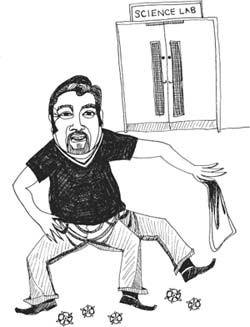
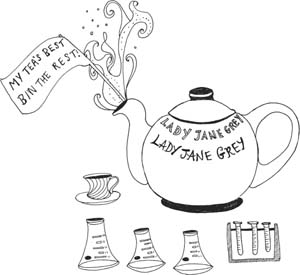
In the lab, Lady Jane Grey is also mounting a small protest – she’s another protestant. She is such a goodie two-shoes, though, that her idea of a protest is to make her own variety of tea when she should be making the plain stuff.
In any case, she only has time to brew it for a lame nine seconds, because Mary is wandering over with a tea towel, disgusted at this protest(ant). We know what the tea towel means for poor Jane, don’t we? So that was the end of Lady Jane Grey – her death in The Tower came after only nine days on the throne.
45
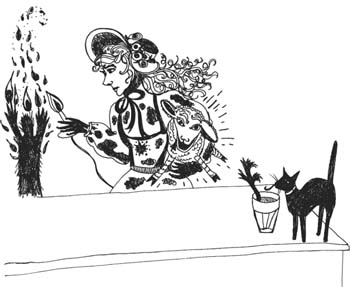
Look at this! Mary, having dealt with Jane Grey, is setting out on a rampage about the classroom with her Bunsen burner, burning anyone she suspects of protesting. She’s left her cocktail in the capable paws of a cat that licks up the potent liquid with great aplomb.
Catholic Queen Mary’s ‘Marian Persecutions’ resulted in her burning at least 300 Protestants at the stake.
46
But Mary’s death brings her half-sister, Elizabeth I, to the throne, a woman whose quiet protest has gone unnoticed during the Marian massacre. It takes an unusual form: she’s training her lizards to perform a subversive forty-five-minute-long play, written by Shakespeare, whose scenes include a battle involving the Spanish Armada, the discovery of the New World and a warty fellow juggling potatoes while cycling on a Raleigh bike smoking a cigarette.
With Shakespearian drama, the defeat of the Spanish, the conquest of the New World and Sir Walter Raleigh’s (related) introduction of potatoes and tobacco, the Elizabethan era is still warmly remembered today as a happening forty-five years.
47
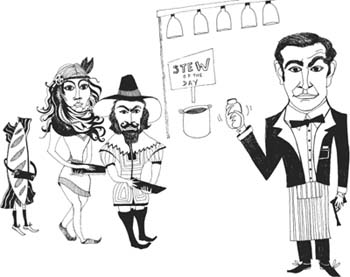
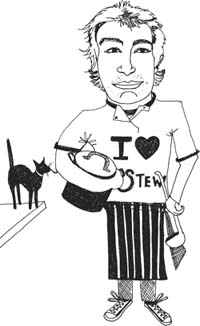
Over in the dining hall Sean Connery, our James I, is Scottish, of course – and he proudly presides over the Stuarts’ stew. It is quite a collection of characters he’s serving – Guy Fawkes and Pocahontas are waiting in line. There’s even a rasher of bacon in a French baguette, Sir Francis Bacon, queuing up.
48
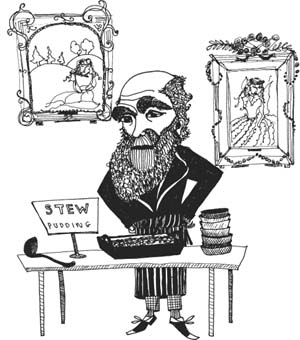
Along the counter, Charles Darwin’s part of the kitchen looks fantastic with all the expensive portraits he’s put up. Charles I was a great patron of the visual arts, and single-minded in his vision of the king’s right to rule as he pleased.
So when Oliver Cromwell starts demanding olive crumble, he refuses to listen to the boy. His decapitation during the food fight that results is noteworthy for its dignity.
We shouldn’t, meanwhile, dwell on the ugly story of Oliver Cromwell, who caused all this, for he was never king. From his selfish crumble demands we know already, I think, that he was a vicious and self-obsessed man.
49
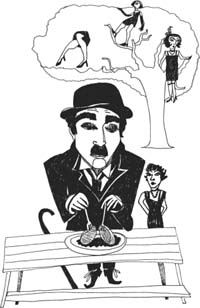
Outside, while eating our food, Charles II drops from the branches of an oak tree to say a merry ‘hi’. He’s been hiding in this oak ever since the Battle of Worcester (sauce) during the latter stages of the food fight we just witnessed. This is what the pub name ‘Royal Oak’ refers to, incidentally.
He soon invites an alarmingly diverse collection of girlfriends down. Lunch in the company of the ‘merry monarch’ himself, Charles II, and his lovely ladies is quite enjoyable; the only thing to mar the meal is the neighbouring table, where diners are falling terribly ill, with horrible screams, before spontaneously combusting.
These experiences may help us recall how Charles II, aside from collecting mistresses, had to deal with such events as the Plague and the Great Fire (of London, not Wem) that took place in 1666.
50
With Jamie Oliver’s arrival, we are initially delighted. But our joy turns to disgust when we see that he’s letting his hand be licked by a mangy little cat.
We all agree that James II’s partiality to being licked by a cat, his Catholicism, is a major health-and-safety issue. So, we vote with our feet and tool onwards to the house of Orange.
James II was the first king removed by vote of parliament – who, in the so-called Glorious Revolution, invited his daughter, Mary (a nice, reliable hater of cats) to assume the throne instead – with the help of her Dutch husband. This all happened in 1688.
51
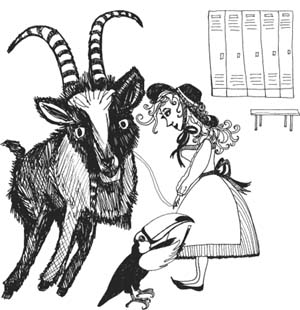
So, William and Mary (unusual joint sovereigns) are still running round and round in circles in their orange changing room when a toucan asks for their autographs. But while busy trying to sign its colourful bill (a great big thing, the perfect size for writing on) William trips on a rogue molehill and falls to his death.
William and Mary signed the Bill of Rights, limiting the monarch’s power yet further, and this was a great inspiration for the American Declaration of Independence. William died of pneumonia after a fall when his horse tripped on a molehill, and the mole, ‘the little fellow in the velvet waistcoat’, was toasted by ribald Jacobites.
52
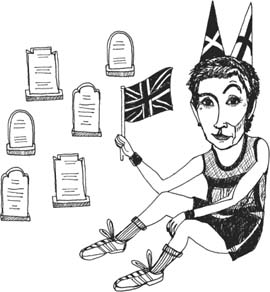
Next to Anne Robinson on the side of the changing rooms, there are, quite alarmingly, seventeen miniature tombstones scattered about the place. The only one of Queen Anne’s seventeen children to survive infancy died at the age of eleven, which just goes to show the state of medicine at the time.
But Anne is putting a brave face on things – she’s waving a Union Jack above her head and she’s got not one but two party hats on. It was during Anne’s reign in 1707 that the act of Union occurred where Scotland officially joined England, the two becoming Britain, and two-party politics also got going.
53
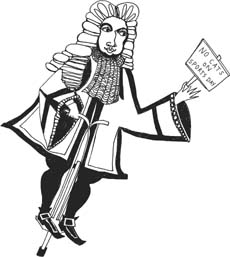
Out on the track, George I, on his pogo stick, is a short, fat, unhealthy, poor-tempered old man – lacking in any kind of charm. He nonetheless totters ahead surprisingly fast on his pogo stick. (Impressive for a fifty-four-year-old, the oldest age for a king to start his reign so far.)
Instead of a baton, he’s carrying a protest banner (reading ‘no cats on sports day!’), so all the English cheer him along enthusiastically. He scowls – not only does he not understand what they’re saying (he speaks no English) but he has little regard for the people over whom he reigns, who selected him for his staunch Protestantism.
He hands the banner-baton over in unorthodox fashion – by whacking it over his son’s head, their relationship being famously fractious.
54
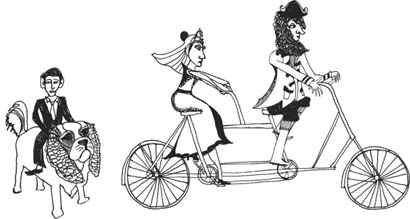
George II, in full military uniform, races forward with his wife Caroline behind him on their tandem. He needs her help – he is being raced on the outside by a young Prince Charles on the dog Bonnie. It’s Bonnie Prince Charlie, the young pretender to the throne. George II outstrips him, though – which is the least you’d expect of the last English king to have fought in battle, and presently he hands over to his own son, continuing the family tradition by beating him over the head.
55
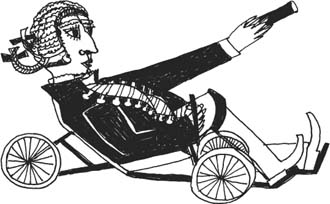
George III seems a pleasanter sort, but events off the track dominate his sixty-yard leg of the race. Most notably, some angry American athletes try to set up a breakaway sports event over on the other side of the track. At this, the loss of the American colonies, George III goes quite mad with rage, and stops in his tracks, unable to continue.
All the same, he does last sixty years on the throne, the longest so far.
56
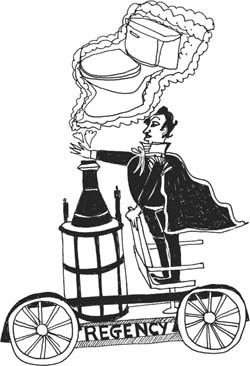
George IV has to reverse his steam engine and take over the baton, even though it’s not yet officially his go. This leg of the race is the so-called Regency – where George carries the baton for his father, who’s too mad to do so himself.
George IV is enormously fat, by the way, hence the need for a steam engine. As he goes along, the steam from his funnel briefly forms the shape of a loo in the air – marking victory in the Battle of Waterloo in 1815.
When George III is finally removed from the track and it’s officially our steam-engine driver’s go, his lady-friend comes on to the track to celebrate but he pushes her away – just as the real George IV had his wife banned from his own coronation. Ouch.
57
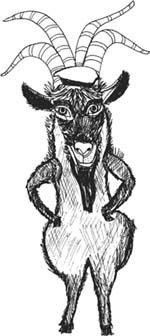
As we cross the finish line ahead of G4 and clatter into our four-pronged goat, we knock a naval cap from its head. William IV was known as the Sailor King, having served in the Royal Navy.
It’s a bit unclear how we’ll ever escape from his horrible horns – they’ve pretty much got us trapped – but at the last moment they re-form, and we drop off and are free again to do as we please. This fortunate Reform Act (of 1832) gave normal people like us the freedom to vote (except for women – they had to wait. And under eighteens – they’re still waiting).
58
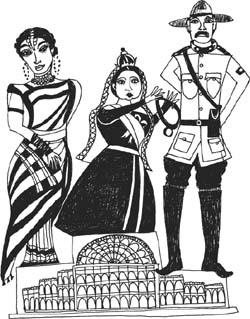
Queen Victoria’s winner’s podium is made entirely of glass. It is a miniature model of the Crystal Palace, the iconic building of Victoria’s reign. On the podium with us are an Indian girl and a Canadian man, this being the peak of the British Empire.
Victoria is so short (five feet tall) that she requires her beloved husband Albert to lift her up to deliver the medals. Hurrah! The only downside is the length of the ceremony, sixty-three minutes: a minute for each year of Victoria’s record-breaking reign.
59
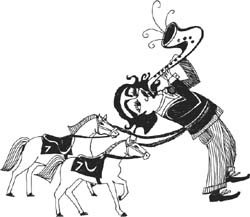
Edward VII, who’s playing the national anthem in the French style, is enjoying the prospect of the approaching marathon. He actually owns several of the horses who’ll be racing alongside us. Hmm… worrying… he’s a terribly successful horse-owner.
He looks very chirpy and mightily relieved to be playing his sax at last, and who can blame him? He spent longer than our own Prince Charles waiting for his mother to pass on the spoon so he could have a go as king – much of which time was in France. There, he established the Entente Cordiale that is still around today.
60
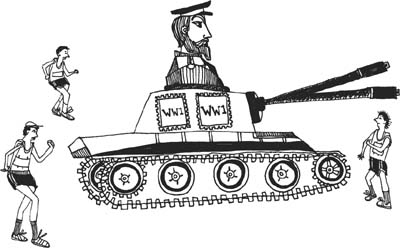
As we hop on to the back of George’s double-barrelled V-tank, we’re not actually lost for things to do during the twenty-six-year marathon reign. For a start, there’s WWI to cheer along, and then there’s George V’s incredible stamp collection to be enjoyed.
George V led Britain through WWI right into the thirties, though he avoided the public spotlight most of the time, preferring time with his stamps.
61
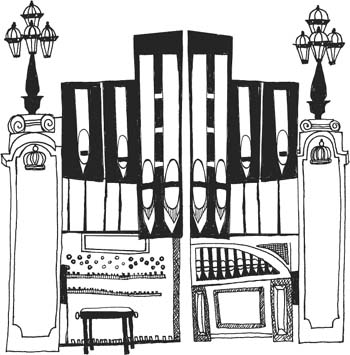
At the organ-gates, Edward VIII seems to be walloping out the theme tune to The Simpsons on his organ. He gets about six bars in and then gives up. This may remind us of how he abdicated the throne after only six months so that he could run off with an American lady named Wallis Simpson.
62
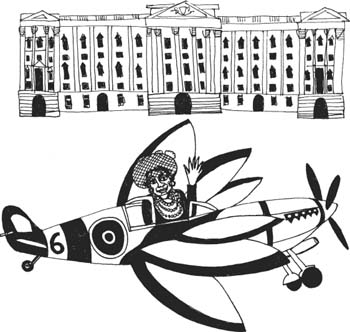
Passing the organ into the courtyard, we notice that the rather smart Spitfire, this means of transport that will take us through WWII, is actually being driven by the Queen Mother, who was George VI’s wife. She’s trying to start the plane now – but the engine is misfiring, stuttering terribly.
George VI had an awkward stutter, but worked hard at overcoming it after unexpectedly acceding to the throne, and was much admired, not least for his supreme wife.
63
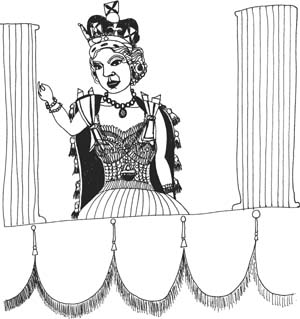
And Queen Elizabeth II – waving at us from the balcony – well, there’s no need to elaborate on her evident perfection, is there?