
Greetings, traveler; you’ve come a long way. While this is the last chapter, it’s all about the journey, not the end. You’re now equipped with the gear and skills required to step into the real world of cryptography. What’s left is for you to apply what you’ve learned.
Before parting ways, I’d like to give you a few hints and tools that’ll be useful for what follows. The quests you’ll face often follow the same pattern: it starts with a challenge, launching you on a pursuit for an existing cryptographic primitive or protocol. From there, you’ll look for a standard and a good implementation, and then you’ll make use of it in the best way you can. That’s if everything goes according to plan. . . .
You’re facing unencrypted traffic, or a number of servers that need to authenticate one another, or some secrets that need to be stored without becoming single points of failure. What do you do?
You could use TLS or Noise (mentioned in chapter 9) to encrypt your traffic. You could set up a public key infrastructure (mentioned in chapter 9) to authenticate servers via the signature of some certificate authority, and you could distribute a secret using a threshold scheme (covered in chapter 8) to avoid the compromise of one secret to lead to the compromise of the whole system. These would be fine answers.
If the problem you’re facing is a common one to have, chances are that you can simply find an existing cryptographic primitive or protocol that directly solves your use case. This book gives you a good idea of what the standard primitives and common protocols are, so at this point, you should have a good idea of what’s at your disposal when faced with a cryptographic problem.
Cryptography is quite an interesting field, going all over the place as new discoveries and primitives are invented and proposed. While you might be tempted to explore exotic cryptography to solve your problem, your responsibility is to remain conservative. The reason is that complexity is the enemy of security. Whenever you do something, it is much easier to do it as simply as possible. Too many vulnerabilities have been introduced by trying to be extravagant. This concept has been dubbed boring cryptography by Bernstein in 2015, and has been the inspiration behind the naming of Google’s TLS library, BoringSSL.
Cryptographic proposals need to withstand many years of careful scrutiny before they become plausible candidates for field use. This is especially when the proposal is based on novel mathematical problems.
—Rivest et al. (“Responses to NIST's proposal,” 1992)
What if you can’t find a cryptographic primitive or protocol that solves your problem? This is where you must step into the world of theoretical cryptography, which is obviously not the subject of this book. I can merely give you recommendations.
The first recommendation I will give you is the free book A Graduate Course in Applied Cryptography, written by Dan Boneh and Victor Shoup, and available at https://cryptobook.us. This book provides excellent support that covers everything I’ve covered in this book but in much more depth. Dan Boneh also has an amazing online course, “Cryptography I,” also available for free at https://www.coursera.org/learn/ crypto. It is a much more gentle introduction to theoretical cryptography. If you’d like to read something halfway between this book and the world of theoretical cryptography, I can’t recommend enough the book, Serious Cryptography: A Practical Introduction to Modern Encryption (No Starch Press, 2017) by Jean-Philippe Aumasson.
Now, let’s imagine that you do have an existing cryptographic primitive or protocol that solves your solution. A cryptographic primitive or protocol is still very much of a theoretical thing. Wouldn’t it be great if it had a practical standard that you could use right away?
You realize that a solution exists that meets your needs, now does it have a standard? Without a standard, a primitive is often proposed without consideration for its real-world use. Cryptographers often don’t think about the different pitfalls of using their primitive or protocol and the details of implementing them. Polite cryptography is what Riad S. Wahby once called standards that care about their implementation and leave little room for implementers to shoot themselves in the foot.
The poor user is given enough rope with which to hang himself—something a standard should not do.
—Rivest et al. (“Responses to NIST's proposal,” 1992)
A polite standard is a specification that aims to address all edge cases and potential security issues by providing safe and easy-to-use interfaces to implement, as well as good guidance on how to use the primitive or protocol. In addition, good standards have accompanying test vectors: lists of matching inputs and outputs that you can feed to your implementation to test its correctness.
Unfortunately, not all standards are “polite,” and the cryptographic pitfalls they create are what make most of the vulnerabilities I talk about in this book. Sometimes standards are too vague, lack test vectors, or try to do too much at the same time. For example, cryptography agility is the term used to specify the flexibility of a protocol in terms of cryptographic algorithms it supports. Supporting different cryptographic algorithms can give a standard an edge because sometimes one algorithm gets broken and deprecated while others don’t. In such a situation, an inflexible protocol prevents clients and services from easily moving on. On the other hand, too much agility can also strongly affect the complexity of a standard, sometimes even leading to vulnerabilities, as the many downgrade attacks on TLS can attest.
Unfortunately, more often than cryptographers are willing to admit, you will run into trouble when your problem either meets an edge case that the mainstream primitives or protocols don’t address, or when your problem doesn’t match a standardized solution. For this reason, it is extremely common to see developers creating their own mini-protocols or mini-standards. This is when trouble starts.
When wrong assumptions are made about the primitive’s threat model (what it protects against) or about its composability (how it can be used within a protocol), breakage happens. These context-specific issues are amplified by the fact that cryptographic primitives are often built in a silo, where the designer did not necessarily think about all the problems that could arise once the primitive is used in a number of different ways or within another primitive or protocol. I gave many examples of this: X25519 breaking in edge cases protocols (chapter 11), signatures assumed to be unique (chapter 7), and ambiguity in who is communicating to whom (chapter 10). It’s not necessarily your fault! The developers have outsmarted the cryptographers, revealing pitfalls that no one knew existed. That’s what happened.
If you ever find yourself in this type of situation, the go-to tool of a cryptographer is pen-and-paper proof. This is not quite helpful for us, the practitioners, as we either don’t have the time to do that work (it really takes a lot of time) or even the expertise. We’re not helpless, though. We can use computers to facilitate the task of analyzing a mini-protocol. This is called formal verification, and it can be a wonderful use of your time.
Formal verification allows you to write your protocol in some intermediate language and test some properties on it. For example, the Tamarin protocol prover (see figure 16.1) is a formal verification tool that has been (and is) used in order to find subtle attacks in many different protocols. To learn more about this, see the papers “Prime, Order Please! Revisiting Small Subgroup and Invalid Curve Attacks on Protocols using Diffie-Hellman” (2019) and “Seems Legit: Automated Analysis of Subtle Attacks on Protocols that Use Signatures” (2019).
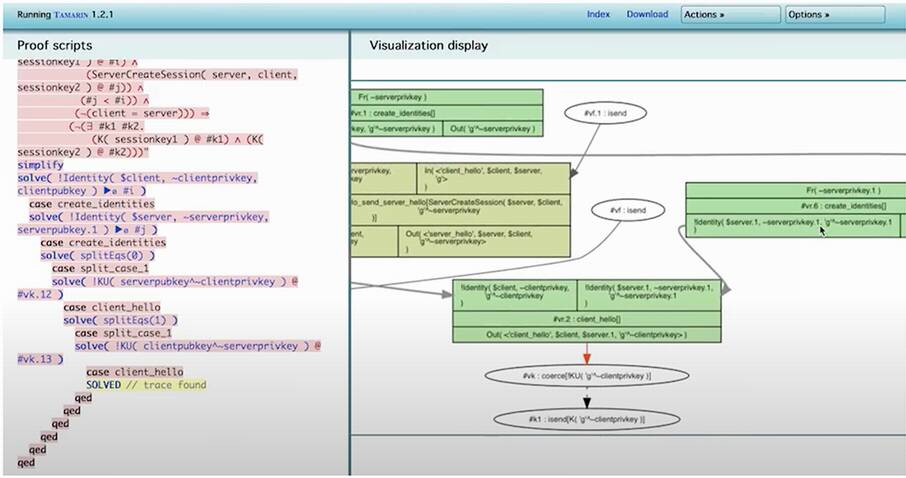
Figure 16.1 The Tamarin protocol prover is a free formal verification tool that you can use to model a cryptographic protocol and find attacks on it.
The other side of the coin is that it is often hard to use formal verification tools. The first step is to understand how to translate a protocol into the language and the concepts used by the tool, which is often not straightforward. After having described a protocol in a formal language, you still need to figure out what you want to prove and how to express it in the formal language.
It is not uncommon to see a proof that actually proved the wrong things, so one can even ask who verifies the formal verification? Some promising research in this area is aimed at making it easier for developers to formally verify their protocols. For example, the tool Verifpal (https://verifpal.com) trades off soundness (being able to find all attacks) for ease of use.
You can also use formal verification to verify a cryptographic primitive’s security proofs using formal verification tools like Coq, CryptoVerif, and ProVerif, and even to generate “formally verified” implementations in different languages (see projects like HACL*, Vale, and fiat-crypto, which implement mainstream cryptographic primitives with verified properties like correctness, memory safety, and so on). That being said, formal verification is not a foolproof technique; gaps between the paper protocol and its formal description or between the formal description and the implementation will always exist and appear innocuous until found to be fatal.
Studying how other protocols fail is an excellent way of avoiding the same mistakes. The cryptopals.com or cryptohack.org challenges are a great way to learn about what can go wrong in using and composing cryptographic primitives and protocols. Bottom line—you need to thoroughly understand what you’re using! If you are building a mini-protocol, then you need to be careful and either formally verify that protocol or ask experts for help. OK, we have a standard, or something that looks like it, now who’s in charge of implementing that?
You’re one step closer to solving your problem. You know the primitive or protocol you want to use, and you have a standard for it. At the same time, you’re also one step further away from the specification, which means you might create bugs. But first, where’s the code?
You look around, and you see that there are many libraries or frameworks available for you to use. That’s a good problem to have. But still, which library do you pick? Which is most secure? This is a hard question to answer. Some libraries are well-respected, and I’ve listed some in this book: Google’s Tink, libsodium, cryptography.io, etc.
Sometimes, though, it is hard to find a good library to use. Perhaps the programming language you’re using doesn’t have that much support for cryptography, or perhaps the primitive or protocol you want to use doesn’t have that many implementations. In these situations, it is good to be cautious and ask the cryptography community for advice, look at the authors behind the library, and perhaps even ask experts for a code review. For example, the r/crypto community on Reddit is pretty helpful and welcoming; emailing authors directly sometimes works; asking the audience during open-mic sessions at conferences can also have its effect.
If you’re in a desperate situation, you might even have to implement the cryptographic primitive or protocol yourself. There are many issues that can arise at this point, and it is a good idea to check for common issues that arise in cryptographic implementations. Fortunately, if you are following a good standard, then mistakes are less easy to make. But still, implementing cryptography is an art, and it is not something you should get yourself into if you can avoid it.
One interesting way to test a cryptographic implementation is to use tooling. While no single tooling can cater to all cryptographic algorithms, Google’s Wycheproof deserves a mention. Wycheproof is a suite of test vectors that you can use to look for tricky bugs in common cryptographic algorithms like ECDSA, AES-GCM, and so on. The framework has been used to find an impressive number of bugs in different cryptographic implementations. Next, let’s pretend that you did not implement cryptography yourself and found a cryptography library.
You found some code you can use, you’re one step further, yet you find there are more opportunities to create bugs. This is where most bugs in applied cryptography happen. We’ve seen examples of misusing cryptography in this book again and again: reusing nonces is bad in algorithms like ECDSA (chapter 7) and AES-GCM (chapter 4), collisions can arise when the misuse of hash functions happen (chapter 2), parties can be impersonated due to lack of origin authentication (chapter 9), and so on.
The results show that just 17% of the bugs are in cryptographic libraries (which often have devastating consequences), and the remaining 83% are misuses of cryptographic libraries by individual applications.
—David Lazar, Haogang Chen, Xi Wang, and Nickolai Zeldovich (“Why does cryptographic software fail? A case study and open problems,” 2014)
In general, the more a primitive or protocol is abstracted, the safer it is to use. For example, AWS offers a Key Management Service (KMS) to host your keys in HSMs and to perform cryptographic computations on-demand. This way, cryptography is abstracted at the application level. Another example is programming languages that provide cryptography within their standard libraries, which are often more trusted than third-party libraries. For example, Golang’s standard library is excellent.
The care given to the usability of a cryptographic library can often be summarized as “treating the developer as the enemy.” This is the approach taken by many cryptographic libraries. For example, Google’s Tink doesn’t let you choose the nonce/IV value in AES-GCM (see chapter 4) in order to avoid accidental nonce reuse. The libsodium library, in order to avoid complexity, only offers a fixed set of primitives without giving you any freedom. Some signature libraries wrap messages within a signature, forcing you to verify the signature before releasing the message, and the list goes on. In this sense, cryptographic protocols and libraries have a responsibility to make their interfaces as misuse resistant as possible.
I’ve said it before, I’ll say it again—make sure you understand the fine print (all of it) for what you’re using. As you’ve seen in this book, misusing cryptographic primitives or protocols can fail in catastrophic ways. Read the standards, read the security considerations, and read the manual and the documentation for your cryptographic library. Is this it? Well, not really. . . . You’re not the only user here.
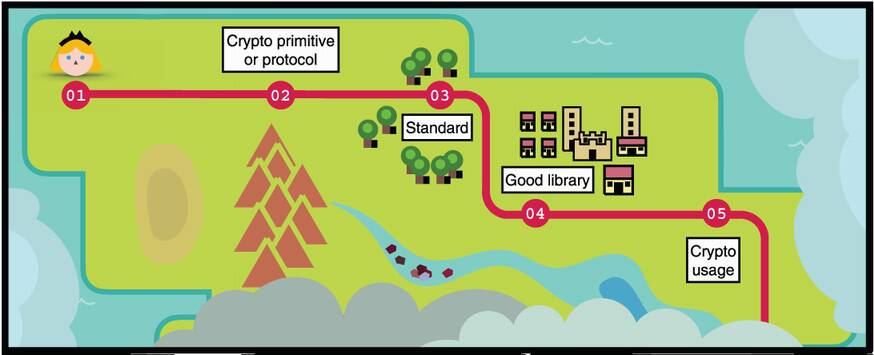
Using cryptography solves problems that applications have in often transparent ways but not always! Sometimes, the use of cryptography leaks to the users of the applications.
Usually, education can only help so much. It is, hence, never a good idea to blame the user when something bad happens. The relevant field of research is called usable security, in which solutions are sought to make security and cryptography-related features as transparent as possible to users, removing as many opportunities for misuse as possible. One good example is how browsers gradually shifted from simple warnings when SSL/TLS certificates were invalid to making it harder for users to accept the risk.
We observed behavior that is consistent with the theory of warning fatigue. In Google Chrome, users click through the most common SSL error faster and more frequently than other errors. [. . .] We also find clickthrough rates as high as 70.2% for Google Chrome SSL warnings, indicating that the user experience of a warning can have a tremendous impact on user behavior.
—Devdatta Akhawe and Adrienne Porter Felt (“Alice in Warningland: A Large-Scale Field Study of Browser Security Warning Effectiveness,” 2013)
Another good example is how security-sensitive services have moved on from passwords to supporting second-factor authentication (covered in chapter 11). Because it was too hard to force users to use strong per-service passwords, another solution was found to eliminate the risk of password compromise. End-to-end encryption is also a good example because it is always hard for users to understand what it means to have their conversations end-to-end encrypted and how much of the security comes from them actively verifying fingerprints (covered in chapter 10). Whenever cryptography is pushed to users, great effort must be taken to reduce the risk of user mistakes.
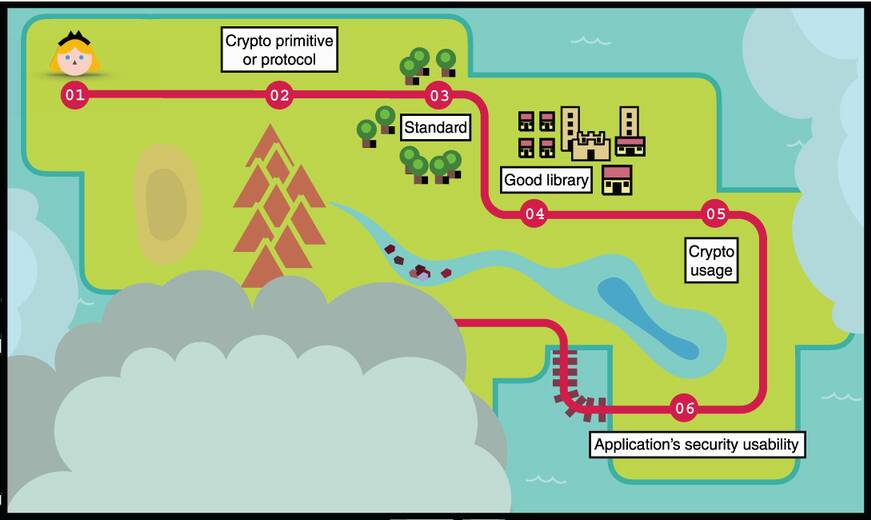
Cryptography is often used as part of a more complex system that can also have bugs. Actually, most of the bugs live in those parts that have nothing to do with the cryptography itself. An attacker often looks for the weakest link in the chain, the lowest hanging fruit, and it so happens that cryptography often does a good job at raising the bar. Encompassing systems can be much larger and complex and often end up creating more accessible attack vectors. Adi Shamir famously said, “Cryptography is typically bypassed, not penetrated.”
While it is good to put some effort into making sure that the cryptography in your system is conservative, well-implemented, and well-tested, it is also beneficial to ensure that the same level of scrutiny is applied to the rest of the system. Otherwise, you might have done all of that for nothing.
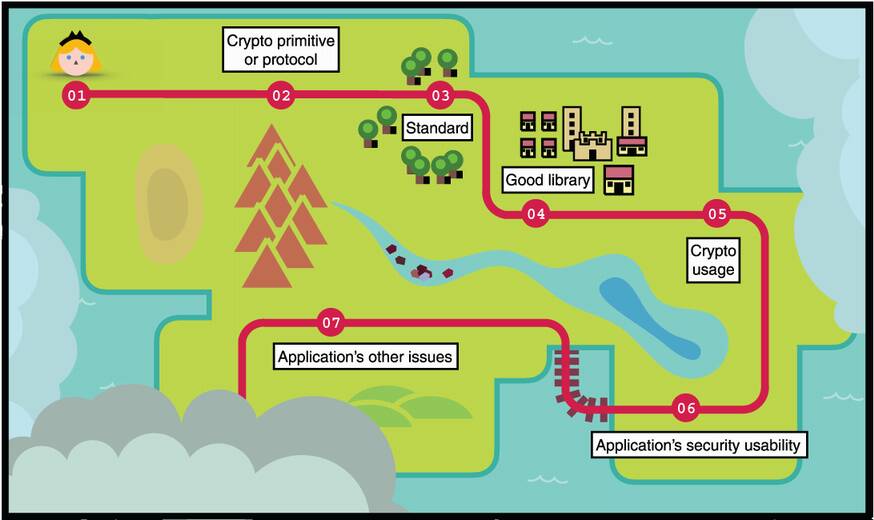
That’s it, this is the end of the book, you are now free to gallop in the wilderness. But I have to warn you, having read this book gives you no superpowers; it should only give you a sense of fragility. A sense that cryptography can easily be misused and that the simplest mistake can lead to devastating consequences. Proceed with caution!
You now have a big crypto toolset at your belt. You should be able to recognize what type of cryptography is being used around you, perhaps even identify what seems fishy. You should be able to make some design decisions, know how to use cryptography in your application, and understand when you or someone is starting to do something dangerous that might require more attention. Never hesitate to ask for an expert’s point of view.
“Don’t roll your own crypto” must be the most overused cryptography line in software engineering. Yet, these folks are somewhat right. While you should feel empowered to implement or even create your own cryptographic primitives and protocols, you should not use it in a production environment. Producing cryptography takes years to get right: years of learning about the ins and outs of the field, not only from a design perspective but from a cryptanalysis perspective as well. Even experts who have studied cryptography all their lives build broken cryptosystems. Bruce Schneier once famously said, “Anyone, from the most clueless amateur to the best cryptographer, can create an algorithm that he himself can’t break.” At this point, it is up to you to continue studying cryptography. These final pages are not the end of the journey.
I want you to realize that you are in a privileged position. Cryptography started as a field behind closed doors, restricted only to members of the government or academics kept under secrecy, and it slowly became what it is today: a science openly studied throughout the world. But for some people, we are still very much in a time of (cold) war.
In 2015, Rogaway drew an interesting comparison between the research fields of cryptography and physics. He pointed out that physics had turned into a highly political field shortly after the nuclear bombing of Japan at the end of World War II. Researchers began to feel a deep responsibility because physics was starting to be clearly and directly correlated to the deaths of many and the deaths of potentially many more. Not much later, the Chernobyl disaster would amplify this feeling.
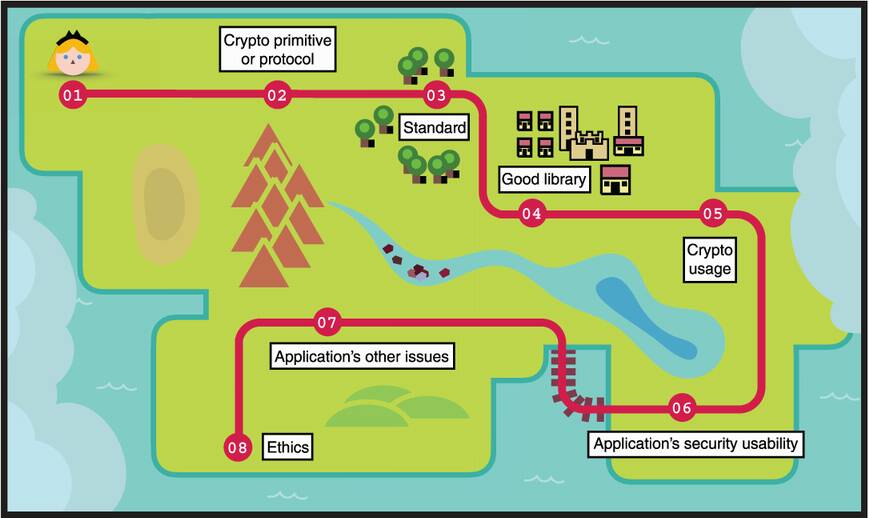
On the other hand, cryptography is a field where privacy is often talked about as though it were a different subject, making cryptography research apolitical. Yet, decisions that you and I take can have a long-lasting impact on our societies. The next time you design or implement a system using cryptography, think about the threat model you’ll use. Are you treating yourself as a trusted party or are you designing things in a way where even you cannot access your users’ data or affect their security? How do you empower users through cryptography? What do you encrypt? “We kill people based on metadata,” said former NSA chief Michael Hayden (http://mng .bz/PX19).
In 2012, near the coast of Santa Barbara, hundreds of cryptographers gathered around Jonathan Zittrain in a dark lecture hall to attend his talk, “The End of Crypto” (https://www.youtube.com/watch?v=3ijjHZHNIbU). This was at Crypto, the most respected cryptography conference in the world. Jonathan played a clip from the television series Game of Thrones to the room. In the video, Varys, a eunuch, poses a riddle to the hand of the king, Tyrion. This is the riddle:
Three great men sit in a room: a king, a priest, and a rich man. Between them stands a common sellsword. Each great man bids the sellsword kill the other two. Who lives, who dies? Tyrion promptly answers, “Depends on the sellsword,” to which the eunuch responds, “If it’s the swordsman who rules, why do we pretend kings hold all the power?”.
Jonathan then stopped the clip and pointed to the audience, yelling at them, “You get that you guys are the sellswords, right?”
Real-world cryptography tends to fail mostly in how it is applied. We already know good primitives and good protocols to use in most use cases, which leaves their misuse as the source of most bugs.
A lot of typical use cases are already addressed by cryptographic primitives and protocols. Most of the time, all you’ll have to do is find a respected implementation that addresses your problem. Make sure to read the manual and to understand in what cases you can use a primitive or a protocol.
Real-world protocols are constructed with cryptographic primitives by combining them like Lego. When no well-respected protocols address your problem, you’ll have to assemble the pieces yourself. This is extremely dangerous as cryptographic primitives sometimes break when used in specific situations or when combined with other primitives or protocols. In these cases, formal verification is an excellent tool to find issues, although it can be hard to use.
Implementing cryptography is not just difficult; you also have to think about hard-to-misuse interfaces (in the sense that good cryptographic code leaves little room for the user to shoot themselves in the foot).
Staying conservative and using tried-and-tested cryptography is a good way to avoid issues down the line. Issues stemming from complexity (for example, supporting too many cryptographic algorithms) is a big topic in the community, and steering away from over-engineered systems has been dubbed “boring cryptography.” Be as boring as you can.
Both cryptographic primitives and standards can be responsible for bugs in implementations due to being to complicated to implement or to vague about what implementers should be wary of. Polite cryptography is the idea of a cryptographic primitive or standard that is hard to badly implement. Be polite.
The use of cryptography in an application sometimes leaks to the users. Usable security is about making sure that users understand how to handle cryptography and cannot misuse it.
Cryptography is not an island. If you follow all of the advice this book gives you, chances are that most of your bugs will happen in the noncryptographic parts of your system. Don’t overlook these!
With what you have learned in this book, make sure to be responsible, and think hard about the consequences of your work.