Chapter 23. Attribute Descriptors
Learning about descriptors not only provides access to a larger toolset, it creates a deeper understanding of how Python works and an appreciation for the elegance of its design.
Raymond Hettinger, Python core developer and guru1
Descriptors are a way of reusing the same access logic in multiple attributes. For example, field types in ORMs, such as the Django ORM and SQLAlchemy, are descriptors, managing the flow of data from the fields in a database record to Python object attributes and vice versa.
A descriptor is a class that implements a dynamic protocol consisting of the __get__, __set__, and __delete__ methods. The property class implements the full descriptor protocol. As usual with dynamic protocols, partial implementations are OK. In fact, most descriptors we see in real code implement only __get__ and __set__, and many implement only one of these methods.
Descriptors are a distinguishing feature of Python, deployed not only at the application level but also in the language infrastructure. User-defined functions are descriptors. We’ll see how the descriptor protocol allows methods to operate as bound or unbound methods, depending on how they are called.
Understanding descriptors is key to Python mastery. This is what this chapter is about.
In this chapter we’ll refactor the bulk food example we first saw in “Using a Property for Attribute Validation”, replacing properties with descriptors. This will make it easier to reuse the attribute validation logic across different classes. We’ll tackle the concepts of overriding and nonoverriding descriptors, and realize that Python functions are descriptors. Finally we’ll see some tips about implementing descriptors.
What’s New in This Chapter
The Quantity descriptor example in “LineItem Take #4: Automatic Naming of Storage Attributes” was dramatically simplified thanks to the __set_name__ special method added to the descriptor protocol in Python 3.6.
I removed the property factory example formerly in “LineItem Take #4: Automatic Naming of Storage Attributes” because it became irrelevant: the point was to show an alternative way of solving the Quantity problem, but with the addition of __set_name__, the descriptor solution becomes much simpler.
The AutoStorage class that used to appear in “LineItem Take #5: A New Descriptor Type” is also gone because __set_name__ made it obsolete.
Descriptor Example: Attribute Validation
As we saw in “Coding a Property Factory”, a property factory is a way to avoid repetitive coding of getters and setters by applying functional programming patterns.
A property factory is a higher-order function that creates a parameterized set of accessor functions and builds a custom property instance from them, with closures to hold settings like the storage_name.
The object-oriented way of solving the same problem is a descriptor class.
We’ll continue the series of LineItem examples where we left off, in “Coding a Property Factory”, by refactoring the quantity property factory into a Quantity descriptor class.
This will make it easier to use.
LineItem Take #3: A Simple Descriptor
As we said in the introduction, a class implementing a __get__, a __set__, or a __delete__ method is a descriptor. You use a descriptor by declaring instances of it as class attributes of another class.
We’ll create a Quantity descriptor, and the LineItem class will use two instances of Quantity: one for managing the weight attribute, the other for price. A diagram helps, so take a look at Figure 23-1.
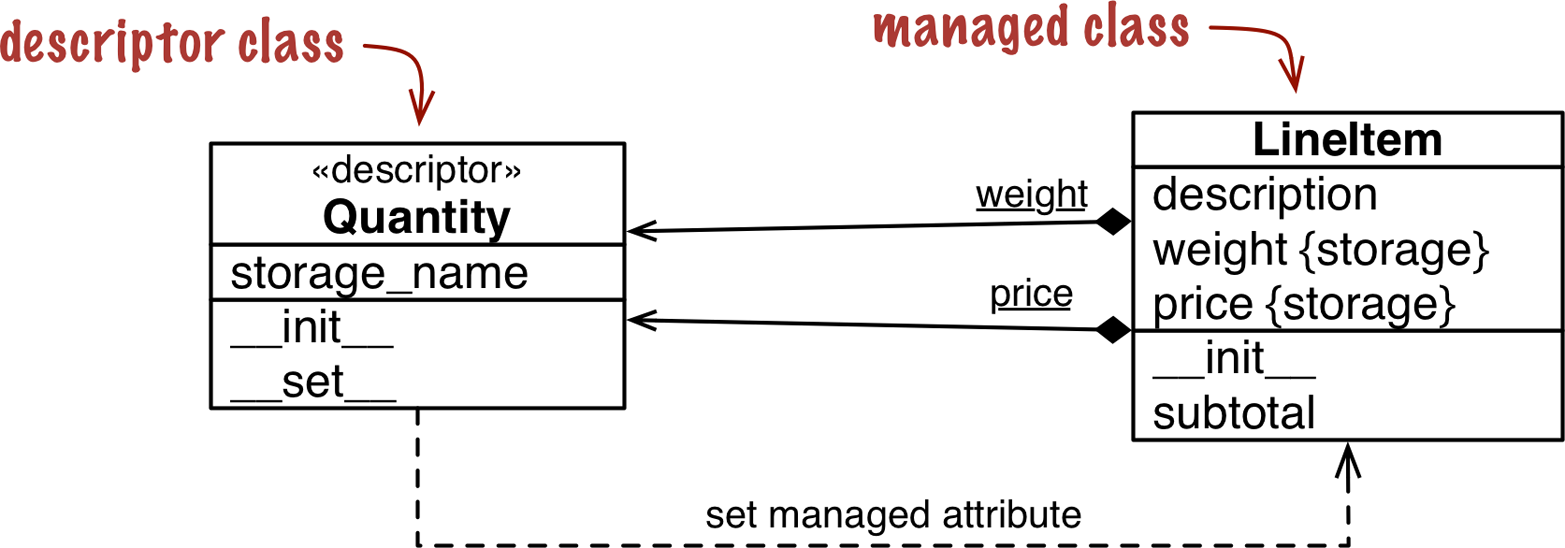
Figure 23-1. UML class diagram for LineItem using a descriptor class named Quantity. Underlined attributes in UML are class attributes. Note that weight and price are instances of Quantity attached to the LineItem class, but LineItem instances also have their own weight and price attributes where those values are stored.
Note that the word weight appears twice in Figure 23-1, because there are really two distinct attributes named weight: one is a class attribute of LineItem, the other is an instance attribute that will exist in each LineItem object. This also applies to price.
Terms to understand descriptors
Implementing and using descriptors involves several components, and it is useful to be precise when naming those components. I will use the following terms and definitions as I describe the examples in this chapter. They will be easier to understand once you see the code, but I wanted to put the definitions up front so you can refer back to them when needed.
- Descriptor class
-
A class implementing the descriptor protocol. That’s
Quantityin Figure 23-1. - Managed class
-
The class where the descriptor instances are declared as class attributes. In Figure 23-1,
LineItemis the managed class. - Descriptor instance
-
Each instance of a descriptor class, declared as a class attribute of the managed class. In Figure 23-1, each descriptor instance is represented by a composition arrow with an underlined name (the underline means class attribute in UML). The black diamonds touch the
LineItemclass, which contains the descriptor instances. - Managed instance
-
One instance of the managed class. In this example,
LineIteminstances are the managed instances (they are not shown in the class diagram). - Storage attribute
-
An attribute of the managed instance that holds the value of a managed attribute for that particular instance. In Figure 23-1, the
LineIteminstance attributesweightandpriceare the storage attributes. They are distinct from the descriptor instances, which are always class attributes. - Managed attribute
-
A public attribute in the managed class that is handled by a descriptor instance, with values stored in storage attributes. In other words, a descriptor instance and a storage attribute provide the infrastructure for a managed attribute.
It’s important to realize that Quantity instances are class attributes of LineItem. This crucial point is highlighted by the mills and gizmos in Figure 23-2.
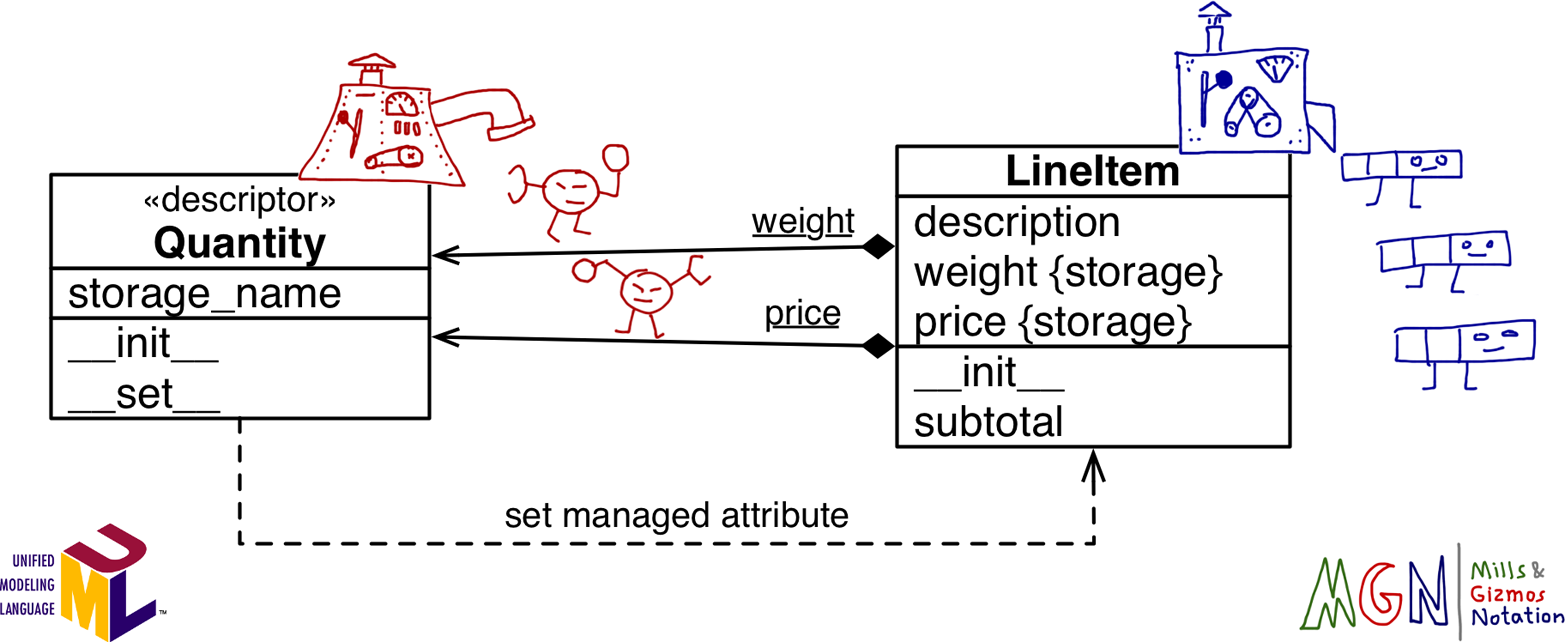
Figure 23-2. UML class diagram annotated with MGN (Mills & Gizmos Notation): classes are mills that produce gizmos—the instances. The Quantity mill produces two gizmos with round heads, which are attached to the LineItem mill: weight and price. The LineItem mill produces rectangular gizmos that have their own weight and price attributes where those values are stored.
Enough doodling for now. Here is the code: Example 23-1 shows the Quantity descriptor class, and Example 23-2 lists a new LineItem class using two instances of Quantity.
Example 23-1. bulkfood_v3.py: Quantity descriptor does not accept negative values
classQuantity:def__init__(self,storage_name):self.storage_name=storage_namedef__set__(self,instance,value):ifvalue>0:instance.__dict__[self.storage_name]=valueelse:msg=f'{self.storage_name} must be > 0'raiseValueError(msg)def__get__(self,instance,owner):returninstance.__dict__[self.storage_name]

Descriptor is a protocol-based feature; no subclassing is needed to implement one.

Each
Quantityinstance will have astorage_nameattribute: that’s the name of the storage attribute to hold the value in the managed instances.
__set__is called when there is an attempt to assign to the managed attribute. Here,selfis the descriptor instance (i.e.,LineItem.weightorLineItem.price),instanceis the managed instance (aLineIteminstance), andvalueis the value being assigned.
We must store the attribute value directly into
__dict__; callingsetattr(instance, self.storage_name)would trigger the__set__method again, leading to infinite recursion.
We need to implement
__get__because the name of the managed attribute may not be the same as thestorage_name. Theownerargument will be explained shortly.
Implementing __get__ is necessary because a user could write something like this:
classHouse:rooms=Quantity('number_of_rooms')
In the House class, the managed attribute is rooms, but the storage attribute is
number_of_rooms.
Given a House instance named chaos_manor, reading and writing chaos_manor.rooms goes through the Quantity descriptor instance attached to rooms,
but reading and writing chaos_manor.number_of_rooms bypasses the
descriptor.
Note that __get__ receives three arguments: self, instance, and owner. The owner argument is a reference to the managed class (e.g., LineItem), and it’s useful if you want the descriptor to support retrieving a class attribute—perhaps to emulate Python’s default behavior of retrieving a class attribute when the name is not found in the instance.
If a managed attribute, such as weight, is retrieved via the class like LineItem.weight, the descriptor __get__ method receives None as the value for the instance argument.
To support introspection and other metaprogramming tricks by the user, it’s a good practice to make __get__ return the descriptor instance when the managed attribute is accessed through the class. To do that, we’d code __get__ like this:
def__get__(self,instance,owner):ifinstanceisNone:returnselfelse:returninstance.__dict__[self.storage_name]
Example 23-2 demonstrates the use of Quantity in LineItem.
Example 23-2. bulkfood_v3.py: Quantity descriptors manage attributes in LineItem
classLineItem:weight=Quantity('weight')price=Quantity('price')def__init__(self,description,weight,price):self.description=descriptionself.weight=weightself.price=pricedefsubtotal(self):returnself.weight*self.price
The first descriptor instance will manage the
weightattribute.The second descriptor instance will manage the
priceattribute.The rest of the class body is as simple and clean as the original code in bulkfood_v1.py (Example 22-19).
The code in Example 23-2 works as intended, preventing the sale of truffles for $0:3
>>>truffle=LineItem('White truffle',100,0)Traceback (most recent call last):...ValueError:value must be > 0
Warning
When coding descriptor __get__ and __set__ methods, keep in mind what the self and instance arguments mean: self is the descriptor instance, and instance is the managed instance. Descriptors managing instance attributes should store values in the managed instances. That’s why Python provides the instance argument to the descriptor methods.
It may be tempting, but wrong, to store the value of each managed attribute in the descriptor instance itself. In other words, in the __set__ method, instead of coding:
instance.__dict__[self.storage_name]=value
the tempting, but bad, alternative would be:
self.__dict__[self.storage_name]=value
To understand why this would be wrong, think about the meaning of the first two arguments to __set__: self and instance. Here, self is the descriptor instance, which is actually a class attribute of the managed class. You may have thousands of LineItem instances in memory at one time, but you’ll only have two instances of the descriptors: the class attributes LineItem.weight and LineItem.price. So anything you store in the descriptor instances themselves is actually part of a LineItem class attribute, and therefore is shared among all LineItem instances.
A drawback of Example 23-2 is the need to repeat the names of the attributes when the descriptors are instantiated in the managed class body. It would be nice if the LineItem class could be declared like this:
classLineItem:weight=Quantity()price=Quantity()# remaining methods as before
As it stands, Example 23-2 requires naming each Quantity explicitly, which is not only inconvenient but dangerous. If a programmer copying and pasting code forgets to edit both names and writes something like price = Quantity('weight'), the program will misbehave badly, clobbering the value of weight whenever the price is set.
The problem is that—as we saw in Chapter 6—the righthand side of an assignment is executed before the variable exists. The expression Quantity() is evaluated to create a descriptor instance, and there is no way the code in the Quantity class can guess the name of the variable to which the descriptor will be bound (e.g., weight or price).
Thankfully, the descriptor protocol now supports the aptly named __set_name__ special method. We’ll see how to use it next.
Note
Automatic naming of a descriptor storage attribute used to be a thorny issue. In the first edition of Fluent Python, I devoted several pages and lines of code in this chapter and the next to presenting different solutions, including the use of a class decorator, and then metaclasses in Chapter 24. This was greatly simplified in Python 3.6.
LineItem Take #4: Automatic Naming of Storage Attributes
To avoid retyping the attribute name in the descriptor instances,
we’ll implement __set_name__ to set the storage_name of each Quantity instance.
The __set_name__ special method was added to the descriptor protocol in Python 3.6.
The interpreter calls __set_name__ on each descriptor it finds in a class body—if the descriptor implements
it.4
In Example 23-3, the LineItem descriptor class doesn’t need an __init__.
Instead, __set_item__ saves the name of the storage attribute.
Example 23-3. bulkfood_v4.py: __set_name__ sets the name for each Quantity descriptor instance
classQuantity:def__set_name__(self,owner,name):self.storage_name=namedef__set__(self,instance,value):ifvalue>0:instance.__dict__[self.storage_name]=valueelse:msg=f'{self.storage_name} must be > 0'raiseValueError(msg)# no __get__ neededclassLineItem:weight=Quantity()price=Quantity()def__init__(self,description,weight,price):self.description=descriptionself.weight=weightself.price=pricedefsubtotal(self):returnself.weight*self.price
selfis the descriptor instance (not the managed instance),owneris the managed class, andnameis the name of the attribute ofownerto which this descriptor instance was assigned in the class body ofowner.This is what the
__init__did in Example 23-1.The
__set__method here is exactly the same as in Example 23-1.Implementing
__get__is not necessary because the name of the storage attribute matches the name of the managed attribute. The expressionproduct.pricegets thepriceattribute directly from theLineIteminstance.Now we don’t need to pass the managed attribute name to the
Quantityconstructor. That was the goal for this version.
Looking at Example 23-3, you may think that’s a lot of code just for managing a couple of attributes,
but it’s important to realize that the descriptor logic is now abstracted into a separate code unit:
the Quantity class.
Usually we do not define a descriptor in the same module where it’s used,
but in a separate utility module designed to be used across the application—even in many applications, if you are developing a library or framework.
With this in mind, Example 23-4 better represents the typical usage of a descriptor.
Example 23-4. bulkfood_v4c.py: LineItem definition uncluttered; the Quantity descriptor class now resides in the imported model_v4c module
importmodel_v4casmodelclassLineItem:weight=model.Quantity()price=model.Quantity()def__init__(self,description,weight,price):self.description=descriptionself.weight=weightself.price=pricedefsubtotal(self):returnself.weight*self.price
Import the
model_v4cmodule whereQuantityis implemented.Put
model.Quantityto use.
Django users will notice that Example 23-4 looks a lot like a model definition. It’s no coincidence: Django model fields are descriptors.
Because descriptors are implemented as classes, we can leverage inheritance to reuse some of the code we have for new descriptors. That’s what we’ll do in the following section.
LineItem Take #5: A New Descriptor Type
The imaginary organic food store hits a snag: somehow a line item instance was created with a blank description, and the order could not be fulfilled. To prevent that, we’ll create a new descriptor, NonBlank. As we design NonBlank, we realize it will be very much like the Quantity descriptor, except for the validation logic.
This prompts a refactoring, producing Validated, an abstract class that overrides the __set__ method, calling a validate method that must be implemented by subclasses.
We’ll then rewrite Quantity, and implement NonBlank by inheriting from Validated and just coding the validate methods.
The relationship among Validated, Quantity, and NonBlank is an application of the template method as described in the Design Patterns classic:
A template method defines an algorithm in terms of abstract operations that subclasses override to provide concrete behavior.5
In Example 23-5, Validated.__set__ is the template method and self.validate is the abstract operation.
Example 23-5. model_v5.py: the Validated ABC
importabcclassValidated(abc.ABC):def__set_name__(self,owner,name):self.storage_name=namedef__set__(self,instance,value):value=self.validate(self.storage_name,value)instance.__dict__[self.storage_name]=value@abc.abstractmethoddefvalidate(self,name,value):"""return validated value or raise ValueError"""
__set__delegates validation to thevalidatemethod……then uses the returned
valueto update the stored value.validateis an abstract method; this is the template method.
Alex Martelli prefers to call this design pattern Self-Delegation,
and I agree it’s a more descriptive name: the first line of __set__ self-delegates to
validate.6
The concrete Validated subclasses in this example are Quantity and NonBlank, shown in Example 23-6.
Example 23-6. model_v5.py: Quantity and NonBlank, concrete Validated subclasses
classQuantity(Validated):"""a number greater than zero"""defvalidate(self,name,value):ifvalue<=0:raiseValueError(f'{name} must be > 0')returnvalueclassNonBlank(Validated):"""a string with at least one non-space character"""defvalidate(self,name,value):value=value.strip()ifnotvalue:raiseValueError(f'{name} cannot be blank')returnvalue
Implementation of the template method required by the
Validated.validateabstract method.If nothing is left after leading and trailing blanks are stripped, reject the value.
Requiring the concrete
validatemethods to return the validated value gives them an opportunity to clean up, convert, or normalize the data received. In this case,valueis returned without leading or trailing blanks.
Users of model_v5.py don’t need to know all these details. What matters is that they get to use Quantity and NonBlank to automate the validation of instance attributes. See the latest LineItem class in Example 23-7.
Example 23-7. bulkfood_v5.py: LineItem using Quantity and NonBlank descriptors
importmodel_v5asmodelclassLineItem:description=model.NonBlank()weight=model.Quantity()price=model.Quantity()def__init__(self,description,weight,price):self.description=descriptionself.weight=weightself.price=pricedefsubtotal(self):returnself.weight*self.price
Import the
model_v5module, giving it a friendlier name.Put
model.NonBlankto use. The rest of the code is unchanged.
The LineItem examples we’ve seen in this chapter demonstrate a typical use of descriptors to manage data attributes.
Descriptors like Quantity are called overriding descriptors because its __set__ method overrides (i.e., intercepts and overrules) the setting of an instance attribute by the same name in the managed instance. However, there are also nonoverriding descriptors. We’ll explore this distinction in detail in the next section.
Overriding Versus Nonoverriding Descriptors
Recall that there is an important asymmetry in the way Python handles attributes. Reading an attribute through an instance normally returns the attribute defined in the instance, but if there is no such attribute in the instance, a class attribute will be retrieved. On the other hand, assigning to an attribute in an instance normally creates the attribute in the instance, without affecting the class at all.
This asymmetry also affects descriptors, in effect creating two broad categories of descriptors, depending on whether the __set__ method is implemented.
If __set__ is present, the class is an overriding descriptor; otherwise, it is a nonoverriding descriptor.
These terms will make sense as we study descriptor behaviors in the next examples.
Observing the different descriptor categories requires a few classes, so we’ll use the code in Example 23-8 as our test bed for the following sections.
Tip
Every __get__ and __set__ method in Example 23-8 calls print_args so their invocations are displayed in a readable way. Understanding print_args and the auxiliary functions cls_name and display is not important, so don’t get distracted by them.
Example 23-8. descriptorkinds.py: simple classes for studying descriptor overriding behaviors
### auxiliary functions for display only ###defcls_name(obj_or_cls):cls=type(obj_or_cls)ifclsistype:cls=obj_or_clsreturncls.__name__.split('.')[-1]defdisplay(obj):cls=type(obj)ifclsistype:returnf'<class {obj.__name__}>'elifclsin[type(None),int]:returnrepr(obj)else:returnf'<{cls_name(obj)} object>'defprint_args(name,*args):pseudo_args=','.join(display(x)forxinargs)(f'-> {cls_name(args[0])}.__{name}__({pseudo_args})')### essential classes for this example ###classOverriding:"""a.k.a. data descriptor or enforced descriptor"""def__get__(self,instance,owner):print_args('get',self,instance,owner)def__set__(self,instance,value):print_args('set',self,instance,value)classOverridingNoGet:"""an overriding descriptor without ``__get__``"""def__set__(self,instance,value):print_args('set',self,instance,value)classNonOverriding:"""a.k.a. non-data or shadowable descriptor"""def__get__(self,instance,owner):print_args('get',self,instance,owner)classManaged:over=Overriding()over_no_get=OverridingNoGet()non_over=NonOverriding()defspam(self):(f'-> Managed.spam({display(self)})')
An overriding descriptor class with
__get__and__set__.The
print_argsfunction is called by every descriptor method in this example.An overriding descriptor without a
__get__method.No
__set__method here, so this is a nonoverriding descriptor.The managed class, using one instance of each of the descriptor classes.

The
spammethod is here for comparison, because methods are also descriptors.
In the following sections, we will examine the behavior of attribute reads and writes on the Managed class, and one instance of it, going through each of the different descriptors defined.
Overriding Descriptors
A descriptor that implements the __set__ method is an overriding descriptor, because although it is a class attribute, a descriptor implementing __set__ will override attempts to assign to instance attributes. This is how Example 23-3 was implemented. Properties are also overriding descriptors: if you don’t provide a setter function, the default __set__ from the property class will raise AttributeError to signal that the attribute is read-only. Given the code in Example 23-8, experiments with an overriding descriptor can be seen in Example 23-9.
Warning
Python contributors and authors use different terms when discussing these concepts. I adopted “overriding descriptor” from the book Python in a Nutshell. The official Python documentation uses “data descriptor,” but “overriding descriptor” highlights the special behavior. Overriding descriptors are also called “enforced descriptors.” Synonyms for nonoverriding descriptors include “nondata descriptors” or “shadowable descriptors.”
Example 23-9. Behavior of an overriding descriptor
>>>obj=Managed()>>>obj.over->Overriding.__get__(<Overridingobject>,<Managedobject>,<classManaged>)>>>Managed.over->Overriding.__get__(<Overridingobject>,None,<classManaged>)>>>obj.over=7->Overriding.__set__(<Overridingobject>,<Managedobject>,7)>>>obj.over->Overriding.__get__(<Overridingobject>,<Managedobject>,<classManaged>)>>>obj.__dict__['over']=8>>>vars(obj){'over':8}>>>obj.over->Overriding.__get__(<Overridingobject>,<Managedobject>,<classManaged>)
Create
Managedobject for testing.obj.overtriggers the descriptor__get__method, passing the managed instanceobjas the second argument.Managed.overtriggers the descriptor__get__method, passingNoneas the second argument (instance).Assigning to
obj.overtriggers the descriptor__set__method, passing the value7as the last argument.Reading
obj.overstill invokes the descriptor__get__method.Bypassing the descriptor, setting a value directly to the
obj.__dict__.
Verify that the value is in the
obj.__dict__, under theoverkey.
However, even with an instance attribute named
over, theManaged.overdescriptor still overrides attempts to readobj.over.
Overriding Descriptor Without __get__
Properties and other overriding descriptors, such as Django model fields, implement both __set__ and __get__, but it’s also possible to implement only __set__, as we saw in Example 23-2. In this case, only writing is handled by the descriptor. Reading the descriptor through an instance will return the descriptor object itself because there is no __get__ to handle that access. If a namesake instance attribute is created with a new value via direct access to the instance __dict__, the __set__ method will still override further attempts to set that attribute, but reading that attribute will simply return the new value from the instance, instead of returning the descriptor object. In other words, the instance attribute will shadow the descriptor, but only when reading. See Example 23-10.
Example 23-10. Overriding descriptor without __get__
>>>obj.over_no_get<__main__.OverridingNoGetobjectat0x665bcc>>>>Managed.over_no_get<__main__.OverridingNoGetobjectat0x665bcc>>>>obj.over_no_get=7->OverridingNoGet.__set__(<OverridingNoGetobject>,<Managedobject>,7)>>>obj.over_no_get<__main__.OverridingNoGetobjectat0x665bcc>>>>obj.__dict__['over_no_get']=9>>>obj.over_no_get9>>>obj.over_no_get=7->OverridingNoGet.__set__(<OverridingNoGetobject>,<Managedobject>,7)>>>obj.over_no_get9
This overriding descriptor doesn’t have a
__get__method, so readingobj.over_no_getretrieves the descriptor instance from the class.The same thing happens if we retrieve the descriptor instance directly from the managed class.
Trying to set a value to
obj.over_no_getinvokes the__set__descriptor method.Because our
__set__doesn’t make changes, readingobj.over_no_getagain retrieves the descriptor instance from the managed class.Going through the instance
__dict__to set an instance attribute namedover_no_get.Now that
over_no_getinstance attribute shadows the descriptor, but only for reading.Trying to assign a value to
obj.over_no_getstill goes through the descriptor set.But for reading, that descriptor is shadowed as long as there is a namesake instance attribute.
Nonoverriding Descriptor
A descriptor that does not implement __set__ is a nonoverriding descriptor. Setting an instance attribute with the same name will shadow the descriptor, rendering
it ineffective for handling that attribute in that specific instance. Methods and @functools.cached_property are implemented as nonoverriding descriptors. Example 23-11 shows the operation of a nonoverriding descriptor.
Example 23-11. Behavior of a nonoverriding descriptor
>>>obj=Managed()>>>obj.non_over->NonOverriding.__get__(<NonOverridingobject>,<Managedobject>,<classManaged>)>>>obj.non_over=7>>>obj.non_over7>>>Managed.non_over->NonOverriding.__get__(<NonOverridingobject>,None,<classManaged>)>>>delobj.non_over>>>obj.non_over->NonOverriding.__get__(<NonOverridingobject>,<Managedobject>,<classManaged>)
obj.non_overtriggers the descriptor__get__method, passingobjas the second argument.Managed.non_overis a nonoverriding descriptor, so there is no__set__to interfere with this assignment.The
objnow has an instance attribute namednon_over, which shadows the namesake descriptor attribute in theManagedclass.The
Managed.non_overdescriptor is still there, and catches this access via the class.If the
non_overinstance attribute is deleted……then reading
obj.non_overhits the__get__method of the descriptor in the class, but note that the second argument is the managed instance.
In the previous examples, we saw several assignments to an instance attribute with the same name as a descriptor, and different results according to the presence of a __set__ method in the descriptor.
The setting of attributes in the class cannot be controlled by descriptors attached to the same class. In particular, this means that the descriptor attributes themselves can be clobbered by assigning to the class, as the next section explains.
Overwriting a Descriptor in the Class
Regardless of whether a descriptor is overriding or not, it can be overwritten by assignment to the class. This is a monkey-patching technique, but in Example 23-12 the descriptors are replaced by integers, which would effectively break any class that depended on the descriptors for proper operation.
Example 23-12. Any descriptor can be overwritten on the class itself
>>>obj=Managed()>>>Managed.over=1>>>Managed.over_no_get=2>>>Managed.non_over=3>>>obj.over,obj.over_no_get,obj.non_over(1,2,3)
Create a new instance for later testing.
Overwrite the descriptor attributes in the class.
The descriptors are really gone.
Example 23-12 reveals another asymmetry regarding reading and writing attributes: although the reading of a class attribute can be controlled by a descriptor with __get__ attached to the managed class, the writing of a class attribute cannot be handled by a descriptor with __set__ attached to the same class.
Tip
In order to control the setting of attributes in a class, you have to attach descriptors to the class of the class—in other words, the metaclass. By default, the metaclass of user-defined classes is type, and you cannot add attributes to type. But in Chapter 24, we’ll create our own metaclasses.
Let’s now focus on how descriptors are used to implement methods in Python.
Methods Are Descriptors
A function within a class becomes a bound method when invoked on an instance because all user-defined functions have a __get__ method,
therefore they operate as descriptors when attached to a class.
Example 23-13 demonstrates reading the spam method from the Managed class introduced in Example 23-8.
Example 23-13. A method is a nonoverriding descriptor
>>>obj=Managed()>>>obj.spam<boundmethodManaged.spamof<descriptorkinds.Managedobjectat0x74c80c>>>>>Managed.spam<functionManaged.spamat0x734734>>>>obj.spam=7>>>obj.spam7
Reading from
obj.spamretrieves a bound method object.But reading from
Managed.spamretrieves a function.Assigning a value to
obj.spamshadows the class attribute, rendering thespammethod inaccessible from theobjinstance.
Functions do not implement __set__, therefore they are nonoverriding descriptors, as the last line of Example 23-13 shows.
The other key takeaway from Example 23-13 is that obj.spam and Managed.spam retrieve different objects. As usual with descriptors, the __get__ of a function returns a reference to itself when the access happens through the managed class. But when the access goes through an instance, the __get__ of the function returns a bound method object: a callable that wraps the function and binds the managed instance (e.g., obj) to the first argument of the function (i.e., self), like the functools.partial function does (as seen in “Freezing Arguments with functools.partial”).
For a deeper understanding of this mechanism, take a look at Example 23-14.
Example 23-14. method_is_descriptor.py: a Text class, derived from UserString
importcollectionsclassText(collections.UserString):def__repr__(self):return'Text({!r})'.format(self.data)defreverse(self):returnself[::-1]
Now let’s investigate the Text.reverse method. See Example 23-15.
Example 23-15. Experiments with a method
>>>word=Text('forward')>>>wordText('forward')>>>word.reverse()Text('drawrof')>>>Text.reverse(Text('backward'))Text('drawkcab')>>>type(Text.reverse),type(word.reverse)(<class'function'>, <class'method'>)>>>list(map(Text.reverse,['repaid',(10,20,30),Text('stressed')]))['diaper',(30,20,10),Text('desserts')]>>>Text.reverse.__get__(word)<boundmethodText.reverseofText('forward')>>>>Text.reverse.__get__(None,Text)<functionText.reverseat0x101244e18>>>>word.reverse<boundmethodText.reverseofText('forward')>>>>word.reverse.__self__Text('forward')>>>word.reverse.__func__isText.reverseTrue
The
reprof aTextinstance looks like aTextconstructor call that would make an equal instance.The
reversemethod returns the text spelled backward.A method called on the class works as a function.
Note the different types: a
functionand amethod.Text.reverseoperates as a function, even working with objects that are not instances ofText.Any function is a nonoverriding descriptor. Calling its
__get__with an instance retrieves a method bound to that instance.Calling the function’s
__get__withNoneas theinstanceargument retrieves the function itself.The expression
word.reverseactually invokesText.reverse.__get__(word), returning the bound method.
The bound method object has a
__self__attribute holding a reference to the instance on which the method was called.
The
__func__attribute of the bound method is a reference to the original function attached to the managed class.
The bound method object also has a __call__ method, which handles the actual invocation. This method calls the original function referenced in __func__, passing the __self__ attribute of the method as the first argument. That’s how the implicit binding of the conventional self argument works.
The way functions are turned into bound methods is a prime example of how descriptors are used as infrastructure in the language.
After this deep dive into how descriptors and methods work, let’s go through some practical advice about their use.
Descriptor Usage Tips
The following list addresses some practical consequences of the descriptor characteristics just described:
- Use
propertyto keep it simple -
The
propertybuilt-in creates overriding descriptors implementing__set__and__get__even if you do not define a setter method.7 The default__set__of a property raisesAttributeError: can't set attribute, so a property is the easiest way to create a read-only attribute, avoiding the issue described next. - Read-only descriptors require
__set__ -
If you use a descriptor class to implement a read-only attribute, you must remember to code both
__get__and__set__, otherwise setting a namesake attribute on an instance will shadow the descriptor. The__set__method of a read-only attribute should just raiseAttributeErrorwith a suitable message.8 - Validation descriptors can work with
__set__only -
In a descriptor designed only for validation, the
__set__method should check thevalueargument it gets, and if valid, set it directly in the instance__dict__using the descriptor instance name as key. That way, reading the attribute with the same name from the instance will be as fast as possible, because it will not require a__get__. See the code for Example 23-3. - Caching can be done efficiently with
__get__only -
If you code just the
__get__method, you have a nonoverriding descriptor. These are useful to make some expensive computation and then cache the result by setting an attribute by the same name on the instance.9 The namesake instance attribute will shadow the descriptor, so subsequent access to that attribute will fetch it directly from the instance__dict__and not trigger the descriptor__get__anymore. The@functools.cached_propertydecorator actually produces a nonoverriding descriptor. - Nonspecial methods can be shadowed by instance attributes
-
Because functions and methods only implement
__get__, they are nonoverriding descriptors. A simple assignment likemy_obj.the_method = 7means that further access tothe_methodthrough that instance will retrieve the number7—without affecting the class or other instances. However, this issue does not interfere with special methods. The interpreter only looks for special methods in the class itself, in other words,repr(x)is executed asx.__class__.__repr__(x), so a__repr__attribute defined inxhas no effect onrepr(x). For the same reason, the existence of an attribute named__getattr__in an instance will not subvert the usual attribute access algorithm.
The fact that nonspecial methods can be overridden so easily in instances may sound fragile and error prone, but I personally have never been bitten by this in more than 20 years of Python coding. On the other hand, if you are doing a lot of dynamic attribute creation, where the attribute names come from data you don’t control (as we did in the earlier parts of this chapter), then you should be aware of this and perhaps implement some filtering or escaping of the dynamic attribute names to preserve your sanity.
Note
The FrozenJSON class in Example 22-5 is safe from instance attribute shadowing methods because its only methods are special methods and the build class method. Class methods are safe as long as they are always accessed through the class, as I did with FrozenJSON.build in Example 22-5—later replaced by __new__ in Example 22-6. The Record and Event classes presented in “Computed Properties” are also safe: they implement only special methods, static methods, and properties. Properties are overriding descriptors, so they are not shadowed by instance attributes.
To close this chapter, we’ll cover two features we saw with properties that we have not addressed in the context of descriptors: documentation and handling attempts to delete a managed attribute.
Descriptor Docstring and Overriding Deletion
The docstring of a descriptor class is used to document every instance of the descriptor in the managed class.
Figure 23-4 shows the help displays for the
LineItem class with the Quantity and NonBlank descriptors from Examples
23-6
and
23-7.
That is somewhat unsatisfactory. In the case of LineItem, it would be good to add, for example, the information that weight must be in kilograms. That would be trivial with properties, because each property handles a specific managed attribute. But with descriptors, the same Quantity descriptor class is used for weight and price.10
The second detail we discussed with properties, but have not addressed with descriptors, is handling attempts to delete a managed attribute.
That can be done by implementing a __delete__ method alongside or instead of the usual __get__ and/or __set__ in the descriptor class.
I deliberately omitted coverage of __delete__ because I believe real-world usage is rare.
If you need this, please see the
“Implementing Descriptors”
section of the Python Data Model documentation.
Coding a silly descriptor class with __delete__ is left as an exercise to the leisurely reader.
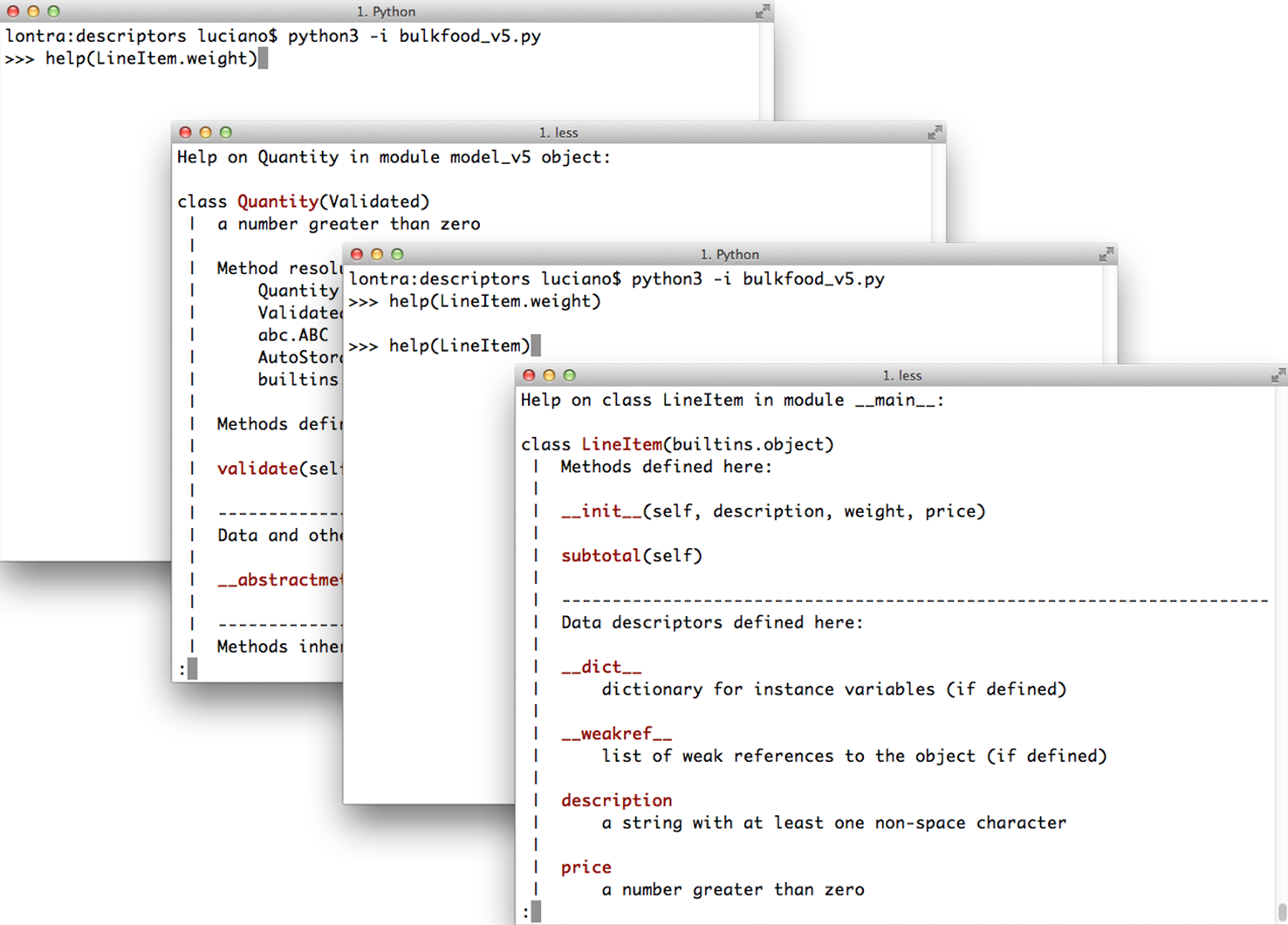
Figure 23-4. Screenshots of the Python console when issuing the commands help(LineItem.weight) and help(LineItem).
Chapter Summary
The first example of this chapter was a continuation of the LineItem examples from Chapter 22. In Example 23-2, we replaced properties with descriptors. We saw that a descriptor is a class that provides instances that are deployed as attributes in the managed class. Discussing this mechanism required special terminology, introducing terms such as managed instance and storage attribute.
In “LineItem Take #4: Automatic Naming of Storage Attributes”, we removed the requirement that Quantity descriptors were declared with an explicit storage_name, which was redundant and error prone. The solution was to implement the __set_name__ special method in Quantity, to save the name of the managed property as self.storage_name.
“LineItem Take #5: A New Descriptor Type” showed how to subclass an abstract descriptor class to share code while building specialized descriptors with some common functionality.
We then looked at the different behaviors of descriptors providing or omitting the __set__ method, making the crucial distinction between overriding and nonoverriding descriptors, a.k.a. data and nondata descriptors. Through detailed testing we uncovered when descriptors are in control and when they are shadowed, bypassed, or overwritten.
Following that, we studied a particular category of nonoverriding descriptors: methods. Console experiments revealed how a function attached to a class becomes a method when accessed through an instance, by leveraging the descriptor protocol.
To conclude the chapter, “Descriptor Usage Tips” presented practical tips, and “Descriptor Docstring and Overriding Deletion” provided a brief look at how to document descriptors.
Note
As noted in “What’s New in This Chapter”,
several examples in this chapter became much simpler thanks to the __set_name__ special method of the descriptor protocol,
added in Python 3.6. That’s language evolution!
Further Reading
Besides the obligatory reference to the “Data Model” chapter, Raymond Hettinger’s “Descriptor HowTo Guide” is a valuable resource—part of the HowTo collection in the official Python documentation.
As usual with Python object model subjects, Martelli, Ravenscroft, and Holden’s Python in a Nutshell, 3rd ed. (O’Reilly) is authoritative and objective. Martelli also has a presentation titled “Python’s Object Model,” which covers properties and descriptors in depth (see the slides and video).
Warning
Beware that any coverage of descriptors written or recorded before PEP 487 was adopted in 2016 is likely to contain examples that are needlessly complicated today, because __set_name__ was not supported in Python versions prior to 3.6.
For more practical examples, Python Cookbook, 3rd ed., by David Beazley and Brian K. Jones (O’Reilly), has many recipes illustrating descriptors, of which I want to
highlight “6.12. Reading Nested and Variable-Sized Binary Structures,” “8.10. Using Lazily Computed Properties,” “8.13. Implementing a Data Model or Type System,” and “9.9. Defining Decorators As Classes.” The last recipe of which addresses deep issues with the interaction of function decorators, descriptors, and methods,
explaining how a function decorator implemented as a class with __call__ also needs to implement __get__ if it wants to work with decorating methods as well as functions.
PEP 487—Simpler customization of class creation
introduced the __set_name__ special method, and includes an example of a
validating descriptor.
1 Raymond Hettinger, Descriptor HowTo Guide.
2 Classes and instances are drawn as rectangles in UML class diagrams. There are visual differences, but instances are rarely shown in class diagrams, so developers may not recognize them as such.
3 White truffles cost thousands of dollars per pound. Disallowing the sale of truffles for $0.01 is left as an exercise for the enterprising reader. I know a person who actually bought an $1,800 encyclopedia of statistics for $18 because of an error in an online store (not Amazon.com in this case).
4 More precisely, __set_name__ is called by type.__new__—the constructor of objects representing classes. The type built-in is actually a metaclass, the default class of user-defined classes. This is hard to grasp at first, but rest assured: Chapter 24 is devoted to the dynamic configuration of classes, including the concept of metaclasses.
5 Gamma et al., Design Patterns: Elements of Reusable Object-Oriented Software, p. 326.
6 Slide #50 of Alex Martelli’s “Python Design Patterns” talk. Highly recommended.
7 A __delete__ method is also provided by the property decorator, even if no deleter method is defined by you.
8 Python is not consistent in such messages. Trying to change the c.real attribute of a complex number gets AttributeError: readonly attribute, but an attempt to change c.conjugate (a method of complex), results in AttributeError: 'complex' object attribute 'conjugate' is read-only. Even the spelling of “read-only” is different.
9 However, recall that creating instance attributes after the __init__ method runs defeats the key-sharing memory optimization, as discussed in from “Practical Consequences of How dict Works”.
10 Customizing the help text for each descriptor instance is surprisingly hard. One solution requires dynamically building a wrapper class for each descriptor instance.