Chapter 14. Inheritance: For Better or for Worse
[...] we needed a better theory about inheritance entirely (and still do). For example, inheritance and instancing (which is a kind of inheritance) muddles both pragmatics (such as factoring code to save space) and semantics (used for way too many tasks such as: specialization, generalization, speciation, etc.).
Alan Kay, “The Early History of Smalltalk”1
This chapter is about inheritance and subclassing. I will assume a basic understanding of these concepts, which you may know from reading The Python Tutorial or from experience with another mainstream object-oriented language, such as Java, C#, or C++. Here we’ll focus on four characteristics of Python:
-
The
super()function -
The pitfalls of subclassing from built-in types
-
Multiple inheritance and method resolution order
-
Mixin classes
Multiple inheritance is the ability of a class to have more than one base class. C++ supports it; Java and C# don’t. Many consider multiple inheritance more trouble than it’s worth. It was deliberately left out of Java after its perceived abuse in early C++ codebases.
This chapter introduces multiple inheritance for those who have never used it, and provides some guidance on how to cope with single or multiple inheritance if you must use it.
As of 2021, there is a significant backlash against overuse of inheritance in general—not only multiple inheritance—because superclasses and subclasses are tightly coupled. Tight coupling means that changes to one part of the program may have unexpected and far-reaching effects in other parts, making systems brittle and hard to understand.
However, we have to maintain existing systems designed with complex class hierarchies, or use frameworks that force us to use inheritance—even multiple inheritance sometimes.
I will illustrate practical uses of multiple inheritance with the standard library, the Django web framework, and the Tkinter GUI toolkit.
What’s New in This Chapter
There are no new Python features related to the subject of this chapter, but I heavily edited it based on feedback from technical reviewers of the second edition, especially Leonardo Rochael and Caleb Hattingh.
I wrote a new opening section focusing on the super() built-in function,
and changed the examples in “Multiple Inheritance and Method Resolution Order” for a deeper exploration of
how super() works to support cooperative
multiple inheritance.
“Mixin Classes” is also new. “Multiple Inheritance in the Real World” was reorganized and covers simpler mixin examples from the standard library, before the complex Django and the complicated Tkinter hierarchies.
As the chapter title suggests, the caveats of inheritance have always been one of the main themes of this chapter. But more and more developers consider it so problematic that I’ve added a couple of paragraphs about avoiding inheritance to the end of “Chapter Summary” and “Further Reading”.
We’ll start with an overview of the mysterious super() function.
The super() Function
Consistent use the of the super() built-in function is essential for maintainable object-oriented Python programs.
When a subclass overrides a method of a superclass, the overriding method usually needs to call the corresponding method of the superclass. Here’s the recommended way to do it, from an example in the collections module documentation, section “OrderedDict Examples and Recipes”:2
classLastUpdatedOrderedDict(OrderedDict):"""Store items in the order they were last updated"""def__setitem__(self,key,value):super().__setitem__(key,value)self.move_to_end(key)
To do its job, LastUpdatedOrderedDict overrides __setitem__ to:
-
Use
super().__setitem__to call that method on the superclass, to let it insert or update the key/value pair. -
Call
self.move_to_endto ensure the updatedkeyis in the last position.
Invoking an overridden __init__ method is particularly important
to allow superclasses to do their part in initializing the instance.
Tip
If you learned object-oriented programming in Java, you may recall that a Java constructor method automatically calls the no-argument constructor of the superclass. Python doesn’t do this. You must get used to writing this pattern:
def__init__(self,a,b):super().__init__(a,b)...# more initialization code
You may have seen code that doesn’t use super(),
but instead calls the method directly on the superclass, like this:
classNotRecommended(OrderedDict):"""This is a counter example!"""def__setitem__(self,key,value):OrderedDict.__setitem__(self,key,value)self.move_to_end(key)
This alternative works in this particular case,
but is not recommended for two reasons.
First, it hardcodes the base class.
The name OrderedDict appears in the class statement and also inside __setitem__.
If in the future someone changes the
class statement to change the base class or add another one,
they may forget to update the body of __setitem__, introducing a bug.
The second reason is that super implements logic to handle
class hierarchies with multiple inheritance.
We’ll come back to that in “Multiple Inheritance and Method Resolution Order”.
To conclude this refresher about super,
it is useful to review how we had to call it in Python 2,
because the old signature with two arguments is revealing:
classLastUpdatedOrderedDict(OrderedDict):"""This code works in Python 2 and Python 3"""def__setitem__(self,key,value):super(LastUpdatedOrderedDict,self).__setitem__(key,value)self.move_to_end(key)
Both arguments of super are now optional.
The Python 3 bytecode compiler automatically provides them
by inspecting the surrounding context when super() is invoked in a method.
The arguments are:
type-
The start of the search path for the superclass implementing the desired method. By default, it is the class that owns the method where the
super()call appears. object_or_type-
The object (for instance method calls) or class (for class method calls) to be the receiver of the method call. By default, it is
selfif thesuper()call happens in an instance method.
Whether you or the compiler provides those arguments,
the super() call returns a dynamic proxy object
that finds a method (such as __setitem__ in the example)
in a superclass of the type parameter, and binds it to the object_or_type,
so that we don’t need to pass the receiver (self) explicitly when invoking the method.
In Python 3, you can still explicitly provide the first and second arguments
to
super().3
But they are needed only in special cases,
such as skipping over part of the MRO for testing or debugging,
or for working around undesired behavior in a
superclass.
Now let’s discuss the caveats when subclassing built-in types.
Subclassing Built-In Types Is Tricky
It was not possible to subclass built-in types such as list or dict in the earliest versions of Python.
Since Python 2.2, it’s possible, but there is a major caveat:
the code of the built-ins (written in C) usually does not call methods overridden by user-defined classes.
A good short description of the problem is in the documentation for PyPy, in the “Differences between PyPy and CPython” section,
“Subclasses of built-in types”:
Officially, CPython has no rule at all for when exactly overridden method of subclasses of built-in types get implicitly called or not. As an approximation, these methods are never called by other built-in methods of the same object. For example, an overridden
__getitem__()in a subclass ofdictwill not be called by e.g. the built-inget()method.
Example 14-1 illustrates the problem.
Example 14-1. Our __setitem__ override is ignored by the __init__ and __update__ methods of the built-in dict
>>>classDoppelDict(dict):...def__setitem__(self,key,value):...super().__setitem__(key,[value]*2)...>>>dd=DoppelDict(one=1)>>>dd{'one': 1}>>>dd['two']=2>>>dd{'one': 1, 'two': [2, 2]}>>>dd.update(three=3)>>>dd{'three': 3, 'one': 1, 'two': [2, 2]}

DoppelDict.__setitem__duplicates values when storing (for no good reason, just to have a visible effect). It works by delegating to the superclass.
The
__init__method inherited fromdictclearly ignored that__setitem__was overridden: the value of'one'is not duplicated.
The
[]operator calls our__setitem__and works as expected:'two'maps to the duplicated value[2, 2].
The
updatemethod fromdictdoes not use our version of__setitem__either: the value of'three'was not duplicated.
This built-in behavior is a violation of a basic rule of object-oriented programming:
the search for methods should always start from the class of the receiver (self),
even when the call happens inside a method implemented in a superclass.
This is what is called “late binding,” which Alan Kay—of Smalltalk fame—considers a key feature of object-oriented programming:
in any call of the form x.method(), the exact method to be called must be determined at runtime,
based on the class of the receiver x.4
This sad state of affairs contributes to the issues we saw in “Inconsistent Usage of __missing__ in the Standard Library”.
The problem is not limited to calls within an instance—whether self.get() calls self.__getitem__()—but also happens with overridden methods of other classes that should be called by the built-in methods.
Example 14-2 is adapted from the PyPy documentation.
Example 14-2. The __getitem__ of AnswerDict is bypassed by dict.update
>>>classAnswerDict(dict):...def__getitem__(self,key):...return42...>>>ad=AnswerDict(a='foo')>>>ad['a']42>>>d={}>>>d.update(ad)>>>d['a']'foo'>>>d{'a': 'foo'}
AnswerDict.__getitem__always returns42, no matter what the key.adis anAnswerDictloaded with the key-value pair('a', 'foo').ad['a']returns42, as expected.dis an instance of plaindict, which we update withad.
The
dict.updatemethod ignored ourAnswerDict.__getitem__.
Warning
Subclassing built-in types like dict or list or str directly is error-prone because the built-in methods mostly ignore user-defined overrides. Instead of subclassing the built-ins, derive your classes from the collections module using UserDict, UserList, and UserString, which are designed to be easily
extended.
If you subclass collections.UserDict instead of dict, the issues exposed in Examples 14-1 and 14-2 are both fixed. See Example 14-3.
Example 14-3. DoppelDict2 and AnswerDict2 work as expected because they extend UserDict and not dict
>>>importcollections>>>>>>classDoppelDict2(collections.UserDict):...def__setitem__(self,key,value):...super().__setitem__(key,[value]*2)...>>>dd=DoppelDict2(one=1)>>>dd{'one': [1, 1]}>>>dd['two']=2>>>dd{'two': [2, 2], 'one': [1, 1]}>>>dd.update(three=3)>>>dd{'two': [2, 2], 'three': [3, 3], 'one': [1, 1]}>>>>>>classAnswerDict2(collections.UserDict):...def__getitem__(self,key):...return42...>>>ad=AnswerDict2(a='foo')>>>ad['a']42>>>d={}>>>d.update(ad)>>>d['a']42>>>d{'a': 42}
As an experiment to measure the extra work required to subclass a built-in, I rewrote the StrKeyDict class from Example 3-9
to subclass dict instead of UserDict. In order to make it pass the same suite of tests, I had to implement __init__, get, and update because the versions inherited from dict refused to cooperate with the overridden __missing__, __contains__, and __setitem__. The UserDict subclass from Example 3-9 has 16 lines, while the experimental dict subclass ended up with 33 lines.5
To be clear: this section covered an issue that applies only to method delegation
within the C language code of the built-in types,
and only affects classes derived directly from those types.
If you subclass a base class coded in Python, such as
UserDict or MutableMapping,
you will not be troubled by this.6
Now let’s focus on an issue that arises with multiple inheritance:
if a class has two superclasses, how does Python decide which attribute to use
when we call super().attr, but both superclasses have an attribute with that name?
Multiple Inheritance and Method Resolution Order
Any language implementing multiple inheritance needs to deal with potential naming conflicts when superclasses implement a method by the same name. This is called the “diamond problem,” illustrated in Figure 14-1 and Example 14-4.
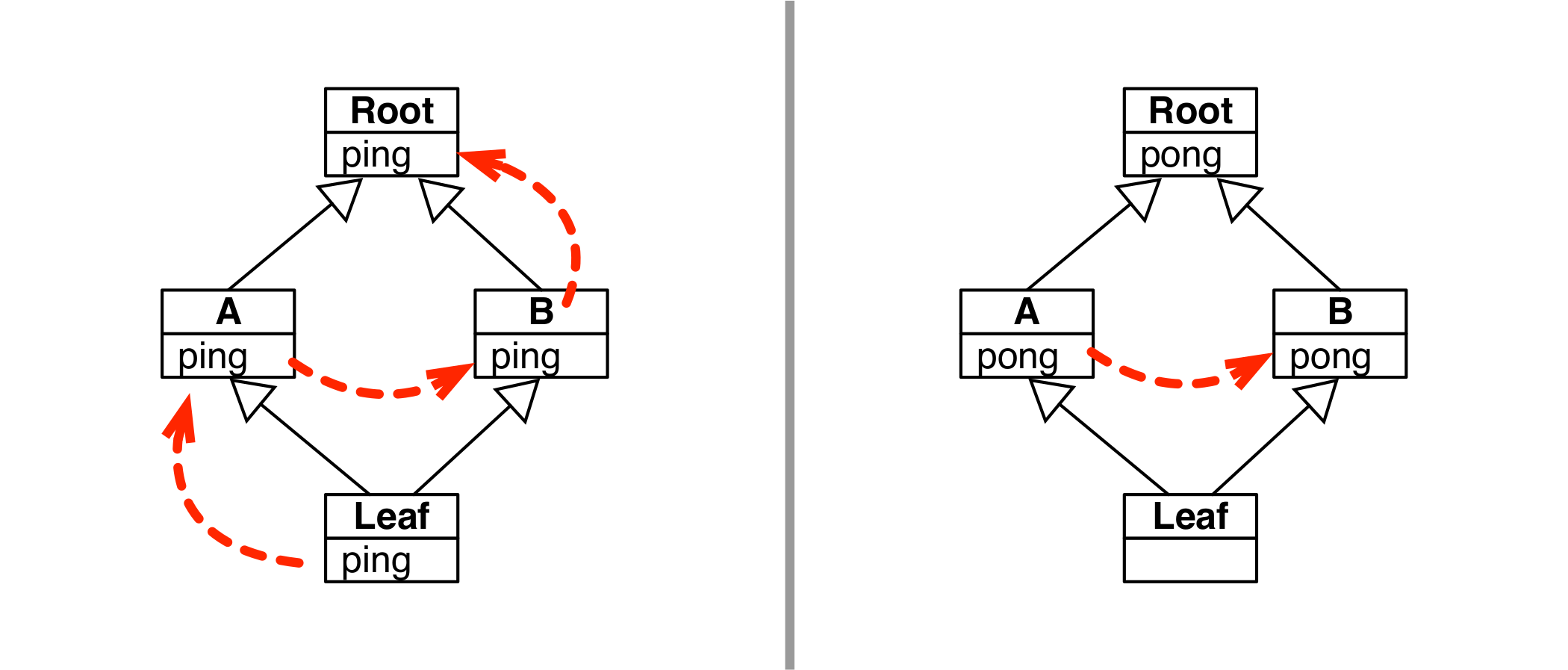
Figure 14-1. Left: Activation sequence for the leaf1.ping() call. Right: Activation sequence for the leaf1.pong() call.
Example 14-4. diamond.py: classes Leaf, A, B, Root form the graph in Figure 14-1
classRoot:defping(self):(f'{self}.ping() in Root')defpong(self):(f'{self}.pong() in Root')def__repr__(self):cls_name=type(self).__name__returnf'<instance of{cls_name}>'classA(Root):defping(self):(f'{self}.ping() in A')super().ping()defpong(self):(f'{self}.pong() in A')super().pong()classB(Root):defping(self):(f'{self}.ping() in B')super().ping()defpong(self):(f'{self}.pong() in B')classLeaf(A,B):defping(self):(f'{self}.ping() in Leaf')super().ping()
Rootprovidesping,pong, and__repr__to make the output easier to read.The
pingandpongmethods in classAboth callsuper().Only the
pingmethod in classBcallssuper().Class
Leafimplements onlyping, and it callssuper().
Now let’s see the effect of calling the ping and pong methods on an instance of Leaf (Example 14-5).
Example 14-5. Doctests for calling ping and pong on a Leaf object
>>>leaf1=Leaf()>>>leaf1.ping()<instanceofLeaf>.ping()inLeaf<instanceofLeaf>.ping()inA<instanceofLeaf>.ping()inB<instanceofLeaf>.ping()inRoot>>>leaf1.pong()<instanceofLeaf>.pong()inA<instanceofLeaf>.pong()inB
leaf1is an instance ofLeaf.Calling
leaf1.ping()activates thepingmethods inLeaf,A,B, andRoot, because thepingmethods in the first three classes callsuper().ping().Calling
leaf1.pong()activatesponginAvia inheritance, which then callssuper.pong(), activatingB.pong.
The activation sequences shown in Example 14-5 and Figure 14-1 are determined by two factors:
-
The method resolution order of the
Leafclass. -
The use of
super()in each method.
Every class has an attribute called __mro__ holding a tuple of references
to the superclasses in method resolution order,
from the current class all the way to the object class.7
For the Leaf class, this is the __mro__:
>>>Leaf.__mro__# doctest:+NORMALIZE_WHITESPACE(<class 'diamond1.Leaf'>, <class 'diamond1.A'>, <class 'diamond1.B'>,<class 'diamond1.Root'>, <class 'object'>)
Note
Looking at Figure 14-1, you may think the MRO describes a breadth-first search, but that’s just a coincidence for that particular class hierarchy. The MRO is computed by a published algorithm called C3. Its use in Python is detailed in Michele Simionato’s “The Python 2.3 Method Resolution Order”. It’s a challenging read, but Simionato writes: “unless you make strong use of multiple inheritance and you have non-trivial hierarchies, you don’t need to understand the C3 algorithm, and you can easily skip this paper.”
The MRO only determines the activation order, but whether
a particular method will be activated in each of the classes
depends on whether each implementation calls super() or not.
Consider the experiment with the pong method.
The Leaf class does not override it, therefore calling leaf1.pong()
activates the implementation in the next class of Leaf.__mro__: the A class.
Method A.pong calls super().pong().
The B class is next in the MRO, therefore B.pong is activated.
But that method doesn’t call super().pong(), so the activation sequence ends here.
The MRO takes into account not only the inheritance graph but also the order in which superclasses are listed in a subclass declaration.
In other words, if in diamond.py (Example 14-4) the Leaf class was declared as Leaf(B, A),
then class B would appear before A in Leaf.__mro__.
This would affect the activation order of the ping methods,
and would also cause leaf1.pong() to activate B.pong via inheritance,
but A.pong and Root.pong would never run, because B.pong doesn’t call super().
When a method calls super(), it is a cooperative method.
Cooperative methods enable cooperative multiple inheritance.
These terms are intentional: in order to work, multiple inheritance
in Python requires the active cooperation of the methods involved.
In the B class, ping cooperates, but pong does not.
Warning
A noncooperative method can be the cause of subtle bugs.
Many coders reading Example 14-4 may expect that when method A.pong
calls super.pong(), that will ultimately activate Root.pong.
But if B.pong is activated before, it drops the ball.
That’s why it is recommended that every method m of a
nonroot class should call super().m().
Cooperative methods must have compatible signatures,
because you never know whether A.ping will be called before or after B.ping.
The activation sequence depends on the order of A and B in the declaration of
each subclass that inherits from both.
Python is a dynamic language,
so the interaction of super() with the MRO is also dynamic.
Example 14-6 shows a surprising result of this dynamic behavior.
Example 14-6. diamond2.py: classes to demonstrate the dynamic nature of super()
fromdiamondimportAclassU():defping(self):(f'{self}.ping() in U')super().ping()classLeafUA(U,A):defping(self):(f'{self}.ping() in LeafUA')super().ping()
Class
Acomes from diamond.py (Example 14-4).Class
Uis unrelated toAorRootfrom thediamondmodule.What does
super().ping()do? Answer: it depends. Read on.LeafUAsubclassesUandAin this order.
If you create an instance of U and try to call ping, you get an error:
>>> u = U()>>> u.ping()Traceback (most recent call last):...AttributeError: 'super' object has no attribute 'ping'
The 'super' object returned by super() has no attribute 'ping'
because the MRO of U has two classes:
U and object, and the latter has no attribute named 'ping'.
However, the U.ping method is not completely hopeless. Check this out:
>>> leaf2 = LeafUA()>>> leaf2.ping()<instance of LeafUA>.ping() in LeafUA<instance of LeafUA>.ping() in U<instance of LeafUA>.ping() in A<instance of LeafUA>.ping() in Root>>> LeafUA.__mro__ # doctest:+NORMALIZE_WHITESPACE(<class 'diamond2.LeafUA'>, <class 'diamond2.U'>,<class 'diamond.A'>, <class 'diamond.Root'>, <class 'object'>)
The super().ping() call in LeafUA activates U.ping,
which cooperates by calling super().ping() too,
activating A.ping, and eventually Root.ping.
Note the base classes of LeafUA are (U, A) in that order.
If instead the bases were
(A, U), then leaf2.ping()
would never reach U.ping, because the super().ping()
in A.ping would activate Root.ping,
and that method does not call super().
In a real program, a class like U could be a mixin class:
a class intended to be used together with other classes
in multiple inheritance, to provide additional functionality.
We’ll study that shortly, in “Mixin Classes”.
To wrap up this discussion of the MRO, Figure 14-2 illustrates part of the complex multiple inheritance graph of the Tkinter GUI toolkit from the Python standard library.
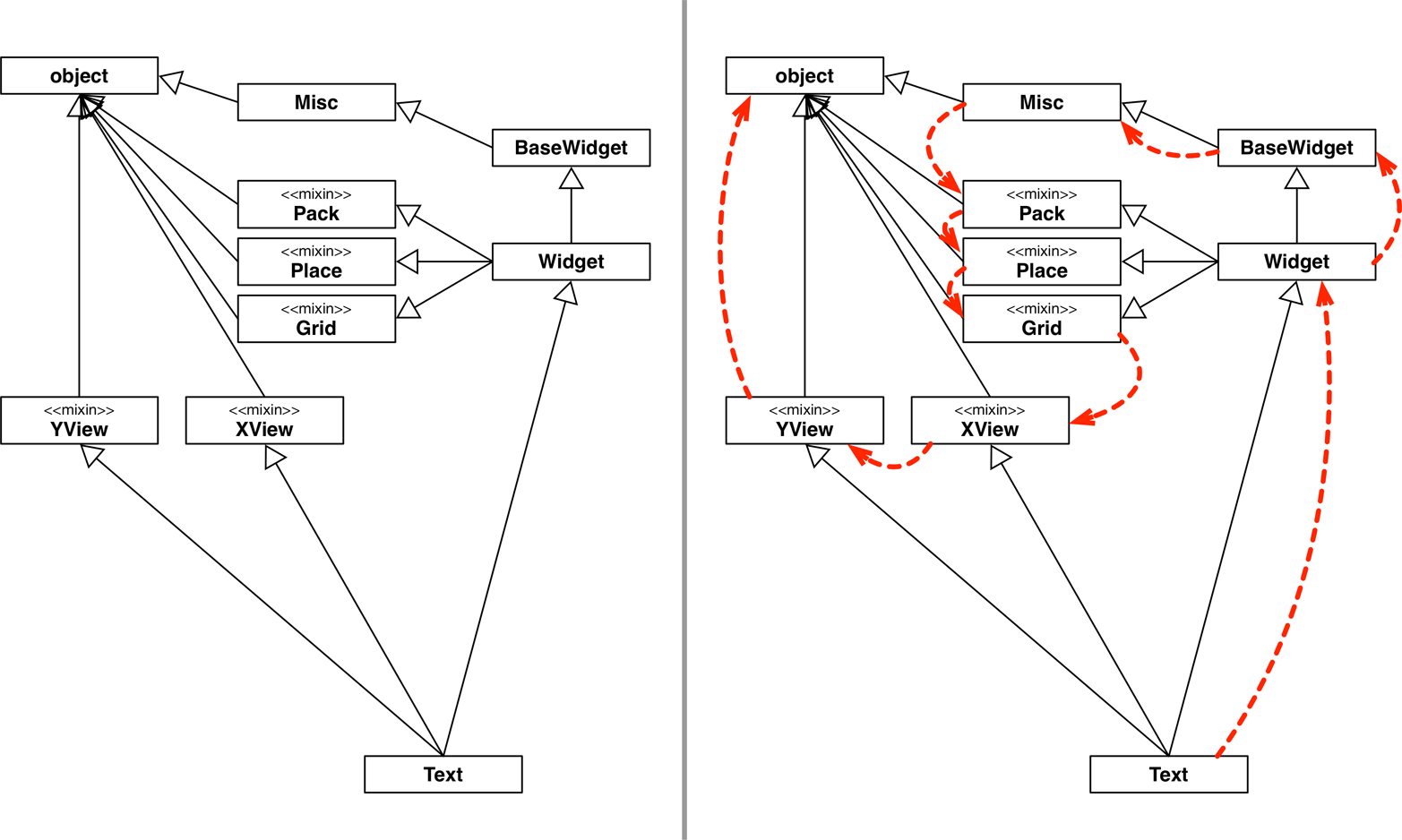
Figure 14-2. Left: UML diagram of the Tkinter Text widget class and superclasses. Right: The long and winding path of Text.__mro__ is drawn with dashed arrows.
To study the picture, start at the Text class at the bottom.
The Text class implements a full-featured, multiline editable text widget.
It provides rich functionality in itself, but also inherits many methods from other classes.
The lefthand side shows a plain UML class diagram.
On the right, it’s decorated with arrows showing the MRO,
as listed in Example 14-7 with the help of a print_mro convenience function.
Example 14-7. MRO of tkinter.Text
>>>defprint_mro(cls):...(', '.join(c.__name__forcincls.__mro__))>>>importtkinter>>>print_mro(tkinter.Text)Text, Widget, BaseWidget, Misc, Pack, Place, Grid, XView, YView, object
Mixin Classes
A mixin class is designed to be subclassed together with at least one other class in a multiple inheritance arrangement. A mixin is not supposed to be the only base class of a concrete class, because it does not provide all the functionality for a concrete object, but only adds or customizes the behavior of child or sibling classes.
Note
Mixin classes are a convention with no explicit language support in Python and C++. Ruby allows the explicit definition and use of modules that work as mixins—collections of methods that may be included to add functionality to a class. C#, PHP, and Rust implement traits, which are also an explicit form of mixin.
Let’s see a simple but handy example of a mixin class.
Case-Insensitive Mappings
Example 14-8 shows UpperCaseMixin,
a class designed to provide case-insensitive access to
mappings with string keys,
by uppercasing those keys when they are added or looked up.
Example 14-8. uppermixin.py: UpperCaseMixin supports case-insensitive mappings
importcollectionsdef_upper(key):try:returnkey.upper()exceptAttributeError:returnkeyclassUpperCaseMixin:def__setitem__(self,key,item):super().__setitem__(_upper(key),item)def__getitem__(self,key):returnsuper().__getitem__(_upper(key))defget(self,key,default=None):returnsuper().get(_upper(key),default)def__contains__(self,key):returnsuper().__contains__(_upper(key))
This helper function takes a
keyof any type, and tries to returnkey.upper(); if that fails, it returns thekeyunchanged.The mixin implements four essential methods of mappings, always calling
super(), with thekeyuppercased, if possible.
Since every method ot UpperCaseMixin calls super(),
this mixin depends on a sibling class that implements or
inherits methods with the same signature.
To make its contribution, a mixin usually needs to appear
before other classes in the MRO of a subclass that uses it.
In practice,
that means mixins must appear first in the tuple of base classes in a class declaration.
Example 14-9 shows two examples.
Example 14-9. uppermixin.py: two classes that use UpperCaseMixin
classUpperDict(UpperCaseMixin,collections.UserDict):passclassUpperCounter(UpperCaseMixin,collections.Counter):"""Specialized 'Counter' that uppercases string keys"""
UpperDictneeds no implementation of its own, butUpperCaseMixinmust be the first base class, otherwise the methods fromUserDictwould be called instead.UpperCaseMixinalso works withCounter.Instead of
pass, it’s better to provide a docstring to satisfy the need for a body in theclassstatement syntax.
Here are some doctests from
uppermixin.py, for UpperDict:
>>> d = UpperDict([('a', 'letter A'), (2, 'digit two')])>>> list(d.keys())['A', 2]>>> d['b'] = 'letter B'>>> 'b' in dTrue>>> d['a'], d.get('B')('letter A', 'letter B')>>> list(d.keys())['A', 2, 'B']
And a quick demonstration of UpperCounter:
>>> c = UpperCounter('BaNanA')>>> c.most_common()[('A', 3), ('N', 2), ('B', 1)]
UpperDict and UpperCounter seem almost magical,
but I had to carefully study the code of UserDict and Counter
to make UpperCaseMixin work with them.
For example, my first version of UpperCaseMixin did not provide the get method.
That version worked with UserDict but not with Counter.
The UserDict class inherits get from collections.abc.Mapping,
and that get calls __getitem__, which I implemented.
But keys were not uppercased when an UpperCounter was loaded upon __init__.
That happened because Counter.__init__ uses Counter.update,
which in turn relies on the get method inherited from dict.
However, the get method in the dict class does not call __getitem__.
This is the heart of the issue discussed in “Inconsistent Usage of __missing__ in the Standard Library”.
It is also a stark reminder of the brittle and puzzling
nature of programs leveraging inheritance, even at a small scale.
The next section covers several examples of multiple inheritance, often featuring mixin classes.
Multiple Inheritance in the Real World
In the Design Patterns book,8 almost all the code is in C++, but the only example of multiple inheritance is the Adapter pattern. In Python, multiple inheritance is not the norm either, but there are important examples that I will comment on in this section.
ABCs Are Mixins Too
In the Python standard library, the most visible use of multiple inheritance is the collections.abc package.
That is not controversial: after all, even Java supports multiple inheritance of interfaces, and ABCs are interface declarations that may optionally provide concrete method implementations.9
Python’s official documentation of
collections.abc
uses the term mixin method for the concrete methods implemented in
many of the collection ABCs.
The ABCs that provide mixin methods play two roles: they are interface definitions
and also mixin classes.
For example, the
implementation of collections.UserDict
relies on several of the mixin methods provided by collections.abc.MutableMapping.
ThreadingMixIn and ForkingMixIn
The
http.server
package provides HTTPServer and ThreadingHTTPServer
classes. The latter was added in Python 3.7. Its documentation says:
- class
http.server.ThreadingHTTPServer(server_address, RequestHandlerClass) -
This class is identical to
HTTPServerbut uses threads to handle requests by using theThreadingMixIn. This is useful to handle web browsers pre-opening sockets, on whichHTTPServerwould wait indefinitely.
This is the
complete source code
for the ThreadingHTTPServer class in Python 3.10:
classThreadingHTTPServer(socketserver.ThreadingMixIn,HTTPServer):daemon_threads=True
The
source code
of socketserver.ThreadingMixIn has 38
lines, including comments and docstrings.
Example 14-10 shows a summary of its
implementation.
Example 14-10. Part of Lib/socketserver.py in Python 3.10
classThreadingMixIn:"""Mixin class to handle each request in a new thread."""# 8 lines omitted in book listingdefprocess_request_thread(self,request,client_address):...# 6 lines omitted in book listingdefprocess_request(self,request,client_address):...# 8 lines omitted in book listingdefserver_close(self):super().server_close()self._threads.join()
process_request_threaddoes not callsuper()because it is a new method, not an override. Its implementation calls three instance methods thatHTTPServerprovides or inherits.This overrides the
process_requestmethod thatHTTPServerinherits fromsocketserver.BaseServer, starting a thread and delegating the actual work toprocess_request_threadrunning in that thread. It does not callsuper().server_closecallssuper().server_close()to stop taking requests, then waits for the threads started byprocess_requestto finish their jobs.
The ThreadingMixIn appears in the
socketserver
module documentation next to ForkingMixin.
The latter is designed to support concurrent servers based on
os.fork(),
an API for launching a child process, available in
POSIX-compliant Unix-like systems.
Django Generic Views Mixins
Note
You don’t need to know Django to follow this section. I am using a small part of the framework as a practical example of multiple inheritance, and I will try to give all the necessary background, assuming you have some experience with server-side web development in any language or framework.
In Django, a view is a callable object that takes a request argument—an
object representing an HTTP request—and returns an object representing an HTTP response.
The different responses are what interests us in this discussion.
They can be as simple as a redirect response, with no content body,
or as complex as a catalog page in an online store,
rendered from an HTML template and listing multiple merchandise with buttons for buying, and links to detail pages.
Originally, Django provided a set of functions, called generic views, that implemented some common use cases. For example, many sites need to show search results that include information from numerous items, with the listing spanning multiple pages, and for each item a link to a page with detailed information about it. In Django, a list view and a detail view are designed to work together to solve this problem: a list view renders search results, and a detail view produces a page for each individual item.
However, the original generic views were functions, so they were not extensible. If you needed to do something similar but not exactly like a generic list view, you’d have to start from scratch.
The concept of class-based views was introduced in Django 1.3, along with a set of generic view classes organized as base classes, mixins, and ready-to-use concrete classes. In Django 3.2, the base classes and mixins are in the base module of
the django.views.generic package, pictured in Figure 14-3. At the top of the
diagram we see two classes that take care of very distinct responsibilities: View and
TemplateResponseMixin.
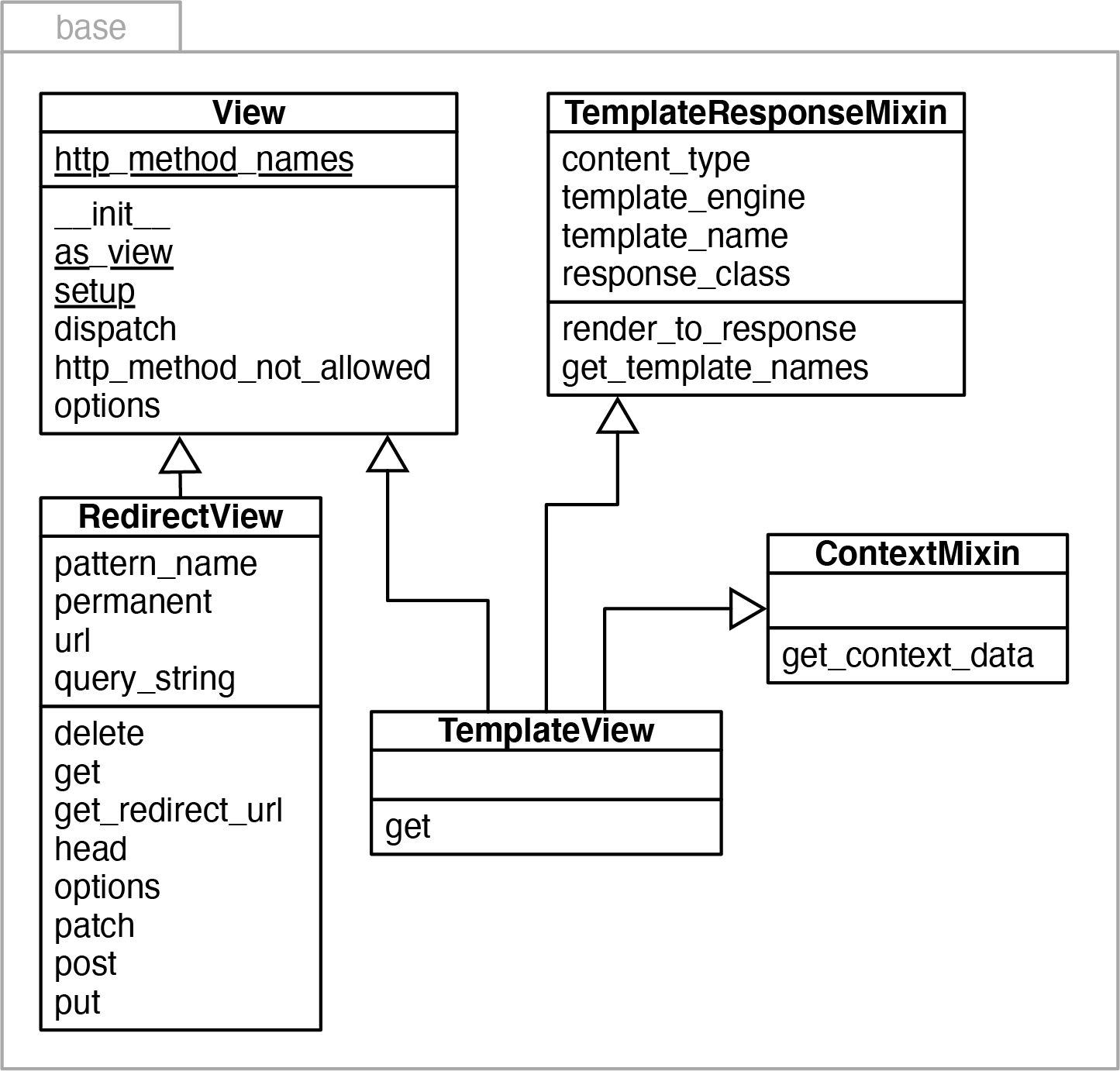
Figure 14-3. UML class diagram for the django.views.generic.base module.
Tip
A great resource to study these classes is the Classy Class-Based Views website, where you can easily navigate through them, see all methods in each class (inherited, overridden, and added methods), view diagrams, browse their documentation, and jump to their source code on GitHub.
View is the base class of all views (it could be an ABC), and it provides core functionality like the dispatch method, which delegates to “handler” methods like get, head, post, etc., implemented by concrete subclasses to handle the different HTTP verbs.10 The RedirectView class inherits only from View, and you can see that it implements get, head, post, etc.
Concrete subclasses of View are supposed to implement the handler methods, so why aren’t those methods part of the View interface? The reason: subclasses are free to implement just the handlers they want to support. A TemplateView is used only to display content, so it only implements get. If an HTTP POST request is sent to a TemplateView, the inherited View.dispatch method checks that there is no post handler, and produces an HTTP 405 Method Not Allowed response.11
The TemplateResponseMixin provides functionality that is of interest only to views that need to use a template. A RedirectView, for example, has no content body, so it has no need of a template and it does not inherit from this mixin. TemplateResponseMixin provides behaviors to TemplateView and other template-rendering views, such as ListView, DetailView, etc., defined in the django.views.generic subpackages. Figure 14-4 depicts the django.views.generic.list module and part of the base module.
For Django users, the most important class in Figure 14-4 is ListView, which is an aggregate class, with no code at all (its body is just a docstring). When instantiated, a ListView has an object_list instance attribute through which the template can iterate to show the page contents, usually the result of a database query returning multiple objects. All the functionality related to generating this iterable of objects comes from the MultipleObjectMixin. That mixin also provides the complex pagination logic—to display part of the results in one page and links to more pages.
Suppose you want to create a view that will not render a template, but will produce a list of objects in JSON format. That’s why the BaseListView exists. It provides an easy-to-use extension point that brings together View and MultipleObjectMixin functionality, without the overhead of the template machinery.
The Django class-based views API is a better example of multiple inheritance than Tkinter. In particular, it is easy to make sense of its mixin classes: each has a well-defined purpose, and they are all named with the …Mixin suffix.
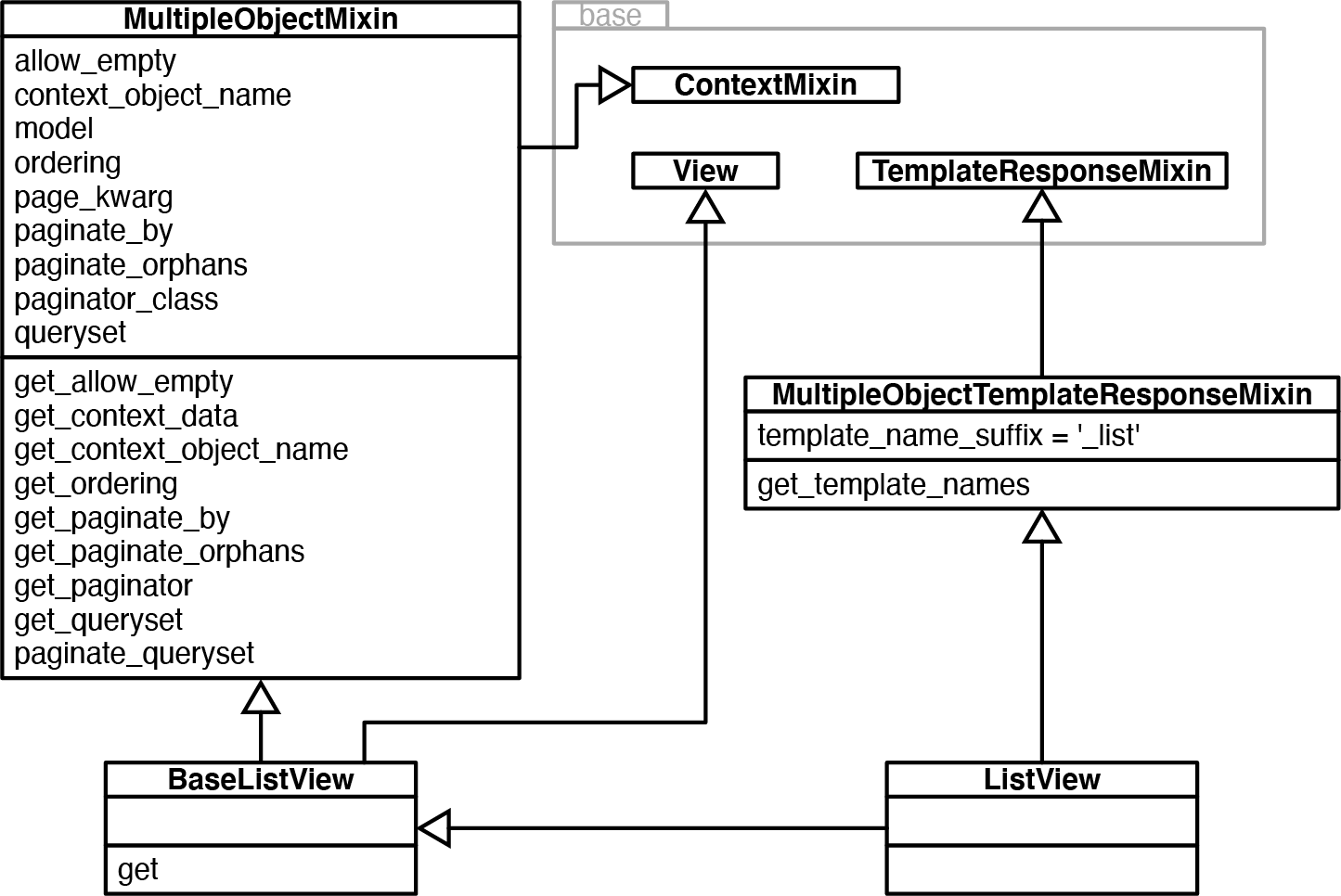
Figure 14-4. UML class diagram for the django.views.generic.list module. Here the three classes of the base module are collapsed (see Figure 14-3). The ListView class has no methods or attributes: it’s an aggregate class.
Class-based views were not universally embraced by Django users. Many do use them in a limited way, as opaque boxes, but when it’s necessary to create something new, a lot of Django coders continue writing monolithic view functions that take care of all those responsibilities, instead of trying to reuse the base views and mixins.
It does take some time to learn how to leverage class-based views and how to extend them to fulfill specific application needs, but I found that it was worthwhile to study them. They eliminate a lot of boilerplate code, make it easier to reuse solutions, and even improve team communication—for example, by defining standard names to templates, and to the variables passed to template contexts. Class-based views are Django views “on rails.”
Multiple Inheritance in Tkinter
An extreme example of multiple inheritance in Python’s standard library is the
Tkinter GUI toolkit.
I used part of the Tkinter widget hierarchy to illustrate the MRO in Figure 14-2.
Figure 14-5 shows all the widget classes in the tkinter base package
(there are more widgets in the tkinter.ttk subpackage).
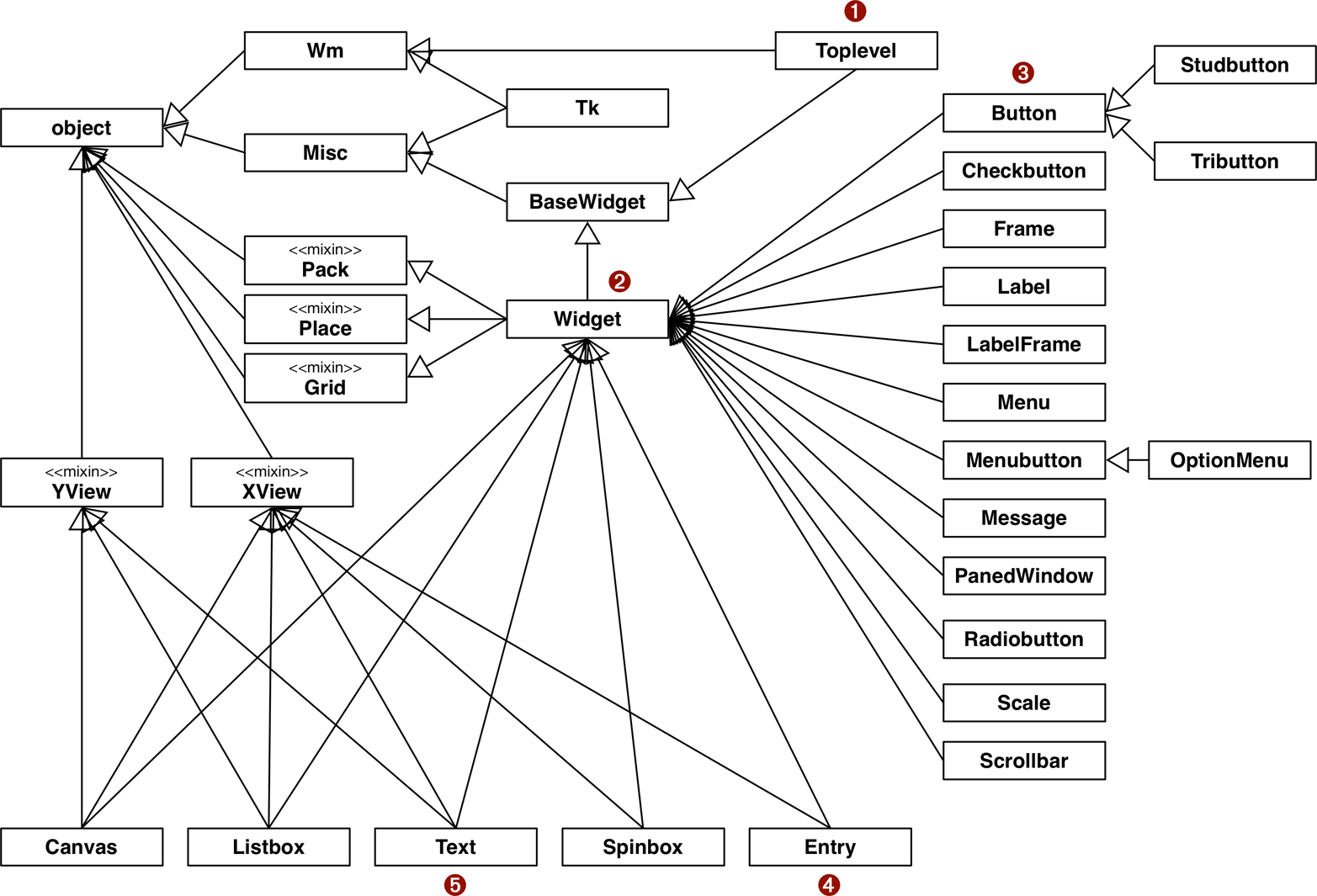
Figure 14-5. Summary UML diagram for the Tkinter GUI class hierarchy; classes tagged «mixin» are designed to provide concrete methods to other classes via multiple inheritance.
Tkinter is 25 years old as I write this. It is not an example of current best practices. But it shows how multiple inheritance was used when coders did not appreciate its drawbacks. And it will serve as a counterexample when we cover some good practices in the next section.
Consider these classes from Figure 14-5:
➊ Toplevel: The class of a top-level window in a Tkinter application.
➋ Widget: The superclass of every visible object that can be placed on a window.
➌ Button: A plain button widget.
➍ Entry: A single-line editable text field.
➎ Text: A multiline editable text field.
Here are the MROs of those classes, displayed by the print_mro function from Example 14-7:
>>>importtkinter>>>print_mro(tkinter.Toplevel)Toplevel, BaseWidget, Misc, Wm, object>>>print_mro(tkinter.Widget)Widget, BaseWidget, Misc, Pack, Place, Grid, object>>>print_mro(tkinter.Button)Button, Widget, BaseWidget, Misc, Pack, Place, Grid, object>>>print_mro(tkinter.Entry)Entry, Widget, BaseWidget, Misc, Pack, Place, Grid, XView, object>>>print_mro(tkinter.Text)Text, Widget, BaseWidget, Misc, Pack, Place, Grid, XView, YView, object
Note
By current standards, the class hierarchy of Tkinter is very deep.
Few parts of the Python standard library have more than three or four levels of concrete classes,
and the same can be said of the Java class library.
However, it is interesting to note that the some of the deepest hierarchies in the Java class library are precisely
in
the packages related to GUI programming:
java.awt and
javax.swing.
Squeak, the modern, free version of Smalltalk,
includes the powerful and innovative Morphic GUI toolkit,
also with a deep class hierarchy.
In my experience, GUI toolkits are where inheritance is most useful.
Note how these classes relate to others:
-
Toplevelis the only graphical class that does not inherit fromWidget, because it is the top-level window and does not behave like a widget; for example, it cannot be attached to a window or frame.Toplevelinherits fromWm, which provides direct access functions of the host window manager, like setting the window title and configuring its borders. -
Widgetinherits directly fromBaseWidgetand fromPack,Place, andGrid. These last three classes are geometry managers: they are responsible for arranging widgets inside a window or frame. Each encapsulates a different layout strategy and widget placement API. -
Button, like most widgets, descends only fromWidget, but indirectly fromMisc, which provides dozens of methods to every widget. -
EntrysubclassesWidgetandXView, which support horizontal scrolling. -
Textsubclasses fromWidget,XView, andYViewfor vertical scrolling.
We’ll now discuss some good practices of multiple inheritance and see whether Tkinter goes along with them.
Coping with Inheritance
What Alan Kay wrote in the epigraph remains true: there’s still no general theory about inheritance that can guide practicing programmers. What we have are rules of thumb, design patterns, “best practices,” clever acronyms, taboos, etc. Some of these provide useful guidelines, but none of them are universally accepted or always applicable.
It’s easy to create incomprehensible and brittle designs using inheritance, even without multiple inheritance. Because we don’t have a comprehensive theory, here are a few tips to avoid spaghetti class graphs.
Favor Object Composition over Class Inheritance
The title of this subsection is the second principle of object-oriented design from the Design Patterns book,12 and is the best advice I can offer here. Once you get comfortable with inheritance, it’s too easy to overuse it. Placing objects in a neat hierarchy appeals to our sense of order; programmers do it just for fun.
Favoring composition leads to more flexible designs. For example, in the case of the tkinter.Widget class, instead of inheriting the methods from all geometry managers, widget instances could hold a reference to a geometry manager, and invoke its methods. After all, a Widget should not “be” a geometry manager, but could use the services of one via delegation. Then you could add a new geometry manager without touching the widget class hierarchy and without worrying about name clashes. Even with single inheritance, this principle enhances flexibility, because subclassing is a form of tight coupling, and tall inheritance trees tend to be brittle.
Composition and delegation can replace the use of mixins to make behaviors available to different classes, but cannot replace the use of interface inheritance to define a hierarchy of types.
Understand Why Inheritance Is Used in Each Case
When dealing with multiple inheritance, it’s useful to keep straight the reasons why subclassing is done in each particular case. The main reasons are:
-
Inheritance of interface creates a subtype, implying an “is-a” relationship. This is best done with ABCs.
-
Inheritance of implementation avoids code duplication by reuse. Mixins can help with this.
In practice, both uses are often simultaneous, but whenever you can make the intent clear, do it. Inheritance for code reuse is an implementation detail, and it can often be replaced by composition and delegation. On the other hand, interface inheritance is the backbone of a framework. Interface inheritance should use only ABCs as base classes, if possible.
Make Interfaces Explicit with ABCs
In modern Python, if a class is intended to define an interface,
it should be an explicit ABC or a typing.Protocol subclass.
An ABC should subclass only abc.ABC or other ABCs.
Multiple inheritance of ABCs is not problematic.
Use Explicit Mixins for Code Reuse
If a class is designed to provide method implementations for reuse by multiple unrelated subclasses, without implying an “is-a” relationship, it should be an explicit mixin class. Conceptually, a mixin does not define a new type; it merely bundles methods for reuse. A mixin should never be instantiated, and concrete classes should not inherit only from a mixin. Each mixin should provide a single specific behavior, implementing few and very closely related methods. Mixins should avoid keeping any internal state; i.e., a mixin class should not have instance attributes.
There is no formal way in Python to state that a class is a mixin, so it is highly recommended that they are named with a Mixin suffix.
Provide Aggregate Classes to Users
A class that is constructed primarily by inheriting from mixins and does not add its own structure or behavior is called an aggregate class.
Booch et al.13
If some combination of ABCs or mixins is particularly useful to client code, provide a class that brings them together in a sensible way.
For example, here is the complete
source code
for the Django ListView class on the bottom right of Figure 14-4:
classListView(MultipleObjectTemplateResponseMixin,BaseListView):"""Render some list of objects, set by `self.model` or `self.queryset`.`self.queryset` can actually be any iterable of items, not just a queryset."""
The body of ListView is empty,
but the class provides a useful service: it brings together
a mixin and a base class that should be used together.
Another example is tkinter.Widget,
which has four base classes and no methods or attributes of its own—just a docstring.
Thanks to the Widget aggregate class,
we can create new a widget with the required mixins,
without having to figure out in which order they should be declared to work as intended.
Note that aggregate classes don’t have to be completely empty, but they often are.
Subclass Only Classes Designed for Subclassing
In one comment about this chapter, technical reviewer Leonardo Rochael suggested the following warning.
Warning
Subclassing any complex class and overriding its methods is error-prone because the superclass methods may ignore the subclass overrides in unexpected ways. As much as possible, avoid overriding methods, or at least restrain yourself to subclassing classes which are designed to be easily extended, and only in the ways in which they were designed to be extended.
That’s great advice, but how do we know whether or how a class was designed to be extended?
The first answer is documentation (sometimes in the form of docstrings or even comments in code).
For example, Python’s
socketserver package
is described as “a framework for network servers.”
Its
BaseServer class
is designed for subclassing, as the name suggests.
More importantly, the documentation and the
docstring
in the source code of the class explicitly note which of its methods are intended to be overridden by subclasses.
In Python ≥ 3.8, a new way of making those design constraints explicit is provided by
PEP 591—Adding a final qualifier to typing.
The PEP introduces a
@final decorator that can be applied to classes or individual methods,
so that IDEs or type checkers can report misguided attempts to
subclass those classes or override those methods.14
Avoid Subclassing from Concrete Classes
Subclassing concrete classes is more dangerous than subclassing ABCs and mixins,
because instances of concrete classes usually have internal state that
can easily be corrupted when you override methods that depend on that state.
Even if your methods cooperate by calling super(), and the
internal state is held in private attributes using the __x syntax,
there are still countless ways a method override can introduce bugs.
In “Waterfowl and ABCs”, Alex Martelli quotes Scott Meyer’s More Effective C++, which says: “all non-leaf classes should be abstract.” In other words, Meyer recommends that only abstract classes should be subclassed.
If you must use subclassing for code reuse, then the code intended for reuse should be in mixin methods of ABCs or in explicitly named mixin classes.
We will now analyze Tkinter from the point of view of these recommendations.
Tkinter: The Good, the Bad, and the Ugly
Most advice in the previous section is not followed by Tkinter, with the notable exception of “Provide Aggregate Classes to Users”.
Even then, it’s not a great example,
because composition would probably work better for integrating the geometry managers into Widget,
as discussed in “Favor Object Composition over Class Inheritance”.
Keep in mind that Tkinter has been part of the standard library since Python 1.1 was released in 1994. Tkinter is a layer on top of the excellent Tk GUI toolkit of the Tcl language. The Tcl/Tk combo is not originally object-oriented, so the Tk API is basically a vast catalog of functions. However, the toolkit is object-oriented in its design, if not in its original Tcl implementation.
The docstring of tkinter.Widget starts with the words “Internal class.” This suggests that Widget should probably be an ABC. Although Widget has no methods of its own, it does define an interface. Its message is: “You can count on every Tkinter widget providing basic widget methods (__init__, destroy, and dozens of Tk API functions), in addition to the methods of all three geometry managers.” We can agree that this is not a great interface definition (it’s just too broad), but it is an interface, and Widget “defines” it as the union of the interfaces of its superclasses.
The Tk class, which encapsulates the GUI application logic, inherits from Wm and Misc, neither of which are abstract or mixin (Wm is not a proper mixin because
TopLevel subclasses only from it). The name of the Misc class is—by itself—a very strong code smell. Misc has more than 100 methods, and all widgets inherit from it. Why is it necessary that every single widget has methods for clipboard handling, text selection, timer management, and the like? You can’t really paste into a button or select text from a scrollbar. Misc should be split into several specialized mixin classes, and not all widgets should inherit from every one of those mixins.
To be fair, as a Tkinter user, you don’t need to know or use multiple inheritance at all. It’s an implementation detail hidden behind the widget classes that you will instantiate or subclass in your own code. But you will suffer the consequences of excessive multiple inheritance when you type dir(tkinter.Button) and try to find the method you need among the 214 attributes listed.
And you’ll need to face the complexity if you decide to implement a new Tk widget.
Tip
Despite the problems, Tkinter is stable, flexible, and provides a modern look-and-feel
if you use the tkinter.ttk package and its themed widgets.
Also, some of the original widgets, like Canvas and Text, are incredibly powerful.
You can turn a Canvas object into a simple drag-and-drop drawing application in a matter of hours.
Tkinter and Tcl/Tk are definitely worth a look if you are interested in GUI programming.
This concludes our tour through the labyrinth of inheritance.
Chapter Summary
This chapter started with a review of the super() function
in the context of single inheritance.
We then discussed the problem with subclassing built-in types:
their native methods implemented in C do not call overridden methods
in subclasses, except in very few special cases.
That’s why, when we need a custom list, dict, or str type,
it’s easier to subclass UserList, UserDict, or UserString—all defined in the collections module, which actually wrap the corresponding built-in types and delegate operations to them—three examples of favoring composition over inheritance in the standard library. If the desired behavior is very different from what the built-ins offer, it may be easier to subclass the appropriate ABC from collections.abc and write your own implementation.
The rest of the chapter was devoted to the double-edged sword of multiple inheritance.
First we saw how the method resolution order,
encoded in the __mro__ class attribute,
addresses the problem of potential naming conflicts in inherited methods.
We also saw how the super() built-in behaves, sometimes unexpectedly,
in hierarchies with multiple inheritance.
The behavior of super() is designed to support mixin classes,
which we then studied through the simple example of the UpperCaseMixin
for case-insensitive mappings.
We saw how multiple inhertance and mixin methods are used in Python’s ABCs,
as well as in the socketserver threading and forking mixins.
More complex uses of multiple inheritance were exemplified by
Django’s class-based views and the Tkinter GUI toolkit.
Although Tkinter is not an example of modern best practices,
it is an example of overly complex class hierarchies we
may find in legacy systems.
To close the chapter, I presented seven recommendations to cope with inheritance, and applied some of that advice in a commentary of the Tkinter class hierarchy.
Rejecting inheritance—even single inheritance—is a modern trend. One of the most successful languages created in the 21st century is Go. It doesn’t have a construct called “class,” but you can build types that are structs of encapsulated fields and you can attach methods to those structs. Go allows the definition of interfaces that are checked by the compiler using structural typing, a.k.a. static duck typing—very similar to what we now have with protocol types since Python 3.8. Go has special syntax for building types and interfaces by composition, but it does not support inheritance—not even among interfaces.
So perhaps the best advice about inheritance is: avoid it if you can. But often, we don’t have a choice: the frameworks we use impose their own design choices.
Further Reading
When it comes to reading clarity, properly-done composition is superior to inheritance. Since code is much more often read than written, avoid subclassing in general, but especially don’t mix the various types of inheritance, and don’t use subclassing for code sharing.
Hynek Schlawack, Subclassing in Python Redux
During the final review of this book, technical reviewer Jürgen Gmach recommended Hynek Schlawack’s post “Subclassing in Python Redux”—the source of the preceding quote. Schlawack is the author of the popular attrs package, and was a core contributor to the Twisted asynchronous programming framework, a project started by Glyph Lefkowitz in 2002. Over time, the core team realized they had overused subclassing in their design, according to Schlawack. His post is long, and cites other important posts and talks. Highly recommended.
In that same conclusion, Hynek Schlawack wrote: “Don’t forget that more often than not, a function is all you need.” I agree, and that is precisely why Fluent Python covers functions in depth before classes and inheritance. My goal was to show how much you can accomplish with functions leveraging existing classes from the standard library, before creating your own classes.
Subclassing built-ins, the super function, and advanced features like descriptors and metaclasses are all introduced in Guido van Rossum’s paper
“Unifying types and classes in Python 2.2”.
Nothing really important has changed in these features since then.
Python 2.2 was an amazing feat of language evolution,
adding several powerful new features in a coherent whole, without breaking backward compatibility.
The new features were 100% opt-in.
To use them, we just had to explicitly subclass object—directly or indirectly—to
create a so-called “new style class.” In Python 3, every class subclasses object.
The Python Cookbook, 3rd ed. by David Beazley and Brian K. Jones (O’Reilly) has several
recipes showing the use of super() and mixin classes. You can start from the illuminating section
“8.7. Calling a Method on a Parent Class”,
and follow the internal references from there.
Raymond Hettinger’s post “Python’s super() considered super!” explains the workings of super and multiple inheritance in Python from a positive perspective. It was written in response to “Python’s Super is nifty, but you can’t use it (Previously: Python’s Super Considered Harmful)” by James Knight.
Martijn Pieters’ response to
“How to use super() with one argument?”
includes a concise and deep explanation of super, including its relationship with descriptors,
a concept we’ll only study in Chapter 23.
That’s the nature of super. It is simple to use in basic use cases,
but is a powerful and complex tool that touches some of Python’s most advanced dynamic features,
rarely found in other languages.
Despite the titles of those posts, the problem is not really the super built-in—which
in Python 3 is not as ugly as it was in Python 2.
The real issue is multiple inheritance, which is inherently complicated and tricky.
Michele Simionato goes beyond criticizing and actually offers a solution in his
“Setting Multiple Inheritance Straight”:
he implements traits, an explict form of mixins that originated in the Self language.
Simionato has a long series of blog posts about multiple inheritance in Python, including
“The wonders of cooperative inheritance, or using super in Python 3”;
“Mixins considered harmful,” part 1 and
part 2;
and “Things to Know About Python Super,” part 1,
part 2, and part 3.
The oldest posts use the Python 2 super syntax, but are still relevant.
I read the first edition of Grady Booch et al., Object-Oriented Analysis and Design, 3rd ed., and highly recommend it as a general primer on object-oriented thinking, independent of programming language. It is a rare book that covers multiple inheritance without prejudice.
Now more than ever it’s fashionable to avoid inheritance, so here are two references about how to do that. Brandon Rhodes wrote “The Composition Over Inheritance Principle”, part of his excellent Python Design Patterns guide. Augie Fackler and Nathaniel Manista presented “The End Of Object Inheritance & The Beginning Of A New Modularity” at PyCon 2013. Fackler and Manista talk about organizing systems around interfaces and functions that handle objects implementing those interfaces, avoiding the tight coupling and failure modes of classes and inheritance. That reminds me a lot of the Go way, but they advocate it for Python.
1 Alan Kay, “The Early History of Smalltalk,” in SIGPLAN Not. 28, 3 (March 1993), 69–95. Also available online. Thanks to my friend Christiano Anderson, who shared this reference as I was writing this chapter.
2 I only changed the docstring in the example, because the original is misleading. It says: “Store items in the order the keys were last added,” but that is not what the clearly named LastUpdatedOrderedDict does.
3 It is also possible to provide only the first argument, but this not useful and may soon be deprecated, with the blessing of Guido van Rossum who created super() in the first place. See the discussion at “Is it time to deprecate unbound super methods?”.
4 It is interesting to note that C++ has the notion of virtual and nonvirtual methods. Virtual methods are late bound, but nonvirtual methods are bound at compile time. Although every method that we can write in Python is late bound like a virtual method, built-in objects written in C seem to have nonvirtual methods by default, at least in CPython.
5 If you are curious, the experiment is in the 14-inheritance/strkeydict_dictsub.py file in the fluentpython/example-code-2e repository.
6 By the way, in this regard, PyPy behaves more “correctly” than CPython, at the expense of introducing a minor incompatibility. See “Differences between PyPy and CPython” for details.
7 Classes also have a .mro() method, but that’s an advanced feature of metaclass programming, mentioned in “Classes as Objects”. The content of the __mro__ attribute is what matters during normal usage of a class.
8 Erich Gamma, Richard Helm, Ralph Johnson, and John Vlissides, Design Patterns: Elements of Reusable Object-Oriented Software (Addison-Wesley).
9 As previously mentioned, Java 8 allows interfaces to provide method implementations as well. The new feature is called “Default Methods” in the official Java Tutorial.
10 Django programmers know that the as_view class method is the most visible part of the View interface, but it’s not relevant to us here.
11 If you are into design patterns, you’ll notice that the Django dispatch mechanism is a dynamic variation of the Template Method pattern. It’s dynamic because the View class does not force subclasses to implement all handlers, but dispatch checks at runtime if a concrete handler is available for the specific request.
12 The principle appears on p. 20 of the introduction to the book.
13 Grady Booch et al., Object-Oriented Analysis and Design with Applications, 3rd ed. (Addison-Wesley), p. 109.
14 PEP 591 also introduces a Final annotation for variables or attributes that should not be reassigned or overridden.
15 Alan Kay, “The Early History of Smalltalk,” in SIGPLAN Not. 28, 3 (March 1993), 69–95. Also available online. Thanks to my friend Christiano Anderson, who shared this reference as I was writing this chapter.
16 My friend and technical reviewer Leonardo Rochael explains better than I could: “The continued existence, but persistent lack of arrival, of Perl 6 was draining willpower out of the evolution of Perl itself. Now Perl continues to be developed as a separate language (it’s up to version 5.34 as of now) with no shadow of deprecation because of the language formerly known as Perl 6.”