Chapter 13. Interfaces, Protocols, and ABCs
Program to an interface, not an implementation.
Gamma, Helm, Johnson, Vlissides, First Principle of Object-Oriented Design1
Object-oriented programming is all about interfaces. The best approach to understanding a type in Python is knowing the methods it provides—its interface—as discussed in “Types Are Defined by Supported Operations” (Chapter 8).
Depending on the programming language, we have one or more ways of defining and using interfaces. Since Python 3.8, we have four ways. They are depicted in the Typing Map (Figure 13-1). We can summarize them like this:
- Duck typing
-
Python’s default approach to typing from the beginning. We’ve been studying duck typing since Chapter 1.
- Goose typing
-
The approach supported by abstract base classes (ABCs) since Python 2.6, which relies on runtime checks of objects against ABCs. Goose typing is a major subject in this chapter.
- Static typing
-
The traditional approach of statically-typed languages like C and Java; supported since Python 3.5 by the
typingmodule, and enforced by external type checkers compliant with PEP 484—Type Hints. This is not the theme of this chapter. Most of Chapter 8 and the upcoming Chapter 15 are about static typing. - Static duck typing
-
An approach made popular by the Go language; supported by subclasses of
typing.Protocol—new in Python 3.8—also enforced by external type checkers. We first saw this in “Static Protocols” (Chapter 8).
The Typing Map
The four typing approaches depicted in Figure 13-1 are complementary: they have different pros and cons. It doesn’t make sense to dismiss any of them.
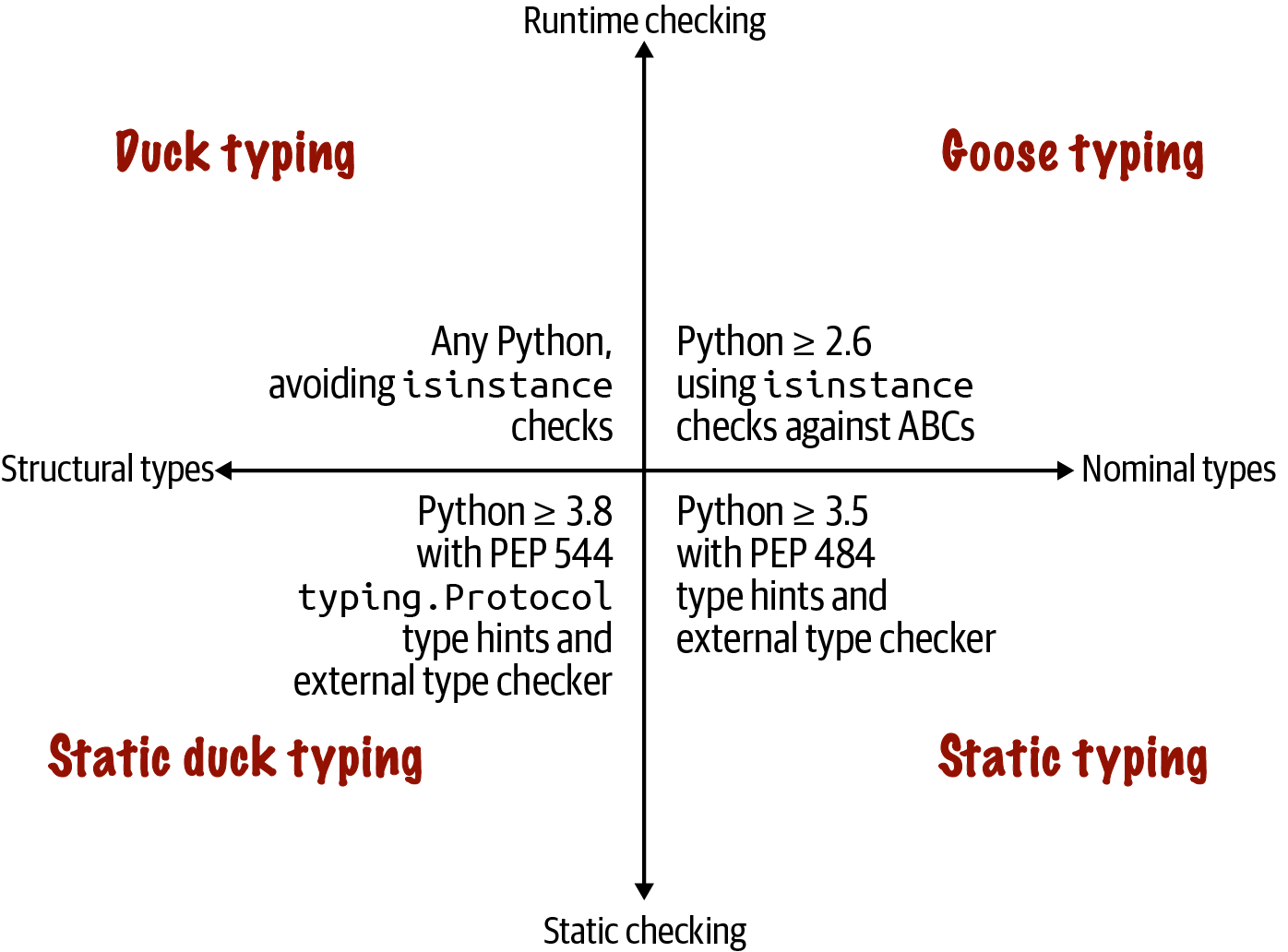
Figure 13-1. The top half describes runtime type checking approaches using just the Python interpreter; the bottom requires an external static type checker such as MyPy or an IDE like PyCharm. The left quadrants cover typing based on the object’s structure— i.e., the methods provided by the object, regardless of the name of its class or superclasses; the right quadrants depend on objects having explicitly named types: the name of the object’s class, or the name of its superclasses.
Each of these four approaches rely on interfaces to work, but static typing can be done—poorly—using only concrete types instead of interface abstractions like protocols and abstract base classes. This chapter is about duck typing, goose typing, and static duck typing—typing disciplines that revolve around interfaces.
This chapter is split in four main sections, addressing three of the four quadrants in the Typing Map (Figure 13-1):
-
“Two Kinds of Protocols” compares the two forms of structural typing with protocols—i.e., the lefthand side of the Typing Map.
-
“Programming Ducks” dives deeper into Python’s usual duck typing, including how to make it safer while preserving its major strength: flexibility.
-
“Goose Typing” explains the use of ABCs for stricter runtime type checking. This is the longest section, not because it’s more important, but because there are more sections about duck typing, static duck typing, and static typing elsewhere in the book.
-
“Static Protocols” covers usage, implementation, and design of
typing.Protocolsubclasses—useful for static and runtime type checking.
What’s New in This Chapter
This chapter was heavily edited and is about 24% longer than the corresponding Chapter 11 in the first edition of Fluent Python. Although some sections and many paragraphs are the same, there’s a lot of new content. These are the highlights:
-
The chapter introduction and the Typing Map (Figure 13-1) are new. That’s the key to most new content in this chapter—and all other chapters related to typing in Python ≥ 3.8.
-
“Two Kinds of Protocols” explains the similarities and differences between dynamic and static protocols.
-
“Defensive Programming and ‘Fail Fast’” mostly reproduces content from the first edition, but was updated and now has a section title to highlight its importance.
-
“Static Protocols” is all new. It builds on the initial presentation in “Static Protocols” (Chapter 8).
-
Updated class diagrams of
collections.abcin Figures 13-2, 13-3, and 13-4 to include theCollectionABC, from Python 3.6.
The first edition of Fluent Python had a section encouraging use of the numbers ABCs for goose typing.
In “The numbers ABCs and Numeric Protocols”, I explain why you should use numeric static protocols from the typing module instead,
if you plan to use static type checkers as well as runtime checks in the style of goose typing.
Two Kinds of Protocols
The word protocol has different meanings in computer science depending on context.
A network protocol such as HTTP specifies commands that a client can send to a server, such as GET, PUT, and HEAD.
We saw in “Protocols and Duck Typing” that an object protocol specifies methods which an object must provide to fulfill a role.
The FrenchDeck example in Chapter 1 demonstrated one object protocol, the sequence protocol:
the methods that allow a Python object to behave as a sequence.
Implementing a full protocol may require several methods, but often it is OK to implement only part of it.
Consider the Vowels class in Example 13-1.
Example 13-1. Partial sequence protocol implementation with __getitem__
>>>classVowels:...def__getitem__(self,i):...return'AEIOU'[i]...>>>v=Vowels()>>>v[0]'A'>>>v[-1]'U'>>>forcinv:(c)...AEIOU>>>'E'invTrue>>>'Z'invFalse
Implementing __getitem__ is enough to allow retrieving items by index, and also to support iteration and the in operator.
The __getitem__ special method is really the key to the sequence protocol.
Take a look at this entry from the Python/C API Reference Manual, “Sequence Protocol” section:
int PySequence_Check(PyObject *o)-
Return
1if the object provides sequence protocol, and0otherwise. Note that it returns1for Python classes with a__getitem__()method unless they aredictsubclasses […].
We expect a sequence to also support len(), by implementing __len__.
Vowels has no __len__ method, but it still behaves as a sequence in some contexts.
And that may be enough for our purposes.
That is why I like to say that a protocol is an “informal interface.”
That is also how protocols are understood in Smalltalk, the first object-oriented programming environment to use that term.
Except in pages about network programming, most uses of the word “protocol” in the Python documentation refer to these informal interfaces.
Now, with the adoption of PEP 544—Protocols: Structural subtyping (static duck typing) in Python 3.8,
the word “protocol” has another meaning in Python—closely related, but different.
As we saw in “Static Protocols” (Chapter 8), PEP 544 allows us to create subclasses of typing.Protocol
to define one or more methods that a class must implement (or inherit) to satisfy a static type checker.
When I need to be specific, I will adopt these terms:
- Dynamic protocol
-
The informal protocols Python always had. Dynamic protocols are implicit, defined by convention, and described in the documentation. Python’s most important dynamic protocols are supported by the interpreter itself, and are documented in the “Data Model” chapter of The Python Language Reference.
- Static protocol
-
A protocol as defined by PEP 544—Protocols: Structural subtyping (static duck typing), since Python 3.8. A static protocol has an explicit definition: a
typing.Protocolsubclass.
There are two key differences between them:
-
An object may implement only part of a dynamic protocol and still be useful; but to fulfill a static protocol, the object must provide every method declared in the protocol class, even if your program doesn’t need them all.
-
Static protocols can be verified by static type checkers, but dynamic protocols can’t.
Both kinds of protocols share the essential characteristic that a class never needs to declare that it supports a protocol by name, i.e., by inheritance.
In addition to static protocols, Python provides another way of defining an explicit interface in code: an abstract base class (ABC).
The rest of this chapter covers dynamic and static protocols, as well as ABCs.
Programming Ducks
Let’s start our discussion of dynamic protocols with two of the most important in Python: the sequence and iterable protocols. The interpreter goes out of its way to handle objects that provide even a minimal implementation of those protocols, as the next section explains.
Python Digs Sequences
The philosophy of the Python Data Model is to cooperate with essential dynamic protocols as much as possible. When it comes to sequences, Python tries hard to work with even the simplest implementations.
Figure 13-2 shows how the Sequence interface is formalized as an ABC.
The Python interpreter and built-in sequences like list, str, etc., do not rely on that ABC at all.
I am using it only to describe what a full-fledged Sequence is expected to support.
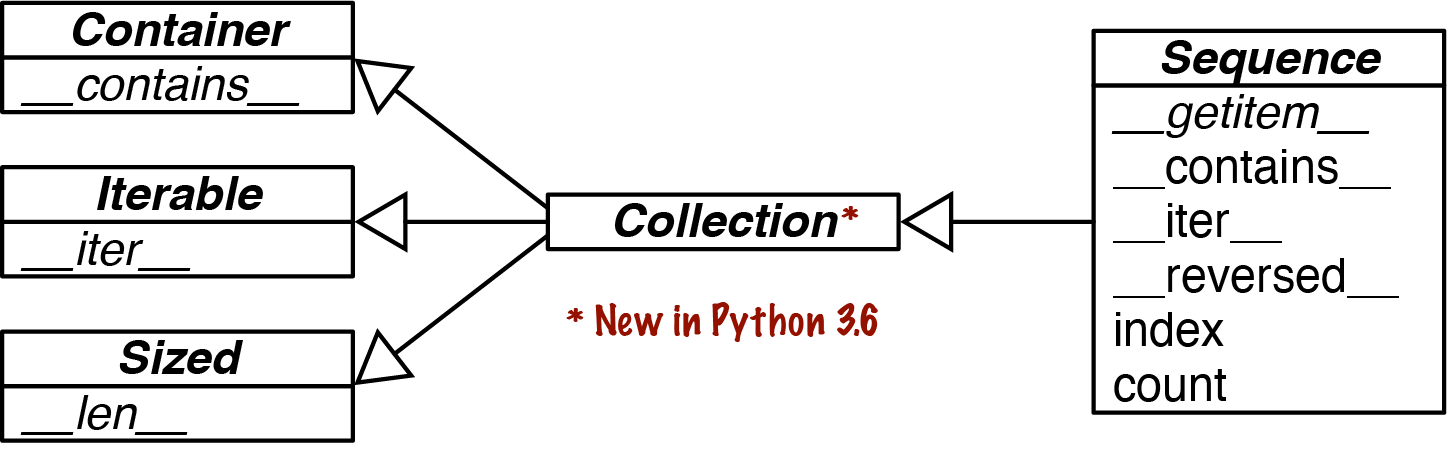
Figure 13-2. UML class diagram for the Sequence ABC and related abstract classes from collections.abc. Inheritance arrows point from a subclass to its superclasses. Names in italic are abstract methods. Before Python 3.6, there was no Collection ABC—Sequence was a direct subclass of Container, Iterable, and Sized.
Tip
Most ABCs in the collections.abc module exist to formalize interfaces that are
implemented by built-in objects and are implicitly supported by the interpreter—both
of which predate the ABCs themselves.
The ABCs are useful as starting points for new classes,
and to support explicit type checking at runtime (a.k.a. goose typing)
as well as type hints for static type checkers.
Studying Figure 13-2,
we see that a correct subclass of Sequence must implement __getitem__ and __len__ (from Sized).
All the other methods in Sequence are concrete, so subclasses can inherit their implementations—or provide better ones.
Now, recall the Vowels class in Example 13-1.
It does not inherit from abc.Sequence and it only implements __getitem__.
There is no __iter__ method, yet Vowels instances are iterable
because—as a fallback—if Python finds a __getitem__ method,
it tries to iterate over the object by calling that method with integer indexes starting with 0.
Because Python is smart enough to iterate over Vowels instances,
it can also make the in operator work even when the __contains__ method is missing:
it does a sequential scan to check if an item is present.
In summary, given the importance of sequence-like data structures,
Python manages to make iteration and the in operator work by invoking __getitem__
when __iter__ and __contains__ are unavailable.
The original FrenchDeck from Chapter 1 does not subclass abc.Sequence either,
but it does implement both methods of the sequence protocol: __getitem__ and __len__.
See Example 13-2.
Example 13-2. A deck as a sequence of cards (same as Example 1-1)
importcollectionsCard=collections.namedtuple('Card',['rank','suit'])classFrenchDeck:ranks=[str(n)forninrange(2,11)]+list('JQKA')suits='spades diamonds clubs hearts'.split()def__init__(self):self._cards=[Card(rank,suit)forsuitinself.suitsforrankinself.ranks]def__len__(self):returnlen(self._cards)def__getitem__(self,position):returnself._cards[position]
Several of the examples in Chapter 1 work because of the special treatment Python gives to anything vaguely resembling a sequence. The iterable protocol in Python represents an extreme form of duck typing: the interpreter tries two different methods to iterate over objects.
To be clear, the behaviors I described in this section are implemented in the interpreter itself, mostly in C.
They do not depend on methods from the Sequence ABC.
For example, the concrete methods __iter__ and __contains__
in the Sequence class emulate the built-in behaviors of the Python interpreter.
If you are curious, check the source code of these methods in Lib/_collections_abc.py.
Now let’s study another example emphasizing the dynamic nature of protocols—and why static type checkers have no chance of dealing with them.
Monkey Patching: Implementing a Protocol at Runtime
Monkey patching is dynamically changing a module, class, or function at runtime, to add features or fix bugs.
For example, the gevent networking library monkey patches parts of Python’s standard library to allow lightweight concurrency without threads or async/await.2
The FrenchDeck class from Example 13-2 is missing an essential feature:
it cannot be shuffled.
Years ago when I first wrote the FrenchDeck example, I did implement a shuffle method.
Later I had a Pythonic insight: if a FrenchDeck acts like a sequence,
then it doesn’t need its own shuffle method because there is already random.shuffle,
documented as “Shuffle the sequence x in place.”
The standard random.shuffle function is used like this:
>>>fromrandomimportshuffle>>>l=list(range(10))>>>shuffle(l)>>>l[5, 2, 9, 7, 8, 3, 1, 4, 0, 6]
Tip
When you follow established protocols, you improve your chances of leveraging existing standard library and third-party code, thanks to duck typing.
However, if we try to shuffle a FrenchDeck instance,
we get an exception, as in Example 13-3.
Example 13-3. random.shuffle cannot handle FrenchDeck
>>>fromrandomimportshuffle>>>fromfrenchdeckimportFrenchDeck>>>deck=FrenchDeck()>>>shuffle(deck)Traceback (most recent call last):File"<stdin>", line1, in<module>File".../random.py", line265, inshufflex[i],x[j]=x[j],x[i]TypeError:'FrenchDeck' object does not support item assignment
The error message is clear: 'FrenchDeck' object does not support item assignment.
The problem is that shuffle operates in place, by swapping items inside the collection,
and FrenchDeck only implements the immutable sequence protocol.
Mutable sequences must also provide a __setitem__ method.
Because Python is dynamic, we can fix this at runtime, even at the interactive console. Example 13-4 shows how to do it.
Example 13-4. Monkey patching FrenchDeck to make it mutable and compatible with random.shuffle (continuing from Example 13-3)
>>>defset_card(deck,position,card):...deck._cards[position]=card...>>>FrenchDeck.__setitem__=set_card>>>shuffle(deck)>>>deck[:5][Card(rank='3', suit='hearts'), Card(rank='4', suit='diamonds'), Card(rank='4',suit='clubs'), Card(rank='7', suit='hearts'), Card(rank='9', suit='spades')]

Create a function that takes
deck,position, andcardas arguments.
Assign that function to an attribute named
__setitem__in theFrenchDeckclass.
deckcan now be shuffled because I added the necessary method of the mutable sequence protocol.
The signature of the __setitem__ special method is defined in
The Python Language Reference in “3.3.6. Emulating container types”.
Here I named the arguments deck, position, card—and not self, key, value as in the language reference—to
show that every Python method starts life as a plain function,
and
naming the first argument self is merely a convention.
This is OK in a console session,
but in a Python source file it’s much better to use self, key, and value as
documented.
The trick is that set_card knows that the deck object has an attribute named _cards,
and _cards must be a mutable sequence.
The set_card function is then attached to the FrenchDeck class as the __setitem__ special method.
This is an example of monkey patching:
changing a class or module at runtime, without touching the source code.
Monkey patching is powerful, but the code that does the actual patching is very tightly coupled with the program to be patched,
often handling private and undocumented attributes.
Besides being an example of monkey patching,
Example 13-4 highlights the dynamic nature of protocols in dynamic duck typing:
random.shuffle doesn’t care about the class of the argument,
it only needs the object to implement methods from the mutable sequence protocol.
It doesn’t even matter if the object was “born” with the necessary methods or if they were somehow acquired later.
Duck typing doesn’t need to be wildly unsafe or hard to debug. The next section shows some useful code patterns to detect dynamic protocols without resorting to explicit checks.
Defensive Programming and “Fail Fast”
Defensive programming is like defensive driving: a set of practices to enhance safety even when faced with careless programmers—or drivers.
Many bugs cannot be caught except at runtime—even in mainstream statically typed languages.3 In a dynamically typed language, “fail fast” is excellent advice for safer and easier-to-maintain programs. Failing fast means raising runtime errors as soon as possible, for example, rejecting invalid arguments right a the beginning of a function body.
Here is one example:
when you write code that accepts a sequence of items to process internally as a list,
don’t enforce a list argument by type checking.
Instead, take the argument and immediately build a list from it.
One example of this code pattern is the __init__ method in Example 13-10,
later in this chapter:
def__init__(self,iterable):self._balls=list(iterable)
That way you make your code more flexible, because the list() constructor handles any iterable that fits in memory.
If the argument is not iterable, the call will fail fast with a very clear TypeError exception,
right when the object is initialized.
If you want to be more explict, you can wrap the list() call with try/except
to customize the error message—but I’d use that extra code only on an external API,
because the problem would be easy to see for maintainers of the codebase.
Either way, the offending call will appear near the end of the traceback,
making it straightforward to fix.
If you don’t catch the invalid argument in the class constructor,
the program will blow up later,
when some other method of the class needs to operate on self._balls and it is not a list.
Then the root cause will be harder to find.
Of course, calling list() on the argument would be bad if the data shouldn’t be copied,
either because it’s too large or because the function, by design,
needs to change it in place for the benefit of the caller, like random.shuffle does.
In that case, a runtime check like isinstance(x, abc.MutableSequence) would be the way to go.
If you are afraid to get an infinite generator—not a common issue—you
can begin by calling len() on the argument.
This would reject iterators, while safely dealing with tuples, arrays,
and other existing or future classes that fully implement the Sequence interface.
Calling len() is usually very cheap, and an invalid argument will raise an error immediately.
On the other hand, if any iterable is acceptable, then call iter(x) as soon as possible to obtain an iterator,
as we’ll see in “Why Sequences Are Iterable: The iter Function”.
Again, if x is not iterable, this will fail fast with an easy-to-debug
exception.
In the cases I just described, a type hint could catch some problems earlier, but not all problems.
Recall that the type Any is consistent-with every other type.
Type inference may cause a variable to be tagged with the Any type.
When that happens, the type checker is in the dark.
In addition, type hints are not enforced at runtime.
Fail fast is the last line of defense.
Defensive code leveraging duck types can also include logic to handle different types
without using isinstance() or hasattr() tests.
One example is how we might emulate the handling of the field_names argument in
collections.namedtuple:
field_names accepts a single string with identifiers separated by spaces or commas,
or a sequence of identifiers.
Example 13-5 shows how I’d do it using duck typing.
Example 13-5. Duck typing to handle a string or an iterable of strings
try:field_names=field_names.replace(',','').split()exceptAttributeError:passfield_names=tuple(field_names)ifnotall(s.isidentifier()forsinfield_names):raiseValueError('field_names must all be valid identifiers')
Assume it’s a string (EAFP = it’s easier to ask forgiveness than permission).
Convert commas to spaces and split the result into a list of names.
Sorry,
field_namesdoesn’t quack like astr: it has no.replace, or it returns something we can’t.split.
If
AttributeErrorwas raised, thenfield_namesis not astrand we assume it was already an iterable of names.
To make sure it’s an iterable and to keep our own copy, create a tuple out of what we have. A
tupleis more compact thanlist, and it also prevents my code from changing the names by mistake.
Use
str.isidentifierto ensure every name is valid.
Example 13-5 shows one situation where duck typing is more expressive than static type hints.
There is no way to spell a type hint that says “field_names must be a string of identifiers separated by spaces or commas.”
This is the relevant part of the namedtuple signature on typeshed
(see the full source at stdlib/3/collections/__init__.pyi):
defnamedtuple(typename:str,field_names:Union[str,Iterable[str]],*,# rest of signature omitted
As you can see, field_names is annotated as Union[str, Iterable[str]], which is OK as far as it goes,
but is not enough to catch all possible problems.
After reviewing dynamic protocols, we move to a more explicit form of runtime type checking: goose typing.
Goose Typing
An abstract class represents an interface.
Bjarne Stroustrup, creator of C++4
Python doesn’t have an interface keyword. We use abstract base classes (ABCs) to define interfaces
for explicit type checking at runtime—also supported by static type checkers.
The Python Glossary entry for abstract base class has a good explanation of the value they bring to duck-typed languages:
Abstract base classes complement duck typing by providing a way to define interfaces when other techniques like
hasattr()would be clumsy or subtly wrong (for example, with magic methods). ABCs introduce virtual subclasses, which are classes that don’t inherit from a class but are still recognized byisinstance()andissubclass(); see theabcmodule documentation.5
Goose typing is a runtime type checking approach that leverages ABCs. I will let Alex Martelli explain in “Waterfowl and ABCs”.
Note
I am very grateful to my friends Alex Martelli and Anna Ravenscroft. I showed them the first outline of Fluent Python at OSCON 2013, and they encouraged me to submit it for publication with O’Reilly. Both later contributed with thorough tech reviews. Alex was already the most cited person in this book, and then he offered to write this essay. Take it away, Alex!
To summarize, goose typing entails:
-
Subclassing from ABCs to make it explict that you are implementing a previously defined interface.
-
Runtime type checking using ABCs instead of concrete classes as the second argument for
isinstanceandissubclass.
Alex makes the point that inheriting from an ABC is more than implementing the required methods: it’s also a clear declaration of intent by the developer. That intent can also be made explicit through registering a virtual subclass.
Note
Details of using register are covered in “A Virtual Subclass of an ABC”, later in this chapter.
For now, here is a brief example: given the FrenchDeck class, if I want it to pass a check
like issubclass(FrenchDeck, Sequence), I can make it a virtual subclass
of the Sequence ABC with these lines:
fromcollections.abcimportSequenceSequence.register(FrenchDeck)
The use of isinstance and issubclass becomes more acceptable if you are checking against ABCs instead of concrete classes.
If used with concrete classes, type checks limit polymorphism—an essential feature of object-oriented programming.
But with ABCs these tests are more flexible.
After all, if a component does not implement an ABC by subclassing—but does implement the required methods—it can always be registered after the fact so it passes those explicit type checks.
However, even with ABCs, you should beware that excessive use of isinstance checks may be
a code smell—a symptom of bad OO design.
It’s usually not OK to have a chain of if/elif/elif with isinstance
checks performing different actions depending on the type of object:
you should be using polymorphism for that—i.e.,
design your classes so that the interpreter dispatches calls to the proper methods,
instead of you hardcoding the dispatch logic in if/elif/elif blocks.
On the other hand, it’s OK to perform an isinstance check against an ABC if you must enforce an API contract:
“Dude, you have to implement this if you want to call me,” as technical reviewer Lennart Regebro put it.
That’s particularly useful in systems that have a plug-in architecture.
Outside of frameworks, duck typing is often simpler and more flexible than type checks.
Finally, in his essay, Alex reinforces more than once the need for restraint in the creation of ABCs. Excessive use of ABCs would impose ceremony in a language that became popular because it is practical and pragmatic. During the Fluent Python review process, Alex wrote in an e-mail:
ABCs are meant to encapsulate very general concepts, abstractions, introduced by a framework—things like “a sequence” and “an exact number.” [Readers] most likely don’t need to write any new ABCs, just use existing ones correctly, to get 99.9% of the benefits without serious risk of misdesign.
Now let’s see goose typing in practice.
Subclassing an ABC
Following Martelli’s advice, we’ll leverage an existing ABC, collections.MutableSequence, before daring to invent our own.
In Example 13-6, FrenchDeck2 is explicitly declared a subclass of collections.MutableSequence.
Example 13-6. frenchdeck2.py: FrenchDeck2, a subclass of collections.MutableSequence
fromcollectionsimportnamedtuple,abcCard=namedtuple('Card',['rank','suit'])classFrenchDeck2(abc.MutableSequence):ranks=[str(n)forninrange(2,11)]+list('JQKA')suits='spades diamonds clubs hearts'.split()def__init__(self):self._cards=[Card(rank,suit)forsuitinself.suitsforrankinself.ranks]def__len__(self):returnlen(self._cards)def__getitem__(self,position):returnself._cards[position]def__setitem__(self,position,value):self._cards[position]=valuedef__delitem__(self,position):delself._cards[position]definsert(self,position,value):self._cards.insert(position,value)
__setitem__is all we need to enable shuffling……but subclassing
MutableSequenceforces us to implement__delitem__, an abstract method of that ABC.We are also required to implement
insert, the third abstract method ofMutableSequence.
Python does not check for the implementation of the abstract methods at import time
(when the frenchdeck2.py module is loaded and compiled),
but only at runtime when we actually try to instantiate FrenchDeck2.
Then, if we fail to implement any
of the abstract methods,
we get a TypeError exception with a message such as
"Can't instantiate abstract class FrenchDeck2 with abstract methods __delitem__, insert".
That’s why we must implement __delitem__ and insert,
even if our FrenchDeck2 examples do not need those behaviors:
the MutableSequence ABC demands them.
As Figure 13-3 shows, not all methods of the Sequence and MutableSequence ABCs are abstract.
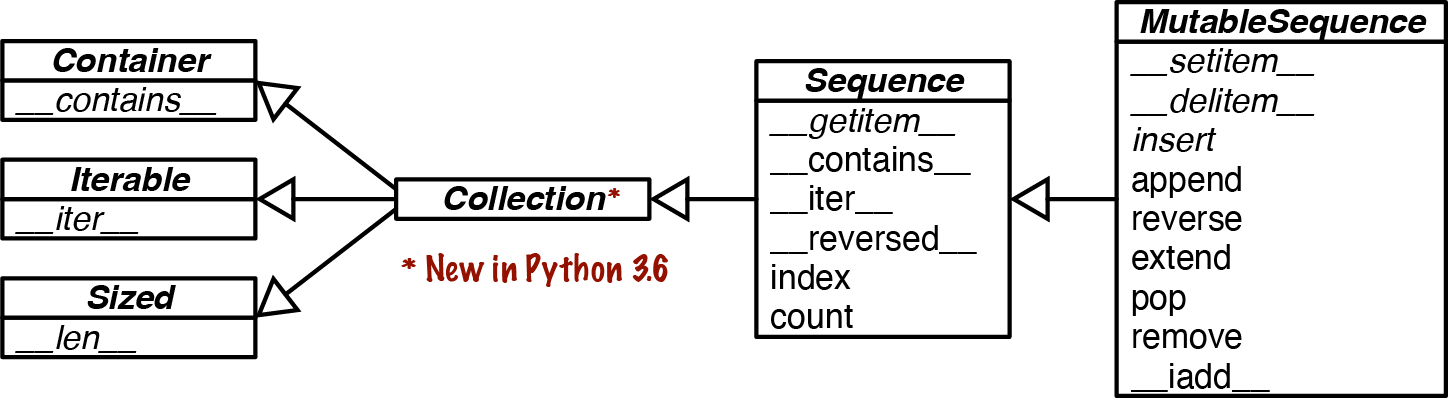
Figure 13-3. UML class diagram for the MutableSequence ABC and its superclasses from collections.abc (inheritance arrows point from subclasses to ancestors; names in italic are abstract classes and abstract methods).
To write FrenchDeck2 as a subclass of MutableSequence,
I had to pay the price of implementing __delitem__ and insert, which my examples did not require.
In return, FrenchDeck2 inherits five concrete methods from Sequence:
__contains__, __iter__, __reversed__, index, and count.
From MutableSequence, it gets another six methods: append, reverse, extend, pop, remove, and __iadd__—which supports the += operator for in place concatenation.
The concrete methods in each collections.abc ABC are implemented in terms of the public interface of the class,
so they work without any knowledge of the internal structure of instances.
Tip
As the coder of a concrete subclass, you may be able to override methods inherited from ABCs with more efficient implementations.
For example, __contains__ works by doing a sequential scan of the sequence,
but if your concrete sequence keeps its items sorted,
you can write a faster __contains__ that does a binary search using the
bisect
function from the standard library.
See “Managing Ordered Sequences with Bisect”
at fluentpython.com to learn more about it.
To use ABCs well, you need to know what’s available. We’ll review the collections ABCs next.
ABCs in the Standard Library
Since Python 2.6, the standard library provides several ABCs.
Most are defined in the collections.abc module, but there are others.
You can find ABCs in the io and numbers packages, for example.
But the most widely used are in collections.abc.
Tip
There are two modules named abc in the standard library. Here we are talking about collections.abc.
To reduce loading time, since Python 3.4 that module is implemented outside of the collections
package—in Lib/_collections_abc.py—so it’s imported separately from collections.
The other abc module is just abc (i.e., Lib/abc.py)
where the abc.ABC class is defined.
Every ABC depends on the abc module, but we don’t need to import it ourselves except to create a brand-new ABC.
Figure 13-4 is a summary UML class diagram (without attribute names) of 17 ABCs defined in collections.abc.
The documentation of collections.abc has a nice table summarizing the ABCs,
their relationships, and their abstract and concrete methods (called “mixin methods”).
There is plenty of multiple inheritance going on in Figure 13-4.
We’ll devote most of Chapter 14 to multiple inheritance,
but for now it’s enough to say that it is usually not a problem when ABCs are
concerned.7
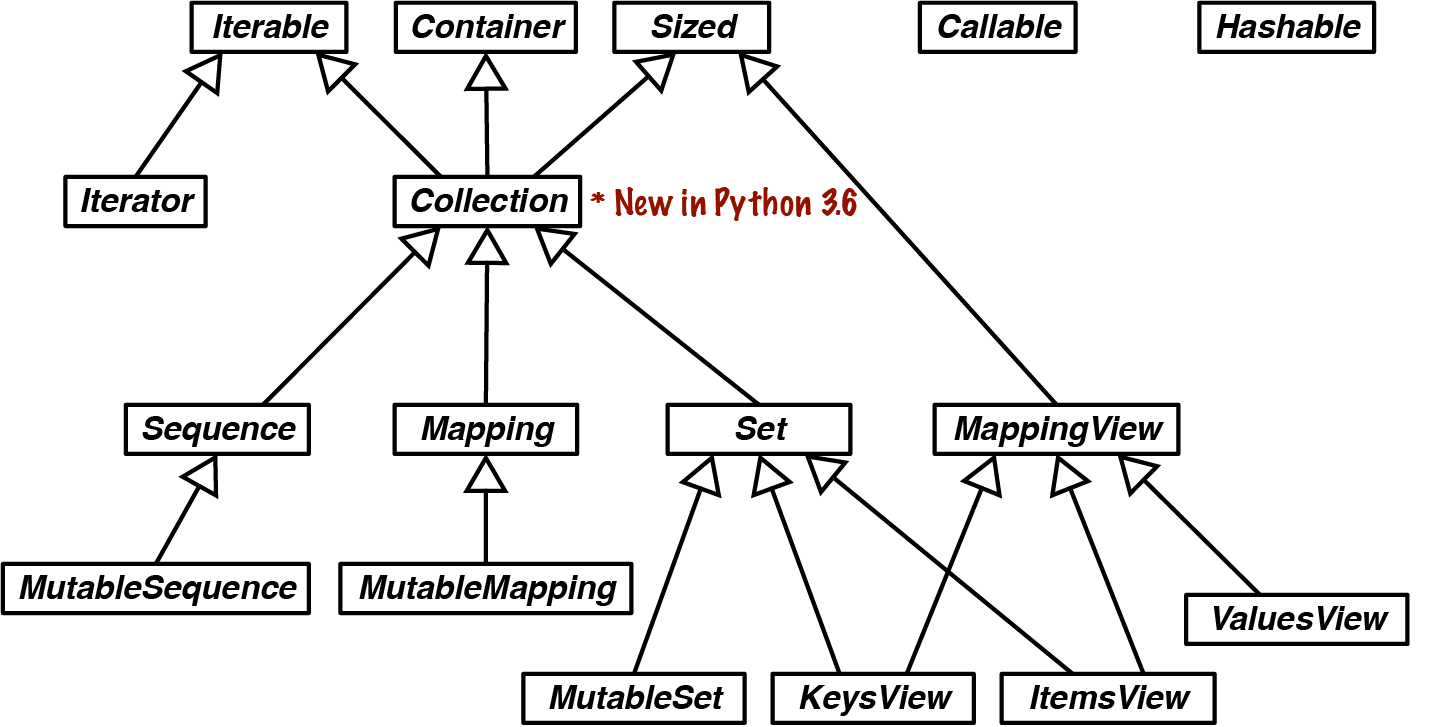
Figure 13-4. UML class diagram for ABCs in collections.abc.
Let’s review the clusters in Figure 13-4:
Iterable,Container,Sized-
Every collection should either inherit from these ABCs or implement compatible protocols.
Iterablesupports iteration with__iter__,Containersupports theinoperator with__contains__, andSizedsupportslen()with__len__. Collection-
This ABC has no methods of its own, but was added in Python 3.6 to make it easier to subclass from
Iterable,Container, andSized. Sequence,Mapping,Set-
These are the main immutable collection types, and each has a mutable subclass. A detailed diagram for
MutableSequenceis in Figure 13-3; forMutableMappingandMutableSet, see Figures 3-1 and 3-2 in Chapter 3. MappingView-
In Python 3, the objects returned from the mapping methods
.items(),.keys(), and.values()implement the interfaces defined inItemsView,KeysView, andValuesView, respectively. The first two also implement the rich interface ofSet, with all the operators we saw in “Set Operations”. Iterator-
Note that iterator subclasses
Iterable. We discuss this further in Chapter 17. Callable,Hashable-
These are not collections, but
collections.abcwas the first package to define ABCs in the standard library, and these two were deemed important enough to be included. They support type checking objects that must be callable or hashable.
For callable detection, the callable(obj) built-in function is more convenient than
insinstance(obj, Callable).
If insinstance(obj, Hashable) returns False, you can be certain that obj
is not hashable. But if the return is True, it may be a false positive.
The next box explains.
After looking at some existing ABCs, let’s practice goose typing by implementing an ABC from scratch and putting it to use. The goal here is not to encourage everyone to start creating ABCs left and right, but to learn how to read the source code of the ABCs you’ll find in the standard library and other packages.
Defining and Using an ABC
This warning appeared in the “Interfaces” chapter of the first edition of Fluent Python:
ABCs, like descriptors and metaclasses, are tools for building frameworks. Therefore, only a small minority of Python developers can create ABCs without imposing unreasonable limitations and needless work on fellow programmers.
Now ABCs have more potential use cases in type hints to support static typing. As discussed in “Abstract Base Classes”, using ABCs instead of concrete types in function argument type hints gives more flexibility to the caller.
To justify creating an ABC, we need to come up with a context for using it as an extension point in a framework.
So here is our context: imagine you need to display advertisements on a website or a mobile app in random order,
but without repeating an ad before the full inventory of ads is shown.
Now let’s assume we are building an ad management framework called ADAM.
One of its requirements is to support user-provided nonrepeating random-picking
classes.8
To make it clear to ADAM users what is expected of a “nonrepeating random-picking” component, we’ll define an ABC.
In the literature about data structures, “stack” and “queue” describe abstract interfaces in terms of physical arrangements of objects. I will follow suit and use a real-world metaphor to name our ABC: bingo cages and lottery blowers are machines designed to pick items at random from a finite set, without repeating, until the set is exhausted.
The ABC will be named Tombola, after the Italian name of bingo and the tumbling container that mixes the
numbers.
The Tombola ABC has four methods. The two abstract methods are:
.load(…)-
Put items into the container.
.pick()-
Remove one item at random from the container, returning it.
The concrete methods are:
.loaded()-
Return
Trueif there is at least one item in the container. .inspect()-
Return a
tuplebuilt from the items currently in the container, without changing its contents (the internal ordering is not preserved).
Figure 13-5 shows the Tombola ABC and three concrete implementations.
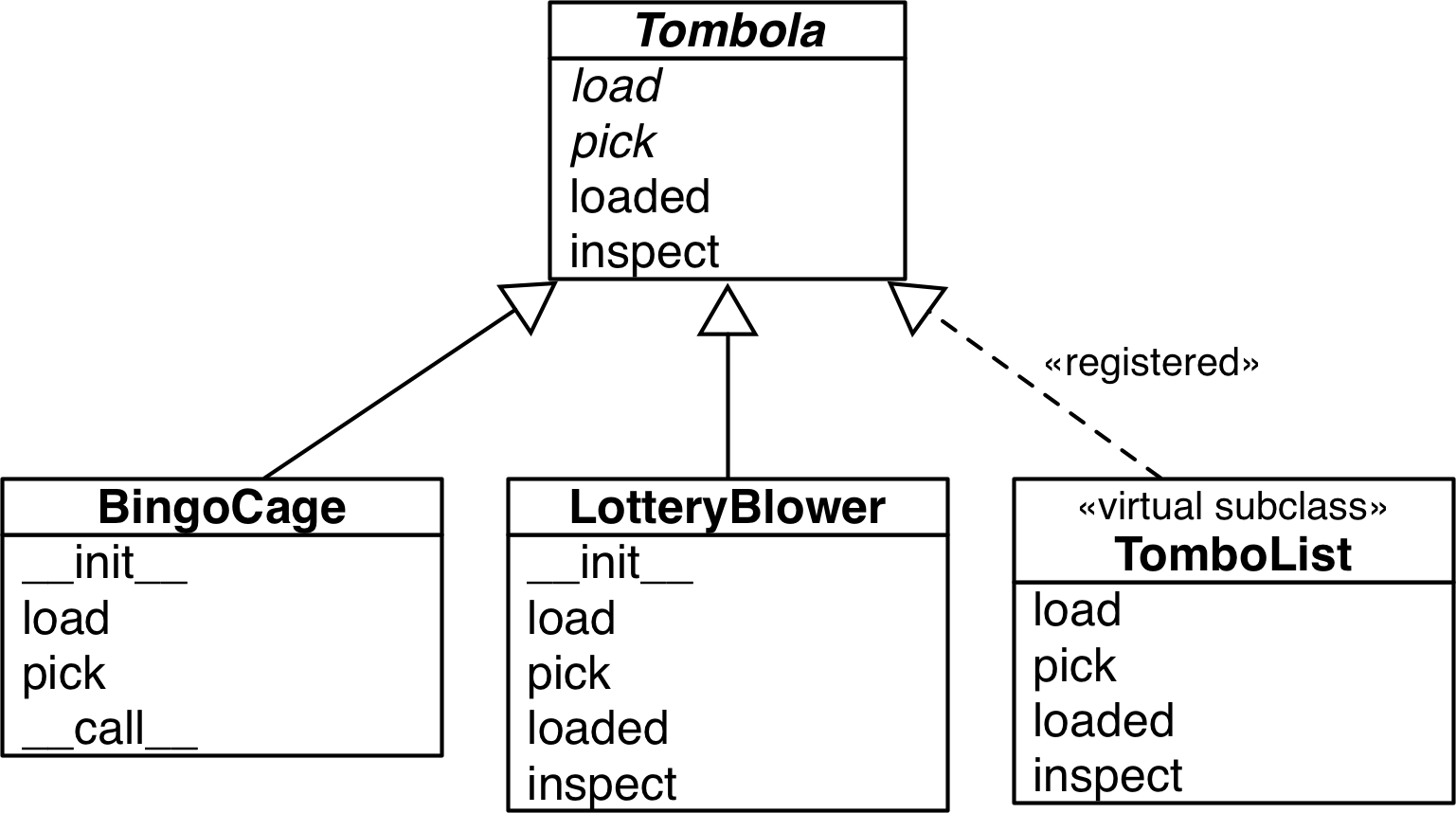
Figure 13-5. UML diagram for an ABC and three subclasses. The name of the Tombola ABC and its abstract methods are written in italics, per UML conventions. The dashed arrow is used for interface implementation—here I am using it to show that TomboList not only implements the Tombola interface, but is also registered as virtual subclass of Tombola—as we will see later in this chapter.9
Example 13-7 shows the definition of the Tombola ABC.
Example 13-7. tombola.py: Tombola is an ABC with two abstract methods and two concrete methods
importabcclassTombola(abc.ABC):@abc.abstractmethoddefload(self,iterable):"""Add items from an iterable."""@abc.abstractmethoddefpick(self):"""Remove item at random, returning it. This method should raise `LookupError` when the instance is empty. """defloaded(self):"""Return `True` if there's at least 1 item, `False` otherwise."""returnbool(self.inspect())definspect(self):"""Return a sorted tuple with the items currently inside."""items=[]whileTrue:try:items.append(self.pick())exceptLookupError:breakself.load(items)returntuple(items)
To define an ABC, subclass
abc.ABC.An abstract method is marked with the
@abstractmethoddecorator, and often its body is empty except for a docstring.10The docstring instructs implementers to raise
LookupErrorif there are no items to pick.An ABC may include concrete methods.
Concrete methods in an ABC must rely only on the interface defined by the ABC (i.e., other concrete or abstract methods or properties of the ABC).
We can’t know how concrete subclasses will store the items, but we can build the
inspectresult by emptying theTombolawith successive calls to.pick()…
…then use
.load(…)to put everything back.
Tip
An abstract method can actually have an implementation.
Even if
it does, subclasses will still be forced to override it,
but they will be able to invoke the abstract method with super(),
adding functionality to it instead of implementing from scratch.
See the abc module documentation
for details on @abstractmethod usage.
The code for the .inspect() method in Example 13-7 is silly,
but it shows that we can rely on .pick() and .load(…) to inspect what’s inside the Tombola
by picking all items and loading them back—without knowing how the items are actually stored.
The point of this example is to highlight that it’s OK to provide concrete methods in ABCs,
as long as they only depend on other methods in the interface.
Being aware of their internal data structures,
concrete subclasses of Tombola may always override .inspect() with a smarter implementation,
but they don’t have to.
The .loaded() method in Example 13-7 has one line, but it’s expensive:
it calls .inspect() to build the tuple just to apply bool() on it.
This works, but a concrete subclass can do much better, as we’ll see.
Note that our roundabout implementation of .inspect() requires that we catch a LookupError thrown by self.pick().
The fact that self.pick() may raise LookupError is also part of its interface,
but there is no way to make this explicit in Python,
except in the documentation (see the docstring for the abstract pick method in Example 13-7).
I chose the LookupError exception because of its place in the Python hierarchy of exceptions in relation to IndexError and KeyError,
the most likely exceptions to be raised by the data structures used to implement a concrete Tombola.
Therefore, implementations can raise LookupError, IndexError, KeyError, or a custom subclass of LookupError to comply.
See Figure 13-6.
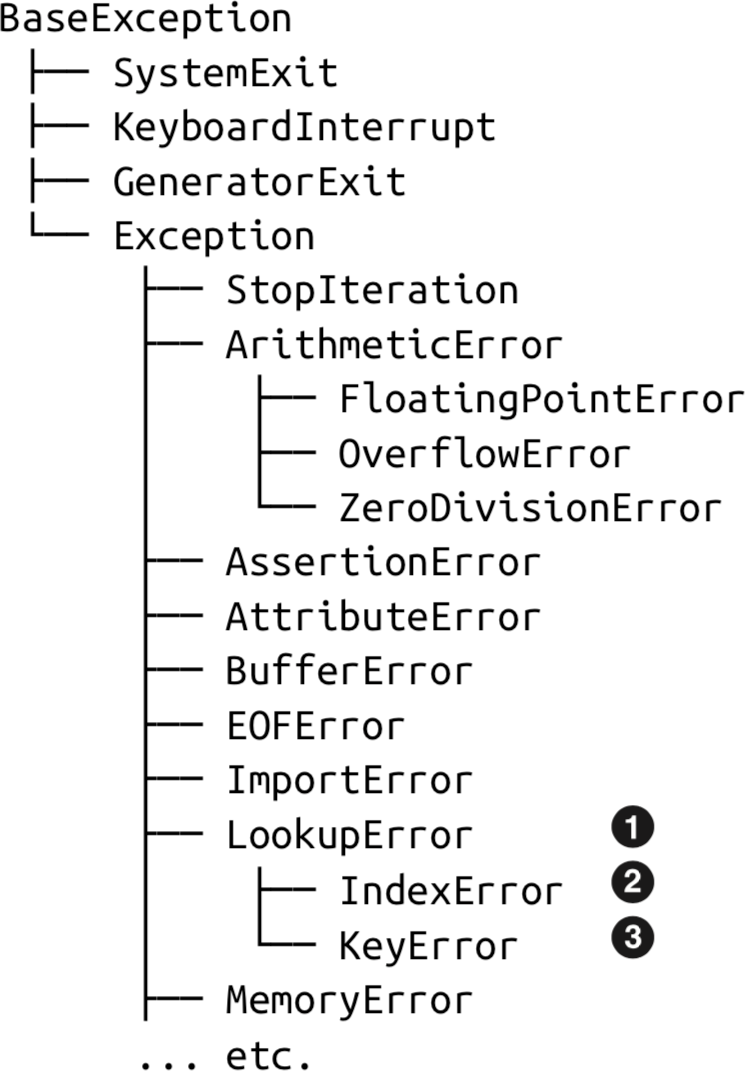
Figure 13-6. Part of the Exception class hierarchy.11
LookupErroris the exception we handle inTombola.inspect.IndexErroris theLookupErrorsubclass raised when we try to get an item from a sequence with an index beyond the last position.KeyErroris raised when we use a nonexistent key to get an item from a mapping.
We now have our very own Tombola ABC. To witness the interface checking performed by an ABC,
let’s try to fool Tombola with a defective implementation in Example 13-8.
Example 13-8. A fake Tombola doesn’t go undetected
>>>fromtombolaimportTombola>>>classFake(Tombola):...defpick(self):...return13...>>>Fake<class '__main__.Fake'>>>>f=Fake()Traceback (most recent call last):File"<stdin>", line1, in<module>TypeError:Can't instantiate abstract class Fake with abstract method load
Declare
Fakeas a subclass ofTombola.The class was created, no errors so far.
TypeErroris raised when we try to instantiateFake. The message is very clear:Fakeis considered abstract because it failed to implementload, one of the abstract methods declared in theTombolaABC.
So we have our first ABC defined, and we put it to work validating a class.
We’ll soon subclass the Tombola ABC, but first we must cover some ABC coding rules.
ABC Syntax Details
The standard way to declare an ABC is to subclass abc.ABC or any other ABC.
Besides the ABC base class, and the @abstractmethod decorator,
the abc module defines the
@abstractclassmethod, @abstractstaticmethod, and @abstractproperty decorators.
However, these last three were deprecated in Python 3.3,
when it became possible to stack decorators on top of @abstractmethod, making the others redundant.
For example, the preferred way to declare an abstract class method is:
classMyABC(abc.ABC):@classmethod@abc.abstractmethoddefan_abstract_classmethod(cls,...):pass
Warning
The order of stacked function decorators matters, and in the case of @abstractmethod, the documentation is explicit:
When abstractmethod() is applied in combination with other method descriptors, it should be applied as the innermost decorator…12
In other words, no other decorator may appear between @abstractmethod and the def statement.
Now that we’ve got these ABC syntax issues covered, let’s put Tombola to use by implementing two concrete descendants of it.
Subclassing an ABC
Given the Tombola ABC, we’ll now develop two concrete subclasses that satisfy its interface.
These classes were pictured in Figure 13-5, along with the virtual subclass to be discussed in the next section.
The BingoCage class in Example 13-9 is a variation of Example 7-8 using a better randomizer.
This BingoCage implements the required abstract methods load and pick.
Example 13-9. bingo.py: BingoCage is a concrete subclass of Tombola
importrandomfromtombolaimportTombolaclassBingoCage(Tombola):def__init__(self,items):self._randomizer=random.SystemRandom()self._items=[]self.load(items)defload(self,items):self._items.extend(items)self._randomizer.shuffle(self._items)defpick(self):try:returnself._items.pop()exceptIndexError:raiseLookupError('pick from empty BingoCage')def__call__(self):self.pick()
This
BingoCageclass explicitly extendsTombola.Pretend we’ll use this for online gaming.
random.SystemRandomimplements therandomAPI on top of theos.urandom(…)function, which provides random bytes “suitable for cryptographic use,” according to theosmodule docs.Delegate initial loading to the
.load(…)method.Instead of the plain
random.shuffle()function, we use the.shuffle()method of ourSystemRandominstance.pickis implemented as in Example 7-8.__call__is also from Example 7-8. It’s not needed to satisfy theTombolainterface, but there’s no harm in adding extra methods.
BingoCage inherits the expensive loaded and the silly inspect methods from Tombola.
Both could be overridden with much faster one-liners, as in Example 13-10. The point is: we can be lazy and just inherit the suboptimal concrete methods from an ABC. The methods inherited from Tombola are not as fast as they could be for BingoCage, but they do provide correct results for any Tombola subclass that correctly implements pick and load.
Example 13-10 shows a very different but equally valid implementation of the Tombola interface.
Instead of shuffling the “balls” and popping the last, LottoBlower pops from a random position.
Example 13-10. lotto.py: LottoBlower is a concrete subclass that overrides the inspect and loaded methods from Tombola
importrandomfromtombolaimportTombolaclassLottoBlower(Tombola):def__init__(self,iterable):self._balls=list(iterable)defload(self,iterable):self._balls.extend(iterable)defpick(self):try:position=random.randrange(len(self._balls))exceptValueError:raiseLookupError('pick from empty LottoBlower')returnself._balls.pop(position)defloaded(self):returnbool(self._balls)definspect(self):returntuple(self._balls)
The initializer accepts any iterable: the argument is used to build a list.
The
random.randrange(…)function raisesValueErrorif the range is empty, so we catch that and throwLookupErrorinstead, to be compatible withTombola.Otherwise the randomly selected item is popped from
self._balls.Override
loadedto avoid callinginspect(asTombola.loadeddoes in Example 13-7). We can make it faster by working withself._ballsdirectly—no need to build a whole newtuple.Override
inspectwith a one-liner.
Example 13-10 illustrates an idiom worth mentioning:
in __init__, self._balls stores list(iterable) and not just a reference to iterable
(i.e., we did not merely assign self._balls = iterable, aliasing the argument).
As mentioned in “Defensive Programming and ‘Fail Fast’”, this makes our LottoBlower flexible because the iterable argument may be any iterable type.
At the same time, we make sure to store its items in a list so we can pop items.
And even if we always get lists as the iterable argument,
list(iterable) produces a copy of the argument,
which is a good practice considering we will be removing items from it and the client might not expect that the provided list will be changed.13
We now come to the crucial dynamic feature of goose typing:
declaring virtual subclasses with the register method.
A Virtual Subclass of an ABC
An essential characteristic of goose typing—and one reason why it deserves a waterfowl name—is the ability to register a class as a virtual subclass of an ABC, even if it does not inherit from it. When doing so, we promise that the class faithfully implements the interface defined in the ABC—and Python will believe us without checking. If we lie, we’ll be caught by the usual runtime exceptions.
This is done by calling a register class method on the ABC.
The registered class then becomes a virtual subclass of the ABC,
and will be recognized as such by issubclass,
but it does not inherit any methods or attributes from the ABC.
Warning
Virtual subclasses do not inherit from their registered ABCs, and are not checked for conformance to the ABC interface at any time, not even when they are instantiated. Also, static type checkers can’t handle virtual subclasses at this time. For details, see Mypy issue 2922—ABCMeta.register support.
The register method is usually invoked as a plain function (see “Usage of register in Practice”),
but it can also be used as a decorator. In Example 13-11,
we use the decorator syntax and implement TomboList, a virtual subclass of Tombola, depicted in Figure 13-7.
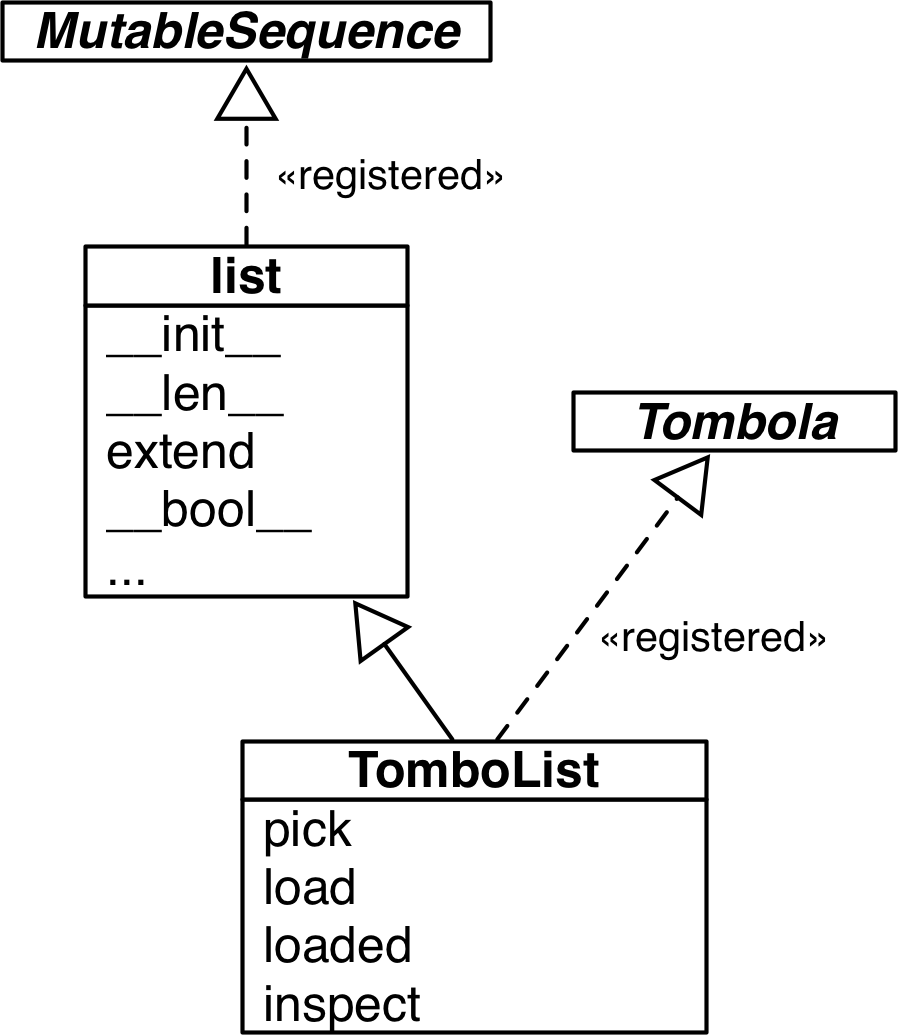
Figure 13-7. UML class diagram for the TomboList, a real subclass of list and a virtual subclass of Tombola.
Example 13-11. tombolist.py: class TomboList is a virtual subclass of Tombola
fromrandomimportrandrangefromtombolaimportTombola@Tombola.registerclassTomboList(list):defpick(self):ifself:position=randrange(len(self))returnself.pop(position)else:raiseLookupError('pop from empty TomboList')load=list.extenddefloaded(self):returnbool(self)definspect(self):returntuple(self)# Tombola.register(TomboList)
Tombolistis registered as a virtual subclass ofTombola.Tombolistextendslist.Tombolistinherits its boolean behavior fromlist, and that returnsTrueif the list is not empty.Our
pickcallsself.pop, inherited fromlist, passing a random item index.Tombolist.loadis the same aslist.extend.loadeddelegates tobool.14It’s always possible to call
registerin this way, and it’s useful to do so when you need to register a class that you do not maintain, but which does fulfill the interface.
Note that because of the registration,
the functions issubclass and isinstance act as if TomboList is a subclass of Tombola:
>>>fromtombolaimportTombola>>>fromtombolistimportTomboList>>>issubclass(TomboList,Tombola)True>>>t=TomboList(range(100))>>>isinstance(t,Tombola)True
However, inheritance is guided by a special class attribute named __mro__—the Method Resolution Order.
It basically lists the class and its superclasses in the order Python uses to search for
methods.15 If you inspect the __mro__ of TomboList,
you’ll see that it lists only the “real” superclasses—list and object:
>>>TomboList.__mro__(<class 'tombolist.TomboList'>, <class 'list'>, <class 'object'>)
Tombola is not in Tombolist.__mro__, so Tombolist does not inherit any methods from Tombola.
This concludes our Tombola ABC case study.
In the next section, we’ll address how the register ABC function is used in the wild.
Usage of register in Practice
In Example 13-11, we used Tombola.register as a class decorator.
Prior to Python 3.3, register could not be used like that—it had to be called as a plain function after the class definition,
as suggested by the comment at the end of Example 13-11.
However, even now, it’s more widely deployed as a function to register classes defined elsewhere.
For example, in the source code for the collections.abc module,
the built-in types tuple, str, range, and memoryview are registered as virtual subclasses of Sequence, like this:
Sequence.register(tuple)Sequence.register(str)Sequence.register(range)Sequence.register(memoryview)
Several other built-in types are registered to ABCs in _collections_abc.py.
Those registrations happen only when that module is imported,
which is OK because you’ll have to import it anyway to get the ABCs.
For example, you need to import MutableMapping from collections.abc to perform a check like isinstance(my_dict, MutableMapping).
Subclassing an ABC or registering with an ABC are both explicit ways of making our classes pass issubclass checks—as well as isinstance checks, which also rely on issubclass.
But some ABCs support structural typing as well. The next section explains.
Structural Typing with ABCs
ABCs are mostly used with nominal typing.
When a class Sub explicitly inherits from AnABC, or is registered with AnABC, the name of AnABC is linked to the Sub class—and
that’s how at runtime, issubclass(AnABC, Sub) returns True.
In contrast, structural typing is about looking at the structure of an object’s public interface to determine its type: an object is consistent-with a type if it implements the methods defined in the type.16 Dynamic and static duck typing are two approaches to structural typing.
It turns out that some ABCs also support structural typing.
In his essay, “Waterfowl and ABCs”, Alex shows that a class can be recognized as a subclass of an ABC even without registration.
Here is his example again, with an added test using issubclass:
>>>classStruggle:...def__len__(self):return23...>>>fromcollectionsimportabc>>>isinstance(Struggle(),abc.Sized)True>>>issubclass(Struggle,abc.Sized)True
Class Struggle is considered a subclass of abc.Sized by the issubclass function
(and, consequently, by isinstance as well) because abc.Sized implements a special class method named __subclasshook__.
The __subclasshook__ for Sized checks whether the class argument has an attribute named __len__.
If it does, then it is considered a virtual subclass of Sized.
See Example 13-12.
Example 13-12. Definition of Sized from the source code of Lib/_collections_abc.py
classSized(metaclass=ABCMeta):__slots__=()@abstractmethoddef__len__(self):return0@classmethoddef__subclasshook__(cls,C):ifclsisSized:ifany("__len__"inB.__dict__forBinC.__mro__):returnTruereturnNotImplemented
If there is an attribute named
__len__in the__dict__of any class listed inC.__mro__(i.e.,Cand its superclasses)……return
True, signaling thatCis a virtual subclass ofSized.Otherwise return
NotImplementedto let the subclass check proceed.
Note
If you are interested in the details of the subclass check,
see the source code for the ABCMeta.__subclasscheck__ method in Python 3.6:
Lib/abc.py.
Beware: it has lots of ifs and two recursive calls.
In Python 3.7, Ivan Levkivskyi and Inada Naoki rewrote in C most of the logic for the abc module, for better performance.
See Python issue #31333.
The current implementation of ABCMeta.__subclasscheck__ simply calls _abc_subclasscheck.
The relevant C source code is in cpython/Modules/_abc.c#L605.
That’s how __subclasshook__ allows ABCs to support structural typing.
You can formalize an interface with an ABC, you can make isinstance checks against that ABC,
and still have a completely unrelated class pass an issubclass check because it implements a certain method
(or because it does whatever it takes to convince a __subclasshook__ to vouch for it).
Is it a good idea to implement __subclasshook__ in our own ABCs? Probably not.
All the implementations of __subclasshook__ I’ve seen in the Python source code are in ABCs like Sized that declare just one special method,
and they simply check for that special method name.
Given their “special” status, you can be pretty sure that any method named __len__ does what you expect.
But even in the realm of special methods and fundamental ABCs,
it can be risky to make such assumptions.
For example, mappings implement __len__, __getitem__, and __iter__, but they are rightly not considered subtypes of Sequence,
because you can’t retrieve items using integer offsets or slices.
That’s why the abc.Sequence class does not implement
__subclasshook__.
For ABCs that you and I may write, a __subclasshook__ would be even less dependable.
I am not ready to believe that any class named Spam that implements or inherits
load, pick, inspect, and loaded is guaranteed to behave as a Tombola.
It’s better to let the programmer affirm it by subclassing Spam from Tombola,
or registering it with Tombola.register(Spam).
Of course, your __subclasshook__ could also check method signatures and other features,
but I just don’t think it’s worthwhile.
Static Protocols
Note
Static protocols were introduced in “Static Protocols” (Chapter 8). I considered delaying all coverage of protocols until this chapter, but decided that the initial presentation of type hints in functions had to include protocols because duck typing is an essential part of Python, and static type checking without protocols doesn’t handle Pythonic APIs very well.
We will wrap up this chapter by illustrating static protocols with two simple examples, and a discussion of numeric ABCs and protocols.
Let’s start by showing how a static protocol makes it possible to annotate and type check the double() function we first saw in “Types Are Defined by Supported Operations”.
The Typed double Function
When introducing Python to programmers more used to statically typed languages,
one of my favorite examples is this simple double function:
>>>defdouble(x):...returnx*2...>>>double(1.5)3.0>>>double('A')'AA'>>>double([10,20,30])[10, 20, 30, 10, 20, 30]>>>fromfractionsimportFraction>>>double(Fraction(2,5))Fraction(4, 5)
Before static protocols were introduced,
there was no practical way to add type hints to double without limiting its possible
uses.17
Thanks to duck typing, double works even with types from the future,
such as the enhanced Vector class that we’ll see in “Overloading * for Scalar Multiplication” (Chapter 16):
>>>fromvector_v7importVector>>>double(Vector([11.0,12.0,13.0]))Vector([22.0, 24.0, 26.0])
The initial implementation of type hints in Python was a nominal type system: the name of a type in an annotation had to match the name of the type of the actual arguments—or the name of one of its superclasses. Since it’s impossible to name all types that implement a protocol by supporting the required operations, duck typing could not be described by type hints before Python 3.8.
Now, with typing.Protocol we can tell Mypy that double takes an argument x that supports x * 2.
Example 13-13 shows how.
Example 13-13. double_protocol.py: definition of double using a Protocol
fromtypingimportTypeVar,ProtocolT=TypeVar('T')classRepeatable(Protocol):def__mul__(self:T,repeat_count:int)->T:...RT=TypeVar('RT',bound=Repeatable)defdouble(x:RT)->RT:returnx*2
We’ll use this
Tin the__mul__signature.__mul__is the essence of theRepeatableprotocol. Theselfparameter is usually not annotated—its type is assumed to be the class. Here we useTto make sure the result type is the same as the type ofself. Also, note thatrepeat_countis limited tointin this protocol.The
RTtype variable is bounded by theRepeatableprotocol: the type checker will require that the actual type implementsRepeatable.Now the type checker is able to verify that the
xparameter is an object that can be multiplied by an integer, and the return value has the same type asx.
This example shows why PEP 544 is titled
“Protocols: Structural subtyping (static duck typing).”
The nominal type of the actual argument x given to double is irrelevant as long as it quacks—that is,
as long as it implements __mul__.
Runtime Checkable Static Protocols
In the Typing Map (Figure 13-1), typing.Protocol appears in the static checking area—the bottom half of the diagram.
However, when defining a typing.Protocol subclass, you can use the @runtime_checkable decorator to make
that protocol support isinstance/issubclass checks at runtime.
This works because typing.Protocol is an ABC, therefore it supports the __subclasshook__ we saw in “Structural Typing with ABCs”.
As of Python 3.9, the typing module includes seven ready-to-use protocols that are runtime checkable.
Here are two of them, quoted directly from the typing documentation:
class typing.SupportsComplex-
An ABC with one abstract method,
__complex__. class typing.SupportsFloat-
An ABC with one abstract method,
__float__.
These protocols are designed to check numeric types for “convertibility”:
if an object o implements __complex__,
then you should be able to get a complex by invoking complex(o)—because
the __complex__ special method exists to support the
complex() built-in function.
Example 13-14 shows the
source code
for the typing.SupportsComplex protocol.
Example 13-14. typing.SupportsComplex protocol source code
@runtime_checkableclassSupportsComplex(Protocol):"""An ABC with one abstract method __complex__."""__slots__=()@abstractmethoddef__complex__(self)->complex:pass
The key is the __complex__ abstract method.18
During static type checking, an object will be considered consistent-with the SupportsComplex protocol
if it implements a __complex__ method that takes only self and returns a complex.
Thanks to the @runtime_checkable class decorator applied to SupportsComplex,
that protocol can also be used with isinstance checks in Example 13-15.
Example 13-15. Using SupportsComplex at runtime
>>>fromtypingimportSupportsComplex>>>importnumpyasnp>>>c64=np.complex64(3+4j)>>>isinstance(c64,complex)False>>>isinstance(c64,SupportsComplex)True>>>c=complex(c64)>>>c(3+4j)>>>isinstance(c,SupportsComplex)False>>>complex(c)(3+4j)
complex64is one of five complex number types provided by NumPy.None of the NumPy complex types subclass the built-in
complex.But NumPy’s complex types implement
__complex__, so they comply with theSupportsComplexprotocol.Therefore, you can create built-in
complexobjects from them.Sadly, the
complexbuilt-in type does not implement__complex__, althoughcomplex(c)works fine ifcis acomplex.
As a result of that last point, if you want to test whether an object c is a complex or SupportsComplex,
you can provide a tuple of types as the second argument to
isinstance, like this:
isinstance(c,(complex,SupportsComplex))
An alternative would be to use the Complex ABC, defined in the numbers module.
The built-in complex type and the NumPy complex64 and complex128 types are all registered
as virtual subclasses of numbers.Complex, therefore this works:
>>>importnumbers>>>isinstance(c,numbers.Complex)True>>>isinstance(c64,numbers.Complex)True
I recommended using the numbers ABCs in the first edition of Fluent Python, but now that’s no longer good advice,
because those ABCs are not recognized by the static type checkers, as we’ll see in “The numbers ABCs and Numeric Protocols”.
In this section I wanted to demonstrate that a runtime checkable protocol works with isinstance,
but it turns out this is example not a particularly good use case of isinstance,
as the sidebar “Duck Typing Is Your Friend” explains.
Tip
If you’re using an external type checker, there is one advantage of explict isinstance checks:
when you write an if statement where the condition is isinstance(o, MyType),
then Mypy can infer that inside the if block, the type of the o object is consistent-with MyType.
Now that we’ve seen how to use static protocols at runtime with preexisting types like complex and numpy.complex64,
we need to discuss the limitations of runtime checkable protocols.
Limitations of Runtime Protocol Checks
We’ve seen that type hints are generally ignored at runtime,
and this also affects the use of isinstance or issubclass checks
against static protocols.
For example, any class with a __float__ method
is considered—at runtime—a virtual subclass of SupportsFloat,
even if the __float__ method does not return a float.
Check out this console session:
>>>importsys>>>sys.version'3.9.5 (v3.9.5:0a7dcbdb13, May 3 2021, 13:17:02) \n[Clang 6.0 (clang-600.0.57)]'>>>c=3+4j>>>c.__float__<method-wrapper '__float__' of complex object at 0x10a16c590>>>>c.__float__()Traceback (most recent call last):File"<stdin>", line1, in<module>TypeError:can't convert complex to float
In Python 3.9, the complex type does have a __float__ method,
but it exists only to raise a TypeError with an explicit error message.
If that __float__ method had annotations,
the return type would be NoReturn—which we saw in “NoReturn”.
But type hinting complex.__float__ on typeshed would not solve this problem
because Python’s runtime generally ignores type hints—and
can’t access the typeshed stub files anyway.
Continuing from the previous Python 3.9 session:
>>>fromtypingimportSupportsFloat>>>c=3+4j>>>isinstance(c,SupportsFloat)True>>>issubclass(complex,SupportsFloat)True
So we have misleading results: the runtime checks against SupportsFloat
suggest that you can convert a complex to float, but in fact that raises a type error.
Warning
The specific isssue with the complex type is fixed in Python 3.10.0b4 with the
removal of the complex.__float__ method.
But the overall issue remains:
isinstance/issubclass checks only look at the presence or absence of methods,
without checking their signatures, much less their type annotations.
And this is not about to change, because such type checks at runtime would
have an unacceptable performance cost.19
Now let’s see how to implement a static protocol in a user-defined class.
Supporting a Static Protocol
Recall the Vector2d class we built in Chapter 11.
Given that a complex number and a Vector2d instance both consist of a pair of floats,
it makes sense to support conversion from Vector2d to complex.
Example 13-16 shows the implementation of the __complex__ method
to enhance the last version of Vector2d we saw in Example 11-11.
For completeness, we can support the inverse operation with a fromcomplex class method
to build a Vector2d from a complex.
Example 13-16. vector2d_v4.py: methods for converting to and from complex
def__complex__(self):returncomplex(self.x,self.y)@classmethoddeffromcomplex(cls,datum):returncls(datum.real,datum.imag)
This assumes that
datumhas.realand.imagattributes. We’ll see a better implementation in Example 13-17.
Given the preceding code, and the __abs__ method the Vector2d already had
in Example 11-11, we get these features:
>>>fromtypingimportSupportsComplex,SupportsAbs>>>fromvector2d_v4importVector2d>>>v=Vector2d(3,4)>>>isinstance(v,SupportsComplex)True>>>isinstance(v,SupportsAbs)True>>>complex(v)(3+4j)>>>abs(v)5.0>>>Vector2d.fromcomplex(3+4j)Vector2d(3.0, 4.0)
For runtime type checking, Example 13-16 is fine,
but for better static coverage and error reporting with Mypy,
the __abs__, __complex__, and fromcomplex methods should get
type hints, as shown in Example 13-17.
Example 13-17. vector2d_v5.py: adding annotations to the methods under study
def__abs__(self)->float:returnmath.hypot(self.x,self.y)def__complex__(self)->complex:returncomplex(self.x,self.y)@classmethoddeffromcomplex(cls,datum:SupportsComplex)->Vector2d:c=complex(datum)returncls(c.real,c.imag)
The
floatreturn annotation is needed, otherwise Mypy infersAny, and doesn’t check the body of the method.Even without the annotation, Mypy was able to infer that this returns a
complex. The annotation prevents a warning, depending on your Mypy configuration.Here
SupportsComplexensures thedatumis convertible.This explicit conversion is necessary, because the
SupportsComplextype does not declare.realand.imagattributes, used in the next line. For example,Vector2ddoesn’t have those attributes, but implements__complex__.
The return type of fromcomplex can be Vector2d if from __future__ import annotations appears at the top of the module.
That import causes type hints to be stored as strings, without being evaluated at import time, when function definitions are evaluated.
Without the __future__ import of annotations,
Vector2d is an invalid reference at this point (the class is not fully defined yet) and should be written as a string:
'Vector2d', as if it were a forward reference.
This __future__ import was introduced in
PEP 563—Postponed Evaluation of Annotations,
implemented in Python 3.7.
That behavior was scheduled to become default in 3.10, but the change was delayed to a later version.20
When that happens, the import will be redundant, but harmless.
Next, let’s see how to create—and later, extend—a new static protocol.
Designing a Static Protocol
While studying goose typing, we saw the Tombola ABC in “Defining and Using an ABC”.
Here we’ll see how to define a similar interface using a static
protocol.
The Tombola ABC specifies two methods: pick and load.
We could define a static protocol with these two methods as well,
but I learned from the Go community that single-method protocols
make static duck typing more useful and flexible.
The Go standard library has several interfaces
like Reader, an interface for I/O that requires just a read method.
After a while, if you realize a more complete protocol is required,
you can combine two or more protocols to define a new one.
Using a container that picks items at random may or may not require reloading the container,
but it certainly needs a method to do the actual pick,
so that’s the method I will choose for the minimal RandomPicker protocol.
The code for that protocol is in Example 13-18, and
its use is demonstrated by tests in Example 13-19.
Example 13-18. randompick.py: definition of RandomPicker
fromtypingimportProtocol,runtime_checkable,Any@runtime_checkableclassRandomPicker(Protocol):defpick(self)->Any:...
Note
The pick method returns Any.
In “Implementing a Generic Static Protocol”,
we will see how to make RandomPicker a generic type
with a parameter to let users of the protocol
specify the return type of the pick method.
Example 13-19. randompick_test.py: RandomPicker in use
importrandomfromtypingimportAny,Iterable,TYPE_CHECKINGfromrandompickimportRandomPickerclassSimplePicker:def__init__(self,items:Iterable)->None:self._items=list(items)random.shuffle(self._items)defpick(self)->Any:returnself._items.pop()deftest_isinstance()->None:popper:RandomPicker=SimplePicker([1])assertisinstance(popper,RandomPicker)deftest_item_type()->None:items=[1,2]popper=SimplePicker(items)item=popper.pick()assertiteminitemsifTYPE_CHECKING:reveal_type(item)assertisinstance(item,int)
It’s not necessary to import the static protocol to define a class that implements it. Here I imported
RandomPickeronly to use it ontest_isinstancelater.SimplePickerimplementsRandomPicker—but it does not subclass it. This is static duck typing in action.Anyis the default return type, so this annotation is not strictly necessary, but it does make it more clear that we are implementing theRandomPickerprotocol as defined in Example 13-18.Don’t forget to add
-> Nonehints to your tests if you want Mypy to look at them.I added a type hint for the
poppervariable to show that Mypy understands thatSimplePickeris consistent-with.This test proves that an instance of
SimplePickeris also an instance ofRandomPicker. This works because of the@runtime_checkabledecorator applied toRandomPicker, and becauseSimplePickerhas apickmethod as required.This test invokes the
pickmethod from aSimplePicker, verifies that it returns one of the items given toSimplePicker, and then does static and runtime checks on the returned item.
This line generates a note in the Mypy output.
As we saw in Example 8-22, reveal_type is a “magic” function recognized by
Mypy. That’s why it is not imported and we can only call it inside
if blocks protected by typing.TYPE_CHECKING, which is only True in the eyes of a static type checker,
but is False at runtime.
Both tests in Example 13-19 pass.
Mypy does not see any errors in that code either,
and shows the result of the reveal_type on the item
returned by pick:
$ mypy randompick_test.py randompick_test.py:24: note: Revealedtypeis'Any'
Having created our first protocol, let’s study some advice on the matter.
Best Practices for Protocol Design
After 10 years of experience with static duck typing in Go, it is clear that narrow protocols are more useful—often such protocols have a single method, rarely more than a couple of methods. Martin Fowler wrote a post defining role interface, a useful idea to keep in mind when designing protocols.
Also, sometimes you see a protocol defined near the function that uses it—that is, defined in “client code” instead of being defined in a library. This is makes it easy to create new types to call that function, which is good for extensibility and testing with mocks.
The practices of narrow protocols and client-code protocols both avoid unnecessary tight coupling, in line with the Interface Segregation Principle, which we can summarize as “Clients should not be forced to depend upon interfaces that they do not use.”
The page “Contributing to typeshed” recommends this naming convention for static protocols (the following three points are quoted verbatim):
-
Use plain names for protocols that represent a clear concept (e.g.,
Iterator,Container). -
Use
SupportsXfor protocols that provide callable methods (e.g.,SupportsInt,SupportsRead,SupportsReadSeek).21 -
Use
HasXfor protocols that have readable and/or writable attributes or getter/setter methods (e.g.,HasItems,HasFileno).
The Go standard library has a naming convention that I like:
for single method protocols, if the method name is a verb,
append “-er” or “-or” to make it a noun.
For example, instead of SupportsRead, have Reader.
More examples include Formatter, Animator, and Scanner.
For inspiration, see
“Go (Golang) Standard Library Interfaces (Selected)” by Asuka Kenji.
One good reason to create minimalistic protocols is the ability to extend them later, if needed. We’ll now see that it’s not hard to create a derived protocol with an additional method.
Extending a Protocol
As I mentioned at the start of the previous section, Go developers advocate to err on the side of minimalism when defining interfaces—their name for static protocols. Many of the most widely used Go interfaces have a single method.
When practice reveals that a protocol with more methods is useful, instead of adding methods to the original protocol, it’s better to derive a new protocol from it. Extending a static protocol in Python has a few caveats, as Example 13-20 shows.
Example 13-20. randompickload.py: extending RandomPicker
fromtypingimportProtocol,runtime_checkablefromrandompickimportRandomPicker@runtime_checkableclassLoadableRandomPicker(RandomPicker,Protocol):defload(self,Iterable)->None:...
If you want the derived protocol to be runtime checkable, you must apply the decorator again—its behavior is not inherited.22
Every protocol must explicitly name
typing.Protocolas one of its base classes in addition to the protocol we are extending. This is different from the way inheritance works in Python.23Back to “regular” object-oriented programming: we only need to declare the method that is new in this derived protocol. The
pickmethod declaration is inherited fromRandomPicker.
This concludes the final example of defining and using a static protocol in this chapter.
To wrap the chapter, we’ll go over numeric ABCs and their possible replacement with numeric protocols.
The numbers ABCs and Numeric Protocols
As we saw in “The fall of the numeric tower”, the ABCs in the numbers package of the standard library
work fine for runtime type checking.
If you need to check for an integer,
you can use isinstance(x, numbers.Integral) to accept int, bool (which subclasses int)
or other integer types that are provided by external libraries that
register their types as virtual subclasses of the numbers ABCs.
For example, NumPy has 21 integer types—as
well as several variations of floating-point types registered as numbers.Real,
and complex numbers with various bit widths registered as numbers.Complex.
Tip
Somewhat surprisingly, decimal.Decimal is not registered as a virtual subclass of numbers.Real.
The reason is that, if you need the precision of Decimal in your program,
then you want to be protected from accidental mixing of decimals
with floating-point numbers that are less precise.
Sadly, the numeric tower was not designed for static type checking.
The root ABC—numbers.Number—has no methods,
so if you declare x: Number, Mypy will not let you do arithmetic or call any methods on x.
If the numbers ABCs are not supported, what are the options?
A good place to look for typing solutions is the typeshed project.
As part of the Python standard library, the statistics module has a corresponding
statistics.pyi
stub file with type hints for on typeshed.
There you’ll find the following definitions, which are used to annotate several functions:
_Number=Union[float,Decimal,Fraction]_NumberT=TypeVar('_NumberT',float,Decimal,Fraction)
That approach is correct, but limited.
It does not support numeric types
outside of the standard library, which the numbers ABCs do support at
runtime—when the numeric types are registered as virtual subclasses.
The current trend is to recommend the numeric protocols provided by the typing module,
which we discussed in “Runtime Checkable Static Protocols”.
Unfortunately, at runtime, the numeric protocols may let you down.
As mentioned in “Limitations of Runtime Protocol Checks”,
the complex type in Python 3.9 implements __float__,
but the method exists only to raise TypeError with an explicit message:
“can’t convert complex to float.”
It implements __int__ as well, for the same reason.
The presence of those methods makes isinstance return misleading results
in Python 3.9. In Python 3.10, the methods of complex that
unconditionally raised TypeError were removed.24
On the other hand, NumPy’s complex types implement __float__ and __int__ methods that work,
only issuing a warning when each of them is used for the first time:
>>>importnumpyasnp>>>cd=np.cdouble(3+4j)>>>cd(3+4j)>>>float(cd)<stdin>:1: ComplexWarning: Casting complex values to realdiscards the imaginary part3.0
The opposite problem also happens:
built-ins complex, float, and int, and also numpy.float16 and numpy.uint8, don’t
have a __complex__ method, so isinstance(x, SupportsComplex) returns False for
them.25
The NumPy complex types, such as np.complex64, do implement __complex__ to
convert to a built-in complex.
However, in practice, the complex() built-in constructor handles
instances of all these types with no errors or warnings:
>>>importnumpyasnp>>>fromtypingimportSupportsComplex>>>sample=[1+0j,np.complex64(1+0j),1.0,np.float16(1.0),1,np.uint8(1)]>>>[isinstance(x,SupportsComplex)forxinsample][False, True, False, False, False, False]>>>[complex(x)forxinsample][(1+0j), (1+0j), (1+0j), (1+0j), (1+0j), (1+0j)]
This shows that isinstance checks against
SupportsComplex suggest that those conversions to complex would fail,
but they all succeed.
In the typing-sig mailing list,
Guido van Rossum pointed out that the built-in complex accepts a single argument,
and that’s why those conversions work.
On the other hand,
Mypy accepts arguments of all those six types in a call to a
to_complex()
function defined like this:
defto_complex(n:SupportsComplex)->complex:returncomplex(n)
As I write this, NumPy has no type hints, so its number types are all Any.26
On the other hand, Mypy is somehow “aware” that the built-in int and float can be converted to complex,
even though on typeshed only the built-in complex class has a __complex__ method.27
In conclusion, although numeric types should not be hard to type check,
the current situation is this: the type hints PEP 484
eschews the numeric tower
and implicitly recommends that type checkers hardcode the subtype relationships among
built-in complex, float, and int.
Mypy does that, and it also
pragmatically accepts that int and float
are consistent-with SupportsComplex, even though they don’t implement __complex__.
Tip
I only found unexpected results when using isinstance checks
with numeric Supports* protocols while experimenting with
conversions to or from complex.
If you don’t use complex numbers,
you can rely on those protocols instead of the numbers ABCs.
The main takeaways for this section are:
-
The
numbersABCs are fine for runtime type checking, but unsuitable for static typing. -
The numeric static protocols
SupportsComplex,SupportsFloat, etc. work well for static typing, but are unreliable for runtime type checking when complex numbers are involved.
We are now ready for a quick review of what we saw in this chapter.
Chapter Summary
The Typing Map (Figure 13-1) is the key to making sense of this chapter. After a brief introduction to the four approaches to typing, we contrasted dynamic and static protocols, which respectively support duck typing and static duck typing. Both kinds of protocols share the essential characteristic that a class is never required to explicitly declare support for any specific protocol. A class supports a protocol simply by implementing the necessary methods.
The next major section was “Programming Ducks”,
where we explored the lengths to which the Python interpreter goes to
make the sequence and iterable dynamic protocols work,
including partial implementations of both.
We then saw how a class can be made to implement a protocol at runtime
through the addition of extra methods via monkey patching.
The duck typing section ended with hints for defensive programming,
including detection of structural types without explicit
isinstance or hasattr checks using try/except and failing fast.
After Alex Martelli introduced goose typing in “Waterfowl and ABCs”,
we saw how to subclass existing ABCs,
surveyed important ABCs in the standard library,
and created an ABC from scratch,
which we then implemented by traditional subclassing and by registration.
To close this section, we saw how the __subclasshook__ special method
enables ABCs to support structural typing by recognizing unrelated classes that
provide methods fulfilling the interface defined in the ABC.
The last major section was “Static Protocols”,
where we resumed coverage of static duck typing, which started in
Chapter 8, in “Static Protocols”.
We saw how the @runtime_checkable decorator also leverages __subclasshook__
to support structural typing at runtime—even though the best use of static protocols is with static type checkers,
which can take into account type hints to make structural typing more reliable.
Next we talked about the design and coding of a static protocol and how to extend it.
The chapter ended with “The numbers ABCs and Numeric Protocols”, which tells the sad story of the
derelict state of the numeric tower and a few existing shortcomings of the proposed alternative:
the numeric static protocols such as SupportsFloat and others added to the typing module in Python 3.8.
The main message of this chapter is that we have four complementary ways of programming with interfaces in modern Python, each with different advantages and drawbacks. You are likely to find suitable use cases for each typing scheme in any modern Python codebase of significant size. Rejecting any one of these approaches will make your work as a Python programmer harder than it needs to be.
Having said that, Python achieved widespread popularity while supporting only duck typing. Other popular languages such as JavaScript, PHP, and Ruby, as well as Lisp, Smalltalk, Erlang, and Clojure—not popular but very influential—are all languages that had and still have tremendous impact by leveraging the power and simplicity of duck typing.
Further Reading
For a quick look at typing pros and cons, as well as the importance of typing.Protocol
for the health of statically checked codebases, I highly recommend Glyph Lefkowitz’s post
“I Want A New Duck: typing.Protocol and the future of duck typing”.
I also learned a lot from his post
“Interfaces and Protocols”,
comparing typing.Protocol and zope.interface—an earlier mechanism for defining
interfaces in loosely coupled plug-in systems, used by the
Plone CMS,
the Pyramid web framework, and the
Twisted
asynchronous programming framework,
a project founded by Glyph.28
Great books about Python have—almost by definition—great coverage of duck typing. Two of my favorite Python books had updates released after the first edition of Fluent Python: The Quick Python Book, 3rd ed., (Manning), by Naomi Ceder; and Python in a Nutshell, 3rd ed., by Alex Martelli, Anna Ravenscroft, and Steve Holden (O’Reilly).
For a discussion of the pros and cons of dynamic typing, see Guido van Rossum’s interview with Bill Venners in “Contracts in Python: A Conversation with Guido van Rossum, Part IV”. An insightful and balanced take on this debate is Martin Fowler’s post “Dynamic Typing”. He also wrote “Role Interface”, which I mentioned in “Best Practices for Protocol Design”. Although it is not about duck typing, that post is highly relevant for Python protocol design, as he contrasts narrow role interfaces with the broader public interfaces of classes in general.
The Mypy documentation is often the best source of information for anything related to static typing in Python, including static duck typing, addressed in their “Protocols and structural subtyping” chapter.
The remaining references are all about goose typing.
Beazley and Jones’s Python Cookbook, 3rd ed.
(O’Reilly) has a section about defining an ABC (Recipe 8.12).
The book was written before Python 3.4,
so they don’t use the now preferred syntax of declaring ABCs by subclassing from abc.ABC (instead, they use the metaclass keyword, which we’ll only really need in Chapter 24).
Apart from this small detail, the recipe covers the major ABC features very well.
The Python Standard Library by Example by Doug Hellmann (Addison-Wesley),
has a chapter about the abc module.
It’s also available on the web in Doug’s excellent PyMOTW—Python Module of the Week.
Hellmann also uses the old style of ABC declaration: PluginBase(metaclass=abc.ABCMeta) instead of the simpler PluginBase(abc.ABC) available since Python 3.4.
When using ABCs, multiple inheritance is not only common but practically inevitable,
because each of the fundamental collection ABCs—Sequence, Mapping, and Set—extends Collection, which in turn extends multiple ABCs
(see Figure 13-4). Therefore, Chapter 14 is an important follow-up to this one.
PEP 3119—Introducing Abstract Base Classes
gives the rationale for ABCs. PEP 3141—A Type Hierarchy for Numbers
presents the ABCs of the
numbers module,
but the discussion in the Mypy issue #3186 “int is not a Number?”
includes some arguments about why the numeric tower is unsuitable for static type checking.
Alex Waygood wrote a
comprehensive answer on StackOverflow, discussing ways to annotate numeric types.
I’ll keep watching Mypy issue
#3186
for the next chapters of this saga, hoping for a happy ending that will make static typing and goose typing compatible—as they should be.
1 Design Patterns: Elements of Reusable Object-Oriented Software, “Introduction,” p. 18.
2 The “Monkey patch” article on Wikipedia has a funny example in Python.
3 That’s why automated testing is necessary.
4 Bjarne Stroustrup, The Design and Evolution of C++, p. 278 (Addison-Wesley).
5 Retrieved October 18, 2020.
6 You can also, of course, define your own ABCs—but I would discourage all but the most advanced Pythonistas from going that route, just as I would discourage them from defining their own custom metaclasses…and even for said “most advanced Pythonistas,” those of us sporting deep mastery of every fold and crease in the language, these are not tools for frequent use. Such “deep metaprogramming,” if ever appropriate, is intended for authors of broad frameworks meant to be independently extended by vast numbers of separate development teams…less than 1% of “most advanced Pythonistas” may ever need that! — A.M.
7 Multiple inheritance was considered harmful and excluded from Java, except for interfaces: Java interfaces can extend multiple interfaces, and Java classes can implement multiple interfaces.
8 Perhaps the client needs to audit the randomizer; or the agency wants to provide a rigged one. You never know…
9 «registered» and «virtual subclass» are not standard UML terms. I am using them to represent a class relationship that is specific to Python.
10 Before ABCs existed, abstract methods would raise NotImplementedError to signal that subclasses were responsible for their implementation. In Smalltalk-80, abstract method bodies would invoke subclassResponsibility, a method inherited from object that would produce an error with the message, “My subclass should have overridden one of my messages.”
11 The complete tree is in section “5.4. Exception hierarchy” of The Python Standard Library docs.
12 The @abc.abstractmethod entry in the abc module documentation.
13 “Defensive Programming with Mutable Parameters” in Chapter 6 was devoted to the aliasing issue we just avoided here.
14 The same trick I used with load() doesn’t work with loaded(), because the list type does not implement __bool__, the method I’d have to bind to loaded. The bool() built-in doesn’t need __bool__ to work because it can also use __len__. See “4.1. Truth Value Testing” in the “Built-in Types” chapter of the Python documentation.
15 There is a whole section explaining the __mro__ class attribute in “Multiple Inheritance and Method Resolution Order”. Right now, this quick explanation will do.
16 The concept of type consistency was explained in “Subtype-of versus consistent-with”.
17 OK, double() is not very useful, except as an example. But the Python standard library has many functions that could not be properly annotated before static protocols were added in Python 3.8. I helped fix a couple of bugs in typeshed by adding type hints using protocols. For example, the pull request that fixed “Should Mypy warn about potential invalid arguments to max?” leveraged a _SupportsLessThan protocol, which I used to enhance the annotations for max, min, sorted, and list.sort.
18 The __slots__ attribute is irrelevant to the current discussion—it’s an optimization we covered in “Saving Memory with __slots__”.
19 Thanks to Ivan Levkivskyi, coauthor of PEP 544 (on Protocols), for pointing out that type checking is not just a matter of checking whether the type of x is T: it’s about determining that the type of x is consistent-with T, which may be expensive. It’s no wonder that Mypy takes a few seconds to type check even short Python scripts.
20 Read the Python Steering Council decision on python-dev.
21 Every method is callable, so this guideline doesn’t say much. Perhaps “provide one or two methods”? Anyway, it’s a guideline, not a strict rule.
22 For details and rationale, please see the section about @runtime_checkable in PEP 544—Protocols: Structural subtyping (static duck typing).
23 Again, please read “Merging and extending protocols” in PEP 544 for details and rationale.
24 See Issue #41974—Remove complex.__float__, complex.__floordiv__, etc.
25 I did not test all the other float and integer variants NumPy offers.
26 The NumPy number types are all registered against the appropriate numbers ABCs, which Mypy ignores.
27 That’s a well-meaning lie on the part of typeshed: as of Python 3.9, the built-in complex type does not actually have a __complex__ method.
28 Thanks to tech reviewer Jürgen Gmach for recommending the “Interfaces and Protocols” post.