Chapter 10. Design Patterns with First-Class Functions
Conformity to patterns is not a measure of goodness.
Ralph Johnson, coauthor of the Design Patterns classic1
In software engineering, a design pattern is a general recipe for solving a common design problem. You don’t need to know design patterns to follow this chapter. I will explain the patterns used in the examples.
The use of design patterns in programming was popularized by the landmark book Design Patterns: Elements of Reusable Object-Oriented Software (Addison-Wesley) by Erich Gamma, Richard Helm, Ralph Johnson, and John Vlissides—a.k.a. “the Gang of Four.” The book is a catalog of 23 patterns consisting of arrangements of classes exemplified with code in C++, but assumed to be useful in other object-oriented languages as well.
Although design patterns are language independent, that does not mean every pattern applies to every language. For example, Chapter 17 will show that it doesn’t make sense to emulate the recipe of the Iterator pattern in Python, because the pattern is embedded in the language and ready to use in the form of generators—which don’t need classes to work, and require less code than the classic recipe.
The authors of Design Patterns acknowledge in their introduction that the implementation language determines which patterns are relevant:
The choice of programming language is important because it influences one’s point of view. Our patterns assume Smalltalk/C++-level language features, and that choice determines what can and cannot be implemented easily. If we assumed procedural languages, we might have included design patterns called “Inheritance,” “Encapsulation,” and “Polymorphism.” Similarly, some of our patterns are supported directly by the less common object-oriented languages. CLOS has multi-methods, for example, which lessen the need for a pattern such as Visitor.2
In his 1996 presentation, “Design Patterns in Dynamic Languages”, Peter Norvig states that 16 out of the 23 patterns in the original Design Patterns book become either “invisible or simpler” in a dynamic language (slide 9). He’s talking about the Lisp and Dylan languages, but many of the relevant dynamic features are also present in Python. In particular, in the context of languages with first-class functions, Norvig suggests rethinking the classic patterns known as Strategy, Command, Template Method, and Visitor.
The goal of this chapter is to show how—in some cases—functions can do the same work as classes, with code that is more readable and concise. We will refactor an implementation of Strategy using functions as objects, removing a lot of boilerplate code. We’ll also discuss a similar approach to simplifying the Command pattern.
What’s New in This Chapter
I moved this chapter to the end of Part III so I could apply a registration decorator in “Decorator-Enhanced Strategy Pattern” and also use type hints in the examples. Most type hints used in this chapter are not complicated, and they do help with readability.
Case Study: Refactoring Strategy
Strategy is a good example of a design pattern that can be simpler in Python if you leverage functions as first-class objects. In the following section, we describe and implement Strategy using the “classic” structure described in Design Patterns. If you are familiar with the classic pattern, you can skip to “Function-Oriented Strategy” where we refactor the code using functions, significantly reducing the line count.
Classic Strategy
The UML class diagram in Figure 10-1 depicts an arrangement of classes that exemplifies the Strategy pattern.
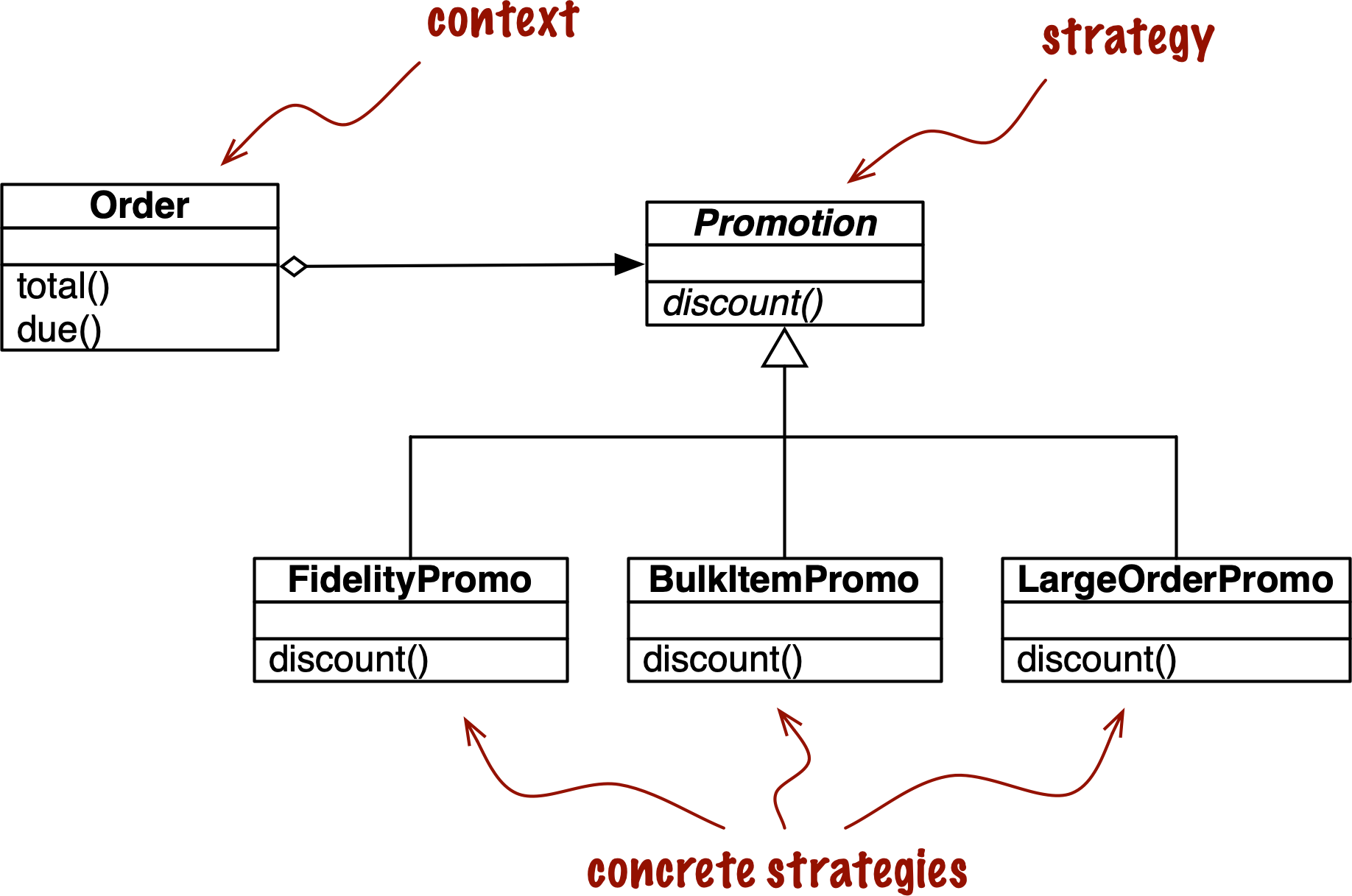
Figure 10-1. UML class diagram for order discount processing implemented with the Strategy design pattern.
The Strategy pattern is summarized like this in Design Patterns:
Define a family of algorithms, encapsulate each one, and make them interchangeable. Strategy lets the algorithm vary independently from clients that use it.
A clear example of Strategy applied in the ecommerce domain is computing discounts to orders according to the attributes of the customer or inspection of the ordered items.
Consider an online store with these discount rules:
-
Customers with 1,000 or more fidelity points get a global 5% discount per order.
-
A 10% discount is applied to each line item with 20 or more units in the same order.
-
Orders with at least 10 distinct items get a 7% global discount.
For brevity, let’s assume that only one discount may be applied to an order.
The UML class diagram for the Strategy pattern is depicted in Figure 10-1. Its participants are:
- Context
-
Provides a service by delegating some computation to interchangeable components that implement alternative algorithms. In the ecommerce example, the context is an
Order, which is configured to apply a promotional discount according to one of several algorithms. - Strategy
-
The interface common to the components that implement the different algorithms. In our example, this role is played by an abstract class called
Promotion. - Concrete strategy
-
One of the concrete subclasses of Strategy.
FidelityPromo,BulkPromo, andLargeOrderPromoare the three concrete strategies implemented.
The code in Example 10-1 follows the blueprint in Figure 10-1. As described in Design Patterns, the concrete strategy is chosen by the client of the context class. In our example, before instantiating an order, the system would somehow select a promotional discount strategy and pass it to the Order constructor. The selection of the strategy is outside the scope of the pattern.
Example 10-1. Implementation of the Order class with pluggable discount strategies
fromabcimportABC,abstractmethodfromcollections.abcimportSequencefromdecimalimportDecimalfromtypingimportNamedTuple,OptionalclassCustomer(NamedTuple):name:strfidelity:intclassLineItem(NamedTuple):product:strquantity:intprice:Decimaldeftotal(self)->Decimal:returnself.price*self.quantityclassOrder(NamedTuple):# the Contextcustomer:Customercart:Sequence[LineItem]promotion:Optional['Promotion']=Nonedeftotal(self)->Decimal:totals=(item.total()foriteminself.cart)returnsum(totals,start=Decimal(0))defdue(self)->Decimal:ifself.promotionisNone:discount=Decimal(0)else:discount=self.promotion.discount(self)returnself.total()-discountdef__repr__(self):returnf'<Order total: {self.total():.2f} due: {self.due():.2f}>'classPromotion(ABC):# the Strategy: an abstract base class@abstractmethoddefdiscount(self,order:Order)->Decimal:"""Return discount as a positive dollar amount"""classFidelityPromo(Promotion):# first Concrete Strategy"""5% discount for customers with 1000 or more fidelity points"""defdiscount(self,order:Order)->Decimal:rate=Decimal('0.05')iforder.customer.fidelity>=1000:returnorder.total()*ratereturnDecimal(0)classBulkItemPromo(Promotion):# second Concrete Strategy"""10% discount for each LineItem with 20 or more units"""defdiscount(self,order:Order)->Decimal:discount=Decimal(0)foriteminorder.cart:ifitem.quantity>=20:discount+=item.total()*Decimal('0.1')returndiscountclassLargeOrderPromo(Promotion):# third Concrete Strategy"""7% discount for orders with 10 or more distinct items"""defdiscount(self,order:Order)->Decimal:distinct_items={item.productforiteminorder.cart}iflen(distinct_items)>=10:returnorder.total()*Decimal('0.07')returnDecimal(0)
Note that in Example 10-1, I coded Promotion as an abstract base class (ABC) to use the @abstractmethod decorator and make the pattern more explicit.
Example 10-2 shows doctests used to demonstrate and verify the operation of a module implementing the rules described earlier.
Example 10-2. Sample usage of Order class with different promotions applied
>>> joe = Customer('John Doe', 0)>>> ann = Customer('Ann Smith', 1100)>>> cart = (LineItem('banana', 4, Decimal('.5')),... LineItem('apple', 10, Decimal('1.5')),... LineItem('watermelon', 5, Decimal(5)))>>> Order(joe, cart, FidelityPromo())<Order total: 42.00 due: 42.00>>>> Order(ann, cart, FidelityPromo())<Order total: 42.00 due: 39.90>>>> banana_cart = (LineItem('banana', 30, Decimal('.5')),... LineItem('apple', 10, Decimal('1.5')))>>> Order(joe, banana_cart, BulkItemPromo())<Order total: 30.00 due: 28.50>>>> long_cart = tuple(LineItem(str(sku), 1, Decimal(1))... for sku in range(10))>>> Order(joe, long_cart, LargeOrderPromo())<Order total: 10.00 due: 9.30>>>> Order(joe, cart, LargeOrderPromo())<Order total: 42.00 due: 42.00>

Two customers:
joehas 0 fidelity points,annhas 1,100.
One shopping cart with three line items.

The
FidelityPromopromotion gives no discount tojoe.
anngets a 5% discount because she has at least 1,000 points.
The
banana_carthas 30 units of the"banana"product and 10 apples.
Thanks to the
BulkItemPromo,joegets a $1.50 discount on the bananas.
long_carthas 10 different items at $1.00 each.
joegets a 7% discount on the whole order because ofLargerOrderPromo.
Example 10-1 works perfectly well, but the same functionality can be implemented with less code in Python by using functions as objects. The next section shows how.
Function-Oriented Strategy
Each concrete strategy in Example 10-1 is a class with a single method, discount.
Furthermore, the strategy instances have no state (no instance attributes).
You could say they look a lot like plain functions, and you would be right.
Example 10-3 is a refactoring of Example 10-1,
replacing the concrete strategies with simple functions and removing the Promo abstract class.
Only small adjustments are needed in the Order class.3
Example 10-3. Order class with discount strategies implemented as functions
fromcollections.abcimportSequencefromdataclassesimportdataclassfromdecimalimportDecimalfromtypingimportOptional,Callable,NamedTupleclassCustomer(NamedTuple):name:strfidelity:intclassLineItem(NamedTuple):product:strquantity:intprice:Decimaldeftotal(self):returnself.price*self.quantity@dataclass(frozen=True)classOrder:# the Contextcustomer:Customercart:Sequence[LineItem]promotion:Optional[Callable[['Order'],Decimal]]=Nonedeftotal(self)->Decimal:totals=(item.total()foriteminself.cart)returnsum(totals,start=Decimal(0))defdue(self)->Decimal:ifself.promotionisNone:discount=Decimal(0)else:discount=self.promotion(self)returnself.total()-discountdef__repr__(self):returnf'<Order total: {self.total():.2f} due: {self.due():.2f}>'deffidelity_promo(order:Order)->Decimal:"""5% discount for customers with 1000 or more fidelity points"""iforder.customer.fidelity>=1000:returnorder.total()*Decimal('0.05')returnDecimal(0)defbulk_item_promo(order:Order)->Decimal:"""10% discount for each LineItem with 20 or more units"""discount=Decimal(0)foriteminorder.cart:ifitem.quantity>=20:discount+=item.total()*Decimal('0.1')returndiscountdeflarge_order_promo(order:Order)->Decimal:"""7% discount for orders with 10 or more distinct items"""distinct_items={item.productforiteminorder.cart}iflen(distinct_items)>=10:returnorder.total()*Decimal('0.07')returnDecimal(0)
This type hint says:
promotionmay beNone, or it may be a callable that takes anOrderargument and returns aDecimal.To compute a discount, call the
self.promotioncallable, passingselfas an argument. See the following tip for the reason.No abstract class.
Each strategy is a function.
Why self.promotion(self)?
In the Order class, promotion is not a method. It’s an instance attribute that happens to be callable.
So the first part of the expression, self.promotion, retrieves that callable.
To invoke it, we must provide an instance of Order, which in this case is self.
That’s why self appears twice in that expression.
“Methods Are Descriptors” will explain the mechanism that binds methods to instances
automatically. It does not apply to promotion because it is not a method.
The code in Example 10-3 is shorter than Example 10-1. Using the new Order is also a bit simpler, as shown in the Example 10-4 doctests.
Example 10-4. Sample usage of Order class with promotions as functions
>>> joe = Customer('John Doe', 0)>>> ann = Customer('Ann Smith', 1100)>>> cart = [LineItem('banana', 4, Decimal('.5')),... LineItem('apple', 10, Decimal('1.5')),... LineItem('watermelon', 5, Decimal(5))]>>> Order(joe, cart, fidelity_promo)<Order total: 42.00 due: 42.00>>>> Order(ann, cart, fidelity_promo)<Order total: 42.00 due: 39.90>>>> banana_cart = [LineItem('banana', 30, Decimal('.5')),... LineItem('apple', 10, Decimal('1.5'))]>>> Order(joe, banana_cart, bulk_item_promo)<Order total: 30.00 due: 28.50>>>> long_cart = [LineItem(str(item_code), 1, Decimal(1))... for item_code in range(10)]>>> Order(joe, long_cart, large_order_promo)<Order total: 10.00 due: 9.30>>>> Order(joe, cart, large_order_promo)<Order total: 42.00 due: 42.00>
Same test fixtures as Example 10-1.
To apply a discount strategy to an
Order, just pass the promotion function as an argument.A different promotion function is used here and in the next test.
Note the callouts in Example 10-4—there is no need to instantiate a new promotion object with each new order: the functions are ready to use.
It is interesting to note that in Design Patterns, the authors suggest:
“Strategy objects often make good flyweights.”4
A definition of the Flyweight pattern in another part of that work states:
“A flyweight is a shared object that can be used in multiple contexts simultaneously.”5
The sharing is recommended to reduce the cost of creating a new concrete strategy object when the same strategy is
applied over and over again with every new context—with every new Order instance, in our example.
So, to overcome a drawback of the Strategy pattern—its runtime cost—the authors recommend applying yet another pattern.
Meanwhile, the line count and maintenance cost of your code are piling up.
A thornier use case, with complex concrete strategies holding internal state, may require all the pieces of the Strategy and Flyweight design patterns combined. But often concrete strategies have no internal state; they only deal with data from the context. If that is the case, then by all means use plain old functions instead of coding single-method classes implementing a single-method interface declared in yet another class. A function is more lightweight than an instance of a user-defined class, and there is no need for Flyweight because each strategy function is created just once per Python process when it loads the module. A plain function is also “a shared object that can be used in multiple contexts simultaneously.”
Now that we have implemented the Strategy pattern with functions, other possibilities emerge.
Suppose you want to create a “metastrategy” that selects the best available discount for a given Order.
In the following sections we study additional refactorings that implement this requirement using a variety of approaches that leverage functions and modules as objects.
Choosing the Best Strategy: Simple Approach
Given the same customers and shopping carts from the tests in Example 10-4, we now add three additional tests in Example 10-5.
Example 10-5. The best_promo function applies all discounts and returns the largest
>>>Order(joe,long_cart,best_promo)<Ordertotal:10.00due:9.30>>>>Order(joe,banana_cart,best_promo)<Ordertotal:30.00due:28.50>>>>Order(ann,cart,best_promo)<Ordertotal:42.00due:39.90>
best_promoselected thelarger_order_promofor customerjoe.Here
joegot the discount frombulk_item_promofor ordering lots of bananas.Checking out with a simple cart,
best_promogave loyal customerannthe discount for thefidelity_promo.
The implementation of best_promo is very simple. See Example 10-6.
Example 10-6. best_promo finds the maximum discount iterating over a list of functions
promos=[fidelity_promo,bulk_item_promo,large_order_promo]defbest_promo(order:Order)->Decimal:"""Compute the best discount available"""returnmax(promo(order)forpromoinpromos)
promos: list of the strategies implemented as functions.best_promotakes an instance ofOrderas argument, as do the other*_promofunctions.Using a generator expression, we apply each of the functions from
promosto theorder, and return the maximum discount computed.
Example 10-6 is straightforward: promos is a list of functions. Once you get used to the idea that functions are first-class objects, it naturally follows that building data structures holding functions often makes sense.
Although Example 10-6 works and is easy to read, there is some duplication that could lead to a subtle bug: to add a new promotion strategy, we need to code the function and remember to add it to the promos list, or else the new promotion will work when explicitly passed as an argument to Order, but will not be considered by best_promotion.
Read on for a couple of solutions to this issue.
Finding Strategies in a Module
Modules in Python are also first-class objects, and the standard library provides several functions to handle them. The built-in globals is described as follows in the Python docs:
globals()-
Return a dictionary representing the current global symbol table. This is always the dictionary of the current module (inside a function or method, this is the module where it is defined, not the module from which it is called).
Example 10-7 is a somewhat hackish way of using globals to help best_promo automatically find the other available *_promo functions.
Example 10-7. The promos list is built by introspection of the module global namespace
fromdecimalimportDecimalfromstrategyimportOrderfromstrategyimport(fidelity_promo,bulk_item_promo,large_order_promo)promos=[promoforname,promoinglobals().items()ifname.endswith('_promo')andname!='best_promo']defbest_promo(order:Order)->Decimal:"""Compute the best discount available"""returnmax(promo(order)forpromoinpromos)
Import the promotion functions so they are available in the global namespace.6
Iterate over each item in the
dictreturned byglobals().Select only values where the name ends with the
_promosuffix and……filter out
best_promoitself, to avoid an infinite recursion whenbest_promois called.No changes in
best_promo.
Another way of collecting the available promotions would be to create a module and put all the strategy functions there, except for best_promo.
In Example 10-8, the only significant change is that the list of strategy functions
is built by introspection of a separate module called promotions. Note that Example 10-8 depends on importing the promotions module as well as inspect, which provides high-level introspection functions.
Example 10-8. The promos list is built by introspection of a new promotions module
fromdecimalimportDecimalimportinspectfromstrategyimportOrderimportpromotionspromos=[funcfor_,funcininspect.getmembers(promotions,inspect.isfunction)]defbest_promo(order:Order)->Decimal:"""Compute the best discount available"""returnmax(promo(order)forpromoinpromos)
The function inspect.getmembers returns the attributes of an object—in this case, the promotions module—optionally filtered by a predicate (a boolean function). We use inspect.isfunction to get only the functions from the module.
Example 10-8 works regardless of the names given to the functions; all that matters is that the promotions module contains only functions that calculate discounts given orders. Of course, this is an implicit assumption of the code. If someone were to create a function with a different signature in the promotions module, then best_promo would break while trying to apply it to an order.
We could add more stringent tests to filter the functions, by inspecting their arguments for instance. The point of Example 10-8 is not to offer a complete solution, but to highlight one possible use of module introspection.
A more explicit alternative to dynamically collecting promotional discount functions would be to use a simple decorator. That’s next.
Decorator-Enhanced Strategy Pattern
Recall that our main issue with Example 10-6 is the repetition of the function names in their definitions and then in the promos list used by the best_promo function to determine the highest discount applicable. The repetition is problematic because someone may add a new promotional strategy function and forget to manually add it to the promos list—in which case, best_promo will silently ignore the new strategy, introducing a subtle bug in the system. Example 10-9 solves this problem with the technique covered in “Registration Decorators”.
Example 10-9. The promos list is filled by the Promotion decorator
Promotion=Callable[[Order],Decimal]promos:list[Promotion]=[]defpromotion(promo:Promotion)->Promotion:promos.append(promo)returnpromodefbest_promo(order:Order)->Decimal:"""Compute the best discount available"""returnmax(promo(order)forpromoinpromos)@promotiondeffidelity(order:Order)->Decimal:"""5% discount for customers with 1000 or more fidelity points"""iforder.customer.fidelity>=1000:returnorder.total()*Decimal('0.05')returnDecimal(0)@promotiondefbulk_item(order:Order)->Decimal:"""10% discount for each LineItem with 20 or more units"""discount=Decimal(0)foriteminorder.cart:ifitem.quantity>=20:discount+=item.total()*Decimal('0.1')returndiscount@promotiondeflarge_order(order:Order)->Decimal:"""7% discount for orders with 10 or more distinct items"""distinct_items={item.productforiteminorder.cart}iflen(distinct_items)>=10:returnorder.total()*Decimal('0.07')returnDecimal(0)
The
promoslist is a module global, and starts empty.Promotionis a registration decorator: it returns thepromofunction unchanged, after appending it to thepromoslist.No changes needed to
best_promo, because it relies on thepromoslist.Any function decorated by
@promotionwill be added topromos.
This solution has several advantages over the others presented before:
-
The promotion strategy functions don’t have to use special names—no need for the
_promosuffix. -
The
@promotiondecorator highlights the purpose of the decorated function, and also makes it easy to temporarily disable a promotion: just comment out the decorator. -
Promotional discount strategies may be defined in other modules, anywhere in the system, as long as the
@promotiondecorator is applied to them.
In the next section, we discuss Command—another design pattern that is sometimes implemented via single-method classes when plain functions would do.
The Command Pattern
Command is another design pattern that can be simplified by the use of functions passed as arguments. Figure 10-2 shows the arrangement of classes in the Command pattern.
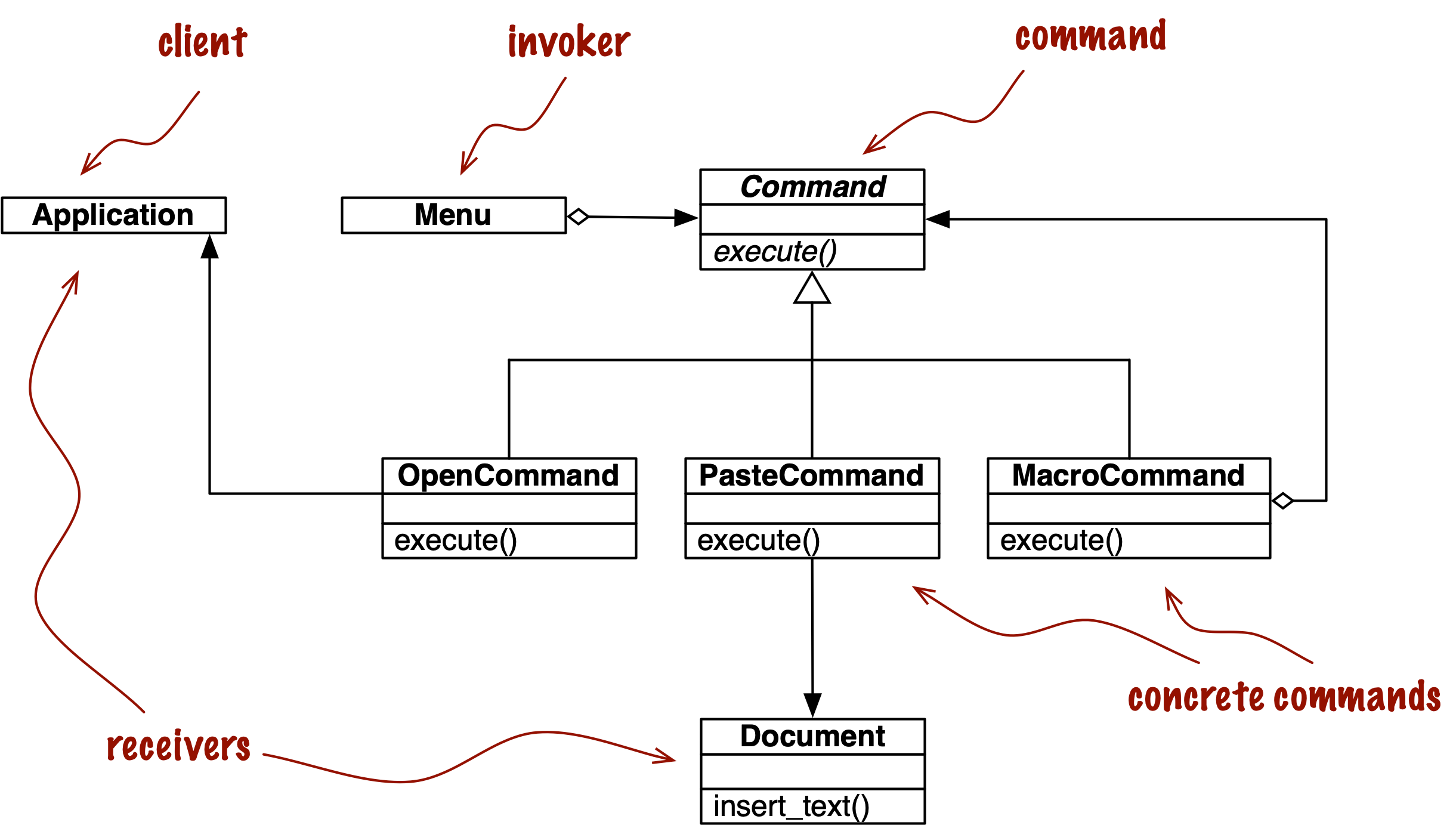
Figure 10-2. UML class diagram for menu-driven text editor implemented with the Command design pattern. Each command may have a different receiver: the object that implements the action. For PasteCommand, the receiver is the Document. For OpenCommand, the receiver is the application.
The goal of Command is to decouple an object that invokes an operation (the invoker) from the provider object that implements it (the receiver). In the example from Design Patterns, each invoker is a menu item in a graphical application, and the receivers are the document being edited or the application itself.
The idea is to put a Command object between the two, implementing an interface with a single method, execute, which calls some method in the receiver to perform the desired operation. That way the invoker does not need to know the interface of the receiver, and different receivers can be adapted through different Command subclasses. The invoker is configured with a concrete command and calls its execute method to operate it. Note in Figure 10-2 that MacroCommand may store a sequence of commands; its execute() method calls the same method in each command stored.
Quoting from Design Patterns, “Commands are an object-oriented replacement for callbacks.” The question is: do we need an object-oriented replacement for callbacks? Sometimes yes, but not always.
Instead of giving the invoker a Command instance, we can simply give it a function. Instead of calling command.execute(), the invoker can just call command(). The MacroCommand can be implemented with a class implementing __call__. Instances of
MacroCommand would be callables, each holding a list of functions for future invocation, as implemented in Example 10-10.
Example 10-10. Each instance of MacroCommand has an internal list of commands
classMacroCommand:"""A command that executes a list of commands"""def__init__(self,commands):self.commands=list(commands)def__call__(self):forcommandinself.commands:command()
Building a list from the
commandsarguments ensures that it is iterable and keeps a local copy of the command references in eachMacroCommandinstance.When an instance of
MacroCommandis invoked, each command inself.commandsis called in sequence.
More advanced uses of the Command pattern—to support undo, for example—may require more than a simple callback function. Even then, Python provides a couple of alternatives that deserve consideration:
-
A callable instance like
MacroCommandin Example 10-10 can keep whatever state is necessary, and provide extra methods in addition to__call__. -
A closure can be used to hold the internal state of a function between calls.
This concludes our rethinking of the Command pattern with first-class functions.
At a high level, the approach here was similar to the one we applied to Strategy:
replacing with callables the instances of a participant class that implemented a single-method interface.
After all, every Python callable implements a single-method interface, and that method is named __call__.
Chapter Summary
As Peter Norvig pointed out a couple of years after the classic Design Patterns book appeared, “16 of 23 patterns have qualitatively simpler implementation in Lisp or Dylan than in C++ for at least some uses of each pattern” (slide 9 of Norvig’s “Design Patterns in Dynamic Languages” presentation). Python shares some of the dynamic features of the Lisp and Dylan languages, in particular, first-class functions, our focus in this part of the book.
From the same talk quoted at the start of this chapter, in reflecting on the 20th anniversary of Design Patterns: Elements of Reusable Object-Oriented Software, Ralph Johnson has stated that one of the failings of the book is: “Too much emphasis on patterns as end-points instead of steps in the design process.”7 In this chapter, we used the Strategy pattern as a starting point: a working solution that we could simplify using first-class functions.
In many cases, functions or callable objects provide a more natural way of implementing callbacks in Python than mimicking the Strategy or the Command patterns as described by Gamma, Helm, Johnson, and Vlissides in Design Patterns. The refactoring of Strategy and the discussion of Command in this chapter are examples of a more general insight: sometimes you may encounter a design pattern or an API that requires that components implement an interface with a single method, and that method has a generic-sounding name such as “execute,” “run,” or “do_it.” Such patterns or APIs often can be implemented with less boilerplate code in Python using functions as first-class objects.
Further Reading
“Recipe 8.21. Implementing the Visitor Pattern,” in the Python Cookbook, 3rd ed., presents an elegant implementation of the Visitor pattern in which a NodeVisitor class handles methods as first-class objects.
On the general topic of design patterns, the choice of readings for the Python programmer is not as broad as what is available to other language communities.
Learning Python Design Patterns, by Gennadiy Zlobin (Packt), is the only book that I have seen entirely devoted to patterns in Python. But Zlobin’s work is quite short (100 pages) and covers 8 of the original 23 design patterns.
Expert Python Programming, by Tarek Ziadé (Packt), is one of the best intermediate-level Python books in the market, and its final chapter, “Useful Design Patterns,” presents several of the classic patterns from a Pythonic perspective.
Alex Martelli has given several talks about Python design patterns. There is a video of his EuroPython 2011 presentation and a set of slides on his personal website. I’ve found different slide decks and videos over the years, of varying lengths, so it is worthwhile to do a thorough search for his name with the words “Python Design Patterns.” A publisher told me Martelli is working on a book about this subject. I will certainly get it when it comes out.
There are many books about design patterns in the context of Java, but among them the one I like most is Head First Design Patterns, 2nd ed., by Eric Freeman and Elisabeth Robson (O’Reilly). It explains 16 of the 23 classic patterns. If you like the wacky style of the Head First series and need an introduction to this topic, you will love that work. It is Java-centric, but the second edition was updated to reflect the addition of first-class functions in Java, making some of the examples closer to code we’d write in Python.
For a fresh look at patterns from the point of view of a dynamic language with duck typing and first-class functions, Design Patterns in Ruby by Russ Olsen (Addison-Wesley) has many insights that are also applicable to Python. In spite of their many syntactic differences, at the semantic level Python and Ruby are closer to each other than to Java or C++.
In “Design Patterns in Dynamic Languages” (slides), Peter Norvig shows how first-class functions (and other dynamic features) make several of the original design patterns either simpler or unnecessary.
The introduction of the original Design Patterns book by Gamma et al. is worth the price of the book—more than the catalog of 23 patterns, which includes recipes ranging from very important to rarely useful. The widely quoted design principles, “Program to an interface, not an implementation” and “Favor object composition over class inheritance,” both come from that introduction.
The application of patterns to design originated with the architect Christopher Alexander et al., presented in the book A Pattern Language (Oxford University Press). Alexander’s idea is to create a standard vocabulary allowing teams to share common design decisions while designing buildings. M. J. Dominus wrote “‘Design Patterns’ Aren’t”, an intriguing slide deck and postscript text arguing that Alexander’s original vision of patterns is more profound, more human, and also applicable to software engineering.
1 From a slide in the talk “Root Cause Analysis of Some Faults in Design Patterns,” presented by Ralph Johnson at IME/CCSL, Universidade de São Paulo, Nov. 15, 2014.
2 Quoted from page 4 of Design Patterns.
3 I had to reimplement Order with @dataclass due to a bug in Mypy. You may ignore this detail, because this class works with NamedTuple as well, just like in Example 10-1. If Order is a NamedTuple, Mypy 0.910 crashes when checking the type hint for promotion. I tried adding # type ignore to that specific line, but Mypy crashed anyway. Mypy handles the same type hint correctly if Order is built with @dataclass. Issue #9397 is unresolved as of July 19, 2021. Hopefully it will be fixed by the time you read this.
4 See page 323 of Design Patterns.
5 Ibid., p. 196.
6 flake8 and VS Code both complain that these names are imported but not used. By definition, static analysis tools cannot understand the dynamic nature of Python. If we heed every advice from such tools, we’ll soon be writing grim and verbose Java-like code with Python syntax.
7 “Root Cause Analysis of Some Faults in Design Patterns,” presented by Johnson at IME-USP, November 15, 2014.