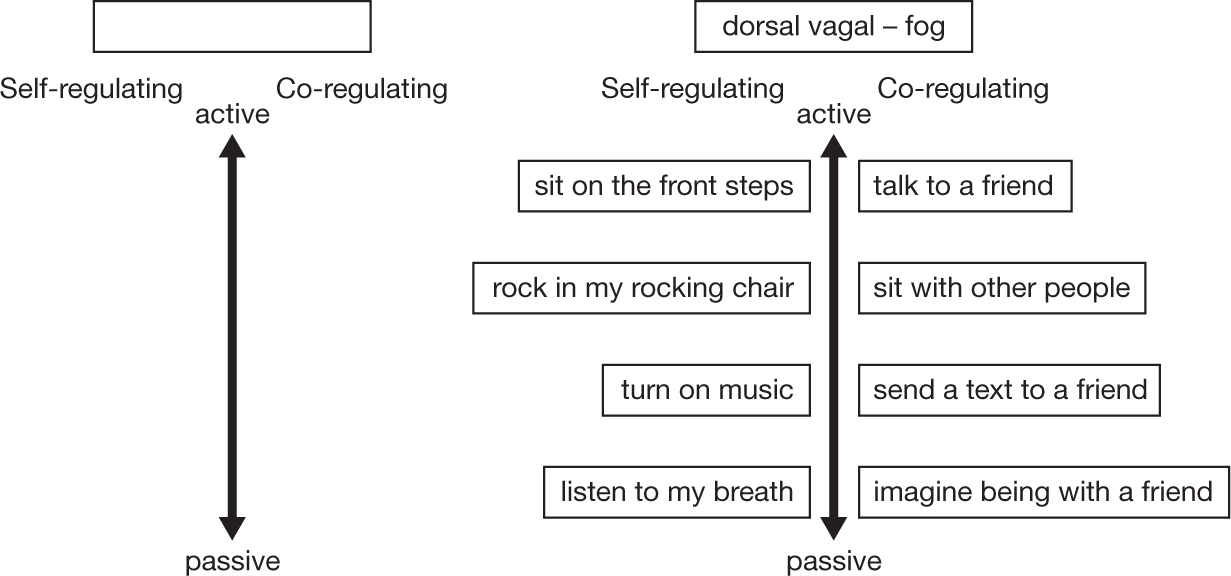
FIGURE 6.1. Energy and Actions Map and Example
EXERCISE
Energy and Actions Map
BACKGROUND
Activities that shape the autonomic nervous system fall along a scale of passive to active. There are times when thinking about moving, remembering a connection with a friend, or simply looking up toward the sky is the right choice and other times when you need to take action, put your body in motion, or head out into the world and seek social connection. Choose an experience that brings a return of energy when the dorsal vagal immobilizing collapse is present, a way to safely discharge energy when feeling the frenetic activity of the sympathetic state, and an action that deepens the feeling of regulation when anchored in the safety of ventral vagal.
STEPS
1. Label your state in the box at the top of the Energy and Actions map. Identify your state through its biological name (dorsal, sympathetic, ventral) or name it in a way that has meaning for you.
2. For sympathetic and dorsal vagal states, move along the line between passive and active and identify actions that take you in the direction of a return to the ventral vagal state of regulation. Use the left side to identify self-regulating actions and the right side to identify co-regulating actions.
3. For your ventral vagal state, move along the line between passive and active and identify actions that deepen your experience of safety and connection. Use the left side to identify self-regulating actions and the right side to identify co-regulating actions.
4. Complete a map for each state.
5. Use your maps to find a resource that is in the range of energy that fits your needs in the moment.
6. Update your maps as you create additional resources.
FIGURE 6.1. Energy and Actions Map and Example
EXERCISE
Finding Glimmers
BACKGROUND
Glimmers are the micro-moments of ventral vagal experience that routinely appear in everyday life yet frequently go unnoticed. To ensure survival, human beings are built with a negativity bias. This means you are biologically wired to pay more attention to negative events than positive ones and can often miss the ventral vagal moments that coexist with moments of dysregulation. Things like seeing a friendly face, hearing a soothing sound, or noticing something enjoyable in the environment go unnoticed. A fundamental step in shaping your system is seeing a glimmer, pausing to take it in, and then beginning to look for more.
STEPS
1. Set an intention to look for a certain number of glimmers each day. Choose a number that feels doable to begin. If glimmers are an unfamiliar experience, watch for a single glimmer. As finding glimmers becomes easier, set a new goal.
2. Notice when you feel a spark of ventral vagal energy. Look for glimmers in your daily activities. Glimmers happen regularly, but because they are micro-moments you need to be on the lookout for them.
3. See, stop, and appreciate your glimmers. Create an easy way to acknowledge a glimmer when it happens. You might bring attention to the moment by simply saying “glimmer” or with a small movement (perhaps your hand on your heart).
4. Track your glimmers. Create a daily glimmers notebook or keep a running list.
5. Look for glimmers in specific places, with particular people, at certain times. Find the ways your glimmers routinely appear.
6. Share your glimmers. You might text your glimmers to a friend, make talking about daily glimmers a family nighttime ritual, or share your list of weekly glimmers to share with your therapist. Find the way that works for you.
EXERCISE
From Glimmer to Glow
BACKGROUND
When you recognize the micro-moment of a glimmer, you feel the spark of your ventral vagal system. Just as sparks can be used to ignite a fire, glimmers can be turned into the deeper experience of a glow. With a glimmer, you pause just long enough to acknowledge that a ventral vagal moment is happening in the flow of your day. With a glow, stop and celebrate the glimmer. Take time to soak it in and give it deeper meaning.
STEPS
1. Notice a glimmer and stop and let the experience fill you. Move beyond a few seconds and stay with the experience for a half a minute or more. Give the glimmer time to become a glow.
2. Feel what happens as you move from connecting for a micro-moment to a longer experience of taking in.
3. Listen to the story that accompanies the glow.
4. Describe your experience of the glimmer and the glow. Notice how the experience changes. For example, a particular glimmer moment might be described as quick hit of happiness that brings a smile, and when you turn it into a glow, the experience feels like basking in the warmth of the sun while breathing a sigh of contentment.
EXERCISE
The Sound of Your Voice
BACKGROUND
The autonomic nervous system uses tone of voice as a way to discern safety. You respond to intonation before you take in information. The way you speak changes the way you feel, the story you tell, and changes the way people around you hear what you are saying.
STEPS
1. Experiment with the ways your voice impacts the way you feel. Tell, or record, a short story in different tones of voice. Notice where the different tones of your voice take you on your autonomic map.
2. Track the way the same word spoken in different tones of voice elicits a different state and feeling. Choose a word, speak it in different ways, and follow the ways your states and feelings shift. Try out a variety of words and notice the specific ways of speaking that elicit certain states and feelings.
3. Talk about a difficult experience using different tones of voice. Track what happens to your autonomic state. Find the way of speaking that brings you into a ventral vagal state. Notice the way of speaking that helps you see options and take regulated actions.
4. Find a friend and experiment with sound. Talk in different tones of voice and get feedback on their response. Ask your friend to do the same and track your own responses.
EXERCISE
The Music in Your Life
BACKGROUND
Music is all around you, affecting your physiology and your feelings. Along with activating a ventral vagal response, music has a paradoxical effect that allows you to safely connect to, and even enjoy, your sympathetic and dorsal vagal states.
STEPS
1. Take an inventory of the way music is a part of your life.
•Music listening: Do you regularly listen to music? Have a favorite radio station? Favorite songs or artists? Do you go to hear live music?
•Music making: Do you make music? Do you play an instrument or sing by yourself or with others?
2. Assess how much music is in your everyday life.
•Is there enough music in your daily experience?
•Do you miss music and want to hear more?
3. If your everyday experience is already filled with music, acknowledge the role of music in your life and identify the ways music is a regulating resource.
4. If your inventory brings a recognition that you have a desire for more musical moments, begin to look for ways to add music to your daily experience.
5. Identify the particular pieces of music that take you to different places on the autonomic hierarchy. Sing along, play along, or move along with the music. Use different selections to safely join with your sympathetic and dorsal vagal states and dive into all the flavors of ventral vagal.
EXERCISE
Moments of Movement
BACKGROUND
Movement occurs along a continuum of expression: simple through complex, micro-movements to full body motions. Each autonomic state has different levels of energy that you can connect with and use to shape your experience. Intentional use of movement is a way to engage your dorsal vagal and sympathetic states, making them less intense and persistent, and it’s also a way to deepen your ventral vagal capacities.
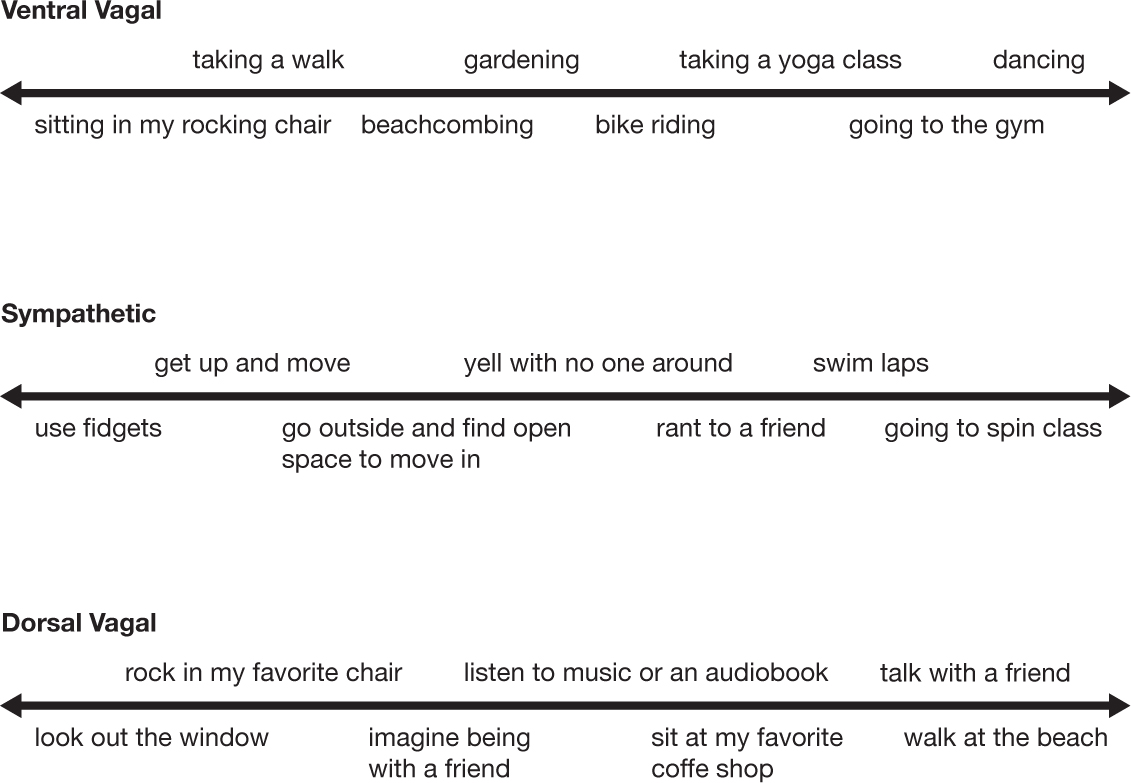
FIGURE 6.2. Movement Continuums
STEPS
1. Choose an autonomic state. Using a line to represent ways you move, identify movements at either end. Look for movements that engage the least and most energy available to you in the state.
2. Identify movements that happen between the ends. In dorsal vagal, look for movements that begin to gently energize you. In sympathetic, look for movements that use the activated energy in organized and safe ways. In ventral vagal, look for movements that prolong the experience.
3. Design a series of movement lines to bring awareness to the range of movements that are possible in each autonomic state.
EXERCISE
Imagined Action
BACKGROUND
Motor imagery is a way for you to be in motion when the environment you’re in doesn’t support moving, when physical challenges make moving difficult, or when making a movement doesn’t feel safe and instead activates a protective survival response. Imagined movement practices, either as a replacement for or as a complement to movement, are another way to get the benefits of moving and experience safely moving through space.
STEPS
1. Identify a movement you are drawn to but haven’t brought into action yet. Play with it. Imagine yourself safely bringing the action to life. See yourself doing it. Sense your body moving on the inside. Feel the emotions that accompany your moving. Hear the story of who you are as you move.
2. Once you get the feel for imagined movement, create a series of movements. Use your imagination to move in ways you have always wanted.
3. Make time each day to bring one of your movements to life on the inside.
4. Notice if, over time, using motor imagery invites bringing the movement out of your imagination into the world or if it is autonomically nourishing when it remains an imagined experience.
EXERCISE
Labyrinth Walking
BACKGROUND
People have been walking labyrinths for centuries. Unlike a maze, a labyrinth has one path and no dead ends. Often thought of as a path to transformation, when you enter a labyrinth, there is a release of connection to the everyday world, a sense of receiving wisdom when you reach the center, and a subtle shift in your sense of yourself and the world when the circuit is completed. When walking a labyrinth there is first a slight increase in mobilization followed by a return to calm making this a gentle autonomic exercise.
STEPS
1. Investigate labyrinth-walking options. The location of thousands of labyrinths around the world as well as access to virtual and printed ones are available at https://labyrinthsociety.org
•Walk a full-size labyrinth.
•Navigate a virtual labyrinth on your computer.
•Trace a printed labyrinth.
•Walk a labyrinth with your fingers using a finger-walking guide.
2. Identify your physiological response to each of the different labyrinth-walking options. Which ones feel the most regulating?
3. Notice any ways your thinking shifts over the course of your labyrinth walk.
4. Keep track of the stories about yourself and the world that you connect with on your labyrinth walks.
5. Find an easily accessible form of labyrinth-walking you can use to return to regulation when you notice a rise in stress.
6. Combine different forms of labyrinth-walking to create a regular practice.
EXERCISE
Find Your Breath
BACKGROUND
There are many ways of breathing. Sometimes breath comes in a quiet and rhythmic cycle and other times it arrives in an erratic and stressed way. Different rhythms of breathing change your physiology, making breath a direct route to shaping your autonomic responses. Use the autonomic hierarchy to map the many kinds of breaths you breathe each day.
STEPS
1. Begin by bringing awareness to what kind of breathing happens in your ventral vagal, sympathetic, and dorsal vagal states.
2. Experiment with different kinds of breath. Notice how each impacts your autonomic state. Identify breaths that are mobilizing, calming, disconnecting, and connecting.
3. Create a breath map.
•Using a line to depict the autonomic hierarchy, come into connection with each state and feel the ways of breathing that happen there.
•Breathe in different ways and see where the breath takes you. Place those breaths on your breath map.
4. Use your breath map to find your place on the hierarchy.
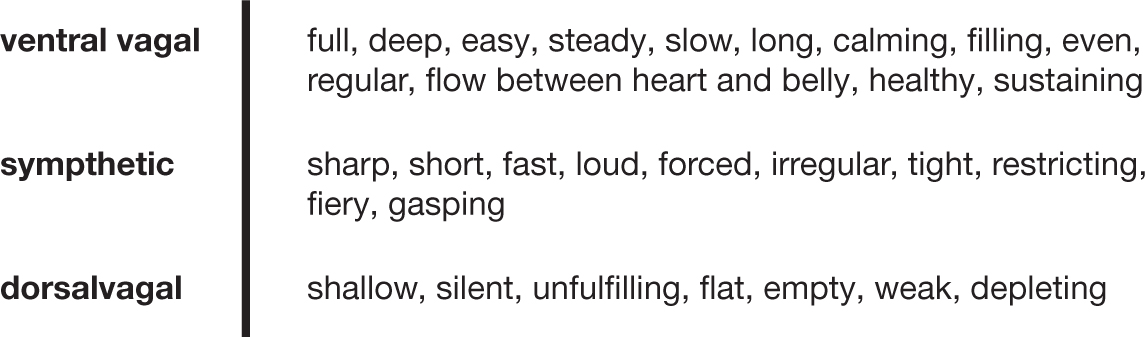
FIGURE 6.3. Sample Breath Map
EXERCISE
Understand Your Breath
BACKGROUND
The diaphragm is the most important muscle in the process of breathing. The diaphragm divides your torso into two parts: the chest cavity inside the ribcage where the lungs and heart reside and the abdominal cavity where the stomach, liver, intestines, and adrenal glands are found. With each breath cycle, the diaphragm changes shape. On an inhalation the muscles of the diaphragm contract and the diaphragm flattens, stretching the lungs to make room for more air. On the exhalation the muscles of the diaphragm relax, restoring the natural curve of the diaphragm to help push air out. When you need extra strength to lift things, during exercise, or in a sympathetically charged state of fight or flight, your breath moves up from your belly to your chest. While this is necessary in the moment, if used for prolonged periods, chest breathing brings anxiety and fatigue. Belly breathing on the other hand emphasizes moving the abdomen, letting it fill and expand on the inhale, empty and contract with each exhale. Belly breathing engages the diaphragm, deepens the breath, and activates the ventral vagal system, inviting a return to regulation.
STEPS
1. Get a feel for the way your diaphragm works.
•Hold your hands in front of you, fingers interlaced, elbows at your side. In this position, your hands take on the shape of the curve of the diaphragm.
•Inhale, raising your elbows pointing them outward and let your fingers flatten.
•Exhale, relaxing your arms letting your elbows fall to your side as your fingers return to the shape of the curve.
•Follow this cycle, letting your motion reflect the rhythm of your breath as you imagine the action of your diaphragm.
2. Play with changing the rhythm of the motion and synchronizing your breath. Speed the motion up and slow it down. Track the ways your autonomic state shifts with different breath rhythms.
3. Listen to the stories that accompany state shifts.
•Practice connecting the action of your diaphragm with your breath and listening to the story.
•Breathe into your chest and track the way your autonomic state changes. Bring awareness to the stories that accompany the change.
•Breathe into your belly and track the way your autonomic state changes. Bring awareness to the stories that accompany the change.
EXERCISE
Follow Your Breath
BACKGROUND
Some of the ways to follow your breath are to attend to each cycle, track the ways your breath moves in your body, add movement to your breath cycle, and create a mantra to tie intention to inhalation and exhalation.
STEPS
1. Count your breaths. Breath counting (counting each exhalation) has been a part of mindfulness training for over 1500 years.
•Begin with short sets—between 3 and 10 exhalations. Experiment until you find the number that brings you into the ventral vagal place on your breath map.
•Count to that number of exhalations and begin again. Experiment with repeating the cycle two or three times to find the number of repetitions that brings a balance between challenge and nourishment.
2. Find the places you feel breath moving in your body.
•Some of the common places to find your breath are the abdomen, chest, heart, throat, just under the breastbone, in the side ribs, and in your lower back.
•Choose two places and put one hand on each. As you inhale and exhale, feel your breath moving between your hands. Find places that offer an easy pathway to feel the breath flowing between your two hands.
3. Create a mantra. The use of mantras is common in mindfulness practice and is a way to bring focused intention to your breath.
•Find a word or a phrase for each inhalation and exhalation that brings awareness to:
•the feeling of energy rising and falling (mobilize, calm)
•sensing inward and outward connection (tune in, reach out)
•moving between action and rest (attentive, peaceful).
•Honor the ways your autonomic nervous system and breath are interconnected. Let your breath and body guide you in finding your own words and phrases.
4. Take breath outside your body and add movement.
•There is a strong connection between breath and posture. Experiment with changing postures (lying down, sitting, or standing; posture slumped, straight, or slightly curved) and listen to the story that accompanies each shift.
•Integrating breath and arm movements strengthens the muscles used in breathing and increases lung capacity. Experiment with adding arm movements to your breath cycle. Try it both seated and standing. Let your body lead the way. Invite your arms to illustrate your inhalation and exhalation. Notice how your movements change when the quality of your breath changes. Find a pattern that feels restorative and create a daily practice of moving with your breath.
5. Add a sigh. Sighing resets the respiratory system, affects your physiological state, and impacts the story that emerges. Humans sigh many times an hour and those spontaneous sighs are a sign your autonomic nervous system is looking for regulation. You can intentionally sigh to engage your system in that process.
•Become aware of the times you spontaneously sigh as your system looks for regulation. Make a practice of noticing. Spend a moment actively appreciating the wisdom of your biology.
•Intentionally sigh. Experiment with a sigh to interrupt a sympathetically activated moment or to bring some energy into a dorsal vagal moment of collapse. Create a habit of bringing a sigh to a difficult situation. Breathe a sigh of relief or sink into a sigh of contentment to deepen a state of regulation and nourish a story of well-being.
EXERCISE
Green, Blue, and Flowering
BACKGROUND
It is a generally accepted that the green effect (the impact of being in green spaces) is a powerful contributor to physical and psychological well-being and that being in a blue environment (around or in the water) reduces stress and enhances well-being. Even the simple act of directly connecting to the earth’s surface, known as grounding, is an autonomically regulating experience. Drawing on the power of the environment and feeling nurtured by nature is a natural way to shape your system toward well-being.
STEPS
1. Head outside into the natural world.
•Walk in the woods. Forest bathing, a term coined in Japan in the 1980s denoting the benefits of being in a forest environment, is regulating and restorative.
•Find the green spaces around your home and work. Regularly return to the places that bring you into a ventral vagal state.
2. Find your way to water.
•Being by the water is an autonomically regulating and restorative experience. Locate the places around you that offer you the opportunity to be in a blue environment. Look toward the ocean, rivers, lakes, ponds, streams, and fountains in city parks.
•Being in the water brings its own benefits. Cool water experiences have been shown to bring a sympathetic nervous system response, and immersion in warm water lowers sympathetic activation and increases ventral vagal influence. Find a way to immerse yourself in the temperature of water that fits your autonomic need in the moment.
3. Make a physical connection to the earth’s surfaces.
•Walk barefoot in the grass, on the ground, or in the sand.
•Dig your hands in the dirt or in the sand.
4. Bring the outside in.
•Add flowers and plants to your home and work environments and benefit from their autonomically regulating effects.
•The smell of clean air and wet earth is something all animals and especially humans are sensitive to. Track what happens in your body and where your autonomic nervous system takes you when you encounter those smells.
•Experiment with scent. The smells found in nature are powerful activators of autonomic states. Juniper, lavender, rose oil, and bergamot are some of the scents that have been shown to bring relaxation and regulation. Rosemary, grapefruit, and fennel increase alertness.
•Discover the fragrances that your autonomic nervous system finds renewing. Experiment with different ways to use them. Living or dried objects from the natural world, candles, essential oils, and body creams are some possibilities. Incorporate your chosen fragrances into your everyday experience.
5. View nature.
•Looking out a window at the natural world for as little as 5 minutes facilitates the return to regulation following a distressing experience.
•Images can be used to complement your time in nature or as a stand-in for spending time in nature when opportunities in real time are limited. Find pictures of nature that are autonomically regulating for you.
EXERCISE
A Ventral Vagal Space of Your Own
BACKGROUND
Danish people have one all-encompassing word for a lifestyle that brings well-being. Hygge describes a way of living that is cozy, caring, content, friendly, and safe. This speaks to our longing to create and inhabit environments that are filled with cues of safety and inspire an enlivening of ventral vagal energy. Bringing these qualities into your home and workplace in small and simple ways is an act of autonomic shaping.
STEPS
1. Listen to your autonomic nervous system and become aware of what is present in your environment.
•Look around your home and see where your sympathetic and dorsal vagal systems begin to activate. Identify what brings those states alive.
•Consider the objects around you that bring a flavor of dissatisfaction or unease.
•Look around your home and find the places that feel cozy, comforting, and connecting. Identify what makes them feel that way.
•Notice the objects around you that inspire safety, contentment, and warmth.
•Do the same with your workplace.
2. Make a list of the places and things in your home and work environments that bring a feeling of safety and connection. Identify the specific qualities that feel regulating and nourishing to your nervous system.
3. Bring curiosity to what might be possible. Look for spaces at home and at work (a room, a corner, or even a shelf) that could become a place of ventral vagal inspiration for you.
4. Find objects that bring your ventral vagal system alive and bring them into your space. Make small changes and track your autonomic response to each. Remember, small moments add up to a tipping point. Look for the moment when a space feels welcoming. Stop and take that in.
5. Ventral vagal spaces are filled with abundance, but abundance does not mean that your spaces are filled with lots of things. Abundance and scarcity are felt not in the presence of absence of objects but in your autonomic states. Find the balance of open and filled spaces that brings you an autonomic feeling of abundance.
EXERCISE
Writing Your Reflections
BACKGROUND
Your autonomic states carry a wealth of information. Adding words brings a different kind of awareness to your autonomic stories. Even if you don’t think of yourself as a writer, your autonomic nervous system benefits as you listen to your state and begin to put words on paper.
STEPS
1. Think of a time when you experienced a dysregulated response. Take just a few minutes to write about it. Listen to your sympathetic or dorsal vagal survival state and write what you hear.
2. Think of a time when you felt the flow of ventral vagal energy. Turn toward that experience. Listen and write what your ventral vagal state wants you to know.
3. Choose a period of time and set an intention to write about an experience from each autonomic state. A suggested timeframe is once a week over the course of 6 weeks. After the initial writing period, if it feels like a positive experience, set the next intention.
4. Find someone to share your writing with or bring your writing to your therapy sessions. You hear your stories in a new way when you tell them to someone. In the telling, deeper awareness and different insights often emerge.
EXERCISE
Reflecting with Compassion
BACKGROUND
Compassion emerges from a ventral vagal state and then shapes your system toward experiencing more ventral vagal energy. Loving-kindness meditation is an ancient practice that focuses on self-generated feelings of love, compassion, and goodwill toward oneself and others. Loving-kindness meditation engages the power of the ventral vagal system first through self-compassion and then by offering compassion to others.
The traditional four phrases of loving-kindness meditation are, “May I be happy. May I be healthy. May I be safe. May I live with ease.” Some variation of these four phrases has been used for centuries. Jack Kornfield and Sharon Salzberg, two giants in the field of meditation, note that it’s okay to adjust the words to find the phrases that are most personally meaningful. What words bring these statements alive for you? Let your ventral vagal state guide you.
STEPS
1. Look at the four categories (happy, healthy, safe, and living with ease) through the language of the autonomic nervous system.
•Find the words that you would use and write your own four phrases. Here is one example of the four phrases:
–May I find glimmers every day.
–May I be nourished by the flow of ventral vagal energy.
–May I be filled with a neuroception of safety.
–May I live in the rhythm of a regulated nervous system.
2. Say your phrases out loud. Listen to the words and feel how they land in your system. You’ll know you’ve found the right words when you feel a deep connection to your ventral vagal system.
3. Say the phrases to yourself (“May I”). Then send the phrases to others (“May you”) beginning with someone you feel safe and connected to, then a neutral person, then someone you may have an unrepaired rupture with, and finally to all living beings.
4. Share your four phrases with someone else. This might be a friend, a family member, or your therapist. Say the phrases to the other person and also have them read your phrases back to you. Notice what happens when you offer and receive your unique phrases. Track your autonomic response to the experience of first offering compassion and then of receiving compassion.