2
. . . But There’s Kryptonite
It’s 2007, on Florida’s Gulf Coast. Jeff Davis, then a captain in the US Marines who recently returned from Iraq, is driving across a long bridge. The view from the bridge is gorgeous. The sun is bright on the water, the sky cloudless and perfect—that color of blue that always seems impossible. But Davis isn’t seeing any of it. Instead, his mind is occupied with scenes of dusty roads and fields of dirt: deep shadows that seem to move. His body is flooded with stress hormones as he feels the same anxiety he used to feel as he drove those roads. His body is on that bridge in Florida, his foot pressing harder and harder on the gas pedal, the car dangerously picking up speed. But his mind—his attention—is halfway around the globe, in Iraq, and he can’t pull it back. What he wants more than anything is to turn the wheel just slightly and drive right off that bridge. It takes everything he has not to do it.
What we see Captain Davis experiencing in this moment is called attentional hijacking. While this example is certainly more extreme and consequential than what most of us may experience, attentional hijacking is quite common. Your attention, that spotlight created by your mind, is constantly being yanked away from where you want it to be and onto something else, something that your mind, in all its complexity, has decided is more “relevant” and “urgent”—even if that’s the furthest thing from true.
In the previous chapter, we talked about how attention is a powerful system that determines the victor in the war inside your brain. Well, there’s a war for your attention outside your brain, too.
Your Attention Is a Hot Commodity
In the lab, attention research is a tightly controlled operation. We keep the environment dim, specifying the exact lumens of light. We seat you, our participant, exactly fifty-six inches from the screen. We check your eye movements to make sure you’re keeping them fixed straight ahead as we’ve instructed. And most important, to make sure all the parameters we are testing are known to us, we direct you precisely where to pay attention, which is a highly contrived and unnatural situation—the real world is so much more complex, unknown, and dynamic. And the real world is where our attention really matters.
Inside your brain, attention biases brain activity. Whatever it advantages “wins the prize” of gaining more influence over your ongoing brain activity. Outside the brain, in the “attention marketplace,” the grand prize is access to your wallet. And attention merchants are doing their best, with teams of designers and programmers all training their algorithms to win your attention, and therefore your money. And it works.
I recently went hunting for a set of magnetic-bottomed pans for my family’s new induction cooktop. I waded through the pages of hits after I Googled “induction pans.” I watched a video from a food blogger I like, cruised through a few pages that looked promising, but nothing was exactly what I wanted. The next day, when I opened Gmail, an ad banner said, “Hello cookware enthusiast!” When I checked my social media apps, there were pans all over my feed. I’m sure it’s not news to you that advertisers pursue you this way, tracking your digital footprint like bloodhounds and throwing their products in your path, hoping you’ll click. And I did. I clicked on one of the ads when I recognized the name of the company; I clicked another that had red flashing text: AMISHI, WE’VE GOT A DEAL FOR YOU! BUT ACT FAST—ONLY LASTS 7 MORE MINUTES!
Our attention is always being hunted. Advertisers know better than anyone how precious it is, and they know exactly how to capture yours. The neuroscience literature points to three main factors that determine when our attention is deployed:
- Familiarity. The first time I clicked, it was because I’d heard the company name before. My attention was immediately and powerfully biased by prior history. That familiar name leapt out and pulled my flashlight like a magnet.
- Salience. The second time I clicked, I was sucked in by the physical features of the ad. The color, the flashing, the size of the text—all of these physical features of the ad were screaming LOOK AT ME! Salience (novelty, loud noises, bright lights and colors, motion) yanks us toward that stimulus—we can’t resist. Salience is tailor-made for each of us—seeing my name, “AMISHI,” got me—which is precisely why so many apps ask us to customize our profiles. We are gripped by personally relevant stuff. Our attention moves—fast and ballistic. It is easily captured.
- Our own goal. Finally, our attention can be “goal-driven,” biased by our own chosen goal. Mine was to find high-quality, affordable pans, so I finally restricted my online search terms to show only those options. This is exactly how attention works when we have a goal in mind: it restricts our perception based on that goal. But my pan-hunting example also highlights a weakness: our goals are the most vulnerable of all these “attentional pulls.” Familiarity and salience were easily able to pull me away.
This was a battle for my orienting system—my flashlight. It was pulled by familiarity, like a magnet drawing it; it was yanked by salience. Ultimately, my goal won the battle—but it took a lot of time and a few detours before I ended up with what I wanted and needed. This isn’t just about buying pans, of course: it can happen with anything we set out to do. Attention is a superpower, but we often have very little awareness of where it is and who or what is in control, not to mention how or when it gets deployed. And on top of that, we spend much of our lives—as we navigate not just the internet but also our careers, our relationships, and all the curveballs life has to offer—under conditions that are like kryptonite for our attentional superpower.
What Is “Kryptonite”?
Three major forces degrade our attention: stress, poor mood, and threat. It’s not always possible to pick them apart—they often function in unison, working together to thwack at the attention system. But I’ll take you through them one by one so we can look at how, and why, these forces can disrupt your attention catastrophically.
Stress
That perceived feeling of being overwhelmed that we call stress fuels mental time travel. We experience a skyrocketing of attentional hijacking, like Captain Davis did on that bridge. The tendency of our minds to get pulled by a memory or worry, and to incessantly create stories, takes us away from the here and now as our stress increases. You’re ruminating on something that occurred in the past, long after the time when reliving it is helpful or instructive. Or you’re worrying about things that not only haven’t happened yet, but may never happen. And this only serves to aggravate and accelerate the amount of stress you’re under. When you experience too much stress for too long, you get caught in the downward spiral of attention degradation: the worse attention gets, the less you’re able to control it; the less you’re able to control it, the worse stress gets.
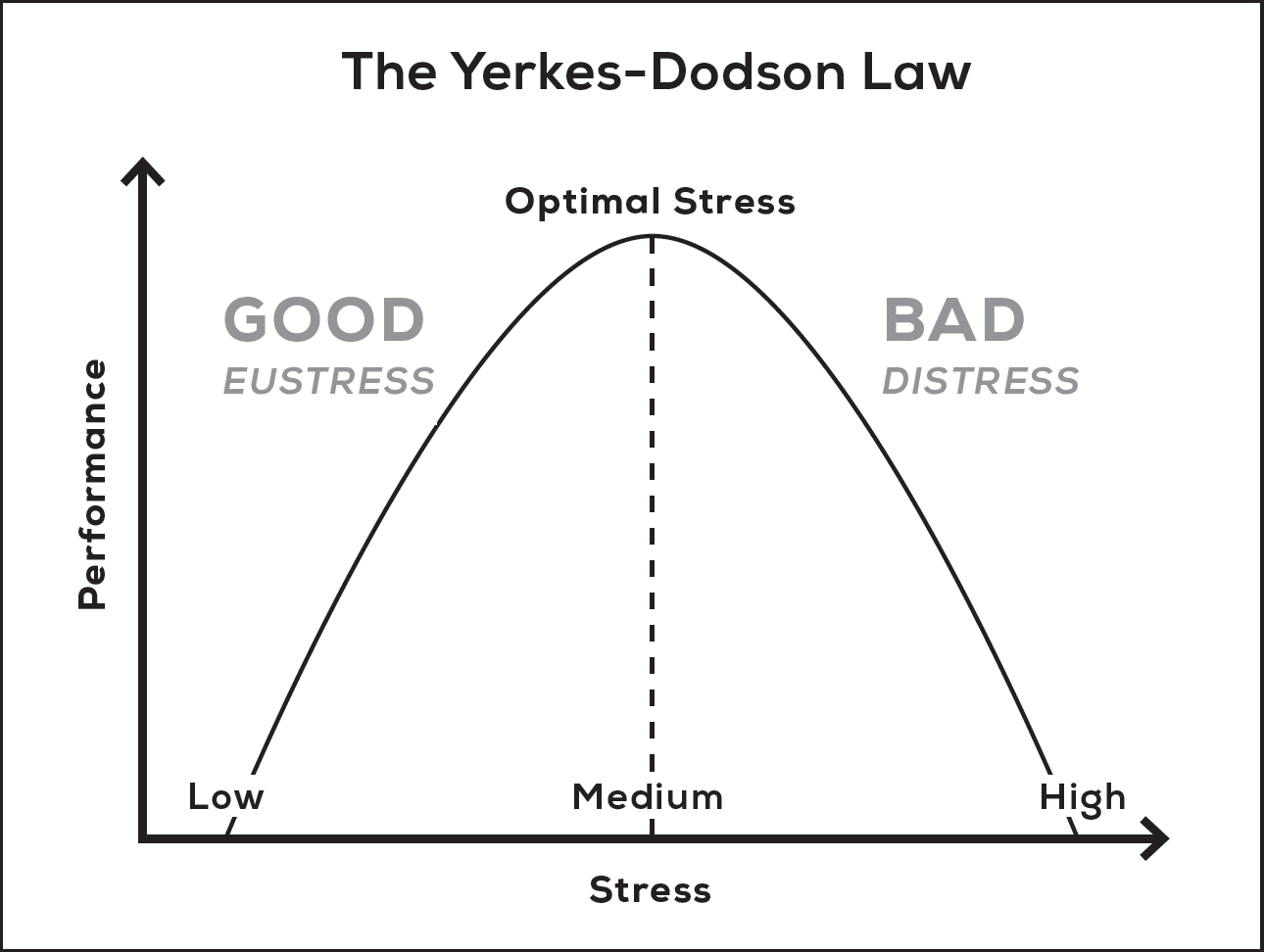
How much stress is “too much” can be pretty individual and subjective. For a lot of the people I work with—and this might be true for you, too—the idea of stress as a problem doesn’t immediately resonate. They see stress as a powerful motivator, something that challenges and inspires them to overcome, push harder, strive for excellence. I get that. Take a look at the graph below, which shows how stress intersects with performance. What it suggests is that, indeed, when our stress is low—when we have nothing driving us, no immediate deadlines for example—our performance isn’t that great, but as our stress increases, we rise to the challenge. This type of “good” stress, called eustress (pronounced “you-stress”), is a powerful engine for performance, all the way up to the very top of that chart, where we reach the optimum level (what I affectionately call the “sweet spot”) where stress is a positive motivator, something that drives and focuses us.
If we could stay here forever, we’d be all set. But the reality is that even this optimum amount of stress, if experienced over a long enough period, starts to push us over that hill and into the long slope down, where eustress becomes distress.
Even if stress begins as motivating or productive, the longer we’re under high-demand conditions, the more that ongoing stress is going to affect us. We’ll start to tip over the optimum stress point and drop down the far side of the stress curve. We rapidly lose any benefits from the stress we’re experiencing, and it becomes a corrosive, degrading force on our attention. More and more, your flashlight gets stuck on negative thoughts. Your alerting system amps up so that everything you encounter feels like a flashing caution sign, pulling you into a hypervigilant mode, making it impossible to focus deeply on anything. And your central executive, the juggler, drops balls so what you want to do and what you actually do no longer match; your actions and goals fall out of alignment. And as all this happens, there’s a natural consequence: mood plummets.
Poor Mood
Everything from chronic depression to how you feel after receiving bad news can constitute poor mood. Whatever the source, the effect can be to send you into loops of repetitive negative thought. In the lab, when we induce a negative mood in study participants, performance on attention tests declines.
How do we “induce a negative mood”? Sometimes we show participants upsetting images, similar to those in the study I mentioned earlier. Or we may ask people to conjure up a negative memory. Then we give them cognitive tasks that tax attention and working memory—such as remembering a few letters and then doing a math problem in their head. Performance is always worse—lower accuracy, slower and more variable responses—after the negative mood induction.
Threat
When you’re under threat—or feel that you are—it can be impossible to focus on the task-at-hand or pursue any goal or plan. That flashlight I described to you in chapter 1? Your powerful ability to direct your attention at will? Poof. Gone. Imagine that steady, brilliant beam of light now haphazardly shaking about, and all of that focus scattering to the shadows. Whatever you were trying to do? It’s not going to happen.
Under threat, attention is reconfigured in two ways: (1) threat vigilance increases, and (2) attention becomes stimulus-driven, so that anything that is threat-related captures and holds attention. There’s an obvious survival reason for this: at pivotal points in human evolution, high vigilance was a requirement, otherwise you wouldn’t survive to pass on your genes. If you were too absorbed in a task to notice a predator stalking you, that was pretty much it. A sense of being threatened had to trigger a rapid switch to being on “high alert.” And, as extra life insurance, evolution doubled down so that the threatening stimulus would capture and hold your focus, ensuring that your attention remained steadfastly and compulsively fixated on it—which allowed you to stay on the watch for a predator and, if you saw one, to know where it was at all times. This probably saved our ancestors’ lives many times over. But it had other consequences that explain why they never wrote brilliant tomes or designed complex machines. If you feel threatened all the time, you aren’t going to be able to engage deeply in any other task or experience. And it doesn’t matter whether the “threat” in question is a literal one or a metaphorical one.
When we study threat in the lab, we don’t put people in situations where they truly feel their physical safety is at risk—that wouldn’t be ethical. However, plenty of people that I work with do face true threats to their physical safety: a soldier going into combat or a live-fire training exercise, or a fire jumper confronting a dangerous blaze in high winds. For most of us, threat will be less literal—but that doesn’t mean its impact on our attention will be less. A meeting with a supervisor regarding a performance review, a dispute with your insurance company, testifying at a public hearing with city officials regarding a new ordinance that affects your neighborhood—these types of circumstances, while not representing threats to our physical safety, can still be threatening. Our reputation, financial well-being, or sense of justice can all be under threat.
Even if you have the highest IQ on the block, here’s a truth about human brains: in some ways, they haven’t changed in thirty-five thousand years. If the brain believes it’s under threat, it’s going to reconfigure attention accordingly, regardless of whether what’s actually in front of you is a threat.
Kryptonite Is Sneaky
Even if you haven’t visited a neuroscience lab or seen the scientific evidence from study after study, it probably makes sense to you that stress, poor mood, and threat are tough on your attention. Okay, we think, then I’ll just reduce stress, keep an eye on my mood, and make sure I’m not feeling threatened by stuff that isn’t really a threat.
The fact is, we’re really bad at identifying forces that degrade attention, even when we’re immersed in them. We often aren’t able to recognize them for what they are. And further, without training to gain a stronger awareness of our own minds, we simply aren’t very cognizant of the effects.
Here’s a good example: stereotype threat. It happens when societal preconceptions about some aspect of one’s identity—often related to gender, ethnicity, or age—function as an obstacle to our performance or well-being. A study on Asian undergraduate women played two common stereotypes against each other: one, that females are inherently bad at math; the other, that Asians are naturally skilled at math. One group of students was asked to record their gender before taking a mathematics test: they simply had to write down “female.” The other group was asked instead to indicate only their ethnicity. The group that was “primed” to hold their ethnicity in mind performed well on the test, while the group set up to identify with their gender performed more poorly.
And there’s a twist: it’s not just when the stereotype is “bad” that performance suffers. In a related study, researchers emphasized an expectation that the participants would do well on a test (“Asians are good at math”)—and yet they ended up doing poorly! In that instance, the high expectation based on the stereotype also functioned as a threat—the “threat” being that they might not live up to those expectations and would fail to confirm that positive stereotype. Stereotype threat can swing both ways: you might promote the low-opinion stereotype (“women can’t do math”), or you might (or might not) promote the high expectation (“Asians are great at math”). Either case threatens some core part of your identity, and that threat shatters your focus. And finally, across all studies, the pattern was only observed in participants who knew of the stereotype—if you feel you are a member of that group, it will hurt you.
Why is this important? Because it highlights why stereotypes become a threat to attention: it’s preoccupying. “I’m getting older, so I’ll be slow and forgetful,” or “I’m too young to be respected as a leader”—these are distractions because they function, in our brain’s attention system, as threats. We take on a major cognitive burden when worrying about confirming the low expectations of others—or failing to confirm the high ones.
Stereotype threat played a role in a pivotal moment in my own life. As an undergrad student in neuroscience, I once worked in a lab that focused on theory of mind—the ability to attribute mental states to oneself and others, and to understand that others have perceptions different from one’s own. I found it fascinating and considered pursuing this research topic in grad school. The professor who ran the lab was a senior faculty member in the department, well-respected. At the end of my junior year, after a year in his lab, I went to him for advice on which graduate programs I might apply to. I remember the look on his face: he was surprised, and then dubious.
“You’re going to grad school?” he asked. “Women from your culture don’t typically go on to have professional lives.”
I remember how hard it hit me—that when he looked at me, he saw my gender and some antiquated version of my culture. Not a talented young student with a lot of potential.
When I left his lab that semester, I never went back. There was a fantastic class I had just finished, one of my favorites in my major, with a professor named Dr. Patti Reuter-Lorenz, who I thought was articulate, brilliant, clear, funny, and, frankly, a real rock star. She’d taught through her third trimester of pregnancy. She was strong, energetic, and undaunted. At the beginning of my senior year, I contacted her and asked if she had any space in her lab, which studied . . . attention.
That incident set me on my life course. I felt the gut punch of stereotype threat, and I wasn’t willing to operate under those kinds of contrary conditions—ones that I knew wouldn’t be conducive to learning and success. If I could speak to that first professor now, I’d thank him—for alerting me to his true colors, just in time for me to change course and find this work, which has changed my life in so many ways.
Think of all the ways you might categorize yourself—by gender, race, sexual identity, ability or disability, weight, appearance, socioeconomic background, educational background, nationality, religion, work experience or inexperience. No matter the historical or prejudicial forces driving our experience of stereotype threat, when we feel it, it undermines our performance, our goal achievement, and even our overall psychological well-being. This is the cultural soup we live in. As great as it would be if we could just drain it away, we can’t. Stereotype threat can put us constantly “on alert” in ways that keep our attention diffused, shallow, and unable to focus.
Stress can also be sneaky.
When Stress Doesn’t Feel Like Stress
Recently, I gave a presentation on my work to the president of my university, the University of Miami, Dr. Julio Frenk. He had heard about my team’s research and was interested in the possibility of having us offer a mindfulness training program for his leadership cabinet. But if his team members were going to spend time on something like this, he needed more information about what they stood to gain.
So I delivered a one-on-one briefing, and began by describing the cognitive costs of high-stress intervals. He listened attentively, but when I was done talking about the damage that these attention-degrading factors can do, he had a question.
“But what if I’m not stressed?”
He acknowledged that he had a lot going on. But it didn’t feel like stress. He wasn’t feeling that sense of overwhelm, urgency, panic, or any of the typical emotions associated with stress. He described it instead as “a lot of things happening in the background that pull me away.”
I nodded. It made sense that someone at his level wouldn’t experience “stress” in the usual way. Often, high-achieving, high-performing leaders don’t identify their experience as stressful. While he understood the concept of one’s attention getting hijacked by preoccupations, the notion of “stress” simply didn’t resonate with him.
As I knew from work in the lab, you don’t have to be feeling stressed for attention to be compromised. Many things leaders deal with—high-cognitive demands, evaluative pressure, tense social interactions, uncertainty—are known to degrade attention, as well. In a recent study, participants were told that they might have to give a speech after completing an attentionally demanding task that would take several minutes. These participants had poorer task performance than those who were told that they would not have to give a speech. That might not be surprising. But here is what was: the “uncertain” group’s task performance was worse than a third group that was told they would definitely be giving a speech—suggesting that the uncertainty itself adds a preoccupying cognitive load that further depletes attention.
This research tells us that it doesn’t have to feel like stress for it to degrade our attention. I knew it from my own personal experience, as well. I hadn’t identified what I was going through during my teeth-numbing episode as “stress”—I never would have labeled it that way.
You might just be feeling like your plate is extremely full, so much so that you start to notice some challenges in isolating and homing in on the most important priorities, or in maintaining that mental clarity you need to function at the top of your game.
We’re all going to have varying levels of stress tolerance (also called “distress tolerance”). You might not experience your life as stressful. But know that when the demands on you are intensive and protracted (from a few weeks to months), in all likelihood they’re having an impact on your attention. Call it “high demand” if that feels right for you. What we’re talking about here is “demand” as a tipping point, when you go past what is comfortable or productive. When there is more going on than your attention system (in its current state) is able to handle, you’re far more prone to discomfort and dysfunction.
Regardless of how you label it, periods of high demand can have a corrosive effect on your attention. Is the obvious solution, then, to avoid the offending circumstances? To set lower expectations? To achieve less? To scale down demands?
My answer is a resounding no. Many stressors are unavoidable, while others are part of our journey to fulfillment and success—if we removed them, we would be limiting ourselves. I’m not here to tell you to change your life, switch careers, or lower your expectations for yourself as a professional, a parent, a community organizer, an athlete—whatever it is that you’ve set out to become. I wasn’t willing to do that, and I’m betting you aren’t, either. This book is not about reducing your demands to optimize attention, or learning how to say no. It’s about optimizing in the face of stress, challenge, and high demand. Things worth doing are demanding. Our jobs are demanding. Parenting is demanding. Achieving success is demanding.
Having big life goals that you’re aiming to reach can be stressful. Our lives are far from perfect—maybe if I hadn’t had my first baby while starting my first tenure-track job and opening my first research lab, my teeth wouldn’t have gone numb! But I wanted to be a mother, and a professor, and a scientist. They all needed to happen on a certain nonnegotiable schedule (according to the laws of biology and the challenging academic career path), and I wasn’t willing to give any of them up.
It’s a classic Catch-22: You’re in a long-term period of high demand, which means you need to be functioning at a high level. And the exact cognitive resources you need in order to function at that high level are being rapidly depleted by that very period of high demand you’re in.
The Attention Continuum
Remember that attention doesn’t only impact job performance. Attention is a multipurpose resource that you use for everything you do. This means that when it starts to break down, we’re not simply talking about your ability to write an email or finish a report. We’re talking about your relationships with the people who are important to you. We’re talking about being able to navigate toward your big life goals, whatever they are—they might be pretty far off, but you need to start closing the gap if you’re going to get there, and attention issues are going to either send you in the wrong direction or leave you drifting. And we’re talking about your ability to respond well during a critical moment, whether in a life-threatening emergency or in an emotional or interpersonal crisis that could determine how a key event or relationship plays out moving forward.
All three modes of attention across all information-processing domains are highly sensitive to the depleting influences of stress, poor mood, and threat, as well as to other adverse conditions—attentional drains can take the shape of anything from an uncomfortably low temperature to mortality salience (thinking about your own death).
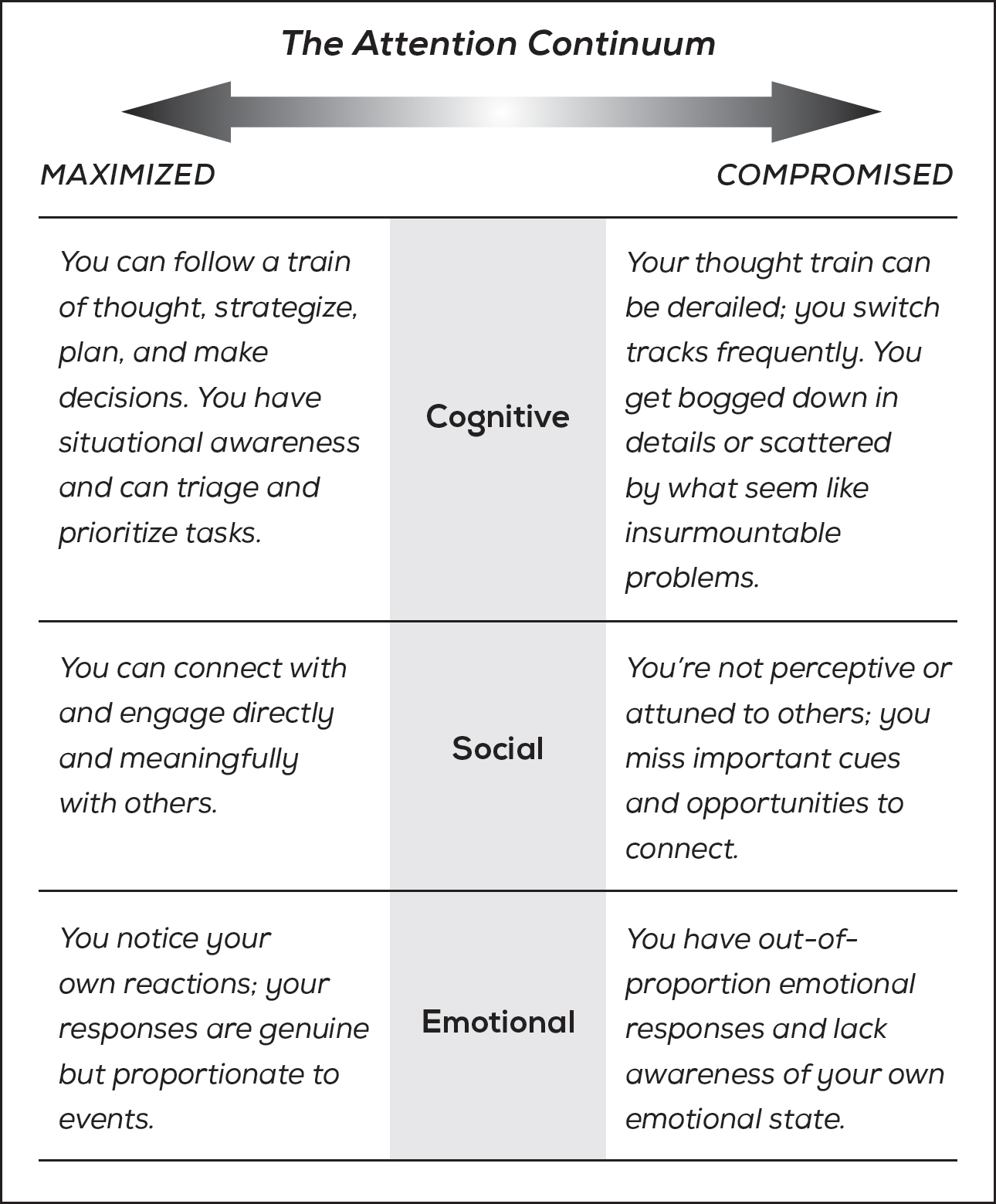
The table above provides a visual overview of what it looks like when attention is maximized, and what it looks like when attention is compromised.
Glance down the left-hand column of the table and what you’ll see is, in essence, the profile of a person successfully using attention. This is what it looks like when attention is strong, flexible, and well-trained. But the truth (supported by mounting evidence from my own lab as well as the broader research field) is that none of us fall reliably or exclusively into that column.
Not students.
Not lawyers.
Not CEOs.
Not generals.
Not top scientists at NASA, Boeing, or SpaceX.
Nobody.
What Makes Kryptonite So Powerful?
There’s a famous test of attention given to people of all ages: You sit at a computer, and a series of letters appears on the screen before you, one after the other. Your job is to say the color of the ink for each cluster of letters, as quickly as you can. Sounds simple, right?
Try it with the graphic shown below. Skim down and say out loud the color of the ink, as quickly and accurately as you can.
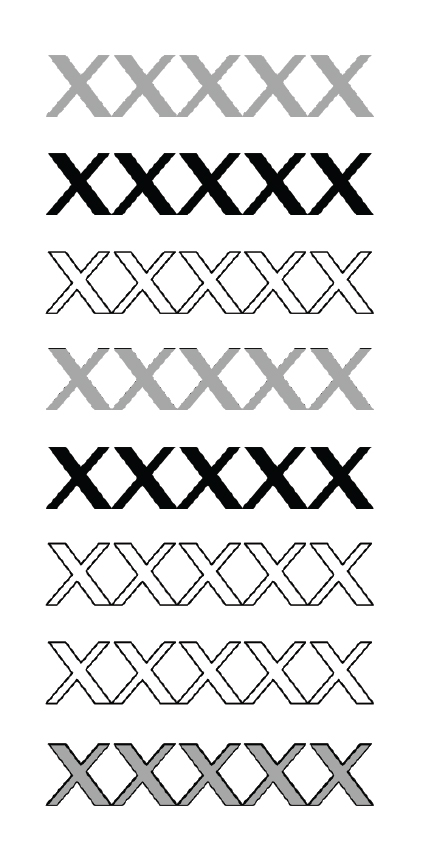
Easy, right? No problem. But now I want you to do this again with the list below. Your task is the same: go down the list and say the ink color one by one. To be clear: say the color of the ink—not the word itself. Ready, set, go!

Easy again? Probably not.
There’s no computer measuring your response times right now, as there would be if you were taking this test in my lab. But you might have noticed that you were slower than you were with the first list. And you likely hesitated, taking just a beat longer when you came across the fourth one down. Your urge to say “black” was probably very strong. You might have even blurted it out and then corrected yourself, to say “gray.”
The instructions were so simple. So why did this happen? Because I set your brain up to battle with itself. The battle was between what happened automatically (you read the word) and what the instructions asked you to do (report the color of the ink). This mismatch produced what we call a “high-conflict” moment.
And in the brain, such moments signal that there is a problem. In response, executive attention is summoned to provide a “power boost.” With attention on hand, you can more easily override automatically reading and saying the word. Your behavior becomes more aligned with your goals. We can track this in the lab. Responses are faster and more accurate for high-conflict trials that follow other high-conflict trials versus those that follow low-conflict trials—which sounds like a good thing. And sometimes it is. But it can also become a root cause of depleting our attention.
In our lives, what we consider challenging situations are often “conflict states.” There is a mismatch between what we perceive is happening and what should be happening. Our minds experience these conflicts in different ways:
- Resisting Mind: We may want whatever is happening to stop—filling us with fear, sadness, worry, resentment, or even hatred.
- Doubting Mind: We may have a distrust in our assessment of what is or should be happening, increasing our sense of doubt.
- Restless Mind: We are restless and agitated, uncertain about what is occurring but dissatisfied nonetheless.
- Craving Mind: We may want more of what is happening, leaving us desiring and craving for it.
These conflict states signal that there is a problem. Attention is summoned to solve it. Yet the problems in our lives aren’t like math problems that can be solved and then checked off our to-do list. These are, more often than not, long-term, complex problems—or simply threads in the texture of being human—and can’t be efficiently “figured out” in that way.
The reason that conflict states are attention-draining: they keep summoning attention over and over again. This continuous engagement of attention depletes it. And as your attention becomes depleted, you go on autopilot. Your mind gets easily “captured” and carried away by whatever is most salient.
When you carry conflict states around with you they can occupy and compete for your mental workspace and attentional resources. You’re so busy carrying that load that very few attentional resources remain to overcome automatic tendencies. Any salient thing will grab you—and keep you longer. So, if you’ve had a long and demanding day—say, you’re stressed, anxious, or preoccupied—you’re more likely to go for the bright shiny thing. You’ll grab the cookies instead of the carrots. You’ll click the flashing ad. You’ll spend the money you meant to save. You’ll spend something even more precious—your attention—in places you never intended to.
And in these situations, we tend to turn to a handful of common strategies to cope. They’re common and natural, thus we default to them often. The problem is, they don’t work.
We’re Using Failed Strategies
Think positive. Focus on the good. Do something relaxing. Set goals and visualize them. Suppress upsetting thoughts. Concentrate on something else. We’ve all heard these types of advice for coping and focusing under stress. Some of them make up a big part of performance psychology and professional leadership training. We often default to these tactics when we find ourselves mind-wandering or caught in a loop of negative thinking. The problem? All these strategies actually require attentional resources to implement. They use up attention instead of strengthening it. As much as we’re told that we can and should “change our experience by changing our thoughts”—by putting on rosier glasses—this strategy, like others, exacts a very high toll. And worse: under high stress, it usually doesn’t work.
Try this: don’t think about a polar bear. I mean it! Don’t. It’s your one job right now. Stop thinking about a polar bear!
What are you thinking about?
I have one guess.
We did a study with active-duty soldiers whom we tested to see if positivity training could help them over a high-demand period of military training. It didn’t. And not only did it not work to improve or protect attention, attention actually got worse over time.
Why? Part of the reason is that it takes a lot of attention to positively reframe an experience when undergoing distressing or demanding circumstances. When attention is already beginning to degrade, it’s hard to build this mental model, and the whole thing crumbles like a sandcastle at high tide. You then pour a lot of your cognitive resources into rebuilding and repairing it—which is like trying to keep your sandcastle from being washed away. You can’t. You end up mentally (and attentionally) exhausted, without anything to show for it.
While there is substantial research that positivity is beneficial under many circumstances, tactics like positivity or suppression are not merely ineffective during periods of high stress and high demand—they can be actively damaging. I call these “failed strategies” because while we try to use them to solve our attention problems, what they do is degrade attention even further. (Imagine having a sprained ankle and trying to run on it.) It’s cyclical and exponential: as our focus fades and distractions intrude, we try to look on the bright side, suppress, escape, push away, barrel through. This effort sucks up cognitive resources. Stress goes up, mood worsens. The attention-degrading forces intensify. As attention degrades further and faster, you lean into these ineffective strategies harder, burning even more cognitive fuel. You’re in a downward spiral, cognitively depleted and less able to cope and function.
You simply can’t not think about that polar bear, and trying not to drains you—fast. These strategies drive up attentional engagement. Using them is like trying to put out a fire with gasoline—it just makes things worse. In our struggle to control our attention, we’re pouring all our cognitive efforts into methods that simply do not work.
The obvious question then becomes: What does?