1
Attention Is Your Superpower
I threw open the bedroom door.
“I can’t feel my teeth,” I said, an edge of panic in my voice. My husband looked up, startled. He was sitting up in bed, tapping away at a homework assignment on his laptop.
“What?” Michael asked.
“I said I can’t feel my teeth!”
It was the strangest feeling, a numbness as if from novocaine. I was struggling to talk, and I felt a little shaky. How would I eat? How would I teach? I was supposed to be giving a major talk later that week on my latest research. What was I going to do—get up on stage in front of hundreds of people and mumble as if I’d just had a cavity filled?
Michael asked me to sit down. He tried to talk me through it. He suggested that perhaps I needed more rest, and the problem would go away. Had I crunched down on something too hard while eating? Did I feel sick in any way?
He picked up my hand and held it. “What’s going on?” he asked gently.
What was going on? Well, a lot. Our son, Leo, was almost three. As it is for many, the first few years of integrating new parenthood into an already busy life had been . . . well, challenging. I’d finished up a postdoctoral fellowship at Duke University and then landed my very first faculty position at the University of Pennsylvania. We relocated, purchasing a hundred-year-old fixer-upper in West Philly, which Michael immediately got to work renovating. Now, as an assistant professor, I had set up my own lab and was on the tenure track—an arduous process during which you are constantly asked to prove your worth and defend your work. I was engaged in the constant, all-consuming work of running the lab: writing grants, conducting studies, teaching courses, mentoring students, publishing. And Michael, who was working full-time as a computer programmer, had also started a demanding graduate program in computer science at Penn. I felt extraordinarily scattered, as if I was being pulled in all directions. At the same time, I felt I should be able to just handle it. Our lives were demanding, sure, but these were all things we wanted to be doing.
When I went to the dentist, he said I must be grinding my teeth in my sleep.
“It’s probably just stress,” he said. “Have a glass of wine to take the edge off.”
One night at bedtime, I began reading Leo his favorite book, One Fish, Two Fish, Red Fish, Blue Fish. A short section of this classic Dr. Seuss book was about wumps—the wumps went here, the wumps went there, the wumps did this or that. Halfway through the book, my son put his little hand on the page to stop me from turning to the next and asked, “What is a wump?”
I opened my mouth to answer him and then stopped. I had no idea what a wump was. I was in the middle of reading a book—one I’d read aloud probably a hundred times, and I could not answer the simplest question about it. Like one of my undergrad students caught off guard by a pop quiz, I tried to salvage the situation, focusing on the page in front of me—what the heck was a wump? It looked like some kind of fuzzy brown lumpy thing, maybe an oversize guinea pig? Whatever it was, I had somehow completely missed it, even with my little boy nestled in my lap, turning the pages, saying the words.
Oh no, I thought. What else am I missing? Am I missing my whole life?
And if I was this way with my son when he was not even three, when he was safe and small and the parenting challenges were also relatively minor—getting him to take a nap, coaxing him to eat his vegetables, helping him find his favorite toy—then what was going to happen when things got really challenging someday? Was I going to be able to be there for him?
It was ironic. I’d spent years as a devoted student of the human brain’s attention system. And now, the lab I ran at a top-notch university was entirely dedicated to the study of attention. Our mission was to investigate how attention worked, what made it worse, and what made it better. When the university’s media team got requests to interview a subject matter expert on the science of attention, they called me. Yet, now, I had no obvious answers for myself. I was distracted and unable to grab hold of my own attention. Nothing I’d learned in my professional life was helping me with this situation. I was used to being able to “study my way” to success, reading everything I could get my hands on to track down an answer, conducting research studies to glean scientific insights. This approach had gotten me far in life, my education, and my work—but it wasn’t working now.
For the first time, I couldn’t “logic” my way out of a problem. I couldn’t analyze or think my way back from feeling out of step with my life, as hard as I tried. I thought about what I could change to make things easier. I thought about my career—the thrill of being on the frontiers of brain science, collaborating with smart colleagues, using cutting-edge neuroscience tools, and guiding the next generation of scientific minds on their journeys. I thought about my family—the all-encompassing love of being a parent and coparenting with the spouse I adore. When I reviewed this life of mine—which was, in so many ways, exactly what I wanted—I felt uneasy instead of happy, just as I had when reading my son his book. A troubling thought bubbled up: I’m not here for this story, either.
I was perpetually preoccupied by a blaring, unrelenting onslaught of mental chatter, ranging from what I should have done differently on the last experiment we ran in the lab, to the most recent lecture I gave, to chasing the next work, parenting, or home-renovation demand. It felt like a perfect storm of overwhelm. Yet, I wanted this life. None of these very real demands were going to magically vanish anytime soon—nor did I want them to. In that moment, I realized something: if I was unwilling to change my life, I was going to have to change my brain.
Can the Brain Really Change?
I was born in the city of Ahmedabad, in Gujarat, a state on the western border of India. It’s notable for being the location of Mahatma Gandhi’s ashram—his legacy looms large there. But when I was a baby, my parents moved to the United States so that my dad could complete his graduate work in engineering. We lived in the suburbs of Chicago, where the neat, straight road grids of the city dissolved into curvy, subdivision cul-de-sacs. In many ways my sister and I were like typical American kids growing up in the 1980s—we listened to Wham and Depeche Mode, and did our best to look like characters from Ferris Bueller’s Day Off. But inside our house, we were on our own little island, surrounded by the ocean of America. Our parents had carried 1970s Indian culture and traditions here with them, and when we were at home, that was the world we lived in. Walking out the door to go to school each morning was a little bit like crossing a bridge to another world, one with rules and rhythms very different from those within the walls of my home.
As Indian kids, the children of hard-working and educated immigrants, my sister and I knew there were but three choices for our eventual professions that would be acceptable to our parents: doctor, engineer, or accountant. This was, of course, an almost comically restrictive stereotype, but I also knew that their expectations for us to pursue and achieve professional success were real. I figured doctor would be the most thrilling, so as a teenager, I declared my intention to get my MD. First step: volunteer in a hospital.
On my first day as a candy striper, I had the realization that I absolutely could not become a doctor. I felt uncomfortable, and thoughts of being surrounded by sickness and death were troubling to me. Unlike my friends who felt purposeful in that environment, I had to accept that it was not for me—all the bad news and uncertainty, the long waits, the fluorescent lights and institutional hallways. But I had signed up, so I stuck to my volunteer hours, disliking nearly every single shift—until they sent me down to the brain injury unit.
My job there was to take people who were recovering from traumatic brain injuries outside for some fresh air. One of the orderlies would get them into a wheelchair (most had varying levels of paralysis), and I would wheel them down the long, windowless hallways with their smells of bleach and cafeteria food and through the double doors into the fresh air. I got to know one of the patients particularly well. His name was Gordon, and he’d been in a motorcycle accident. At first, I thought he was a quadriplegic, paralyzed from the neck down, but as time went on, he started to regain the use of one of his arms. Initially, I had to push his wheelchair when we went outside. Then, gradually, he started to be able to move his hand just enough to press a little lever on the armrest of an electric wheelchair so he could move it forward without my help. I’d walk next to him, in case he had any trouble, but he did better and better. He was getting physical therapy to help with the recovery, but he told me something else—that at night, when he was lying in bed in the dark, trying to fall asleep, he’d vividly imagine the hand motion of pressing that lever in his mind. Even after the hours of physical therapy he was receiving, he’d still spend even more time every night going over the motion in his mind, memorizing that muscle movement, repeating it to himself like the lyrics to a favorite song he never wanted to forget.
“It exercises my brain!” he would say to me as we stuttered along the sidewalk, his hand pressing the lever and then pressing it again and again as he rolled along.
That was it—the moment that it dawned on me. I thought, Wow, he’s training his brain to be different. He’s actually changing his own brain!
Later, in the midst of my undergraduate neuroscience studies, I discovered that professional athletes use this tactic—it’s a known strategy of “mental practice” in sports psychology. Even when athletes aren’t physically training, they’ll go over a move or motion in their minds as a form of practice. Golfers talk about visualizing their swing, while pitchers imagine the pitch, from the first muscle twitch to the last. After the superstar swimmer Michael Phelps won one of his gold medals at the Olympics, he described the way he “lives the strokes” in his head all the time, even when he’s not in the water. And brain imaging research shows that this mental rehearsal activates the motor cortex similar to the way actual physical movement does, exercising and strengthening neural networks that control movement, similar to the way physical exercise does for muscles.
After my stint volunteering in the brain injury unit, my fascination with the brain only grew. I became captivated by its fragility, its resilience, its capacity for change. I wondered: How does the brain work? How can it control all these different functions? How can it adapt and change so radically? How does it manage to be this shifting map that can rewrite itself, altering and updating its roads and boundaries—all those things that seemed so permanent, as if carved in stone?
Eventually, my pursuit of these questions led me to the brain system that has been the passion and focus of my career: attention.
Super-powerful
The attention system performs some of the brain’s most powerful functions. It reconfigures the brain’s information processing in important ways that allow us to survive and thrive in an ever-complicated, information-dense, and rapidly changing world. Like X-ray vision, your attention zooms through a crowded sea of thousands of people, a cacophony of sounds and flashing lights, to find your friends and your seat at a concert. Attention gives you the ability to slow down time: you can do everything from watching the sun slowly sink over the horizon to meticulously checking your gear before a rock-climbing trip or following a checklist or instruction sheet for an intricate job you’re about to perform—as medical teams do before surgery—and not miss a thing. (As my military friends put it: “Slow is smooth and smooth is fast.”)
Attention allows you to time travel—you can browse through your happy memories and select one to unpack, relive, and savor. You can use it to peer into the future as if clairvoyant, planning and dreaming and imagining what fun or exciting things might happen next. Of course, we can’t use our attention to move mountains, fly, or walk through walls, but it does allow us to get transported into these thrilling alternate realities, either while watching a movie, reading a book, or letting our imaginations run wild. If I haven’t convinced you yet that your attention is a superpower, consider what life would be like if your mind couldn’t do any of these things: superdull.
Attention simultaneously highlights what’s important and dims distractions so we can think deeply, problem-solve, plan, prioritize, and innovate. It’s the portal to learning, taking in new information so we can remember and use it. It’s a key player in how we regulate our emotions—and by that I don’t mean suppressing or denying; I mean having awareness of our emotions and generating proportionate responses based on our feelings. And attention is the entry point to another important system: working memory, a dynamic cognitive workspace that you use for nearly everything you do. (We’ll get into this more deeply in the chapters that follow.) Yet perhaps the greatest power attention holds is that it threads together the moment-by-moment colors, flavors, textures, insights, memories, emotions, decisions, and actions that create the fabric of our lives.
What you pay attention to is your life.
There’s a famous study on attention that goes like this: A group of research participants is shown a video of two teams on a basketball court, practicing passing and intercepting the ball. One team wears white shirts, the other wears black shirts. Participants are told that their job is to count the number of passes between the white-shirted players over the course of a few minutes. There are two balls in play, one for each team. While moving around, behind, and in front of each other, the black-shirted players pass a ball from player to player and the white-shirted players do the same. It’s a little bit hard to track the movement of the ball between the white-shirted players, but if you really focus you can do it. At the end of the video, the researcher asks the study group: “How many passes did you count?”
Anybody who answers “Fifteen” is correct. But there’s another question.
“Did you see the gorilla?”
The response to that is usually total confusion. What gorilla?!
When the video is rewound, it’s obvious: halfway through, a person in a gorilla suit strolls into the middle of the basketball game, stops and waves (or even does a little dance, in some variations—this study has been run many times), and then meanders offscreen. And nobody sees it. If you’re thinking to yourself, “Well, I’d see it—there’s no way I’d miss a gorilla!” then consider this: This demo was run with a group of astronauts at NASA, arguably some of the most intelligent, highly focused people on the planet. Did any of them see the gorilla? Nope.
When scientists talk about this study, they usually discuss it as a failure of attention. It’s a “gotcha” moment at the end of the activity—you missed something you should have noticed: fail! However, I see it as an example of how incredibly powerful your attention can be. It shows that your attention system can be highly effective at shutting out distractions. In this instance, you were given a mission—count the passes—so you focused on those white shirts and filtered out anything dark, including that gorilla. To me, that sounds like an incredible strength of attention. It’s so effective at illuminating the relevant and blocking out the irrelevant that it made a dancing gorilla invisible.
But this next point is important: your attention system is doing this constantly—highlighting certain things and shutting out others. It was my attention system’s capacity to do this that was messing with me during those overwhelming teeth-numbing months. I had “selected” certain things to focus on—worries about work, the house, the future—and everything else was dimmed: my husband, my son, the rest of my life.
We all need to be asking ourselves:
What is my attention highlighting right now?
What is it shutting out?
And how does this factor into the experience I have of my life?
This Is Your Brain on Attention
Your brain is built for bias. That might sound like a bad thing—immediately we think of biases based on race, gender, sexual orientation, age, or any number of other aspects of someone’s core personhood that lead to unjust mistreatment or privilege—but this isn’t the bias I’m talking about right now. By built for bias, I mean that the brain does not treat all information it encounters equally. And as a matter of fact, neither do you. Maybe you like the color green more than the color blue, or dark chocolate more than milk chocolate, deep house or country music more than classical. You can probably think up all kinds of explanations (from your past, your relationships, your experiences, and so on) for why you have these particular preferences, but when it comes to how the brain functions, evolutionary pressures are actually what have led to many of its biases.
Here’s an example: We humans can see better than we can smell. Meanwhile, our dogs can smell better than they can see. Why? Our ancestors thousands of years ago almost certainly relied on sight more than smell to survive—and vice versa with our furry friends. How much of your brain do you think is devoted to vision? Take a guess. And keep in mind that the brain has many functions outside of vision. Five percent? Ten percent? Twenty-five percent?
The answer is 50 percent.
A full half of your brain is devoted to one job: visual perception. So, right off the bat, your brain is biased toward visual cues over other sensory inputs. Then it gets even more intense.
Look up from this page for a minute and keep your head and eyes facing straight ahead. You just experienced your “field of view”: the extent of the observable world that is possible for you to see at any moment in time. For humans who have two functioning eyes, that field of view is about 200 degrees. So if you were to draw a big 360-degree circle around yourself, you can perceive a little more than half of that range. And the place where you have the best acuity is right smack at the center of your field of view. This little wedge is the only region where we have 20/20 vision. And when I say “little,” I mean little. Out of those 200 degrees that you can perceive, you have high visual acuity in just two of them.
Try this: Take both of your arms and extend them out in front of you. Now hold up both thumbs so they are side by side, touching. The width of your two thumbnails next to each other is roughly two degrees. That’s it—that’s the narrow little slice of your visual field that has high acuity. If you don’t believe me, try gradually moving your thumbs apart, while keeping your eyes steady. Very quickly you’ll notice that things get fuzzy. To keep both thumbs crisp and clear, you have to dart your eyes back and forth, which is basically rapidly shifting your field of view, again and again, so that each thumb is briefly in the center again.
Those two degrees of high visual acuity you have? They rely on 50 percent of the cells in your brain’s visual cortex. The reason I’m mentioning this is to illustrate exactly how much bias there really is in your brain, all the time, no matter what you’re doing: your brain is biased toward visual information. And it’s even more biased toward that tiny slice of your visual field. Whatever’s in those precious two degrees is going to have a massive overrepresentation in your brain.
Representation of your body in your brain is also highly biased. You won’t be all that surprised to learn that we have many more neurons devoted to tactile sensation on our fingertips compared to the forearm. Which would you rather use to feel the soft fur of a cute bunny, your fingertips or your arm? Reach out right now and touch something textured—a blanket, your sweater, anything. Stroke it with the back of your hand; then stroke it with your fingertips. Notice the difference. This is you having direct contact with one of your brain’s “biases.” Many more neurons are involved and firing as your fingertips touch your sweater compared to other parts of your hands or arms.
These built-in structural biases we have in the brain are essential. They were born out of the evolutionary pressures endured by our ancestors to advantage their survival. We rely on them all the time: think of moving your eyes to the doorway to check who’s coming in. Our gaze and our attention are tightly yoked, like dancing partners always in step. Moving our gaze is often how we direct attention and how we show others (including your dog) where our attention is. Eye gaze is an incredibly powerful social cue.
However, having your eyes somewhere doesn’t guarantee that your attention is there too or that information processing will be successful—think about the last time you zoned out in the middle of a conversation. In other words: you could be petting that bunny without really feeling the soft fur; you could be looking at your child’s face without hearing what he’s saying. Why? Because inside your own brain, there is a continuous battle unfolding over which information gets processed versus which gets suppressed. And attention is the powerful force that can tip the scale.
Your Brain Is a War Zone and Attention Rigs the Fight
The brain is a war zone where neurons, nodes (clusters of neurons), and networks (interconnected nodes, like a subway map with hubs) compete for prominence, fighting to suppress each other’s activity. Sometimes they form alliances, enhancing each other’s activity; other times they go to war with each other. Nodes can exert more influence than individual neurons, and even more so when they link up into networks, like a national political party opening offices across the country, solidifying its influence into a coherent message and strong collective action. There are multiple networks warring for prominence in your brain at any moment in time.
Forget the myth that you only use 10 percent of your brain. One hundred percent of your brain is active right now, with all of its 86 billion neurons—organized into nodes and networks—coordinating, enhancing, and suppressing each other. As the activity of one network goes up, another’s is tamped down. This is mostly a very good thing! If the network activity tied to moving your hand in an upward direction didn’t suppress network activity for downward movement, you would not be able to move your hand. In fact, this is the kind of thing that can happen with certain neurodegenerative diseases that impair cognition, movement, vision, and more—neurons lose their clear marching orders and stop coordinating the way they’re supposed to.
In the brain wars, we want to have definitive winners and losers in the moment-to-moment dynamics of brain function. This allows us to do everything from moving our bodies to pursuing certain lines of thought and not others.
In my lab, we use complex visual items like faces and scenes to explore perception and attention. Faces are special. There is a unique electrical brain signature that we can index by putting electrodes on your scalp. Our recording equipment reliably picks it up 170 milliseconds after you are shown an image of a human face. And the amplitude of the signal—in other words, the voltage that is produced by the sheer number of neurons that fire together in response to the face—is high. It’s a strong, reliable brain signature. We call it the N170.
If I were to show you the image of a face while recording the ongoing electrical activity in your brain, I’d see a strong N170 from you. If I showed you a second face half a second later, I’d see another strong N170. But if I showed you two faces at the same time, the N170 would suddenly drop to being smaller in amplitude. It immediately shrinks and weakens.
That seems very strange—why would more visual information lead to a smaller brain response? Answer: the brain wars! The groups of neurons processing each face suppress each other. We get a weaker signal because the faces are in competition for our neural activity. As a result, neither face gets processed well.
So what? Well, consider the consequences for our experience of the world: the amount of neural activity determines the richness of the perceptual experience we have. Our ability to perceive details, or act based on what we perceive, is tied to the activity of our perceptual neurons. Think of the last Zoom call you were on. If it was a call with one other person, you probably had a sharp read on their expressions, their appearance. But if you had a fifteen-person meeting, it might have felt both fuzzy and overwhelming. With more faces, there will be even more inhibition driving down and compromising the richness of your perception. And this is true for anything—not just faces. Everything around us is competing for brain activity at all times.
This is where attention becomes the superhero.
Let’s come back to those two faces. This time, I tell you to pay attention to the face on the left. You aren’t allowed to move your eyes—keep them perfectly still while shifting your attention to the left face. What we’d see in the lab is that even though there are still two faces on the screen, and nothing has changed, you will be much better at perceiving and reporting back information regarding the left face. Paying attention to the face boosts the activity of the corresponding neurons, and more activity means more richness of perception. It won the fight! And attention is what determined the winner.
Here’s the recap: attention biases brain activity. It gives a competitive advantage to the information it selects. Whatever it is you pay attention to will have more neural activity associated with it. Your attention, quite literally, alters the functioning of your brain at the cellular level. It truly is a superpower.
Attention Is Not Just One Thing
So far I’ve been talking about attention as if it were a single brain system—one that you can direct somewhere to selectively enhance information processing. But this is only one form of attention. There are actually three subsystems that work together to allow us to fluidly and successfully function in our complex world.
The Flashlight
Your attention can be like a flashlight. Where you point it becomes brighter, highlighted, more salient. Whatever’s not in the flashlight’s beam? That information remains suppressed—it stays dampened, dimmed, and blocked out. Attention researchers call this your orienting system, and it’s what you use to select information. You can point that flashlight beam anywhere: outward at your external environment, or inward, to your own thoughts, memories, emotions, body sensations, and the like. We have this fantastic capacity to willfully direct and select with this flashlight of ours. We can shine it at a person we’re with, into the past or into the future—anywhere we want, we can point it.
The Floodlight
This is, in some ways, the opposite of the flashlight. Where the flashlight is narrow and focused, this subsystem, called the alerting system, is broad and open. I have a giant floodlight above my garage door. It’s not always on, but when the motion detector gets triggered, on it goes. When I look out my window, I can scan to see what’s happening. Is there a package? A racoon? A visitor? My attention is ready for whatever or whomever it is. Think of what happens when you see a flashing yellow light as you’re driving—you immediately go “on alert” as your attention system shines its floodlight. Diffuse and ready, just like me looking out my window at home, it has a broad, receptive stance. You are now in a state of vigilance. You’re not sure what you’re looking for, but you know you’re looking for something, and you’re ready to rapidly deploy your attention in any direction as you respond. What you’re alerted to could be something in your environment, or it could be a thought or emotion generated from within.
The Juggler
To direct, oversee, and manage what we’re doing, moment to moment, as well as ensure that our actions are aligned with what we’re aiming to do: this is the job of the juggler. This subsystem is what people are referring to when they talk about “executive function,” and the formal name for it is actually the “central executive.” This is the overseer that makes sure we stay on track. We may be aiming to accomplish microgoals that are near-term, such as finish reading this chapter, draft an email, clean up the kitchen. Or we may have big long-term goals, like train for a marathon, raise happy children, earn a promotion. No matter how big the goal or how far away it is on the horizon, there will always be challenges along the way, distractions to overcome, competing forces to contend with. So we will need to navigate multiple demands at once.
The central executive functions like a juggler, keeping all the balls in the air. The juggler’s job isn’t to do everything itself. It’s to make sure that the whole operation is fluidly ongoing. It’s to match up goals with behaviors to make sure those goals get accomplished. Example: Your goal is to finish a time-sensitive project by 6:00 p.m. But instead, you’re on a group chat until 5:00 p.m., planning an event six months away. That’s a failure of the central executive: your juggler has lost track of your current goal. It failed to override the pull of your phone as the pinging messages came in one after another in rapid fire. Soon your behavior no longer aligns with what you wanted to accomplish. Now multiply that by all the things you need to accomplish in a day, a week, a month . . .
Importantly, you use your juggler to override automatic tendencies (like picking up that phone at every ping), as well as to update and revise a goal based on new information that’s come in, and to refresh the goal to remind you of what you are aiming to do. Override. Update. Refresh. Every time we do any of these things, we’re engaging our central executive. The more tasks you’re planning and managing, the more you rely on this form of attention. Sometimes, you’re juggling and somebody throws another ball (task) at you—you have no choice but to deal with it. It might bump another ball out of orbit. Or maybe you chose to keep picking up more and more balls, thinking you can handle them all—and maybe you can, depending on how well your juggler is able to align your behaviors and goals.
As effective as your attention can be when it’s in any of these three modes, it won’t typically operate in multiple modes at once. For instance, it can’t really be the flashlight and the floodlight in the same moment. Think of a time when you’ve been deeply focused and engaged in an activity. If someone were to walk up and speak to you right then, it might take you a few extra seconds just to realize that something had been said, much less be able to start the process of deciphering what was actually said! (How many times have you looked up from a book, your phone, video game screen, or laptop, and said, “What?”) That’s high-orienting, low-alerting functioning: your flashlight was so fixed on its target that everything else—from sights and sounds in your environment to random thoughts generated in your mind—went dark.
Now imagine walking home and taking a shortcut down a dark and deserted alley. Before, you were deep in thought planning out your day tomorrow, but now you drop that mental activity and shift into high alert, scanning for possible threats. That’s high-alerting, low-executive functioning—the floodlight is on, and the juggler’s got only one job: to manage your safety.
If you’re “on alert” for whatever reason (you don’t have to be threatened, you just have to feel threatened), you won’t be able to focus or plan. And while it might seem like it, this is not actually a failing of attention. This is exactly how attention is supposed to work, so that we can:
- focus when we need to,
- notice when we need to, and
- plan and manage our behavior when we need to.
When we tell someone to “pay attention,” what we often mean is focus. But attention is about so much more than that. Attention is a currency, a multipurpose resource. We need it for nearly every aspect of our lives, and each form that it takes (the flashlight, the floodlight, the juggler) is relevant for everything we do. We’ve talked about how attention enables you to perceive the environment around you. In addition to perception, the three forms of attention operate across three types of information-processing domains: cognitive, social, and emotional. Take a look at the three simple charts below to get a sense of how attention is used in each of these domains—this pretty much encompasses all the “information processing” you’re going to do over the course of a day, and over the course of your life.
Cognitive (thinking, planning, decision making)
Flashlight |
You can follow and sustain a train of thought. |
Floodlight |
You have situational awareness—you can notice thoughts, concepts, and perspectives that relate to your task. |
Juggler |
You have a goal and can hold it in mind, knowing what you need to do next to move toward accomplishing it. You overcome distractions and “autopilot” behaviors (like picking up your phone) that could derail you. |
Social (connecting, interacting)
Flashlight |
You can direct the beam of your flashlight toward other people to listen and connect. |
Floodlight |
You can gain awareness of the tone of someone’s voice, and of other people’s emotional states. |
Juggler |
You can negotiate a conversation with multiple people, select relevant points of view to hold in mind, then filter and evaluate them when conflicting opinions are expressed. |
Emotional (feeling)
Flashlight |
You can turn your flashlight toward your own emotional state, first to know what it is, and then to recognize when it’s interfering with your ability to do other things. |
Floodlight |
Your emotional reactions alert you to how you are feeling. You can see if they’re “proportionate” (appropriate to the situation) or not. |
Juggler |
You can execute an emotional course-correction when required. |
There is another, critical brain system that you use for all of this. It’s not a part of your attention system, yet is a close cousin to it: working memory. Your working memory is a kind of temporary “workspace” in the brain where you can manipulate information over very short periods of time, from a few seconds to a minute, max.
Attention and working memory work together: anytime we pay attention, in any way (whether it’s narrow, broad, or juggled), the information that’s processed has to be temporarily stored somewhere long enough for us to work with it. Attention and working memory form not only the current contents of our conscious experience, but also our ability to use that information as we maneuver through life.
Do I Need a Better “Boss”?
We’ve spent a fair amount of time thus far talking about how powerful attention is, so you might be wondering—if my attention is already a superpower, why do I need to improve it?
Attention is powerful. I do want you to come away from this book really understanding, and fully appreciating, the innate power of your attention system. I want you to gain an awareness of everything your attention is doing for you that you might not have had before. We often take for granted the superpowers of attention, the same way we might take for granted the other amazing things our bodies and minds do for us moment to moment. You might not sit around thinking about the fact that your heart pumps two thousand gallons of blood per day, but it does. It’s constantly working for you, circulating oxygen and nutrients through your body. Your attention may be similarly underappreciated. Often, we don’t clue into the powers of our minds or bodies until, for whatever reason, something goes awry.
And that’s where getting a better boss comes in.
When my own attention crisis struck, it was a really unusual symptom (I’d never heard of anyone losing the ability to feel their teeth before!). But having an attentional crisis is hardly rare. Look around, and it might seem that everyone you know is in a crisis of attention. It may feel as if your focus is constantly flicking from one thing to the next, that you’re scattered and ineffective. You may have realized this even as you have been reading this book, putting it down to check your phone. If attention is supposed to be so powerful, then why all the struggle?
Some of the very things that make attention so powerful—like its ability to constrain and limit what you perceive, to zoom through time and space, and to simulate imagined futures and other realities—can all be turned against you. They turn on you for a few key reasons. One is the human brain’s natural, millennia-old tendencies—some of which we may find frustrating, though they have very good reasons for existing that relate to our survival. Yet another reason has to do with the world we live in.
Attention Disruption
Imagine your ancestors, picking berries or hunting. All of a sudden they spot a face through a thicket of branches. Is it a predator (run!) or a possible meal (charge!)? They needed to be able to decide—fast.
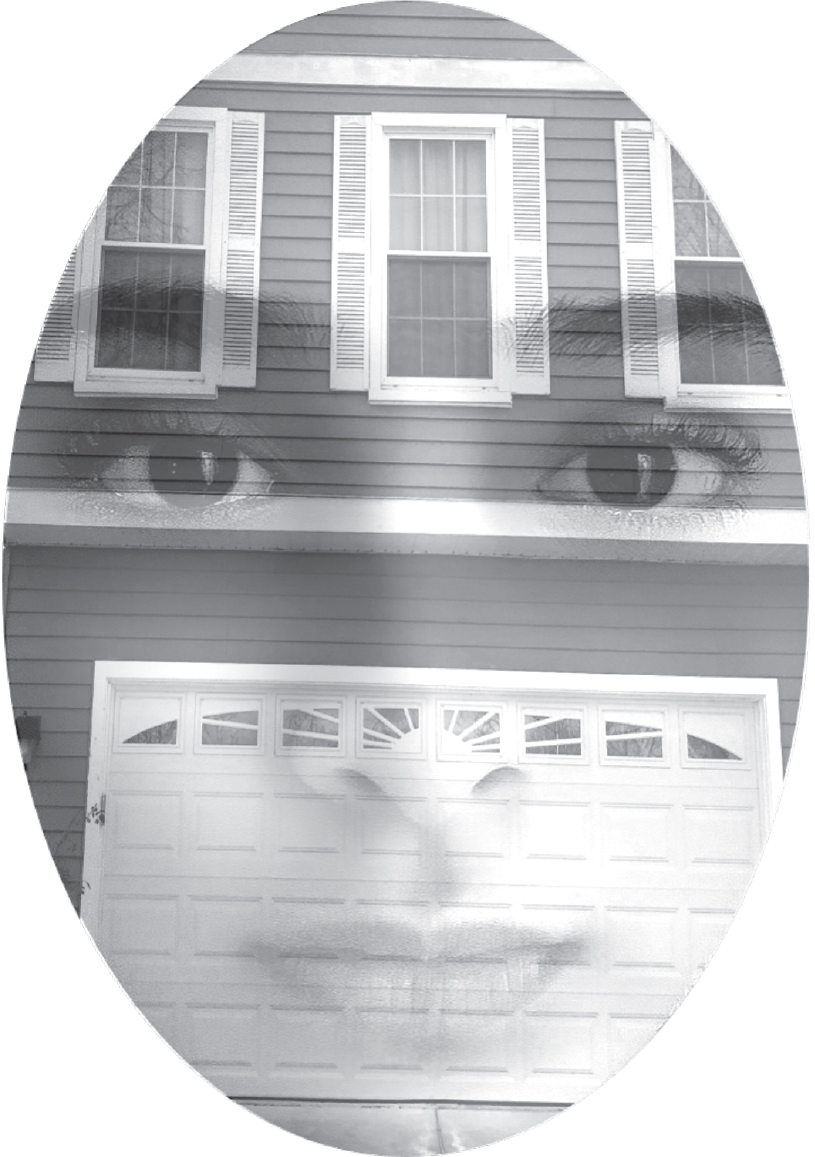
In the lab, we showed people the image above. Watching their brains’ electrical activity, we asked them questions about the scene (Is it inside or outside? Urban or rural?) or about the face (Is this person male or female? Are they happy or sad?). When people paid attention to the face, the N170 was much stronger compared to when we asked them to pay attention to the scene. Attention enhanced face perception. This helped our participants perform well on the task, just as it helped our ancestors survive to eat another day, and not be eaten themselves! But sometimes, our ancestors did get eaten. So why does attention sometimes fail us?
In a variant of the experiment, we showed the same face/scene images. But every now and then, we’d flicker a different image on the screen: a negative image, something violent or upsetting. These were pulled from the media—the kind of stuff you might see on a twenty-four-hour news network, in your Facebook feed, or on whatever method of doom scrolling you prefer. Even though our participants were doing the same “pay attention” task, their ability to distinguish between “relevant” and “irrelevant” nearly vanished. The mere presentation of stressful images, like those we are surrounded by all the time, was enough to diminish the power of attention.
Every superpower has its corresponding kryptonite—that thing that breaks it down fast. As attention breaks down, those amazing strengths can quickly turn against you. Your attention morphs into a glitchy DeLorean, hopping through time without intention or control, ruminating on regrets and predicting catastrophes that may never come to pass; it fixates on things that are not productive; it fills up working memory with irrelevant clutter.
Attention is powerful, but it’s not invincible. Certain circumstances are potent kryptonite for attention. And unfortunately, they just so happen to be the circumstances of our lives.