Postscript
What it amounts to
When I look back over the course of this investigation it is now clear that the three separate streams of questioning and doubt from which it began have merged into one. They have, bit by bit, grown into an absorbing awareness of the need for practical enquiry into creative process.
The central certainty that this process does not work from purpose to deed, in the way that expedient activities do, is easy to put into words now, at the end, but was not there with effective conviction from the beginning. This means that the part of the book called Introduction is misleading. The habit of thinking in terms of purpose to deed was still so strong that when writing the introduction, after the book was nearly finished, I had almost believed that it was a true statement of how this investigation had begun. I had almost believed that it had in fact all started with a clearly thought-out purpose; I had almost believed that there had been a conscious decision that if it should be possible both to settle the vague questions stimulated by the emergence of the free drawings, and to find out how to paint, then it would also be possible to answer the question of what was being left out in traditional education. But now I can see that this is not true. There had been nothing in the beginning but vague uneasy feelings and an urge to follow certain trickles of curiosity wherever they might lead. All the same, I have left the introduction as it was originally written, partly because books need introductions, partly because the fact that it had seemed, retrospectively, that that was what I had set out to do from the beginning, was in itself an illustration of the later discovered truth that activity creates purpose.
Thus the book is not the retrospective account of a creative experience which had happened independently and was then written about, it is itself an attempted embodiment of the process of creating. And what had been created, not just by the activity of making the free drawings without preconceived purpose, but also by writing the book without fore-knowledge of where it would lead, was finally a new certainty of belief. And included in this belief was a realisation of the total inadequacy of an earlier belief, previously unrecognised but doubly potent because of that, the belief that new things are produced by an omnipotent command from above, rather than by the free interplay of differences with equal rights to be different.
Also, having laboriously worked through to this view of creative process, not as a result of intellectual analysis but as something lived, it had now become possible to be aware of how the same idea is fertilising the general understanding of human affairs in many fields: not only internal affairs, between will and instincts, head and heart, standards and actuality, but also external ones, between managers and workers, teachers and taught, governments and governed.
And not only this; for I had also been unable to avoid the conclusion that this misconception about the nature of creative process, that I had been unwittingly acting upon, was the result of an urgent emotional need. It was the content of the free drawings that had made it clear, to me at least, that it is not through inadvertence that we cling to this misconception of the omnipotent fiat of creation, it is part of our immaturity. They had also made it clear that in order to grow out of such a misconception, in order to reach the maturity of being able to base all one’s actions on the belief in interplay of differences, it was apparently necessary to be prepared for mental pain. For without a doubt this capacity to recognise and allow for the creative interplay of differences had a long and often stormy history; it was a position only won, if at all, after protracted battles with in-loveness, expectation, high hopes, and with feeling one’s love betrayed, disillusion and despair, battles which had begun in the earliest years of our lives. For gradually I had come to recognise the fact that one could not know any baby well, if one was honest with oneself, without knowing also that these battles are first experienced, in all of us, if our experience has been normal, long before we have any words to tell of it or power to know that that is what is happening to us.
There was also one aspect of creative process that had turned out to be fundamental in this study, the aspect of perception of the external world. Observations of problems to do with painting had all led up to the idea that awareness of the external world is itself a creative process, an immensely complex creative interchange between what comes from inside and what comes from outside, a complex alternation of fus-ing and separating. But since the fusing stage is, to the intellectual mind, a stage of illusion, intoxication, transfiguration, it is one that is not so easily allowed for in an age and civilisation where matter-of-factness, the keeping of oneself apart from what one looks at, has become all-important. And this fact surely has wide implications for
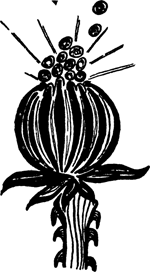
Figure 49
education. For it surely means that education for a democracy, if it is to foster that true sanity which is necessary in citizens of a democracy, foster the capacity to see the facts for oneself, rather than seeing only what one is told to see, must also fully understand the stages by which such objectivity is reached. In fact, it must understand subjectivity otherwise the objectivity it aims at will be in danger of fatal distortion.