16
Painting and living
I have tried to show how this study of the free drawings had led me to think about a particular kind of new experience, one which resulted from the interplay of the two fundamental differences. The two partners in the interplay could be given various names, such as:
imagination and action
dream and reality
incorporated environment and external environment.
But whatever the name, they always seemed to refer to two sets of happenings which certainly have to be distinguished if one is to go on living; since there is all the difference in the world, for instance, between thinking about having a meal and actually having one.
Of course this idea of the two fundamental differences was not something I had only just begun to think about. I had once even succeeded in answering examination questions on the history of philosophy; I had had to start with Descartes and learn how he made the distinction between mind and matter, and how this became the foundation of modern scientific achievement. But now I had not only found, after years of uncomfortable experience, that it was an urgent task to bring these two together again; I had also found that the making of the distinction was not only an intellectual achievement, it was also an emotional one, having a long history of accepted disillusion behind it.
Now also I had found a new way of thinking about the distinction, at least, new to me. It was in terms of the difference between the external environment and the incorporated one. And this way of describing it did now serve to emphasise certain specific aspects of the difference; for instance, that of changeability. Thus some of the drawings had seemed to show that, unlike the external environment, the incorporated one did actually change according to one’s feelings, and particularly in response to one’s unadmitted feelings. If one had been full of unadmitted hate it could apparently become a desert land with only dead bones in it, since the destructive wishes could be felt as fulfilled merely by thinking them. And I had had to realise also, through the drawings, how close love and hate are bound to be; and that since to hate what one loves is probably the most mentally painful of all human experiences, it is very hard not to deny the hating and pretend to oneself that it does not exist. But I had had to realise too that the denied hate can then work itself out internally, making one feel, in extreme conditions, that one’s inner world is wrecked and everything is hopeless; even though the external environment, objectively seen, may be full of promise.
There were further aspects of the difference between the inner world and the outer one, brought to the fore by the drawings. Sometimes the inner is described as a reflection of the outer; but surely it was a very active and headstrong kind of reflection, it could apparently elaborate on its external prototype as freely as Alice’s ‘Through the Looking Glass’ world did. Thus it seemed that, although it owed its basic pattern and shape to the original external environment, yet every kind of modification could happen to it once it was incorporated and in the process of incorporation. Moreover it was surely different from the objectively seen environment even in the moment of incorporation, since what we take in to the stuff of our psyche is obviously a relationship; it is not the objectively seen public facts of our lives, as they appear to detached observers, that become part of us, it is the way things seem to us at the moment they happen that is taken in, at the moment when we are actively and emotionally involved in them. And once stored inside us, these memory traces of what were originally actual experiences of relationship, bits of life already lived, could become, amongst other things, types, they could lose their accidental qualities and keep their common essences. For instance, the good ones could become more good and the bad ones more bad; as illustrated by the innocent and wicked creatures in the drawings. In fact, apparently every kind of re-sorting could go on, and produce a whole inner universe, including an Olympus and an Underworld. Of course, such a relative independence in the internal world did not mean that there was not, at least in psychic health, a continual interchange between the two, just as in Greek mythology the gods continually get themselves mixed up in human affairs. It did not mean that one’s internal weather could not spread sunlight or gloom over the outer contacts, or conversely, that good fortune or disaster externally could not also bring a change in the inner landscape. But at the same time a certain independence of the external world persisted, otherwise we would surely not be able to endure great reverses of our external fortune without a corresponding wrecking of our inner stability. Thus the discrepancy between the two was biologically necessary if one was to have any capacity to rise above one’s circumstance and be more than the blind slave of accident. All the same, when one first experienced the discrepancy one certainly did not know it was a biological advance, it could feel more like a matter for burning fury of despair. So behind the bare fact of the discrepancy there could lurk a tremendous potentiality of primitive hate, the feeling accompaniment of the disillusion inherent in the human situation.
Of course I had known intellectually that this was one of the main tenets of psycho-analytic theory; but I certainly had not really believed it, I think it had seemed a too hopeless picture of human existence. And what I had not known, until the study of the method of the free drawings had forced me to see it, was that this hate that is inherent in the fact that we do have to make the distinction between subject and object, if we are to develop at all beyond blind instinct, is overcome in a particular way through the arts. It is surely through the arts that we deliberately restore the split and bring subject and object together into a particular kind of new unity. What I had not seen clearly before was that in the arts, although a bit of the outside world is altered, distorted from its ‘natural’ shape, to fit the inner experience, it is still a bit of the outside world, it is still paint or stone or spoken or written words or movements of bodies or sounds of instruments. It is still a bit of the outside world, but the difference is that work has been done, there has been a labour to make it nearer one’s inner conception, not in the way of the practical work of the world, but in an ‘as if’ way. Thus it seemed that the experience of outer and inner coinciding, which we blindly undergo when we fall in love, is consciously brought about in the arts, through the conscious acceptance of the as-if-ness of the experience and the conscious manipulation of a malleable material. So surely it comes about that in the experience which we call the aesthetic one the cause of the primary hate is temporarily transcended. But not only is it temporarily transcended, surely also it is permanently lessened. For in the satisfying experience of embodying the illusion there has in fact been an interchange. Since the object is thereafter endowed with a bit of the ‘me’, one can no longer see it in quite the same way as before; and since the ‘me’, the inner experience, has become enriched with a bit more of external reality, there is now a closer relation between wishes and what can really exist and so less cause for hate, less despair of ever finding anything that satisfies. In fact the aesthetic experience has modified the wish, moulded a bit of oneself into a new form by giving it a new object; and at the same time it has given a previously indifferent bit of the outside world a new emotional significance.
Such a view of art threw light on a question I had long puzzled about, the difference between painters in their attitude to realism in painting. There were obviously great differences in whether they were more concerned with landscapes of the inner world or the outer; or rather, differences in the amount of contribution from public or private reality in what interested them, and hence differences in the amount of remoteness or distortion in their painting. I remembered hearing that one painter had said ‘One distorts in order to love’ and now I could see what he meant; for one might have to alter very extensively the appearance of the peg to make it carry one’s earliest and yet perhaps most vital dreams.
The study of the free drawings had also shown that there was yet another form of the basic contradiction to be taken into account. It was connected with the specific role of art as self-expression and the fact that the inner subjective and outer objective aspects of reality are in a continual state of change and development. Thus there is not only a permanent gap between the perfection we have it in us to conceive of and the actuality of what can really happen, there is also a gap between the inner reality of feeling and the available ways of communicating what we feel. It is obviously a discrepancy that varies in degrees in different people and in different phases of society; it is a gap that is bigger wherever the conditions of our living are changing rapidly so that the old forms for describing our feeling experiences become no longer adequate. Thus art is not only a created fusion between what is and what might be; it is also a created way of giving the inner subjective reality of feeling an outer form, in order that it may be shared, and so also tested and verified; it is a making of new bottles for the continually distilled new wine of developing experience.
This view of the artist’s task led on to still another aspect of the creative synthesis between subject and object. It was to do, not so much with the problem of what one seeks to find in the external world, but with what one seeks to give. Here I found Blake’s way of putting it useful. When two people meet in relationship the Prolific (to use Blake’s terms) in one cannot give unless the Devourer in the other is ready to receive; and the Devourer in one cannot receive unless the Prolific is willing to give at the moment his products are required and what is required. So here was the problem, not only of endowing the outside world with one’s own dream and so giving it desirability, coming to believe that what it offers is what one wants, but also the reverse problem of coming to believe that the outside world wants what one has to give. Obviously this belief can be very precariously established; and it is impeded, not only by inner doubts about one’s wish to give, doubts of the strength of one’s love and constructive wishes as compared with one’s hate and envy and greed, but also by actual failures of one’s surroundings to need what one has to give. One could think of it in terms of social life and finding one’s niche in the world; but also in more personal terms, the difficulty of bringing the dream person one would like to give to, the ideal receiver of one’s gifts, down to the earth of the actual persons around one and their actual needs. Everyone’s task in the transition from childhood to adulthood clearly centres round this problem of finding a particular niche in the social world, of finding the gap or need in the social structure into which one can pour one’s energies and find that they are wanted. I supposed that those who can find a ready-made gap have an easier task, but many have to make their own, and some can neither find one nor create one. But perhaps in painting one does create one’s own gap by deciding on the frame, both literally and metaphorically; for one can make the size of the gap, the frame that has to be filled, to suit oneself; and one must also choose what shall fill it. Whether one will find a wider gap or need to be filled, in the sense of finding one’s public and fulfilling a social as well as an individual function in one’s painting depends on many circumstances. I supposed that the well-adjusted person who is not an artist is one for whom real life has succeeded in providing and he in coming to recognise and believe in two things: both real external producers of what he needs and real external devourers of what he has to give. But the painter as painter has tried to solve the problem on another plane than that of external reality, he has invented a half-way house between the dream receiver and the external one; a half-way house that is more pliable and under his own control than the external world, but also more fixed and stable than the merely internal dream receiver of his love.
There were also other questions to be considered, to do with the relation of art as an activity to ordinary life activities. It seemed to me that the non-artist in each of us, the common sense practical man in us, has relinquished a great part of his early illusions. He has accepted the conventional view of external or shared reality more or less with a good grace and prosaicness, he has been practical and renounced both the high ecstasies and the terrors of his illusion, for the sake of solid realities of living – except when he is in love. But the renunciation may be at a higher cost than he realises, since he may pay for what he gets in the denying or killing off of part of his psychic potentialities. On the other hand the artist in us surely deals with the basic conflict in a different way, since he seems to have an unyielding determination neither to deny his dream nor the claims of external reality. He does not, as the neurotic in us does, try to deny the conflict altogether and get himself in a great muddle by unwittingly treating bits of the external world as if they were part of his dream. He recognises and accepts the difference, at least as far as his practice is concerned, even if he does not consciously say that that is what he is doing, even if he consciously claims to be an idealist philosopher and tries to deny the objective existence of the external world. In his practice his recognises the real objective qualities of his medium, but he manipulates these to suit his inner conception. Thus he does not try to deny or forget about illusion, instead, he seeks to affirm it and take responsibility for it, even in its most primitive aspects.
But the artist in us also has to pay and perhaps with an opposite currency from the practical man, for he has to give up working for the direct pleasures that the practical man enjoys. And he also has to pay in another way, directly to the demands of that external reality which is society. He has to accept some public artistic convention, such as the outline or the musical scale or the grammar and vocabulary of a particular language, something that his particular time and place in history make available for him to use in conveying his private idea. Of course he may contribute to this convention himself, enrich and enlarge it, but he cannot start off without it, he cannot jump off from nothing. And perhaps he accepts this need to pay in communicability the more readily because, with others able to share his dream, he is more absolved from the guilt of defiance of common sense reality, absolved from the guilt of clinging on to ‘the many splen-doured thing’ while others have felt obliged to give theirs up. And if it be true that the artist in us and the lover in us have refused to give up their ‘intimations of immortality’ it would suggest another reason for some of the public resistance to new forms of art; for when a person chooses to make the artist in himself the basis of his relation to society and becomes professionally ‘an artist’, then if he does not make his dreams comprehensible so that more than a small coterie can share them, then he earns the fierce animosity of those who feel themselves shut out. I thought those who do not understand the artist’s creations are liable to indulge in the righteous indignation of the child who feels he himself has been good and given up his earlier enjoyments, but sees another child who has been less docile and obedient and yet is getting away with it.
Such ideas about what one might be trying to do in one’s painting pointed the way to settling certain very practical doubts I had had about the relation between painting and living. For years I had had to decide each week-end, should I shut myself away and paint or should I just live? It was perhaps less of a problem for the professional painter who could live in his spare time. But for the Sunday-painter it brought the need to balance up the various renunciations and gains. I had so often come away from a morning spent painting with a sense of futility, a sense of how much better it would have been to get on with something practical that really needed doing. And I had often felt, when out painting, both exalted and yet guilty, as if I were evading something that the people round me, all busy with their daily lives, were facing, that their material was real life and mine was dreams.
But was it?
There was one drawing which did seem to embody, through its associations, these very thoughts. Its title was from Francis Thompson:
‘O dismay,
I, a wingless mortal sporting
With the tresses of the sun.’
It had been intended as an exercise in learning the correct proportions of the human figure, but it had turned out an abstract geometric design (Fig. 48). At first, I had thought the title showed fears that, like Prometheus and Icarus, one might meet with disaster from presuming too high. Also I had found a diary note on the same theme:
‘If one paints in order to possess, make one’s own, it’s not
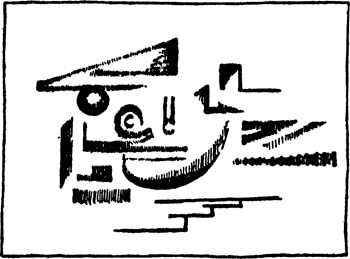
Figure 48
only perhaps a greedy thing to do, but also a kind of stealing the fire of the gods, stealing immortality, eating the forbidden fruit of the tree of life which would make men as gods.’
Certainly it did seem to express the feeling that it was taking a risk not to rest content with the conventional view of reality and with the duties that were publicly recognised as such. Certainly also it expressed the thought that to try to re-make what one loved, in order to have it permanently there and under one’s control, was an attempt to cheat mortality. Certainly the greatest disillusion, the greatest discrepancy between one’s wish and the external facts, is the fact of death. Dreams can be made relatively immortal, in words and stone and paint, but people all grow old and die. But now I felt, even if it was cheating, stealing a march on death, I was prepared to accept that, take responsibility for it, since it no longer seemed, as in the Prometheus myth, like stealing a power to create which by right only belonged to the parents. And this surely was not the end of the matter anyway, it was not only cheating mortality; for in trying to re-make the object of one’s love, symbolically, surely one was also re-making the desire for it, trying to turn the desire into something which did not destroy, by its possessiveness, the very thing one loved. And if this were true, then the doubt whether it was only dreams one was concerned with when trying to paint could be answered; for it suggested that the material in which the artist in us is trying to create is basically the raw stuff of human impulses. Through the process of giving life to the portrayal of one’s subject, of coming to see it as a whole through the discovery of pattern and rhythm and so coming imaginatively to appreciate its nature, one is actually creating something, creating the spiritual reality of one’s power to love it – if it is lovable; or laugh at it or hate it – if it is laughable or hateful. Ultimately then it is perhaps ourselves that the artist in us is trying to create; and if ourselves, then also the world, because one’s view of the one interpenetrates with one’s view of the other.