14
The role of the medium
‘I saw a peacock with a fiery tail
I saw a blazing comet drop down hail
I saw a cloud wrappèd with ivy round
I saw an oak creep on along the ground
I saw a pismire swallow up a whale
I saw the sea brimful of ale
I saw a Venice glass five fathom deep
I saw a well full of men’s tears that weep
I saw red eyes all of a flaming fire
I saw a house bigger than the moon and higher
I saw the sun at twelve o’clock at night
I saw the man that saw this wondrous sight.’
Anon.
‘Deare love, for nothing less than thee
Would I have broke this happy dreame,
It was a theame,
For reason much too strong for phantasie
Therefore thou wakd’st me wisely: yet
My Dreame thou brok’st not, but continued’st it,
Thou art so true, that thoughts of thee suffice,
To make dreames truths; and fables histories;
Enter these armes, for since thou thoughtst it best,
Not to dreame all my dreame, let’s act the rest.’
John Donne
A further aspect of this problem of establishing a dialogue relation between two differences, as illustrated by the method of the free drawings, was to do with the extreme pliability of the material, of chalk, charcoal, paint. I thought of this aspect of the matter when considering a painter’s definition of painting as being ‘the expression of certain relationships between the painter and the outside world’.* For I felt a need to change the word ‘expression’ of certain relationships into ‘experiencing’ certain relationships; this was because of the fact that in those drawings which had been at all satisfying there had been this experiencing of a dialogue relationship between thought and the bit of the external world represented by the marks made on the paper. Thus the phrase ‘expression of’ suggested too much that the feeling to be expressed was there beforehand, rather than an experience developing as one made the drawing. And this re-wording of the definition pointed to a fact that psycho-analysis and the content of the drawings had forced me to face: the fact that the relationship of oneself to the external world is basically and originally a relationship of one person to another, even though it does eventually become differentiated into relations to living beings and relations to things, inanimate nature. In other words, in the beginning one’s mother is, literally, the whole world. Of course the idea of the first relationship to the outside world being felt as a relationship to persons, or parts of persons, was one I had frequently met with in discussions of childhood and savage animism. But the possibility that the adult painter could be basically, even though unconsciously, concerned with an animis-tically conceived world, was something I had hardly dared let myself face.
Looked at in these terms the problem of the relation between the painter and his world then became basically a problem of one’s own need and the needs of the ‘other’, a problem of reciprocity between ‘you’ and ‘me’; with ‘you’ and ‘me’ meaning originally mother and child. But if this was the earth from which the foundations for true dialogue relations with the outside world should spring, did they always get established there? It looked as if they did not, at least cer-tainly not over the whole field of experience. It looked as if for many people they only became established partially, that
there were always certain areas of psychic country in which they had failed; and what was established instead, as always when dialogue relationship fails, was dictatorship, the dominance of one side or the other. It seemed that in those areas in which one had lost hope of making any real contact with the outside world one of three things could happen. First one could try to deny the external demand and become an active, dictatorial egoist, actively denying the need of the other, trying to make one’s own wishes alone determine what happened. Secondly one could become a passive egoist, retreating from public reality altogether and taking refuge in a world of unexpressed dreams, becoming remote and inaccessible. Thirdly, one could allow the outside world to become dictator, one could fit in to external reality and its demands, but fit in all too well, the placating of external reality could become one’s main preoccupation, doing what other people wanted could become the centre of life, one could become seduced by objectivity into complete betrayal of one’s own side of the matter. Seduced by objectivity seemed the right phrase; for I remembered how, when the scribbled free drawing did not begin to look like a recognisable object soon enough and I would deliberately force it into something recognisable, then the drawing had an unpleasant quality for which the word ‘meretricious’ came to mind.
The results of such a seduction were, it seemed to me, shown by the content of such drawings as the heath fire and the blasted beeches; for these surely offered an example of the possible discrepancy between what one could imagine one was feeling about the object looked at and what one really felt. Thus it certainly did look as though one could sacrifice too much to apparent sanity, to seeing only the public reality of the external world, the objective aspect that is conventionally agreed upon. And having so denied the private one it could become or remain proportionately distorted, so that one’s dreams could be not at all what one imagined them to be, the gap between the sky and earth, inner and outer, could become too big to be easily bridged.
This idea of being seduced by objectivity raised again the whole question of the actual ways in which one’s relation to the outside world develops, from the moment of birth onwards. It suggested that such a dictatorship of the external could be set up in infancy, even with the best of intentions on the part of the adults, simply by inability to give time for the wish to enter into relationship to come from the child’s end; thus the establishing of reciprocity could fail simply because the child’s time rhythms of need and wish are different from the adult’s. Or not only could it fail from wrong timing, it could fail through inability to establish communication, since the child’s small gestures of relationship are so easily over-looked or misunderstood. Of course this failure of relationship is inevitable at times, it is part of the agonising side of being a child; but here came in the particular aspect of the free drawing method that apparently made it partly able to compensate for that failure, able to act as a bridge between the public and the private worlds. For by it one could find an ‘other’, a public reality, that was very pliant and undemanding; pencil and chalk and paper provided a simplified situation in which the other gave of itself easily and immediately to take the form of the dream, it did not stridently insist on its own public nature, as I had found natural objects were inclined to do. So by means of this there could perhaps come about the correcting of the bias of a too docilely accepted public vision and a denied private one. And apparently it could come about just because there was this experience of togetherness with one’s medium lived through together. Because of this one could reclaim some of the lost land of one’s experience, find in the medium, in its pliability yet irreducible otherness, the ‘other’ that had inevitably had to fail one at times in one’s first efforts at realising togetherness. Granted that it was a very primitive togetherness, one that allowed the other only a very small amount of identity of its own, yet it did seem able to serve as the essential basis for a more mature form in which both other and self have an equal claim to the recognition of needs and individuality; just as psycho-analysis does through the analyst acting as a pliant medium, giving back the patient’s own thought to him, in a clarified form, rather than intruding his own needs and ideas.
Such a formulation of the process also made clearer the Noah’s Dove drawing in the series on the theme of ‘Earth’ (Fig. 10 b). Thus the extreme result of the lack of correspondence in time, between the experiencing of one’s earliest needs and the satisfying of them by the adult concerned, would surely be this: it would be that the dreams of what one wanted might never become related to any reality of the external world at all, so there would be, so far as feeling was concerned, nothing but a waste of waters everywhere. The result of such an extreme discrepancy, in terms of character, would surely be a person who does not know what he wants because what he wants cannot be described in terms of anything that exists. If this lack of correspondence permeated one’s whole life one would of course be mad and incapable of looking after oneself. But one might also be mad in parts, with this primary kind of madness, there might be certain aspects of one’s experience which had never been properly hitched on to external reality; so one might at times become as a mariner sailing into a windless ocean and be temporarily unable to move in any direction whatever.
There was one drawing (Fig. 47) which had never been
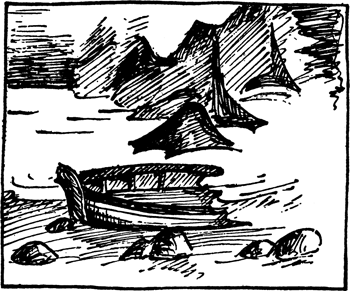
Figure 47
finished (all the others were made in one sitting). Its story was that somewhere in this desolate island there was a cast-away whose boat had become so broken that he could not escape. The title was ‘Ego-Island’ and the broken boat seemed now to be the broken bridge to the external world. In fact, the drawing seemed to portray a state of mind which was perhaps close to that described by Traherne when he said:
‘My piercing Eyes unto the Skies
I lifted up to see;
But no Delight my Appetite
Would sate;
Nor would that Region shew Felicity:
My Fate
Deny’d the same; Above the Sky,
Yea all the Heav’n of Heav’ns, I lift mine Eye:
But nothing more than empty Space
Would there discover to my Soul its face.’
Now also it seemed possible to try to re-state these ideas about both the role of the free drawings, and of psychoanalysis, in terms of illusion. Could one say that by finding a bit of the outside world, whether in chalk or paper, or in one’s analyst, that was willing temporarily to fit in with one’s dreams, a moment of illusion was made possible, a moment in which inner and outer seemed to coincide? Was it also true to say that it was by these moments that one was able to re-establish the bridge, mend the broken boat, and so be re-awakened at least to the possibility of creative life in a real world? Was it not a legitimate hypothesis to suppose that by these moments of achieved fusion between inner and outer one was at least restored potentially to a life of action, a life in which one could seek to rebuild, restore, re-create what one loved, in actual achievement? So one could turn one’s fables (which were originally histories, but seen subjectively) once more into histories, into real experience in a real world. And this was made possible, both in a small way in free drawing, but more fully in psycho-analysis, because in both the situation has well-defined limits, in neither is one committed to the repercussions that action in the real world brings. In drawing one can draw anything one likes, because it is only a drawing and the paper can be torn up. In psychoanalysis one can say anything one likes, because it is only saying and the analyst has been trained not to react as he might in real life; in fact it is just because he has made a bargain that he will not ‘act the rest’ and yet is a real person that he can therefore serve as the bridge which makes ‘dreames truths and fables histories’.
But if this were right and I really had succeeded in discovering a primitive reciprocity through the use of the medium, in the free drawings method, I did not want to stop there; I wanted to go on and learn how to bring an ‘other’ that had a less pliable nature than chalk and paper into the relationship. I wanted to learn how to create, by painting, a true reciprocal relationship between dreams and what was outside; in fact to learn how to endow the objects of the external world with a spiritual life, ‘action’, that was appropriate to their nature. It was not enough to treat the external object merely as a peg on which to hang quite fortuitous private fancies, I wanted what I imagined about it to fit in with the object’s essential nature. I wanted to ensoul nature with what was really there, to make perception of the hidden insides and essential nature of objects fit in with what I knew, in moments of keenest awareness, to be really there. I wanted painting to be both a means towards and a record of true imaginative perception of significance. And to do this it was necessary to select those details of appearances which emphasised the nature of the ‘soul’ of what I was looking at, a ‘soul’ which was both really there, but which also was something that I had given to it from my own memory and feeling, since otherwise I would not have been able to see what was really there.
Certainly the experience of making the free drawings could be looked upon as a stage towards this. Undoubtedly they had achieved the clothing of certain dreams with recognisable qualities of shape and colour so that they could now be given ‘a local habitation and a name’. After this they would never be quite the same again, both the gods and the demons were being brought down to earth, their power more ready to be harnessed to real problems of living, madness was becoming more domesticated and tamed to do real work in a real world. Instead of remaining abstracted and bewitched by an inner vision that had only a very remote and distorted relation to the external world, one could bring ‘the man that saw this wondrous sight’ down to earth and action. Also, by achieving a concretisation of dreams, a permanent recording of the transfigurations, there was the possibility that other people could share them. And by the fact of other people being able to share, vicariously, the moment when one’s gods had descended, one then gained a firmer hold on the spiritual reality of one’s gods – or one’s devils. So one came to know more clearly what one loved and would want to cherish in living and what one hated and would seek to eliminate or destroy; and by this one’s life developed a clearer pattern and coherence and shape and was less a blind drifting with the tides of circumstance.